INTRODUCTION
Until recently the study of the Classic Maya ruins of Xultun, Guatemala was restricted to three sources of evidence: the hieroglyphic inscriptions of its highly eroded monumental corpus, a handful of references to Xultun lords from other contemporary sites, and the texts on various ceramic vessels looted from the site and surrounding region (Garrison and Stuart Reference Garrison, Stuart, Laporte, Arroyo and Mejía2004; Houston Reference Houston1986; Krempel and Matteo Reference Krempel and Matteo2012; Martin and Grube Reference Martin and Grube2008:87). Recent systematic archaeological excavations at Xultun now provide a new window into the city's past, helping to link many hypotheses and conclusions drawn from scant textual sources to contextual archaeological evidence (see Rivera Castillo and Saturno Reference Rivera Castillo and Saturno2012; Romero and Saturno Reference Romero and Saturno2010; Rossi et al. Reference Rossi, Stuart, Saturno, Arroyo, Salinas and Paiz2015a, Reference Rossi, Saturno and Hurst2015b; Saturno et al. Reference Saturno, Aveni, Stuart and Rossi2012a, Reference Saturno, Hurst, Rossi, Castillo and Saturno2012b; Saturno et al. Reference Saturno, Hurst, Rossi and Stuart2015). One recent find, the painted murals of Structure 10K2 in the Los Sabios Group, allows particular insight not only into Xultun history but into the structures and entanglements of Classic-period Maya politics and ritual. Its content is two-fold: a colorful narrative scene of ritual performance, and a group of more than 40 individual “micro-texts” mostly painted on one wall (see Aveni et al. Reference Aveni, Saturno and Stuart2013; Bricker et al. Reference Bricker, Aveni and Bricker2014; Rossi and Stuart Reference Rossi, Stuart and Rossi2015; Saturno et al. Reference Saturno, Aveni, Stuart and Rossi2012a, Reference Saturno, Hurst, Rossi and Stuart2015). The narrative scene depicts a uniformed order of individuals interacting with an important eighth-century king named Yax We'nel Chan K'inich. In this article, we present an in-depth analysis of these wall paintings and their associated inscriptions in order to place their content within broader social and political contexts. We draw on epigraphic, ethnographic, and historical records to posit a possible connection between the mural's narrative and annual New Year rituals. We then closely examine the “uniformed” figures in the scene, several of whom are labeled with ranked variations of a title read Taaj, commonly translated as “obsidian” (Houston Reference Houston, Pillsbury, Doutriaux, Ishihara-Brito and Tokovinine2012:89; Wanyerka Reference Wanyerka2002:v, Reference Wanyerka2003:86). The Los Sabios group was both the residence and workspace for individuals who specialized in astronomical and calendrical knowledge as well as in the creation of murals and bark-paper codices—at least one of whom (though probably others as well) seems to have been a member of this Taaj “order” or social category (Aveni et al. Reference Aveni, Saturno and Stuart2013; Bricker et al. Reference Bricker, Aveni and Bricker2014; Rossi Reference Rossi2015; Rossi et al. Reference Rossi, Stuart, Saturno, Arroyo, Salinas and Paiz2015b; Saturno et al. Reference Saturno, Aveni, Stuart and Rossi2012a, Reference Saturno, Hurst, Rossi and Stuart2015).
We provide evidence that the Taaj title refers to a type of organizational entity not previously attested among the Classic Maya. Furthermore, we argue that the Taaj order was made up of individuals acting as specialist agents of the Maya state—producing ceremony, performing sacrifice, writing texts, calculating astronomical sciences, and transmitting specialized knowledge. This purview of duties fits comfortably within Fray de Landa's descriptions of the roles performed by Colonial-era Yucatec “high-priests” (Ah K'in Mai) and, more broadly, within commonly understood duties of priesthoods globally (Sabourin Reference Sabourin1973; Winkelman Reference Winkelman1992:69–76). Despite these overlaps and our occasional use of the adjective “priestly,” however, we hesitate in fixing the term “priest” to these Taaj individuals. Instead, we use the term “order,” which we define as a ranked hierarchy whose members share ritual and political objectives, and whose members' ranks in the hierarchy correspond to diverse functions in achieving those ritual and political objectives. This definition vaguely recalls the civil-religious hierarchies described in Chiapas or cofradía organizations in the Guatemalan highlands today (see Colby and Colby Reference Colby and Colby1981:31–45; Collins Reference Collins and Jones1977; LaFarge and Byers Reference LaFarge and Byers1931; Miles Reference Miles1957, Reference Miles, Wauchope and Willey1965; Orellana Reference Orellana1984; Villa Rojas Reference Villa Rojas1985; Vogt Reference Vogt1969, Reference Vogt1976).
The following review is an effort toward describing the Taaj on their own terms through the specific roles, activities, and functions they performed within Maya society, as gleaned from epigraphy and archaeology. Although the individuals labeled as Taaj may at first seem standardized on the mural, they exhibit certain differences in internal rank, expressed hieroglyphically. Following research into similar Maya orders and “priesthoods,” we seek a more nuanced understanding of the specific political, social, and religious roles of the Taaj as well as the internal organization of the order as a whole (see Collins Reference Collins and Jones1977; Miles Reference Miles1957, Reference Miles, Wauchope and Willey1965; Zender Reference Zender2004a).
Clarifying the nature of the Taaj order and its internal make up can potentially shed light on the design and intent of Structure 10K2 as part of a large elite residential group at Xultun. By extension we can examine how the members of the Taaj order and their actions were related to the king Yax We'nel Chan K'inich and to structures of Xultun royal authority. In light of the mural's unusual theme and associated inscribed texts, we suggest that the ruler may have relied on the Taaj order for calculating and executing key calendrical rituals and ceremonies; offering guidance on political issues; and even instructing and educating aristocratic youth in indigenous scientific, ritual, and other forms of specialized knowledge.
XULTUN AND THE LOS SABIOS MURAL
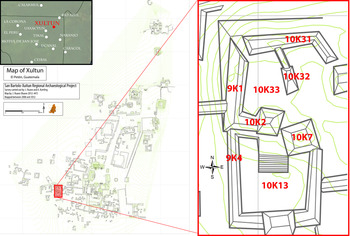
The ruins of Xultun are located between the Río Ixcán and the Río Uaxactun in the northeast Petén region of Guatemala (Figure 1). The San Bartolo/Xultun Regional Project has been conducting systematic archaeological research at the site since 2008, elucidating various details of Xultun's development and history during its continuous occupation from the Middle Preclassic period (900–300 b.c.) up until the Terminal Classic period (800–1000 b.c.) (Rivera Castillo and Saturno Reference Rivera Castillo and Saturno2012; Romero and Saturno Reference Romero and Saturno2010). Xultun was first discovered by Aurelio Aguayo, a local chiclero (gum-resin harvester), in September 1915 (Morley Reference Morley1938:383). The site did not receive archaeological attention until the Fourth Central American Expedition of the Carnegie Institution of Washington visited for three days in May 1920. Morley, who led the expedition, was impressed with the size of the ruins:
“The new site, to which the name Xultun was given, proved to be of great importance, no less in fact than a city of the second class with two principal plazas, 50 subsidiary courts, and 18 sculptured monuments. It has more structures, covering a larger area, than either Piedras Negras or Quirigua, and has more sculptured monuments than either Nakum or Palenque. It is larger than La Honradez in the same region, and was probably the largest city of the Old Empire in northeastern Peten” (Morley Reference Morley1938:322).
Maps of the site of Xultun and location of Xultun in relation to other regional sites. Map by Jonathan Ruane, Adam Kaeding, and Franco D. Rossi.

It was during this first visit that Morley and his companion Carl Guthe gave the ruins their name, xul meaning “end” or “close” and tun meaning “stone” in Yucatec Maya. This name was based on their reading of the date on Xultun Stela 10 (10.3.0.0.0, or a.d. 889), which at the time was the latest known date in the Maya lowlands; thus, “End Stone” (Morley Reference Morley1920:322). The Carnegie Institution, focusing on making a preliminary plan of the main architectural groups and on documenting inscribed monuments, made three subsequent visits to Xultun in 1921, 1923, and 1924 (Morley Reference Morley1920, Reference Morley1921, Reference Morley1938:383–422).
Following the initial Carnegie Expeditions, Xultun was not investigated by archaeologists until Von Euw paid two visits as part of the Corpus of Maya Hieroglyphic Inscriptions project (Von Euw Reference Von Euw1978:8–10). Xultun's monumental inscriptions were at last made widely available with the publication of Von Euw's photographs and line drawings (see Von Euw Reference Von Euw1978; Von Euw and Graham Reference Von Euw and Graham1984). As a result, Houston (Reference Houston1986) first identified the site's emblem glyph and Garrison and Stuart (Reference Garrison, Stuart, Laporte, Arroyo and Mejía2004) were able to detect personal names of rulers and other members of the nobility. Steady epigraphic progress has continued, including the proposal of a phonetic decipherment of the main Xultun emblem glyph as “hammerstone hill” or baax[tuun] witz (BAAX?-?-WITZ) (Prager et al. Reference Prager, Wagner, Matteo and Krempel2010). Not all ancient nobles bearing the title Baax Witz Ajaw were Xultun rulers. It seems that high kings took an additional set of titles, perhaps read K'uhul K'abte’ Yook'in, the exact translation of which remains problematic (Figure 2; see Garrison and Stuart Reference Garrison, Stuart, Laporte, Arroyo and Mejía2004).
Xultun royal titles as they appear on a Late Classic Polychrome vessel: baax witz ajaw k'uhul k'abte’ yook'in. Drawing by Franco D. Rossi.

Los Sabios, the larger group of which Structure 10K2 is part, is a high-status residential patio group located roughly 300 meters to the southwest of Xultun's southern ceremonial core and equidistant due west from the heart of the southern palace complex (Figure 1; Rossi Reference Rossi2015:69–75). Maxwell Chamberlain, who was casually investigating one of many looters' trenches penetrating the group's architecture, discovered the mural paintings in 2010. One such illicit excavation had cut into the buried central room of Structure 10K2, exposing a small section of painting on the west interior wall. Few examples of Maya mural painting are known from residential contexts, so Los Sabios quickly presented a rare opportunity for investigating how such art functioned in a private and non-royal setting.
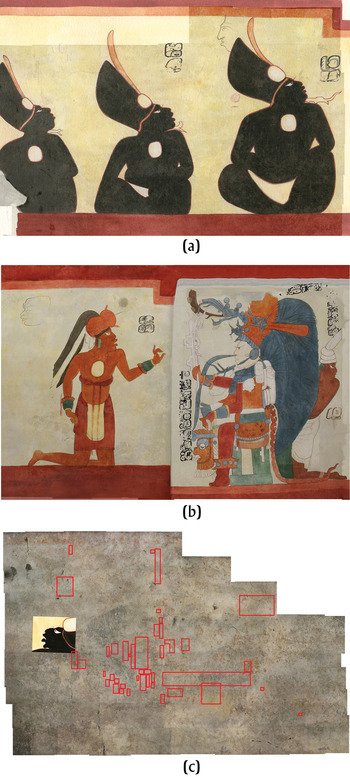
The mural shows eleven individuals. Three of the eleven bear a title featuring the term Taaj (Figure 3:Individuals 3, 6, and 9). Two of the eleven are identified as “youths” (ch'ok) (Individuals 1 and 2). The seated Xultun ruler and his attendant Baahtz'am (numbered Individuals 7 and 8, respectively) are depicted in the north wall niche, and two males in military dress are painted on the sloped vault above the north wall (Individuals 4 and 5). Two individuals (Individuals 10 and 11), who are too eroded to accurately identify, are just visible on the east wall (Figure 3, Figures 4a–4c). The hieroglyphic titles for six individuals in the Xultun mural survive and additional portrait heads and incised elements possibly name or characterize these individuals further. The relationship between these Taaj and the king and the organization of their ranked order are prominent components of the mural narrative (see Saturno et al. Reference Saturno, Hurst, Rossi and Stuart2015). There are three primary captions, two of which are well preserved and discussed here. Finally, the northeast niche jamb and the east wall have multiple texts that were repeatedly painted and incised with calendric and astronomical calculations (Figure 4c; see Aveni et al. Reference Aveni, Saturno and Stuart2013; Saturno et al. Reference Saturno, Aveni, Stuart and Rossi2012a). While the mural figures and associated captions were painted at the same time, the superimposition of many calendrical texts over the narrative scene demonstrates that this room was an active place for writing and notation for the resident Taaj until its eventual architectural incorporation into a mausoleum (Rossi Reference Rossi2015; Rossi et al. Reference Rossi, Stuart, Saturno, Arroyo, Salinas and Paiz2015b).
Schematic of the 10K2 mural with numbered figures: (1, 2) Tek'eet Ch'ok; (3) Sakun Taaj; (4, 5) individuals in military attire and scorpion tails; (6) Itz'in Taaj; (7) Xultun ruler Yax We'nel Chan K'inich; (8) Baahtz'am; (9) Tek'eet Taaj; (10, 11) unidentifiable east wall individuals. Artwork by Heather Hurst.

10K2 Mural: (a) north wall, (b) west wall, and (c) east wall. Illustrations by Heather Hurst, images by William A. Saturno and Franco D. Rossi.

The Mural Scene and Yax We'nel Chan K'inich
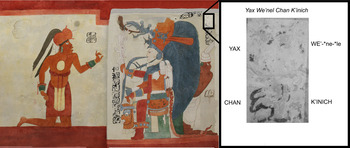
The portrait of Yax We'nel Chan K'inich dominates the mural narrative scene of Structure 10K2 (Figure 5). The name of this eighth-century Xultun ruler appears more than any other local figure in the inscribed ceramics that can be linked to Xultun, showing up in the dedicatory texts of at least seven unprovenienced vessels (Garrison and Stuart Reference Garrison, Stuart, Laporte, Arroyo and Mejía2004; Krempel and Matteo Reference Krempel and Matteo2012; Rossi et al. Reference Rossi, Saturno and Hurst2015a). While the historical record for this king is spotty, he was clearly an influential and important personage at Xultun, as indicated by his assortment of honorific titles, including Bakab, Baax(?) Witz’ Ajaw, and K'uhul K'abte’ Yook'in(?), all of which we find associated with other Xultun kings in the Classic period. His less common titles are K'ahk’ Tzuhl Chan Yopaat (Kerr Nos. 4997, 4572, 9271) and 13 ?ta K'awiil (Kerr No. 8007; XUL Stela 25) (for all vessels with Kerr Numbers, see Kerr Reference Kerr2014). On vessel K2324 he bears the well-known title Kaloomte’, often associated with particularly powerful lords who oversaw regional hegemonies (the literal meaning and function of this title remain uncertain and open to debate). The vessels that feature Yax We'nel Chan K'inich have stylistically been attributed to the second half of the eighth century (Krempel and Matteo Reference Krempel and Matteo2012:154–157). Unfortunately, no specific dates are provided on these vessels, which has prevented any firm chronological placement of this king's reign in Xultun's dynastic line; that is, until his identification on the Xultun mural (Rossi et al. Reference Rossi, Saturno and Hurst2015a:667–669).
The north wall of the 10K2 mural with a photographic detail of the name caption of Yax W'enel Chan K'inich's. Illustration by Heather Hurst. Photograph by Franco D. Rossi.

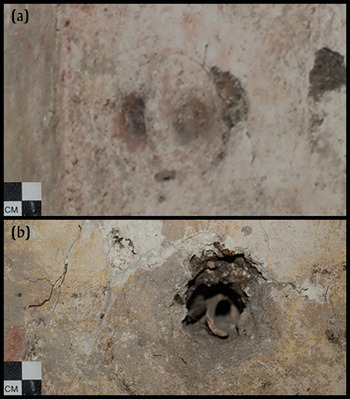
Painted within a niche (a closed off interior doorway), the portrait of Yax We'nel Chan K'inich is the central figure in a scene. He is flanked by several seated or kneeling attendants accompanied by hieroglyphic captions, painted on the west, north, and east walls (Figures 3–5). Cord-holders indicate that this niche could be covered from time to time, whereas the rest of the mural program was always visible to anyone in the small room (Figure 6). A deep bench occupies most of the interior space of the chamber. An individual sitting upon the bench surface would be approximately at eye-level with the painted figures that are depicted at roughly two-thirds life-size.
Cord-holders on the (a) east wall and (b) north wall. Photograph by Franco D. Rossi.

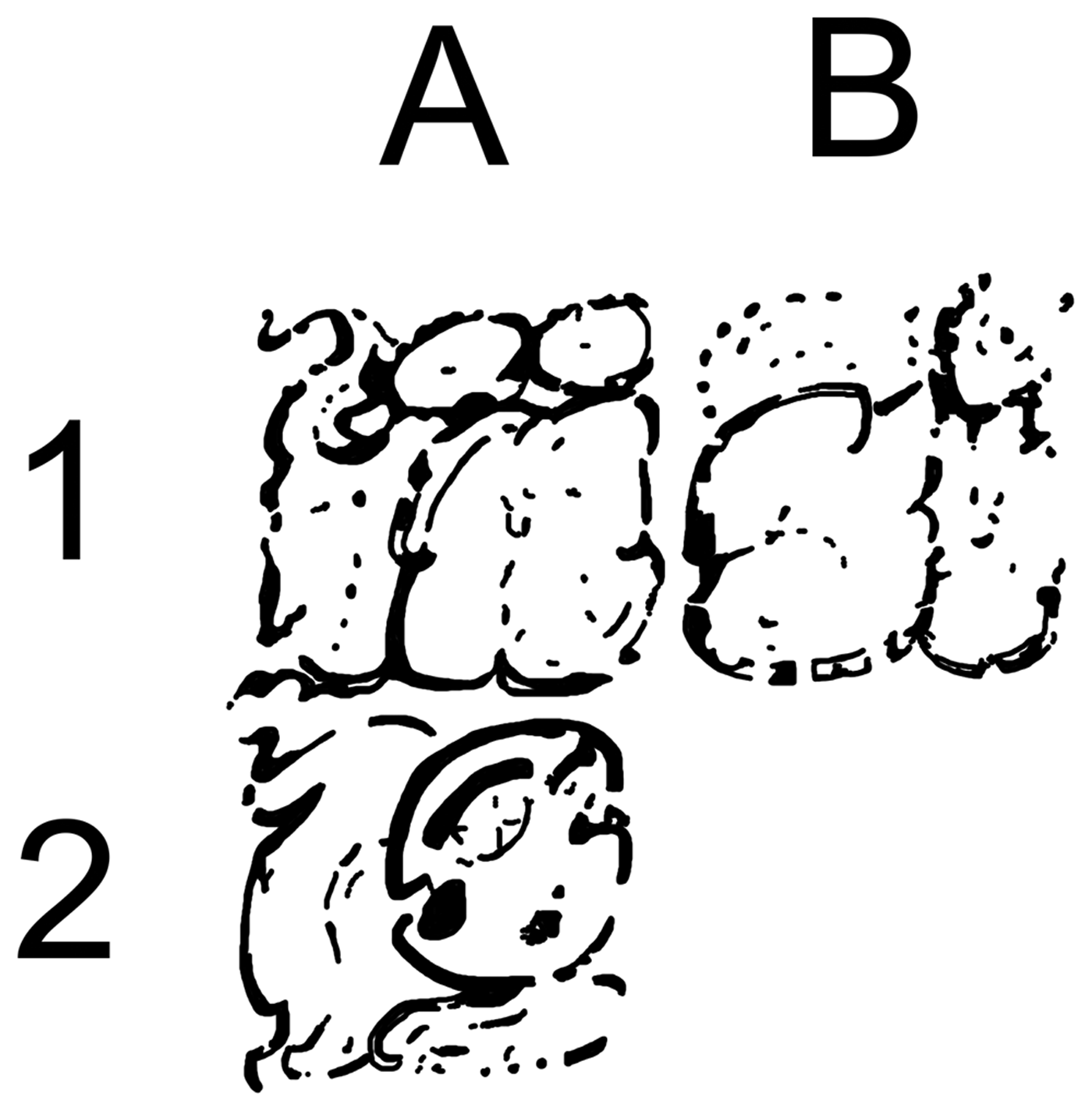
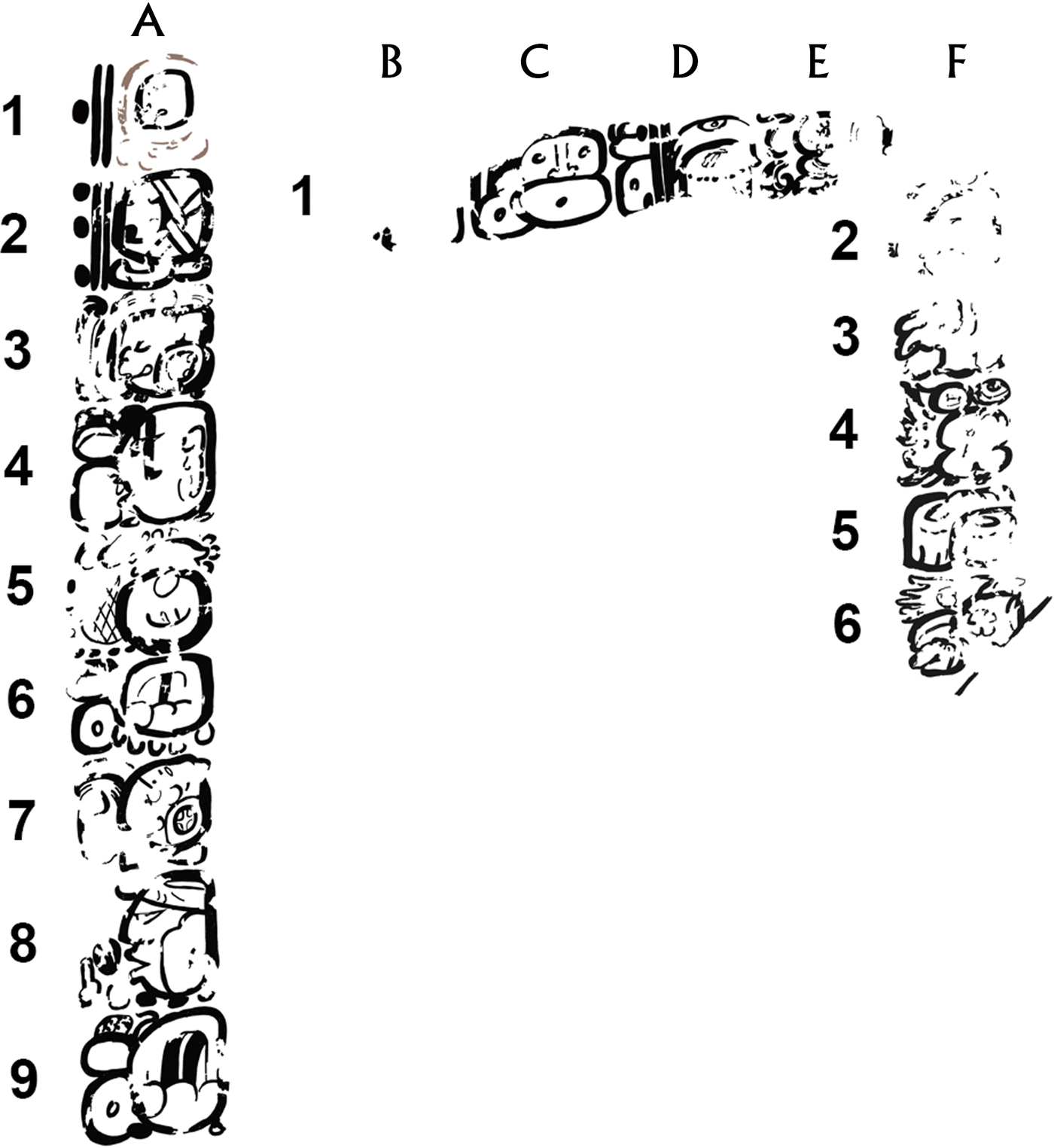
The niche text begins with the Calendar Round (CR) date 11 Oc 13 Pop, most likely corresponding to the Long Count date 9.15.17.13.10, or February 12, 749 a.d. (Figure 7:A1–A2). In an earlier study this CR was originally read as 11 Men 13 Pop, which corresponds to February 9, 762 (Saturno et al. Reference Saturno, Aveni, Stuart and Rossi2012a). A closer analysis during the drawing of the text indicated that 11 Oc is the more likely date. Following this CR record the text goes on to recount an event in which the reigning Xultun king, Yax We'nel Chan K'inich, impersonated the deity named “First Wind-Maize with Obsidian” (Hun Ik’ Ixiim ti taaj) (Figure 7:A7–A9). The long caption text may also reference a ballgame-related ritual title along with the name and honorific titles of the king. Taken together, the caption glyphs suggest strong associations with agricultural fertility and acts of sacrifice (Rossi and Stuart Reference Rossi, Stuart and Rossi2015:353–358).
Niche caption. Drawing by David Stuart.

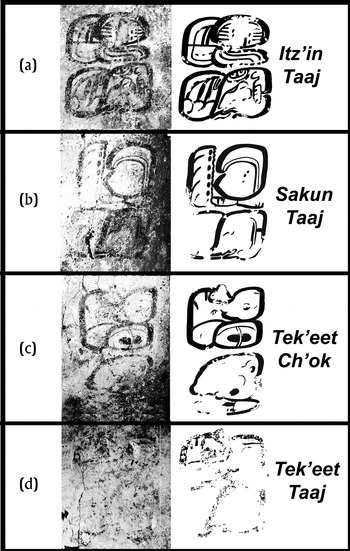
The focal point of the mural scene on the north wall shows Yax We'nel Chan K'inich facing a kneeling Individual 6, labeled hieroglyphically as Itz'in Taaj (“Junior Obsidian”; Figure 5b, Figure 8a). This caption is not a personal name but rather is a title or designation known from a handful of other inscriptions outside of Xultun. Emerging from behind the king's feathered cape and headdress, still within the bounds of the north wall niche, a courtly attendant labeled as a Baahtz'am (“first or head throne” or perhaps “before the throne”) peaks out, looking in the opposite direction from the ruler (Houston Reference Houston, Pillsbury, Doutriaux, Ishihara-Brito and Tokovinine2012:89–90; see Houston Reference Houston2008 for discussion of baah titles; Stone and Zender Reference Stone and Zender2011:97 for discussion of tz'am and its associations).
Taaj title captions from the 10K2 mural room: (a) Itz'in Taaj, (b) Sakun Taaj, (c) Tek'eet Ch'ok, and (d) Tek'eet Taaj. Photographs by Franco D. Rossi. Drawings by David Stuart and Franco D. Rossi.

Yax We'nel Chan K'inich is shown dressed as the wind/maize deity mentioned in the hieroglyphic caption (Hun Ik’ Ixiim ti taaj) in what amounts to an “impersonation phrase” (Houston and Stuart Reference Houston and Stuart1996). He holds a scepter with repeating Ik’ or “wind” cut-out motifs as well as a zoomorphic incense bag. The king's costume is adorned with blue-green plumage and inverted heads (seemingly decorative) and behind him we see what appears to be a scorpion's tail (Figure 5). A similar scorpion-tailed impersonation by a Naranjo king with the same Ha'b date, 13 Pop is depicted on Naranjo Stela 2, and the fusion of maize god and scorpion imagery is a previously well-attested iconographic complex in Classic Maya art, perhaps related to celestial imagery, as well as agricultural and rain related themes (Milbrath Reference Milbrath1999; Rossi Reference Rossi2015:57–65; see Rossi and Stuart Reference Rossi, Stuart and Rossi2015 for full discussion).
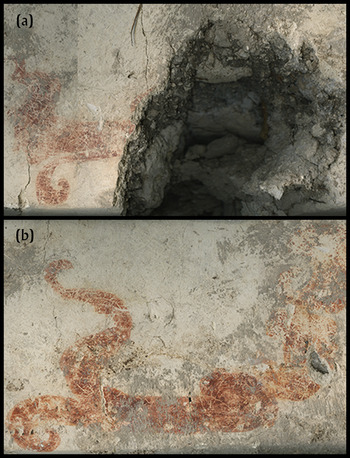
Individual 6, the Itz'in Taaj, kneels before the king with his hand raised, possibly in a gesture of communication, garbed in red and white accouterments with a white circular pendant suspended over his chest. As mentioned at the start of this article, the term taaj is generally understood to mean “obsidian” or “obsidian blade,” and its use here as part of an official title constitutes an important conflation of instrument and agent, as will be discussed further below. Two males in military dress, Individuals 4 and 5, adorn the sloping vault immediately above this central interaction. They stand facing west and hold shields similar to many figures depicted in the Structure 1, Room 2 murals of Bonampak. Like the king, they each have a scorpion tail perhaps referencing the same celestial or zodiacal episode or entity enfolded into the royal impersonation being depicted (Figure 9; see Rossi Reference Rossi2015:45).
Ends of scorpion tails of Individuals 4 and 5 painted on vault. Photograph by Franco D. Rossi.

Moving westward in the mural scene we come to three men who we refer to as Individuals 1, 2, and 3. In terms of the scene's horizontal composition they all sit behind the Itz'in Taaj (Figures 3 and 4a). All three are rendered on the west wall, yet their gaze is nonetheless directed toward the interaction unfolding on the north wall between the Itz'in Taaj and the king. These three individuals are each simply and uniformly depicted wearing a loincloth, a white pendant over the chest, and a large black headdress adorned with a single orange feather and a circular white ornament identical to the chest pendant. These three men, as well as another identically rendered male painted on the east wall (Individual 9, see Figures 3 and 4c), are all distinguished by their black body paint. The principal differences to be noted between these four individuals derives from their titles and the size in which each is rendered, with Individuals 3 and 9 being depicted as larger than Individuals 1 and 2. Individual 3 is labeled Sakun Taaj or “Senior Obsidian” (Figure 8b). Individual 2's name caption is read either Tek'eet Cho'k or Tek'at Ch'ok (spelled phonetically te-k'e-ta-ch'o-ko), a unique and therefore difficult term to translate and interpret (Figure 8c). For the sake of our discussion here, we will we refer to this provisionally as Tek'eet.
Tek'eet is most likely derived from the Proto-Mayan verb “to step on,” to be discussed below. The second word in the title, ch'ok, identifies him as a “youth” (Grube and Stuart 1987), here perhaps in a more figurative way, since ch'ok can also reference individuals who were often “‘unmarried’ or ‘not fully grown’ (in a social sense)” (Houston Reference Houston2009:163). The presence of ch'ok in the caption may explain the diminutive rendering of this figure and imply that Individual 1, whose inscribed label does not survive, shares a ch'ok status and title. Only one of the three figures originally rendered on the east wall is discernible in any real detail, Individual 9 (Saturno et al. Reference Saturno, Hurst, Rossi and Stuart2015). He is depicted in identical dress to the west wall figures and is also seated in a cross-legged position; his title survives and also reads Tek'eet, although rather than ch'ok the second word in the title is Taaj (Figure 8d).
The Mural Narrative
Our understanding of the wider mural scene derives first from a consideration of the main caption accompanying the portrait of Yax W'enel Chan K'inich. As we have seen, this refers to a ritual impersonation by the king on the day 11 Oc 13 Pop, involving a deity with wind and maize associations and perhaps a reference to the Maya ballgame. Overall the caption is difficult to translate, given several unique terms and areas of poor preservation (Figure 7).Footnote 1
The ha'b station of the date, 13 Pop (Figure 7:A1), may provide an important clue for understanding the larger significance of the occasion commemorated in the mural scene. Pop is the very first month in the 365-day year and its presence here raises the possibility that the king's impersonation is a New Year ritual of some sort, perhaps not unlike the many ceremonies of the month Pop cited in ethnohistorical sources such as Landa's Relación (Tozzer Reference Tozzer1941:151–153).
The phrase ti taaj, “with obsidian,” appears twice in this main caption (Figure 7:A6, A9), and likely refers to a kind of sacrificial object or event. This may be corroborated by the initial phrase of the text (u baah ti ?; Figure 7:A3–A4) where the glyph at position A4 (ti ?) includes a rare logograph otherwise known only from the similar impersonation captioned on Stela 2 at Naranjo. There, as mentioned above, the ruler of Naranjo is also depicted holding a censer bag and wearing obsidian-related ornaments, a feather cape, and a distinctive a scorpion-like tail (just visible between his legs). The event on Naranjo Stela 2 is also said to have taken place on 13 Pop (falling on 9.14.19.9.0 6 Ahau 13 Pop, or February 17, 731). In addition, we are intrigued by the clear association with “wind” as indicated in the toponymic register shown beneath the Naranjo king's feet (see Graham and Von Euw Reference Graham and Von Euw1975; Stuart and Houston Reference Stuart and Houston1994). On the Xultun mural, Yax We'nel Chan K'inich is the main acting figure, and as we discuss below, the deity he impersonates and the ritual he performs are both concerned with agricultural rites.
The impersonated deity, which we read Hun Ik’ Ixiim ti taaj or “First Wind-Maize with Obsidian” (Figure 7:A7–A9), also occurs on the rim text (dedicatory formula) of an Ik’-style vessel at the Museum of Fine Arts, Boston (Kerr No. 1728). This vase's owner carries the Ik’ or Ik'a’ emblem glyph traditionally connected to Motul de San Jose (Marcus Reference Marcus1976:Figure 1.7; Stuart and Houston Reference Stuart and Houston1994:28), although probably encompassing the wider Lake Petén Itzá area as a whole (see Foias and Emery Reference Foias and Emery2015). Here the god's name is also part of an impersonation phrase, indicating that the local ruler assumed the guise of this particular deity on the occasion mentioned (no such impersonation phrase is given on Naranjo Stela 2, however). We interpret this name “First Wind-Maize with Obsidian” as suggestive of the impersonated deity's association with agricultural abundance and the sacrifice necessary to ensure it.
The Xultun caption text continues with a reference to an enigmatic “black” T533 “at/of/with 12 handspans” (ti 12 nahb) (Figure 7:B1, C1, D1), employing a glyph that is usually found on depictions of large rubber balls in ballgame scenes (Zender Reference Zender2004b). A highly similar phrase—perhaps an extended title sequence—also occurs on a Late Classic period vessel very likely from the nearby Holmul-Naranjo area (Kerr No. 2358). This is referred to as the drinking vessel for atole (yuk'ib ti ul) of a deity whose name is eroded beyond legibility. In its dedicatory text, we also see a reference to the “black T533” and then to the ballgame, with the term pitz “ball play” inscribed instead of the “12 handspans” term.
Sacrifice is often a key component of ballgame-related narratives and imagery and ballcourts famously serve as mythical passageways between the human realm and the underworld (see Christenson Reference Christenson2007; Houston Reference Houston2014a). Ballcourts were closely associated with fertility and abundance as well, specifically with regard to maize (Schele and Freidel Reference Schele, Freidel, Scarborough and Wilcox1991). The ballgame-related phrase in the Xultun ruler's title, with the impersonated deity “First Wind- Maize with Obsidian,” therefore seems to echo many of these symbolic overlays, linking a number of related ritual themes present within the mural.
The rest of the caption text comprises the king's name and assorted titles (Figure 7:E1–F6), as previously mentioned. These include the standard Xultun royal honorifics as well as various elements known across many inscriptions of the northeastern Peten (Garrison and Stuart Reference Garrison, Stuart, Laporte, Arroyo and Mejía2004; Krempel and Matteo Reference Krempel and Matteo2012; Matteo and Krempel Reference Matteo, Krempel, Arroyo, Paiz, Palma and Arroyave2011:959–960; Prager et al. Reference Prager, Wagner, Matteo and Krempel2010; Rossi et al. Reference Rossi, Saturno and Hurst2015a).
While the mural's specified ritual occasion does not fall precisely on the first day of the New Year, the 13 Pop date nonetheless may have been a significant station in a month full of New Year renewal rituals and celebrations. The number 13 is ubiquitously meaningful in Mesoamerica, serving as the highest coefficient in the so-called Tzolk'in or 260-day ritual calendar. In his account of festivities in the month Pop in contact-era Yucatan, Landa describes a special concern with rites of purification and cleansing (Tozzer Reference Tozzer1941:151–153). He specifically writes of the preparatory actions of individuals he refers to as priests, who would fast up to three months in advance, “but no one less than thirteen days” (Tozzer Reference Tozzer1941:152). He mentions that during ritual fasts, priests would cover themselves with black paint or soot, only to be cleansed of the black soot—both physically and symbolically purified—at the end of the fast. The New Year month, Pop, was a time period during which such fasts would end. Landa writes of the cleansing ceremony:
“Here now the men [earlier called priests and lords] came clean and ornamented with their red ointment, after having cleaned themselves of the black soot with which they covered themselves when they fasted. All having come together with the presents of food and drinks, which they had brought, and also a great quantity of wine, which they had made, the priest purified the temple, seating himself in the middle of the court, clothed like a pontiff, having near him a brazier and the little boards with incense” (Tozzer Reference Tozzer1941:152–153).
Discussed by Love (Reference Love1986:171) as a type of renewal ceremony, the scene described by Landa is remarkably reminiscent of the Xultun mural scene. Only in the mural it is the king who is elaborately clothed and holding an incense device (a bag, not a brazier) rather than the “priest.”
Another obvious parallel emerges between Landa's account of priests covered in black soot and the dark-painted individuals on the mural. While carbon-black is a commonly used black pigment, in the case of the Xultun mural applying a color rendered from “soot” may have intentionally invoked a ceremonial practice similar to what Landa describes. Fray Las Casas (Reference de Las Casas1967:215–216) mentions the blackening of skin during ritual fasts as well, also stating that the application of soot from pine torches to the skin was the preferred method of pigmentation. At Xultun the composition of the paint has additional significance: black pigment used on Individuals 1, 2, 3, and 9 was a mixture of carbon-black and hematite. It is precisely the same paint recipe used to render the obsidian element of the king's headdress, suggesting that this compositional choice was intentional, used to link the four black-bodied personages with the substance and sheen of obsidian itself. Individual 6, labeled as the Itz'in Taaj, is distinguished from the others within the scene by his red-orange skin and differing dress. This, of course, seems a more natural skin-tone, further highlighting the distinctiveness of the black body paint on the other individuals, but also may reflect the “red ointment” adorned by a priest that Landa describes as having freshly “come clean” of the black skin paint associated with fasting.
These connections, paired with the epigraphic and iconographic evidence, suggest that the Xultun mural scene does indeed represent a New Years ritual akin to the renewal rites attested in Landa's Relación and select codices, in which fasting priests “came clean” for the coming year, or a moment of preparation immediately preceding or following such an event. We further suggest that this was somehow related to a ceremonial ballgame or ballcourt and associated sacrificial rites. Considering the time of year at which this event is said to have occurred, it is possible that this deity was petitioned to invoke the first winds and first maize harvest that mark the dry season—and, perhaps un-coincidentally, this period of seasonal transition regularly occurred when the constellation Scorpio would have been strongly visible in the night sky (potentially explaining the scorpion tail) (Bricker and Bricker Reference Bricker, Bricker and Aveni1992:157, Bricker and Bricker Reference Bricker and Bricker2011:734; Rossi Reference Rossi2015:58–59). This wind-maize scorpion-tailed deity, which offers sacrifice as part of agriculturally related and New Years rituals, may thus blend these various seasonal elements into a single petitioning actor.
The mural makes clear that those individuals labeled Taaj were involved in a very direct way, perhaps depicted toward the end of a ritual fast at a moment just before cleansing. As previously mentioned, we believe that at least one individual carrying a Taaj title was in residence in the Los Sabios group, although more than one Taaj was probably working within the room and onsite (Rossi et al. Reference Rossi, Stuart, Saturno, Arroyo, Salinas and Paiz2015b). We turn now to these Taaj individuals in an effort to gain a better understanding of how their order features in the portrayed ceremony, and to discuss the nature of their relationship with the king and Maya political ceremony more broadly.
RELIGION IN MESOAMERICAN GOVERNANCE
Public ritual, sacrifice and performance, the likes of what we see in the mural narrative, is a dominant feature in Mesoamerican politics, critical to kingly legitimation and governance of Classic Maya polities (Foias Reference Foias2013:165–192; Houston Reference Houston, Inomata and Coben2006; Inomata Reference Inomata2006; Lucero Reference Lucero2003; Miller and Brittenham Reference Miller and Brittenham2013). As we see on the Xultun mural, Maya kings and their high-ranking officials were commonly the focus of artworks depicting such events. Yet, the Los Sabios mural is unusual in that it presents a ranked order of officials, which we refer to as the Taaj order—an order which epigraphic and archaeological evidence suggests played key roles in the planning and orchestration of such events. Notably, three of the main subordinates (Individuals 3, 4, and 7) are labeled with two-glyph titles the second word of which is Taaj. The first glyph in each these titles is different, marking distinct modifiers or “ranks” within this uniformed order —likely indicating distinct roles as well.
The Classic Mayan word taaj survived across a wide array of colonial and modern day Mayan languages, most often referring not only to the material we call obsidian, but also to blades, lancets and other implements used for ritual bloodletting and sacrifice (see Barrera Vázquez Reference Barrera Vazquez1991:748; Ciudad Real Reference Ciudad Real and Hernandez1929:806–807; Feldman Reference Feldman2000:50; Hull Reference Hull2005:19; Pío Pérez Reference Pío Pérez1866–1877:312). During periods of fasting and penitence in which these obsidian objects were used, Indigenous ritual specialists and diviners covered themselves head to toe in black soot, perhaps in visible invocation of this very material used for penitential bloodletting, just as we see with the black-painted Taaj on the Los Sabios mural.
This conceptual fusion of the act—the practitioner and the material—turn up prominently in the ethnographic record as well. Drawing from anthropological work in the village of Santa Eulalia in highland Guatemala, LaFarge (Reference LaFarge1947:121) documented a particular ritual he witnessed called tcai, where an order of ritual specialists known as “Prayermakers” bloodlet by flogging themselves with thongs edged with small pieces of glass called tcai, the K'anjobal Mayan word for obsidian. He notes the likely antiquity of this practice and also that it probably once incorporated actual tcai, or obsidian, rather than glass fragments. This example grows more intriguing when we when we consider that those prayermakers wielding the tcai (and collectively called tcaxlom) each carry two-part official titles that feature a rank followed by the term tcax. For example, the “head alcalde prayermaker” is called satalkal tcax while the “second alcalde prayermaker” is called kapalkal tcax. The word tcax [see also tca’] is generally translated as “prayer, to pray” (LaFarge Reference LaFarge1947:131–136; LaFarge and Byers Reference LaFarge and Byers1931:143–152). Additionally, the linguistic affinity to the word for obsidian, tcai, (the material with which these tcax would bloodlet) is intriguing. Not only are the titles of these two orders similarly structured in two parts, one a changeable ranking and the other marking membership in a cohort, but the second component in each title seems to have its roots in the same substance, obsidian (see Rossi Reference Rossi2015:124–128 for full discussion).
Additional support for this conceptual and linguistic fusion of agent, material, and implement appears in the Motul dictionary of Colonial Yucatec. There we see a survival of the term taaj in its meaning as ta, meaning “blade, lancet or bloodletter” (Ciudad Real Reference Ciudad Real and Hernandez1929:806–807). We see an agentive form of this Classic period term survive as well, preserved in Yucatec (from Ciudad Real Reference Ciudad Real and Marín1995:43–44) as ah taah, literally meaning, “he of taah,” and translated as “representative or one who speaks with fluency and eloquence,Footnote 2 ” (see Real Academia Española 2001 for Spanish definition of the term decidor). In line with these meanings, another dictionary entry, ta taah, which literally means “of the taah,” is translated as “a work; writing; sermon; injurious words, ill-conceived and carried out” (Ciudad Real Reference Ciudad Real and Marín1995:705).Footnote 3 This association with the spoken word mirrors what we see in K'anjobal, where tca’ refers to prayer, but also to the practitioners of prayer, while tcai refers to the sacrificial implements. In colonial Yucatec, ta, referred to this implement while taah seems to have referred to prayer as well as writings—acts ostensibly within the purview of individuals labeled ah taah. At Los Sabios, we suggest that the ranked Taaj individuals portrayed on the mural represent earlier forms of these later titles and associated roles.
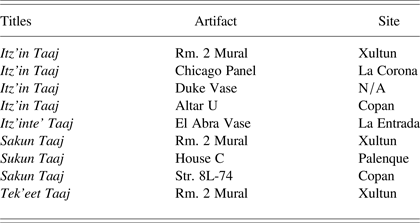
Several scholars have explored the prominence of metaphorical thinking among Maya peoples both ancient and modern, revealing how seemingly disparate but culturally linked concepts and materials were often cognitively and linguistically conflated (Hanks Reference Hanks1990, Reference Hanks and Hanks2000; Jackson Reference Jackson2013:111–140). If we are allowed to speculate, perhaps Classic Mayan taaj brought to mind more than simply the physical material of obsidian, but also signaled various sensory associations as well—its “cultural synesthesia” (Houston and Taube Reference Houston and Taube2000). Through this layering of meaning, taaj may have come to define those specialists who wielded taaj in physical forms and in particular ritual settings. The term was eventually extended to other parts of these individuals' roles as well—prayer, sermons and eloquence in speech, not to mention writings (an important inclusion when we consider the archaeological and inscribed evidence at Los Sabios). At least one of these specialist roles (writing) we know was actively being practiced by residents within Los Sabios; however, as we explore other Classic period references to the Taaj order (listed in Table 1), aspects of these other roles come into play as well.
Glyphic References to Taaj Titles.

Junior Taaj, Senior Taaj
In texts from the Classic period, the terms itz'in and sakun (also written as sukun) take on the hierarchical meanings of “junior” and “senior,” respectively, and usually appear in kinship terms for “younger brother” (itz'in winik) and “elder brother” (sak[un] winik) (Stuart Reference Stuart, Macri and Ford1997). In the Xultun murals, rather than preceding the Maya word for “person” (winik), itz'in and sakun precede the word taaj, hence our reading “junior obsidian” and “senior obsidian.” Such senior-junior pairings are well attested ethnographically, not only in referencing people, but “hills, mountains, waterholes, crosses, cargoholders, shamans, fireworks, drums, and so forth,” and also denoting other types of unequal relationships like “more powerful” and “less powerful” or “more prestigeful” and “less prestigeful” as well (Vogt Reference Vogt1969:238). Among the Tzotzil Maya these ways of ranking factored significantly into the formal ritual features and deferential behaviors of the “cargo system,” the Tzotzil civil-religious hierarchy (Vogt Reference Vogt1969:238–269).
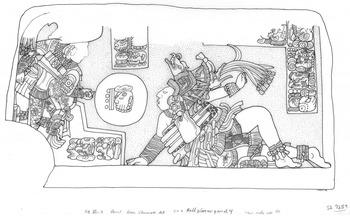
The title Itz'in Taaj shows up in several other inscriptions besides the Los Sabios mural, where it seems to have been a more publically visible post than the Sakun Taaj (or any other Taaj for that matter), despite the “junior” ranking (Figures 10a–10c; Table 1). These hieroglyphic references come from across the Maya area: the Petén lakes region, La Corona, and the area near Copan. Another likely reference to this title can be found on the so-called “El Abra” vessel from the La Florida Valley of Honduras (Figure 11). There it occurs as one of two ”junior” titles: Itz'in Te' [Itz'in] Taaj, or “junior sticks, junior obsidians” (Zender et al. Reference Zender, Dmitri and Albert2016:43). Individuals designated as Itz'in Taaj are always mentioned alongside the ruler and other important officials of the Maya court. This proximity is explicitly shown on the Xultun mural where the Itz'in Taaj’s position relative to the king is compositionally emphasized in comparison with the other Taaj in the scene, but it also holds in other mentions of the Itz'in Taaj as well, reviewed below.
Other occurrences of Itz'in Taaj: (a) Copan Altar U, (b) ballplayer panel in Art Institute of Chicago, and (c) polychrome vessel at Duke Art Museum, Kerr Vessel No. 3046. Drawings by Franco D. Rossi.

“El Abra” Alabaster vase recovered from near La Entrada, Honduras (Schele Number, SD-1041). Drawing by Linda Schele, © David Schele.

On a looted polychrome ceramic vessel in the “Ik style,” currently part of the collections at the Duke University Museum of Art (Kerr No. 3046), an individual labeled as “the guardian of K'an ?” is also called an Itz'in Taaj (Figure 10c). He kneels before one of several members of a dancing nobility. This Itz'in Taaj wears a red and white pectoral and a headband (likely made of paper) stained red at its middle. The red and white headband and pectoral often feature in scenes focused on sacrifice and may intimate that sacrificial rites accompanied the dances depicted on the vessel with the Itz'in Taaj serving a central role.
A sculpted block from La Corona, Guatemala, currently housed within the Art Institute of Chicago, also cites an Itz'in Taaj who is shown in ballplay alongside a well-known individual of La Corona named Chak Ak’ Paat Yuk (see Stuart et al. Reference Stuart, Canuto, Quezada and St. Hillaire2015 for this most recent reading). The text states that the portrayed event occurred at Calakmul (referred to as Uxte’ Tuun, Chihk Nahb) (Martin Reference Martin, Golden, Houston and Skidmore2012; Stuart and Houston Reference Stuart and Houston1994:28–29; Tokovinine Reference Tokovinine2013:8, 71–72). Although most of this Itz'in Taaj’s name is eroded, the Taaj title is clear, and it is followed by another official title—and important epigraphic clue (Figures 11b and 12). A second title, U Ti'huun Kaloomte,’ translates to “Speaker of/for the headband of the Kaloomte,’” which Zender (Reference Zender2004a:210) notes as the “most important of all the priestly offices.” The Kaloomte’ in question could have only been the Calakmul king, which suggests that this Itz'in Taaj served at Calakmul. Elements of his costume are closely associated with the highland Mexico rain deity (called Tlaloc by the much later Nahuatl speakers) and this may suggest the ballgame in which the Itz'in Taaj took part was related to rain or fertility ritual like the ceremony we see depicted on the Los Sabios mural. This particular Tlaloc-like iconography possesses strong connections with the material obsidian as well (Agurcia Fasquelle et al. Reference Agurcia Fasquelle, Sheets and Taube2015; Rossi Reference Rossi2015:112).
Ballplayer panel in Art Institute of Chicago. L-shaped panel with text recording the birth of Yuknoom Yich'aak K'ak’ of Calakmul; Site Q, Calakmul (Schele Number, SD-7259). Drawing by Linda Schele, © David Schele.

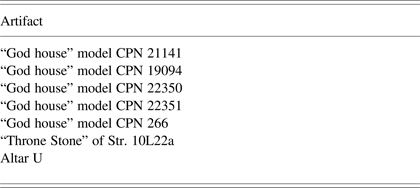
Perhaps the most informative window into the role of an Itz'in Taaj comes from Copan, Honduras. There, one particularly well-documented Itz'in Taaj, who goes by the name Yax K'amlay ? Chan (Figure 10a), occurs on several monuments and “God House” incensario fragments (Table 2). Together these various texts mention Yax K'amlay in a scattering ritual (on the “throne stone” of Str. 10L22a) and in two different seating events (one on Altar U and incensario fragment CPN 22350, and another on incensario fragment, CPN 22351). The lengthiest of these references occurs on Altar U in a complex passage that involves not only Yax K'amlay but at least three other mortal characters. These are: the sixteenth Copan King, Yax Pasaj Chan Yopaat; an individual believed to be his brother (Bardsley Reference Bardsley1990); and Ix Chak ? Xok, a noblewoman, possibly from Palenque, who was the mother of the royal brothers (Schele and Freidel Reference Schele and Freidel1990:330–331; Schele and Grube Reference Schele and Grube1987). The word itz'in included as part of Yax K'amlay's name and associated “seating” event (a verb normally reserved for entry into rulership or high office) initially suggested that he was also a brother of the commissioning Copan king Yax Pasaj Chan Yopaat—“seated” by him into a high-ranking administrative position. Exactly which office Yax K'amlay entered during this event is never mentioned and remains enigmatic (Bardsley Reference Bardsley1990, Reference Bardsley, Robertson, Macri and McHargue1996; Schele and Freidel Reference Schele and Freidel1990:333–334; Stuart Reference Stuart1992:179–181). The spelling of Itz'in Taaj (i-tz'i-*ni-ta-ji) is beyond a doubt and shows that rather than specifying him as a younger brother to the king, it serves to identify Yax K'amlay as a Taaj. As the text continues onto the opposite side of Altar U, Yax K'amlay's status as a mortal being seems to change, however. Between positions P3 and R2 on the opposite side, Yax K'amlay is named again, possibly labeled as an Itz'in Taaj again but then additionally (and enigmatically) he is also referred to as k'uh or “god” rather than as a “noble lord of Copan” (YAX-Copan E.G.-AJAW-wa) as is done in the initial reference.
References to Yax K'amlay.

These various texts concerning Yax K'amlay have become increasingly perplexing in light of the 1990 discovery of several “godhouse” (uwaybil k'uh) sculptures (Andrews and Fash Reference Andrews V and Fash1992:78–79; Bardsley Reference Bardsley1990). These “god-houses” name several well-established local deities as their owners (like Bolon Yokte’), but they also name individuals who seem to have been mortal humans like Yax K'amlay, only further obscuring the line between human and god. All other known occurrences of the title Itz'in Taaj refer to living individuals. Based on these ambiguities, we believe that Yax K'amlay was actually a historical figure that may have been deified after his death—with the noted change in status from human to “god” inscribed on Altar U perhaps serving as an epigraphic account of his apotheosis event. The deification of prominent human figures upon their death is a widely attested and well-known trope in the historical and anthropological record, often linking institutions of sovereignty to ideological systems. Significantly, this may be the first purely textual reference to such an event we are aware of for the Maya area (see Estrada-Belli and Tokovinine Reference Estrada-Belli and Alexandre2016:154–159 for discussion of apotheosis events among Maya peoples).
The frequency with which Yax K'amlay is discussed across monuments and objects at Copan and the various public ceremonies in which he took part shows the Itz'in Taaj was not only an especially important figure to the king, but to the public face of Maya political and ritual spectacle as well. Imagery of an agent whose roles may be similar to those of an Itz'in Taaj appears in the Bonampak murals. This figure, rendered on the east wall of Room 3, Structure 1 at Bonampak (HF14), holds a scepter or rattle in his raised hand and a spear or staff in the other as he oversees a performance of dance and bloodletting by noble and elite youths and the sacrifice of a captive. He is between dancers on the Bonampak pyramid steps wearing a puma skin cape and a dark blue oblong headdress; furthermore, he wears a simple white oval pectoral ornament visible in front of the knot of the tie around his neck. His gesture and position suggests he is a ritual specialist who directs the ceremonial activities. The distinctive shape of the headdress worn by this enigmatic figure—who “seems to direct some part of the performance” (Miller and Brittenham Reference Miller and Brittenham2013:136)—closely resembles those headdresses worn by the Taaj.
Returning to the mural at Los Sabios, the title Sakun Taaj, or “Senior Obsidian,” labels Individual 3 on the west wall. Unlike the Itz'in Taaj (Individual 6) he is depicted in the standardized “uniform” mentioned earlier. He is shown seated at the fore of two smaller, but otherwise identically dressed individuals–Individual 1 and Individual 2 (labeled Tek'eet Ch'ok). The caption labeling Individual 1 does not survive, though his size indicates that he was likely labeled ch'ok as well—visually placing the Sakun Taaj at the head of two youths or novices.
The Sakun Taaj title is decidedly rare; we are able to find only two other occurrences in the hieroglyphic corpus. At Palenque it appears as part of the inscription on the western base of House C of the Palenque Palace (Figure 13a). There, seven individual texts were carved along the lower wall just beneath the building's supporting platform. Six of these texts name specific individuals who are ch'ok and each is identified with the “Wa-Bird” toponymic emblem associated with the site of Santa Elena. Collectively, they are usually interpreted as captives taken in battle (Martin and Grube Reference Martin and Grube2008:165; Schele Reference Schele, Robertson and Fields1994; Stuart and Stuart Reference Stuart and Stuart2008:158–159). One name included amongst these six individuals stands out: “the Sukuun Taaj of the youthful lord/heir”—revealing that actually only five of the inscribed six ch'ok titles refer to youths, and one refers to the possessed Sukuun Taaj (local spelling of Sakun Taaj) of a particularly important youth, possibly an heir to the Santa Elena throne (see Houston and Inomata Reference Houston and Inomata2009:144; Houston and Stuart Reference Houston, Stuart, Inomata and Houston2001:66–67 for discussion of the heir designation title).
Other occurrences of Sakun Taaj: (a) panels from Western Substructure of Palace House C, Palenque. The texts name “ch'ok-ob,” or young lineage members (Schele Number, SD-168). Drawing by Linda Schele, © David Schele; (b) medallion inscription from Str. 8L-74, North Group, Copan. Drawing by Franco D. Rossi after C. Carrelli in Ashmore Reference Ashmore1991:210.

Courtly positions that are “possessed” in such a manner are common in the hieroglyphic corpus, most taking the form of ruler who possesses courtiers. Beyond reflecting the affiliation of particular officeholder with specific royal people, these statements clearly relate the hierarchical superiority on the part of the “owner” (i.e., the ruler) and also convey a binding sense of service and duty on the part of the courtier toward his/her “owner” (for example, see u-sajal, y-ajaw, and yAhk'uhuun). Given these other cases, this specific example of the Sakun Taaj title tells us quite a bit. Firstly, he is named as the only non-ch'ok alongside a collectivity of notable ch'ok (“youths”) taken in battle, suggesting that part of the Sakun Taaj’s role concerns these young, highly important agents in Maya politics and society. As mentioned earlier, the Sakun Taaj on the Xultun mural also appears in close association with youths, depicted on the mural's west wall at the head of two ch'ok, in visual confirmation of the connection suggested by the Palenque example.
A second key insight provided by the Palenque reference concerns the socio-political identity of the Sakun Taaj’s “owner”—the ch'ok ajaw or “lordly youth/heir.” Like possessive constructions of human agents elsewhere in the Maya world, this text at Palenque indicates an inequality in status between the younger but higher status possessor (the noble-born youth and lordly heir or ch'ok ajaw) and the much older, lower status possessed (the Sakun Taaj). Yet by the same token, it also indicates the importance of this possessed office to the ch'ok ajaw merely by its prominent mention as part of a captive-taking narrative. The Sakun Taaj of the heir was clearly a meaningful figure to have been captured alongside the many other noble youths from Santa Elena.
At Copan, this relationship between the heir apparent and the Sakun Taaj emerges again within a Late Classic elite residential compound located to the north of the city's central zone. Group 8L-10, known as the “North Group” (see Ashmore Reference Ashmore1991; Rossi Reference Rossi2015:143–145 for further comparison with Los Sabios). At that group, the title Sakun Taaj is mentioned on one of several sculpted stone medallions (26–31 cm in diameter each) that had fallen from the west façade of one of the group's structures (Figure 13b). This text remains incomplete—more hieroglyphs are surely to be unearthed but it no doubt once referred to the dedication of a building associated with Waxaklajun Ubaah K'awiil, the thirteenth Copan king commonly referred to as “18 Rabbit,” who ruled from a.d. 695 to 738 before meeting his untimely end at the hands of a former vassal king.
The Calendar Round is helpful here. When paired with this Copan king's name, only two possible dates emerge. The later option falls in a.d. 738, just days after Waxaklajun Ubaah K'awiil is said to have been beheaded by the king of Quirigua (Ashmore Reference Ashmore1991; Stuart Reference Stuart1992). An alternative, earlier option worth considering falls on May 12, 686 (9.12.14.1.8 8 Lamat 6 Sek), which would have been nine years before Waxaklajun Ubaah K'awiil acceded the throne and during the especially long and prosperous reign of his father, Ruler 12—intriguingly at a point in time, when Waxaklajun Ubaah K'awiil would himself have been a “lordly youth/heir” (ch'ok ajaw). Perhaps, a future recovery of additional portions of what is currently the incomplete textual record of this Copan group will elucidate specifics regarding the relationship between this Sakun Taaj and the thirteenth Copan king.
Thus, in two of three known epigraphic contexts (Los Sabios Mural and Palenque House C), the Sakun Taaj is shown in direct relation with two or more ch'ok. We believe these arrangements intimate a potential supervisory, and possibly even instructional, role on the part of these particular Taaj—a role in line with ethnographic and ethnohistoric records that describe such specialists as overseeing and educating highborn youths (Sahagún Reference de Sahagún, Dibble and Anderson1969:209–218, Reference de Sahagún, Dibble and Anderson1978:61–70; Tozzer Reference Tozzer1941:27, 111–112; see Calnek Reference Calnek, de Alva, Nicholson and Keber1988; Houston Reference Houston2009 for broader reviews). Adding this epigraphic evidence to the Los Sabios palimpsest of the east wall and its varied handwritings raises the strong possibility that the mural room and nearby spaces may have once served pedagogical ends, in addition to specialized occupational ones—with education overseen not by just a Taaj, but specifically by a Sakun Taaj (Rossi Reference Rossi2015:142–145, 160–209).
Tek'eet Ch'ok, Tek'eet Taaj
Returning once more to the Los Sabios mural, the full title of at least one of the two youths seated behind the Sakun Taaj is called a Tek'eet Ch'ok. Tek'eet is a poorly understood and previously unattested term in the hieroglyphic corpus. It may belong to a certain type of Classic-period title that ends in –Vt or -VVt, such as with the titles Ebeet (“messenger”), Itz'aat (“sage”), or the “banded bird” title (Houston et al. Reference Houston, Stuart and Taube2006:241–251; Jackson Reference Jackson2013:15; Miller and Martin Reference Miller and Martin2004:29; Stuart Reference Stuart1989, Reference Stuart2005:133–137). It remains to be seen whether the title can stand alone as Tek'eet.
As previously mentioned, the Tek'eet title is written twice in the mural room, preceding the terms ch'ok (labeling Individual 2) and Taaj (labeling Individual 9). It identifies two identically dressed but differentially sized individuals who were painted on opposite interior walls. As previously mentioned, the root of the word Tek'eet is almost surely tek’, “to step on” (Kaufman and Norman Reference Kaufman, Norman, Justeson and Campbell1984:132). Although the word Tek'eet is known only from the Los Sabios mural, the root tek’ does occur in four other glyphic contexts (Figure 11, Figures 14a–14c): on the Dumbarton Oaks panel from the Palenque area; on Stela 19 from Aguateca; on the previously mentioned “El Abra” vessel from near La Entrada; and in the Dresden Codex where it is used as a verb twice in the same section of the same page. These four examples of tek’ in verbal form all refer to religiously charged and deliberate actions (Houston and Taube Reference Houston, Taube, Pillsbury, Doutriaux, Ishihara-Brito and Tokovinine2012:41–43). Specifically, these were acts of ritual movement or “stepping,” which were usually carried out by local kings or heirs in or around shrines, temples, and processional ways at certain times of year—in other words, in sacred spaces at sacred times (Houston Reference Houston, Inomata and Triadan2014b:244–248; Houston and Taube Reference Houston, Taube, Pillsbury, Doutriaux, Ishihara-Brito and Tokovinine2012; Zender et al. Reference Zender, Dmitri and Albert2016:43n15)
Texts featuring the root, tek’: (a) tehk'aj (te-k'a-ja); column A, glyph 1, Dumbarton Oaks Panel (drawing by A. Tokovinine, courtesy of A. Tokovinine and Dumbarton Oaks); (b) tehk'aj (te-k'a-ja); column B, glyph 2, Seibal Stela 19 (drawing by Stephen D. Houston, courtesy of Stephen Houston and Takeshi Inomata); (c) utehk'aj (u-te-k'a-ja); column A, glyph 1; column D, glyph 1 (drawing by Franco D. Rossi of page D.8c of the Dresden Codex).

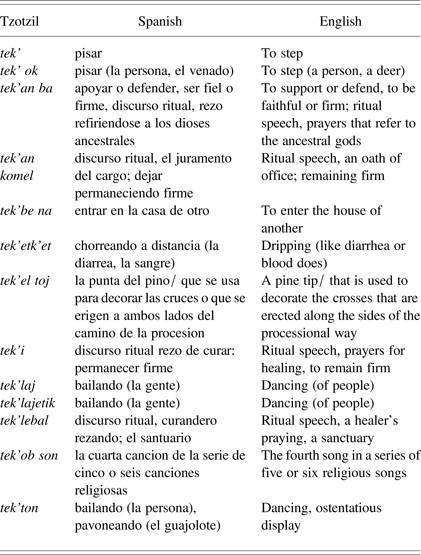
This Classic-period association with religious acts is echoed in how the same verb tek’ is incorporated into various modern Tzotzil words (Table 3). One especially noteworthy example is tek'an ba “to support or defend; to be faithful or devout; ritual discourse; prayer that refers to ancestral deities” (Laughlin Reference Laughlin2007:304 [authors' translation from Spanish]). Although there is a range of meanings in the definitions of these Tzotzil terms, they nearly all cite religious acts, movements, or functionalities and many align with these Classic period usages of the verb.
Modern tzotzil words and phrases incorporating the verb tek’ (after Laughlin Reference Laughlin2007:304).

Tek'eet (te-k'e-ta) is spelled identically in both the Los Sabios examples. Considering the forms in which the root tek’ appears in the epigraphic, iconographic, and linguistic records, we suggest that it may have identified individuals who participated in religiously charged events through their entry and movement within sacred space. Houston (Reference Houston2009) notes that access to temple spaces and the lesser duties within those spaces were often the responsibility of “youths.” The Tek'eet title's use in both an adult title (Tek'eet Taaj) and a youthful one (Tek'eet Ch'ok) at Xultun demonstrate that it could identify multiple individuals within the Taaj order and that it was not necessarily tied to age grades, but rather to function. The inherent ranking which accompanies the title Sakun and Itz'in make the notion of a Sakun Ch'ok or Itz'in Ch'ok highly unlikely, especially since we normally see a ch'ok distinguished from others through the term baah or “head, first” (Houston Reference Houston2009:157). This suggests that Tek'eet served as part of a more standard title within the Taaj order—that perhaps it marked individuals who were part of the order, whether ch'ok or Taaj, simply as individuals who were permitted to tread on sacred space and take part in the acts being carried out in those spaces.
The Ritual Cabinet
The depiction on the mural of the Taaj order with the Xultun king Yax We'nel Chan K'inich demonstrates that an intimate and ritually driven relationship existed between them. In Classic Maya art, most prominent courtiers we know of were commonly portrayed or mentioned alongside their kings—with closeness of certain offices to the king emphasized in particular sites and regions. When considering this wide array of other offices and titled individuals, Taaj titles are quite rare in the artistic and glyphic record. Yet, as we see in the discussion above, the instances where they do occur are telling.
As we have seen, when portrayed or mentioned in texts, the Itz'in Taaj operated in close contexts with their kings. It seems the Itz'in Taaj was an important public figure with considerable influence in political as well as in royal religious affairs. A Calakmul Itz'in Taaj was also a Ti'huun, an office for individuals with well-attested public importance and close ties to the ruler. Glossed by some epigraphers as “mouth of the crown,” Ti'huun were, “known to have presided over period ending rituals for or in place of their overlords…[and] may have been responsible for entertaining lesser vassals in their visits” (Zender Reference Zender2004a:221). It is not currently known whether this additional title was carried by the Itz'in Taaj at Xultun but his placement on the Xultun mural immediately before the king and ahead of the other Taaj visually suggests an elevated position within his order and a strong official relationship with the king in line with other examples. In the mural, his greenstone jewelry, clothing, and distinctive headdress imply a readiness for public appearance. Perhaps it is no coincidence that when the curtain would have been drawn, effectively hiding the king behind it, the Itz'in Taaj would remain alone on the north wall of the Los Sabios mural room, presiding over the scene during the visual absence of the king as he seems to have done at particular times in other contexts.
Although the Tek'eet title is otherwise unknown in the hieroglyphic record, its contemporaneous verbal uses and subsequent meanings suggest that ritual movement or “stepping” within sacred spaces like temples and shrines was a key role for individuals and novices with this title. Such figures would likely have taken part in high-level rituals, though would not necessarily have served as primary actors in public ceremony, which was more often reserved for the king and other high-ranking courtiers (specifically those courtiers “seated” into positions) and youths or ch'ok of the Maya court. Sakun Taaj is closely associated with such youths in the Los Sabios mural, House C of the Palenque Palace, and possibly the North Group of Copan.
In carrying out their collective duties, the Taaj were naturally positioned close to the ruling personality, just like many courtly officials of the time. Yet Taaj titles are also unlike many of these courtly titles in that they existed as part of a ranked unified order—an organizational structure echoed in much later civil-religious hierarchies, “Prayermaker” orders and Cofradía associations ethnographically attested from the colonial period to the present day. We obviously do not posit an exact overlay between these temporally distant types of organizations and their functionalities. Any Classic-period manifestation of such orders would have been embedded within a dramatically different political and social system, and would have reflected these larger differences accordingly. Later forms of ranked civil-religious organizations may nonetheless help shed light on the nature of the Taaj order, as they seem to have more in common with the Taaj than the Taaj do with other contemporaneous Classic-period offices as we currently understand them.
Classic-period offices and noble titles are found in wide variety throughout the hieroglyphic corpus. Many have been well-explored by epigraphers and archaeologists alike for many years (Houston Reference Houston2008; Jackson Reference Jackson2005, Reference Jackson2013; Stuart Reference Stuart2005; Zender Reference Zender2004a) but none of these other offices or titled positions bear evidence of having had a shared “cohort” identity or an internal ranking system based on junior/senior principles and age grade designations. There are several examples of age grade designations for certain titles suggesting novice members were training in particular positions akin to what we suggest for the Taaj (i.e., –‘ahk'uhuun and ahk'uhuun ch'ok; and baah tz'am and baah tz'am ch'ok). The same system of junior/senior internal ranking is difficult to identify: the closest example is the designation of specific figures as baah or “first” among peers (i.e., —baah took’; baah pakal; baah ch'eb; baah ajaw; baah ch'ok; baah sajal; baah te’; baah tz'am) (see Houston Reference Houston2008).
The majority of these baah terms label officials and courtiers working as part of military forces or administrative apparatuses of a Maya polity or regional hegemony—like “first shield” (baah pakal), a term for leading warrior; “first throne” (baah tz'am), a term for high-ranking courtly attendant; baah sajal (first sajal) denoting “first among vassals”; or “first quill” (baah ch'eb), ostensibly marking a high-ranking courtly scribe. Other baah titles are necessarily tied to age groupings, like baah ch'ok, which distinguishes a “first youth/novice” (yet this ch'ok title does not necessarily indicate an “heir” like the title Ch'ok Ajaw). The title baah kab, or “first in the land,” similarly differs from the majority baah titles in that it commonly forms part of the collective titles of Maya kings, paramount kings, and vassal kings alike.
Other common noble titles borne by high officials, sajal officials and kings alike, are anahb(?) and ch'ajoom; though these may not signify offices at all but, rather, less formal honorifics linked to specific politico-religious actions. Ch'ajoom specifically references those who “scatter incense” (uchokow ch'aaj) in ceremonial events and can thus be held by a wide variety of individuals.
While rare, family surnames are sometimes used inter-generationally in the hieroglyphic texts following localized distribution patterns akin to noble titles. These differ from such titles, however, in that they are not distributed across large regions, but rather, are distinctly localized. In addition to surviving as a title, the word Taah also survived in Yucatan as a surname, a possibility recently suggested to the authors as an explanation for its occurrence with the Xultun figures (Barrera Vázquez Reference Barrera Vazquez1980:748). However, the widespread and consistent use of Taaj in hieroglyphic contexts reviewed above reveals a pattern consistent with standardized titles and not names—i.e., consistent with ajk'uhuun usage as opposed to family names such as K'utim (see Jackson Reference Jackson2013).
It is also important to note that insofar as can be gleaned from current evidence, individuals were not officially “seated” in the Taaj order—a trait shared with the baah titles above but different from what are perhaps the five most pertinent and widely discussed official titles we know of during the Classic period: Sajal; Ti’ (sak)huun; Yajaw K'ahk’; ‘Ahk'uhuun; and the “banded bird” title (Jackson Reference Jackson2013:10–12; see also Stuart Reference Stuart2005:133–137). Individuals who assumed these specific offices did so through “seating” (chum) or “tying/wrapping” (k'al / joy) events, paralleling the accession of rulers by using the same verbal constructions. It is also possible that individuals who were part of the Taaj order could simultaneously serve within a seated office, as we see in case of the Itz'in Taaj, who was also a Ti'huun of Calakmul.
An especially tricky question concerns how long individuals served in courtly offices. Data on tenure for any of the offices mentioned above is extremely limited. When encountered, it often sheds light indirectly on such questions through highlighting individuals whose tenure bridged the successive reigns of kings at particular sites. There are no specific “terms of office” mentioned or even alluded to in the hieroglyphic record.
It is likely that there was considerable variability in the length of time individuals inhabited particular posts, some serving in life appointments with others serving in shorter-term capacities. An age-related status like that marked by the label, ch'ok, would obviously change as such “youths/novices” entered adulthood (see Houston Reference Houston2009). Winkelman writes of priestly training that, “the central part of status acquisition for the priests is the occurrence of an inauguration ceremony in which full ascendance to practitioner status is recognized or bestowed” (Reference Winkelman1992:71). Whether Tek'eet Ch'ok moved on to become Tek'eet Taaj is of course unknowable—but it is plausible, just as we expect an Ajk'uhuun Ch'ok and Baahtz'am Ch'ok would move on to become an Ajk'uhuun and a Baahtz'am respectively. In general, movement through the ranks of the Taaj order—Tek'eet Ch'ok to Tek'eet Taaj to Itz'in Taaj to Sakun Taaj—is certainly a very real possibility, though by no means a surety. These questions, however, force us to consider the issue of exactly how courtly officials of various kinds were trained within Classic Maya society. Other positions were likely tied to particular kings, much in the way elected officials bring in their own advisory counsels or cabinets. Where the Taaj order stood in all this is difficult to say given the information available. Hierarchical orders of later periods often featured both rotational positions, as in the cargo system of Chiapas, but also more permanent ones, as in the priestly orders of Yucatan. Training included highborn members who would serve in the orders in temporary capacities, but also those who would train as permanent practitioners. At Los Sabios, the burial of one individual with the accouterments of a Taaj suggests he died a part of the order, though this does not necessarily indicate such posts were permanent (see Rossi et al. Reference Rossi, Stuart, Saturno, Arroyo, Salinas and Paiz2015b).
As a set of specialized offices, the Taaj were apparently responsible for a range of religious and political functions in the courtly ritual life of Maya polities. Specifically, the reviewed evidence suggests they may have been primary players in coordinating bloodletting and sacrificial events that featured specially curated obsidian blades and other ritual accouterments and which were timed in accordance with layered astronomical, seasonal, and historical events. The evidence also suggests that their movements in and around sacred precincts, ancestral temples, and religious loci were perhaps key components of their offices. Furthermore, inscribed evidence from the Los Sabios mural at Xultun forcefully demonstrates a keen talent for highly advanced calendrics and mathematics. If we are to entertain that Taaj individuals resided in or about Los Sabios (as archaeological evidence suggests, see Rossi et al. Reference Rossi, Stuart, Saturno, Arroyo, Salinas and Paiz2015b), then such esoteric knowledge must have been part of their repertoire. The many inscriptions of Str. 10K2 alongside several material and epigraphic lines of evidence at the Los Sabios group suggests these same figures also made and inscribed codex books and also transmitted their specialized knowledge (Rossi et al. Reference Rossi, Stuart, Saturno, Arroyo, Salinas and Paiz2015b; Saturno et al. Reference Saturno, Aveni, Stuart and Rossi2012a). It is intriguing to think of this order as a kind of ritual cabinet—incorporating secret bodies of knowledge into guiding royal decorum, advising political action, and choreographing the presentation of such bodies of knowledge and their inherent messages within public ceremony and ritual forums.
CONCLUSION
While the true motivations underlying the Los Sabios mural scene may never be fully understood, its existence nonetheless illuminates a previously unacknowledged class of specialist. The Taaj order as defined and discussed here is currently our only example of a Classic-period ranked order but we emphasize that it was not likely the only one of its kind acting within the politico-religious hierarchies of Classic Maya society. These “obsidians,” intimately bound up with their material namesake and its sacrificial functionalities, may simply be one among several such orders that existed within Classic Maya society—similarly linked with symbolic material and specialized function. Through focused inquiries into specialist orders like the Taaj—who were at once elite, scribal, pedagogical, religious, and highly political—we can add anthropological depth to monolithic views of elite power during the Classic period and, perhaps, build a better understanding of the dynamic relationships underpinning sovereignty and governance not only for the Classic Maya but for ancient societies in other global contexts, as well.
RESUMEN
Hasta fechas recientes, el estudio de la historia del sitio maya clásico de Xultun (Guatemala) se había limitado a tres fuentes principales de información: las inscripciones sumamente deterioradas de su corpus monumental, las escasas inscripciones referentes a la nobleza de Xultun que aparecen en otros sitios, y los numerosos textos que adornan vasijas de cerámica indudablemente obtenidas del sitio por saqueo (Garrison and Stuart Reference Garrison, Stuart, Laporte, Arroyo and Mejía2004). Ahora, recientes y sistemáticas excavaciones arqueológicas realizadas en el sitio permiten un nuevo acercamiento al pasado de esta ciudad, ya que ayudan a conectar las hipótesis y conclusiones basadas en los textos con datos arqueológicos. En este artículo, presentamos análisis epigráficos e iconográficos de las pinturas murales descubiertas en el interior del Grupo de Los Sabios en Xultun. El Grupo de los Sabios fue un conjunto residencial, a la vez que un espacio de trabajo para individuos especializados en astronomía y calendario, así como en la creación de murales y de códices pintados en papel de corteza (Aveni et al. Reference Aveni, Saturno and Stuart2013; Saturno et al. Reference Saturno, Aveni, Stuart and Rossi2012a, Reference Saturno, Hurst, Rossi and Stuart2015.). Además, datos arqueológicos procedentes de una tumba recién descubierta sugieren que por lo menos una persona llevando el título de Taaj residió en el Grupo de los Sabios (Rossi Reference Rossi, Stuart, Saturno, Arroyo, Salinas and Paiz2015b).
Al exponer esta nueva parte de nuestra investigación, nos interesaremos primero en el bien conocido e importante gobernante llamado Yax We'nel Chan K'inich, mostrando que se trata del gobernante representado en el interior de un nicho en el cuarto pintado de la estructura 10K2. Luego, examinaremos la interacción entre el texto y las imágenes de los murales, y nos apoyaremos en los textos etnohistóricos para proponer que la escena representada está relacionada con las celebraciones del año nuevo que tenían lugar anualmente. De ahí pasaremos a discutir detalladamente las figuras de uniforme que aparecen en el mural, varias de las cuales llevan el título de Taaj y están retratadas con el gobernante en esta escena. Proponemos que estos Taaj fueron parte de un orden jerárquico, así como lo sugieren los títulos Sakun Taaj o “Taaj Mayor” y Itz'in Taaj o “Taaj Menor,” y que cada uno de estos títulos Taaj correspondía a diferentes atribuciones y funciones. Planteamos que el Itz'in Taaj se ocupaba principalmente de la administración de las ceremonias públicas y de los rituales performativos, y era una figura pública importante. El Tek'eet Taaj era más bien un funcionario que apoyaba de manera general en la realización de los eventos rituales y el mantenimiento de las zonas sagradas. En cuanto al Sakun Taaj, se encargaba de mantener y perpetuar el saber especializado, transmitiéndolo a los jóvenes o Ch'ok, cuyas figuras aparecen también en el mural.
Comprender los diferentes papeles desempeñados por los individuos dentro del orden Taaj, junto con los contenidos de sus obras de arte y de sus escritos, contribuye a echar luz no sólo sobre los motivos subyacentes a la colocación de estos murales en un espacio residencial, pero tal vez también sobre ciertos aspectos de las relaciones que estas figuras mantenían con el gobernante de Xultun. Para cerrar, el artículo explora estas posibles relaciones, formulando la hipótesis de que Yax We'nel Chan K'inich se apoyaba en el orden Taaj para realizar cálculos y ejecutar importantes ceremonias y rituales vinculados con el calendario pero también para obtener asesoría en cuestiones políticas significantes, y posiblemente también por sus aptitudes pedagógicas. Aunque varias de los planteamientos de esta última parte son todavía tentativos, tiene sentido explorar la posibilidad de que órdenes como la de los Taaj hayan sido instrumentos políticos específicos, integrados en los antiguos sistemas de gobierno maya, debido a que la enseñanza que tales órdenes difundían, así como el arte que producían eran fundamentales para el mantenimiento y la perpetuación de las estructuras políticas del clásico tardío.
ACKNOWLEDGMENTS
The authors wish to thank IDAEH and the Departamento de Monumentos, Guatemala, for support of the Proyecto Regional Arqueológico San Bartolo-Xultun research in the Petén, Guatemala. We further express our appreciation to co-director, Patricia Rivera Castillo, for her facilitation of this work, as well as Angelyn Bass for the conservation of the murals and Caitlin O'Grady for compositional analysis. This study was supported through the National Geographic Society (Grants 9091-12, 8931-11, EC0497-11 and 8782-10), and the National Science Foundation (SUN Network Advance Grant 0820080), the American Philosophical Society, Cora Du Bois Trust and the Dumbarton Oaks Research Library and Museum.