Domestic law increasingly serves as an important element of global governance. Despite traditional coupling of legal systems and sovereignty, courts and regulatory agencies apply national rules to conduct transpiring outside of their physical borders.Footnote 1 Such extraterritoriality has spread to an expanding set of issues including antitrust, criminal law, the environment, intellectual property, online markets, securities, and trade.Footnote 2 This has led one leading legal scholar of the issue to conclude that “as the United States has stepped up its claims to extraterritorial jurisdiction, other countries claim ‘me too.’ In many ways then, the use of domestic laws to address transnational challenges is itself becoming an international norm.”Footnote 3
Within international law and international relations research, however, a wide array of views exists as to the effects of such interventions. Studies suggest that decisions made by a select group of courts and regulatory agencies from large markets can have far-reaching consequences, transforming the behavior of transnational firms and promoting policy convergence.Footnote 4 Skeptics, by contrast, conclude that these interventions are a costly form of coercion that is difficult to maintain in the face of economic interdependence.Footnote 5 While work has begun to explore quantitatively when substate actors might choose to employ extraterritorial authorityFootnote 6, there is to our knowledge no systematic investigation of its effects. Are jurisdictions that experience extraterritorial cases more likely to alter the way they monitor and implement their national legislation? More generally, can the application of domestic law by bureaucracies in powerful states alter cooperative dynamics globally?
Examining the specific case of foreign bribery, we seek to test the association between U.S. extraterritorial action and the implementation of national legislation. As multinational corporations want access to major markets and hold assets in them, regulators from large markets frequently have the authority to regulate firm behavior, which takes place outside of their geographic territory.Footnote 7 Regardless of a company's location or country of origin, for example, mergers that affect either the United States or the European Union (EU) are potentially subject to the respective intervention of the two lead regulators' antitrust rules.Footnote 8 In addition to the success or failure concerning the specific case at hand, extraterritorial acts by lead regulators can have important indirect, and perhaps unintended, political consequences for foreign jurisdictions concerning the convergence of policy implementation.Footnote 9 Extraterritorial cases may become a political resource within target jurisdictions for those that want to strengthen the enforcement of national rules or they may alter the cost and benefits associated with inaction. Extraterritorial acts may then have second-order consequences that alter the political economy of regulation in the target actor's home jurisdictions and thus transform implementation failures endemic in non-cooperative prisoner's dilemma situations.Footnote 10
We test the association between U.S. extraterritoriality and national policy implementation on an original time-series panel data set of foreign bribery regulation between 1998 and 2008. Such regulation criminalizes the bribery of foreign officials by national firms conducting international business. For example, the French Ministry of Justice can prosecute a French firm for bribing a Nigerian official, while doing business in Nigeria. Foreign corrupt practices laws have converged across the advanced industrial democracies in the last decade after the adoption by the Organization of Economic Cooperation and Development (OECD) of the Convention on Combating Bribery of Foreign Public Officials in International Business Transactions in 1997. OECD members pledged to pass domestic legislation to regulate their national companies as they conducted business abroad. Proponents of the convention suggest that it marks a revolution in the fight against corruption and is a significant component of the international regime for foreign direct investment.Footnote 11 Nevertheless, enforcement of these laws has varied widely across the OECD with some countries prosecuting cases against major global firms while others have failed to charge a single company.Footnote 12 Given the potential payoff to a country's firms of maintaining a weak enforcement regime, the fact that more than 60 percent of OECD members have enforced their national laws is striking.
Our analysis offers an assessment of the extraterritorial argument because the U.S. Department of Justice (DOJ) and Securities and Exchange Commission (SEC) have considerable authority to prosecute foreign firms regardless of the firm's country of origin or the location of the bribery incident when the firm has some connection to the U.S. A foreign company taking advantage of U.S. markets (for example, if it has to register or file reports with the SEC or holds assets in U.S. banks) potentially falls under the jurisdiction of U.S. regulations. The DOJ, for example, can investigate a French firm listed on the U.S. stock exchange for bribing a Nigerian official while conducting business in Nigeria. This study, then, investigates the effect of U.S. prosecution of international bribery by a French firm on the French enforcement of national foreign bribery legislation.
Our empirical analysis finds strong statistical evidence linking extraterritoriality to national policy implementation. Specifically, jurisdictions that were home to firms facing extraterritorial action by the DOJ or SEC were associated with national enforcement of foreign corrupt practices regulation in later periods. This association was substantively quite large with the odds of a jurisdiction enforcing more than twenty times greater if it experienced U.S. extraterritoriality.
This study makes three central contributions to research on international cooperation and global governance. First, it builds on new strains of research interested in the application of extraterritorial authority to international cooperation to offer a political model of the nexus between domestic law and global governance.Footnote 13 Despite the fact that domestic actors such as courts, prosecutors, or independent regulators routinely exercise extraterritorial powers, few studies have examined the effects of such actions internationally. Our results suggest that lead regulators from large markets may alter domestic enforcement decision making in other jurisdictions, underscoring the subtle legal authority enjoyed by bureaucracies from powerful states to influence international markets. Second, the article adds to the growing literature on international compliance that examines how domestic institutions shape treaty implementation.Footnote 14 While research has increasingly focused on explaining variation among regime type, little work has attempted to account for variation within democracies. In particular, we highlight the limits of peer emulation and underscore the importance of integrating the international interaction between domestic bureaucracies into political explanations of convergent policy implementation. Finally, the empirical findings bear directly on our understanding of how to address the supply side of corruption. As organizations such as the OECD, World Bank, and the International Monetary Fund emphasize the need for transnational mechanisms to address foreign bribery and police the behavior of multinational corporations, the effectiveness of such efforts is of critical importance.
In this study, we first present the argument linking extraterritoriality to national implementation. Second, we offer background on the OECD convention and initial anecdotal evidence for our argument. We then present the empirical results with several robustness checks. Finally, we conclude with implications for international cooperation concerning corruption and for global governance arguments more generally.
Extraterritoriality and Domestic Implementation
Since the birth of the state system, domestic law has been tightly coupled to national territorial borders. Nevertheless, even in the early modern period, exceptions were necessary, diplomatic law being one of the most common examples.Footnote 15 This traditional form of extraterritoriality provides a government with sovereign authority over its diplomats and frequently a physical embassy space outside its territory.
After the end of World War II, however, U.S. courts and Congress transformed legal territoriality.Footnote 16 With the development of the “effects doctrine”—whereby a state can exercise jurisdiction over the activities of persons or firms outside of the state's physical borders so long as those activities produce effects within the state's territory—domestic prosecutors, judges, and regulators with considerable independence from their political principals began to claim jurisdiction over the conduct of foreign actors.Footnote 17 Congress passed laws, which extended such extraterritoriality to domains ranging from insider trading to the environment. In its latest incarnations, governments and courts have moved beyond the “effects doctrine” to mere “presence.” Regardless of the effect on U.S. markets or citizens, U.S. authorities may apply extraterritorial law to actors that have some presence or tie to the United States. Actors holding assets in U.S. banks quickly become subject to U.S. law.
While modern extraterritoriality was conceived in the United States, it has rapidly spread globally. Europe, Japan, and increasingly China have applied their domestic laws to conduct transpiring outside of their borders. While non-U.S. forays into extraterritoriality were initially used in issues of antitrust, it has become a commonplace international policy tool.Footnote 18
Despite the rapid assent of extraterritoriality, little systematic empirical work has examined its effect on major issues of global governance. Early anecdotal accounts emphasized the constraining nature of globalization for extraterritorial interventions.Footnote 19 Multinational corporations could leverage their mobility to evade state regulations and force a global race to the bottom. More recent contributions, however, have identified the role of market access and asset location for effective extraterritoriality.Footnote 20 Regulators from jurisdictions that enjoy sizable domestic markets may threaten to exclude private actors from lucrative markets or they may sanction assets held in their jurisdictions. Raustiala has concluded that “extraterritoriality should consequently be understood as an important yet underappreciated alternative to more familiar forms of managing differences across jurisdictions, whether more consensual, such as the negotiation of treaties, or more coercive, such as colonization.”Footnote 21
Extending on this work, we test the hypothesis that extraterritoriality is associated with minimizing the differences associated with global interdependence, and in particular the relationship between extraterritorial acts and national policy implementation. A sizable literature highlights the far reaching and frequently unanticipated external effects of policy decisions by powerful states.Footnote 22 In the regulatory domain, for example, Vogel has identified the “trading-up” effect whereby regulatory standards in large markets may induce political activism by exporting firms in their home jurisdiction for regulatory symmetry. Here the domestic rules of large markets passively filter into policy debates in foreign countries. Research on international law has identified similar interactions between international and local courts, as decisions reached globally have become critical arguments in national courts, altering case law and policy trajectories.Footnote 23
Extraterritorial cases cannot force national implementation but may have broader spillover effects by altering the domestic political economy of regulation in target states. With many market regulations, there are important distributional consequences that motivate groups to seek weak oversight. Such capture is then maintained and supported by political actors that benefit from the regulatory status quo.Footnote 24 Extraterritorial interventions offer political resources to domestic actors hoping to step up enforcement and undermine the political legitimacy of those advocating a weak implementation regime.
Extraterritorial interventions may have the potential to unsettle the weak enforcement equilibrium in at least three ways. First, firms in target states face mounting costs to maintaining a weak regime. Prior to extraterritoriality, noncompliers could count on the low risk of sanction. An extraterritorial case, however, raises the probability of punishment and injects a level of uncertainty into their operations. Second, the position of the lead regulator offers legitimacy and attention to implementation advocates who hope to bolster financial and institutional resources dedicated to policy implementation. These advocates may use the symbolic nature of the lead regulator's authority to lobby for their cause. Third, and finally, the extraterritorial intervention raises the salience of the issue and has the potential to inject it into electoral competition. Opposition parties can use the failure to implement national law as a mechanism to undercut the credibility of and distinguish themselves from the current government. All three causal pathways potentially unsettle the political coalition supporting weak enforcement and have been described across a diverse array of qualitative case studies examining extraterritoriality in issues such as insider trading, antitrust, and agricultural policy.Footnote 25
Given the plausibility for extraterritorial actions to spillover beyond any specific legal action into the domestic politics of target states, this study examines quantitatively the association between extraterritorial acts and national policy implementation. Following the proponents of extraterritoriality, we expect that jurisdictions that have experienced an extraterritorial action by U.S. agencies to be more likely subsequently to have enforced their national foreign bribery rules. Before examining the argument in the context of an econometric analysis, we offer background on the case of foreign bribery and highlight initial anecdotal evidence supporting the extraterritorial claim.
Reigning in Foreign Bribery and the Role of U.S. Extraterritoriality
Through the late 1990s, foreign bribery was a widespread feature of global business, as multinational firms made corrupt payments to foreign government officials to obtain government contracts, negotiate preferential customs duties, and create barriers to entry. A World Bank Survey of 3,600 companies in 69 countries found that 40 percent of those companies paid bribes to facilitate international business.Footnote 26 The World Bank estimated that $1 trillion is paid in bribes annually worldwide.Footnote 27 Bribing foreign officials had become so routine that many capital-exporting countries, ranging from Australia to Switzerland, had made such practices tax deductible.Footnote 28
U.S. law had long been the exception, with the government passing the Foreign Corrupt Practices Act (FCPA) in 1977 as a response to shady foreign deals linked to the Watergate scandal. The FCPA was the first of its kind, criminalizing the foreign bribery of public officials by U.S. companies.Footnote 29 It also has significant transnational implications as its prohibitions extend to foreign companies that have some connection to the United States. U.S. jurisdiction applies to any foreign firm that takes advantage of U.S. markets (for example, their stock trades on U.S. exchanges)Footnote 30 and if the firm has to register or file reports with the SEC. Additionally, jurisdiction applies to firms that make use of the “mails or other instrumentalities of interstate commerce” or do “any acts within the territory of the United States” in furtherance of an offer, promise, or payment of an unlawful payment to a non-U.S. official.Footnote 31 However, if the foreign company is not an issuer and causes no act (for example, wire transfer through U.S. banks) in the United States in furtherance of the bribe, then the antibribery provisions would not apply to the firm, and the United States would not have jurisdiction.
Convergence among the advanced industrial democracies on foreign bribery was a long time coming. From the FCPA's inception, U.S. officials unsuccessfully proposed international rules in a host of fora including the UN and the OECD. U.S. firms complained that they were disadvantaged when competing against foreign corporations not subject to similar laws.Footnote 32 Between April 1994 and May 1995 alone, U.S. firms allegedly lost contracts 80 percent of the time to firms willing to pay bribes.Footnote 33 The U.S. government documented almost 100 cases in which American firms lost contracts valued at a total of $4.5 billion to foreign companies that paid bribes.Footnote 34
A multilateral OECD agreement was again taken up by the Clinton administration in 1993, and built on an emerging coalition of international nongovernmental organizations (NGOs) and the international financial institutions.Footnote 35 By 1996, formal negotiations began on a binding Convention on Combating Bribery of Foreign Public Officials in International Business Transactions. During negotiations a number of countries, including Germany, France, the U.K. and also Japan, voiced longstanding concerns that early ratification of a binding convention would translate into competitive disadvantages. Their firms claimed that bribing public officials was a necessary part of business transactions in certain countries. As a compromise, it was agreed that the convention would only enter into force after ratification by five of the ten largest OECD exporters, representing at least 60 percent of total OECD exports.
The OECD convention was seen as a landmark in combating international corruption by requiring legislative convergence on the issue. It was the first transnational attempt by the major capital-exporting nations to reduce the “supply side” of bribery, that is, the willingness of multinational firms to bribe foreign public officials.Footnote 36 To achieve this goal, the convention requires signatories to “implement a comprehensive set of legal, regulatory and policy measures to prevent, detect, investigate, prosecute, and sanction bribery of foreign public officials.”Footnote 37 This requirement means that a rule that criminalizes bribery of foreign public officials must be written (or rewritten) into the criminal code of all signatory countries.
While some countries have actively enforced their laws, considerable variation in implementation persists. This variation is not simply an artifact of a lack of cases. While data gathered by Transparency International (TI) shows an increase in both prosecutions and investigations in select countries from 2005 to 2009, TI warns that due to a lack of political will, many of the signatory countries are failing to fully enforce a ban on foreign bribery:
The principal cause of lagging enforcement is lack of political will. This can take a passive form, such as failure to provide adequate funding and staffing for enforcement. It can also take an active form, through political obstruction of investigations and prosecutions. The lack of political will must be forcefully confronted … by the active involvement of the OECD Secretary-General, as well as, high-level pressure on the laggards from governments committed to enforcement.Footnote 38
The TI report goes on to note that even some of those countries that had enforced their rules long delayed implementation and calls for a better understanding of ways to alter the political calculus in countries that might promote enforcement.
Descriptive Evidence and Anecdotal Support for Extraterritorial Effects
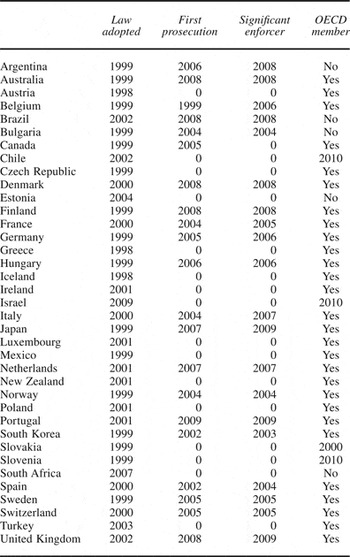
Before presenting the econometric analysis, a quick review of descriptive evidence offers preliminary support for the association between extraterritorial acts and policy implementation. Sixty-three percent of OECD countries have prosecuted a case under their national foreign bribery laws, representing a broad array of nations from Hungary to South Korea (see Table A1). Of the OECD members that have enforced their legislation, 78 percent have experienced an extraterritorial action by the United States compared to 22 percent that did not.
Percent of OECD members enforcing foreign bribery legislation (1998–2009)
Note: Percentage of OECD enforcers (N = 18).

Anecdotal evidence suggests a connection between U.S. extraterritorial FCPA enforcement and national implementation in line with the causal pathways suggested above.Footnote 39 The U.K. investigation of BAE Systems in Britain offers an important example for how a U.S. case can alter the political will in a target state. In 2004, Britain's Serious Fraud Office (SFO), the agency in charge of such cases, began reviewing BAE for payments of more than $2 billion in illegal bribes to Saudi Price Bander bin Sultan and others in the 1980s.Footnote 40 BAE allegedly engaged in this bribery to secure an arms deal known as Al Yamamah, in which military hardware were sold to Saudi Arabia. In 2007, the British government suspended SFO activity, citing national security concerns. Given the large scale of the contract and the importance of the Saudi relationship to the U.K., this was widely seen within the anticorruption community as a case where political intervention stopped what might have been the U.K.'s first significant antibribery enforcement action. Although the SFO had not filed a prosecution, the United States began its own case.Footnote 41 In response to the U.S. case, the local media and the political opposition pushed for greater enforcement of corruption regulations.Footnote 42 Liberal Democrat Vince Cable, then in opposition and later business secretary, attacked the Brown government arguing,
It is extraordinary and embarrassing that we have to rely on the higher standards of probity in the United States to investigate alleged corruption by a British Company in its overseas business operations. One of the most important challenges facing Gordon Brown is to alter the sleazy behaviour of the outgoing Blair administration and ensure that this government is committed to higher ethical standards and the rule of law.Footnote 43
In 2010, BAE plead guilty in the U.S. case to a criminal conspiracy to make false statements to the U.S. government and agreed to pay $400 million. On the same day, the company announced that it had also reached a settlement with the SFO for £30 million.
The head of the SFO repeatedly cited the U.S. investigation as a reason to increase SFO authority, independence, and resources.Footnote 44 As the United States wrapped up its BAE case, the British government promised tough new anticorruption legislation and significantly expanded the SFO's budget. The agency has started a number of prosecutions.Footnote 45 In fact, the number of SFO active investigations increased from twenty to eighty-four between 2007 and 2009 and in that time they have successfully prosecuted ten cases.Footnote 46 In an interesting turn, new U.K. antibribery legislation would empower the U.K. regulator with similar extraterritorial authority enjoyed by the DOJ.
U.S. extraterritorial interference in Germany provides an additional example of how the rise of extraterritorial FCPA cases has played an important role in changing the domestic behavior of foreign bureaucracies.Footnote 47 In 2004, the United States opened investigations against Daimler AG, alleging that the company engaged in a long-standing practice of paying bribes to foreign officials in at least twenty-two countries to secure contracts valued at hundreds of millions of dollars.Footnote 48 According to the DOJ, Daimler AG used corporate cash desks, offshore bank accounts, deceptive pricing, and third-party intermediaries to pay bribes.Footnote 49 German public prosecutors—the officials tasked with bringing foreign bribery cases—had long resisted enforcement of foreign corruption rules, but in the face of U.S. pressure shifted gears and began to prosecute cases.Footnote 50 The ramifications of the extraterritorial Daimler investigation apparently affected the German approach to foreign bribery. In the 1.3 billion dollar settlement of international bribery charges against Siemens from 2008, the United States repeatedly praised the work of Munich-based prosecutors, words absent from the earlier Daimler investigation by DOJ. Germany has increased its enforcement from 1 antibribery case and 12 investigations in 2005 to a total of 117 cases and 150 investigations by 2009, making it the second-most-active OECD convention enforcer, after the United States.Footnote 51 U.S. extraterritorial cases have created a new uncertainty for firms in Europe, leading to an explosion of compliance practices by companies globally. A prominent FCPA lawyer involved in the Siemens case concluded that “companies in Europe and other developed countries are also worried that their regulators will emulate U.S.-style prosecutions.”Footnote 52 Figure 2 shows the timing of U.S. intervention relative to domestic enforcement activity in the two countries. Foreign cases are only counted when a successful prosecution occurs and given the complexity of many foreign bribery cases, we would expect a temporal lag between the opening of the first U.S. action and domestic enforcement. The sequence and timing of U.S. extraterritoriality versus national enforcement in the two countries further corroborates the extraterritorial argument.
Cases prosecuted in Germany and the United Kingdom versus U.S. extraterritorial enforcement

Data Set and Empirical Analysis
In order to test the association between extraterritorial actions and national implementation, we constructed a new data set on the enforcement of foreign bribery legislation by OECD countries between 1998 and 2008. We chose 1998 as the start date, because it is the earliest year in which OECD member laws enter into force, and 2008 as the end date to maximize available data for possible covariates. We focused the primary analyses on the twenty-nine OECD members that signed the convention in 1997 and had not previously actively enforced regulations against foreign bribery (excluding the United States, which has long enforced such legislation). Most of the data on enforcement of the convention comes from TI's reports on the OECD convention. To assure greater accuracy, we cross-referenced the data with information from the OECD Working Group on Bribery in International Business Transactions—the body responsible for monitoring implementation and enforcement of the convention—country reports. For the primary analysis, the dependent variable, first case, denotes the first prosecution of a case by a country with foreign bribery rules. In an extension, we repeat the analysis but use TI assessments of national enforcement systems. The dependent variable significant enforcer is determined by the number of cases prosecuted by a country weighted by the country's involvement in the international economy. Through 2008, TI reported only if a country had reached significant enforcer status or not and thus we code the variable as a binary outcome.
The year a country adopts foreign bribery rules, it enters the data set because it is now in a position to enforce its legislation. A country receives a 0 every year they have not prosecuted a case, and a 1 in the year of the first prosecution. Once a country has enforced its legislation, the country exits the data set. These criteria result in 219 country-year observations (for 29 countries). Similarly, for the secondary analysis measuring the classification as a significant enforcer, a country receives a 0 every year it is not classified as such, and a 1 in the year it receives significant enforcer status. This results in 238 country-year observations (for 29 countries).Footnote 53
We use one indicator to measure our main predictor of interest—U.S. extraterritorial application of the FCPA. The variable us enforcement captures FCPA cases brought against foreign firms or citizens, including ongoing investigations against firms. This measure is a dichotomous variable, where a value of 1 indicates that a country has experienced U.S. extraterritorial enforcement, as defined above, and a 0 if it has not. A country receives a 0 for every year there is no U.S. enforcement, and a 1 in the year it first experiences U.S. enforcement and for every year thereafter. The data on U.S. extraterritorial enforcement of the FCPA comes from Shearman & Sterling's FCPA Digest. They report on all FCPA investigations from 1977 to 2008.Footnote 54
While our principle interest is the relationship between enforcement of national legislation and extraterritorial application of the FCPA, we also examine alternative explanations for the variation in enforcement. Earlier work on treaty compliance in general and OECD cooperation in particular has emphasized peer effects.Footnote 55 The fundamental assumption of the OECD antibribery convention concerning enforcement rests on peer assessment mechanisms built into the treaty. We therefore control for the possible effect of the peer review process through peer review, where a value of 1 indicates that a country has received an OECD implementation report and a 0 indicates that it has not. We also include a variable that captures more diffuse emulation processes within the OECD. The variable oecd emulation represents the total number of OECD countries (excluding the member under observation) that have enforced their rules as a percentage of OECD members.
A second set of arguments popular in the corruption literature suggests that international integration may play a role in enforcement.Footnote 56 Sandholtz and Gray, for example, have demonstrated that countries that are more integrated into the international economy are more exposed to economic and normative pressures against corruption.Footnote 57 Those countries that are more dependent on trade or the export of foreign direct investment may then be more likely to enforce their national rules. To measure interdependence pressures we include trade openness and fdi out. trade openness measures imports and exports as a percent of gross domestic product (GDP) and is a general indicator of international exposure. fdi out measures outward FDI stock as a ratio to gross domestic product and offers an indicator of the relative importance of outbound FDI to the national economy.
In addition to peer effects and international integration variables, research suggests that corruption studies and work on compliance should account for domestic political economy and normative dimensions.Footnote 58 Our models include a measure of legal system to account for difference in enforcement that might arise from variation in prosecutorial culture. legal system is a dichotomous variable, coded 1 for common law systems. We also control for a number of domestic factors cited in the literature. To capture differences in economic development, we include gdp cap, which measures GDP per capita in U.S. dollars. Because of our sample, there is little variation in many domestic variables such as polity scores or measures of bureaucratic quality. To control for domestic levels of corruption, we use TI's Corruption Perception Index, which varies on a scale from 0 (corrupt) to 10 (not corrupt). As religion has often been tied to corruption studies, we include the variable protestant, which captures the percentage of the population identifying as protestant.Footnote 59 Finally, we include a dummy variable, transition, to account for countries that transitioned from communism after the end of the Cold War. Additional information regarding the variables and their sources are given in Table A2.
For the empirical analysis, we employ a duration analysis known as discrete event history analysis.Footnote 60 This methodology explores the probability that a unit will experience a particular event in a period of time, given that the event has not already transpired. Discrete event history analysis is appropriate when data is not collected continuously in time but rather at specific moments. As is the case with much data in International Relations, observations occur in large increments of time, such as years, and thus discrete models are preferred to calculate the hazard rate and approximate a Cox model.Footnote 61 Given that observations occur at discrete points in time, t i, the function for a discrete random variable can be written as Pr(T = t i) while the survival function for the discrete random variable can be written as Pr(T ≥ t i). As the hazard rate is equivalent to the probability of failure to the probability of survival, the hazard rate including covariates can be expressed as

As the dependent variable in discrete event history analysis is binary (the event occurring versus not occurring), we are interested in the probability of an event occurring, Pr(y it = 1) = λi, versus the probability of nonoccurrence, Pr(y it = 0) = 1 − λi. We can then use the logit function to specify a distribution for the model:

The discrete-time model is analogous to a parametric model with an exponential distribution.Footnote 62 As the underlying hazard in the model is a constant, it is important to account for possible time and duration dependencies. To do this, we follow Carter and Signorino and include a polynomial cubic count variable.Footnote 63 We lag the effect of extraterritorial investigations, peer review, and OECD emulation by one period and cluster by country using STATA 10 clustering procedure. The polynomial cubic count variable and lagged independent variables minimize temporal autocorrelation and simultaneity concerns respectively while the country clusters and OECD emulation variable address spatial autocorrelation. In the robustness section, we account for a number of possible selection and additional endogeneity issues.
Results
Econometric Analysis
Table 1 reports the results of the logit regression estimate for enforcement of national foreign bribery legislation by OECD members. The findings strongly support the extraterritorial spillover hypothesis as U.S. enforcement has a positive and statistically significant association with a country's likelihood of enforcing their own national laws. The relationship between extraterritorial application of the FCPA and enforcement holds in both our main model analyzing when a country prosecutes its first case, and a model examining when a country becomes identified as a significant enforcer.
Event history analysis for enforcement of foreign bribery legislation

Notes: Robust standard errors are in parentheses.
*** p < .01;
** p < .05;
* p < .10.
The association between U.S. extraterritorial cases and national enforcement is positive and substantively very strong (Table 1, Model 1). Holding all other variables constant, the odds of a country enforcing its first case are twenty times greater if a country has experienced extraterritorial application of the FCPA as compared to countries that have not. This finding offers considerable support for our expectation that extraterritorial interventions will be positively associated with the behavior of the target jurisdiction's enforcement activities.
We re-analyzed the data using a different dependent variable, which measured the classification of a country by TI as a significant enforcer. The association was statistically significant and had a strong association (Table 1, Model 2). This finding offers further support for the expectation that extraterritorial intervention can alter the regulatory status quo in a target country.
In a further extension, we examine our model in a larger sample of countries. An additional seven non-OECD member countries had ratified the convention and implemented national foreign bribery legislation by 2008. While this larger sample potentially suffers from a greater threat of selection bias as these countries voluntarily joined the convention, the analysis extends the generalizability of the finding. Once again we found a statistically significant and substantively large relationship between an extraterritorial case and national enforcement both for the first prosecution and becoming a significant enforcer (Table 1, Models 3 and 4).
In addition to our main variable of interest, we find evidence for covariates highlighting the importance of international interdependence and domestic factors—fdi out and legal system. The relative importance of outbound foreign direct investment to the national economy was related to the likelihood that a country would enforce its domestic legislation. Legal system was also significant across the models with common law countries less likely to enforce foreign bribery laws. trade openness was significant in Models 1 and 3 but the variable was not stable across the specifications and held a negative sign. Importantly, even controlling for the jurisdiction's legal tradition and the relative importance of FDI a country exports, the extraterritorial effect held.
Robustness
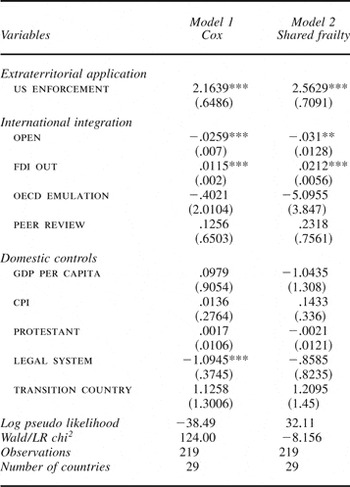
In order to further bolster the results, we conducted a number of robustness checks. We altered our model specification so as to make sure that the logit functional form or the discrete event history setup was not driving our results. First, we analyzed our data using a Cox proportional hazard model. Cox models require continuous data, so we reorganized our dependent variable as a count measure indicating time to failure along with a dummy variable capturing whether or not the observation is right censored. Cox models do not require a specification of the distributional form of duration dependence and thus are seen as advantageous for resolving temporal autocorrelation issues when no theoretical expectation concerning duration dependence is present. The re-analysis using a Cox model further supports the association between extraterritorial action and national enforcement (see Table 2, Model 1). Our measure of a U.S. case retains statistical significance and carries a positive sign in relation to a country's first prosecution.
Robustness checks predicting first enforcement by OECD members

Notes: Robust standard errors are in parentheses.
*** p < .01;
** p < .05;
* p < .10.
We also tried alternative specifications of our main independent variable. The U.S. enforcement variable was coded 1 if a country had ever experienced a FCPA case (including those cases conducted prior to the ratification of the OECD convention). We constructed a separate variable that measured U.S. enforcement starting in 1998. Models using this variable strengthened the association. It is possible that the association might depend on the number of cases lodged by the United States over time. We constructed a count variable of all U.S. cases and ongoing investigations experienced by a country and used this as the main independent variable. total u.s. cases was significant and had a similar substantive effect in the model predicting the first prosecution. It did not, however, reach significance for the model examining significant enforcement. This suggests limits to an additive association.
In terms of selection, the case of foreign corrupt practices legislation is particularly well suited for the analysis. The OECD convention required all signatories (except the United States) to significantly reform their domestic legislation. All members faced the treaty obligations simultaneously and OECD membership cannot be construed as linked to issues of foreign bribery or corruption. In short, signatories had to change their domestic regulatory systems because of the convention and these changes could not have motivated historical cooperation in the OECD.
Our central goal is to evaluate the potential association between extraterritorial acts and national enforcement. Nevertheless, our model could suffer from omitted variable bias and unobserved heterogeneity. To account for this, we included a battery of alternative causal factors into our main model. It is possible that absolute rather than relative economic activity might be related to prosecution and thus we included GDP, trade, and foreign direct investment (FDI) as a percent of world GDP, trade, FDI. The inclusion of these variables did not substantively alter the findings. We controlled for membership in the EU as a regional factor that could explain potential variation and produce spatial autocorrleation. This did not significantly change the results. In addition to these alternative variables, we used a shared frailty model to mitigate concern regarding unobserved heterogeneity. As duration analysis cannot easily incorporate fixed effects, shared frailty models are used to account for the fact that researchers rely on multiple observations of a single unit and that some unobserved characteristic of the unit might be responsible for event occurrence. As in other continuous event models, the dependent variable is a count measure of time to failure. These models include an additional random parameter distributed according to the Gamma distribution that conditions the hazard rate on the potential frailty.Footnote 64 The shared frailty model returned similar results as our main model (see Table 2, Model 2) and thus further allays endogeneity concerns related to omitted variable bias.
Finally, our main independent variable of interest could suffer from endogeneity, as systematic factors could be associated with our treatment of U.S. extraterritorial intervention. While there is as yet no empirical work that accounts for variation in FCPA cases, interviews suggest that U.S. agencies may be motivated by their ability to successfully prosecute a case.Footnote 65 This logic would be in keeping with a bureaucratic politics argument.Footnote 66 Given the complex nature of FCPA cases, U.S. authorities rely on the cooperation of foreign prosecutors to collect the necessary evidence to investigate a case. In instances where the United States has a cooperative legal infrastructure in place, it is more likely to obtain needed information from the target market and succeed in its case. We thus use the presence or absence of a memorandum of understanding (MoU) between the SEC and a foreign government as a proxy. Such MoUs have been shown to be important for U.S. agency cross-border cooperation.Footnote 67 Moreover, there is no evidence suggesting that having an agreement with the SEC affects national enforcement and thus the instrument should not be correlated with the second-stage outcome. Using sec mou as an instrument, we conduct a two-stage least squares analysis to examine and correct for possible endogeneity.Footnote 68 After employing sec mou as an instrument for us enforcement, us enforcement was still significant and positively signed. The result minimizes potential endogeneity concerns related to the nonrandom nature of the treatment of U.S. enforcement. Moreover, a Hausman test, which is used to identify possible endogeneity, was not significant, offering further support for the assumption that us enforcement is exogenous. Given the lack of work explaining the motivations driving U.S. enforcement decisions, however, further research concerning alternative instruments will be necessary to increase confidence in the results of the two-stage model. Additionally, despite the various robustness checks, the results face the limits of observational studies in which treatment and control cases are derived historically rather than through experimental random assignment.
Conclusion
In this study, we examine the claim that extraterritorial acts may serve as a form of global governance, shaping the behavior of national policymakers. Specifically, we find that extraterritorial application of the FCPA by U.S. regulators is associated with the likelihood that a country with foreign bribery legislation will enforce their national rules. The findings offer further evidence that the application of domestic law can have significant international consequences and calls on scholars of global governance to more fully incorporate extraterritorial effects into their analyses.Footnote 69
Naturally, our results are limited in generalizability as we assess our argument in the foreign bribery case, which among other things focuses on U.S. extraterritoriality and advanced industrial democracies. Future work is therefore needed to expand the scope of regulatory areas considered. Nevertheless, there is good reason to think that the argument has broad application. Both the United States and the EU have extensive extraterritorial powers in a host of areas—financial services, antitrust, environment, and product standards.Footnote 70 At least anecdotally, we know that extraterritorial interventions have had similar effects in several of these.Footnote 71 Future work will be necessary to identify the specific mechanisms at work across sectors and their application particularly in nondemocratic regimes and by lead regulators other than the United States.
In conclusion, we turn to the broader implications of the argument for several core international political economy debates. First, our findings underscore the crucial, yet often neglected role that substate actors such as courts, regulatory agencies, and other domestic bureaucracies play internationally.Footnote 72 In particular, the results highlight the privileged position of lead regulators. Decisions by domestic administrators that oversee large markets, such as the United States, the EU, or increasingly even China, may have far-reaching spillover effects, unintentionally altering national decision making in other countries. This challenges more functionalist models of regulatory cooperation and extends the potential of hegemonic power into the everyday operations of foreign bureaucracies. At the same time, the findings condition the application of hegemonic authority on the global interaction of bureaucracies and domestic law.
Second, this study refocuses attention to policy convergence after policy adoption. While considerable work has examined factors that might account for variation in de jure policy change, relatively few studies have attempted to understand events thereafter. This is particularly striking as research highlights the implementation phase as critical for signaling, institutional innovation, and normative change.Footnote 73 A primary implication of our findings is that these implementation decisions are not isolated within national jurisdictions but are conditioned on international interdependencies. Extraterritoriality, then, may offer an understudied mechanism to overcome prisoners' dilemma cooperative failures and weak enforcement outcomes associated with domestic regulatory capture.
Finally, the empirical findings bear directly on our understanding of how to address the supply side of corruption. As policymakers emphasize the need for transnational mechanisms to address foreign bribery, the effectiveness of such efforts is of critical importance. The International Financial Institutions, OECD, U.S. government, and a host of NGOs have elevated anticorruption efforts to the top of the global public policy agenda. Nevertheless, our study suggests that voluntary peer review is not enough to explain commitment by the suppliers of corruption. The United States, and more specifically international FCPA cases brought by U.S. domestic agencies, have played a critical role in motivating reluctant foreign governments to take action against their wayward multinational corporations and will no doubt continue to do so moving forward.
Adoption and national enforcement of foreign bribery laws

Descriptive statistics and data sources

Sources:
(1) Heimann and Dell 2005–Reference Heimann and Dell2010 and OECD various years;
(2) Urofsky Reference Urofsky2009;
(3) World Bank 2010;
(4) OECD, “OECD Member Countries,” available at ⟨http://oecd.org⟩;
(5) La Porta et al. Reference La Porta, Lopez-de-Silanes, Shleifer and Vishny1999;
(6) Beny Reference Beny2002;
(7) UNCTAD Statistics, available at ⟨http://unctadstat.unctad.org⟩.