Introduction
Negative aging stereotypes, defined as deprecating beliefs about aging, are linked to a broad range of adverse physical, mental, and cognitive health outcomes (Levy, Reference Levy2003), as well as mortality (Kotter-Gruhn et al., Reference Kotter-Gruhn, Kleinspehn-Ammerlahn, Gerstorf and Smith2009). According to stereotype embodiment theory (Levy, Reference Levy2009), these negative aging stereotypes become internalized when their assimilation and reinforcement from the surrounding culture and social environment lead to negative perceptions of aging that can negatively affect health and functioning.
U.S. veterans represent an important population in which to examine prevalence and correlates of negative aging stereotypes, as they are 20 years older relative to U.S. non-veterans, and have a high prevalence of physical, mental, and cognitive health conditions (Tansey et al., Reference Tansey, Raina and Wolfson2013; Williamson et al., Reference Williamson, Stevelink, Greenberg and Greenberg2018). Recent work has found that negative aging stereotypes are associated with higher rates of posttraumatic stress and generalized anxiety disorders, as well as suicidal ideation (Levy et al., Reference Levy, Chung, Slade, Van Ness and Pietrzak2019). To date, however, no known study has examined the prevalence, and sociodemographic, health, and psychosocial factors associated with negative aging stereotypes in a nationally representative sample of U.S. military veterans. Such data can help inform population-based burden of negative age stereotypes, and identify potential “upstream” intervention targets to help mitigate risk for adverse health conditions and early mortality risk.
In the present study, we analyzed data from a large, nationally representative sample of U.S. veterans to examine: (1) the current prevalence of negative aging stereotypes related to physical, mental, and cognitive health and (2) sociodemographic, health, and psychosocial factors associated with these stereotypes.
Methods
Participants
A total of 4,069 predominantly older U.S. veterans were surveyed between 11/18/19 and 3/8/20 as part of the National Health and Resilience in Veterans Study (NHRVS). The NHRVS cohort was drawn from KnowledgePanel, a probability-based survey panel of more than 50,000 U.S. adults covering approximately 98% of U.S. households that is maintained by the research firm Ipsos. A total of 7,860 veterans in the panel were invited and 4,069 completed the survey (51.8% completion rate). Post-stratification weights using benchmarks of the distribution of U.S. veterans were computed from the recent Veterans Supplement of the U.S. Census Bureau Current Population Survey (August 2019). Further details about the methodology are provided in Pietrzak et al. (Reference Pietrzak, Levy, Tsai and Southwick2021). All participants provided electronic informed consent and the study protocol was approved by the Institutional Review Board of the VA Connecticut Healthcare System.
Negative aging stereotypes
Negative aging stereotypes were assessed using the following three items from the 12-item Expectations Regarding Aging (ERA) scale: “Every year that people age, their energy levels go down a little more;” “Forgetfulness is a natural occurrence just from growing old;” and “It is normal to be depressed when you are old.” These items had the highest factor loadings from the original 12-item ERA in physical, cognitive, and mental health domains (loadings = 0.76–0.80). Each item is rated on a 4-point scale: Definitely true, Somewhat true, Somewhat false, or Definitely false. Higher scores are indicative of endorsement of more negative aging stereotypes (see citation in Table 1 footnote). In the current study, endorsement of Somewhat true or Definitely true was considered a positive endorsement of negative aging stereotypes.
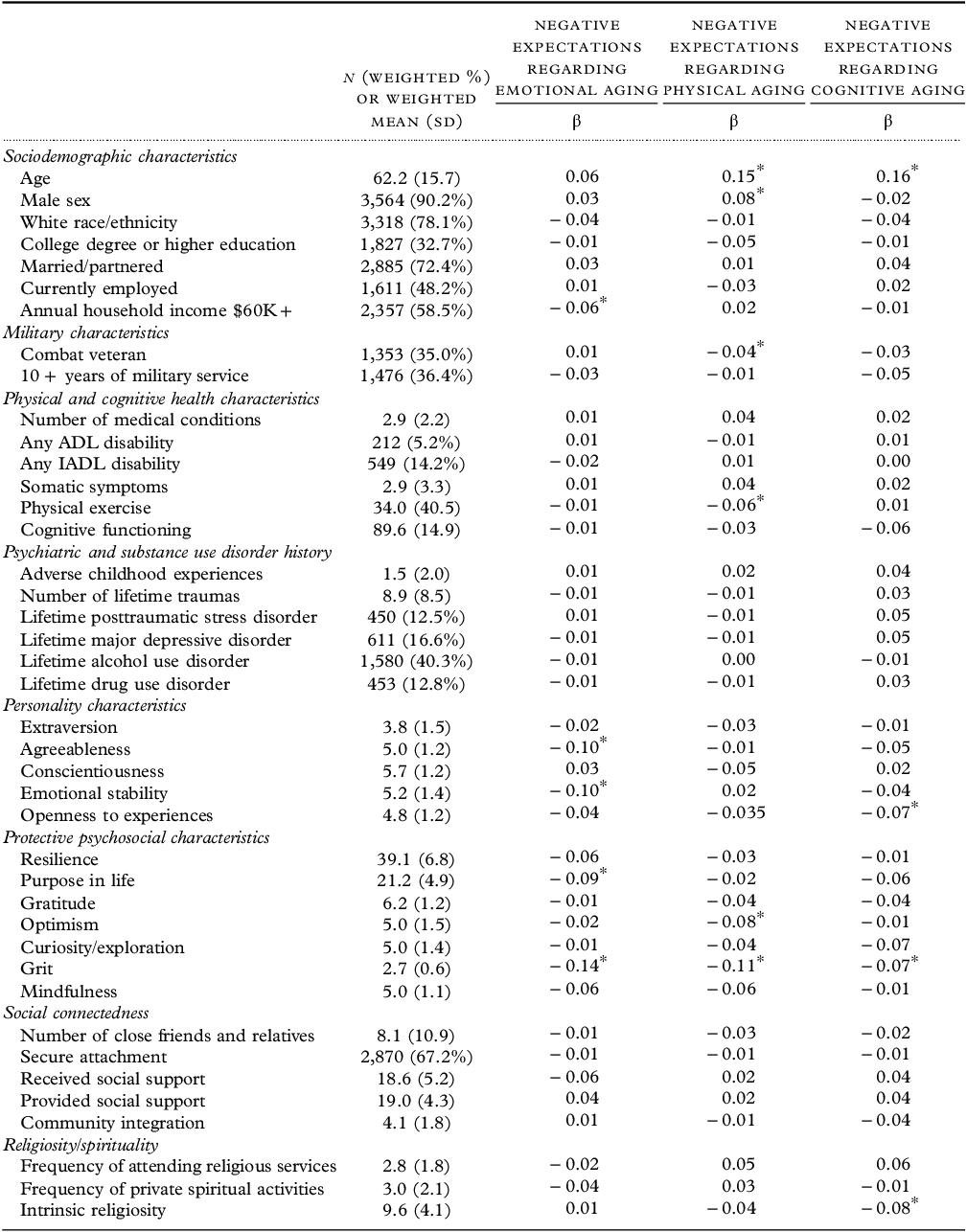
Sample characteristics and results of multivariable regression analyses predicting aging stereotypes

Note: β = standardized coefficient.
Statistically significant association after Bonferroni-correction: *p < 0.0012.
Collinearity diagnostics did not reveal any evidence of multicollinearity (all tolerance values > 0.62; all variance inflation factor values < 1.61).
Negative expectations regarding physical, emotional, and cognitive aging were rated on a 4-point scale: Definitely true, Somewhat true, Somewhat false, or Definitely false. Higher scores are indicative of endorsement of more negative aging stereotypes.
Sarkisian, C. A., Steers, W. N., Hays, R. D., & Mangione, C. M. (2005). Development of the 12-item expectations regarding aging survey. Gerontologist, 45(2), 240–248.
Covariates
Demographic variables such as age, sex, race/ethnicity, annual household income, years of education, and marital status; health variables such as number of physical health conditions; trauma-related variables such as lifetime trauma exposures and combat exposure; psychosocial variables such as resilience; and personality variables such as extraversion and emotional stability were assessed using psychometrically validated instruments. Further details about measures and assessments can be found in Supplemental Table 1.
Data analysis
Item-level missing data (<5%) were imputed using chained equations. Data analyses proceeded in three steps. First, descriptive statistics were computed to identify the prevalence of negative stereotypes regarding physical, emotional, and cognitive aging. Second, variables associated with physical, emotional, and cognitive aging stereotypes at the p < 0.05 level were entered into three separate Bonferroni-corrected multivariable ordinal regression analyses to examine independent correlates of negative stereotypes regarding aging. Third, relative weight analyses (Tonidandel and LeBreton, Reference Tonidandel and LeBreton2011) were conducted to compute the relative variance in negative aging stereotypes for each significant correlate (p < 0.0012) from each of the regression models. This analysis computes the proportional contribution that each independent variable makes to the overall variance explained, considering both its individual effect and its effect when combined with other independent variables.
Results
On average, the sample was 62.2 years old (standard deviation = 15.7, range: 22–99; median age = 64, interquartile range = 51–74) and predominantly male (90.2%), married/partnered (72.4%), and non-combat-exposed (65.0%). With regard to race/ethnicity, 78.1% were non-Hispanic white, 11.2% non-Hispanic Black, 6.6% Hispanic, and 4.1% other or bi/multiracial race/ethnicity.
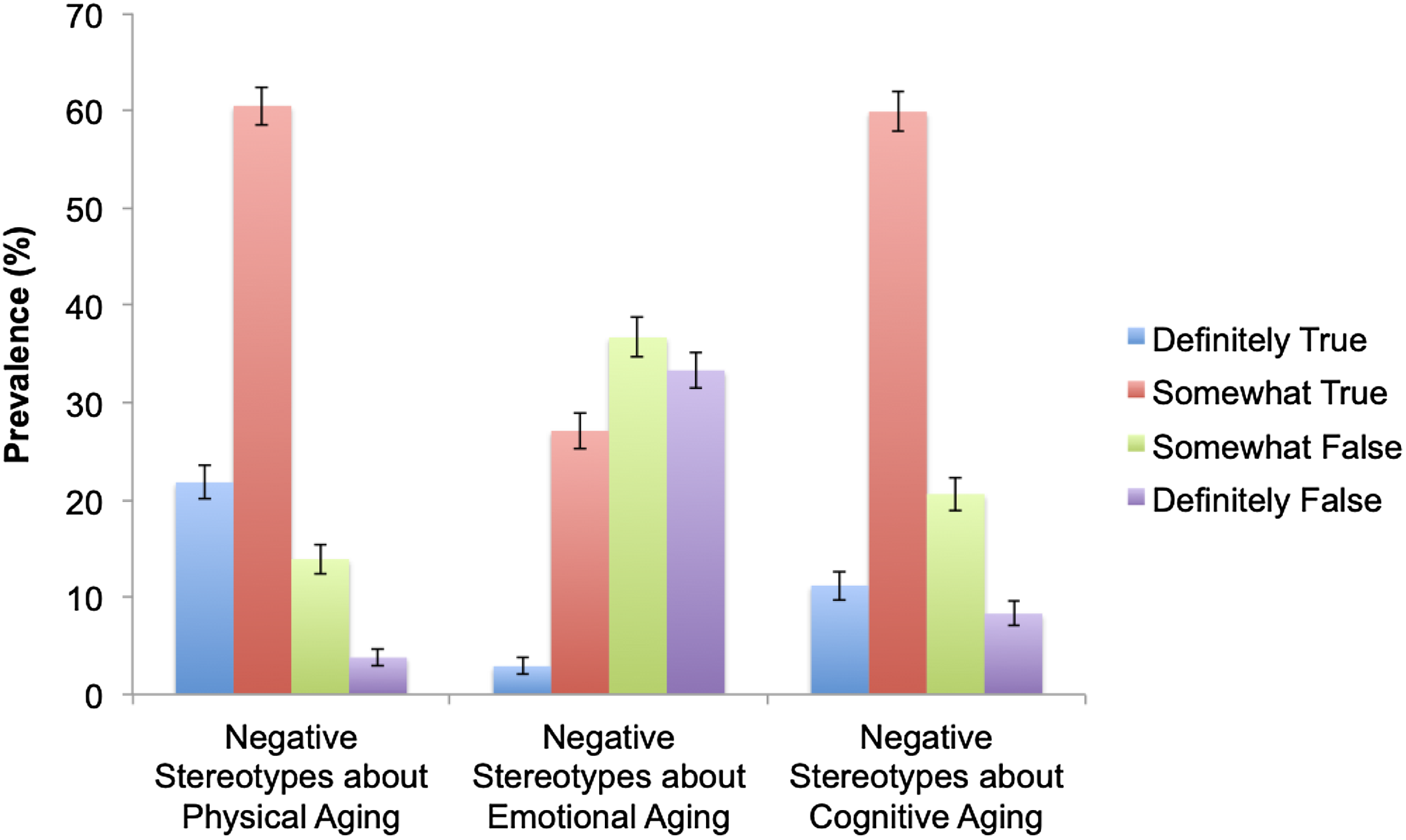
As shown in Figure 1, prevalence data revealed that veterans were most likely to endorse negative stereotypes regarding physical and cognitive aging relative to emotional aging, with 82.3%, 71.1%, and 30.0% of veterans endorsing Somewhat or Definitely true for these domains, respectively.
Prevalence of negative stereotypes regarding physical, emotional, and cognitive aging in U.S. veterans. Note: Error bars reflect 95% confidence intervals.

Table 1 shows sample characteristics and results of regression models predicting negative aging stereotypes. Higher household income, agreeableness, emotional stability, purpose in life, and grit were negatively associated with negative stereotypes related to emotional aging. Results of a relative importance analysis revealed emotional stability (28.8% relative variance explained [RVE (Tonidandel and LeBreton, Reference Tonidandel and LeBreton2011)]), purpose in life (28.8%), and grit (25.3%) explained the majority of the variance in this measure, with agreeableness (13.0%) and higher income (4.1%) explaining the remainder of the variance in this measure.
Older age and male sex were positively associated with negative stereotypes related to physical aging, while combat veteran status, physical exercise, optimism, and grit were negatively associated with this measure. Results of a relative importance analysis revealed that older age (36.6%), grit (23.6%), and optimism (17.5%) explained the majority of the variance in this measure, with male sex (13.1%) and physical exercise (9.2%) explaining the remainder of the variance in this measure.
Older age was positively associated with negative stereotypes related to cognitive aging, while openness to experiences, grit, and intrinsic religiosity were negatively associated with this measure. Results of a relative importance analysis revealed that grit (46.6%), openness to experiences (31.5%), and older age (15.1%) explained the majority of the variance in this measure, with intrinsic religiosity (6.8%) explaining the remainder of the variance in this measure.
Discussion
Using data from a contemporary, nationally representative sample of U.S. veterans, we examined the current prevalence and correlates of negative age stereotypes regarding emotional, physical, and cognitive aging. Results revealed that the endorsement of negative stereotypes related to physical and cognitive aging was higher relative to those related to emotional aging (82.3% and 71.1% vs. 30.0%). One interpretation of this finding is that aging stereotypes may be internalized in a domain-specific manner (Levy, Reference Levy2003; Levy, Reference Levy2009). Alternatively, greater endorsement of certain aging stereotypes may be influenced in part by a higher prevalence of certain, domain-specific health difficulties in the current sample. For example, while the vast majority of the current sample reported having been diagnosed with at least one physical health condition (87.6%), a relatively smaller percentage (16.6%) screened positive for a lifetime diagnosis of major depressive disorder.
Experimental studies have shown that, once internalized, negative aging beliefs can influence health outcomes through individuals’ perceptions and experiences that are socially and culturally reinforced (Levy, Reference Levy2003; Levy, Reference Levy2009). Negative aging stereotypes can, in turn, adversely affect physical, cognitive (Levy, Reference Levy2003; Levy, Reference Levy2009), and mental health (Levy et al., Reference Levy, Chung, Slade, Van Ness and Pietrzak2019; Levy et al., Reference Levy, Pilver and Pietrzak2014) outcomes. The endorsement of negative aging stereotypes may be further compounded by age-related challenges such as physical difficulties, retirement, and loss of friends and loved ones (Tansey et al., Reference Tansey, Raina and Wolfson2013). Longitudinal studies are needed to examine the temporal development of negative aging stereotypes and how they interrelate with domain-specific health measures over time.
Negative aging stereotypes may influence an individual’s perception and outlook on life (Levy, Reference Levy2009). Thus, positive psychosocial factors such as emotional stability, optimism, and openness to experiences may potentially help protect against the internalization of negative aging stereotypes, which could potentially help improve health outcomes and preserve functioning. Although the temporal associations among these measures remain to be elucidated, it is plausible that interventions to bolster certain psychosocial factors may help mitigate aging stereotypes or vice versa, and that such interventions could reduce risk for adverse health outcomes. Further research is needed to evaluate this possibility.
To our knowledge, this is the first study to suggest an association between grit and negative aging stereotypes. Grit, which encompasses traits such as self-control, self-regulation, and perseverance of effort and consistency of interest (Hwang and Nam, Reference Hwang and Nam2021), emerged as a strong correlate of negative aging stereotypes regarding all three health domains assessed. Prior work has found that grit is malleable throughout the lifespan and can influence health-related cognitions, emotions, and behaviors (Hwang and Nam, Reference Hwang and Nam2021). Thus, it is possible that greater grit may help bolster other positive psychosocial factors found to be inversely linked to negative aging stereotypes, such as emotional stability, purpose in life, and optimism. Interpersonal and environmental conditions may also help foster the development and maintenance of grit (Hwang and Nam, Reference Hwang and Nam2021). Given that grit is potentially modifiable, intervention strategies such as cultivation of a growth mindset – the belief that one’s abilities can change or improve over time through effort (Hwang and Nam, Reference Hwang and Nam2021) – may help counteract negative aging stereotypes and potentially help mitigate risk for adverse health outcomes.
Limitations of this study must be noted. First, although we identified a consistent association between grit and negative aging stereotypes, the cross-sectional design of the current study did not allow us to disentangle temporal/causal associations among these and other variables. Second, our use of a brief 3-item ERA measure rather than longer ERA scales did not allow us to evaluate the broader dimensionality of negative aging stereotypes. Third, consistent with the demographic composition of the U.S. veteran population, our nationally representative sample was comprised predominately of older, male, and white veterans, so results may not generalize to more diverse populations. Fourth, age stereotypes are multi-determined (Levy, Reference Levy2009), and we did not assess environmental or cultural factors that may be related to them.
Notwithstanding these limitations, results of the current study provide contemporary data regarding the current prevalence and correlates of negative age stereotypes among U.S. veterans. Further research is needed to replicate these findings in other samples; examine longitudinal interrelationships among psychosocial factors linked to negative aging stereotypes; and evaluate the efficacy of interventions targeting key correlates of negative aging stereotypes (e.g., grit, purpose in life, and openness to experiences) in promoting health and functional outcomes in veterans and other aging populations.
Conflict of interest
The authors have no conflicts of interest to declare.
Source of funding
None.
Description of authors’ roles
M.F.G.: Study concept, plan of analysis, literature search and review, write-up of the manuscript, revision of the manuscript; M.A.B.: literature search and review, revision of the manuscript; I.C.F.: literature search and review, revision of the manuscript; R.H.P.: study concept, plan of analysis, data management, data acquisition, statistical analysis, literature search and review, revision of the manuscript.
Acknowledgements
The authors thank the veterans who participated in the National Health and Resilience in Veterans Study and the Ipsos staff who coordinated data collection. The views expressed in this study do not necessarily represent the views of the U.S. Department of Veteran Affairs, the National Institute on Aging, the National Institutes of Health, or the United States Government.
Supplementary material
For supplementary material accompanying this paper visit https://doi.org/10.1017/S1041610223004507
Data availability
Data are not available to the public due to privacy and ethical restrictions.