1. Introduction
When scientists introduce and defend hypotheses, they do what philosophers do: give talks and publish articles. These presentations amount to arguments: they are supposed to provide justification for belief in new, even controversial, ideas. But scientific arguments are not limited to verbal and mathematical expressions. More often than not, visual representations are involved. A typical volume of Science includes graphs, charts, diagrams, and images produced by various techniques such as electron microscopy, PET scans, and X-rays. Comments about figures from journal referees and grant review panels, as well as informal discussion of papers and talks, show that scientists scrutinize figures when they evaluate papers. Scientists treat figures as integral parts of their arguments, whose strength and soundness depend on visual representations as much as they do on linguistic representations.
Could a visual representation be a genuine part of an argument? Philosophers define arguments in terms of sets of statements. This may explain why philosophers of science have paid so little attention to figures.Footnote 1 But defining arguments in terms of sets of statements is clearly too narrow a characterization to use to determine whether or not visual representations can be components of arguments. An alternative is to use a very broad characterization of an argument, as a set of representations, each of which must be capable of supporting a conclusion (or being supported by other representations). This characterization does not settle the question of whether or not a figure can be part of an argument, but it does point the way to an important criterion. The support that premises provide a conclusion is analyzed in terms of validity or strength, and soundness, so any representation that is an integral part of an argument must be one to which those features could be relevant. Validity, strength, and soundness are understood in terms of the truth conditions of premises and conclusions, so representations that contribute to arguments must have the capacity to bear truth. To show that figures are nontrivial parts of scientific arguments, the first question that must be addressed is whether visual representations can be true or false.
To find out if there is something about the visual representations in science that is incompatible with the capacity to bear truth, the first thing to check is whether the features that distinguish visual representations from text and mathematical representations are compatible with the capacity to bear truth.Footnote 2 The fundamental formal difference between visual representations and text is the sequential format of linguistic representations versus the two-dimensional spatial format of visual representations. Written words are two-dimensional characters; we identify letters by their shapes, and both height and width are relevant. However, the meaning of linguistic statements is determined just by the sequence of letters, punctuation, and spaces. The spatial form of serial representations is arbitrary with respect to their meaning. The shapes of letters are unrelated to the referents of the words and sentences they comprise, and the spatial position of words does not contribute to the meaning of text, except in terms of the sequence of linguistic characters. And even though linguistic representations must be read in a certain direction, e.g., left to right, the left-right spatial relation is not itself meaningful. Relative position on the page is not interpreted as denoting something about the referent. The fact that the visible forms of written sentences are arbitrary with respect to their meaning is a great source of the convenience and flexibility of textual representations. It is an easy format with which to express very abstract or general ideas, which is why serial representations are the preferred systems for expressing logical relations.
Visual representations are significantly different. The relation of their component parts in space does contribute to the meaning of figures. The spatial features of a figure can refer to spatial relations (as in a diagram of a molecule), temporal relations (time lines), relations between properties (graphs) etc. Other visible features like color may also contribute to the meaning of visual representations, depending on the system, but the referential role of spatial relations is the fundamental feature of visual representations. Because of this fundamental feature, the visible forms of visual representations are related to their referents.
The difference between the two is exemplified in the following two representations:
The square is on the right of the diamond.
♦∎
So the first step to deciding whether or not scientific figures can bear truth is to see whether it is possible for representations with two-dimensional formats to be true or false, or whether visual representations, in contrast to serial forms of representation, are incapable of bearing truth. This question is easily answered, because there are visual representations which behave just like truth-bearing linguistic representations, in spite of their two-dimensional format. Eric Hammer Reference Hammer1995 gives soundness and completeness proofs for several historical diagram systems (Venn, Euler, and Peirce diagrams). The two-dimensional format does not result in differences between the capacities of visual representations and serial representations to represent the logical relations expressed in these diagram systems. These visual symbol systems support truth-preserving inferences from diagram to diagram. Hammer thus provides us with several examples of visual representations that function just like exemplars of truth-bearing representations. This proves that the visual format itself does not prohibit a symbol system from the capacity to bear truth.
Hammer's work gives us good reason to think that some visual representations can bear truth. However, it does not show that the kinds of figures used in science can. Hammer's diagram systems are designed to convey very abstract content, like set membership, and to support deductive inferences based on that content. This is very different from both the content conveyed by figures in scientific articles and the kind of inferences the figures seem to be involved in. Is there any reason to think that visual representations used in science could bear truth, and support the kind of reasoning involved in scientific arguments?
In ancient Greece, the science of geometry was conducted with visual representations. Greek mathematicians drew figures in sand to work out new results and to teach, and some diagrams were recorded and survive: for example those in Euclid's Elements. The importance of the role of visual representations has been downplayed in modern assessments of Greek mathematics. Since the seventeenth century, diagrams were thought to play heuristic roles, for example by helping a person follow a proof. Euclidean diagrams were not thought to serve as a system of proof.Footnote 3
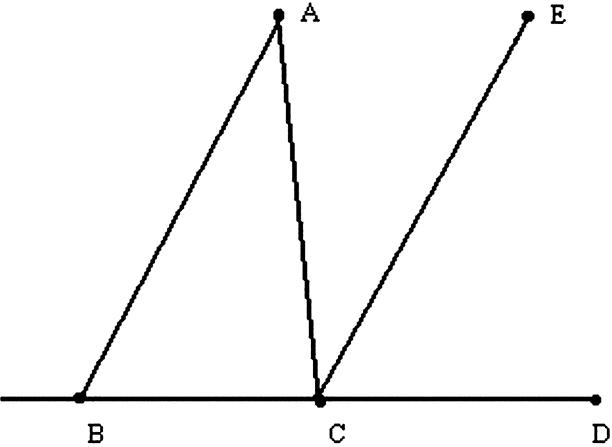
These later views should not obscure the role visual representations played in the development of geometry. Miller Reference Miller2001 explains how reasoning with visual representations was central to Euclidean geometry. For example, Euclid's first postulates are literally translated as drawing instructions—the first one “allows you to ‘draw a straight line from any point to any point’” (Miller Reference Miller2001, 5). The drawing rules specify the kinds of modifications one could make to a diagram, leading a researcher from an initial diagram to a different final visual representation. The diagram system is capable of expressing claims and demonstrating relations among claims. The diagrams represent geometric facts: characters are composed of lines and markings to identify, for example, identical angles, and they refer to geometric objects like points, lines, angles, and curves. The drawing rules function like rules of proof: they specify the acceptable modifications that can be made to a diagram, thus imposing constraints on moving from one representation to another. This type of reasoning will be familiar to anyone who has studied geometry; see Figure 1 for an example of such a proof.
This proof uses allowed construction rules for the diagram, as well as previously proved propositions from Book I, and common notions (C.N.), which Euclid takes as assumptions.
Let ABC be a triangle, and let one side of it BC be produced to D.
I say that the exterior angle ACD equals the sum of the two interior and opposite angles CAB and ABC, and the sum of the three interior angles of the triangle ABC, BCA, and CAB equals two right angles.
(I.31) Draw CE through the point C parallel to the straight line AB.
(I.29) Since AB is parallel to CE, and AC falls upon them, therefore the alternate angles BAC and ACE equal one another.
(I.29) Again, since AB is parallel to CE, and the straight line BD falls upon them, therefore the exterior angle ECD equals the interior and opposite angle ABC.
(C.N.2) But the angle ACE was also proved equal to the angle BAC. Therefore the whole angle ACD equals the sum of the two interior and opposite angles BAC and ABC. Add the angle ACB to each. Then the sum of the angles ACD and ACB equals the sum of the three angles ABC, BCA, and CAB.
(I.13 CN1) But the sum of the angles ACD and ACB equals two right angles. Therefore the sum of the angles ABC, BCA, and CAB also equals two right angles.
Therefore in any triangle, if one of the sides is produced, then the exterior angle equals the sum of the two interior and opposite angles, and the sum of the three interior angles of the triangle equals two right angles. Q.E.D.

Miller Reference Miller2001 provides a more thorough evaluation of the Euclidean diagram system. He creates a formal diagram system much like Euclidean diagrams, and evaluates its properties in terms of its capacity to support rigorous proofs. Miller concludes that his formal diagram system “shows that some of the aspects of Euclid's proofs that have been viewed as flaws can be viewed as correct uses of a diagrammatic method that was not fully explained” (Reference Miller2001, 104). For example, “many of Euclid's proofs that have often been criticized for making unstated assumptions, such as the proof of his first proposition, turn out to look exactly the same in [Miller's formal diagram system], because the assumptions are taken care of by the underlying diagrammatic machinery.” Miller's conclusion is very strong: this system has the properties of a proof system. This is not the standard that will apply in most scientific contexts, when inductive support, but not deductive proof, is required. In addition, the Euclidean system is a science of spatial relations, which is different from the subject matter of contemporary natural sciences.Footnote 4 However, Miller's work proves that ancient Greek geometers used a system of reasoning with visual representations that meets the criteria for arguments.
Because scientific arguments are significantly different from the deductive diagrammatic systems Miller and Hammer evaluate, we cannot extrapolate from their results to the figures that appear in contemporary research journals. Although it is now clear that the two-dimensional format alone does not preclude the capacity to bear truth, perhaps those visual representations share features, besides the two-dimensional format, which prevent them from bearing truth. So now we need to determine whether or not the kinds of figures seen in contemporary scientific arguments can bear truth. This requires a deeper understanding of the nature of visual representation in general, and a close look at the features of the different kinds of visual representations used in contemporary science. I develop the former by clarifying the role of interpretive convention in visual representation, and then use Goodman's catalog of syntactic and semantic features of symbol systems to characterize different types of representations used in scientific papers: text as well as various figures. Analyzing figures in these terms shows that individual visual representations have definite truth conditions determined by properties of the symbol system to which they belong.
2. Syntactic and Semantic Features of Symbol Systems
In Languages of Art (Reference Goodman1976) Nelson Goodman argues that the meanings of all representations are determined by conventions that guide interpretation of the symbols.Footnote 5 For example, textual representations convey meaning in virtue of interpretive conventions we apply to the sequence of letters and punctuation we see when reading a book. The claim that the connection between the perception and the meaning of words is determined by conventional relationships is not surprising, because the visible forms of words are obviously arbitrary with respect to their meanings. On the other hand, the role of interpretive conventions in pictorial representation is not obvious. The pictures we are all familiar with seem to be pictures of their subjects just because they are like their subjects.
Goodman argues that resemblance is neither necessary nor sufficient for representation. Resemblance is not necessary: any perceptible object can be designated to represent something. Resemblance is not sufficient: Wellington resembles his portrait but does not represent it. Goodman concludes that similarities between symbol and referent are completely irrelevant to pictorial representation. This conclusion is not warranted. Files Reference Files1996 shows that Goodman does not distinguish between two different issues concerning representation. One is the question of what determines which objects are representations at all: what does it take for an object to be a representation? The other is the question of what determines the content of a representation: why does an object that is a representation convey the particular content it does? Goodman's examples bear on the first question: the reason the portrait represents the man, and not the reverse, is because we apply conventions of use that identify one of those objects (the painting) as something that bears a reference relation to something else. With different conventions in play, the man could represent the portrait. So Goodman has provided good grounds to think that resemblance is neither necessary nor sufficient for an object to be a representation.
This implication does not, however, prove that the forms of visual representations bear completely arbitrary relations to their referents: it does not prove that resemblance relations cannot be relevant to what the painting refers to. What determines the content of a representation? As Goodman's argument implies, objects serve as representations through convention; these conventions determine which objects are appropriately interpreted—which things should be interpreted as standing for something else. Interpretive conventions determine what is a representation, and they also determine how symbols should be interpreted. The interpretive conventions that determine content of individual representations govern all the representations in a particular symbol system. Goodman thinks that there is nothing intrinsic to the form of image, or its causal history, that determines its meaning independent of conventions; we could use photos of different animals (in an admittedly unusual symbol system) to refer to months of the year, for example.
And while this conventionality may initially seem to exclude any role for resemblance in addressing the second question, it does not. There are different kinds of interpretive conventions. For some systems, like languages, the relation determining the reference of particular characters will be set for individual pairs of symbols and their referents, by stipulation or other means of pairing up an individual term with a referent. What is distinctive about these ways of generating reference relations is that the shape of a written linguistic symbol like ‘cat’ does not constrain the reference relation in any way. However, stipulating relations between particular pairs of symbols and referents is not the only way to determine the content of symbols in a system.
Content can also be determined by conventions that relate symbol and reference through resemblance relations. For example, a botanical print represents a particular species because the print has properties (color, spatial features, etc.) that resemble those of the plant. Convention is still essential to answering Files's second question, because the form of any visual representation stands in multiple relations to its referent. Only a subset of these matter in a particular system, and the relations that connect pictures and their referents vary from system to system—just consider a black and white photo of a person versus a portrait in watercolors. Convention is essential, not just to determine which objects are representations, but in determining which of the properties of both symbol and referent are relevant to representation. These aspects are determined at the level of symbol system: they hold for all the pictures in that particular system. So for some symbol systems, the conventionally determined features involved in the reference relation of the system are resemblance relations, or other systematically defined relations between properties of the symbol and those of the referent.Footnote 6 This is quite different from the form-independent conventions that determine reference of words and numerals, by individually assigning characters to objects. This has an important result for scientific visual representations as well: it means that the form of a symbol may determine its content in virtue of some relationship between that form and features of the referent. The definition of visual representations given earlier depends on this possibility: some spatial relations refer to some aspect of the referent.Footnote 7
Summing up, Files's identification of two different questions about representation has allowed for identification of two different roles convention plays in representation. One is that of determining which objects are representations, and the other is determining a symbol's referent. Both of these roles are necessary for representation, but since the conventions determining symbol-referent relations can involve resemblance relations, resemblance can also play a role in representation. This supports the distinction between visual representation and serial representation: serial representations are those whose form is arbitrary with respect to their referents, while visual representations are symbols from systems whose conventions involve determining referents based on relations between the form of the symbol and properties of the referent.
That distinction does not provide sufficient resources to characterize the different kinds of representations in science, however. It does not allow for identification of any similarities between serial representations and visual symbols, and it does not help identify differences among different kinds of visual representations. Since the interpretive functions apply to the symbol system as a whole, the differences and similarities between types of representations can only be explained through analysis of symbol systems, rather than of particular symbols. The relation between the form of a representation and its content is determined at the level of the symbol system, by the interpretive conventions for that system. These form/content relations vary in kind. Goodman provides the conceptual resources to categorize representations according to features of their symbol systems. Using these resources requires an initial investment in some new terminology, but this investment is quickly repaid by an explanation of the differences between important types of representations such as text, diagrams, and photographs.
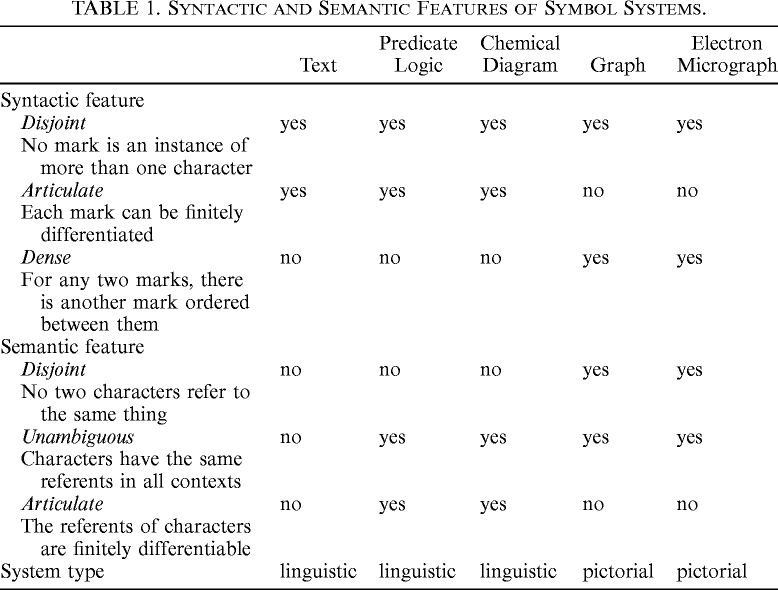
According to Goodman, symbol systems consist of characters (classes of utterances or visible marks), rules for combining characters to form others, and rules for character interpretation (Reference Goodman1976). Comprehension of representations requires identifying and interpreting the marks that compose them. The marks in any visible representation (text or figure) must be identified as instances of characters, and the characters determine what the marks denote. For example, comprehension of written English requires (1) identifying words or phrases through identifying the sequence of individual letters that compose them (e.g., identify the first mark in ‘cat’ as an instance of the letter c, etc.), and (2) associating the correct referent objects with particular words or phrases (e.g., between cats and the character instantiated by ‘cat’). Goodman identifies several variants in each of these two aspects of the interpretation of symbols, and uses these variations to categorize different symbol systems. The syntactic criteria relate to the first part of the interpretive process: how marks are individuated and identified as characters. The semantic criteria have to do with the second part of the interpretive process: how the referents of characters are defined and differentiated. For a summary of these features and how they apply to various symbol systems, see Table 1 below.

| Text | Predicate Logic | Chemical Diagram | Graph | Electron Micrograph | |
|---|---|---|---|---|---|
| Syntactic feature | |||||
| Disjoint | yes | yes | yes | yes | yes |
| No mark is an instance of more than one character | |||||
| Articulate | yes | yes | yes | no | no |
| Each mark can be finitely differentiated | |||||
| Dense | no | no | no | yes | yes |
| For any two marks, there is another mark ordered between them | |||||
| Semantic feature | |||||
| Disjoint | no | no | no | yes | yes |
| No two characters refer to the same thing | |||||
| Unambiguous | no | yes | yes | yes | yes |
| Characters have the same referents in all contexts | |||||
| Articulate | no | yes | yes | no | no |
| The referents of characters are finitely differentiable | |||||
| System type | linguistic | linguistic | linguistic | pictorial | pictorial |
In syntactically disjoint systems each mark is assigned to at most one character. English is syntactically disjoint because any of the marks that appear in a particular word are instances of exactly one letter of the alphabet. There might be an infinite number of characters (e.g., the standard symbols for fractions) but each mark is an instance of only one. Syntactically nondisjoint systems contain some marks that are instantiations of more than one character. (Suppose that a mark like ○ could be either an ‘O’ or a ‘0’.) In such a system, the character assignment of at least some marks will be either undecidable or context dependent.
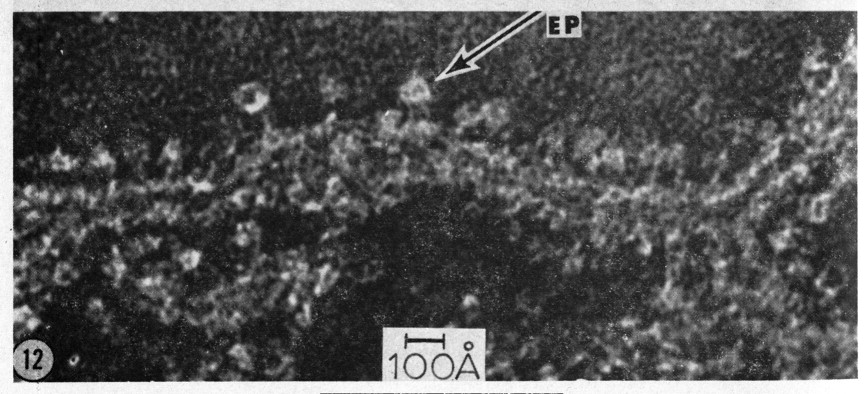
Another way to categorize symbol systems is by distinguishing between those whose characters are all differentiable from one another and those with characters that are undistinguishable in principle. A system is syntactically articulate when any mark that does not belong to two characters can be determined not to be an instance of either one or the other. Written English is a syntactically articulate system; markings for each letter of the alphabet can be determined not to be instances of other letters. But many visual representations are not syntactically articulate. For example, the identity of the electron micrograph is determined by the exact array of black and white, including gradation in tone (Figure 2). Limitations on measurement make it impossible to determine the form of this character with complete precision. As a result, the exact identity of the figure as a unique character cannot be determined.
Electron micrograph (from Humberto Fernandez-Moran (Reference Fernandez-Moran1962), “Cell-Membrane Ultrastructure: Low-Temperature Electron Microscopy and X-Ray Diffraction Studies of Lipoprotein Components in Lamellar Systems”, Circulation 26: 1039–1065).

Systems with infinitely many characters are syntactically dense if the characters are ordered such that for any two characters there is another ordered between them. Goodman points out that fractional symbols for rational numbers compose such a system; he uses this particular system to show that density does not imply lack of articulation. In contrast, the electron micrograph is part of a system that is syntactically dense in addition to its lack of syntactic articulation.
Systems are semantically disjoint if no two characters denote the same thing. In semantically disjoint systems the identity of the object is sufficient to specify which term refers to it (if any) because there is at most one such term. The numerals and natural numbers they refer to are a disjoint system. Discursive systems, such as natural language and predicate logic, are not, because there are many objects which are referred to by more than one word or term.
Systems are semantically unambiguous if all the marks which instantiate a character refer to the same objects. The context in which the mark occurs does not affect what the mark refers to. Characters whose referents depend on the context in which the character appears are ambiguous. Written and spoken English is semantically ambiguous; propositional logic is not.
In semantically articulate systems, in any case in which a character does not refer to both of two objects, it can be determined that the character does not refer to at least one of the two in question. Systems are semantically articulate if it is possible to discriminate between referents and non-referents of a character.Footnote 8
Goodman calls systems that are syntactically disjoint and articulate linguistic systems. Examples include natural languages, symbolic logic, and mathematical systems: discussion of linguistic representations below should be taken to include symbols from these types of systems, e.g., mathematical expressions. Natural languages, including the linguistic representations in scientific arguments, are redundant, so they are semantically nondisjoint. They are also semantically ambiguous and inarticulate: they include terms whose reference is context-dependent and not completely differentiable.
Systems that are syntactically articulate and discrete can be contrasted with systems which are syntactically inarticulate and dense. I will refer to such systems as pictorial systems, since this category includes the kinds of images we think of as pictures (photographs, perspective drawings, courtroom sketches, etc.). The difference between pictorial representation and representation with articulate and discrete syntax is exemplified in the contrast between the sweeping second hand of an analog clock and the discrete integers of a digital clock.
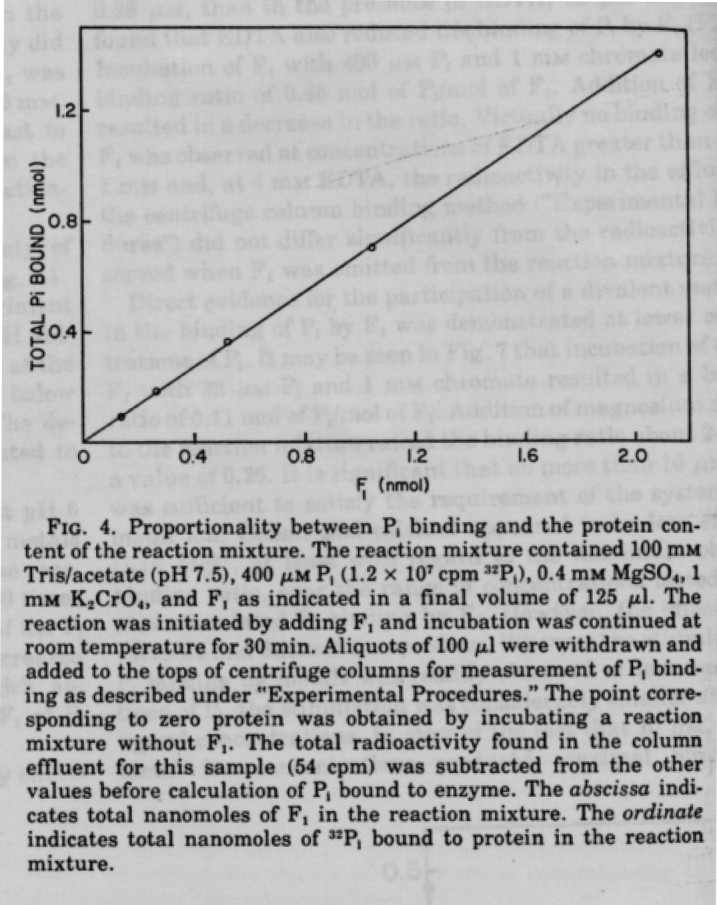
Pictorial systems have been defined based on syntactic and semantic criteria. Based on this definition, not all pictorial representations look like pictures. Graphs (e.g., Figure 3) with syntactic and semantic density and lack of articulation count as pictorial representations. On the other hand, it should be remembered that not all visual representations are pictorial representations. The diagram in Figure 4 has disjoint and articulate syntax, and is not part of a dense symbol system. It has these syntactic features in common with linguistic representations. Goodman's criteria, along with the distinction between visual vs. serial symbol systems, allows for the identification of three basic types of symbol used in science: serial representations with linguistic syntax (natural language sentences, mathematical formulas), visual representations with linguistic syntax (diagrams), and visual representations with pictorial syntax and semantics (some graphs, micrographs, etc.).
Graph (Penefsky Reference Penefsky1977).

Mechanism diagram (from Jan Pieter Abrahams, Andrew G. W. Leslie, René Lutter, and John E. Walker (Reference Abrahams, Leslie, Lutter and Walker1994), “Structure at 2.8 Å Resolution of F1-ATPase from Bovine Heart Mitochondria”, Nature 370 (6491)). Reprinted with permission of Nature (http://www.nature.com).

One more point about the symbol systems used in science: many figures used by scientists involve a combination of different types of representation. For example, Figure 2 is an electron micrograph with an arrow. The micrograph is a pictorial representation, from a system with dense and inarticulate syntax. Unlike the rest of the figure, the form of the arrow is not correlated with its referent. In fact, it does not refer to an aspect of the sample, but serves to call attention to part of the micrograph. The arrow is a character from a system with articulate syntax. This is an example of a character from one symbol system being imposed on a character from another. I will ignore this complication in order to focus on the more basic questions about the semantics of alternate types of symbol systems.
3. Truth and Symbol Systems
Goodman's characterization of symbol systems in terms of syntactic and semantic features can be used to identify features relevant to a representation's capacity to bear truth. It should now be clear that the question of whether a representation can be truth bearing or not must be answered in terms of symbol systems rather than individual representations. In principle, any perceptible thing can be assigned a meaning. And because the content of a sentence (or other acknowledged truth bearer) can be assigned to any object, any object can bear truth. The truth value of the object is the same as that of the sentence whose meaning the object is stipulated to convey. But this jury-rigged ability to represent states of affairs, and so to bear truth, is not what we are interested in. Demonstrating that scientific figures can bear truth will require showing that their symbol systems support the capacity to bear truth, independent of mediation by other representations to assign meanings to individual members of the visual symbol system (that is, without using linguistic representations as the underlying system).
Tarski's Reference Tarski1956 pivotal work on truth provides a method to do just this. Tarski attempts to capture the intuitive idea that sentences are true when the states of affairs they refer to obtain, while working around the constraint that a fully general theory of truth cannot be given, because the truth of any sentence depends on the fact expressed by that particular sentence. Tarski meets these conditions by working at the level of symbol systems: he shows how to define a concept of truth for formal languages. A materially adequate definition of truth allows, for every sentence s in the language, derivation of a statement of this form: X is true if, and only if, p. Such a definition is a set of statements of the conditions under which sentences of the language are true. X is the name of the sentence, and p is a translation of sentence s into the metalanguage of the definition (or p is s itself, if the metalanguage includes s). The name is determined by the form of the sentence: it is a function of the sequence of symbols constituting the sentence. Tarski uses satisfaction as the basic semantic concept, and satisfaction is defined as a recursive function of the form of the sentences in the language. This allows for definition of truth values for logically complex statements in terms of a recursive specification of satisfaction conditions.
Tarski's work shows that even though there is no general theory of truth with which we can test individual visual representations for the capacity to have truth value (and as explained above, this would be of little use for the task at hand), certain symbol systems are characterized by a systematic relation between symbol form and referent, in which the truth conditions of symbols are a function of their form. In the case of first-order predicate logic, this relationship is a recursive function. Definition of a materially adequate concept of truth was possible for this system because both the name of the sentence and its truth conditions are functions of the symbolic form of sentences of predicate logic. To show that visual symbols are capable of bearing truth, we need to show that their symbol systems support truth-bearing by individual representations. This means showing that the state of affairs the symbol refers to is not arbitrarily assigned, but is defined at the level of the symbol system. Such a relationship between symbol form and referent is demonstrated by the definition of a concept of truth, and so defining a concept of truth for a visual symbol system is sufficient to show that its representations can bear truth without requiring mediation by a linguistic symbol system.
To define truth for a symbol system you need a systematic way to (1) name each representation in the system and then (2) state the fact the symbol represents. Tarski accomplished this for formal linguistic systems by describing a method for naming every statement based on its structural form (the sequence of atomic characters) and providing the means to translate statements into a metalanguage. A statement of the definition of truth for a visual system requires a way to assign a linguistic name to each symbol, based on its structural form, and also a linguistic expression of the content of each representation. A definition of truth for a visual symbol system consists of a statement of this form for every figure f in a system: Name(f) is true IFF statement(f).
Certain features of linguistic symbol systems are essential to Tarski's ability to define a concept of truth for predicate logic: articulate and discrete syntax allow for the recursive definition of complex characters from atomic parts. The fact that the formal system has an unambiguous semantic structure means that referents can be correlated with characters. The formal system expresses content that can be translated into a linguistic metalanguage—no surprise there, since the object language is a linguistic form of representation. These features are also essential to Hammer's soundness and completeness proofs for logical diagram systems. Those diagram systems have articulate and discrete syntax and unambiguous semantics, which support a precise and recursive definition of the structure of the characters involved and their referents.
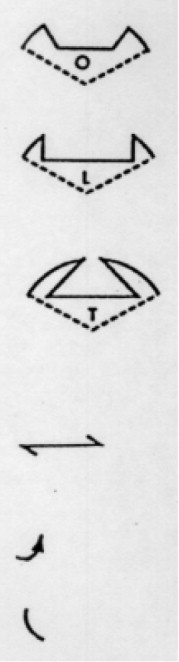
Some scientific figures also have these features. The diagram in Figure 4 represents the mechanism of the F1ATPase (the enzyme that makes ATP, the energy currency of the cell). This is a character in a syntactically and semantically articulate system. The figure can be decomposed into markings that each instantiate a specific atomic character. The meaning of the figure is determined by the arrangement of atomic characters (see Figure 5 and Appendix).
Parts of mechanism diagram.

The wedge shapes refer to subunits of the F1ATPase enzyme complex, which are chemically identical but can change shape. The O, L, and T wedges refer to three different conformations of the subunit (open, loose, and tight, respectively). Contiguity of the wedge characters refers to colocation of subunits in the enzyme complex. The horizontal double arrows refer to transitions between different states of the enzyme, in which the same subunit changes to a different conformation (for example, from loose to tight)—this diagram doesn't represent the complex as rotating. The linguistic terms in the figure have their usual chemical referents; their position at the ends of hooks represents the addition of those items from the complex during transition from one state to another, and their position at the ends of curved arrows represents the deletion of those items. Positioning terms in the concave part of the subunit symbols means that the item is bound to a subunit in that conformation.
This diagram represents a sequence of changes in the conformation and binding of subunits of the F1ATPase. It is true just in case enzyme in one state (with an ATP bound to a subunit in the tight conformation, and empty loose and open subunits) can bind ADP to the subunit in the loose conformation, and that the input of energy to the complex in this new state will change the loose ADP-binding subunit to the tight conformation, and the tight ATP binding subunit to the open conformation, etc.
The interpretative convention used to understand the figure determines a particular state of affairs, which can be expressed linguistically. The truth conditions of the figure are thus determined by the interpretive conventions for the system. The concept of truth for such systems can be specified because every representation in the system can be given both a name and a statement of the fact that makes it true, both expressed as a recursive function of the arrangement of atomic characters.
So some diagram systems used in scientific papers will allow for a definition of their concept of truth, if they have the right kind of syntax and semantics. What about other kinds of visual representations? Pictorial representations do not have the articulate syntax of diagrams. For this reason, pictorial systems cannot be fully decomposed into articulate atomic characters. The dense and inarticulate syntax of pictorial representations prevents a recursive specification of the meaning of their characters. However, this does not imply that a concept of truth cannot be defined for such systems.
Consider the graph in Figure 3. Characters in this graph system vary along two visible dimensions that are each relevant to the meaning of the representation. Position of the curve with respect to the x-axis represents the concentration of F1ATPase. Position of the curve with respect to the y-axis represents the amount of Pi bound to each F1ATPase complex. The atomic characters here include the axes, terms for values, the circles, and the continuous line. The position of the circles and shape of the line determine the identity of the character. We can distinguish the two visible features that determine the identity of this character (horizontal and vertical position), and each of these features corresponds to a distinct feature of the referent (ligand binding or enzyme concentration).
The values represented by any curve in this system can be given a mathematical representation (one that expresses the relation between ligand binding and enzyme concentration). Because both the symbols and their referents can be assigned linguistic representations, a systematic definition of the concept of truth is possible. We can use linguistic representations to name the characters of the system by their x and y coordinates, and we can also linguistically express the facts to which they refer. This graph is true IFF the number of molecules of Pi indicated by the vertical position of the curve is the number of Pi molecules that bind F1ATPase complexes at the concentration of F1ATPase indicated by the horizontal position, for every part of the curve. The claim that the graph has a truth value is justified not because its symbol form and truth conditions can be expressed linguistically, but because every graph in this system has truth conditions that are determined by the form of the symbol and the interpretive conventions of the symbol system.
There is a complication. This is a syntactically nonarticulate and dense system, so we cannot give a translation of this graph, because we cannot make an absolutely precise determination of exactly which character it is. In giving a definition of the concept of truth for this system, you list the names and contents of the representations in the system: we know what they are and what they mean because of the mathematical structure of both the symbols and the referents of this system. But there is no algorithmic way to state the fact that makes a particular representation true, because we cannot precisely identify the character. Nevertheless, the claim that the graph has a truth value is supported by the definition of truth for the system as a whole, composed of statements of truth conditions for individual representations. Such a definition shows that graphs can be true or false because these systems can have the right kind of relationship between symbol form and referent.
But not all pictorial systems used in science seem to support a definition of the concept of truth. Consider Figure 2. This electron micrograph shows F1ATPase complexes attached to mitochondrial membranes. The characters in this system are the products of a technique which beams electrons through a very thin sample of biological material surrounded by an electron-deflecting stain. The electrons that pass through the sample are detected and the electronic information is converted to visible output. The light areas visible in the micrograph correspond geometrically to the shapes of unstained areas in the sample. The micrograph represents the shapes of stain-excluding (biological) materials present in the sample, scaled to account for the magnification of the image.
The meaning of this representation is not a function of the arrangement of discrete atomic characters. The visible form of the representation is correlated with its content in a way that is difficult to describe with precision. It is like black and white photography in that gradations in light/darkness in both horizontal and vertical dimensions are relevant throughout the image. This creates two problems in generating a definition of truth for the system: how is each character to be named in terms of its form, and how is the content to be expressed linguistically, in terms of the form of the character?Footnote 9
The first problem seems soluble. Electron micrographs are images that are created as a composite of discrete elements that are too small to be detected by human vision. These elements can be used to name individual micrographs: in terms of an array of photographic pigments and their exposure (if the image is generated the old fashioned way, by detecting electrons with film) or in terms of a pixel array (if the image is generated by electronic detectors). The second problem is less tractable. The linguistic expression of the form of an electron micrograph provides values that refer to the number and location of electrons detected. These linguistic expressions do not refer to the shapes we see in the micrograph; it's the perceived two-dimensional form of the image that refers to the form of the sample. Perhaps a geometric analysis of the pixel information, generating a mathematical description of shapes, could match the content we derive from the image by perception. This approach is problematic however, because this is a type of image whose interpretation depends on our visual perception of shapes, and it is unclear how the information stored in pixel data relates to the information humans extract from the image.
If there was a systematic way to translate micrographs into linguistic expressions, then we could define truth for the system. However, I will assume the most problematic case for the question of capacity to bear truth: I will assume that micrographs cannot be translated into linguistic expressions. As noted above, it is not clear how to express the content of such figures with linguistic representations. Furthermore, adopting this assumption forces an important issue: the relevance of linguistic expressibility to a symbol system's capacity to support truth value. Under this assumption, it will not be possible to define a concept of truth for micrographs due to inability to generate the right kind of statements. Can micrographs bear truth, even if truth cannot be defined for that system?
Recall that definition of the concept of truth was a method used to demonstrate that a system exhibits an appropriately systematic relationship between the form of its symbols and the states of affairs they refer to, because such a systematic relationship determines truth conditions for the symbols of a system. A precise description of the relationship between form and content that is at the heart of the interpretive conventions governing this symbol system would support the claim that there is a systematic relation between the form of a micrograph and its content—and thus show that these symbols can bear truth—but there are difficulties. Meaning is not determined as a function of atomic characters; it is a function of the form of the image as a whole, for every image in the system. Furthermore, because this is a pictorial representation, meaning is a function of the precise form of the symbol—any variation in certain features (like location and tone of light areas) corresponds to a difference in content. For this reason the relationship may be specifiable with only limited precision. But inability to specify the precise relation between symbol form and content does not imply that content is not a function of form within this system.
And there is evidence that content is a function of form. Without such a relation, referents of micrographs would have to be determined by form-arbitrary individual pairings of symbol and referent. But this is not compatible with the fact that micrographs are produced by techniques which can generate comprehendible representations of phenomena never thought of or experienced before. Figure 2 is just such a case: the scientist that produced this figure did not expect to see the ball-and-stalk shapes attached to long linear shapes. He was the first to generate a representation of mitochondrial samples with such spatial features, but he was able to understand it as a representation of a structure with those spatial features, because he knew how to interpret the form of the symbol. It's the same interpretive convention that would be applied to any micrograph.Footnote 10 Unless there was a systematic relation between the form of the symbol and the state of affairs it represents, it seems impossible to explain how such a figure could be understood.
Nevertheless, any progress in clarifying the nature of the systematic relation between the micrograph's form and content would be illuminating. The determining relation involved is not one of visible resemblance, as in photography. The referents are too small for human perception, so visible resemblance cannot be the relation that determines the content of individual micrographs. However, there is a relation between visible properties of micrographs and properties of their referents. The spatial features of the light areas are interpreted as geometric projections of unstained areas of the sample: the shape of the light areas in the micrograph is interpreted as being (roughly) the shape of the biological sample. The light areas of the sample are not perfectly correlated with all the spatial features of the sample, because the sample has some depth and the micrograph only represents two spatial dimensions. Nevertheless, the spatial features of the micrograph are interpreted as a projection of that mostly two-dimensional structure onto a solely two-dimensional array.
This relation between symbol form and its interpreted content allows for an informal description of the concept of truth for the system. The description is informal because the relation has only been given an approximate description. However, this is enough to characterize the truth conditions for electron micrographs: an electron micrograph is true IFF the shape of the micrograph is a geometric projection of the shape of the sample scanned in producing the micrograph.
Recall the results so far. Some visual systems with discrete and articulate syntax support a definition of truth in terms of the truth of individual representations (diagrams). Some pictorial systems, like graphs, can support a definition of truth because their characters can be systematically named and their content represented with linguistic expressions. This does not seem to work for other pictorial systems, like micrographs. Under the assumption that the characters in the micrograph system cannot be systematically translated into a linguistic system, it is impossible to generate a Tarski-style definition of the concept of truth due to the inability to systematically correlate a linguistic name with a linguistic expression of content of each character in the system. Neither the visual format, nor pictorial syntax and semantics, prohibits defining truth for a symbol system, as demonstrated by the diagram and graph systems discussed.
Do these results imply that micrographs are not truth bearing? Since there is a systematic relationship between the symbol form and the states of affairs represented by characters in this system, denying their capacity to bear truth at this point could only rest on the failure of the system to support a (linguistic) definition of truth. Is the capacity to support such a definition a necessary condition for truth value?
The statements made in natural language in scientific arguments belong to a system which does not support a definition of truth, but those representations are credited with the capacity to bear truth. So a definition of the concept of truth for a symbol system is not a necessary condition for a system to support truth values. But perhaps the reason why micrographs fail to support a definition of truth explains their failure to support truth values. Natural languages fail to support a definition of truth because these systems do not have the appropriate structure to support a systematically defined symbol-referent relationship. Micrographs do not lack such a systematic symbol-referent relationship—the meaning of each micrograph is a function of its form—but they are not translatable into a linguistic form of representation, and this is essential to generate the appropriate statements comprising a definition of truth for a symbol system.
We need to decide if our ability to express the content of a representation with serial linguistic representations (like text or mathematical symbols) is essential to its capacity to be true or false. If so, then we do have a reason to claim that micrographs are not truth bearing. But there are two good reasons to reject the claim that expressibility in a language with linguistic syntax and semantics is a necessary condition for the capacity to bear truth. First of all, this investigation was launched to show whether nonlinguistic representations can bear truth or not. This question is begged by invoking the assumption that only representations whose content can be expressed with a linguistic form of representation have the capacity to bear truth. So the question of whether a micrograph could be true or false cannot be settled in this way. Second, that stance does not fit with the fundamental intuition that truth value depends on reference to states of affairs, since micrographs not only represent states of affairs, but do so without their content being assigned to them through the mediation of another symbol system.
4. Conclusion
One last option for those who wish to reserve the concept of truth for verbal and mathematical representations is to use the term ‘accuracy’ to express the relationship between visual representations and states of affairs, and ‘truth’ for the kind of relationship holding between statements and states of affairs. But this terminological distinction implies that there are two different sorts of correspondence relationships between representations and reality. However, this study found that the differences that preclude pictures from supporting a recursively defined concept of truth are properties of the symbol system of which they are elements. These features alone prevent definition of concepts of truth; without identification of some difference in the kind of relationships between individual representations and the facts they denote, there is no warrant for such a terminological distinction.
Finally, since visual representations and textual ones operate together in scientific arguments, there is a strong motivation to find a semantic value applicable to both. Lacking some good reason to reserve the concept of truth for linguistic representations, it should be applied to figures as well. Ultimately, a thorough philosophical analysis of science will have to include an understanding of how visual representations contribute to the articulation and defense of scientific claims. This study is a preliminary step to an explanation of how figures function in arguments. Since philosophers have always conceived of arguments in linguistic terms, it was necessary to show that figures could be genuine components of arguments, because they have the capacity to bear truth. One major barrier to participation in arguments simply does not apply to figures: they can indeed be true or false, just as linguistic representations can.
Appendix: Semantics for Diagram System
Definition of Well-Formed Figure (wff) for This System
Elementary characters: subunit terms (O, L, T), chemical terms (ATP, ADP, Pi, energy), transition terms (double arrow, curved arrow, hook).
1. Any of combination of three of the subunit terms (O, L, T) in which the apexes meet is a complex character, and a wff.
2. For any wff ϕ, a figure formed by placing one chemical term in one subunit concavity is a wff.
3. For any wff ϕ, ϕ↔ is a wff.
4. For any wffs ϕ and ψ, ϕ↔ψ is a wff.
5. For any wff ϕ↔ψ, ϕ↔ψ with an arrow or a curve and ‘c’ at the end of the arrow or curve is a wff, where c is any chemical term.
Semantics of Well-Formed Figures
1. A complex character with subunit terms x, y, z (where x, y, and z can each be any of the subunit terms) refers to an enzyme complex in which there are three subunits in the states referred to by the subunit terms (O: open, L: loose, and T: tight conformation).
2. A complex character with a chemical term at its concavity refers to an enzyme complex with one molecule of the chemical referred to by the chemical term bound to the type of subunit referred to by the subunit term in which the chemical term is located.
3. A wff of the form ϕ↔ψ refers to a transition from the enzyme complex denoted by the rightmost complex character in ϕ to the enzyme complex denoted by the leftmost complex character in ψ.
4. A wff of the form ϕ↔ refers to a sequence of transitions from the enzyme complex denoted by the leftmost complex character in ϕ to the enzyme complex denoted by the rightmost complex character in ϕ.
5. If a figure contains a wff of the form ϕ↔ with a hook and a chemical term attached to ↔, then the item referred to by the chemical term is added to the enzyme complex denoted by the rightmost complex character in ϕ during the transition.
6. If a figure contains a wff of the form ϕ↔ with a curved arrow and a chemical term attached to ↔, the item referred to by the chemical term is removed from the enzyme complex denoted by the rightmost complex character in ϕ during the transition.