In classroom settings where communication and meaningful interactions are important, second language (L2) teachers often recognize the value of foregrounding the development of speakers’ motivation, collaboration, and positive emotion to improve their language learning experiences. Affective variables, in particular, appear to be essential in understanding the learning process (Gregersen et al., Reference Gregersen, MacIntyre and Meza2014; MacIntyre & Mercer, Reference MacIntyre and Mercer2014) because they influence how L2 speakers communicate (MacIntyre & Vincze, Reference MacIntyre and Vincze2017) and how they react to the learning context (Gardner & MacIntyre, Reference Gardner and MacIntyre1993). For example, negative emotions, such as nervousness, can be associated with L2 speakers’ unwillingness to engage in communication (Liu & Jackson, Reference Liu and Jackson2008) and can even negatively impact their language performance, as evidenced by poorer performance on vocabulary tests (MacIntyre & Gardner, Reference MacIntyre and Gardner1989) and lower class grades (Horwitz, Reference Horwitz1986). Furthermore, negative emotions can affect L2 speakers’ long-term achievement, such as by inhibiting the development of L2 comprehensibility (Saito et al., Reference Saito, Dewaele, Abe and In’nami2018). Identifying and understanding behaviors associated with speakers’ emotional states is therefore important for fostering successful interactions and facilitating L2 development.
One of the most widely studied emotions in language learning is anxiety, where one experiences a negative emotional reaction when learning or using an L2 (MacIntyre, Reference MacIntyre and Young1999). Anxiety can be understood as both a trait, which is a stable personality characteristic reflecting a predisposition to be anxious (Scovel, Reference Scovel1978), and a state, which is a transient experience that occurs in response to a particular stimulus (Spielberger, Reference Spielberger1983). L2 anxiety and related feelings of nervousness and tension manifest in relation to various skills, including listening and speaking (Horwitz et al., Reference Horwitz, Horwitz and Cope1986), but they can be driven by various nonlinguistic factors as well, such as individual differences and other social-psychological factors. With respect to individual differences, L2 speakers characterized as having high trait language anxiety tend to also be more likely to experience state anxiety in L2 contexts (MacIntyre & Gardner, Reference MacIntyre and Gardner1989). In terms of sociopsychological factors, more extensive use of the target language and greater self-confidence tend to lead to lower language anxiety (Baker & MacIntyre, Reference Baker and MacIntyre2000; Sevinç, Reference Sevinç2018), whereas negative perceptions of the interaction or one’s interlocutor may lead to negative affect. For instance, because listener responses, such as backchannels, vary across individuals in frequency and placement (Cutrone, Reference Cutrone2005; Heinz, Reference Heinz2003), if those conventions are not shared, speakers may perceive their interlocutor as being impatient or interrupting (Cutrone, Reference Cutrone2005), possibly causing miscommunication (Li, Reference Li2006), anxiety, or frustration. Overall, these social-psychological factors are often larger contributors to language anxiety than linguistic factors, such as language proficiency (Hashemi, Reference Hashemi2011; Sevinç, Reference Sevinç2018; Sevinç & Dewaele, Reference Sevinç and Dewaele2018).
Much of prior work on L2 anxiety, however, tends to take a broad and retrospective approach to examining emotional dimensions in L2 contexts by using self-reports based on ratings, questionnaires, or interviews (Liu & Jackson, Reference Liu and Jackson2008; MacIntyre & Gardner, Reference MacIntyre and Gardner1994; Matsuda & Gobel, Reference Matsuda and Gobel2004). Yet changes in emotion can occur during L2 communication (Gregersen et al., Reference Gregersen, MacIntyre and Meza2014), which would be compatible with a dynamic systems perspective on language learning and use (e.g., de Bot et al., Reference de Bot, Lowie and Verspoor2007), where linguistic and nonlinguistic aspects of interaction would be subject to change over time, display interconnectedness, and tend to self-organize into preferred and dispreferred states (e.g., high and low affective states). This highlights the need for additional methods that could measure emotional responses more dynamically, especially since self-reports are often argued to be inaccurate (Caldwell-Harris et al., Reference Caldwell-Harris, Tong, Lung and Poo2011; Cramer, Reference Cramer2003). One such method involves capturing moment-by-moment changes in L2 speakers’ physiological responses as these signify activation (or arousal) of the autonomic nervous system that regulates emotions.
Along with heart rate (Kreibig, Reference Kreibig2010), the most commonly used physiological measure of anxiety is skin conductance response, which is obtained by using galvanic skin response sensors to assess sweating. Increased arousal, linked to a higher skin conductance response, indicates increased activity in the sympathetic nervous system (a branch of the autonomic nervous system known to be associated with response to stressors) which is otherwise known as the fight or flight response (MacPherson et al., Reference MacPherson, Abur and Stepp2017). Skin conductance has been widely adopted as a reliable measure of stress reaction related to anxiety (e.g., Santos Sierra et al., Reference Santos Sierra, Sánchez Ávila, Guerra Casanova and Bailador del Pozo2011; Setz et al., Reference Setz, Arnrich, Schumm, La Marca, Tröster and Ehlert2010) and shown to be the most effective in differentiating between anxious and nonanxious states compared to other physiological measures, including cardiovascular or respiratory (Blechert et al., Reference Blechert, Lajtman, Michael, Margraf and Wilhelm2006).
Skin conductance research has shown that increased arousal tends to occur under more demanding or stressful conditions, typically associated with an increase in cognitive load (MacPherson et al., Reference MacPherson, Abur and Stepp2017), or can occur in response to speech-related anxiety, such as during public speaking (Clements & Turpin, Reference Clements and Turpin1996; Croft et al., Reference Croft, Gonsalvez, Gander, Lechem and Barry2004; Kreibig, Reference Kreibig2010), especially for speakers with higher levels of trait anxiety (Witt et al., Reference Witt, Brown, Roberts, Weisel, Sawyer and Behnke2006). Similar findings have emerged in L2 contexts. Gregersen et al. (Reference Gregersen, MacIntyre and Meza2014) found that L2 Spanish learners with high trait anxiety experienced higher arousal during a classroom presentation than their classmates with low trait anxiety. Focusing on Turkish-Dutch bilinguals, Sevinç (Reference Sevinç2018) found that bilinguals experienced higher arousal (i.e., greater levels of skin conductance) when speaking with a native speaker in their less dominant language, which was consistent with their self-reported anxiety.
To date, physiological measurements have been primarily used to detect anxiety in stress-inducing contexts (e.g., class presentations, public speaking) and compared across different conditions (e.g., manipulating cognitive difficulty of tasks). However, while controlled experimental studies are important, recording skin conductance during open-ended conversations allows for exploration of a wider range of behaviors and interactional features, providing further insight into what may be associated with stress reactions during interaction. It could be that the interlocutor’s speech or the topics that arise during the conversation are related to an affective response. For example, during interaction, L2 speakers with lower oral proficiency tend to demonstrate higher skin conductance responses (e.g., Sevinç, Reference Sevinç2018), possibly due to changes in skin conductance being directly related to linguistic performance (e.g., code-switching, errors) or certain stimuli, such as unknown words (Geen, Reference Geen and Paulus1989). The nature of the conversation may also be associated with arousal, where discussing more negative topics (e.g., situations when one felt sad or angry) can elicit a stronger skin conductance response than when discussing positive topics (e.g., situations when one felt excited or happy), relative to neutral topics (Burbridge et al., Reference Burbridge, Larsen and Barch2005). However, it is less clear how interactional features (e.g., backchanneling, questions) or the type of discussion topics (i.e., personal experiences, language-focused content) may influence the arousal experienced by L2 speakers. While prior research has compared speech events (e.g., public speaking, completing a complex task, speaking in a less dominant language) that may be stress-inducing (e.g., Sevinç, Reference Sevinç2018; Wallbott & Scherer, Reference Wallbott and Scherer1991), it has not been examined what happens within a communicative event that is associated with stress reactions. Therefore, an examination of interactional features and discussion topics may provide further insight into the components of interaction that contribute to L2 speakers’ feelings of anxiousness.
In addition to using physiological measures to detect anxiety, researchers have also investigated visual cues as a way of identifying anxiety-driven behaviors. For example, by comparing facial expressions and body movements between relaxed, neutral, and anxious states as manipulated through elicitation tasks that varied in emotional strength, Giannakakis et al. (Reference Giannakakis, Pediaditis, Manousos, Kazantzaki, Chiarugi, Simos, Marias and Tsiknakis2017) found that small, rapid head nods, a higher blink rate, and more brow movement and mouth activity were more common in the anxious state. Gregersen (Reference Gregersen2005) also investigated nonverbal behaviors, where during an oral foreign language exam, self-reported high-anxious learners blinked more, made less eye contact, and more frequently touched their face, hair, or fidgeted with an object. These examples of self-contact and object manipulation, which are categorized as self-adaption gestures within Ekman and Friesen’s (Reference Ekman and Friesen1969) gesture category of “adaptors” (i.e., unintentional body movements), are widely recognized as responses to stress or negative feelings about oneself or others (Gregersen, Reference Gregersen2005; Richmond & McCroskey, Reference Richmond and McCroskey2004). Furthermore, adjusting one’s posture and restlessness (Ekman & Friesen, Reference Ekman and Friesen1974) and leaning away from the interlocutor (Burgoon & Koper, Reference Burgoon and Koper1984) have been associated with negative affect, such as feelings of awkwardness, tension, or anxiety.
To date, most research investigating nonverbal behaviors of autonomic arousal has focused on experimentally induced stress conditions. For example, Wallbott and Scherer’s (Reference Wallbott and Scherer1991) high cognitive stress condition was associated with more physiological indicators of anxiety (higher pulse and respiration rate) compared to the low stress condition, along with more brow lowering and more smiling, likely a defensive masking of negative emotions (see also Giannakakis et al., Reference Giannakakis, Pediaditis, Manousos, Kazantzaki, Chiarugi, Simos, Marias and Tsiknakis2017). In contrast, other research has suggested that maintaining tenser facial muscles, thus less smiling and less brow movement, is more common for high- than low-anxious learners (Gregersen, Reference Gregersen2005). One reason for these mixed findings could be that nonverbal behaviors, especially facial expressions, may be influenced by culture, and thus have multiple meanings (Gregersen, Reference Gregersen2009; Hashemi, Reference Hashemi2011). Different cultures may have different conventions for controlling facial expressions when feeling anxious in social situations, such as smiling to mask certain expressions (Ekman, Reference Ekman, Siegman and Feldstein1977). Therefore, research that includes speakers from diverse multicultural backgrounds is necessary to identify more generalizable relationships between physiological measures and nonverbal behaviors that characterize autonomic arousal.
Despite calls for research to explore the emotional experiences of L2 speakers, which are essential to understanding learner psychology, and to examine verbal and nonverbal cues associated with state language anxiety (Gregersen et al., Reference Gregersen, MacIntyre and Meza2014; MacIntyre & Mercer, Reference MacIntyre and Mercer2014; MacIntyre & Vincze, Reference MacIntyre and Vincze2017), there is little research investigating these affective variables during L2 interaction particularly from a dynamic rather than a static, trait-oriented perspective (e.g., Matsuda & Gobel, Reference Matsuda and Gobel2004). Therefore, the current study adopted a time-sensitive approach by measuring L2 speakers’ skin conductance (i.e., sweating), which is considered a reliable indicator of anxiety (e.g., Kreibig, Reference Kreibig2010), to assess their affective responses continuously in real-time interaction. The goal of the study was to explore the verbal and nonverbal characteristics accompanying L2 speakers’ physiological responses. The following research questions were addressed:
-
1. Which verbal features (e.g., disfluencies, listener responses, questions, discussion topics) occur among L2 speakers when they experience high versus low autonomic arousal during L2 interaction?
-
2. Which nonverbal features (e.g., eye gaze, facial, and body gestures) occur among L2 speakers when they experience high versus low autonomic arousal during L2 interaction?
Method
Participants
The participants were 60 L2 English speakers with a mean age of 24.57 years (SD = 4.74, range = 18–44) who were studying at English-medium universities in Montréal, Canada, as undergraduate (30) or graduate students (30). These participants were sampled from the larger Corpus of English as a Lingua Franca Interaction (CELFI), which consists of a diverse sample of L2 English students carrying out three discussion tasks in pairs (McDonough & Trofimovich, Reference McDonough and Trofimovich2019). Assuming that responses to arousal and anxiety may be affected by gender (e.g., Wallbott & Scherer, Reference Wallbott and Scherer1991) and culture (e.g., Ekman, Reference Ekman, Siegman and Feldstein1977), the 30 pairs were selected to balance gender (10 male–male pairs, 10 female–female pairs, 10 male–female pairs) and to have a diverse representation of language backgrounds within each gender group. Overall, the speakers spoke 21 different first languages, with the majority being Mandarin (10), Spanish (7), Arabic (6), and French (5). Participants in each pair came from different language backgrounds and did not know each other prior to the study. They had been studying English for an average of 12.33 years (SD = 5.06, range = 2–20) and had been living in Canada for an average of 3.83 years (SD = 4.39, range = 2 weeks–22 years).
Materials
The materials included a communicative task, a post-task survey consisting of 10 rating scales, a background questionnaire, and an L2 communicative trait-anxiety questionnaire [study materials posted at http://www.iris-database.org].
Communicative task
Both participants were given a handout with the following discussion prompt: “What are three challenges or problems that are important for most international students arriving in Québec? Try to find one possible solution for each challenge or problem you have identified and give reasons for why you are suggesting that solution.” This interactive task was chosen for analysis among the three discussion tasks used in CELFI (McDonough & Trofimovich, Reference McDonough and Trofimovich2019) as it promoted collaborative brainstorming and problem solving and was a familiar topic to all participants who were international students themselves. In addition, during post-experiment debriefing, this task was described by participants as being relatively easy compared to the other two tasks (academic discussion, exchange of personal narratives), so task difficulty would not play a major role in triggering anxiety-related arousals.
Rating scales
After the discussion task, participants received ten 100-millimeter continuous scales (a line with labeled endpoints, where the left endpoint indicated negative ratings and the right indicated positive ratings). Participants marked an X on the scale to rate themselves and their discussion partner for five different criteria: comprehensibility, flow, motivation, collaboration, and state-anxiety. These ratings were part of the data corpus, but only participants’ self-ratings of state-anxiety (perceived level of stress, worry, or nervousness during the task) were used in the current study.
Trait-anxiety questionnaire
Adapted from MacIntyre and Gardner’s (Reference MacIntyre and Gardner1994) input, processing, and output anxiety scales, this questionnaire measured participants’ trait-anxiety when using English by having them indicate their agreement with 18 different statements on a 6-point Likert scale (1 = strongly disagree, 6 = strongly agree). Both negatively- and positively-worded items were used as suggested by Dörnyei (Reference Dörnyei2003). Statements were related to how anxious participants feel when speaking English (e.g., I feel relaxed when I have to speak in English), when learning and thinking in English (e.g., Learning English vocabulary does not worry me, I can acquire it in no time), and when listening to English (e.g., I get upset when English is spoken too quickly). Items were modified from MacIntryre and Gardner (Reference MacIntyre and Gardner1994) to focus on oral communication by changing statements mentioning tests or readings to refer to presentations and lectures instead.
Procedure
Experimental setup
The study took place in a lab setting, where the two participants were seated at a table across from each other with a FOVIO eye-tracking system placed between them to monitor their eye gaze behavior. Two Logitech webcams captured each participant’s field of vision (i.e., the upper body of their conversation partner) and their eye movements, which were visually depicted by a green dot in the video. The FOVIO units and cameras were connected to two synchronized Dell laptops, where the field-of-vision data and eye movements were recorded using Eyeworks Record software. Participants’ galvanic skin responses were measured using TEA Captiv T-sens sensors. The charged battery packs of the sensors were attached to a velcro wristband strapped to the participants’ nondominant hand, with the two electrodes secured with a velcro strap on the distal (first) phalanges of their middle and index fingers. The electrodes measured participants’ skin conductance, assessing sweat secretion, and thus captured the episodes of autonomic arousal experienced by participants during their interaction. The signal from the sensors was captured via Bluetooth using a T-Receiver box and recorded in Captiv software (http://www.teaergo.com) on a Dell laptop. Participants generally stated that the equipment did not preclude them from engaging in natural conversation, as they provided an average rating of 81.2 (SD = 18.6) when asked how distracted they were by the experimental setup (where 100 indicates they were not at all distracted). Although it remains possible that the lab equipment created an unnatural and hence stressful environment, participants reported that they felt comfortable interacting with their partner (M = 86.75, SD = 14.00), that their overall experience was positive (M = 89.58, SD = 14.61), and that they perceived to have experienced only minimal anxiety overall during the task (M = 70.50, SD = 22.00), where 100 meant they felt very comfortable, their experience was very positive, and that they were not at all anxious, respectively.
Task procedure
After signing the consent form, participants were introduced to the rating scales and the definitions of the terms (5 minutes). Instruction was then given to participants on how to attach the sensors to their fingers, followed by a four-point calibration of the eye-tracking equipment (5 minutes). Once both the sensors and eye-trackers had started recording, the discussion topic was introduced with a brief warm-up, which was not analyzed as part of the main task (3 minutes). The discussion prompt was then explained to participants orally and given to them on a handout. To minimize any potential stress induced by the presence of an observer, the researcher left the room, giving participants 10 minutes to complete the task. Afterward, both participants were given the rating scales and rated themselves and their partner in terms of comprehensibility, state-anxiety, motivation, collaboration, and flow (2 minutes). Finally, participants filled out the background questionnaire and trait-anxiety questionnaire (10 minutes).
Data analysis
Autonomic arousal
The webcam field-of-vision videos with participants’ recorded eye movements were synchronized for each pair using Captiv software, and each participant’s sensor data were synchronized with the videos. This allowed participants’ behavioral reactions and their speech (as seen and heard in the videos) to be linked to their physiological responses (i.e., arousal episodes). No task lasted less than 10 minutes; for the six longer task performances, only the first 10 minutes of the task were analyzed. The proprietary coding algorithm in Captiv identified five levels of arousals, categorizing each episode as either high, medium-high, medium, medium-low, or low, based on both the amplitude (peak value) and the slope of the recorded skin conductance function. These levels, which are specific to the TEA Captiv T-sens sensor, are expressed in microSiemens (µS), where a greater value is associated with a higher rate of sweat secretion (Dawson et al., Reference Dawson, Schell, Filion, Cacioppo, Tassinary and Berntson2016). The determined arousal level reflected the range of each individual’s response, such that what constituted high, medium, or low arousal depended on the magnitude of absolute differences in skin conductance levels recorded for a given individual. Because the goal of this study was to document verbal and nonverbal features of high and low affective response, for this study, only the episodes of high and low arousals were analyzed to compare the two extremes. Thus, high arousals corresponded to responses with the steepest function slopes and highest amplitudes while low arousals corresponded to responses with the shallowest function slopes and lowest amplitudes, relative to all arousal episodes experienced by a given participant.
A response function in a sensor signal indicated either a specific skin conductance response, where the reaction was due to a specific external stimulus or event (e.g., due to something a speaker’s partner said), or a nonspecific skin conductance response, where the reaction was related to an emotional component, such as feeling discomfort when speaking English (Setz et al., Reference Setz, Arnrich, Schumm, La Marca, Tröster and Ehlert2010). However, as individuals’ skin conductance levels vary substantially (Setz et al., Reference Setz, Arnrich, Schumm, La Marca, Tröster and Ehlert2010), using raw amplitude measurements in µS for comparison between individuals was not plausible. For example, a skin conductance level of 8 µS may be considered high for one individual but may be relatively low for another (Dawson et al., Reference Dawson, Schell, Filion, Cacioppo, Tassinary and Berntson2016). To exemplify this in the context of our sample, participants’ average low arousal was 7.25 µS (SD = 5.22; range = 1.91–22.85), while their average high arousal was 10.53 µS (SD = 10.16; range = 1.01–43.57). As shown by the high standard deviations and wide ranges, a value as low as 1.01 was a high arousal for one participant while 22.85 was low for another participant. Due to this variability and given that the frequency of skin conductance responses is used as a measure of psychophysiological activation (Setz et al., Reference Setz, Arnrich, Schumm, La Marca, Tröster and Ehlert2010), the proportions of high and low arousals (out of all instances of arousal experienced at the five recorded levels), which included both specific and nonspecific responses, were used in all further analyses as a standardized measure to compare the occurrence of high and low arousals between participants. In addition, because skin conductance response typically has a latency period of 1–3 seconds (Bradley, Reference Bradley, Cacioppo, Tassinary and Berntson2000; Figner & Murphy, Reference Figner, Murphy, Schulte-Mecklenbeck, Kuehberger and Ranyard2011), the arousal episodes were identified within a moving window of 1–3 seconds prior to the first significant deviation in the signal. This response delay was taken into account to connect the behavioral and linguistic events in the videos to the physiological responses. Therefore, participants’ verbal and nonverbal behaviors occurring within these 2-second windows were coded.
Interlocutor behaviors
To create a coding scheme for interlocutor behaviors, five participants’ task performances (not included in this study) were first open coded by a trained coder for recurring verbal and nonverbal characteristics to capture as many features that could be potentially associated with autonomic arousal. These initial dimensions spanned 14 categories for verbal features and 20 categories for nonverbal features. Through iterative coding, the categories were reduced to four verbal features and nine nonverbal features, to include only the categories that occurred commonly in this data set and that were investigated previously in relation to anxiety, such as blinks (Wallbott & Scherer, Reference Wallbott and Scherer1991) or brow movement (Giannakakis et al., Reference Giannakakis, Pediaditis, Manousos, Kazantzaki, Chiarugi, Simos, Marias and Tsiknakis2017).
Verbal features
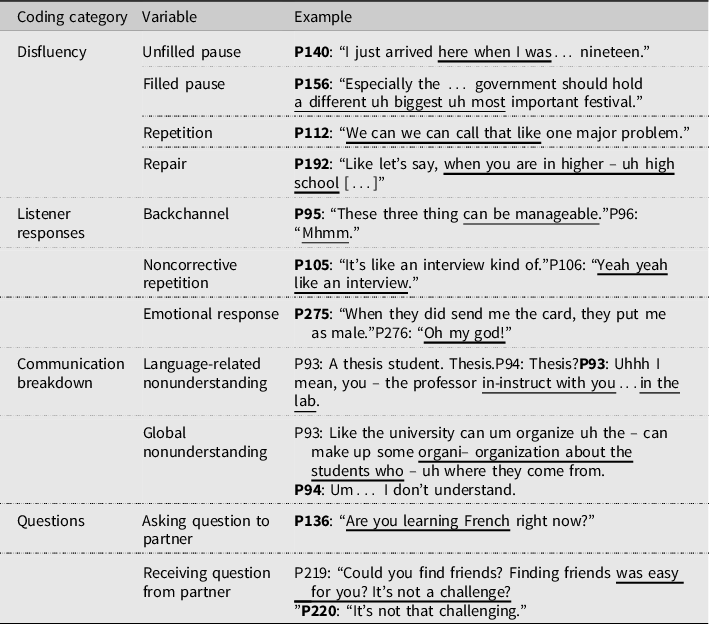
The final coding framework for verbal features is summarized in Table 1, along with illustrative examples of high arousal episodes for each category, where bolding indicates who was experiencing the arousal and underlining highlights when it occurred. The dysfluency category included unfilled pauses, defined as silent pauses longer than 0.5 seconds within a sentence or phrase (Riggenbach, Reference Riggenbach1991), filled pauses (e.g., uh, um), repetitions (i.e., repeating the same word or phrase), and repairs (i.e., self-corrections of pronunciation, grammar, or vocabulary). The listener response category included three types of reactions from each speaker’s interlocutor: backchannels (e.g., mhmm, yeah, okay), noncorrective repetitions (i.e., repeating a word or phrase the interlocutor said to show agreement or understanding), and emotional responses (i.e., reactions of amazement, disbelief, disgust, etc.). The remaining categories included communication breakdowns (i.e., difficulties understanding language or the global message of the utterance) and questions (i.e., asking or receiving a question). All verbal variables were coded categorically in terms of whether they occurred or not. Another trained coder used this framework and independently coded arousals from 10% of the participants (6 participants, 50 arousal episodes). Coding reliability (Cohen’s kappa) was .73 for disfluencies, 1.00 for listener responses, and .85 for questions, suggesting substantial reliability (Landis & Koch, Reference Landis and Koch1977). There was no kappa value for communication breakdown, as it did not occur in the subset of data used to measure interrater reliability.
Coding Framework for Verbal Features

Note. Underlining indicates when the high arousal (where appropriate) occurred, and bolding indicates who experienced it.
Topics of discussion
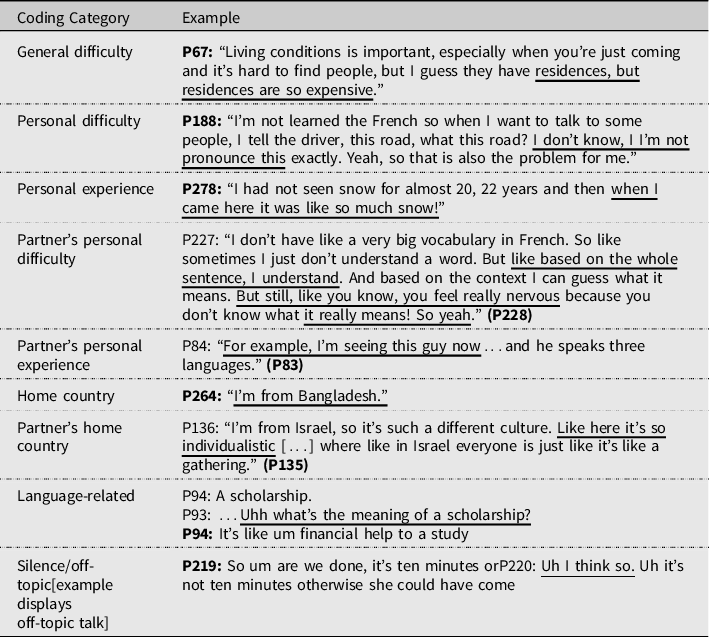
Assuming that a speaker’s arousal might also be associated with the content discussed, thus influencing the occurrence and magnitude of skin conductance responses (Burbridge et al., Reference Burbridge, Larsen and Barch2005), additional variables were derived by coding the topics of participants’ discussions. High and low arousals were examined within the broader context of the conversation (i.e., from the beginning of the idea that was being discussed when the arousal occurred) using bottom-up coding. Conversation themes that emerged included topics related to general difficulties in Montréal that international students tend to face and solutions to those problems (i.e., discussion directly related to the task prompt), personal difficulties participants have dealt with and personal (nonproblematic) experiences, discussing their home country, or when their partner was discussing a personal difficulty or experience or talking about their home country. Additionally, when participants diverged from the task, or when there was complete silence, it was coded as silence/off-topic. This was a relevant category for our multicultural sample, as silent behavior and the typical length of pauses between speaking turns varies across cultures (King, Reference King2013; Ruetenik, Reference Ruetenik2013). Lastly, when they discussed language, such as the meaning of a word used, the content was coded as language related. Table 2 outlines these conversation themes with illustrative examples of high arousal episodes, where bolding indicates who experienced the arousal, and underlining highlights the utterance when it occurred. The same trained coder coded the discussion content, and a re-coding of the discussions during 50 arousal episodes by another blind coder revealed a κ coefficient of .70, indicating substantial interrater reliability (Landis & Koch, Reference Landis and Koch1977).
Coding Framework for Topic of Conversation

Note. Underlining indicates when the high arousal (where appropriate) occurred, and bolding indicates who experienced it.
Nonverbal features
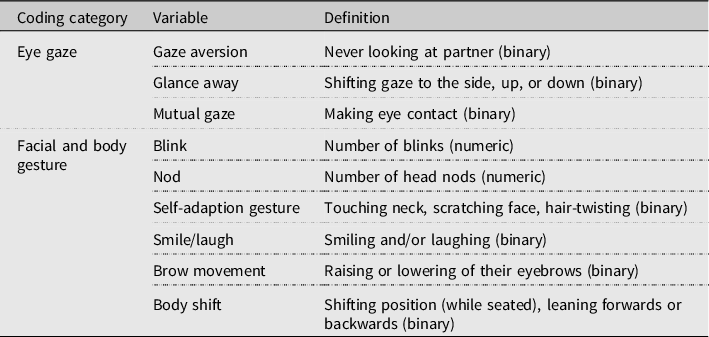
The final coding framework for nonverbal features, along with the definition of each category, is shown in Table 3. Except for nods and blinks, which were numeric variables, the remaining variables were binary, where the occurrence of the feature was coded as 1 and the absence of the feature was coded as 0. The recorded eye gaze, depicted by green dots in the videos, allowed for precise coding of participants’ eye movement. The initial coding was carried out by the same trained coder, and a subset of the data (10%) was coded by another blind coder. For the numeric variables, coding reliability (Cronbach’s alpha) was .88 for blinks and .97 for nods. For the binary variables, coding reliability (Cohen’s kappa) was greater than .74 for the eye gaze categories, greater than .81 for body gestures (body shift, self-adaption gestures), and greater than .72 for facial gestures (brow movement, smile/laugh), again suggesting substantial reliability (Landis & Koch, Reference Landis and Koch1977).
Coding Framework for Nonverbal Features During Episodes of High and Low Arousal

Because participants varied in the number of arousals they experienced (see the section below on the occurrence of high and low arousal), to obtain a standardized, comparable measure for all analyses, the occurrences of each coded variable within every verbal, content, and nonverbal category type were normalized per participant for high and low arousal episodes separately, such that the frequency of each coded category was divided by the total number of high (or low) arousals for that participant.
Ratings and questionnaires
The post-task ratings (i.e., self-ratings of state-anxiety) were measured (in millimeters) from the left endpoint to the cross marked by participants to obtain a rating between 0 and 100. Regarding the trait-anxiety questionnaire, positive statements were reverse-scored for analysis, such that higher scores (more agreement) indicated greater L2 communicative trait-anxiety. After internal consistency (Cronbach’s alpha) was checked for each subconstruct (input, output, processing trait-anxiety), two items from processing anxiety and one item from input anxiety were removed due to their initial low reliability (George & Mallery, Reference George and Mallery2003). Mean scores of each component – L2 input trait-anxiety (α = .69), L2 output trait-anxiety (α = .77), L2 processing trait-anxiety (α = .71) – were used for subsequent analyses.
Results
Occurrence of high and low autonomic arousal
Across the 60 participants, the data set was composed of a total of 444 arousal episodes (271 high, 173 low), identified by Captiv’s coding algorithm. Participants on average experienced 4.52 high arousals (SD = 3.43; range = 0–16) and 2.88 low arousals (SD = 3.51; range = 0–14) during the 10-minute communicative task. Put differently, out of all the arousals experienced by a participant, which also included the medium-high, medium, and medium-low arousals that were not included in the main analysis, on average 10% were considered high (SD = 7%; range = 0–33%) and 6% were considered low (SD = 7%; range = 0–32%).
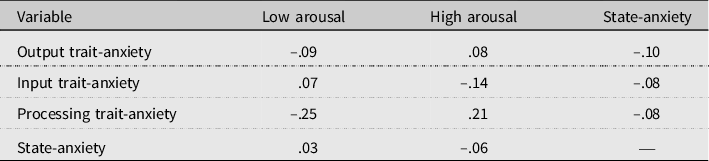
To explore how the occurrence of arousal may be related to anxiety, Pearson correlations (two-tailed) were conducted between the proportion of participants’ high and low arousals (out of all arousals experienced), their trait-anxiety scores (input, output, and processing anxiety), and their self-ratings of state-anxiety (see Table 4). First, the associations between state and trait measures of anxiety were below the field-specific threshold (.25) for a weak relationship (Plonsky & Oswald, Reference Plonsky and Oswald2014), which suggested that (at least in this data set) the two sets of measures tapped into distinct aspects of anxiety. Second, the associations between the anxiety measures and the occurrence of high and low arousals were also weak to nonexistent (Plonsky & Oswald, Reference Plonsky and Oswald2014), which implied that the arousals may have occurred due to participants’ specific task and partner experiences rather than because they were generally anxious (trait-anxiety) or perceived themselves as anxious during the task (state-anxiety).
Correlations Between Anxiety Variables and Proportion of Arousals Experienced

Verbal features of autonomic arousal
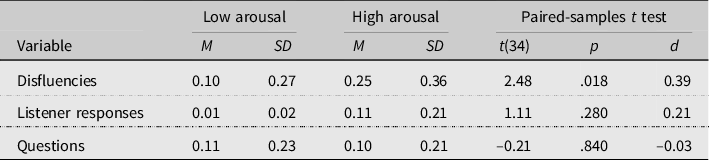
To answer the first research question focusing on the verbal features that occur when L2 speakers experience high versus low arousal episodes in interaction, the instances of three verbal features were compared between high and low arousals to see if an affective response may be related to either language issues (e.g., disfluent speech), asking or receiving a question, or having an interlocutor who is an active listener giving verbal feedback. Communication breakdowns were ultimately removed from the analyses as they occurred for only seven of the 60 participants, making the data set too small to examine how communication breakdowns related to arousal. Although pairwise comparisons (Bonferroni corrected α = .017) yielded no significant differences for any of the verbal features (see Table 5), there was a trend for speech disfluencies (e.g., filled and unfilled pauses, repairs, and repetitions) to occur more often during high arousals (one instance every four arousals) compared to low arousals (one instance every 10 arousals). Therefore, none of the coded verbal variables seemed to distinguish high versus low arousals.
Verbal Features of High Versus Low Arousal

Note. Comparisons based on 35 participants that experienced both low and high arousal.
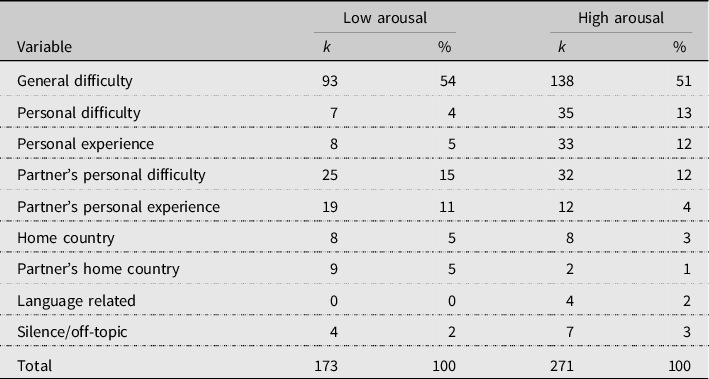
In terms of possible relationships between participants’ psychophysiological responses and the conversational content, as shown in Table 6, the majority of both high and low arousals happened while participants discussed difficulties experienced by international students and provided possible solutions to these difficulties, which was content directly related to the task goal. More noteworthy, however, was that a greater proportion of the high arousals occurred when participants spoke about their personal difficulties (13% vs. 4% of high and low arousals, respectively) or personal experiences (12% vs. 5% of high and low arousals, respectively). On the other hand, a larger proportion of the low arousals co-occurred with the speakers’ partners describing their personal experiences (4% vs. 11% of high and low arousals, respectively).
Proportions of Topics (k Instances) Discussed During High Versus Low Arousal

Nonverbal features of autonomic arousal
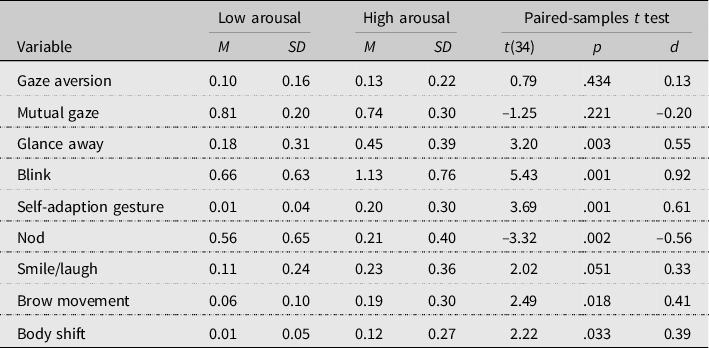
The second research question focused on the nonverbal features that occur when L2 speakers experience high versus low arousal episodes in interaction. First, we compared the occurrences of the nine nonverbal features between high and low arousal episodes on the assumption that any variables that occurred significantly more frequently during high versus low arousals could be behavioral manifestations of a given affective response. As summarized in Table 7, paired-samples t tests (Bonferroni corrected α = .006) revealed that four nonverbal features differed significantly in their occurrence between high and low arousal episodes. More specifically, participants glanced away, blinked, and used self-adaption gestures more frequently when they were experiencing high arousal but nodded more often during episodes of low arousal, all with small-to-medium effect sizes (Plonsky & Oswald, Reference Plonsky and Oswald2014). In relative terms, participants were 2.5 times more likely to glance away, 1.7 times more likely to blink, and 20 times more likely to use self-adaption gestures during high than low arousals, but they were 2.7 times more likely to nod when experiencing low than high arousals.
Nonverbal Features of High Versus Low Arousal

Note. Comparisons based on 35 participants that experienced both low and high arousal.
Discussion
The goal of this study was to investigate L2 anxiety from a dynamic perspective, examining L2 speakers’ physiological responses in relation to various verbal and nonverbal features of interaction. From a dynamic systems perspective (e.g., de Bot et al., Reference de Bot, Lowie and Verspoor2007), the complexity of L2 speakers’ emotions requires a moment-by-moment approach in investigating speaker affect due to the interconnectedness of the variables involved in L2 communicative events and the potential for their influence on each other to change even over short periods of time. Our results therefore highlight how a speaker’s cognition and emotion, an interlocutor’s contributions, and nonverbal behavior are intertwined as part of a complex system (i.e., L2 peer interaction). In terms of the verbal features co-occurring with arousal, none of the coded variables appeared to distinguish between the episodes of high versus low arousal experienced by L2 speakers, although high arousals tended to occur when L2 speakers discussed their personal difficulties and personal experiences, while low arousals tended to coincide with the speakers’ partner discussing their own difficulties and experiences. However, high arousals appeared to be distinguished from low arousals through nonverbal behaviors, with more frequent glancing away, blinking, and self-adaption gestures associated with high arousal episodes and more frequent nodding linked to low arousal episodes.
Nonverbal indicators of autonomic arousal
In this data set, episodes of high versus low arousal were distinguished through L2 speakers’ nonverbal behaviors, such that glancing away, blinking, and self-adaption gestures (e.g., scratching one’s face, hair twisting) were indicative of high arousal while frequent nodding coincided with low arousal. Regarding eye gaze behaviors, even though glancing away (breaking eye contact) was linked to autonomic arousal, gaze aversion (absence of any eye contact), and mutual gaze (consistent eye contact between interlocutors) did not differ between levels of autonomic response. It may therefore be that a physiological response is associated with the action of breaking eye contact rather than with its presence or absence. Assuming that maintaining eye contact indicates a nonverbal attempt for a speaker to reinforce the interaction with their interlocutor (Richmond & McCroskey, Reference Richmond and McCroskey2004), it could be that the more anxious L2 speakers, who were perhaps more reticent, glanced away more frequently to avoid engaging in prolonged eye contact. This behavior aligns with that of Gregersen’s (Reference Gregersen2005) high-anxious L2 learners who maintained less direct eye contact with their teacher during an oral exam.
Glancing away could also be attributed to cognitive processing, as both speakers and listeners tend to look away when attempting to process complex information (Knapp & Hall, Reference Knapp and Hall2001). Consistent with this explanation, blinking was also increased during high arousals, which is typically a behavior associated with a higher cognitive load, thinking, and internal attention situations, such as when completing mental tasks (Eckstein et al., Reference Eckstein, Guerra-Carrillo, Miller Singley and Bunge2017; Karson et al., Reference Karson, Berman, Donnelly, Mendelson, Kleinman and Wyatt1981) and when responding to questions (Hirokawa et al., Reference Hirokawa, Yagi and Miyata2004). As increased arousal also tends to be associated with an increase in cognitive load (e.g., MacPherson et al., Reference MacPherson, Abur and Stepp2017), a higher blink rate may be the involuntary behavior that manifests along with an emotional response due to more complex cognitive processing and speakers shifting their attention inward when speaking and formulating their thoughts. Alternatively, blinking may have been a reflex to anxiety-evoking stimuli, as blink rate also tends to increase while in an anxious state or under stress conditions (Giannakakis et al., Reference Giannakakis, Pediaditis, Manousos, Kazantzaki, Chiarugi, Simos, Marias and Tsiknakis2017; Harrigan & O’Connell, Reference Harrigan and O’Connell1996). The present finding therefore contributes to previous work which lacked physiological measures but nonetheless used blinking as an index to measure interpersonal stress (e.g., Hirokawa et al., Reference Hirokawa, Yamada, Dohi and Miyata2001).
Categorized as unintentional body movements (Ekman & Friesen, Reference Ekman and Friesen1969) that tend to be responses to stress or negative feelings about oneself or others (Gregersen, Reference Gregersen2009), self-adaption gestures occurred significantly more frequently during high arousals compared to low arousals. This result aligns well with prior findings showing the occurrence of self-adaption behaviors among high-anxious L2 learners (Gregersen, Reference Gregersen2005). Based on Harrigan’s (Reference Harrigan1985) findings that speakers tend to engage in self-adaption gestures just seconds before or after an utterance, it is also possible that this nonverbal behavior may reflect psycholinguistic processes, such that the accompanying physiological response may have occurred due to anxiety associated with language processing (before an utterance) or the speech content (after an utterance).
On the other hand, facial expressions, such as smiling and brow movement, were not found to be representative of high arousal, and both rarely occurred (only about once every five high arousal episodes). It is not surprising that a high affective response did not appear to be marked by facial cues considering that high-anxious L2 learners are less likely to use facial expressions compared to low-anxious learners (Gregersen, Reference Gregersen2005) and that anxious speakers generally display rigid communicative behavior (Buck, Reference Buck1984). Although body shifts tended to occur more often during high arousals, this nonverbal behavior did not distinguish reliably between low and high arousals, likely because this broad category encompassed movements associated with negative affect, such as leaning back (Burgoon & Koper, Reference Burgoon and Koper1984), readjusting posture, and restlessness (Ekman & Friesen, Reference Ekman and Friesen1974), along with other movements associated with positive affect, such as leaning forward (Harmon-Jones et al., Reference Harmon-Jones, Gable and Price2011; Miragall et al., Reference Miragall, Vara, Cebolla, Etchemendy and Baños2019), and more generally with nonanxious states (Gregersen, Reference Gregersen2007). Finally, our finding that head nods occurred significantly more frequently during low arousals (about one every other episode) than high arousals (about one every five episodes) is consistent with previous work suggesting that nonanxious learners tend to use more head nods than anxious learners (Gregersen, Reference Gregersen2005). Thus, head nods might be a particularly useful indicator that those displaying this type of behavior during interaction are likely not experiencing negative affect or struggling with communication reticence.
Verbal and content indicators of autonomic arousal
Unlike the visual behaviors, verbal features appeared to be distributed similarly across high and low arousal levels, but there was a trend for high arousals to occur more frequently during speech disfluencies (i.e., unfilled and filled pauses, repetitions, repairs). It is widely acknowledged that individuals generally have more difficulties with language production when feeling negative emotions, such that more anxious students tend to exhibit poorer output quality (MacIntyre & Gardner, Reference MacIntyre and Gardner1994; MacIntyre et al., Reference MacIntyre, Noels and Clément1997). The trend highlighted in our results points to the possibility of negative affect being associated with speech fluency through increased physiological arousal, similar to how high arousal could impair cognitive task performance (Anderson, Reference Anderson1994). Just as certain nonverbal behaviors (blinking, glancing away, self-adaption gestures) reflected a possible relationship between physiological arousal and cognitive processing, participants’ increased disfluencies may have emerged as verbal indicators of high arousal impairing cognitive and language functions (Burbridge et al., Reference Burbridge, Larsen and Barch2005).
Although none of the verbal features in our study distinguished high arousals from low arousals, high arousals occurred more often when speaking compared to listening (56% speaking, 44% listening), but low arousals occurred more frequently while listening (35% speaking, 65% listening). This suggests that different conversational roles and different levels of interactional engagement may in fact contribute to physiological arousal, but it remains for future research to explore further which aspects of speech production and comprehension may be associated with a speaker’s emotional response. Furthermore, although listener responses (backchannels, noncorrective repetitions, emotional reactions) may lead to negative perceptions during interaction if speakers misunderstand the intention of such listener contributions (Cutrone, Reference Cutrone2005), there was no evidence in this data set that listener responses were associated with certain levels of a speaker’s arousal. Perhaps listener responses were positively received by the speakers and therefore played no role in their affective reaction, particularly because all interactions were nonconfrontational and collaborative.
In terms of the speech content associated with high versus low autonomic arousal, apart from conversations directly related to the task goal, the speakers tended to experience more high arousals while sharing a personal story (positive or negative). On the other hand, low arousals occurred more commonly while the speakers’ partner was sharing a personal experience (positive or negative). In other words, the speakers tended to have a high affective response while recounting stories about themselves but felt calmer when listening to their partner share their experiences or challenges. Although existing findings are mixed, positive emotions can reflect autonomic nervous system activity (Kreibig, Reference Kreibig2010), so the high arousal experienced by the speakers could have been a response to feelings of happiness, amusement, or pride when describing their positive experiences. Experiencing high arousal while discussing personal difficulties also aligns with prior research showing a higher frequency of skin conductance responses while discussing affectively negative topics (Burbridge et al., Reference Burbridge, Larsen and Barch2005). It is likely that the speakers were simply more anxious when sharing stories about themselves with an interlocutor whom they had never met before, given that speaker familiarity with interlocutors can lead to fluctuations in anxiety (Shirvan & Talebzadeh, Reference Shirvan and Talebzadeh2017).
Alternatively, the emotionality of the content discussed may have contributed to high arousal, especially because higher levels of skin conductance have been shown to be associated with receiving empathetic, emotional responses from listeners compared to inattentive behavior (Finset et al., Reference Finset, Stensrud, Holt, Verheul and Bensing2011). Therefore, the speakers’ partner may have remained attentive and expressed statements of empathy in return, triggering a high affective response for the speaker, just as the empathetic remarks from the interlocutor in the Finset et al. study (Reference Finset, Stensrud, Holt, Verheul and Bensing2011) reinforced the speakers’ distress related to their own emotionally charged experience. While receiving empathy may trigger a high affective response for the speaker, feeling empathy toward others may have the opposite effect, which could explain why low arousals were more common while listening to others’ personal stories. Indeed, identification (which involves acknowledging someone else’s emotion and adopting it as one’s own) appears to be a defense mechanism to stress associated with lower skin conductance levels (Cramer, Reference Cramer2003). Because all speakers could relate to the discussion topic (challenges experienced by students arriving in a new context), they could identify with the experience described by their partner and empathize with any emotions conveyed through the story, which was then reflected through their low arousal.
Limitations and future work
Although promising, the findings of this study have several limitations. A major limitation pertains to our use of sensor-specific skin conductance levels to capture autonomic arousal, which implies that verbal and nonverbal indicators of a speaker’s affective response are particular to the relative differences between high versus low autonomic arousal and are specific to the skin conductance sensor used. Similarly, we only examined the two extreme levels of arousals, disregarding intermediate values. For instance, it could be that some behaviors may not have been coded because they did not co-occur with the highest level of arousal, but they may still have been present as a reaction to an intermediate-level arousal. In addition, although it was not necessary for our current comparison of skin conductance responses associated with high and low autonomic arousal, we did not have a baseline measurement of skin conductance. To determine how speakers’ skin conductance levels change over time in response to particular stimuli, future studies should include a baseline measurement. Therefore, researchers should consider taking a finer-grained approach to include moderate levels of arousal or should instead compare arousal levels across resting and target conditions as a way of including baseline data and increasing the range of affective states investigated. Finally, future work should examine the extent to which experimental lab settings, where speaker interaction is monitored through video recording, eye-tracking, and skin conductance measurement, potentially contribute to additional anxiety experienced by speakers, compared to communication in less controlled contexts.
The current exploratory study offers several avenues for future work using skin conductance measures to capture L2 speakers’ affective responses dynamically in relation to various speaker and task dimensions. For example, by taking a more controlled, within-group experimental approach, future studies could compare L2 speakers’ skin conductance across different conditions, such as in response to different corrective feedback types, when discussing various content in different tasks, or when conversing in different languages, to determine whether and to what extent speakers’ affective states predict their performance. In addition, skin conductance measures offer L2 research guided by the dynamic systems theory (e.g., de Bot et al., Reference de Bot, Lowie and Verspoor2007) to explore how interrelated variables (e.g., affect, speech input and output, nonverbal behavior) and their influence on each other change over time within a complex system (e.g., L2 peer interaction). To extend work on nonverbal behaviors, future research could also study specific body, facial, or gestural indicators of affective states. For instance, closed and tense body posture, crossed arms, and leaning away tend to indicate anxiety (Burgoon & Koper, Reference Burgoon and Koper1984), while leaning forward and maintaining a relaxed and open posture characterize nonanxious individuals (Gregersen, Reference Gregersen2007). Although a given nonverbal behavior might not convey “a specific message outside of the restrictive environs of the context or culture in which it occurs” (Gregersen, Reference Gregersen2005, p. 394) in this study, high arousal behaviors (blinking, glancing away, self-adaption gestures) and low arousal behaviors (nodding) occurred among L2 speakers from various language backgrounds. The extent to which such nonverbal markers of arousal are universal must be examined in future work.
Finally, future work should examine the relationship between autonomic arousal and trait- and state-anxiety (Gregersen et al., Reference Gregersen, MacIntyre and Meza2014; Sevinç, Reference Sevinç2018; Witt et al., Reference Witt, Brown, Roberts, Weisel, Sawyer and Behnke2006). Although no such relationship emerged in the present data set, this does not necessarily mean that high arousal was not an indicator of underlying feelings of anxiousness or negative affect during the speaking task, as autonomic arousal does not always correspond to one’s subjective experience (Gross, Reference Gross1998), especially when it is a retrospective judgment. For instance, the speakers’ arousal and possible feelings of anxiousness could have been related to their task-specific experiences, such as from negative perceptions of their speech during the task (Gregersen & Horwitz, Reference Gregersen and Horwitz2002; Szyszka, Reference Szyszka2011), or linked to partner-specific experiences, such as from impressions of their partner’s language competence (Heng et al., Reference Heng, Abdullah and Yusof2012). Thus, in future research, it would be important to focus on speakers’ interpretation of their affective states (e.g., through interviews or retrospective recall procedures) to understand how autonomic arousal during interaction is associated with various affective states (in terms of state-anxiety) and how this association might differ across various speakers and listeners (in terms of trait-anxiety).
Conclusion
Motivated by work on language anxiety (Gregersen, Reference Gregersen2005; MacIntyre & Gardner, Reference MacIntyre and Gardner1989; Szyszka, Reference Szyszka2011), this study extended prior research by investigating L2 speakers’ emotional responses during interaction in real time using sensors to record skin conductance, which is an established physiological index of anxiety. The goal of this dynamic approach was to draw connections between autonomic arousal and verbal and nonverbal behaviors shown by L2 speakers in interaction and to explore how arousal may be associated with self-reported anxiety. The main findings showed that high arousals were characterized by significantly more blinks, glances away, and self-adaption gestures, with a trend for more speech disfluencies, while low arousals involved more nodding. Our findings contribute to discussions of how emotions can interact with cognitive processing, such that negative affect may induce a stress response leading to changes in arousal, which in turn may affect language and cognitive functions (Burbridge et al., Reference Burbridge, Larsen and Barch2005). In terms of practical considerations, our findings provide implications for both L2 educators and learners by raising their awareness of nonverbal indicators of language anxiety expressed by L2 speakers. If teachers or learners are able to recognize that their interlocutor is blinking excessively, breaking eye-contact continuously, or repeatedly touching their face or hair during interaction, steps can be taken immediately to address the possible source of this reaction (e.g., by speaking more slowly, changing the topic of discussion, providing encouragement, etc.). In addition, as our results descriptively support prior research suggesting that high arousals are more likely to occur when discussing negatively valenced topics (Burbridge et al., Reference Burbridge, Larsen and Barch2005), educators may wish to provide appropriate scaffolding, coping, or exit strategies for learners engaged in interactive tasks that prompt conversations about personal challenges or difficulties. We call for further examination of possible triggers of arousal and its behavioral manifestations, which would be important for educators who seek pedagogical strategies to reduce L2 speakers’ negative affect as a way of building their confidence and supporting their L2 development.
Acknowledgments
We would like to thank the members of our research group (Tzu-Hua Chen, Chen Liu, Oguzhan Tekin, Aki Tsunemoto, and Pakize Uludag) for their valuable insights and help with data collection.
Competing interests
The authors declare none.
Funding statement
This research was supported by a Social Sciences and Humanities Research Council of Canada (SSHRC) grant awarded to the second and third authors (435-2019-0754).