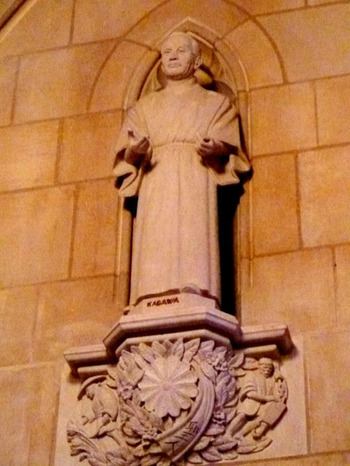
Along the North Outer Aisle of the nave of the Washington National Cathedral in the District of Columbia are a series of niche statues of personages from world history. Illuminated by sunlight from the nearby stained-glass windows, the corridor is adorned with stone sculptures of iconic figures such as St. Augustine, Albert Schweitzer, and Martin Luther King Jr. Among such exalted company stands a man who, today, is less well-known. Clad in kimono-like garb and perched atop a corbel featuring a chrysanthemum, the likenesses of a peasant and a worker, and the characters for saint (seijin), is the Japanese Christian leader Kagawa Toyohiko (1888–1960) (Fig. 1).Footnote 1
Kagawa Statue in the Washington National Cathedral.
Photographed by the author in 2014.

Kagawa's statue is unique and worthy of study for several reasons. First, despite a recent spate of interest in Kagawa from scholars of American history and Christianity, the very existence of his statue in the Washington National Cathedral is largely unknown to the public.Footnote 2 Second, for all the Cathedral's multicultural and interfaith credentials, Kagawa's statue represents the only such depiction of an East Asian Christian figure inside its walls. This begs the question: how did this man from Japan come to occupy a place of such honor inside the Cathedral—a sacred site of considerable religious, not to mention political, significance in the heart of the American capital? Third, the statue is more complicated than what initially meets the eye. Instead of being an object of straightforward commemoration, Kagawa's statue was the product of a specific moment in the history of U.S.-Japan relations and global Christianity, providing valuable insight into the rise and fall of Christian internationalism in the twentieth century.
By unpacking the complex history behind the construction of his statue in the 1970s, I will argue that Kagawa's depiction in the Washington National Cathedral as a symbol of Japanese Christianity—as opposed to a universal Christianity—reflected a broader shift away from the Christian internationalism of the interwar period to a more nationalistic form of Christianity that emerged during the Cold War era. In making this argument, I rely primarily upon a group of records in the Cathedral archives which document the behind-the-scenes tensions involved in preparing a statue design of Kagawa. Although the statue was originally proposed by a retired U.S. Navy rear admiral following a monetary donation in 1969, deciding on the physical characteristics of the Japanese Christian leader proved to be a contentious undertaking. What at first seemed like a simple request soon turned into a prolonged debate between donor and sculptor over the statue's iconography, style of dress, and its symbolic meaning. Disagreements over the statuary representation of Kagawa, who had already passed away a decade earlier in 1960, revealed not only the contested nature of his image but also a broader decline in influence of the Christian internationalism he had once represented.
In using the term “Christian internationalism,” I follow the definition proposed by Michael G. Thompson, who locates its origins in the post-World War I proliferation of a host of new technologies and enterprises devoted to producing Christian reflection on the ethics of international relations—such as world conferences, traveling seminars, print and periodical culture, and ecumenical study commissions.Footnote 3 This was a missionary-based movement that distinguished itself from the legal and institutional focus of mainstream liberal internationalism as inspired by Woodrow Wilson's Fourteen Points. In fact, Christian internationalism was but one of multiple competing visions of the world during the interwar period—Wilsonian, socialist, feminist, Pan-Asian, Pan-Islamic, and so on—which, to varying degrees, sought to create regional or international order based on a shared ideological perspective.Footnote 4
In addressing this crowded marketplace of ideas, Christian internationalists combined the hard-earned lessons of World War I with their intimate knowledge of the non-Western world as acquired through their missionary sojourns, prompting them to engage in a self-conscious critique of the ways in which Protestant foreign missions had abetted the forces of Western imperialism in the past. By rectifying the institutional biases of the traditional missionary enterprise, Christian internationalists vowed to bring about a multicultural Christianity that would transcend national and racial differences and serve as the basis for a more peaceful world. As with many of the other internationalisms already mentioned, however, such a grandiose vision had its limits, and many of its goals remained purely aspirational rather than realized.Footnote 5
Although the movement underwent a significant decline during World War II and the Cold War years, the history of Christian internationalism is one that deserves greater attention by scholars. This is not only because it adds to our understanding of the diverse range of ideas that flourished in the interwar period but also because of the sheer power and influence Christian internationalism had during its heyday. Through their extensive financial and institutional resources, interwar missionary internationalists were able to create a vast, transnationally organized sphere of religious and intellectual discourse that enabled the imagination of boldly conceived solutions to global problems such as war, racism, and economic depression. Stationed at the forefront of political hotspots around the world, moreover, many missionaries were avid contributors to U.S. foreign policy debates at a time when most Americans preferred to withdraw into isolationism. Perhaps most remarkable of all was the fact that the person most prominently featured in such discussions—the figure seen to most effectively embody the movement's emerging priorities—was a Japanese Christian by the name of Kagawa.
I. Kagawa and the Toppings: A Transpacific Partnership
Prior to addressing the question of the Cathedral statue, it is necessary to discuss Kagawa's rise as an internationally renowned Christian figure—the result of a mythmaking process that evolved in close association with American missionary activity.Footnote 6 Protestant foreign missions became a major player in pursuing the cause of internationalism and world friendship after World War I.Footnote 7 This was a movement led by liberal Protestant laymen from America, such as the World YMCA leaders John R. Mott (1865–1955) and Sherwood Eddy (1871–1963), who saw as their mission the social transformation of non-Western societies through Christian evangelization. Influenced by the principles of the social gospel and increasingly skeptical of the assumed superiority of Western civilization, missionary internationalists such as Mott and Eddy stressed the social dimension of their evangelistic work—foregoing the traditional focus on individual conversion—and proclaimed the need for Western Christians to engage those from other nations on the terms of cultural equality.Footnote 8
It was precisely at this critical juncture that Kagawa began to attract the attention of a wide domestic and overseas audience. Born in 1888 to a merchant household in Kobe, Kagawa first encountered Christianity as a teenager when he happened upon a bible school run by a pair of American Southern Presbyterian missionaries in rural Tokushima. After being baptized at the age of sixteen, he contracted a near-fatal case of tuberculosis during which he experienced a revelatory vision of God. Having narrowly escaped death, he emerged into the public consciousness for his 1909 decision to move into the impoverished Shinkawa neighborhood of Kobe and dedicate his life to serving the poor. Kagawa's decade-long residency in the slums—not including a three-year period (1914–1917) of study abroad in the United States at Princeton Theological Seminary—served as the inspiration for a semi-autobiographical novel that became one of the bestselling books of Taishō-era Japan (1912–1926) and was his major claim to fame.Footnote 9 Although an English translation of this book would be published in 1924, the story of his slum ministry was already well known in missionary circles even before then, as could be seen from the accounts of American missionaries who made a point of visiting Kagawa during their tours of East Asia.Footnote 10 For example Sherwood Eddy, a fellow Princeton graduate, spent a day in Kobe with the Japanese Christian leader in 1922. During his stay Eddy visited, among other places, the “little church where [Kagawa] conduct[ed] services for the laborers who ha[d] to go to work before six o'clock in the morning,” an experience which impressed Eddy enough to make the following statement: “He [Kagawa] is the Saint Francis of the poor, the Gandhi of the labor movement of Japan. . .Like the title of his book, he is living ‘Beyond the Death Line.’ But he walks unafraid, the friend of little children, the benefactor of the poor, the guide of labor, the arousing conscience of the church.”Footnote 11
While Eddy was among the earliest American missionaries to sing Kagawa's praises to an international audience, the missionary partners who would go on to exercise the greatest influence over Kagawa's overseas image were the Topping family. Originally hailing from Wisconsin, Henry (1857–1942) and Genevieve Faville Topping (1863–1953) responded to a call from the Baptist Board of Foreign Missions to help set up a boys’ mission school in Tokyo.Footnote 12 After arriving in Japan in 1895, Henry became head administrator at the Tokyo Baptist Academy, while Genevieve took charge of the Baptist mission kindergarten and also set up an institution for the training of kindergarten instructors, leading her to acquire the nickname, “Mother Topping.”Footnote 13 Although the Toppings knew of Kagawa through their shared social concerns and networks in Japan, it was not until the 1920s that their paths would cross in a meaningful way.
Kagawa's decision to hire Henry and Mother Topping's daughter, Helen Faville Topping (1889–1981), as his English-language secretary solidified the lifelong transpacific partnership that would underpin his career.Footnote 14 Helen, who divided her time growing up between America and Japan, served as a field worker for the Pacific Coast YWCA after college and became the founding general secretary of the Kobe YWCA in the early 1920s. This was a fraught period in U.S.-Japan relations due to America's increasingly exclusionist immigration policies, as exemplified by the passage of the 1924 Immigration Act (also known as the National Origins Act or the Johnson-Reed Act). Offended by the discriminatory nature of the law—which, among other things, effectively banned Japanese immigration to the United States—American YMCA leaders invited Kagawa to be the guest of honor at a student conference in Asilomar, California, in late 1924. Kagawa's stateside visit was especially welcomed by local Japanese American Christians, who hosted him in their churches and founded, in his honor, “Friends of Jesus” prayer groups, named after the fellowship group of the same name that had been established by Kagawa's followers in Japan.Footnote 15 In early 1925, following his attendance at the YMCA conference in Asilomar and the Foreign Mission Convention in Washington, D.C., Kagawa met with Helen Topping, who was pursuing a master's degree at Teachers College in New York, to ask if she would like to come work for him full time.Footnote 16 Helen, while delighted at the opportunity, first needed to secure a sponsor who could help fund her appointment.
Helen's wish was ultimately granted through the help of a group of American missionaries and mission-related individuals dedicated solely to the purpose of supporting Kagawa's work. Two years after Kagawa's visit, a group of his supporters in northern California founded the Kagawa Cooperators in Berkeley, with the Disciples of Christ missionary Harvey Guy (1870–1936) as chairman and the scholar of Asian religions Kenneth Saunders (1883–1937) as vice chairman.Footnote 17 The organization, whose membership consisted mainly of ex-missionaries and American church leaders closely tied to the Protestant missionary network, grew over the next few years to include branches in Toronto, New York, and Los Angeles.Footnote 18 Through their independent fundraising efforts, which operated outside the framework of existing denominational mission boards, the Kagawa Cooperators supported Kagawa's various social projects—which at this point had grown to include consumers’ cooperatives, settlement houses, medical clinics, credit unions, and farmers’ unions—and made possible Helen's appointment as Kagawa's secretary in 1927. Helen thus came to occupy a unique role: a missionary child who, instead of receiving an assignment from a denominational board, received a salary financed exclusively by a group of American volunteers (the Kagawa Cooperators) to work for an indigenous Christian leader in Japan. At a welcome party held for Helen in Yokohama, Kagawa expressed his hopes for the new partnership, calling on his fellow workers to “pray and work together” in order to realize what he termed “Christian universalism” (Kirisutokyō bankoku shugi).Footnote 19 He also insisted that the Japanese workers treat Helen “not simply as a guest from America. . .but as a like-minded co-worker with whom we share a common bond,” thereby underscoring the inclusionary spirit of his cosmopolitan vision.Footnote 20
II. Internationalist Hero of the Interwar Period
As Kagawa's chief missionary collaborators, the Toppings utilized the latest technologies of evangelism to promote him as an exemplar of international Christianity to a global audience. Soon after her appointment in 1927, Helen began to publish an English-language journal called Friends of Jesus. The publication featured excerpts from Kagawa's speeches and writings, as well as articles by Western church leaders and theologians advocating an internationalist perspective. One article in 1931, for example, cast a critical eye over the traditional missionary paradigm while heralding the dawn of a new era of international cooperation, freed from the shackles of the “White Man's Burden” and the overbearing “manifest destiny” of the “Anglo-Saxon civilization.”Footnote 21 Producing the journal solely out of her office in Tokyo, Helen enlisted the help of international distributors—missionary-affiliated individuals as well as organizations in over ten different countries—to provide interested readers around the world with copies of current and back issues.Footnote 22
At around this time, the elderly Topping couple came out of retirement to join their daughter in helping Kagawa on a voluntary basis.Footnote 23 Despite already being in their seventies, Henry and Mother Topping worked vigorously to publicize Kagawa's work. Thanks to their efforts, a large number of Kagawa's religious writings were translated and published for the English-speaking world for the first time.Footnote 24 Glowing tributes from the wider missionary world accompanied the publications, lending an air of authority and importance to the works. The prominent Quaker theologian and educator Rufus Jones (1863–1948), for example, stated in his foreword to Love, the Law of Life, “Kagawa is one of the striking phenomena of the Christian world today. . .He is showing, once more, that Christianity is not talk, it is action; it is not words, it is power.”Footnote 25 For the poetry collection Songs from the Slums, Sherwood Eddy contributed the following: “With Kagawa's faith and love we are able constantly to lift our eyes above the sordid slums of man to the shining stars of God.”Footnote 26 Kenneth Saunders, who had become chairman of the Kagawa Cooperators in Berkeley, penned an introduction to New Life through God, wherein he declared Kagawa “an apostle for these complex and difficult times.”Footnote 27 Furthermore, Allan A. Hunter, pastor of the Mount Hollywood Congregational Church in Los Angeles—which occasionally hosted Friends of Jesus communion services—wrote a series of articles which were used as publicity material by the local Japanese American press during Kagawa's 1931 visit to the United States.Footnote 28
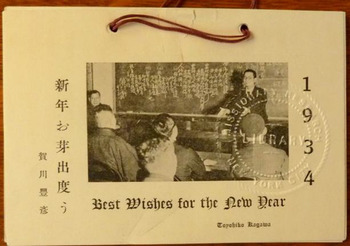
Mother Topping played an especially crucial role in Kagawa's image construction as the creator of the Kagawa Calendar, an annual English language flip-through calendar that fostered a community of readers invested in Kagawa's work (Fig. 2). Begun in 1934—two years after the publication of fellow Baptist missionary William Axling's (1873–1963) influential biography of Kagawa—the Calendar uses quotes, descriptions, and images of everyday scenes from Kagawa's life to evoke a sense of familiarity with the Japanese Christian leader.Footnote 29 The cover of the 1934 edition, for example, shows Kagawa in front of a blackboard addressing a class of attentive Japanese students. In addition to promoting Kagawa's religious and social teachings, the Calendar also served as a fundraising tool, with all proceeds going toward the support of his social projects in Japan. Its easily accessible nature and practical calendrical format, moreover, made it highly popular among followers around the world, with the Toppings needing to print 30,000 copies annually by the mid-1930s to meet the demand.Footnote 30 Combined with the frequent coverage Kagawa received in mainline Protestant periodicals by the likes of Thoburn Taylor Brumbaugh (1896–1974), a former Methodist missionary to Japan and the Tokyo correspondent for The Christian Century, the various Kagawa-related publications came together to create the image of a respected leader who epitomized the Christian internationalist ideal.Footnote 31
1934 Kagawa Calendar.
Kagawa Papers (MRL 7), Series 1, Box 1, Folder 3, The Burke Library at Union Theological Seminary.

Such publicity helped make Kagawa's 1936 U.S. tour a major success. Nominally organized by an independent committee headed by J. Henry Carpenter of the Brooklyn Federation of Churches, the visit was jointly sponsored by the Federal Council of the Churches of Christ (FCC) and the Cooperative League of the United States of America (CLUSA).Footnote 32 The Kagawa Cooperators of Southern California, headed by Allan Hunter, organized church fundraisers in support of Kagawa's tour.Footnote 33 The FCC also prominently advertised the tour in its printed materials and coordinated with local interdenominational councils to sponsor visits throughout the country.Footnote 34 Through such efforts, Kagawa's visit became a highly anticipated event. In July 1935, for example, University of Texas president H.Y. Benedict sent a personal invitation to Kagawa via Helen Topping, who was in charge of coordinating the itinerary, to make an appearance at Austin during his upcoming tour. Benedict stated that his university community had “expressed a keen interest in the work of Dr. Kagawa for world peace, and particularly in his work with cooperatives.”Footnote 35
Kagawa's pacifism and economic program became the centerpiece of his whirlwind tour, which lasted for six months in the first half of 1936. After being quarantined in San Francisco upon his arrival because of an eye disease he had picked up during his slum residency, Kagawa was granted entry through the direct intervention of U.S. President Franklin D. Roosevelt (1882–1945), and began his lecture circuit in Phoenix, Arizona.Footnote 36 Many people around the country who were suffering from the effects of the Great Depression eagerly listened to Kagawa's message of religiously-based economic cooperation. Ultimately, he would end up making hundreds of appearances before an aggregate total of 750,000 people in 150 different cities in the U.S. and Canada, ending with a June 30, 1936, radio broadcast on the NBC network.Footnote 37
The biggest highlight of Kagawa's celebrated tour came during his visit to the Colgate-Rochester Divinity School in upstate New York, from April 11 to 18. It was here that he was invited to give the prestigious Rauschenbusch Lectures—named after the Baptist theologian and social gospel leader Walter Rauschenbusch (1861–1918). As such, it was a fitting platform for Kagawa to draw attention to the spiritual and practical aspects of his teachings. The connection between the spirit of sacrifice as personified by Jesus Christ, and the spirit of social solidarity as exemplified by the cooperative system of democratic and mutual aid, were some of the key themes that were expounded in his lecture series, which was later adapted into a book to great public demand.Footnote 38 Brotherhood Economics, the summation of Kagawa's Rauschenbusch lectures, was subsequently translated into seventeen languages and sold in twenty-five countries.Footnote 39
Kagawa was not without his detractors, however, who sought to discredit the Japanese evangelist by painting him as a left-wing agitator. In contrast to the liberals’ overwhelming support of Kagawa, conservative Protestants actively fought against what they perceived as his radical socialist agenda. For example, Harold Strathearn (1890–1950), executive secretary of the Interstate Evangelistic Association, provocatively claimed, “Kagawa preaches a sinister plan to advocate consumers’ cooperatives and socialism under the cloak of the Christian Church.”Footnote 40 Strathearn enlisted the help of J. Frank Norris (1877–1952), a fundamentalist Baptist minister from Fort Worth who was known by his nickname “Two Gun Norris.” In order to obstruct Kagawa's itinerary, Norris went to the trouble of staging competing events at the same time as Kagawa's Rauschenbusch Lectures in Rochester, and published a tract accusing him of attempting to “Sovietize” America.Footnote 41 Although they were relatively few in number compared to his supporters and many of their claims misguided—as in the case of the erroneous accusation that Kagawa was in favor of Soviet-style communism—such opposition demonstrated that not everyone was in agreement with the liberal Protestant vision of an emerging world Christianity based on religious and economic cooperation.
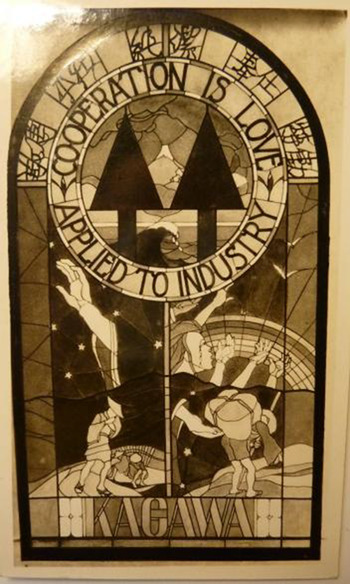
At the same time, some Americans were enthralled by Kagawa's message, as could be seen in the installment of a dedicated stained-glass window in Grant Community Church, Michigan, shortly after his departure (Fig. 3). The Kagawa Memorial Window, unveiled in December 1936, was installed as the first in a series of seven to pay tribute to “modern major prophets.”Footnote 42 The window design, which was inspired by Julian Brazelton's illustrations in Songs from the Slums, featured the phrase, “Cooperation is love applied to industry,” the letters, “KAGAWA,” and the Japanese characters for the five tenets of the Friends of Jesus: devotion (keiken), peace (heiwa), purity (junketsu), service (hōshi), and labor (rōdō).Footnote 43 The memorial window visually and symbolically encapsulated the sanctification of Kagawa as a modern-day saint and internationalist icon among his most ardent American supporters.
Kagawa-themed stained-glass window at Grant Community Church, Michigan.
Kagawa Papers (MRL 7), Series 1, Box 3, Folder 3, The Burke Library at Union Theological Seminary.

Outside of missionary circles, Kagawa's reputation captured the attention of radical Christian pacifists associated with the Fellowship of Reconciliation (FOR). The FOR was a pacifist organization founded during World War I by the British Quaker and former missionary Henry Hodgkin (1877–1933), and subsequently transplanted to the United States in 1915. Taking inspiration from the same social gospel-influenced liberal Protestantism that became the breeding grounds of Christian internationalism, FOR leaders regarded the problem of violence to be the central issue of the modern world and found early inspiration in the figure of Mohandas K. Gandhi (1869–1948). While Gandhi's espousal of nonviolence as an effective tool of resistance against British colonial rule served as a potent model for pacifists around the world, American FOR members soon began to see Kagawa, who had made headlines for his 1934 public apology to China over Japanese military aggression, as a powerful counterpart to the Indian nationalist leader. For one, both were spiritual leaders from the “mystic East,” an Orientalist notion that played on the idea of Asians as having access to a spirituality that had been lost in the modern West.Footnote 44 Moreover, while both figures paid tribute to the primacy of the example of Jesus Christ—and even seemed to emulate him in their voluntary poverty and sacrificial lifestyle—Kagawa satisfied the criterion of actually being a Christian, with the further advantage of having direct, personal exposure to U.S. audiences (something that Gandhi never enjoyed).Footnote 45
As a result, by the mid-1930s, Kagawa ranked alongside Gandhi and several others held in high esteem by interwar pacifists, in a grouping which Patricia Appelbaum has termed the “heroes of peace.”Footnote 46 In addition to Gandhi and Kagawa, this pacifist hagiography included contemporary FOR-related social activists such as Jane Addams (1860–1935) and Muriel Lester (1883–1968), as well as missionary-doctors and educators such as Albert Schweitzer (1875–1965) and Frank Laubach (1884–1970).Footnote 47 A 1937 practice manual for peace activists, for example, recommended as subjects of discussion a number of historical and contemporary world figures who exemplified the “heroic” ideals of pacifism: Buddha, Laozi, Jesus, Saint Francis of Assisi, John Woolman, William Lloyd Garrison, Leo Tolstoy, Romain Rolland, Jane Addams, Kagawa, and Gandhi.Footnote 48 The manual, written by the Harvard-trained lawyer and leading interpreter of Gandhian nonviolence, Richard Gregg (1885–1974), had been published as a supplement to The Power of Non-violence, a 1935 book that later inspired Martin Luther King Jr. (1929–1968) in his leadership of the civil rights movement. Kagawa's inclusion in this grouping was reinforced by two of his American supporters—Kenneth Saunders of the Kagawa Cooperators in Berkeley, and Allan Hunter of the Kagawa Cooperators in Southern California—who each authored a book that compared Kagawa with Gandhi.Footnote 49 Although Kagawa would go on to have an unexpectedly strained personal encounter with Gandhi in India following his attendance at the 1938 International Missionary Council meeting at Madras, in the eyes of his admirers, he continued to represent a hero who embodied the universal values of peace and internationalism.Footnote 50
By the late 1930s, Kagawa's construction as an internationalist hero was complete. Taking advantage of the extensive global reach of the Protestant missionary network, the Toppings utilized a variety of print media—journals, pamphlets, book translations, and calendars—to disseminate Kagawa's image to a worldwide audience. Crucially, his depiction in these publications was not as an indigenous leader whose main task was the evangelization of Japan but that of a global leader whose teachings had a broad, universal appeal to Christians around the world. While it is true that mission agencies of various stripes upheld Kagawa as a “missionary trophy,” self-interestedly seeking out his endorsement to legitimize the foreign missions enterprise, the core group of Kagawa supporters, as exemplified by the Toppings in Japan and the Kagawa Cooperators in America, strongly believed in the potential of Christianity as a universal religion and viewed Kagawa as the closest living embodiment of that ideal.Footnote 51 Indeed, Kagawa's social reformism and work with economic cooperatives served as a model for how to implement the teachings of the social gospel. His cosmopolitan outlook and opposition to war, moreover, made him an appealing advocate for world peace. Through their voluntary labor and fundraising efforts, American missionary supporters helped construct Kagawa as an exemplary Christian pacifist and internationalist—an image that went beyond the scope of an indigenous leader engaging in cross-cultural friendship and aimed to address a global audience on issues of universal significance.Footnote 52
III. Proposing the Statue at Washington National Cathedral
Compared to the concerted publicity campaign that led to Kagawa's celebration as an internationalist hero in the interwar period, his postwar commemoration in the Washington National Cathedral underwent many difficulties before its completion. The donation for the statue, moreover, originated from an unlikely source: an American war veteran. In 1969, Francis Edward Fleck Jr. (1912–1990), a retired U.S. Navy rear admiral, along with his wife, Isabelle Seltzer Fleck (1915–2006), proposed building a statue of Kagawa in the Cathedral following a monetary donation. Although no specific reason was given for their choice, the Flecks’ interest in Kagawa might have derived from their period of stay in postwar Japan, where Admiral Fleck had helped set up the forerunner of the present-day Japanese Maritime Self-Defense Forces, as part of a U.S. military advisory group under the Allied Occupation (1945–1952).Footnote 53 No records exist which suggest that they ever met the Japanese Christian leader in person. After retiring from the Navy and settling down in Washington D.C., the Flecks became active in the Washington National Cathedral, the local English-Speaking Union, and the Japan-America Society, which eventually led to their donation in 1969—nine years after Kagawa's death.Footnote 54
The Flecks’ proposal was met with enthusiasm from Cathedral officials, who set out to hire a sculptor to create the statue design. On November 21, 1969, Richard T. Feller (1909–2003), the Clerk of the Works who supervised Cathedral construction projects, contacted the Missouri-based sculptor William C. Severson (1924–1999), informing him of the Cathedral Building Committee's offer of a $1000 commission to design and furnish a plaster model of Kagawa that would later be turned into a stone statue.Footnote 55 Feller and Severson had previously worked together on the commission for a statue of Søren Kierkegaard (1813–1855), the Danish philosopher-theologian, in the North Outer Aisle—the same aisle where the Kagawa statue was to be placed. Since “all of these outer aisle figures are ‘non-American,’” Feller noted in his letter, “it has been suggested and we rather feel that [Kagawa's] best representation would be in Japanese dress rather than western clothing, which he undoubtedly wore most of the time.”Footnote 56 In making this suggestion, Feller advanced an argument for the Japanese evangelist's appearance that would later be raised again by the donors—namely that, “without Kagawa being garbed in oriental costume it may be difficult to spot him, or delineate him, from other occidentals.”Footnote 57 This was a reference to the other statues in the aisle, all of whom hailed from Western Christendom: Kierkegaard, Saint Bridget of Sweden, and Saint Augustine of Hippo.
The Kagawa statue proposal sparked a wide-ranging discussion over issues of representation and commemoration, its religious context, and the very identity of the Cathedral itself. Founded in 1893 under a charter passed by the U.S. Congress, the Washington National Cathedral holds a unique place in American religious and political life that distinguishes it from any other church in the country. Although belonging to the Episcopal Church, with strong historic ties to the Church of England, the Cathedral does not cater to any specific denomination and has instead embraced its billing as the “national house of prayer for all people,” regularly welcoming members of other denominations and religions to make use of its worship space over the years.Footnote 58 As the “spiritual home for the nation,” the Cathedral has furthermore served as the venue for many secular, governmental functions over the years, such as the hosting of nearly all U.S. presidential funeral and memorial services since its founding. At the time of the Kagawa statue proposal, the Cathedral was entering a period of major construction inside its nave, entailing the addition of many new sculptural and architectural elements that have since become iconic features of the church.Footnote 59 As such, Kagawa's statue was part of a historic chapter in the Cathedral's development, which was to culminate in a grand dedication ceremony in 1976, in observance of the nation's bicentennial. From the Cathedral's viewpoint, therefore, the statue represented an opportunity to showcase the all-embracing scope of its mission.
For the sculptor, Severson, however, such a vision was not immediately apparent. After doing some research into Kagawa's life following his acceptance of the commission in April 1970, Severson raised the question: “Isn't it a strange anachronism that the Cathedral chooses persons uncomfortable during life within ornate church walls to adorn its walls in stone after death?”Footnote 60 Here, Severson was presumably referring to Kagawa's dislike for ecclesiastical formalities, which Kagawa saw as an impediment to his mission of reaching out to those in society most in need of help. In response, Feller stated that it was the Cathedral's policy to honor not just bishops and church prelates but also other great Christians (or, for that matter, non-Christians such as Gandhi) who carried out “their major endeavor and activity outside of a church building or the institutional church.”Footnote 61 To illustrate his point, Feller gave the example of Abraham Lincoln as somebody who may not have been comfortable within the confines of the organized church, but was nevertheless a “Godly man” whom the Cathedral planned to commemorate with a larger-than-life-size statue.Footnote 62 For him, Lincoln symbolized the unique mission of the Cathedral to serve the nation and the public at large—something that set it apart from a membership-based church that had a regular parish constituency and defined its interests along strict denominational lines.Footnote 63 In a similar fashion, Feller argued, the statue was intended to be a tribute to Kagawa's work as a Christian preacher and worker in the broadest possible sense.
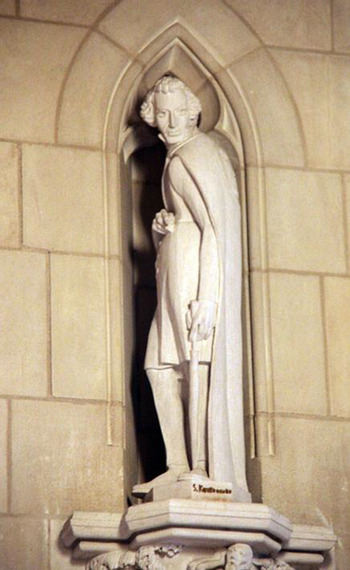
The question about the Cathedral's intentions hinted at Severson's conscientious approach toward the art of sculpting. Severson was a native of Wisconsin who had studied under the tutelage of the famed Croatian sculptor Ivan Mestrovic at Syracuse University. After earning a master of fine arts there, he relocated to Chesterfield, Missouri, to begin work at Scopia Art Studios, from which he undertook a number of corporate, institutional, and liturgical commissions.Footnote 64 Before working on each design, Severson conducted meticulous research on the subject at hand—a preparatory step which enabled him to add his own interpretive touch to the model. This aspect of his work can be seen in his Cathedral statue of Kierkegaard (Fig. 4). Instead of facing the viewer straight on, Severson depicted Kierkegaard with the body turned backwards and face angled toward the viewer, as if to symbolize the Danish philosopher's idiosyncratic authorial style through the unconventional posturing. Furthermore, the corbel (i.e. the supporting structure underneath the statue) includes a portrayal of the binding of Isaac by Abraham, a biblical scene meant to reflect the theological aspects of Kierkegaard's work.Footnote 65 Severson's statue of Kierkegaard, in other words, reflected his stance of staying as true as possible to his subject by identifying a characteristic trait and expressing it through the medium of posturing and physical appearance.
Kierkegaard Statue in the Washington National Cathedral.
Photographed by the author in 2014.

Satisfied with the Cathedral's answer to his query, Severson set out to impart his artistic sensibility to the figure of Kagawa. After several months of working on a preliminary design, Severson decided upon a model that would reflect the activist nature of Kagawa's ministry. Accordingly, he placed him in a “poised stride to suggest the on-the-go manner of a man with much to do in little time,” with his right hand opened as if he was “proffering service” and the left hand holding high an “open Bible—the action book.”Footnote 66 By the time Severson wrote this reply, it had already been close to half a year since the initial contract had been signed, and the Cathedral officials were getting anxious to see his progress. In order to assuage their concerns, Severson sent a few “polaroid snaps to let [the Cathedral] know where the statue [was].”Footnote 67
The images of the preliminary plaster model, however, were not well-received by the Building Committee. Upon reviewing the progress report from Severson, Feller and the Dean of the Cathedral, Francis B. Sayre Jr. (1915–2008)—who was the first grandchild of President Woodrow Wilson—expressed disappointment, finding the clothing on the proposed model “completely unacceptable” due to its lack of “Oriental costume.”Footnote 68 Kagawa's statue, Feller maintained, was to be part of the “Saints of All Nations” series, an international grouping of sculptural figures in the Cathedral nave which relied upon dress as the key feature that visually differentiated between each culture and nationality. While conceding that he knew “very little about Kagawa,” and the Japanese evangelist “no doubt. . .wore western style clothes,” Feller stressed that the point of depicting him in ethnic dress was to mark him out as a figure “symbolic of Japanese Christianity,” complaining that the current model made him look “like a Japanese businessman or diplomat.”Footnote 69 “Very few bishops wear cope and mitre on the street,” he stated, using a Western metaphor to reiterate his point: “but we vest them in these garments in statues to emphasize the symbolism.”Footnote 70 After expressing regret at their difference in direction, Feller concluded the letter by asking Severson to update the Building Committee periodically for their approval, “before you invest long hours of painstaking work on it.”Footnote 71
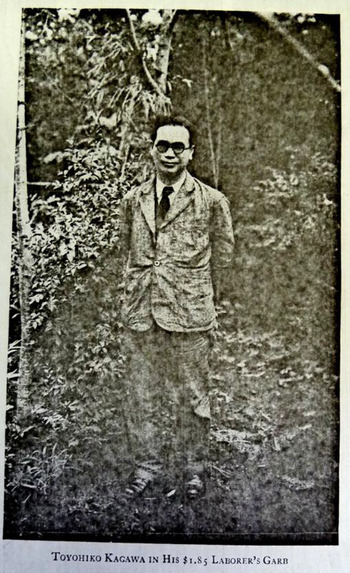
Severson, for his part, defended his choice of dress by claiming he was trying to remain faithful to his subject. Upon receiving the Cathedral's criticism, Severson replied that his choice of a Western-style suit was intended to represent a work suit that Kagawa himself had “pioneered and designed to be made and sold for a minimum amount for the working classes of Japan.” (Fig. 5)Footnote 72 “It was a kind of symbol of his concern and efforts in the area of human dignity for the working class,” Severson explained, citing his research into Kagawa's background, “for after all, it is a very unusual thing for any man to be designing any garment, hence I ascribe a symbolic meaning to this apparel.”Footnote 73 In addition to the perceived need to visually display Kagawa's dedication to the “poor working class” victims of “industrial exploitation,” Severson's hesitation to incorporate ethnic dress into his model also stemmed from a cultural misunderstanding regarding the use of traditional Japanese garments. To him, traditional Japanese clothing such as kimono—which he misspelled as “kimona” in his letter—represented the “baronial finery of the Orient”; an extravagant luxury enjoyed only by the aristocracy, and thus “highly inappropriate” for someone like Kagawa.Footnote 74 In reality, kimono (literally meaning, “something that is worn”) is a general category of loose, long-sleeved clothing that comes in various types and grades, ranging from casual dress for commoners—indeed, something that Kagawa liked to wear at home—to more elaborate outfits befitting formal ceremonial occasions. Severson, however, interpreted the Cathedral's request for an “oriental costume” as an “ostentation” that he could not “afford. . .his image [of Kagawa to] suffer,” leading him to go so far as to declare: “If [Kagawa] is worthy of the respect to put him in the Cathedral, his integrity as a person shall not be violated by my hand.”Footnote 75 Instead, he asked the Cathedral “to be open to the realism of my Kagawa,” and promised that his model need not be seen as failing the objective of symbolizing “Oriental Christianity,” as long as they were “willing to accept the expression of his orientalism in other than the specific trappings of coolie or oriental garb.”Footnote 76
Kagawa in his laborer's garb.
“Kagawa file,” 17 December 2020, Washington National Cathedral Archives.

The above exchange reveals the opposing views of Cathedral and donor versus the sculptor, as well as a superficial understanding of Japanese culture on both sides. On a practical level, Feller's concern that Kagawa be portrayed in “Oriental costume”—even if it did not accurately reflect his values—is understandable, given the institutional desire to represent a diverse, international group of figures within the space of the Cathedral nave. In his view, Severson's insistence on providing an uncompromising and honest portrayal of the subject needed to be balanced with the Cathedral's needs as well as the donor's demands. On the other hand, it is telling that the Cathedral and donor focused on outward appearances—using the vaguely essentializing term “oriental” to describe Kagawa—whereas Severson was the only one who made an effort to develop more than a cursory understanding of the Japanese evangelist. Despite his misconceptions over the use of traditional Japanese dress, Severson accurately grasped the core values that underlay Kagawa's teachings and ministry. Crucially, however, neither party brought up Kagawa's credentials as a leader of global Christianity in their discussions of his representation in the Cathedral, thus marking a stark contrast with his interwar internationalist image.
IV. Reuniting God and Nation in War and Occupation
The disagreement of donor and sculptor over Kagawa's statuary depiction mirrored the real-life contestation over his image following World War II, also known in Japan as the Asia-Pacific War (1937–1945). Kagawa's actions during the wartime period—namely, his appearance on propaganda programs broadcast by the Japanese state-sponsored station Radio Tokyo—drew criticism from American observers and sowed doubts in the minds of some of his supporters. The idea that a figure so renowned as a pacifist and espouser of universal Christian principles would cooperate with the Japanese imperial government caught many by surprise. This led to a schism in his overseas reputation in the postwar period, between those who saw him as an imposter and others who continued to admire him as the potential leader of a new, democratic Japan to come. Such developments, combined with the emergence of Cold War ideology and the overall decline of the Christian internationalist movement, ultimately led to the de-internationalization of Kagawa's image.
Kagawa's wartime broadcasts on Radio Tokyo unsettled his prewar image as a Christian pacifist and cast a long shadow over his postwar legacy. Between 1942 and 1945, Kagawa, at the behest of Japanese officials, appeared as a guest speaker on at least five different shortwave broadcasts on Radio Tokyo for American audiences. The radio shows, which were delivered in English and aimed at Allied soldiers in the Pacific, as well as stateside listeners, were ostensibly billed as religious programs marking traditional Christian holidays such as Christmas and Easter. Kagawa, however, used the platform to castigate the Anglo-American enemy for their “unchristian” bombing of Japanese cities and the “barbarous acts” they allegedly carried out on the bodies of fallen Japanese soldiers.Footnote 77 Such programs formed part of the Japanese military's strategy of psychological warfare; a propaganda tactic meant to undermine the spirit and morale of American civilians and combatants.
While it is not clear how effective this strategy was during the war, the Radio Tokyo broadcasts nevertheless called into question Kagawa's credibility in the postwar period. Following Japan's surrender on August 15, 1945, General Douglas MacArthur (1880–1964) arrived in Japan as the Supreme Commander of Allied Powers (SCAP), with the mandate to eradicate all traces of militarism and ultranationalism so as to facilitate the country's transformation into a liberal democracy. MacArthur attempted to achieve this lofty goal through a combination of institutional reforms and unofficial religious guidance, based on his belief that the Japanese lacked a core of spiritual values—with Christianity as the only religion that would be able to fill the “spiritual vacuum.”Footnote 78 To this end, he even had a giant Christmas arch erected above his General Headquarters (GHQ) building in Tokyo, and invited Kagawa to give a speech at the GHQ's 1945 Christmas service.Footnote 79 Kagawa's appearance, however, had to be canceled at the last minute because of a controversial article published only a few days before the event. Barnard Rubin, an army corporal who was working as a columnist for the Pacific edition of the U.S. military newspaper Stars and Stripes, had published an article titled, “Under Christian Guise, This Jap Fostered War.” The article launched a scathing attack on Kagawa, citing his wartime propaganda broadcasts as evidence of him being a “warmonger” who had used his pacifist reputation as a cloak to “camouflage” his true nature.Footnote 80
The incident caused a major stir within the SCAP hierarchy, leading MacArthur to remove the author, Rubin, from Stars and Stripes duty in order to contain the spread of public discussion.Footnote 81 This move, however, only served to feed further speculation and debate. For example, an April 1946 issue of the Christian Register, a Unitarian monthly in Boston, rehashed the contents of Rubin's article, stating that Americans needed to “know the record of a Christian who surrendered to militaristic nationalism” and practiced a brand of “quasi-pacifism.”Footnote 82 In response, T.T. Brumbaugh, former Japan correspondent of The Christian Century, jumped to Kagawa's defense, characterizing Rubin's article as a smear campaign seeking to defame Kagawa “in the same manner as Martin Niemoller's fair name was besmirched following Germany's capitulation.”Footnote 83 The so-called “Kagawa question,” in fact, became such a heated point of contention that the F.B.I. received letters from concerned citizens “in search [of] true facts” regarding Kagawa's wartime activities.Footnote 84
Other observers clung to the view of Kagawa as a model Christian, albeit not as an internationalist hero, but rather as a leader for a democratic Japan. For example, the Christian Herald, the most widely circulated Protestant news and general interest magazine of the early twentieth century, published an article in 1950 titled, “Japan's Two Men of Destiny.”Footnote 85 The piece drew a rosy portrait of the positive transformations Japan had achieved under the Allied occupation, focusing especially on the contributions of Emperor Hirohito and Kagawa to the nation's peaceful recovery. According to the article, their willingness to embrace General MacArthur's efforts to promote Christianity in Japan marked them out as key leaders of the postwar transition. Here, Kagawa no longer represented the ideal of Christian internationalism, but rather became the symbol of a newborn Japan alongside its emperor, who had relinquished his role as imperial sovereign and issued the so-called Humanity Declaration in 1946 in an effort to underscore the country's project of renewal along democratic lines.Footnote 86
By the early 1950s, the influence of Christianity as an international force was being overshadowed by more pressing political plotlines: Japan's catastrophic defeat, the Allied occupation, and East Asia's frontline role in the emerging Cold War between the United States and the Soviet Union. The nature of Christian internationalism, moreover, experienced a dramatic shift during the 1940s. Under the chairmanship of John Foster Dulles (1888–1959), the Commission on a Just and Durable Peace, established by the Federal Council of the Churches of Christ and whose members included many major figures of 1930s and 1940s Christian internationalism, lobbied to bring mainline Protestantism into closer alignment with the U.S. government. By positioning the commission as a mediator between American churches and the state during various wartime forums on postwar international organization, Dulles successfully recast Christianity as a “national faith” vital to the United States’ upcoming struggle against the “atheistic” Soviet Russia. In doing so, he effectively “Americanized” Christian internationalism, moving it away from its interwar emphasis on universalism toward a more messianic ideology that strove to reunify God with the nation.Footnote 87
The “Americanization” of Christian internationalism took place concurrently with the reconfiguration of Kagawa as a figure associated with the Japanese nation-state. While these developments resulted in large part from a shifting global climate that demanded a stronger adherence to nationalistic demands, Kagawa in fact sowed the seeds for his own move away from internationalism through his pro-Japanese activities during the war. The general decline of Christian internationalism, in effect, only quickened the overshadowing of Kagawa's contributions and significance within global Christianity, a process which had already begun during the wartime period and was further solidified in the postwar aftermath.
V. The De-Internationalization of Kagawa in the National Cathedral
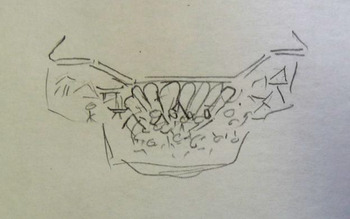
In balancing the demands of multiple stakeholders, Kagawa's Cathedral statue endured a series of false starts before its final completion. After their initial disagreement over the direction of the statue, the Cathedral and sculptor eventually agreed in early 1971 to try to solve the issue of judicious national representation by utilizing a hybrid design that placed a symbol of ancient, traditional Japan next to that of modern Japan. Based on his view that Kagawa signified an “instrument of change” who helped “a class of laborers struggling against ancient Japanese feudal attitudes,” Severson maintained that “old Japan” must be visually represented in the model to evoke the sense of change over time.Footnote 88 On this point, he accepted Dean Sayre's suggestion of using the chrysanthemum flower, the symbol of Japan's imperial family, to exemplify traditional Japan. The chrysanthemum, Severson suggested, should be located on the corbel alongside a depiction of Shinkawa, the Kobe slums where Kagawa had devoted many years of his life in helping the poor (Fig. 6).
Dean Sayre's chrysanthemum corbel design sketch.
“Chrysanthemum,” n.d., Washington National Cathedral Archives.

Given the placement of the statue on an elevated niche above an arched corridor, Feller and Sayre envisioned the viewer's eye first meeting the chrysanthemum corbel representing “old Japan,” out of which would sprout Kagawa in his laborer's garb, representing the “new Japan.”Footnote 89 Severson ultimately insisted that he be allowed to keep the Western-style “work suit,” since he regarded the so-called Kagawa suit (“which sold for $1.85”) as the material representation of “his hopes for a state of existence without class distinction,” and thus an essential symbol for his statue design.Footnote 90
Severson's finished model, however, did not satisfy the donors, ultimately leading to the termination of his contract. Mr. and Mrs. Fleck, the donors, upon hearing the proposed iconography of the statue and corbel, “were not entirely enthusiastic about the concept of western garb on Kagawa,” reiterating their emphasis on having him attired in “something which will be visually symbolic of a nation.”Footnote 91 Despite such warning signs, on May 30, 1971, Severson rushed photographic prints of his plaster model to Feller, along with a hastily written note explaining his artistic decisions. The note began with the confession that “Toyohiko Kagawa has not ‘turned me on’ the way S. K. [Søren Kierkegaard] did.”Footnote 92 The resulting model, it turned out, was quite different from what had been discussed. Instead of showing Kagawa standing up straight, Severson depicted him in a “very full” suit, looking at a book “drawn. . .tightly to the face,” suggesting “his immediacy in applying the gospel to all of life situations,” as well as adding a small “chrysanthemum in K's outstretched hand.”Footnote 93 The corbel design featured one central chrysanthemum flanked on both sides by scenes of the “busy contemporary Japan” and the “slum buildings of Shinkawa in Kobe,” and “in the pedals [sic] of the flower, people stand as in Shinkawa.”Footnote 94
After a five-month delay, the Cathedral Building Committee concluded that Severson's model did not meet their demands, paving the way for its rejection and his replacement with a new sculptor. The Building Committee and the Dean gave an unfavorable appraisal of the statue design, finding “that the figure appears distorted and somewhat unpleasing in appearance,” leading them to perceive “the chrysanthemum in his hand to be indistinguishable and relatively meaningless to anyone who looked at the photograph.”Footnote 95 As for the corbel, Severson's attempt to represent the chrysanthemum and the slums together gave the unfavorable impression of “the chrysanthemum and the little human beings crawling around in the leaves [looking] like bees in a flower.”Footnote 96
By this time, Feller was under pressure from the Building Committee to step up the pace of nave construction in order to have everything ready for the public viewing scheduled for the national bicentennial in 1976.Footnote 97 As such, he could not afford to spend any more time trying to work out a satisfactory design with Severson through further negotiations. While he did have the option of making more specific suggestions and corrections to Severson's model, Feller felt that such a path would only result in artistic compromise and “mediocrity of the worst sort.”Footnote 98 In the end, Feller offered to pay Severson the full contract fee out of respect for the time and effort he had spent on the project, in exchange for terminating the commission. Severson accepted the check begrudgingly.Footnote 99
Even after this transition, the Kagawa statue project experienced further difficulties from the donors. Following the termination of the initial commission with Severson, Feller and Dean Sayre sought out a different artist for the statue. Out of concern that the donors “had become rather upset with the lengthy process [of deciding upon a design],” Feller and Sayre commissioned a young local sculptor in Washington D.C., Rick Hart, in the hope that the donors could personally visit his studio to offer direct input and feedback whenever they wished.Footnote 100 However, even this arrangement proved insufficient. After an interval of four years, on the eve of the bicentennial year, Feller confided in a letter to Severson that while the Cathedral had “tried another sculptor and even though his model was passed by the Building Committee,” Admiral Fleck and his wife proved “exceedingly difficult about the matter,” leading the two sides to part ways in the end.Footnote 101 While it is unclear what had transpired between the Flecks and the Cathedral, Feller revealed that the donors did not finish their pledge for the Kagawa statue, and the model ended up costing much more than what they had given. In order to salvage the situation, Feller decided to put away the plaster model of Kagawa in the Cathedral's vault until such a time that the two had “passed on or moved to another location.”Footnote 102
The archival documents do not state when the Kagawa statue was crafted into its current form. It is likely, however, that it was completed before April 18, 1976, which was the date of the nave's grand Easter unveiling in the lead-up to the bicentennial celebrations in July. The final design, while ultimately crafted by a different artist, nevertheless bore the imprints of the original negotiations between the Cathedral, donor, and sculptor. The statue depicts Kagawa standing upright in an open stance, wearing what appears to be a Japanese-style kimono, in seeming deference to the Flecks’ insistence on showcasing the “Oriental” background of the Japanese Christian leader. The corbel features a large chrysanthemum flower in the center, an idea originating from Dean Sayre, flanked by the images of a Japanese farmer and laborer in recognition of Kagawa's social commitments, a point suggested by Severson. Toward the bottom, furthermore, the Japanese characters for saint (seijin) appear as part of the wreath surrounding the chrysanthemum, in a subtle reminder of his national origin and status. Nowhere in the statue, however, is there anything to suggest the high international acclaim or global stature Kagawa once enjoyed. Through its amalgamation of a number of disparate symbols—ethnic, national, and occupational—the statue celebrates Kagawa as a Japanese “saint” while simultaneously deemphasizing what made him so famous in the first place: his vision of Christianity as a universal religion and unifying force that transcended such social and political divides.
VI. Conclusion
If Kagawa could be described as a leading internationalist of the interwar period, as I have attempted to show here, his posthumous statue in the Washington National Cathedral—perhaps appropriately, given the name of the institution—de-internationalized this erstwhile image. No longer seen as representing the ideals of a global Christianity, Kagawa, in reflection of the broader decline of the Christian internationalist movement in the postwar period, became construed more narrowly as a symbol of Japanese Christianity.
Historical context informed the contrasting ways in which Kagawa was viewed in the 1930s versus the 1970s. During the interwar period, the devastation caused by World War I provided impetus for the rise of a radical, anti-imperialist strand of missiological thinking that questioned the moral and political grounds of the international missionary project. As a convert who had seemingly internalized the best aspects of the faith of his “fathers”—as he affectionately referred to the Presbyterian missionary mentors he met in his youth—Kagawa gained prominence as a non-Western, non-white Christian leader who offered comforting reassurance to an American Protestantism suffering from internal divisions and declining membership figures. At the same time, he stood as a harbinger for a new type of faith; one that recognized the growing potential of the non-Western churches and organized itself along universalist values in service of an ethnically and culturally inclusive world Christianity. Not merely an indigenous partner to his white missionary associates, Kagawa became a pacifist hero who embodied the lofty ideals of a multicultural, global Christianity.
In contrast, the postwar advent of a new Cold War ideology stressing religious nationalism overshadowed the previously influential Christian internationalism of the interwar period, replacing it as the primary lens through which world figures and events were interpreted. With regard to Kagawa, the intervening years also entailed revelations regarding his wartime cooperation with the Japanese imperial state, which contradicted his cultivated image as a principled internationalist. As it turned out, this did not completely destroy Kagawa's reputation, as he continued working as a public figure in postwar Japan and even embarked on two U.S. lecture tours in 1950 and 1954. It did, however, affect his legacy and the ways in which he was remembered. On the one hand, Admiral Fleck and his wife presumably donated their money for the construction of Kagawa's statue because they saw him as someone worth memorializing in America's national house of prayer. On the other hand, their insistence that the statue convey distinctly “Oriental” qualities reflected the assumption that Kagawa was a keeper of Japanese Christianity, in much the same spirit as one might declare Birgitta Birgersdotter, or Saint Bridget—who happens to have her own statue in the same corridor as Kagawa in the National Cathedral—as the patron saint of Sweden. Despite his prewar image as an international leader with universal appeal, Kagawa's statuary incarnation placed him in the category of a Japanese saint whose Oriental origin was his defining feature.
While the symbolism of his statue design was a contested issue among its builders, Kagawa's depiction in the Cathedral also reflected broader shifts in the changing social imagination of postwar Japan. Ruth Benedict's The Chrysanthemum and the Sword—an influential 1946 book originating from a series of national character studies that the Columbia University anthropologist had undertaken for the Office of War Information during the Pacific War—set a precedent for the postwar portrayal of Kagawa as being quintessentially “Japanese.” Seeking to explain why Japanese troops were willing to keep fighting even when defeat seemed inevitable, for example, Benedict cited Shisen o koete (Across the Death-line), Kagawa's semiautobiographical account of his experience of becoming a Christian and social reformer.Footnote 103 Pointing to the scene where the protagonist declared his intention of devoting his remaining life to Christ after nearly succumbing to a fatal illness, Benedict cited his resolve to “enter into the conflict [here, meaning the slums of Kobe] as one already dead”—the titular moment of “crossing the death-line”—as an illustration of the Japanese soldier's ability to act “as one already dead” in combat and thus free from all circumspection and fear.Footnote 104 Despite the irony of taking as her example a Christian leader recounting his decision to dedicate his life to spiritual service, Benedict related Kagawa's experience as one typical of the Japanese mind—thus cementing the association between Kagawa and Japan in Western minds and contributing to the de-internationalization of his image.
In the end, Kagawa's statue was constructed in spite of the many difficulties that arose during the design process. As it stands, the statue—which was constructed in the absence of any direct input from Kagawa's family or his close associates—is a unique example of the ways in which historical memory and commemoration operates. By the time of the initial statue proposal, Kagawa was a largely forgotten figure in the U.S. public sphere, and many of the contemporaries who knew him best, including his transpacific American partners, were passing from the scene. While nominated multiple times for the Nobel Prize in Literature and the Nobel Peace Prize in the 1940s and 1950s, Kagawa never ended up winning either award, and his fame never quite regained the heights it had previously attained before the war.Footnote 105 His statue designers, as a result, struggled to reconstruct an image of Kagawa that most agreed with their personal, social, and institutional concerns. Kagawa's statue in the National Cathedral, perhaps more than anything else, stands as a testament to the once-substantial sway of interwar Christian internationalism, as well as the fundamental shifts in the global geopolitical landscape that have since altered the position and perception of one of its most celebrated leaders.
Bo Tao received his PhD in history from Yale in 2019 and is currently a Visiting Research Fellow at Waseda University. His research focuses on state-religion relations in modern Japan, transpacific encounters, and the history of Christianity in its East Asian and global contexts.