Introduction
Language has long been studied in schizophrenia. We and others have recently hypothesized that language features may do more than describe experience and mark thought disorder; lexical markers may report on underlying psychopathology. Here, we harnessed the power of ‘real-world’ writing from public blogs to test the ecological validity and specificity of previously reported differences between psychosis and control subjects in laboratory samples.
Computational methods for lexical analysis can distinguish language from psychosis and control groups
Recently, computational methods have facilitated the rapid assessments of language features in large text corpora. Several groups have compared the frequencies of words or word categories in psychotic v. control subjects, or used language to classify subjects by diagnosis (Junghaenel et al. Reference Junghaenel, Smyth and Santner2008; Strous et al. Reference Strous, Koppel, Fine, Nachliel, Shaked and Zivotofsky2009; Hong et al. Reference Hong, Nenkova, March, Parker, Verma and Kohler2015), by degree of anhedonia (Buck et al. Reference Buck, Minor and Lysaker2015a ), and by social functioning and metacognition (Minor et al. Reference Minor, Bonfils, Luther, Firmin, Kukla, MacLain, Buck, Lysaker and Salyers2015).
Self-referential words as markers of psychosis
Frequency of self-referential pronouns is a potential marker of psychosis. Three groups have independently identified self-referential pronouns as differing in frequency between psychotic and non-psychiatric control subjects: Strous et al. (2009) in Hebrew writing samples, Hong et al. (Reference Hong, Nenkova, March, Parker, Verma and Kohler2015) in English speech samples, and Buck & Penn (Reference Buck and Penn2015) in English speech samples. Furthermore, two of the three diagnostic classifiers (computational algorithms to sort cases into diagnostic categories, in this case based on word frequencies) which have been reported rely heavily on self-referential pronouns, and both achieve >75% accuracy to distinguish psychosis from control subjects (Strous et al. Reference Strous, Koppel, Fine, Nachliel, Shaked and Zivotofsky2009; Hong et al. Reference Hong, Nenkova, March, Parker, Verma and Kohler2015).
Examining lexical changes in patient samples and novel controls opens new windows on etiology
We know that specific word frequencies differ in psychosis v. control subjects in the laboratory – we aimed to extend this finding to understand how well these observed differences generalize to language samples produced outside the laboratory or clinic, and what aspects of psychotic illness are associated with these changes.
We tested lexical features in two corpora, one from patient interviews and another from online blog entries. The interview corpus allowed us to replicate others’ findings and relate the observed lexical markers to specific symptoms. In particular, we tested three candidate lexical markers of psychosis suggested by others’ work: two markers of self-reference: I, biological processes (Strous et al. Reference Strous, Koppel, Fine, Nachliel, Shaked and Zivotofsky2009; Buck & Penn, Reference Buck and Penn2015; Hong et al. Reference Hong, Nenkova, March, Parker, Verma and Kohler2015), and negative emotion (Cohen et al. Reference Cohen, Alpert, Nienow, Dinzeo and Docherty2008, Reference Cohen, St-Hilaire, Aakre and Docherty2009; Buck et al. Reference Buck, Minor and Lysaker2015b ; Minor et al. Reference Minor, Bonfils, Luther, Firmin, Kukla, MacLain, Buck, Lysaker and Salyers2015).
The blog corpus included carefully chosen comparison groups aimed at differentiating the experiences of mental illness, chronic illness, strong belief system, odd beliefs, and social isolation. In addition to validating lexical differences in real-world samples, we aimed to understand the dimensions of psychosis relevant to observed lexical differences.
Method
Speech study
Interview subjects
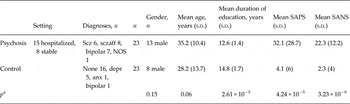
This protocol was approved by the Yale Institutional Review Board, and consistent with the Declaration of Helsinki. We recruited 23 subjects with psychosis from the in-patient psychiatric hospital and our out-patient clinic. We included people currently treated for psychosis in the context of schizophrenia, schizo-affective disorder or bipolar disorder. Hospitalized patients were admitted for current exacerbation of psychotic symptoms. Subjects with stable psychosis and 23 control subjects without any history of psychosis were identified by posters and word of mouth, and initial inclusion criteria verified by brief telephone screen. Written informed consent for all subjects was obtained by standard procedures. See subject demographics in Table 1 (summary) and online Supplementary Table S1 (details).
Demographic and symptom data for subjects in the interview experiment

s.d., Standard deviation; SAPS, Scale for the Assessment of Positive Symptoms; SANS, Scale for the Assessment of Negative Symptoms; scz, schizophrenia; sczaff, schizo-affective disorder; bipolar, bipolar disorder; NOS, psychosis not otherwise specified; depr, depression; anx, anxiety
a p Values represent significance on the result of Student's t test comparing the two groups.
Symptom scales
To quantify and describe psychotic symptoms in both groups, trained interviewers met with each subject to discuss psychiatric history and to administer the Scale for the Assessment of Positive Symptoms (SAPS) (Andreasen, Reference Andreasen1984) and the Scale for the Assessment of Negative Symptoms (SANS) (Andreasen, Reference Andreasen1983) (for results, see Table 1 and online Supplementary Table S1).
Interview speech samples
Interviews were digitally recorded and transcribed. Subjects responded to the prompt ‘We like to begin by hearing about you. Would you tell us a little about yourself?’ Each was encouraged to continue talking for 10 min. This technique is similar to that in recent reports of lexical analysis in schizophrenia (Cohen et al. Reference Cohen, Alpert, Nienow, Dinzeo and Docherty2008; St-Hilaire et al. Reference St-Hilaire, Cohen and Docherty2008; Strous et al. Reference Strous, Koppel, Fine, Nachliel, Shaked and Zivotofsky2009; Buck et al. Reference Buck, Minor and Lysaker2015a , Reference Buck, Minor and Lysaker b ; Minor et al. Reference Minor, Bonfils, Luther, Firmin, Kukla, MacLain, Buck, Lysaker and Salyers2015), though others focused more on emotional experience (Junghaenel et al. Reference Junghaenel, Smyth and Santner2008; Cohen et al. Reference Cohen, St-Hilaire, Aakre and Docherty2009; Buck & Penn, Reference Buck and Penn2015; Hong et al. Reference Hong, Nenkova, March, Parker, Verma and Kohler2015). This interview question was part of a larger experiment with three subsequent speech prompts and psychological tasks, which will be reported elsewhere.
Blog study
This protocol was determined by the Yale Institutional Review Board to be exempt from oversight.
Blog groups
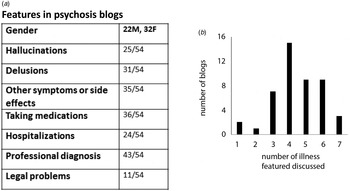
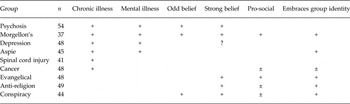
To investigate the relationship between lexical features and specific aspects of psychosis, we compared word use in psychosis blogs with blogs from eight comparison groups. The comparison groups were blog-writers with chronic illness, mental illness, odd beliefs, strong beliefs and social (dis)engagement (Table 2). Each group was selected to share some, but not others, of these specific features. Each group was self-identified: the blogger declared that they belonged to the group, and there was no evidence that it was a parody. We read each blog in the Psychosis group for further evidence of psychotic illness, such as discussion of hallucinations, delusions, other symptoms, professional diagnosis, medication use, side effects, psychiatric hospitalization, legal problems and other recovery-oriented activities (Fig. 1b ; for more detail, see online Supplementary Table S2).
Blog authors have features of psychosis. (a) Psychosis blog sample with regard to gender distribution of writers and what fraction of the sample included mention of each listed feature of psychosis. (b) Density of psychosis features in the sample, such that the left-most bar shows that our sample included two blogs mentioning one feature, and the right-most bar shows that our sample included three blogs that mentioned seven features. M, Male; F, female.

Blog groups listed with number of entries in each group and features of interest

+, Feature present; ?, feature may be present; ±, feature may or may not be present.
Psychosis group
(1) Psychosis (n = 54). These bloggers identified as having schizophrenia or schizo-affective disorder. Their heterogeneous experiences included strong and/or odd beliefs, hallucinations, experiences of social stigma and feelings of isolation, as well as physical discomfort and sometimes a sense of pride or community. We aimed to identify language markers of these aspects of the experience of psychosis in the blogs.
Comparison groups
Illness groups
Five groups were formed using blog entries written by people with physical or psychiatric conditions. These groups varied in degree of strong or odd beliefs, physical discomfort, social isolation and sense of community.
-
(1) Morgellon's (n = 37). This group is from a largely Internet-based community of people who rally around physical symptoms (skin lesions, fatigue and overall poor health) that are very bothersome, and that they believe result from infestation or environmental exposure. Most medical experts understand this to be in the psychiatric realm, a kind of delusional parasitosis (Hylwa et al. Reference Hylwa, Foster, Bury, Davis, Pittelkow and Bostwick2012; Pearson et al. Reference Pearson, Selby, Katz, Cantrell, Braden, Parise, Paddock, Lewin-Smith, Kalasinsky, Goldstein, Hightower, Papier, Lewis, Motipara and Eberhard2012; Misery, Reference Misery2013; Mortillaro et al. Reference Mortillaro, Rodgman, Kinzie and Ryals2013). The bloggers described their distress, their failed efforts to come to common understanding with medical professionals, and relief at finding community. This group had features of strong beliefs, odd beliefs, chronic illness (diagnosis), physical discomfort (itching and pain) and sense of community (group of believers online).
-
(2) Depression (n = 48). People with depression, especially those with suicidality, increase self-reference and bodily focus in their language (Pennebaker, Reference Pennebaker2011). In a cognitive–behavioral frame, depression is understood in terms of maladaptive beliefs (Beck, Reference Beck1992), and people with depression have been shown to exhibit depressive realism – a tendency to make more accurate, less positively biased beliefs than control subjects (Alloy & Abramson, Reference Alloy and Abramson1979). This group had features of social isolation, chronic illness (diagnosis) and some had physical discomfort.
-
(3) Aspie (n = 45). Some people with high-functioning autism spectrum disorder (previously called Asperger's) self-identify as ‘Aspies’. We included this group because they are people with a chronic mental illness who have embraced this identity. We searched for blog authors who self-identified as ‘Aspie’ – not other autism blogs. These blogs included much speculation about what it is like for non-Aspies to emote and relate, and, for several bloggers, the relief at learning, as adults, that they are Aspies. This group has features of social isolation, chronic illness and strong sense of community
-
(4) Spinal cord injury (SCI, n = 41). We included this group with chronic non-psychiatric illness that may be visible to others (due to gait change or wheelchair use, for example). As the symptoms and behaviors of people with psychosis can at times make them recognizable to others in the community, we expected that many people with SCI may also feel social loss due to the visibility of their condition and attendant social stigma. However, we note that among the bloggers we identified, many had dramatic stories of physical and social feats: climbing mountains, establishing social organizations, etc., after their injury and often found a sense of community online. This group had features of social isolation, chronic illness, physical discomfort, and, for some, a strong sense of community.
-
(5) Cancer (n = 48). We included this group because they have an uncertain prognosis in the non-psychiatric realm: diagnosis may be very upsetting, and could be both isolating (due to not feeling well, others going on with their lives) and socially supportive (strong family support, support groups, gentle care in the hospital). Though we would not suggest that people would be happy to have cancer, many of these bloggers were proud to be survivors. In sum, this group had features of social isolation, chronic illness, physical discomfort and strong sense of community (as above).
No-illness groups
Three groups were formed without illness. They were characterized by strong and/or odd beliefs, but no spoken-of physical or mental health problems.
-
(6) Evangelical (n = 48). We selected this group for their strongly held beliefs that are accepted by much of society (not ‘odd’). They described worries and conflicts with others who do not agree, but more of the focus was on explicating the beliefs, and on the positive affect related to participation in worldwide, local and family groups. This group had features of strong belief (religious doctrine), social engagement and related sense of pride/community (church, missionary work for some).
-
(7) Anti-religion (n = 49). We selected this group for their strongly held beliefs that, although perhaps less popular than religious beliefs, are still broadly accepted. Many of the bloggers in this group identified as having left (mostly Judeo-Christian) groups, and many were angrily separating themselves. This group had features of strong belief, social isolation (many left religious groups) and a sense of community online.
-
(8) Conspiracy (n = 44). We selected this group for their identification with strongly held beliefs that are often considered odd – not as acceptable as Evangelical and Anti-Religion beliefs. They were notable for seeking out others with shared beliefs – many of the blogs included extensive lists of links to other similar blogs – but also for describing the groups they oppose. Many were deeply involved with seeking out evidence to corroborate their beliefs. This group had features of strong belief, odd belief, and both isolation and community due to these beliefs. Though some may have clinical diagnoses, we saw no mention of psychiatric diagnosis, specific symptom-like experiences (other than their strong/odd belief) or psychiatric treatment on the blogs we included.
Blog collection
We collected the most recent 150+ word entry from blogs maintained by single authors (not edited or curated by someone else), written in English, and publicly available on the Internet. One trained study team member read each blog entry for inclusion criteria and processing. Each entry was formatted into a single plain text file using standard procedures (Pennebaker et al. Reference Pennebaker, Chung, Ireland, Gonzales and Booth2007). This included correcting spelling errors when the intended word was obvious. We also removed citations and quotations longer than two sentences.
Lexical analysis
Linguistic Inquiry and Word Count 2007 (LIWC) is a software program that counts the frequency of 68 particular word categories in a text corpus (Pennebaker et al. Reference Pennebaker, Chung, Ireland, Gonzales and Booth2007) including function words (words that structure the sentence, such as pronouns, prepositions) and content words (words that indicate topic, such as nouns, regular verbs, and some adverbs and adjectives). For between-group comparisons, we compared the frequency of 54 categories (we excluded punctuation and some grammar super-categories, such as ‘function words’ and ‘pronouns’).
Statistical analyses
Between-group comparisons
For between-group comparisons, we checked that each word category was used with >1% mean frequency. For the interview sample, we used two-tailed Student's t tests to examine differences between the psychosis and control groups. For the blog sample, we used one-way analysis of variance (ANOVA) to examine differences between the nine groups. For both samples, we set significance at p < 0.05 after false discovery rate (FDR) correction (Benjamini & Hochberg, Reference Benjamini and Hochberg1995) to reduce the likelihood of type I error from 54 simultaneous word categories tested. For the ANOVA, we used Tukey post-hoc tests for pair-wise comparisons between the Psychosis group and each of the other groups, with significance set at p < 0.05. In the interview corpus, 35 of the 54 categories we tested represented more than 1% of the words in the sample (our cut-off for inclusion in further analysis). Of these, eight categories were significantly different between groups (online Supplementary Table S4).
Correlation analyses
Pearson's correlations were used to test the relationships between the three LIWC categories that are candidate lexical markers of psychosis based on the previous work described in the Introduction of this paper (I, Biological Processes, and Negative Emotions) and interview subject symptom scores (SAPS and SANS) with significance set at p < 0.05 (for results, see online Supplementary Table S3). We included positive symptom subscales for hallucinations, delusions, thought disorder and bizarre delusions. We also included negative symptom subscales for anhedonia, inattention, avolition, alogia and affective flattening.
Clustering
We used an unbiased clustering approach to parse the blog entries into groups based on LIWC results. We entered the frequencies of the 37 LIWC content word categories that were not umbrella categories, e.g. ‘see’, but not ‘perceptions’, into a principal components analysis to reduce them to five factors. Single blog entries were clustered based on these factor values using the ‘mclust’ algorithm in the statistical program ‘R’. Mclust is a package for model-based clustering which determines the optimum number of clusters based on the Bayesian information criterion (Fraley et al. Reference Fraley, Raftery, Murphy and Scrucca2012).
Results
Two language samples: a laboratory sample and a real-world sample
To validate and extend the above-described previous findings about word use in the language of people with psychosis, we collected speech samples from patient and control subject interviews (for details, see Fig. 1a and online Supplementary Table S1) and writing samples from blogs by people with psychosis and eight comparison groups (for details, see Fig. 1b and online Supplementary Table S2).
Interview corpus
We compared demographics in the two interview subject groups (Fig. 1a and online Supplementary Table S1). Psychosis and control subject groups were age and gender matched. The control group had on average 2 more years of education than the psychosis group. Psychosis group diagnoses (made by their clinicians prior to the study) included schizophrenia, schizo-affective disorder and bipolar disorder. As expected, our interview elicited more positive and negative symptoms from the psychosis group.
Blog corpus
We collected blog entries from writers with psychosis and each of eight other groups designed to test aspects of psychosis that might be associated with language changes (Fig. 1b ). Each writer contributed one entry to the corpus. We examined each psychosis group blog (multiple entries) for mentions of the writer having experiences consistent with psychosis. These features were present in many of the blogs (Fig. 1a ) and many of the blogs included multiple features (Fig. 1b ).
Three candidate lexical markers of psychosis
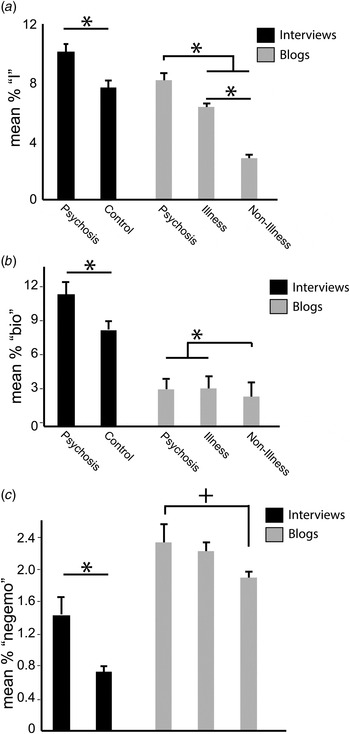
We analysed our interview sample, in which subjects spoke for 10 min on the prompt ‘Tell me about yourself’, for putative lexical markers of psychosis (Cohen et al. Reference Cohen, Alpert, Nienow, Dinzeo and Docherty2008, Reference Cohen, St-Hilaire, Aakre and Docherty2009; Junghaenel et al. Reference Junghaenel, Smyth and Santner2008; St-Hilaire et al. Reference St-Hilaire, Cohen and Docherty2008; Strous et al. 2009; Hong et al. Reference Hong, Nenkova, March, Parker, Verma and Kohler2015; Buck et al. Reference Buck, Minor and Lysaker2015b ; Buck & Penn, 2015; Minor et al. Reference Minor, Bonfils, Luther, Firmin, Kukla, MacLain, Buck, Lysaker and Salyers2015) (Fig. 2, black bars). First-person pronouns (Fig. 2a , black bars, t = 3.66, FDR adjusted p = 7.00 × 10⁻³) and biological process words (Fig. 2b , black bars, t = −4.34, FDR adjusted p = 1.67 × 10⁻³) were more frequent in Psychosis than Control. Negative emotion words (Fig. 2c , black bars, t = 3.66, FDR adjusted p = 0.02) were also more frequent in Psychosis than Control.
Candidate lexical marker frequencies in interview and blog corpora. Frequencies of candidate lexical markers (I, bio, and negemo) in the interview (■) and blog ( ) corpora. Values are means, with standard deviations represented by vertical bars. * Mean frequencies that significantly differ (p < 0.05). + Mean frequencies that trend toward a significant difference (p < 0.1).

Furthermore, frequency of these candidate lexical markers correlated with use of the other candidate markers (online Supplementary Table S3A), positive symptom scores (online Supplementary Table S3B) and negative symptom scores (online Supplementary Table S3C).
Lexical patterns united bloggers with illness more than bloggers with strong or odd beliefs
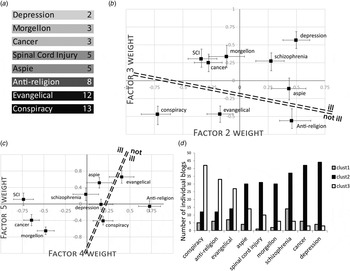
In light of previous work identifying self-referential and negative emotion words as more frequent in both psychosis and depression (Junghaenel et al. Reference Junghaenel, Smyth and Santner2008; Strous et al. 2009; Bedi et al. Reference Bedi, Carrillo, Cecchi, Slezak, Sigman, Mota, Ribeiro, Javitt, Copelli and Corcoran2015; Buck et al. Reference Buck, Minor and Lysaker2015a ; Buck & Penn, Reference Buck and Penn2015; Hong et al. Reference Hong, Nenkova, March, Parker, Verma and Kohler2015; Minor et al. Reference Minor, Bonfils, Luther, Firmin, Kukla, MacLain, Buck, Lysaker and Salyers2015), we thought that these words could be markers of mental illness. However, we predicted that overall word use pattern in Psychosis would most reflect the strong odd beliefs (delusions) that often pervade the language of people with psychotic disorders. We used factor analysis followed by clustering to describe the patterns of word frequencies in the 37 thematic (non-grammar) categories. We predicted that these methods would reveal similarities between psychosis and other writers with strong odd beliefs (Conspiracy theorists, people with Morgellon's syndrome) and to a lesser degree, writers with strong beliefs (Evangelicals, Anti-religion writers). Contrary to our prediction, we found more word categories significantly differing from Psychosis in Conspiracy than any other group (Fig. 3a ). Factor analysis revealed that word use in the Psychosis group was more similar to that of other groups with illness than to that of non-illness groups (Fig. 3b and c ). To verify these groupings, we applied an unbiased clustering algorithm to the factor data. Each blog entry (without consideration of group) was assigned to a cluster: a three-cluster solution emerged. Psychosis (and other illness group) blog entries were predominantly assigned to cluster 2, whereas Conspiracy (and other strong belief) blogs were predominantly assigned to cluster 3 (Fig. 3d ).
Blog corpus thematic word frequencies and clustering results. (a) Numbers of word categories significantly different from Psychosis are listed for each group. (b, c) Factor weights for each group are plotted. (d) Number of blogs assigned to each cluster (clust) is marked for each group. SCI, Spinal cord injuries.

The three candidate markers were increased across illness groups
To test the revised hypothesis that the lexical markers that are increased in psychosis and depression are actually markers of illness in general rather than of having strong odd beliefs or mental illness in particular, we checked the frequency of self-referential and negative emotion words in the blog corpus. They did follow the predicted pattern (Fig. 2, gray bars). ‘I’ was most frequent in psychosis, less in the Ill group, and even less in the Non-ill group (Fig. 2a , gray bars. Means: 8.16, 6.33, 2.84%, ANOVA F = 82.71 and p = 7.61 × 10⁻³¹, and p < 0.05 for psychosis v. ill, psychosis v. non-ill, and ill v. non-ill). ‘Bio’ was more frequent in psychosis and the Ill group than in the Non-ill group (Fig. 2b , gray bars. Means: 3.18, 3.33, 2.31%, ANOVA F = 10.71 and p = 2.94 × 10⁻⁵, and p < 0.05 for psychosis v. non-ill and ill v. non-ill). ‘Negemo’ was most frequent in psychosis, less in the Ill group, and even less in the Non-ill group (Fig. 2c , gray bars. Means: 2.39, 2.25, 1.91%, ANOVA F = 3.65 and p = 0.03, and p < 0.1 for psychosis v. non-ill, and ill v. non-ill).
Furthermore, in the interview corpus, these three categories correlated with each other and with symptom burden (online Supplementary Table S3).
Discussion
We replicated the finding that first-person pronouns are increased in psychosis (Junghaenel et al. Reference Junghaenel, Smyth and Santner2008; Strous et al. Reference Strous, Koppel, Fine, Nachliel, Shaked and Zivotofsky2009; Bedi et al. Reference Bedi, Carrillo, Cecchi, Slezak, Sigman, Mota, Ribeiro, Javitt, Copelli and Corcoran2015; Buck et al. Reference Buck, Minor and Lysaker2015a ; Buck & Penn, Reference Buck and Penn2015; Hong et al. Reference Hong, Nenkova, March, Parker, Verma and Kohler2015; Minor et al. Reference Minor, Bonfils, Luther, Firmin, Kukla, MacLain, Buck, Lysaker and Salyers2015). We found that another self-referential category, biological processes, which includes words such as body and health, was more frequent in psychosis. Self-reference word categories such as ‘I’, ‘ingestion,’ and ‘sex’ have been previously identified as markers of depression (Oxman et al. Reference Oxman, Rosenberg, Schnurr and Tucker1988; Rude et al. Reference Rude, Gortner and Pennebaker2004) and suicidality (Stirman & Pennebaker, Reference Stirman and Pennebaker2001; Lester, Reference Lester2009; Baddeley et al. Reference Baddeley, Daniel and Pennebaker2011). In a corpus of published essays, we have previously found more self-referential words and fewer third-person plural words (‘they’) in depression than schizophrenia (Fineberg et al. Reference Fineberg, Deutsch-Link, Ichinose, McGuinness, Bessette, Chung and Corlett2015).
We replicated these findings in the more ecologically valid setting of blog writing: candidate markers were increased in psychosis v. eight comparator groups (for I, negemo). However, using factor analysis and clustering, we found that word use patterns across a large set of categories do not align groups that share the presence of strongly held or odd beliefs. Rather, patterns are most similar across groups with illness. Furthermore, in the interview sample, the three candidate lexical markers correlated with symptom intensity, and each marker was more frequent in the illness than non-illness blogs. Future work will determine if more symptomatic patients with other illnesses also use more of these lexical features.
Our finding that frequencies of these three lexical markers are positively correlated with one another in our interview subjects could suggest that these lexical markers relate to some common illness-associated process in these subjects.
Self-reference and illness experience
Illness is attended by shifts in self-concept and discomforts that pull one's attention inward. A functional magnetic resonance imaging marker of psychosis, dorsolateral prefrontal cortex activation, also correlates with distress (Corlett & Fletcher, Reference Corlett and Fletcher2012). Furthermore, belief-associated distress separates people with schizophrenia from others with high magical ideation, e.g. conspiracy theorists (Swami et al. Reference Swami, Chamorro-Premuzic and Furnham2010), and predicts delusion-motivated violence (Coid et al. Reference Coid, Ullrich, Kallis, Keers, Barker, Cowden and Stamps2013).
The similarity in word use among the ill groups in our sample also accords with research in neuro-immunology. Circulating inflammatory markers can promote ‘sickness behaviors’, a syndrome of low energy and depressed mood quite similar to major depression (Dantzer et al. Reference Dantzer, O'Connor, Freund, Johnson and Kelley2008). Psychiatric symptoms are also linked to interferon-α treatment of hepatitis C (Smith et al. Reference Smith, Norris, O'Farrelly and O'Mara2011), post-coronary recovery period (Lafitte et al. Reference Lafitte, Tastet, Perez, Serise, Grandoulier, Aouizerate, Sibon, Capuron and Couffinhal2015) and chronic gut inflammation (Zonis et al. Reference Zonis, Pechnick, Ljubimov, Mahgerefteh, Wawrowsky, Michelsen and Chesnokova2015). Inflammation has also been implicated in post-traumatic stress disorder (O'Donovan et al. Reference O'Donovan, Chao, Paulson, Samuelson, Shigenaga, Grunfeld, Weiner and Neylan2015) and schizophrenia (Minor et al. Reference Minor, Bonfils, Luther, Firmin, Kukla, MacLain, Buck, Lysaker and Salyers2015). We are not aware of any studies directly testing the relationship between inflammatory markers and word use patterns with LIWC, although there are some studies considering the health effects of sharing one's illness narrative (Pennebaker et al. Reference Pennebaker, Kiecolt-Glaser and Glaser1988; Petrie et al. Reference Petrie, Booth, Pennebaker, Davison and Thomas1995, Reference Petrie, Fontanilla, Thomas, Booth and Pennebaker2004). Perhaps the most parsimonious explanation of our present data is that the psychological state of being distressed is common to both physical and mental illness. This state may have immune consequences. Future studies relating language markers to inflammatory processes in psychiatric syndromes may help discern this effect and perhaps even target therapy.
Affective words
Previous data on affect word use in psychosis are mixed. Some have found more negative emotion words in psychosis v. control, specifically in discussion of neutral/unpleasant v. pleasant topics (Cohen et al. Reference Cohen, St-Hilaire, Aakre and Docherty2009). In psychosis with anhedonia, both decreased (Cohen et al. Reference Cohen, Alpert, Nienow, Dinzeo and Docherty2008) and increased use have been documented (Cohen et al. Reference Cohen, St-Hilaire, Aakre and Docherty2009). One study found that patients with anhedonia use more negative emotion words when prompted to talk about pleasant experiences (Cohen et al. Reference Cohen, St-Hilaire, Aakre and Docherty2009). However, Junghaenel et al. found no relationship between affect word use and anhedonia (Buck et al. Reference Buck, Minor and Lysaker2015b ), and they and others have reported no significant difference in negative emotion words in schizophrenia v. control subjects (Junghaenel et al. Reference Junghaenel, Smyth and Santner2008; St-Hilaire et al. Reference St-Hilaire, Cohen and Docherty2008). Two groups have reported no differences between groups in positive emotion word use (Cohen et al. Reference Cohen, Alpert, Nienow, Dinzeo and Docherty2008, Reference Cohen, St-Hilaire, Aakre and Docherty2009), but Junghaenel et al. found fewer positive emotion words in schizophrenia v. control subjects (F = 4.9, p < 0.05) (Junghaenel et al. Reference Junghaenel, Smyth and Santner2008). In our speech samples, negative emotion words were more frequent in Psychosis than Control, and positive emotion words did not differ.
As our sample seems to have included more acutely psychotic subjects (many of our subjects were interviewed during psychiatric hospital admissions, whereas other studies included mostly stable out-patients), we wondered whether negative emotion words might correlate with symptom burden, perhaps explaining differences between reported results. Others have found that emotion word use in schizophrenia but not control subjects was positively correlated with trait anxiety (St-Hilaire et al. Reference St-Hilaire, Cohen and Docherty2008). In another study, negative emotion word frequency correlated with PANSS score (Minor et al. Reference Minor, Bonfils, Luther, Firmin, Kukla, MacLain, Buck, Lysaker and Salyers2015), and with the global affective flattening subscale of the SANS (not the overall SANS score) (Cohen et al. Reference Cohen, Alpert, Nienow, Dinzeo and Docherty2008). Positive emotion words did not correlate with SAPS or SANS (Cohen et al. Reference Cohen, Alpert, Nienow, Dinzeo and Docherty2008) or PANSS (Minor et al. Reference Minor, Bonfils, Luther, Firmin, Kukla, MacLain, Buck, Lysaker and Salyers2015). Positive but not negative emotion word frequency correlated with social functioning (Cohen et al. Reference Cohen, Alpert, Nienow, Dinzeo and Docherty2008). Here, we found that frequency of negative emotion words was positively correlated with positive and negative symptom burden (online Supplementary Table S3). This, together with the positive correlations between self-referential words and symptom scores, suggests that these word categories could be markers of the intensity of symptoms.
Study limitations
Though our interview sample is matched on age and gender, we note that the discrepancy in education may reflect not only differences in years in the classroom, but also the vulnerable age when many of our psychosis subjects may have had education interrupted by symptom onset. By contrast, many of our control subjects are students with trajectory toward yet more education.
Language collected from blogs also has important limitations: most critically, we can not verify the identity or affiliations of the authors. Without meeting these writers or having access to their psychiatric histories, we cannot be certain of how well each blogger fits into their assigned group, and how many might possibly fit into another group as well. This does increase the potential for greater heterogeneity in the samples. However, we did find mention of experiences consistent with having a psychotic disorder in most of the psychosis blogs (Fig. 1). Furthermore, we did see similar word categories differ in our Interview sample (including many acutely ill patients). Also, writers with diagnosed conditions may be a subset of those with illness: those doing well enough to engage in the blogging project. Our correlation results from the Interview experiment do, however, suggest that self-referential and negative emotion words actually correlate with more not fewer symptoms.
Lastly, Conspiracy, Anti-religion and Evangelical bloggers may write more about strong belief than about themselves, which could account for some of the observed differences. However, the consideration of these data in the context of interview studies (ours and others’) suggests that the differences we observed are in fact quite similar to those seen in Psychosis and Control subjects responding to the same prompts. Nonetheless, future studies to examine language from people talking about strong beliefs or other kinds of prompts will be important.
Conclusions
The similarities we have observed in lexical markers across mental and physical illnesses reinforce the importance of considering common mechanisms as we describe the pathophysiology of mental illness. This work does not allow us to define causality (this would be better understood in a prospective repeated-measures design). Future work will help us to understand the relative contributions of the social and biological aspects of illness to changes in lexical markers. In particular, lexical analyses may be of interest as novel therapies are introduced, word use metrics can be simply (and cheaply) tracked through illness onset, recovery and relapse across diagnoses. Based on our present findings, word use may represent an assay of current clinical status, distress and discomfort, regardless of specific symptoms and diagnosis.
Supplementary material
The supplementary material for this article can be found at http://dx.doi.org/10.1017/S0033291716001215
Acknowledgements
This work was supported by the Connecticut Mental Health Center (CMHC) and Connecticut State Department of Mental Health and Addiction Services (DMHAS). P.R.C. was funded by an IMHRO/Janssen Rising Star Translational Research Award and CTSA Grant Number UL1 TR000142 from the National Center for Research Resources (NCRR) and the National Center for Advancing Translational Science (NCATS), components of the National Institutes of Health (NIH), and NIH roadmap for Medical Research. S.K.F. was supported by National Institute of Mental Health (NIMH) grant no. 5T32MH019961, ‘Clinical Neuroscience Research Training in Psychiatry,’ and by a NARSAD Young Investigator Grant. The contents of this work are solely the responsibility of the authors and do not necessarily represent the official view of the NIH or the CMHC/DMHAS.