

Introduction
Introducing his seminal work on the ‘tax state’, Schumpeter asserted that, ‘The public finances are one of the best starting points for an investigation of society, especially though not exclusively of its political life.’Footnote 1 In accordance with this assumption, the study of taxation has developed into a vigorous branch of political science. What kinds of taxes do governments levy? How do they distribute the tax burden? These and related questions are undoubtedly useful keys to understanding the socio-economic structure of a country and its relationship with political institutions. From a historical perspective, the evolution of a tax system is an eloquent indicator of both economic growth and shifts in political leadership.
As far as research on modern Japan is concerned, however, one area has commanded attention due to its pivotal importance in the transition from a feudal regime to a centralized nation-state: the land tax reform carried out in the early reign of the Meiji emperor (1868–1912). Based on the legal recognition of private landholding, this reform replaced crop sharing and collective village responsibility with regular cash payments by landowners. As the main fiscal foundation for restructuring state institutions, it was indeed a major achievement of the new oligarchic government in the critical years that followed the fall of the shogunate. Perhaps because of the lack of equally extraordinary events, subsequent developments have been rather neglected by scholars.Footnote 2
In an effort to contribute to a more balanced survey, this paper focuses on the 1920s, a time when reform of the tax system was hotly debated under the stimulus of fast-paced socio-economic change. I will highlight three aspects of that controversy: the emergence of new attitudes towards the redistributive function of taxes; more specifically, the significance of measures advocated by the two largest parties—the Rikken seiyūkai and the Kenseikai—in terms of welfare policy; and the consistency of these positions with party platforms and overall achievements. The major aim of this inquiry is to appraise the extent to which the parties intervened to improve tax equality, and why. In the background is a much broader issue: party responsiveness to the peaking of progressive trends (so-called ‘Taishō democracy’) in the interwar period.Footnote 3
Political background
There are a number of reasons for looking at Japanese political history through the composite prism of taxes and party politics. In the first place, the intensification of the debate on fiscal reform that occurred in the 1920s coincides with the emergence of party cabinets based on the Lower House of the Diet.Footnote 4 Leading the administration alternately almost continuously from 1918 until 1932, both Seiyūkai and Kenseikai (reorganized as Rikken minseitō in 1927) kept tax legislation high on the agenda, respectively enacting quite extensive revisions in 1920–21 and 1926. After several efforts, the Minseitō too managed to complete a significant reform of the land tax in 1931, defeating a long-sought-after scheme by the Seiyūkai to devolve land and business taxes to local government. Discussion of all these steps deserves more space than a single paper allows; further mention will therefore appear here in connection with the latter dispute, which unfolded throughout the decade as a leitmotif in party rivalry. As will be pointed out, contrasting approaches towards fiscal decentralization, far from being a mere matter of propaganda, were rooted in the core financial views of both parties.
Secondly, the development of tax debates is intimately connected to a central issue in Japanese interwar politics, that is, how to adjust public finance to the deep economic and social transformations that were sweeping through the country at the time, after the First World War had accelerated long-term trends. Facing a troubled economy and growing social unrest, the parties in power had to search for original solutions to prevent the collapse of the Meiji framework. As in industrialized countries in the West, a concept that acquired considerable ground in the process of rethinking nineteenth-century standards was the need to boost the state's ability to attenuate social conflict by means of welfare reforms. It was simply logical that an instrument as powerful as taxation to redistribute wealth and influence economic activity would be affected by the changing attitude towards finance.
Another point of interest is the constitutive function of brokers that was performed by the big parties across different institutions and social groups and which makes the study of their behaviour especially suited to understanding the balance of forces among the main political actors. After a rather turbulent start as loose associations of dissidents, in three decades of constitutional practice the ‘established parties’ had decidedly improved their status: on the one hand, by pragmatically coming to terms with elites entrenched in the House of Peers, the emperor's Privy Council, the higher military and civil services, and, on the other, by expanding their social base of support down to the middle classes through gradual extension of suffrage. As the principal heirs to that tradition, by the 1920s both Seiyūkai and Kenseikai had become respectable enough to recruit high-ranking bureaucrats and influential businessmen, thus fostering their own abilities in organizational management and institutional negotiation. Thanks to the leverage bestowed by their dominant position in the elected House of the Diet, the parties gained increasing access to government, to the point of assuming key cabinet posts. Nevertheless, in spite of a certain resemblance to two-party rule following the British model, no legal provision guaranteed further progress towards parliamentarianism. In fact, as the Meiji constitution distributed the prerogatives of the state to largely autonomous organs that were ultimately responsible (in theory) to the emperor only, the configuration of power was multipolar to a high degree. From the Meiji oligarchs, who had reserved for themselves the extra-constitutional role of supreme advisers to the throne, the parties inherited the task of ensuring the necessary cooperation among competing centres of authority. Leaving aside whether this handover depended more on deliberate initiatives by far-sighted elder statesmen or was just the outcome of a cartel failure,Footnote 5 it is clear that recognizing them as efficient mediators was vital to the parties’ success.
Throughout the 1930s, however, the parties would instead retreat under the blows of right-wing terrorism, military and bureaucratic encroachment, and loss of public confidence. To what extent party politicians were simply the victims of such a process is a controversial issue; some of those very same people who had supported parliamentary government now actively participated in the building of a new, more ‘rational’ type of authoritarian regime that might better serve the national—as well as their private—interest.Footnote 6 Marxist historians have argued that acceptance into the hegemonic power bloc—not democracy—had long been the objective of basically identical bourgeois parties. Less ideologically committed research, though, has brought to light a more complex picture, showing how each party pursued its distinctive policies. Some have likened the relationship between Seiyūkai and Kenseikai-Minseitō to that between the British Conservative and Liberal parties in the early twentieth century.Footnote 7
With respect to finance, the most striking difference is that between the Seiyūkai expansionary, or ‘positive’, policies and its rival's efforts for fiscal and monetary stabilization by means of retrenchment. The choice for either a ‘Keynesian’ or ‘monetarist’ approach, as Mark Metzler conveniently labelled it, depended in part on the inclinations of the leaders: it is often remarked that some Minseitō executives, due to their former careers in the Finance Ministry or central banking, shared the latter, more orthodox frame of mind.Footnote 8 Perhaps more relevant, however, was the timing of the parties’ access to power. Holding more Diet seats and better equipped with oligarchic connections since the beginning, the Seiyūkai used its foothold in government to launch massive public works projects, starting with railway construction. In a still developing country like Japan, pork barrel soon brought evident electoral gains, increasing in turn the party's chances of controlling the administration.Footnote 9 By agreeing to allocate a large share of the budget to the Army and Navy, on the other hand, Seiyūkai leaders managed to keep at bay the military and their political allies. From this perspective, the orientation of the other large party has received less attention; nevertheless, similar considerations can help explain it. Born in 1916 from the aggregation of heterogeneous anti-Seiyūkai factions, the Kenseikai remained confined to opposition until 1924. It therefore had little reason to agree with expansionary measures, which the majority was able to direct to its own gain. What might have started as a second-best strategy, though, greatly increased its appeal when the economic crisis of the 1920s undermined support for inflated budgets. In fact, although the gist of Kenseikai criticism against Seiyūkai finance until 1919 was that positive spending had been reduced to a tool of clientelism, afterwards they condemned that kind of approach.Footnote 10
Since then, however, common wisdom has it that policy cleavages stemmed from differences in the parties’ electoral base: in the case of the Seiyūkai, overwhelmingly rural, therefore conservative and inclined to rely on public investment; for the Kenseikai, relatively urbanized, thus more liberal but also channelling business concerns.Footnote 11 These stereotypes are not entirely misleading. Given the structure of national income and the overrepresentation of farmers in the electoral system, it seems reasonable that the mainstream party would develop a strong bias towards rural interests, leaving other segments of society to flock to the opposition. At the same time, this polarization requires more critical scrutiny, especially in view of the fact that the apparent urban bias of the Kenseikai was numerically thin until the mid-1920s.Footnote 12 An inquiry into tax policy should shed more light on the logic underpinning divergent party choices. It may help clarify how the Seiyūkai tried to adjust its customary commitments to the shortfall in revenue and a more fluid society, while the same conditions offered the Kenseikai opportunities to develop an alternative strategy. More broadly, research can provide further evidence of the kind of preparations the parties undertook before the advent of mass politics.
In addition, taxation is a good basis from which to explore the relationship between parties and bureaucracy. This problem of agency is an ever-present subject in discussions of Japanese politics, as the thesis of bureaucratic governance in a developing state has found many proponents in the postwar era.Footnote 13 Others, on the contrary, have used rational choice theory to contend that modern bureaucrats were always subservient to their overseers, be they oligarchs, party ministers or top military officers. The chief evidence they have put forward is that bureaucrats had to comply with the demands of politicians because the latter aggressively exerted their powers of appointment and dismissal.Footnote 14 This paper keeps its distance from the extreme conclusions of either thesis, arguing that although bureaucratic initiative played an important part in policy-making in the 1920s, it was subject to effective screening by party leaders.
Finally, one must recall a narrower aspect of early tax debates—the weight of taxpaying in electoral regulations. Until the concession of universal manhood suffrage in 1925, voting rights for the Lower House were granted to those who paid a certain amount in direct national taxes. Under that requirement, any major variation in tax revenue could alter the size and structure of the electorate in a macroscopic way. This is what happened most conspicuously in the wake of the Russo-Japanese War (1904–05) as a result of the combined effect of industrial growth and emergency tax hikes: while in 1904 voters numbered 1.6 per cent of the total population, four years later this figure had jumped to 3.3 per cent.Footnote 15 Politicians had to ponder carefully how tax revision would affect enfranchisement. Acknowledging that wider participation in the polls was a necessary safety valve to socio-political unrest, in 1920 the Kenseikai submitted a bill that replaced tax requirements with a generic requirement for ‘economically independent living’; two years later, it finally endorsed unconditional manhood suffrage. The Seiyūkai only adopted the same policy in 1924, after suffering a major secession. Consequently, fiscal decentralization still had important electoral implications for the latter party when its planning started earlier in the decade.
The above points will be investigated by taking a close look at the first tax committee that worked on comprehensive fiscal reform after the First World War, setting the tone of debate for the 1920s. However, in order to extract the political meaning from the measures proposed, it is useful first to outline the previous development of Japanese finance, define the place national and local taxation occupied in it, and point at the negative impact of structure unbalances on social problems.
A sense of crisis
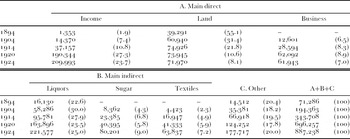
Determined to put their country on a par with the menacing Western powers, the Meiji statesmen created a centralized administrative system that would harness Japan's relatively scarce resources to the imperative goal of rapid modernization. Under the slogan ‘Rich country, strong military’, the government engaged in providing infrastructure, building model factories, and radically reorganizing the armed forces and other institutions. At the same time, it supported private entrepreneurship by all available means, from education and training to fiscal incentives.Footnote 16 To sustain the cost of these undertakings, the state turned initially to the land tax, that is, tax imposition on the most widespread and stable source of wealth. As industrialization progressed, indirect taxes gradually increased in importance due to their greater elasticity (see Table 1). For the purpose of securing still more elastic revenue and correcting the regressive character of the early legislation, income tax was introduced in 1887 in a stealthy manner: quite affluent individuals paid at most 3 per cent of their net earnings, while corporations were exempt. Notwithstanding remarkable advancement since 1899, corporate income and interest on capital continued to receive privileged treatment, as distributive justice remained subordinate to economic development.Footnote 17
National taxes, 1894–1924.

Source: From Tōyō keizai shinpōsha, Meiji Taishō zaisei shōran (Tōyō keizai shinpōsha, 1926), pp. 4, 378, 380, 384, 388.
Numbers indicate thousands of yen, and those in brackets, the percentage of total revenue.
However, while the state refrained from fully exploiting the ability of big industrial and financial companies to pay, other taxpayers had to bear a proportionally larger share of an increase in the tax burden, which the government used primarily for backing imperialist penetration of East Asia. After the Sino-Japanese War of 1894–95, along with the enactment of new excises, the central administration obtained business tax from the prefectures, which targeted a wide range of activities, from manufacturing to commerce and services. Assessed by a combination of flat rates and lump sums (with parameters that often did not reflect actual profit), the tax affected mid to small enterprises most heavily; from the very start, business associations lobbied for its abolition.Footnote 18 A heavier, general increase of taxes supplemented the exponential growth of state indebtedness to finance the fight against the tsarist empire. It became permanent in the ensuing years, with the chief justification that Japan needed to invest in the defence and development of its newly acquired colonies and the leased territory in South Manchuria. The average tax burden per person thus nearly doubled in real terms between 1897 and 1914.Footnote 19 By the Taishō era, it was evident that taxation presented serious flaws either horizontally, due to insufficient transfer of the burden from the agricultural to the secondary and tertiary sectors, or vertically to the disadvantage of those on a low income.Footnote 20
The land tax is representative of both problems. The flat rate on cadastral value and the lack of a minimum threshold benefited larger landlords, while real property in the cities was grossly undervalued compared to the countryside. The cadastre, moreover, had generally fallen behind market appreciation. For the state, raising rates whenever required was an easier, if less fair, way to defend revenue than periodically embarking on costly surveys. After 1914, however, wartime inflation by far offset previous upward adjustments: in 1919 the average price of a paddy was 13.4 times its taxable value, while that of residential estates in the cities had skyrocketed to 55.6 times their taxable value.Footnote 21 The fact that the land tax ceased to expand did not mean, though, that the total imposition on farmers decreased as a result. Besides other national taxes, the weight of local levies should not be forgotten.
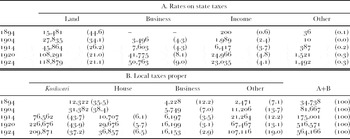
Due to its feudal past, Japan had a solid tradition of decentralized taxation. The Meiji state, while conceding a certain degree of fiscal autonomy to local communities, took care that it did not question the neat primacy of the central government.Footnote 22 Only municipalities were equipped with both a legislative and executive body of their own, albeit with some restrictions. Instead, districts (abolished in 1921–26) and prefectures had locally elected councils but depended on personnel assigned by—and chiefly responsible to—the Home Ministry to carry out the administration. As the state tended to monopolize the most elastic resources, according to their original design, local governments should have relied on property management and fees for services to support themselves. In practice, however, revenues other than taxes soon proved insufficient to sustain the bulk of expenditure, especially as the state found it convenient to oblige other administrations to perform various tasks on its behalf without providing either adequate assistance or greater independence. Ranging from education to public works, these delegated functions drained a large share of local budgets. Pressed by necessity, local authorities resorted to borrowing and tax hikes, but they were hampered by considerable constraints. On the debit side, initiative suffered from the state policy of giving precedence to Treasury bonds. These had also become tax free since the war with Russia, so that local issuers had to pay higher interest to attract investors. Fiscal autonomy was hardly more advanced with regard to taxation (see Table 2). Rates on national taxes could not be raised beyond their legal ceiling without the joint consent of the Finance and Home ministries. Moreover, being nothing but a supplementary imposition, they amplified the defects of the central system.
Local taxes, 1894–1924.

Source: From Tōyō keizai shinpōsha, Meiji Taishō, pp. 524, 529–30, 534–35.
Numbers indicate thousands of yen, and those in brackets, percentage of total revenue (A+B).
Besides surtaxes, prefectures and municipalities could rely on their own taxes, enjoying some discretion in their assessment criteria. The unfairness of these levies, nevertheless, was equally conspicuous. On the one hand, myriad impositions on petty business and small properties afflicted low-income residents. On the other, the kosūwari, usually assessed by a combination of property and income, followed an apportionment method that frequently relied on arbitrary estimates. (In period sources, kosūwari is translated as ‘household tax’; however, as this may cause confusion with house tax, the Japanese term will be used throughout this paper.) Though contemporary accounts made light of the kosūwari's excessive burden on poorer families, research on its distribution has yet not progressed beyond fragmentary case- studies.Footnote 23 It is certain, instead, that this levy had a prevalently rural character. In the big centres, where population density and mobility made assessment more difficult, the house tax substituted for it.Footnote 24
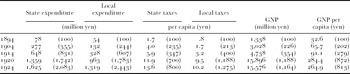
The financial health of local governments deteriorated in parallel with the upgrading of infrastructures and services, reaching an alarming level after the outbreak of the First World War. As expenditure started growing at a faster pace than that of the central administration, so did the average tax burden per person (see Table 3). The fiscal structure of Taishō Japan thus presented some contradictory peculiarities: although both spending and revenue were quite decentralized in quantitative terms, control over these flows and access to the most efficient resources remained largely the prerogative of the state.
Public expenditure and tax burden (indexes), 1894–1924.

Source: From Tōyō keizai shinpōsha, Meiji Taishō, pp. 648, 651; Andō, Kindai Nihon, pp. 2, 4.
It seemed, for a while, that the Great War in Europe would help Japan find a way out of financial straits thanks to the unprecedented economic boom it brought to the country.Footnote 25 The natural increase in fiscal revenues, however, did not suffice to meet the needs of public administrations, nor did it solve, by itself, the problem of unfair taxation. As cabinets in 1914–18 persisted in armament expansion, no major initiative to improve the fiscal capacity of local governments took off. In order to provide some relief to municipalities, in early 1918 the minimum annual contribution of the Treasury to the salaries of primary school teachers, totalling 40 million yen that year, was fixed by law at 10 million.Footnote 26 This measure deserves attention as it was a first step towards the establishment of an extensive subsidy system which, together with centrally managed tax transfers, has since 1940 represented in Japan the statist solution to the fundamental weakness of local finance.Footnote 27 Despite a deeply changed institutional setting, recent efforts for fiscal autonomy started bearing fruit only with the abolition of ‘delegated functions’ in 1999, followed by other reforms still in progress.Footnote 28 In its embryonic stage, however, state support was but a light palliative. Furthermore, when the wartime boom dissolved, the Japanese economy entered a decade of unbalanced growth marked by chronic crises. Industry suffered from the aftereffects of overproduction and excessive indebtedness, which perturbed financial markets and led to outbursts of panic. Agriculture, still supporting 47.7 per cent of the working population in 1930,Footnote 29 stagnated through most of the period, finally sliding into the Great Depression. Fiscal revenues tended to decline accordingly, giving rise to fiercer competition over the allocation of resources.
The rapid but uneven spread of prosperity during the War, combined with the strained conditions that followed, made for an explosive mix with already present causes of social unrest. Fuelled by rampant inflation, the ‘rice riots’ that broke out in the summer of 1918 were the most dramatic of the more persistent symptoms of increased conflict, such as labour strikes and collective tenancy disputes. These organized protests became all the more alarming as they tended to transcend economic claims and take on political overtones. Although socialism would remain a rather circumscribed movement, the spread of the Bolshevik revolution to eastern Siberia and its reverberations in China were strong reminders to the elites in power that something had to be done to prevent that ‘dangerous thought’ taking root in Japan too.Footnote 30 To this purpose, time-honoured police control proved an effective instrument on several occasions; nevertheless, repression alone could not offer an adequate answer to complex problems.
Just as they reached the apex of their trajectory, the two main parties had to shoulder the responsibility of working out how to redefine the state's role in mediating conflicting interests. Used as a catchall to indicate these efforts, the expression ‘social policy’ (shakai seisaku) took on nuances in public opinion that stretched beyond welfare in its narrow sense, and came to imply the concession of universal suffrage. With agriculture facing dimmer prospects for recovery, debate throughout the 1920s centred mainly on the precarious condition of farming villages, perceived as a threat to socio-political stability. Labour-related issues also became increasingly visible. Being a reflection of upper and middle-class constituencies, the big parties were hardly the most qualified actors to implement daring reforms; however, if they had been quite successful so far in serving the interests of a limited portion of society, it was not difficult to foresee that thereafter their fortunes would depend increasingly on their ability to acquire a wider following. The Kenseikai took bolder steps in this direction, albeit with mixed results. Though it was able to enact progressive legislation on some important problems, such as universal suffrage or the mediation of tenancy disputes (1924), it also surrendered to conservative opposition on labour unions and other key bills. The Seiyūkai, for its part, coupled suppression of radical groups with encouraging economic development, rather than distribution of wealth, as a solution to social distress. Either approach was consistent with the parties’ respective financial policies: the Seiyūkai's positive stand called for a light welfare system, where businesses would take care of their employees and higher productivity would guarantee decent profits for farmers; Kenseikai programmes for the re-establishment of ‘sound’ finance, on the other hand, involved deflationary measures that required, in compensation for their social cost, a stronger commitment to welfare reforms. Taxation, in a country that still lacked public networks of social security, represented an immediately available instrument to engage in the latter task. Hamaguchi Osachi, the future Minseitō premier, dwelled explicitly on this concept when he presented bills for cutting indirect taxes at the 46th Diet (30 January 1923).Footnote 31
Before the Great War, the Kenseikai had sided with middle-class entrepreneurs against the imposition of business tax and some indirect levies. In the 1920s, it put a stronger emphasis on the need to ease the plight of the masses through substantial cuts to tax on staple commodities. This objective had figured as one of the party's pledges since October 1921 and constituted one of the three prongs of the first Kenseikai plan for extensive fiscal reform, on which a small committee (including Hamaguchi) had started working in May of the same year. Their other two priorities were raising education subsidies to pay for half of the salaries of primary school teachers and setting aside resources for social policy, meaning chiefly the health insurance system for which the Kenseikai had submitted bills in the two previous Diet sessions. Retrenchment in other areas would provide the necessary backing.Footnote 32
With this scheme, responsiveness to the expectations of business circles dovetailed nicely with more innovative social concerns. Excise cuts would benefit both consumers and producers as lower prices would make Japanese goods more competitive; locally, an increase in state subsidies would make room for cuts to petty taxation and simultaneously bring municipalities under tighter central control. All of these effects appear to support the Kenseikai's foremost monetary goal, which was to peg the yen to gold via deflation. The gold standard, suspended during the First World War (as in other countries), guaranteed the stability of member currencies in trade and international flows of capital; as a prerequisite to raising foreign loans, it had been an indispensable support for Japanese imperial ambitions. However, in order to secure specie reserves sufficient to restore the convertibility of the yen, it was necessary to first reduce trade deficit and public spending. Speaking to party members at the 1922 congress, President Katō Takaaki warned that without ‘a significant fall of prices, it may be impossible to avoid the foundations of finance being as weak as before’.Footnote 33 The Hamaguchi cabinet, opting for a tough deflationary policy, finally achieved prewar parity in January 1930, just as the system was about to collapse due to the world depression. In an effort to mend the disastrous results of this untimely event, the next—and last—Seiyūkai administration promptly reinstated the gold embargo, pursuing—under Finance Minister Takahashi Korekiyo—proto-Keynesian measures for economic recovery that would soon prove successful.Footnote 34
Although debate on the gold standard became central in politics with the 1927 bank panic, the two parties had taken different positions on the issue several years earlier. When Takahashi had served in the cabinet of Seiyūkai President Hara Takashi (1918–21), he had missed the chance to peg the yen shortly after the end of the war for reasons typical both of his party and of his own thinking. Domestically, the government did not intend to retrench the many engineering projects in which it had vital electoral stakes; abroad, it was engaged in an anti-Bolshevik adventure that had brought military spending to 69 per cent of general and special accounts combined. Deflation would also inhibit private investment at a time when Takahashi still believed industry should take advantage of European weakness to catch up quickly. Moreover, he wanted to freeze gold reserves in view of the massive loans to China which, according to his plans, would displace the Western powers from their position of financial dominance.Footnote 35 Because of its ‘positive’ attitude both in economic and foreign affairs, the Seiyūkai could hardly consent to net tax reduction backed by budget cuts, as proposed by the other large party. However, if in the late Meiji era it had supported tax hikes in a manner that put revenue before equity, increased consideration of the latter was unavoidable in the context of Taishō politics. Redistribution, more than overall reduction of the tax burden, would emerge in times of low growth as the keyword of Seiyūkai attempts to correct taxation.
Already, in 1913, the party had sponsored a revision of income tax that balanced a heavier imposition on corporations and wealthier individuals with benefits for those in the lower brackets. Taken together with an increase of the threshold from 300 to 400 yen, these measures were to the advantage of the lower middle classes, such as small landowners or shopkeepers. Blue-collar workers, in contrast, had been exempt since the beginning: in 1913, the daily wage of a male factory worker averaged 0.56 yen, making for an annual income well below the threshold.Footnote 36 In 1920 the Hara cabinet presided over further improvements along similar lines, although it coupled this initiative with the usual aggravation of liquor excises. In the following years, however, the Seiyūkai would focus on a much more complex project, namely the transfer of state taxes to local governments. Fiercely opposed by the rival party, the plan would reach its ultimate shape under the Tanaka Giichi cabinet (1927–29).Footnote 37 In this version, revised land and business taxes were to replace those local levies that most oppressed the poorer strata of the populace. At the same time, robust strengthening of income tax would partially offset revenue loss at central level. The bills cleared the Lower House, only to end up buried by the Peers amid widespread criticism of inadequate backing and outcries about the destabilizing effects of decentralization. The Minseitō, building on the former Kenseikai platform, put forward the alternative proposal that local fiscality should be reformed by raising the Treasury's share of education expenses to full payment of teachers' salaries. Although, in the end, neither party managed to implement its plan, the general reform of 1940 would contain elements that recalled both: the state ceded to local governments the whole revenue from land and business taxes, without making any concession in terms of autonomous assessment. Equalization was pursued through the introduction of a distributive tax, made up of shares of national taxes, and strong expansion of subsidies. This formula, most satisfying to the military and bureaucratic elites who aimed at strengthening central authority, found their justification in the need to rationalize resources for the war effort.Footnote 38
There is a certain agreement that a political struggle over decentralization started in late 1922, when Seiyūkai executives decided to endorse the land tax transfer to counter a Kenseikai bill for reducing it, which threatened to increase support for the latter party among farmers.Footnote 39 However, it would be reductive to consider the Seiyūkai proposal as a hurried tactical move. The tax devolution question, in fact, had already emerged in a government advisory committee in 1920–22. Commentators have long praised the scientific quality of the committee report, noting that it worked as a matrix to all major reforms drafted or implemented until the end of the decade.Footnote 40 A prominent scholar has written that the plan recommended in that document was the expression of ‘purely theoretical arguments on the structure of taxation’; others have pointed out that bureaucracy took the initiative because neither Seiyūkai nor the interest groups involved had a definite vision.Footnote 41 The rest of this paper will deal chiefly with this tax committee, for the purpose of verifying who played the leading role in it, and for which objectives. The following section discusses the circumstances of the formation of the tax committee, with special attention paid to the relationship between parties and bureaucracy, then presents the gist of the report. The next section looks more closely at the drafting process, focusing on the assertions of party members and relating them to the broader political confrontation taking place in the background.
Planning reform
Before the Great War, restructuring the tax system had been under scrutiny since about 1906 in the higher bureaucracy and academic circles, particularly the Social Policy Society (Shakai seisaku gakkai).Footnote 42 Members Kuwata Kumazō and Yokoi Tokiyoshi, drawing inspiration from reform implemented in Prussia in 1891–93, called for a transfer of autonomous resources from central to local governments in order to solve the problem of unfair imposition at the local level. In line with the ‘rational’ evolution of finance, national direct taxation would become more income-centred, possibly acquiring a property tax as a supplement. Yokoi was especially in favour of devolution of the land tax as a means of easing the burden on small farmers, whom he considered the bulwark of traditional values against the corruption of industrialized society.Footnote 43 As in imperial Germany, it seemed that advanced economic theory could thus underpin policies that were aimed at preserving the stability of the socio-political order. Within the bureaucracy, instead, the idea that sustainable local fiscality required decentralization made more inroads in the Home Ministry than among Finance officials. To explain the different positions of the two agencies that exerted the most authority over local government, it may be useful to consider both institutional functions and factionalism. In the first place, the Home Ministry had a generalist character that encompassed responsibility for finance, social stability, and local administration as a whole. Its officials were therefore subject to greater pressure to solve the problems of local taxation. Secondly, for as long as local personnel management remained under the control of the latter Ministry, decentralization would represent a greater loss of jurisdiction for Finance than Home Ministry bureaucrats.
For several years, the agenda set by the elder statesmen—with the limited but increasing involvement of the parties—had shelved more innovative tax plans in favour of piecemeal additions and corrections. By the end of the First World War, however, several conditions facilitated a policy change. The development of income tax had considerably lessened the importance of other direct taxes at central level, making the prospect of partial devolution more realistic. Moreover, both parties had now to demonstrate that they were sufficiently prepared to take on the reins of government, which included planning projects of a certain scope. It was also around this time that a younger generation of bureaucrats reached the middle ranks of the administration. Several are remembered for holding quite liberal views, especially those who, in the 1920s, drafted labour legislation in the newly established Social Bureau of the Home Ministry.Footnote 44 All of those working on highly sensitive political issues, in any case, would have had to follow guidelines from party cabinets or risk demotion.
Though it is a widespread opinion that prewar bureaucrats had an even greater influence on policy-making than their present-day colleagues, in fact they were also vulnerable to external pressures. Rules on appointment to almost any position below minister, perfected in the 1880–90s, confined recruitment in the higher civil service to those who took state examinations and regulated further advancement by seniority.Footnote 45 Protection from undue infiltration by members of the rising parties had not been a secondary goal in the final stage of this complex operation; nevertheless, as the elder statesmen did not want to stifle mobility, transfers and suspension from office were left to the discretion of the responsible ministers. This breach in bureaucratic insulation enabled the parties, once installed in top cabinet posts, to secure the cooperation of officials through incentives and punishments. Moreover, for those lacking oligarchic patronage, informal or even official affiliation to a party became an increasingly valid qualification to pursuing a second career in politics.Footnote 46 Although the majority of bureaucrats tried to protect themselves from government turnover by keeping a low profile, some staked their futures on one party. A real spoil system began to develop, until in 1932, after the assassination of the last party premier, the incoming cabinet revised regulations in agreement with the Privy Council to definitively put an end to the practice. The Seiyūkai had an early advantage in attracting support, thanks chiefly to Hara's intermittent tenure as Home minister in 1906–14.
Therefore, when the same Hara was finally appointed premier in the wake of the rice riots, the situation was ripe for a long-awaited reform of taxation. Earlier that year, the Diet had again approved tax hikes in the name of national defence, voting down ancillary bills on the grounds that thorough reorganization should be carried out after the end of the war.Footnote 47 In February 1919, the Rikken kokumintō, the third and most liberal party, brought the issue back to the Lower House, with a motion for the establishment of a think tank formed by ‘competent persons both in and out of government’.Footnote 48 The majority welcomed the proposal, which the cabinet put into effect in July by creating an Extraordinary Research Commission for Fiscal Policy and the Economy.Footnote 49 As agreed by Hara and confirmed in the Diet, this composite council should have engaged chiefly in restructuring taxation;Footnote 50 however, the premier initially charged separate committees with studying the problem of national food supply, the management of the salt monopoly, the development of steel manufacturing, and shipbuilding.Footnote 51 Although these matters had to be dealt with fairly urgently, Hara let almost a year lapse before putting to one more committee the question: ‘How should the basic policy be concerning the reorganization of the tax system’ (1 June 1920). In the meantime, the cabinet took the initiative unilaterally by relaxing surtax ceilings (in March 1919 and August 1920) and introducing bills to raise income tax and liquor excises (in January 1920, enacted in June). One scholar has therefore inferred that Hara had no intention of entrusting an advisory organ with important assignments.Footnote 52 Moreover, as it took the tax committee two years to formulate a plan that later remained mostly on paper, the same author has concluded that the ‘congenital anarchy’ of capitalism would inevitably doom long-term projects. An assessment of the role that the tax committee played in policy-making should clarify, in the first place, whether it was simply a cauldron where proposals would boil on indefinitely while the cabinet took the decisions that mattered on its own. As recalled elsewhere with respect to the participation of spokesmen for big business, debate in similar investigatory councils was far from perfunctory.Footnote 53 This does not mean that convenors would just mediate among interest groups without holding to their own goals. The fact that partial tax revision was enacted before any plan emerged from the tax committee suggests, rather, that the government was setting the stage to direct discussion along its preferred track. The timing of the committee's formation, Hara's choice of members, and his instructions at the opening meeting all reinforce this impression.
The delay in facing the problem of tax reform makes more sense from the viewpoint of political tactics. As the result of an accurately planned snap election, on 10 May 1920 the Seiyūkai won an absolute majority in the Lower House. A few weeks later, the prime minister was thus able to proceed with increased authority to appoint the tax committee. Although it has been assumed that postponing the debate derived accidentally from the dissolution of the House, the opposite view is found in the press.Footnote 54 Here some data on membership may suffice to convey the predominance of government supporters. Among party men holding seats in the Lower House, the Seiyūkai outnumbered the Kenseikai by seven to one (Hamaguchi), while the Kokumintō was excluded altogether. The Kenkyūkai, chief ally to the cabinet in the Upper House, obtained three of the four seats reserved for Peers, with business spokesman Gō Seinosuke from the Kōseikai filling the remaining seat. Although his group oscillated between the two main parties, Gō himself inclined towards the Seiyūkai. There were allegations that he already owed Hara an appointment in the wartime Munitions Council; in the Extraordinary Research Commission, he was also to secure protection for Japan's heavy industry.Footnote 55
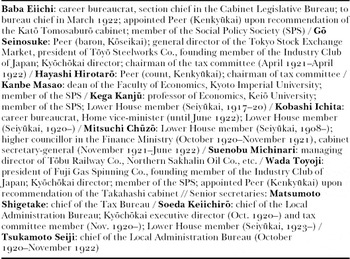
Besides Diet legislators, the tax committee included 17 more people comprising career bureaucrats, influential entrepreneurs, and academicians. Some of them had already served in either House, others would soon do so. Biographical data, especially of those who sat in the principal subcommittees, point again to the primacy of pro-Seiyūkai members (see Table 4).
Members of subcommittees on direct taxation and secretaries.

Source: Biographical data mainly from Senzenki kanryōsei kenkyūkai (ed.) and I. Hata, Senzenki Nihon kanryōsei no seido-soshiki-jinji (Tōkyō daigaku shuppankai, 1981); Shimonaka Kunihiko (ed.), Nihon jinmei daijiten, six volumes (Heibonsha, 1937–38, reprinted 1979), Shūgiin and Sangiin (eds), Gikai seido hyakunenshi, Volume: Shūgiin giin meikan, Kizokuin-Sangiin giin meikan (Ōkurashō insatsu kyoku, 1990).
It may therefore be assumed that the outcome of debate would eventually match the position of the majority party. Even before discussion started, though, Hara put a condition on aggregate revenue:
[As] expenditure is going to rise along with the progress of society and the development of the state, [it is important] to reorganise radically the tax system without reducing the current revenue of either national or local taxes[.]Footnote 56
As the cabinet had already arranged a major increase in surtaxes and excises, as well as strengthening income tax, the above premise meant that reform would not run counter to the expansionary policy pursued by the Seiyūkai. The political context, therefore, provides a clue as to why the tax committee could not work on net tax reduction in spite of a slack economy. Hara demanded that reform should maintain revenue levels and redistribute the burden in a more equitable way. More specifically, the committee was to study three alternatives: to flank the aggregate income tax with revised land and business taxes; to substitute the latter two with a general property tax or with a classified income tax targeting each source of income, such as real estate, securities or business.Footnote 57 Although all options confirmed income tax as a cornerstone of direct state taxation, they diverged on what its best form should be. The first proposal called for the preservation of the present structure. The other two, on the contrary, implied that major changes could also take place at a local level. As the officials from the Finance and Home ministries assigned to the tax committee secretariat explained to members, land and business taxes would be ceded to local governments in addition to their current surtaxes, thus providing leeway to cut the kosūwari and many petty levies. In the process, revising the land and business taxes would ensure that their flaws would be removed: while adherence to the market value of land would be restored by taking rents for assessment, the business tax would more faithfully reflect capacity, thanks to an improved mix of benchmarks. The tax committee concluded that to carry out this double adjustment locally offered decisive advantages.
The question, at this point, was how to cover the loss that devolution would cost the Treasury. Classified income tax, though refining the distinction between labour and capital, would be very similar indeed to its general counterpart, as self-assessed returns already left too much room for error and evasion. This was also the chief justification for not basing the business tax simply on profit. In the end, the committee's choice fell on the property tax: it would strengthen imposition on capital, hitting those movable assets that had not been adequately taxed so far; assessed on current value, it would promptly adjust to appreciation; and irrespective of the actual income accruing from an asset, it would encourage productive investment. It was acknowledged, however, that the burden might fall chiefly on the most easily detectable kind of wealth, namely landholding. In view of this difficulty, it was agreed that ‘for the time being’ the property tax should stay ‘at the lowest possible rate’, which meant a flat 1.5/1,000 instead of excess progressive rates (4–10/1,000), as originally intended. At the same time, the threshold would drop from 10,000 to 2,000 yen, in order to allow immediate allocation of nearly half of the land and business taxes. The initial limit took as standard ‘the property amount necessary to earn an income at the minimum taxable level’, that is 800 yen.Footnote 58 From tax committee proceedings and a later report by the Tax Bureau, this was the average income of the owner of approximately two chō (about two hectares) of rice paddy.Footnote 59 A lower figure (1.7 chō) is obtained by dividing 10,000 yen by the average market value of 0.1 chō in 1918–20.Footnote 60
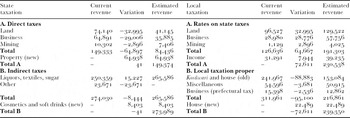
In other words, the lowest bracket of the property tax would affect middle-class farmers engaged in direct cultivation with the assistance of hired labour.Footnote 61 Conversely, imposition starting from 2,000 yen would hit the mass of tenant-owners, who constituted about 40 per cent of Japan's farmers. We shall return to the social significance of these changes to the prospective tax. In the final plan, the land and business taxes would temporarily subsist in the state system at lower rates, while a sum roughly equivalent to the property tax would accrue to local governments in the form of increased surtaxes (see Table 5).Footnote 62
General plan for tax reform, 1922.

Source: From Zeisei seirian, pp. 23–27.
Numbers indicate thousands of yen.
Note: Includes only taxes affected by revenue variation.
‘Business’ includes patent medicine business tax (310).
‘Other’ indirect taxes: on passenger tickets, soy sauce, combustible oil, and medicine stamps.
Mining surtaxes and part of miscellaneous taxes were incorporated into the prefectural business tax, but are separated here to avoid confusion on the source of revenue variation.
House tax was levied instead of kosūwari in certain areas, especially cities, without unified criteria of assessment. It was to be replaced nationwide by a new tax on the rental value of houses.
At this stage, in sum, decentralization was not planned to proceed beyond a partial revenue transfer. Moreover, revision of the land tax was to be suspended. The tax committee's report stated that this phase would end when the property tax could back devolution in full, but remained silent on the modalities of such improvement. In a final attachment, however, the committee expressed the wish that the reform be completed by an alternative means, that is cuts to military expenditure. It was a clear allusion to the outcome of the Washington Naval Conference (November 1921 to February 1922), which bound Japan not to strengthen its bases in the Pacific and suspend the construction of capital ships.Footnote 63
The advice to back half of the devolution with a tighter budget, while contravening Hara's veto, showed some sympathy for the population suffering the effects of the economic crisis. Nevertheless, it failed to win favour when discussion moved on to the plenary meetings of the Extraordinary Research Commission (10–20 July 1922). Besides objecting to specific elements of the plan, several members were vocal in calling for thorough tax relief, in line with the international postwar trend.Footnote 64 The independent press supported this view.Footnote 65 In the end, acting on the suggestion of the recently appointed premier, Admiral Katō Tomosaburō, the report was submitted to the cabinet for reference only, with an invitation to carry on the study. The incoming administration would soon adopt a policy of financial austerity, which enabled it to revise and reduce the business tax in 1923 in accordance with the tax committee's recommendations; it did not proceed, however, to any decentralization of the tax system.Footnote 66
Even from this brief outline, it appears that the tax committee had been bogged down in a mire of contradictory goals. On the one hand, it pursued devolution both as a prerequisite to correcting land and business taxes and as a necessity to sustain local finance in place of those levies that weighed heavily on low-income families. On the other, it was reluctant to back the project by means of an equally substantial state tax that would hit the middle and upper classes, nor did it consider cutting expenditure until stiff Anglo-American pressure halted the expansion of the Navy. With its clumsy combination of ‘mild’ property tax, postponement of land tax revision, and recourse to not yet quantified disarmament, the report lacked consistency. To shed light on the causes of such an outcome, it is necessary to go back to the interplay of forces within the committee.
Behind the report
Despite the initial options, a restricted group of subcommittees, chosen by the chairman, worked single-mindedly on the property tax scheme, pushing through the agenda with the support of secretaries. First presented to other members in January 1921, the new tax scheme was redesigned by June. As later explained in the report, this was chiefly due to criticism that it was too burdensome, especially for landowners. At the year-end, it was suggested a two-step implementation of the land and business taxes transfer might be avoided by taking advantage of the Washington Naval Treaty. After that, however, all that opponents managed was to gain time, until the plan was passed by a majority vote. The liberal press denounced these high-handed tactics, claiming that the group of subcommittees was paving the way for another increase in the tax burden on behalf of the government.Footnote 67
Although the arguments put forward by each participant are relevant to understanding which interests were at stake, here we will focus on two party men—Mitsuchi Chūzō and Hamaguchi Osachi—who would have prominent roles in fiscal politics for a decade. The former, at the time a mid-ranking Seiyūkai executive, had been picked by Hara to fill the post of higher councillor in the Finance Ministry. It was a sign of great trust, as this function, so far reserved for career bureaucrats, had just been opened to discretional appointment after strenuous negotiations with the Privy Council.Footnote 68 Mitsuchi thereafter became a close associate of Takahashi, who promoted him directly to cabinet secretary-general upon taking over the premiership after Hara's assassination in November 1921.Footnote 69 Eventually Takahashi secured for his protégé the succession to Finance minister in the Tanaka cabinet. Under that administration, which endorsed devolution of land and business taxes to the extent of making it the top Seiyūkai issue at the first general election held with universal suffrage (1928), Mitsuchi strove again to blend ‘positive policy’ with social-minded tax relief; the two goals, however, remained too much at odds to be reconciled.
As a staunch proponent of tax transfer to local governments, Mitsuchi would clash repeatedly with Hamaguchi, probably the foremost Kenseikai expert on the matter. A former bureaucrat, Hamaguchi had spent the early years of his career directing tax offices around the country. He flatly rejected the subcommittee draft, as ‘the structure of state taxation is thrown into confusion’.Footnote 70 He preferred to reverse the approach: first outline a property tax with realistic parameters, and then decide whether to use it to implement partial devolution or reduce other taxes. As Hamaguchi did not agree with the need to correct the land and business taxes locally, he instead proposed to offset a cut of 32 million yen in indirect taxes by levying progressive rates on property (0.5–2/1,000, starting from 5,000 yen).Footnote 71 Later on, although he could not prevent the devolution scheme from prevailing, Hamaguchi still insisted on a mildly progressive property tax with the threshold at 10,000 yen. The majority of the committee rejected this proposal on the grounds that it brought in insufficient revenue.Footnote 72
Hamaguchi's proposals on indirect taxes were quite in line with the Kenseikai platform. While the former, however, called the new tax ‘necessary to attenuate frictions between propertied classes and proletariat’, his party chose to offset revenue loss entirely by means of retrenchment. A prevalence of business interests over social concerns is also discernible in the smaller Kokumintō. At first, Secretary-general Suzuki Umeshirō declared that a progressive property tax could be a useful instrument of social policy, while criticizing the flat-rate version preferred by the tax committee.Footnote 73 However, when his successor Ōguchi Kiroku intervened at the Extraordinary Research Commission meetings the next year, he spoke in favour of devolution, backed exclusively by cuts to expenditure. By the late 1920s only the socialists endorsed the introduction of a property tax. Though it is open to speculation why Hamaguchi took a more progressive stand than that of his party, it is clear that dissent between Seiyūkai and Kenseikai representatives on the specific issue of taxation reflected a more general conflict on fiscal and monetary policies.Footnote 74 Hamaguchi's party disliked decentralization, as it involved the risk that expenditure might grow out of control. It conceived of tax reform in the context of budget tightening in a manner incompatible with Hara's instructions: as late as April 1922, Mitsuchi was adamant that ‘not decreasing tax revenue is put as a necessary condition’.Footnote 75 At the time, the official line of the Takahashi cabinet was that they would use armament reduction to finance river works projects and increase state subsidies for elementary education.Footnote 76 The former measure represented the attempt to preserve, at least in part, the traditional Seiyūkai policy; the latter deprived the opposition of a valid argument with which to attack the majority. It should also be noted that devolution would not exclude an increase in subsidies per se, especially if its primary aim was not to foster local autonomy. Before the war, officials in the Home Ministry had already suggested combining the two initiatives.Footnote 77
Judging from how the discussion unfolded in the 1920s, it is doubtful that either party ever fostered a genuine interest in developing local self-government.Footnote 78 How can it be explained, then, why Mitsuchi took land and business taxes devolution so much to heart? As he himself stated (on 27 April 1922), and as is evident from Table 5, the main purpose of this reform was to drastically reduce the kosūwari. At the meeting of 16 June 1921, secretaries explained that kosūwari and house surtaxes levied by towns and villages in the previous year amounted to 177.6 million yen, or 74.7 per cent of the total tax revenue of those administrations; the 17.3 million levied by cities, by contrast, constituted only 25.6 per cent of their tax revenue.Footnote 79 These data, while confirming that the kosūwari fell prevalently on rural communities, provide no clue as to vertical equity. Quite revealing on the political relevance of this tax, however, are some remarks made by former prefectural governor Soeda, who at the time was one of the Kyōchōkai (Cooperation Society) directors.Footnote 80 Established at the end of 1919, the Kyōchōkai was a semi-governmental organization charged with promoting harmony between labour and management. Though originally conceived of by Seiyūkai bureaucrats to prevent the diffusion of autonomous workers’ unions, it would function mainly as a research institute.Footnote 81 Speaking on the basis of years-long fieldwork, Soeda warned that reducing indirect taxes was fine, but cutting the kosūwari that weighed on the ‘lean people in the countryside’ was a more urgent matter, especially in light of the recent reform of local councils. As ‘the election law has become close to general suffrage’, with the result that ‘there are already not just a few towns and villages where council members are all tenant farmers’, it could be expected that the kosūwari would become more and more the main object of contention in rural administration:
[W]e have to foresee that many tenants, harboring ideas of retaliation towards past measures, will try to impose an especially heavy taxation on the propertied classes. Of course we must devise with every means a way of reconciliation[.]Footnote 82
It seems, therefore, that reducing the kosūwari was intended also to shield landlords from the political rise of tenants. In April 1921, the Diet had approved a cabinet bill that downgraded the requirement for municipal suffrage to include those who paid any amount in local taxes; moreover, the computation system that assigned greater weight to wealthier voters was abrogated in the smaller centres and simplified in the cities. The next year, it also became possible to vote for prefectural councils after paying any amount in national taxes.Footnote 83 Though historians have generally emphasized the Seiyūkai's stubborn rejection of general suffrage, the Hara and Takahashi cabinets did extend the franchise in a more wary progression. The process started in 1919, when the voting qualification for the Lower House fell from 10 to three yen in national taxes. The result of this first step was far from radical, as those entitled to cast their vote at the election of 1920 made up 4.63 per cent of the Japanese population, compared to 2.58 in 1917. Under manhood universal suffrage, the share would eventually rise to and remain stable around 20 per cent.Footnote 84 Yet it cannot be denied that reform had remarkable effects at the local level: at the time of enactment, municipal electors rose from 8.79 to 13.70 per cent of the total population, while those of prefectural councils rose from 4.21 to 12.96.
Therefore, though Soeda exaggerated change, the pattern of enfranchisement pursued by the Seiyūkai was one of a gradual opening up of mass politics in which local voting represented the frontline. Notes in Hara's diary confirm that the attitude of the party leadership towards general suffrage was not so much one of absolute (and unrealistic) refusal as of prudent preparation.Footnote 85 It is in this light that several cabinet decisions best show their complementary character. Home Minister Tokonami Takejirō (1918–22), a former bureaucrat who had long enjoyed Hara's protection, oversaw both election reform and the drafting of a bill for the repression of ‘radical social movements’; his labour policy marginalized unions while enhancing state mediation through the Social Bureau and the Kyōchōkai. In 1919 Tokonami also launched a ‘campaign to foster national strength’ which extolled the merits of ‘cooperation and harmony’ among all layers of society; like similar bureaucratic campaigns waged since the early 1900s, it appealed mainly to the residents of towns and villages.Footnote 86
As noted by one author with regard to those precedents, officials tended to concentrate their efforts for social stability on the rural populace not simply because of its high demographic ratio but also because they considered it to be the repository of national identity, that is state cohesion.Footnote 87 Despite the relative decline in importance of the agricultural sector and the rapidly shrinking contribution of the primary sector to net domestic product (from 30.2 to 17.6 per cent between 1920 and 1930),Footnote 88 the countryside would retain a prominent position in the political life of modern Japan. Among the parties, the Seiyūkai had the most robust ties with rural society. It is therefore logical that this relationship would be reflected in an approach to the problem of tax reform that assigned great weight to land tax and kosūwari. The reduction of indirect taxes that the Kenseikai advocated, instead, was a matter of primary concern in the cities, which were the main centres of both manufacturing and consumption. Why the Kenseikai seemed less eager to confront rural issues is a more intriguing question. After all, both parties depended chiefly on the farmers’ vote to elect their representatives. Data for 1922 indicate that 86 per cent of the electors of the Lower House resided in rural districts; within this share, 68.6 per cent owed the franchise exclusively to paying the land tax.Footnote 89
Landowners enjoyed easier access to the polls because the land tax had no threshold. According to tax committee estimates, direct farming of about two chō of rice paddy would yield a net return of 800 yen, sufficient to qualify these farmers for voting through the lowest bracket of income tax. A tenant or tenant-owner, though, had to subtract the landlord's share from his earnings. Moreover, about 90 per cent of farmers cultivated less than two chō.Footnote 90 However, the owner of even a small patch would be able to vote thanks to the land tax, which averaged 15.7 yen per chō.Footnote 91 By contrast, since no tax was levied on income if the amount after deductions was less than 800 yen, a company employee needed to earn at least 1,000 yen to qualify, due to the 20 per cent deduction on labour income. Deductions for dependent family members would further increase the minimum amount required to vote. Thus, the abrogation of tax requirements would not only extend the franchise down to the popular masses, but also bring the relative weight of rural and urban voters closer to their demographic representation. In perspective, industrial growth and consequent urbanization may even reverse the internal balance of the electorate. The Kenseikai, because of its comparative advantage in urban constituencies, had a valid incentive to promote general suffrage. In fact, between 1920 and 1924 the percentage of urban votes gained by the Kenseikai rose from 12.2 to 16.8, while that of the Seiyūkai remained almost unchanged (7.4 to 7.1 or 8.3 if combined with results for the splinter Seiyū hontō).Footnote 92 One may conclude that Kenseikai liberalism, rather than stemming from a decisive superiority in urban districts, was more a calculated bet on the eventual expansion of that support base.
However, the question of alignment to either urban or rural interests gets more complicated with respect to the property tax. While the main purpose of the land and business taxes transfer was to improve equity in the countryside, the property tax that was to accompany it took much criticism—precisely for being biased against landowners. It was for this reason that even an early advocate of fiscal decentralization such as Yokoi opposed the whole project. He also wrote that implementing tax devolution at a time when the Chambers of Commerce were lobbying hard for reducing the business tax would be likely to shift the burden onto farmers.Footnote 93 The author of a more recent study, who estimates that the property tax was split evenly between ‘rural villages-landlords’ and ‘cities-capitalists’, concludes on the contrary that the former enjoyed a tax reduction. This analysis poses some problems, particularly as it seems to confuse the first and final version of the tax committee's plan.Footnote 94 Even assuming that a 50–50 partition may be close to the expected result of the flat-rate version, this hardly seems a big gain for farmers, who in 1920 bore about 48 per cent of the total land and business taxes. Several provisions in the report suggest, rather, that subcommittee members agreed to keep the tax burden on industrial and financial assets low: exemption for corporations was in place from the first draft, while progressive rates were soon abandoned, mainly to the advantage of wealthy entrepreneurs. It is worthy of notice, in this light, that one of Mitsuchi's arguments against the classified income tax was purely political: as the income tax revision of the previous year had already met with opposition, it would have been difficult to implement further changes.Footnote 95 The redistributive potential of the property tax was further weakened by the adoption of a low threshold.Footnote 96 In concrete terms, the passage from 10,000 to 2,000 yen meant especially shifting the tax base from the middle class to the lowest and most numerous type of landowners. Though defending their plan to the last, subcommittee members had to acknowledge that taxing property below two chō was far from ideal from the standpoint of social policy.Footnote 97
The political process that resulted in the failed endorsement of the tax committee's report is summed up here. Inspired by reform in Prussia, socially concerned scholars and officials in the Home Ministry developed ideas that would combine fiscal decentralization with the introduction of a property tax. This proposal aroused interest in the Seiyūkai, as it had the potential to ease social conflict, particularly in rural districts that were of foremost importance to the party, without drying up resources for a positive spending policy. After taking legislative steps that would smooth the passage of the plan, Hara entrusted a committee to build consensus. However, due in part to the cabinet's rigid stand on revenue, the property tax appeared too heavy to many tax committee members. Consequent revision of the original plan, which largely deprived the property tax of its function to shift the burden towards the upper classes and urban interests, was a major gain for the representatives of big business; it also halved the margin for a reduction of current local taxes, again to the main detriment of lower-income taxpayers in the countryside. To remedy the latter defect, leading members agreed to allow a decrease in national tax revenue, backed by cuts to the naval budget. Although a majority in the tax committee accepted the revised plan, the persistence of a negative economic trend undermined the chances for its approval at the Extraordinary Research Commission general meetings. The new cabinet shelved the tax committee's plan, eventually carrying out limited amendments that did not alter the structure of taxation. It has been pointed out that the change of premiership from Takahashi to Katō sealed the fate of the committee project, because the incoming administration adopted a policy of budget curtailment.Footnote 98 In fact, Takahashi's resignation (on 6 June 1922) came at a crucial moment of the debate. However, in order to evaluate the impact of this political factor on the final outcome, it would be opportune to establish first to what extent the Katō cabinet actually distanced itself from the Seiyūkai on fiscal issues.
Turning plans into practice
Admiral Katō was the first of three non-party premiers who held office between 1922 and 1924, under a brief revival of ‘bureaucratic’ government propped up by the surviving members of the Meiji oligarchy. Nevertheless, this sequence of ‘neutral cabinets’ was more than a return to past practice and was intended as an interregnum when neither big party seemed to offer sufficient guarantees for a stable administration. Though holding an absolute majority in the Lower House, the Seiyūkai had plunged into bitter internecine struggle since Hara's sudden disappearance.Footnote 99 For this reason, Katō was able to retain some autonomy in policy decisions. Finance Minister Ichiki Otohiko, a Kenkyūkai Peer who had long served in that department, set out guidelines for tightening the budget as requested by business circles. However, the Seiyūkai was still united enough to curb the minister's resolution considerably, obtaining major amendments to the early draft on railways, river works, education subsidies, and other expenses. The military held their ground even more effectively, compensating for cuts with a number of new items. The Navy, in particular, managed to divert funds from the construction of battleships to smaller vessels that did not fall under the restrictions of the Washington Treaty. The liberal press, reporting that over 35 per cent of state expenditure for 1923 was destined for military purposes, commented that it was ‘as usual, an arms-biased, militarist budget’.Footnote 100 Thus, under the crossfire of military and party demands, ultimately Katō did not depart much from the policy of moderate restraint in spending that Takahashi had inaugurated in early 1922.Footnote 101 It should also be noted that the cabinet line-up itself appeared ‘quasi-Seiyūkai’: although no party member was represented, several posts went to trusted supporters, starting with Home Minister Mizuno Rentarō.Footnote 102 All things considered, it is likely than dissent within the Seiyūkai, more than from the new administration, prevented implementation of the tax committee's plan. Takahashi later claimed to have endorsed devolution since the Hara cabinet, as did his party; however, other sources shift such commitment to late 1922.Footnote 103 The emergence of increasing obstacles to backing reform may help to explain this discrepancy. In any case, there is evidence that some high-ranking party members who sat in the tax committee opposed the early project.Footnote 104 As they all seceded from the Seiyūkai in 1924, the correspondence between policy and factional choices may suggest that conflicting opinions over finance were a relevant cause of the party split. However, their importance in a much more intricate web of allegiances and strategic views should not be overemphasized. Notwithstanding their contribution to the tax committee draft, both Kobashi and Soeda would eventually walk out of the Seiyūkai, together with factional leader Tokonami.
Internal strife might have also resulted from the implications of fiscal reform on the electoral system. It has been noted that when the actual leader of the progressive Takahashi faction, Yokota Sennosuke, managed to have tax devolution formally adopted as party policy, it was partly to win acceptance of universal suffrage.Footnote 105 According to an investigatory committee presided over by Minister Mizuno, under the law at the time, abolishing the national land tax without a substitute would have had the unacceptable effect of disqualifying over 60 per cent of electors, while joint land and business taxes devolution would raise this share to 69 per cent.Footnote 106 As mentioned previously, this was because most people eligible to vote were able to do so exclusively thanks to the land tax. A similar problem, however, would have arisen even if a property tax was levied as recommended by the tax committee. While a very small plot was enough to qualify people to vote through the land tax, a plot about ten times larger was needed to reach 10,000 yen in property value. Even the 2,000 yen threshold would have not prevented the electorate from shrinking.Footnote 107 This does not necessarily mean that the tax committee plan involved universal suffrage; less radical options were available, such as restricting the vote to economically independent men, possibly under proof of payment of local taxes (numbering 9,448,668 people in 1920) and to middle school graduates (numbering 735,731 in 1921). This, in fact, was the solution proposed to Katō in the Mizuno report.Footnote 108 At the 46th Diet, Mitsuchi explained reticently that his party intended to accommodate devolution with suffrage enlargement in a manner that would pay due respect to Japan's ‘national polity’.Footnote 109 The tax committee plan, therefore, prefigured for the Diet requirements that were similar to those just enacted for local councils.
Finally, to conclude the discussion on the relationship between Katō and the Seiyūkai, it would be hasty to infer from the lack of legislative progress that the former remained deaf to calls for fiscal decentralization. The Seiyūkai motion stated that reorganizing local taxes must take priority and that the government should ‘devolve independent forms of taxation such as the land tax’.Footnote 110 Spokesman Mitsuchi clarified that, although it would be best to include the business tax in this initiative, as a first step the land tax would be more effective in relieving farming villages from the kosūwari. This proposal did not come with any specific idea of offsetting the revenue decrease at national level, aside from a vague hint of retrenchment. Put under pressure, Mitsuchi acknowledged that full backing might require hikes in tariffs and postal fees, perhaps even a new tax. Later on, he hazarded words in favour of a ‘soft’ property tax, likely derived from one of the tax committee hypotheses.Footnote 111 Just a few weeks earlier, though, Seiyūkai representatives had declared at the Conference of the Agricultural Associations that budget curtailment made abolishing the land tax possible. This awkward behaviour seems to indicate that party executives, alarmed by mounting dissatisfaction in rural districts, emphasized the most appealing part of the devolution plan before they could find a reliable means to back it. This delicate task was left to the cabinet, which in June 1923 established a Finance Ministry committee to investigate the matter.Footnote 112 One scholar has argued that the government was just biding its time in order to keep the Seiyūkai quiet.Footnote 113 However, debate progressed quite smoothly between Finance and Home officials, until the former recommended not levying a substitutive tax, as per the prevailing public opinion, in case of land tax devolution. The committee held one more meeting (on 22 August) shortly before the premier's death, and was later disbanded in the wake of the earthquake and fire that razed most of the capital on 1 September. What might have been the fruit of further discussion remains a matter of conjecture.
In the next few years, reconstruction and other issues would take precedence over tax reform, until this issue re-emerged in the summer of 1925. At that time, having joined forces to defeat the Seiyū hontō in the general election, the Kenseikai and Seiyūkai were strange bedfellows in a coalition cabinet dominated by the former party. Some historians note that a clash on tax measures was the justification both partners used to break free from each other. Seiyūkai representatives resigned in protest at the general reform plan drafted by Hamaguchi and his subordinates, as it did not contemplate devolution of the land tax. In light of all the evidence presented above, however, it should be clear that such a complaint had more substance than mere pretext to leave the cabinet. The plan the Kenseikai eventually turned into law in 1926 followed the scheme that got the lowest marks in the tax committee report—that is, correction of land and business taxes within the national system, supplemented by a new house tax and a tax on capital interest (finally including state bonds). Due to government turnover, though, reform of the land tax was enforced by the Hamaguchi cabinet only in 1931. On that occasion, thanks to the reduction of the Navy budget after the London Conference, the administration was also able to slightly cut land and business tax, as well as that on sugar and textiles. Yet, at neither time did the party solve the basic deficiencies of local taxation, nor did it manage to carry out a substantial decrease in the tax burden. As in 1923, the Navy ingeniously circumvented treaty limitations by shifting funds to allowed items, so that for the whole 1931–36 period only 134 million yen remained available for tax reduction out of the potential 508 million yen. Debate on fiscal reorganization continued into the 1930s under national unity cabinets, which had growing concerns about how to finance the military advance in Asia with higher tax revenue while preventing social rifts on the home front. After the outbreak of all-out war in China, big business had to yield to pressure for more progressive taxation; the reform of 1940 achieved this goal mainly through the introduction of classified and corporate income taxes. At the same time, the long-standing question of local fiscality was settled in the statist manner already described.
Conclusion
As a compromise between protecting vested interests and making overtures to the newly enfranchised masses, the initiatives taken by party cabinets fell short of bringing the ‘radical improvement’ that the tax committee had advocated in its report. Nevertheless, it cannot be denied that since the early interwar years party leaders had been acutely conscious of the need to amend taxation as a part of a new social policy. The system laid out in the Meiji era, with its dominant concern for fast industrialization and military build-up, had caused distortions that could not but aggravate conflicts in Japanese society. The parties did attempt to correct some of the most blatant defects, although they found it hard to mediate on behalf of those who did not belong to their older constituencies. Postwar historiography has frequently sketched an opposition between a reactionary, landlord-based Seiyūkai and a more urban-oriented, relatively liberal Kenseikai. However, a closer look at specific issues reveals that party responses to a range of external stimuli was more articulated than it is often acknowledged; it also reminds us that different opinions coexisted within each party. The question of tax devolution is a case in point, especially with regard to the Seiyūkai.
Although the centrality of farmers to devolution proposals was already evident to contemporary observers, urban interests too had a strong voice in the party and played a major role in the failure of the tax committee's proposals. Political leaders had to think how to reconcile a rural base with numerically thin but better organized business elites, who not only provided essential funding but also constituted the social milieu of many party executives. Until economic growth provided sufficient fiscal resources, the Seiyūkai could limit friction between these two sectors with prodigal investment in infrastructures and public facilities for rural communities. It is a strategy that offers some striking similarities to the one the Liberal Democratic Party adopted during its long hegemony in the postwar era. However, in the interwar years (as later in the 1990s) worsening financial conditions brought the situation to a deadlock.
As mentioned above, the Kenseikai-Minseitō achieved more tangible results than its rival in the field of taxation, enforcing measures that included an appreciable element of social policy. This was possible thanks to a strategic vision that tied up orthodox economic thought with progressive liberalism, in an effort to revitalize the party's ability to mediate among different layers of society. Yet, in the end, results remained below target. Though the Kenseikai advocated retrenchment to offset tax cuts, contingent needs such as earthquake reconstruction limited the scope of the 1926 reform. Moreover, military spending compressed the cabinet's room to manoeuvre, leading to disappointingly meagre tax relief in 1931. Admittedly, it was the Seiyūkai that faced the biggest problems in backing tax cuts with armament reduction, due to its strong Chinese policy. The other big party pursued international concertation, which was also functional to containing expenditure. Nevertheless, neither party contested the need to maintain a colonial empire or to protect Japan's special interests in northern China with a certain degree of armed preparedness. Besides sharing some common goals with the parties in this respect, the military continued to enjoy an institutional autonomy that rested on far more solid ground, which became manifest in the early 1930s.
The higher civil service experienced the season of party cabinets in a more traumatic way, because the legal framework that allowed the latter to interfere in the careers of officials also enabled them to set policy priorities. In the case of tax legislation, it has been noted how over time the same bureaucrats drafted contrasting bills, depending on which party was in power.Footnote 114 However, this does not prove that civil servants had lost all initiative. As pointed out in a case-study on postwar tax politics, the bureaucracy can reach its goals when a proposal touches a chord with the ruling party. To fulfil this condition, it may be necessary to adapt the initial project until it becomes palatable to politicians.Footnote 115 The tax committee's plan drew largely on ideas from the Home Ministry and best served its objectives, but took definitive shape in a policy forum that Hara had established. Similarly, the alternative scheme for the revision of national taxes without devolution, which better suited the needs of the Finance Ministry, became law with the consent of the Kenseikai. The integration of several higher bureaucrats into party directorates certainly contributed to smoothing cooperation between the two levels of policy-making. It would be hard to say, for instance, whether Kobashi supported the devolution plan more in the guise of a Seiyūkai member or as vice-minister for Home Affairs. Tax policy, in sum, provides insight into a number of key issues in Japanese history, from the interplay among political institutions to their relationship with wider society. It is a theme that deserves further research, as it can usefully complement more advanced areas of study.