Introduction
Among insects, diapause is the primary means of achieving seasonal synchronization. This adaptation not only affects dormancy and survival during adverse conditions, and also determines, in large part, the timing and rates of growth, development and reproduction during favorable periods (Tauber et al., Reference Tauber, Tauber and Masaki1986). The occurrence of diapause is determined by various environmental factors. Among the environmental stimuli that influence diapause, photoperiod and temperature are the most important (Tauber et al., Reference Tauber, Tauber and Masaki1986; Danks, Reference Danks1987; Saunders, Reference Saunders2002). Widely distributed insects frequently develop local adaptations in various life-history traits along a climatic gradient. Therefore, an insect species that occupies a vast geographic area may exhibit much diversity in diapause mechanism. Comparisons among populations occurring at different latitudes have been proven especially useful because one can assume that there are underlying gradients in the physical environment, particularly in day length, temperature and duration of growing season. Diapause incidence in response to a particular combination of environmental conditions is also an inherited characteristic. Thus, geographical variation in diapause has formed the basis of many studies on the genetics of diapause (Beck, Reference Beck1980).
However, almost all studies of genetic analysis of diapause through crosses of geographic strains focus on those insects with photoperiodic control of diapause (Danilevskii, Reference Danilevskii1965; Beck, Reference Beck1980; Tauber et al., Reference Tauber, Tauber and Masaki1986; Saunders, Reference Saunders2002). Cross-mating of strains from different geographical areas reveals that several types of genetic mechanisms may have involved in the determination of diapause characteristics based on polygenetic inheritance or Mendelian inheritance (Tauber et al., Reference Tauber, Tauber and Masaki1986; Saunders, Reference Saunders2002). The polygenic inheritance of diapause characteristics has been found in many insects, such as the knot-grass moth, Acronycta rumicis, the arctiid moth, Spilosoma menthastri, the cabbage butterfly, Pieris brassicae, the satin moth, Leucoma salicis (Danilevskii, Reference Danilevskii1965), the boll Weevil, Anthonomus grandis (McCoy et al., Reference McCoy, Lloyd and Bartlett1968), the flesh fly, Sarcophaga peregrina (Kurahashi & Ohtaki, Reference Kurahashi and Ohtaki1977), the face fly, Musca autumnalis (Kim et al., Reference Kim, Krafsur, Bailey and Zhao1995), the blowfly, Calliphora vicina with a maternal characteristic (McWatters & Saunders, Reference McWatters and Saunders1996, Reference McWatters and Saunders1997), the European corn borer, Ostrinia nubilalis with a sex-linkage (Ikten et al., Reference Ikten, Skoda, Hunt, Molina-Ochoa and Foster2011), the comma butterfly, Polygonia c-album (Söderlind & Nylin, Reference Söderlind and Nylin2011) and the Asian corn borer, Ostrinia furnacalis (Xia et al., Reference Xia, Chen, Tu, Yang and Xue2012; Huang et al., Reference Huang, Chen, Xiao, Xia, Hu and Xue2013), in which the incidence of diapause and the critical photoperiod of all F1 hybrids were intermediate between those of their parents. A simple Mendelian inheritance of diapause has been found in some insects, such as the linden bug, Pyrrhocoris apterus (Dolezel et al., Reference Dolezel, Vaneckova, Sauman and Hodkova2005), the spider mite, Tetranychus pueraricola (Suwa & Gotoh, Reference Suwa and Gotoh2006), and the flesh fly, Sarcophaga bullata (Han & Denlinger, Reference Han and Denlinger2009), in which the segregation rate of diapause in hybrids was close to 3:1, implying a major role for one gene or a small gene cluster in diapause induction. So far, no crossing experiments were conducted between two strains in which one exhibits a photoperiodic induction of diapause, whereas another lacks photoperiodic response.
The cabbage beetle, Colaphellus bowringi Baly (Coleoptera: Chrysomelidae), is a serious pest of crucifers that is widely distributed in China, undergoing an imaginal diapause in the soil. The seasonal life cycle of the cabbage beetle is very complicated because of the geographical variation in diapause characteristics. According to our observations, the most-northern strain originated from Harbin city (as HB strain, 45°8′N, 126°6′E, 151 m a.s.l.) has generally one generation per year, and enters winter diapause. In the field, the larvae of the HB strain occur between the end of May and early July. New emerged adults burrow into the soil for dormancy between early June and late July after several days of feeding (Hu et al., Reference Hu, Yu, Sun and Xue2008). Photoperiodic response at the daylengths range from 8 to 16 h in HB strain showed that all adults enter diapause at ≤28 °C regardless of photoperiod; however, there were some developing individuals without diapause at the high temperature of 30 °C under these photoperiods (Xue FS, unpublished data). The southern strains originated from Xiushui county (as XS strain, 29°1′N, 114°4′E, 120 m a.s.l.) have four generations per year (one generation in spring and three generations in autumn) with both summer and winter diapause. In spring, the larvae hatch from the end of March to early May and begin to burrow into the soil to pupate in mid-April, ending in mid-May. Newly emerged adults burrow into the soil for dormancy between the end of April and early June. In autumn, the larvae occur between the end of August and early December. The adults produced by the autumn generations enter winter diapause from mid-September to the end of December (Xue et al., Reference Xue, Li, Zhu, Gui, Jiang and Liu2002a). The XS strain shows a short-day response in which insects grow and develop at short daylengths but enter diapause at long daylength. However, photoperiodic responses for the strain highly depend on temperature; all adults entered diapause at ≤20 °C regardless of photoperiods. The diapause-averting influence of short daylengths was expressed only at high temperatures (above 20 °C). High temperatures strongly weakened the diapause-inducing effects of long daylengths. Furthermore, diapause in XS strain is also complex, there were always some individuals entering diapause regardless of the experimental conditions (Xue et al., Reference Xue, Spieth, Li and Hua2002b).
In the present study, the inheritance of diapause has been investigated by crossing the southern XS strain with the most-northern HB strain. Photoperiodic response for diapause induction is observed in the parental strains and F1 progeny at 25 °C. The diapause incidence data obtained from all crosses under LD 12:12 at 25 °C were used to evaluate the inheritance of diapause.
Materials and methods
Strains of C. bowringi
The two strains used in the present study were the XS strain from Xiushui county in Jiangxi Province and the HB strain from Harbin city, Heilongjiang province. Naturally diapausing C. bowringi adults of the two strains collected in 2010 from vegetable fields were reared on Chinese cabbage leaves (Brassica chinensis) under laboratory conditions for several days, and then they were transferred into glass bottles (diameter: 50 cm; height: 180 cm) containing soil in which they could burrow and become dormant. These bottles were kept under natural conditions. When the postdiapause adults just emerged from the soil in spring, 2011, we sexed them immediately and housed males and females separately in plastic Petri dishes (height: 1.5 cm; diameter: 9.0 cm) lined with filter paper and fresh Chinese cabbage leaves, so that we could ensure that the beetles we used in experiments were virgins. Females and males used in this experiment were all 5-day-old virgins. The Petri dishes were cleaned by replacing the filter paper and fresh Chinese cabbage leaves daily.
Crosses
Pure strains and reciprocal parental crosses were made as follows: XS×XS (females shown on the left); HB×HB; XS×HB; and HB×XS. In the reciprocal cross-experiments, we introduced a virgin XS female or HB female into a Petri dish and then, added a virgin HB male or XS male. At least 50 pairs were used in each cross. The eggs produced by these pairs were collected for experiments. The progeny of these crosses were fed with mature leaves of Chinese cabbage in transparent plastic boxes (17.5×12.5×6.5 cm) under different photoperiods at 25 °C.
Backcrosses and hybrids for F1 crosses were obtained from those non-diapausing parents that were reared under LD 12:12 at 30 °C. When these adults just emerged, they were individually placed in a Petri dish. These virgin females and males were paired after 5 days as follows: XS×(XS×HB), XS×(HB×XS), (XS×HB)×XS, (HB×XS)×XS, (XS×HB)×HB, (HB×XS)×HB, HB×(XS×HB), HB×(HB×XS), (XS×HB)×(XS×HB) and (HB×XS)×(HB×XS). The progeny of these crosses were reared under LD 12:12 at 25 °C.
The equation used for the present analyses was as described by Henrich & Denlinger (Reference Henrich and Denlinger1983). In brief, the expected incidences of diapause (E) for an additive model of a backcross to the HB (Bc-HB), XS (Bc-XS) and F2 were generated with the equations:
 $$E_{{\rm Bc} - {\rm HB}} = (O_{{\rm HB}} + O_{{\rm F}1} )/2$$
 $$E_{{\rm Bc} - {\rm XS}} = (O_{{\rm XS}} + O_{{\rm F}1} )/2$$
 $$E_{{\rm F}2} = (O_{{\rm HB}} + 2O_{{\rm F}1} + O_{{\rm XS}} /4$$
where O indicates the observed incidence of diapause of the designated population. If the observed and expected values in the F2 group are equal:
 $$E_{{\rm F}2} = O_{{\rm F}2} $$
 $$4O_{{\rm F}2} - O_{{\rm HB}} - 2O_{{\rm F}1} - O_{{\rm XS}} = 0.$$
All experiments were performed in illuminated incubators (LRH-250-GS, Guangdong Medical Appliances Plant, Guangdong, People's Republic of China). The light intensity during photophase was approximately 1.97 W m−2 and variation of temperatures was ±1 °C. In our experiments, each treatment was repeated three times. Unless otherwise stated, there were not less than 200 progeny in each treatment.
Identification of diapause
Diapausing adults are easy to identify because they all display digging behavior and burrow into the soil after 5–6 days of feeding at 25 °C (Xue et al., 2002b).
Statistical analyses
All data were arcsin  $\sqrt x $ transformed prior to analysis using SPSS 19.0 version (SPSS Inc., IBM). The incidences of diapause in different groups under each photoperiod were compared using multiple comparisons by Tukey's honestly significant difference (HSD) test following one-way analysis of variance (ANOVA). Pearson's χ2 test was used to test whether the results obtained under LD 12:12 at 25 °C for the F2, Bc-XS and Bc-HB individuals fitted the predictions of the additive model for these populations.
Results
The photoperiodic response curves for the two strains and their F1 progeny
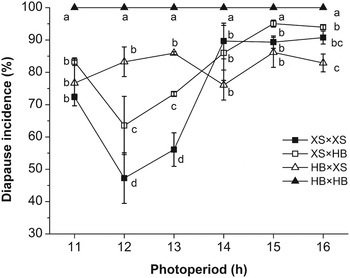
Photoperiodic response curves for the induction of diapause in the XS strain, HB strain and their F1 progeny from reciprocal crosses (XS×HB, HB×XS) at 25 °C were presented in fig. 1. The XS strain showed a clear long-day response for the induction of imaginal diapause. The short daylengths of 12 and 13 h induced development of 52.7% and 44% individuals without diapause, whereas 90% individuals entered diapause under the long daylengths of 14, 15 and 16 h. However, the HB strain had no photoperiodic response, all individuals entered diapause regardless of the photoperiod. Interestingly, the XS×HB progeny also showed a short-day response, the incidence of diapause was higher than 93% at the long daylengths of 15 and 16 h. However, the HB×XS progeny had no photoperiodic response, and the incidence of diapause was between 76.1 and 86.2%. There were no significant differences among the daylengths (d.f.=5, 12, F=0.863, P=0.533). This result suggests that photoperiodic induction of diapause is influenced by maternal genotype. Figure 1 also showed that the incidence of diapause of XS×HB progeny tended to the XS strain under the short daylengths of 12 and 13 h, and the incidence of diapause of HB×XS progeny tended to the HB strain, suggesting that the diapause phenotype was an incomplete dominant trait. However, the incidence of diapause in XS×HB progeny was significantly lower than that in HB×XS progeny under the short daylengths of 12 and 13 h (d.f.=3, 8, F=24.51, P=0.000 for 12 h; d.f.=3, 8, F=131.947, P=0.000 for 13 h), suggesting a sex linkage in the inheritance of diapause induction. Furthermore, under the long daylengths of 14, 15 and 16 h, the incidence of diapause in XS×HB progeny was higher than those in HB×XS progeny, with a significant difference under the long daylength of 16 h (d.f.=3, 8, F=45.9, P<0.05), indicating that summer diapause induced by long daylengths is determined by the female parent. It is worth mentioning that diapause response is very complicated; there were more than 40% individuals entering diapause even under the diapause-averting short daylengths.
Photoperiodic response curves for the induction of adult diapause in Colaphellus bowringi for the Harbin strain (HB), Xiushui strain (XS) and their F1 progeny (XS×HB, HB×XS) (n=77–341) at 25 °C.

Genetic analysis of diapause
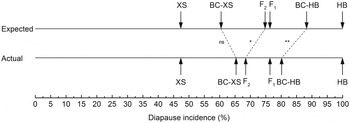
The diapause incidence data obtained from all crosses under LD 12:12 at 25 °C were used to evaluate the inheritance of diapause in this beetle (table 1). Diapause incidence in F1 under the short daylengths of 12 and 13 h has suggested that the diapause phenotype was an incomplete dominant trait with a sex linkage to the parental female (fig. 1). In the experiment of backcross to HB strain, the incidence of diapause was higher when it had an HB strain grandmother gene than when it had an HB strain grandfather gene, for example, progeny from (HB×XS)×HB diapaused at a higher rate (81.6%) than (XS×HB)×HB progeny (76.1%). In the experiment of backcross to XS strain, progeny from (XS×HB)×XS (with an XS strain grandmother gene) had a significantly lower incidence of diapause (62.8%) than (HB×XS)×XS progeny (76.1%). The results suggest that maternal grandmother also had an influence on diapause incidence of subsequent progeny. Results from the χ2 test revealed that the pattern of diapause was not additive, the incidences of diapause in F2 and Bc-HB were significantly different from the expectations (F2: χ2=6.613, P<0.05; Bc-HB: χ2=31.364, P<0.01) (table 1 and fig. 2), suggesting a hypothesis of incomplete dominance. However, the Bc-XS data adequately fitted the modified additive model.
A comparison between the observed diapause incidences under LD 12:12 at 25 °C among the progeny of crosses involving lines of Colaphellus bowringi. The results were predicted by an additive model with incomplete dominance (χ2 test, nsP>0.05, *P<0.05, **P<0.01). See also table 1.

Imaginal diapause incidence of the parental strain, F1, F2 and backcross progeny using the HB strain and XS strain of Colaphellus bowringi under LD 12:12 h at 25 °C.

nsP>0.05, *P<0.05, **P<0.01, Cum., cumulative number for each corresponding reciprocal group.
Discussion
So far, studies of geographical variation of diapause all described those insect species with photoperiodic control of diapause, where the northern populations (i.e., those with short growing seasons) tended to have long critical photoperiods and an associated high percentage of univoltinism; southern populations (i.e., those with long growing seasons) showed shorter critical photoperiods and an associated tendency toward multivoltine or non-diapause life cycles (Danilevskii, Reference Danilevskii1965; Beck, Reference Beck1980; Tauber et al., Reference Tauber, Tauber and Masaki1986). The present study revealed an unusual geographical difference in diapause response. The northern HB strain entered diapause without referring to photoperiod, whereas the southern XS strain entered diapause in response to long photoperiods and is a short-day species. Such a geographical variation in diapause response is surprising to us, as why does not the HB strain use the photoperiod as a seasonal cue? In Harbin, the first generation larvae occurred in late May and late June, the season of the longest daylengths. Almost all first generation adults that emerged between early June and early July entered diapause (Hu et al., Reference Hu, Yu, Sun and Xue2008). Generally, the northern HB strain should use the long daylengths as a cue to inducing diapause. However, photoperiodic responses in this beetle at 25, 28 and 30 °C showed that all individuals entered diapause at 25 and 28 °C and the incidence of diapause also exceeded 80% at 30 °C, regardless of photoperiod (unpublished data). Therefore, it may be better to use the temperature as a cue to induce diapause because the mean daily temperature in June is obviously lower than 25 °C in Harbin city. It is also possible that HB strain is strictly or even obligatorily univoltine and no cues are needed to induce obligatory diapause. In XS county, the overwintering adult emerged from soil between the late February and early April. The first generation larvae occurred in late March and mid-May. Almost all the first generation adults from the larvae that hatched between late March and April entered summer diapause in response to low temperatures (<20 °C); whereas those adults from the larvae that hatched in May entered summer in response to long daylengths (Xue et al., 2002a). In autumn, the XS strain can produce three generations because their progeny experienced short daylengths combined relatively higher temperatures (Xue et al., 2002b). To our knowledge, this is the first example in which southern strain exhibits a photoperiodic induction of diapause, while northern strain lacks photoperiodic response.
One interesting result of this study is the observation that the XS×HB progeny exhibits a photoperiodically regulated diapause, similar to that of the XS strain; but HB×XS progeny has no photoperiodic response, similar to that of the HB strain (fig. 1). This result may be the first demonstration that photoperiodic induction of diapause is influenced by maternal genotype.
Under short daylengths of 12 and 13 h, the incidence of diapause in F1 progeny was intermediate between their parents, being consistent with the previous study in which we crossed a high-diapause XS strain with an artificially selected non-diapausing XS strain under different photoperiods and temperatures (Kuang et al., Reference Kuang, Xu, Xia, He and Xue2011). The intermediate responses from F1 crosses indicate that diapause inheritance is not controlled by a dominant gene. The intermediate response of F1 hybrids is generally considered as a characteristic of polygenic inheritance (Danilevskii, Reference Danilevskii1965; Beck, Reference Beck1980; Tauber et al., Reference Tauber, Tauber and Masaki1986). However, the incidence of diapause in all crosses under LD 12:12 was highest with HB strain mothers or grandmothers and lowest with XS strain fathers or grandfathers (table 1), suggesting that diapause responses may be sex-linked to the parental female. A similar result was found in the reciprocal crosses of the blow fly, C. vicina, in which northern mothers produced a higher incidence of diapause among their offspring than southern mothers (McWatters & Saunders, Reference McWatters and Saunders1996).
The percentage of beetles in diapause for the pooled F2 and Bc-HB was significantly lower than the percentage predicted for these populations (table 1), indicating that the inheritance of diapause does not fit an additive hypothesis. The incidence of diapause for the pooled Bc-HB progeny (80.1%) tended to the high-diapausing HB strain (100%); the incidence of diapause for the pooled Bc-XS progeny (65.4%) also obviously higher than the low-diapausing XS strain (47.3%), suggesting that the capacity for diapause is transmitted genetically (or possibly epigenetically) in a manner of incomplete dominance, with the diapause characteristic partially dominant over the non-diapausing characteristic. In fact, the diapause characteristic in XS strain is very complicated. According to the laboratory observations, there were always some individuals entering diapause regardless of the experimental conditions (see Xue et al., Reference Xue, Spieth, Li and Hua2002b). As shown in fig. 1, there are also more than 40% individuals entering diapause even at the diapause-averting short daylength conditions, suggesting that the XS strain may contain a mixture of obligatory and facultative diapause individuals. This further complicates inheritance of the diapause response.
Our results suggest that a number of genetic factors are associated with differences in diapause capability in this beetle. Such incomplete dominance for the inheritance of the diapause phenotype is also reported for the flesh fly S. bullata (Henrich & Denlinger, Reference Henrich and Denlinger1983), face fly M. autumnalis (Kim et al., Reference Kim, Krafsur, Bailey and Zhao1995) and flesh fly Sarcophaga similis (Goto, Reference Goto2009).
ACKNOWLEDGEMENTS
This work was supported by the National Natural Science Foundation of People's Republic of China (31060243). The authors thank Dr Shaohui Wu from Department of Entomology in Rutgers University for advice and comments on the manuscript and all the students in our laboratory for their contributions to our research. The authors also thank the two anonymous reviewers for their valuable comments.