


INTRODUCTION
Discerning the deep-time dynamics of the human-climate relationship is of imminent importance across the globe today (Urrego et al., Reference Urrego, Bush, Silman, Niccum, De la Rosa, McMichael, Hagen and Palace2013; Anton et al., Reference Anton, Potts and Aiello2014; Levin, Reference Levin, Jeanloz and Freeman2015; Markofsky et al., Reference Markofsky, Ninfo, Balbo, Conesa and Madella2017; Palace et al., Reference Palace, McMichael, Braswell, Hagen, Bush, Neves, Tamanaha, Herrick and Frolking2017; Sullivan et al., Reference Sullivan, Bird and Perry2017; Werner and Willoughby, Reference Werner and Willoughby2017; Belmaker and O'Brien, Reference Belmaker and O'Brien2018; Ermolli et al., Reference Ermolli, Ruello, Cicala, Di Lorenzo, Molisso and Pacciarelli2018; Tan et al., Reference Tan, Han, Cao, Huang, Mao, Liu and An2018). An examination of data from East Africa is no exception (see Marchant et al., Reference Marchant, Richer, Boles, Capitani, Courtney-Mustaphi and Lane2018 for a recent review). Paleoclimate and paleoenvironmental records from the tropical regions of Africa are essential to understanding both past changes in the climate system and long-term interactions between humans and the environment (Trauth et al., Reference Trauth, Maslin, Deino, Junginger, Lesoloyia, Odada, Olago, Olaka, Strecker and Tiedemann2010; Shultz et al., Reference Shultz, Nelson and Dunbar2012; Maslin et al., Reference Maslin, Brierley, Milner, Shultz, Trauth and Wilson2014). In tropical Africa, lake sediments are a primary source of data for environmental and climate history (Verschuren, Reference Verschuren2003). Both lakes and wetlands are affected by internal and external factors, including climate, changes in local and regional vegetation, aquatic biota, and anthropogenic activities. Employing a multi-proxy approach to records in tropical lake and swamp sediments has the potential to provide a comprehensive record of the paleoenvironment that can be explored to resolve questions on both anthropogenic impacts on climate variability and vegetation change over thousands of years into the past. The multi-proxy approach can also offer insights into how the natural environment may respond to human-related climate change in the future (Battarbee, Reference Battarbee2000; DeMenocal, Reference DeMenocal2004; Kiage and Liu, Reference Kiage and Liu2009b; Bonnefille, Reference Bonnefille2010). However, this potential remains largely unexplored.
The oft-overlooked non-pollen palynomorphs (NPPs) such as fungal spores, which are usually recovered in the process of pollen preparation, can be an excellent source of paleoecological data. Different studies (e.g., Montoya et al., Reference Montoya, Rull and van Geel2010; Ejarque et al., Reference Ejarque, Miras and Riera2011; Lopez-Vila et al., Reference Lopez-Vila, Montoya, Canellas-Bolta and Rull2014; Vives et al., Reference Vives, Miras, Riera, Julia, Allee, Orengo, Paradis-Grenouillet and Palet2014; Revelles et al., Reference Revelles, Burjachs and van Geel2015) have demonstrated the efficacy of fungal spores recovered from lakes and swamp deposits for reconstructing paleoenvironmental histories, especially when paired with pollen and archaeological finds. Fungal spores, in particular, are a vital complement to elemental geochemistry data and pollen analysis because they provide proxies for environmental changes that may be overlooked if only pollen or elemental geochemistry is utilized (van Geel, Reference van Geel, Smol, Birks and Last2001). Quantitative analysis of fungal spores is excellent for providing specific information on environmental conditions, including human impacts due to livestock grazing pressure and eutrophication of water. Fungal spore data can also provide information on ecological conditions such as humidity; substrate information, including decaying organic matter and/or dung, and specific host plants; and geomorphologic processes such as soil erosion (van Geel, Reference van Geel and Berglund1986, Reference van Geel, Smol, Birks and Last2001; van Geel et al., Reference van Geel, Buurman, Brinkkemper, Schelvis, Aptroot, van Reenen and Hakbijl2003; Kiage and Liu, Reference Kiage and Liu2009a; Lopez-Merino et al., Reference Lopez-Merino, Lopez-Saez, Alba-Sanchez, Perez-Diaz and Carrion2009; Cugny et al., Reference Cugny, Mazier and Galop2010).
The East African environment is an archetype of a tropical region that has strong influence on the global climate system (Thompson et al., Reference Thompson, Davis, Mosley-Thompson, Sowers, Henderson, Zagorodnov and Lin1998; Barker et al., Reference Barker, Street-Perrott, Leng, Greenwood, Swain, Perrott, Telford and Ficken2001; Thompson et al., Reference Thompson, Mosley-Thompson, Davis, Henderson, Brecher, Zagorodnov and Mashiotta2002; Lea et al., Reference Lea, Pak, Peterson and Hughen2003; Ivanochko et al., Reference Ivanochko, Ganeshram, Brummer, Ganssen, Jung, Moreton and Kroon2005; Garcin et al., Reference Garcin, Williamson, Taieb, Vincens, Mathe and Majule2006; Garcin et al., Reference Garcin, Vincens, Williamson and Buchet2007). Understanding paleoenvironmental change in East Africa is significant as it provides an opportunistic window into the past for the study of variability in tropical climate systems and their causal mechanisms that, to date, remain largely unresolved. Investigating East Africa's paleoenvironment, especially during the late Holocene, provides an essential perspective on long-term processes and consequences of land use and environmental change in the region. The paleoclimate of East Africa during the Holocene was for a while assumed to have been stable mainly due to poor chronologic control (Butzer et al., Reference Butzer, Isaac, Richardson and Washbourn-Kamau1972; Livingstone, Reference Livingstone1975; Livingstone, Reference Livingstone1980; Hamilton, Reference Hamilton1982). Increasing evidence now reveals that East Africa may have been climatically unstable, especially during the late Holocene, characterized by a series of decadal-centennial scale moisture-balance fluctuations (Cloudsley-Thompson, Reference Cloudsley-Thompson1984; Lamb et al., Reference Lamb, Darbyshire and Verschuren2003; Russell et al., Reference Russell, Verschuren and Eggermont2007; Kiage and Liu, Reference Kiage and Liu2009b).
The problem of poor chronologic control and low time-resolution can be resolved by examination of environmental data from crater lakes that are dotted throughout the Albertine Rift in East Africa, especially in western Uganda. Crater lakes are ideal for high-resolution sedimentary records because they tend to be small in size, tend to have well-defined catchment areas with simple morphology, and are often characterized by high sedimentation rates due to steep slopes bounding them and small catchments (Battarbee, Reference Battarbee2000; Lamb et al., Reference Lamb, Leng, Lamb and Mohammed2000; Ssemmanda et al., Reference Ssemmanda, Ryves, Bennike and Appleby2005). This paper presents findings from a study that investigated the history of climate, vegetation change, and human impact on tropical African environments during the Holocene through the examination of a multi-proxy record of fungal spores, microscopic charcoal, and elemental geochemistry data recovered from sediment cores from Lake Kifuruka, a crater lake in western Uganda.
Study area
Lake Kifuruka (0°29′18″N and 30°17′19″E) (Fig. 1) occupies one of the small volcanic craters that straddle the equator in East Africa. This lake is one in a cluster of lakes occupying crater kettles with steep-sided walls referred to as the Ndali-Kasenda crater lake landscape in Kabarore District, located approximately 25 kilometers south of the town of Fort Portal in western Uganda (Efitre et al., Reference Efitre, Chapman and Murie2009). The crater lakes were formed following tectonic and volcanic activity linked to the development of the East African rift valley system that is connected with the Afar-Red Sea and Gulf of Aden rift system (Ebinger, Reference Ebinger1989; Foster et al., Reference Foster, Ebinger, Mbede and Rex1997; Roberts et al., Reference Roberts, Stevens, O'Connor, Dirks, Gottfried, Clyde, Armstrong, Kemp and Hemming2012; Macgregor, Reference Macgregor2015). The rift valley lies above a broad, intercontinental, swell known as the East African Plateau and consists of two branches—the Western and Kenya (Gregory) Rift Valleys (Ebinger, Reference Ebinger1989; Ring, Reference Ring2014). The Ndali-Kasenda cluster of lakes, associated with the western branch of the rift valley (also known as the Albertine Rift) system in East Africa, are small and have closed catchments that are ideal for high-resolution analyses of regional and local impacts due to climate change and human activity (Ssemmanda et al., Reference Ssemmanda, Ryves, Bennike and Appleby2005; Ryves et al., Reference Ryves, Mills, Bennike, Brodersen, Lamb, Leng, Russell and Ssemmanda2011). The important, and largely as of yet untapped, potential of small lakes for high-quality, high-precision, and high-resolution records has recently been highlighted (Marchant et al., Reference Marchant, Richer, Boles, Capitani, Courtney-Mustaphi and Lane2018).
Satellite imagery showing the location of the study area in western Uganda. The figure shows the study area within an inset of the map of Africa (indicated by a red star) and shown in the red rectangle (shown in A) and a picture of Lake Kifuruka taken during fieldwork in 2014 from the northeastern part of the lake. The approximate core location (0°29′18.5″N and 30°17′19.3″E) on the lake is indicated by the red arrow. (For interpretation of the references to color in this figure legend, the reader is referred to the web version of this article.)

Lake Kifuruka presents such a small lake, and this research program was the first to conduct paleoecological research here. This lake has a surface area of 16 hectares (0.16 km2) and an average depth of 5 m, served by a catchment area of 125 hectares (1.25 km2) at an elevation of 1410 meters above sea level. Lava and volcanic ash that have yielded deeply weathered, fertile, brown volcanic soils underlie the catchment area. The small basin size and simple hydrologic setting of Lake Kifuruka make it an ideal site for recovering paleoenvironmental data because the relationships between lake history and climate history are relatively uncomplicated.
The western Uganda region, where Lake Kifuruka is located, is humid with biennial rainfall maxima, controlled by the seasonal movement of the Intertropical Convergence Zone (ITCZ) and the Congo Air Boundary (CAB) (Nicholson, Reference Nicholson, Johnson and Odada1996). The climate exhibits an intricate pattern due to topographical diversity that includes large inland lakes, mountains, and decreasing maritime influences from the Indian Ocean to the east and the tropical Atlantic to the west. The climate of the region is also influenced by teleconnections involving El Niño–Southern Oscillation (ENSO), which oscillates irregularly at time intervals of 3–7 years. Total annual rainfall in the area around Lake Kifuruka averages over 1300 mm (Engler et al., Reference Engler, Randin, Thuiller, Dullinger, Zimmermann, Araujo and Pearman2011; Menendez et al., Reference Menendez, Gonzalez-Megias, Jay-Robert and Marquez-Ferrando2014), while average monthly temperatures vary between 24°C and 27°C with a diurnal range of 10°C–15°C (Diem et al., Reference Diem, Hartter, Salerno, Breytenbach and Grandy2017).
The topography, soils, and climate of western Uganda support tropical montane moist and semi-deciduous forest (White, Reference White1983). There is evidence of human impact on the natural environment throughout the crater lakes area. Most of the original forest, in the general vicinity of Lake Kifuruka and the surrounding craters, has been logged and replaced with small-scale agricultural farms that are cropped with maize, millet, sorghum, cassava, and bananas, among other crops. Only a scattering of small forest patches can now be found near Lake Kifuruka (Hartter and Southworth, Reference Hartter and Southworth2009; Ryan et al., Reference Ryan, Palace, Hartter, Diem, Chapman and Southworth2017).
MATERIALS AND METHODS
During the summer of 2014, three lake sediment cores were collected from a floating mat of papyrus on the southern part of Lake Kifuruka. A modified Livingstone corer (Wright et al., Reference Wright, Mann and Glaser1984) was mounted on a platform on a boat to provide stability and used to collect the cores from a depth of 4.5 m. While at the field collection sites, all the cores were labeled, described, and preserved in transparent PVC tubes that were carefully sealed on both ends. The cores were shipped to the Department of Geosciences laboratories at Georgia State University in the United States for processing and analysis. At the laboratory, each PVC tube containing the sediment was longitudinally split into two halves, photographed, and macroscopically described. One half was subsampled while the other was archived for future use. The longest core (core Kf 02) was selected for detailed analysis, considering it was likely to provide the longest record.
XRF and LOI analyses
X-ray fluorescence (XRF) core-scanning is a non-destructive tool that is excellent for rapid assessment of elemental variations in core sediments. The analysis of bulk elemental geochemistry composition of the sediments was done using a handheld Innov-X Alpha-400 energy dispersive XRF gun (cf. Gregory et al., Reference Gregory, Patterson, Reinhardt, Galloway and Roe2019; Peros et al., Reference Peros, Collins, G'Meiner, Reinhardt and Pupo2017). The sediment core was carefully abraded before being subjected to scanning. The XRF gun was set on soil analysis mode and run at 60-second cycles twice at every centimeter throughout the sediment core. Utmost circumspection was exercised to secure the X-ray beam in a perpendicular position to the surface measured at all times.
Subsampling for loss-on-ignition (LOI) consisted of retrieving about 1-cm3 samples consecutively throughout the cores at 1-cm intervals. The LOI data have previously been presented in Kiage et al. (Reference Kiage, Howey, Hartter and Palace2017). LOI analysis was performed using standard procedures (Dean, Reference Dean1974) that involved drying samples overnight at 105°C, followed by weighing to establish the water content. Afterward, organic matter was oxidized for an hour at 550°C to carbon dioxide and ash. Finally, carbon dioxide was evolved from carbonate for an hour at 1000°C, leaving oxide. Sample weight loss during the reactions was measured by weighing before and after combustion. The weight loss is closely linked to the organic matter and carbonate content of the sediment (Dean, Reference Dean1974).
Palynological analyses
Fungal spores and microscopic charcoal were recovered in the process of pollen preparation. Before the chemical treatment of the sediment samples, two tablets of exotic spores of Lycopodium clavatum (batch number 1031, ordered from the Department of Geology, Lund University, Sweden) were added to each sample to aid in the counting and calculations of pollen concentration and influx (Stockmarr, Reference Stockmarr1971; Maher Jr., Reference Maher1981). The sediments were chemically treated to concentrate pollen, NPPs, and microscopic charcoal following the standard procedure (Faegri and Iverson, Reference Faegri and Iversen1989): dissolving carbonates in dilute hydrogen chloride (10%) and silicates in cold hydrogen fluoride (70%). This was followed by the removal of colloidal silica with warm diluted hydrogen chloride, and removal of humic acids by dilution in potassium hydroxide (10%) solution. The residue obtained was then diluted in silicon oil and mounted on slides for counting. For each level, counting ceased when at least 300 identifiable pollen and pteridophyte spores were counted or 1000 L. clavatum spores, whichever came first. The total number of fungal spores counted in the different samples ranged from 24 to 233. The counting was done on an Olympus Bx43 microscope fitted with × 10 oculars and × 40/60 objectives, mostly at 400X magnification.
Fungal spore identification relied heavily on publications by van Geel, Reference van Geel1978, Reference van Geel and Berglund1986, Reference van Geel, Smol, Birks and Last2001; van Geel et al., Reference van Geel, Buurman, Brinkkemper, Schelvis, Aptroot, van Reenen and Hakbijl2003; Gelorini et al., Reference Gelorini, Verbeken, Van Geel, Cocquyt and Verschuren2011; and van Geel et al., Reference van Geel, Gelorini, Lyaruu, Aptroot, Rucina, Marchant, Damste and Verschuren2011. The counts were recorded by hand and then entered into a spreadsheet, sorted, and plotted using Tilia version 1.7.16 software (Grimm, Reference Grimm2011). The total count included unknown and indeterminate types (i.e., well-preserved spores, but which were unmatched to any in the reference types) and was the basis for the calculation of percentages and concentrations. Tilia version 1.7.16 was also used to perform the Constrained Incremental Sum of Squares (CONISS) cluster analysis, a multivariate method for quantitative delineation of stratigraphic zones/units (Grimm, Reference Grimm1987). For purposes of simplifying the presentation of results, we adopted the five stratigraphic zones that were generated through CONISS for core Kf 02 that was presented in Kiage et al. (Reference Kiage, Howey, Hartter and Palace2017).
The radiocarbon ages of plant macrofossils (plant leaves and seeds) were determined at the DirectAMS laboratory in Seattle, Washington, through accelerator mass spectrometry (AMS) (cf. Kiage et al., Reference Kiage, Howey, Hartter and Palace2017). The samples for radiocarbon dating at 40 cm, 120 cm, 160 cm, and 228 cm all represent different lithological units of core Kf 02. The radiocarbon dates were calibrated to calendar years using the CALIB 6.0 program from the University of Washington (http://calib.qub.ac.uk/calib/calib.html) and the relevant atmospheric data (Reimer et al., Reference Reimer, Bard, Bayliss, Beck, Blackwell, Bronk and Buck2013). BACON (the Bayesian Accumulation model) was used to generate the age model and age points in between the calibrated radiocarbon tie points (Blaauw and Christen, Reference Blaauw and Christen2011). BACON utilizes Bayesian statistics to reconstruct accumulation histories with clear limits of confidence that are constrained by radiometric ages, analytical errors, and any ancillary assumptions.
RESULTS
Core stratigraphy and chronology of the sediments
Five distinct lithological units constitute the sediment assemblage in core Kf 02 from Lake Kifuruka. The lithological sections display different patterns in the water and organic contents, as is evident in the results from LOI analyses and the geochemical characteristics (Fig. 2). The lithological units largely parallel the five stratigraphic zones (Kf I, Kf II, Kf III, Kf IV, and Kf V) of core Kf 02 using CONISS.
(color online) A plot of XRF counts of geochemical elements at different depths in core Kf 02 from Lake Kifuruka during the Holocene. The plot also shows the percentage of organic and calcium content in the core.

Figure 3 shows the chronology and age-depth model of core Kf 02. The AMS radiocarbon chronology of leaf fragments that were recovered from near the base of the core at 225 cm yielded a date of 11,560 cal yr BP, which corresponds with the terminal phase of the Pleistocene and/or the onset of the Holocene. Subsequent samples taken at 192 cm, 160 cm, 120 cm, and 40 cm yielded decreasingly younger dates (Table 1). The chronological data based on AMS radiocarbon dating shows sedimentation rates generally increasing upwards of the core with a significant increase in the rates at about 150 cm (about 4000 cal yr BP) (Fig. 3).
Age-depth model generated using the radiocarbon chronology of core Kf 02 from western Uganda.

Accelerator Mass Spectrometry (AMS) radiocarbon chronology for core Kf 02 from Lake Kifuruka along with calibrated dates generated using Calib 5 program (Stuiver and Reimer, Reference Stuiver and Reimer1993; Stuiver et al., Reference Stuiver, Reimer and Reimer2005).

Fungal spores
Thirty-two distinct types of fungal spores were identified in core Kf 02, including those whose identity was unknown. The bulk of the latter were unknown taxa or those missing key morphological features such as asci that are necessary for proper identification. Fungal spore types whose total numbers were low (i.e., <4 counts in more than half of the levels) were grouped and categorized along with unknown and/or unidentifiable taxa in the category Others/Unknown-types. Figure 4 presents a summary of the important types of spores for paleoenvironmental reconstruction that were recovered from core Kf 02. The abundance of spores varied throughout the core. Higher abundances were observed in Kf IV (115 cm–70 cm), while the lowest abundances were in zones Kf I and Kf IIa (230 cm–185 cm).
(color online) Fungal spore diagram showing the results of the analysis based on core Kf 02 from Lake Kifuruka during the Holocene. The diagram shows the frequency of fungal spores as well as the sum of spores and different depths throughout the core.
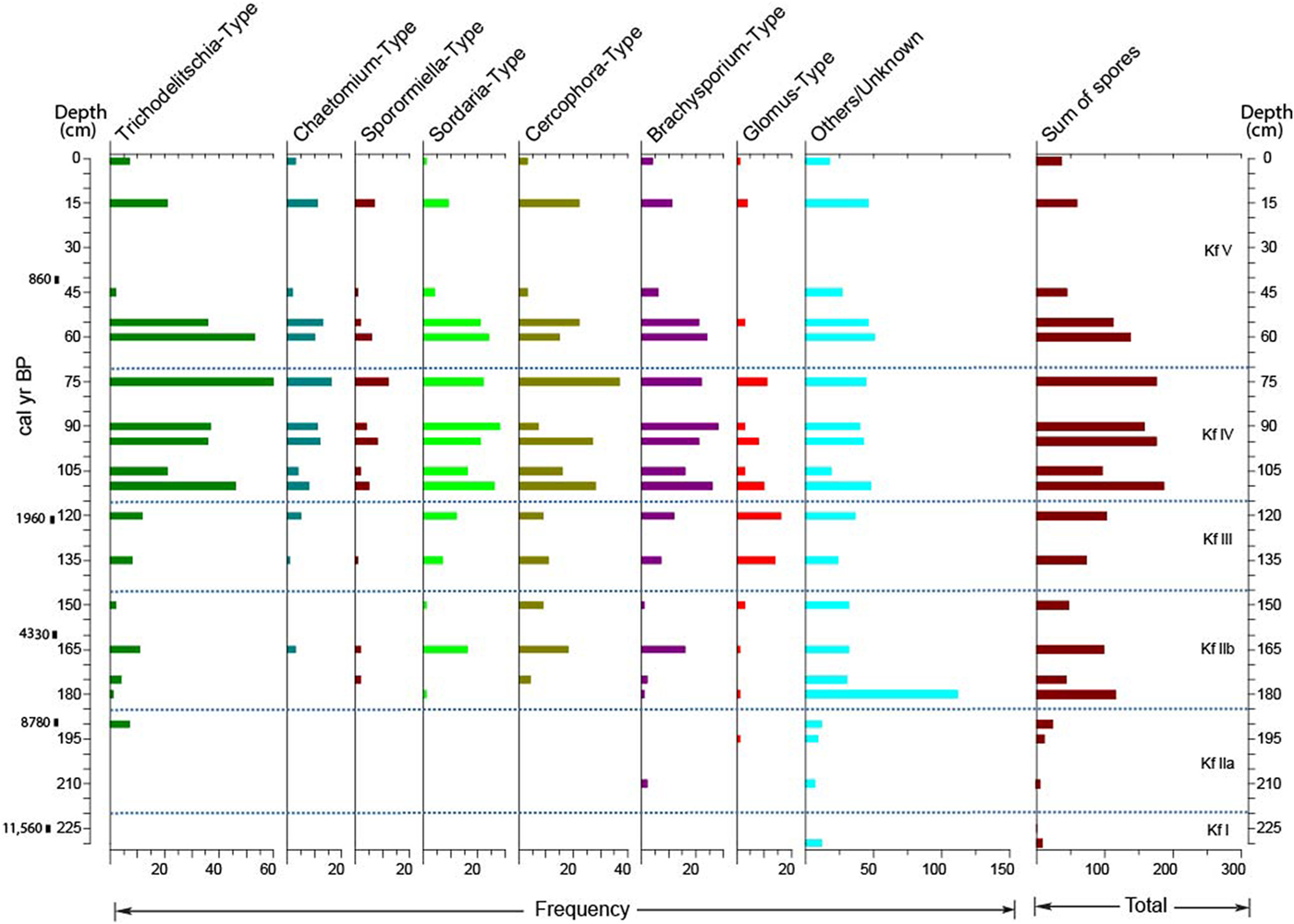
The sediments near the bottom of the core, representing zones Kf I and Kf IIa (~11,700–8300 cal yr BP), are distinguished by the low sum of spores that are primarily in the category Others/Unknown-types, and this accounts for most of the spores that were counted in the bottom sections of the core. Trichodelitschia-type, Brachysporium-type, and Cercophora-type are the only other notables that had a presence in zones Kf I and Kf IIa.
Zone Kf IIb, representing sediments that were deposited in Lake Kifuruka between 8300 cal yr BP and 4100 cal yr BP, is characterized by the appearance of several fungal spore types that are not represented in the bottom section of the core (i.e., 232 cm—185 cm). The fungal spores appearing for the first time in the sequence include Chaetomium-type, Sporormiella-type, Sordaria-type, and Glomus-type, albeit in varying level of abundances. Cercophora-type, in particular, has high abundances in this section of the core and Sordaria-type has a peak in abundance at 165 cm. The category Others/Unknown-types is also well represented in zone Kf IIb with a significant peak at 180 cm.
In zone Kf III, which includes material that was mostly deposited between 4100 cal yr BP and 1890 cal yr BP, there is a peak in the abundances of Glomus-type fungal spores. Other fungal spores that are well represented in this section include Sordaria-type and Cercophora-type. Others/Unknown-types occur in lower frequencies when compared to previous sections, while Brachysporium-type shows an increase in abundance.
The sediment materials in zone Kf IV were deposited between 1890 cal yr BP and 1260 cal yr BP. The defining feature of this section is the heightened sum of fungal spores. All the spore types, except for Others/Unknown-types, register an increase in this section. The most notable increases are in Chaetomium-type along with Trichodelitschia-type, Sordaria-type, Cercophora-type, and Brachysporium-type. The same trend persists in zone Kf V, albeit only within some sections.
Geochemical proxies
The geochemical parameters (calcium [Ca], potassium [K], titanium [Ti], iron [Fe], and Rubidium [Rb]) show notable variability throughout the period covered in the core. The basal sediments that represent the materials that were deposited in Lake Kifuruka just before 11,560 cal yr BP (represented by zone Kf I) are notable for the high level of Ca (average of 24,200 counts) in XRF data that occur concurrently with low organic and carbonate contents in the LOI data (Fig. 2). The XRF data also show that zone Kf I was also characterized by low Ti as well as high Ca:Ti ratio. The levels of Fe and Rb in the sediment are relatively high in this zone.
The dominant feature in zone Kf IIa is the sharp decrease in Ca in the XRF data preceded by significant increases in the organic and carbonate contents in the LOI data. The increase in the organic and carbonate contents begins at 225 cm, whereas the marked decrease in Ca begins at 215 cm. The carbonate content is high between 218 cm and 200 cm before it sharply declines and remains suppressed upwards of the core. The level of Ti in the sediment increases from very low at the beginning of zone Kf IIa to very high at about 200 cm upwards of the zone. It is also at about 200 cm that the levels of K and Rb abruptly increase. The Ca:Ti ratio decreases to its lowest level in the core and never significantly rebounds for the rest of the zones upwards of the core.
The LOI data show a sharp decrease in the organic content in zone Kf IIb that commences at 192 cm (~8780 cal yr BP), near the top of zone Kf IIa, and the trend continues to 165 cm (just before ~4330 cal yr BP) where there is some recovery. The slight rebound in the level of Ca that started at 200 cm continues into zone KF IIb with averages of 10,200 counts, but this is still less than half of the counts recorded in the basal sediments (Fig. 2). The K and Ti counts are generally high in this zone and follow a similar trend observed in the levels of Fe and Rb.
The general trend in the geochemical data (Fig. 2) is a relative increase (albeit with oscillations) in recorded levels of Ca, K, Ti, Fe, and Rb between 200 cm and 87 cm in the core, representing mostly zones Kf IIb and Kf IV. This represents the period between 8300 cal yr BP and 1890 cal yr BP. During this period, the LOI data show the organic and carbonate contents of the sediments to be generally low. There is a negative correlation between organic content and Ca levels in the sediments.
Zone Kf V (1260 cal yr BP to present), representing the youngest materials in the core, is characterized by a substantial increase in the organic content and a slight increase in the carbonate content, after 87 cm upwards of the core. The XRF data show a sharp decrease in the levels of Ca, K, Ti, Fe, and Rb. The sediments in this section are also characterized by a slight increase in the Ca:Ti ratio.
Charcoal
Figure 5 provides the results of the frequencies of microscopic charcoal at different levels in the stratigraphy of core Kf 02. The record shows an increasing trend in the sum of microscopic charcoal particles upwards of the core. In zone Kf I, the record shows a spike in the counts, and this is succeeded by a sharp decline. A trend of mostly low frequencies (<100) of charcoal counts persists and dominates zones Kf IIa, Kf IIb, and Kf III. However, in zone Kf IV, there is an evident increase in the frequencies with counts of over 100 registered at three levels. Zone Kf V, which is consistent with the most recent period, is distinguished by the highest counts (>150) in the entire stratigraphy.
A microscopic charcoal sequence diagram showing the results of the analysis based on core Kf 02 from Lake Kifuruka during the Holocene. The diagram shows the frequency of microscopic charcoal different depths throughout the core as well as zones Kf I through Kf V generated from CONISS.

DISCUSSION
Interpreting compositional changes in the fungal spores and geochemical parameters in the sediment cores from Lake Kifuruka requires information on the sediment source area. The bulk of the sediment in the lake is derived from its confined drainage basin containing both mineral material and organic matter. The latter includes fungal spores and pollen as well as products of photosynthesis that may have originated either on the land surface or in the waters of the lake. The pollen data also includes grains that may not have originated within the lake catchment area and, therefore, may incorporate the regional character of vegetation and climate. However, unlike pollen, the majority of fungal spores that originate from the lake's catchment represent local environmental conditions. Fungi are among the most ubiquitous living eukaryotic life forms on earth and can be located in many environments. Fungal communities play a significant role in many ecosystems where almost all organisms rely on them to decompose materials in order to recycle carbon and mineral nutrients (Boddy et al., Reference Boddy, Buntgen, Egli, Gange, Heegaard, Kirk, Mohammad and Kauserud2014). They can be found within soil, freshwater swamps, lakes, and streams and even live on or inside plants and animals where they settle in different substrates to perform diverse functions, including ecosystem services (Cantrell et al., Reference Cantrell, Dianese, Fell, Gunde-Cimerman and Zalar2011; Boddy et al., Reference Boddy, Buntgen, Egli, Gange, Heegaard, Kirk, Mohammad and Kauserud2014; Miao et al., Reference Miao, Warny, Liu, Clift and Gregory2017).
Fungal spores and geochemical data from the basal sediments recovered from Lake Kifuruka suggest that the period between 11,800 and 11,300 cal yr BP, which is consistent with the period just before the onset of the Holocene, was characterized by dry conditions. The fungal spore data shows that the period (represented by zones Kf I and Kf IIa) had an exceptionally meager sum of spores that can be attributed to dry conditions that inhibited fungal growth (Boddy et al., Reference Boddy, Buntgen, Egli, Gange, Heegaard, Kirk, Mohammad and Kauserud2014). Due to their primitive vasculature system, fungi require ample moisture conditions in order to feed by extracellular digestion, without which they cannot thrive. Too little soil moisture causes fungi to have difficulty in taking up and retaining water and obstructs fungal enzyme functioning (Boddy et al., Reference Boddy, Buntgen, Egli, Gange, Heegaard, Kirk, Mohammad and Kauserud2014). The charcoal record shows a spike in zone Kf I (just before 11,560 cal yr BP) that indicates the occurrence of a fire event around that period that suggests the prevalence of dry conditions.
The sediments recovered at the base of core Kf I are also characterized by high counts of Ca and Rb as well as the highest Ca:Ti ratio in the sequence that, along with the low level of K, supports the interpretation of a prevalence of dry conditions during that period. K, which is associated with mineral particles rather than with organic matter, is susceptible to removal in solution and can be considered a proxy for the rate of erosional removal of mineral matter from the land surface (Luleva et al., Reference Luleva, van der Werff, Jetten and van der Meer2011). Therefore, the low K count at the onset of the Holocene corresponds with low rates of erosion, likely due to reduced rainfall (Pechlivanidou et al., Reference Pechlivanidou, Cowie, Hannisdal, Whittaker, Gawthorpe, Pennos and Riiser2017). The interpretation of the Rb content is treated with caution, given that it occurs in relatively low counts throughout the core. There is mostly a linear relationship between K and Rb concentrations in sediments such that higher K concentrations are often accompanied by high Rb. However, K grains may sometimes contain very low Rb values (Buylaert et al., Reference Buylaert, Ujvari, Murray, Smedley and Kook2018. Whereas carbonates are often associated with Ca, showing mostly a positive correlation, there is a discordance in the timing of the increase in carbonates and Ca in the basal sediments. The carbonates were estimated using LOI analysis that can have errors of up to 5% for carbonate analysis, especially in clay- or diatom-rich sediment (Heiri et al., Reference Heiri, Lotter and Lemcke2001). Santisteban et al. (Reference Santisteban, Mediavilla, Lopez-Pamo, Dabrio, Zapata, Garcia, Castano and Martinez-Alfaro2004) showed that although LOI data generally agree with estimates from direct measurements, the method can be unreliable because sediment composition can induce significant deviations of values that lack a predictable trend, resulting in unexpected occurrence or disappearance of peak values. That may explain the incongruence between the carbonate estimate in LOI data and the Ca measurements of XRF from the basal sediments. When compared to the rest of the core, the sediments near the bottom of the core are relatively rich in carbonates, albeit discretely. The deposition of calcareous sediments leading to Ca enrichment in the basal sediment is further evidence for the prevalence of dry conditions at Lake Kifuruka at the onset of the Holocene (Curtis et al., Reference Curtis, Brenner, Hodell, Balser, Islebe and Hooghiemstra1998).
The pollen record from Lake Kifuruka discussed by Kiage et al. (Reference Kiage, Howey, Hartter and Palace2017) also identified a period of desiccation just before the onset of the Holocene, and this is consistent with observations from other sites in the region. Indeed, studies from multiple locations in the East African region (e.g., Coetzee, Reference Coetzee1967; Hamilton, Reference Hamilton1982; Gasse et al., Reference Gasse, Ledee, Massault and Fontes1989; Roberts et al., Reference Roberts, Taieb, Barker, Damnati, Icole and Williamson1993; Beuning et al., Reference Beuning, Talbot and Kelts1997;Olago, Reference Olago2001) show evidence of desiccation in the period preceding the Holocene. For instance, Johnson et al. (2000) showed evidence of the termination of overflow conditions in Lake Victoria and a return to closed-basin conditions before the onset of the Holocene, which corresponds with diminished rainfall and the consequent low lake levels. Beuning et al. (Reference Beuning, Talbot and Kelts1997) also report the occurrence of a period of desiccation at Lake Albert that was marked by an expansion of grassland vegetation communities at the expense of forests. The onset of the desiccation period in the region is debatable. However, it is thought to be synchronous with the Younger Dryas event in the Northern Hemisphere (Beuning et al., Reference Beuning, Talbot and Kelts1997).
The Lake Kifuruka record indicates that the environment of aridity that began just before the onset of the Holocene was replaced by a period of enhanced rainfall mid-way through zone Kf IIa, corresponding with sometime before 8780 cal yr BP. Ivory and Russell (Reference Ivory and Russell2018), who studied Lake Edward, near Lake Kifuruka, also observed the prevalence of wet and warm conditions that were marked by widespread expansion of forests at both high and low elevations during the early Holocene. The results from core Kf 02 show high amplitude oscillations in the major elements associated with heightened rainfall to be concentrated between 8780 cal yr BP and shortly after 1960 cal yr BP. The record shows strong sedimentary changes take place beginning at 220 cm, with elevated and high sediment influx and strong erosion pulse around 115 cm. Evidence for enhanced rainfall during that period is indicated by high counts of K, Ti, Fe, and Rb. These high counts are concurrent with a drop in Ca counts, signifying low or lack of carbonate preservation that begins at about 200 cm upwards of the core. In particular, the high frequency of K, which is removed by solution, is consistent with increased soil erosion that accompanied the increased rainfall during the humid early Holocene. The interpretation of increased soil erosion is supported by the fungal spore record, which shows an active presence of Glomus concurrent with elevated K levels. Glomus is a genus of arbuscular mycorrhizal fungi characterized by obligate symbionts that form special mycorrhiza with plant roots. These fungi require plant roots to complete their life cycle while host plants gain benefits such as improved nutrient uptake and resistance to disease and droughts. Members of the genus Glomus have been found in all terrestrial environments that contain plant cover (Kirk et al., Reference Kirk, Cannon, Minter and Stalpers2008). Glomus are usually uncovered after soil erosion, leading to root exposure, hence their presence in lake sediments is a proxy for soil erosion in a landscape.
Sedimentary and geochemical data further suggest that the humid period that began shortly before 8780 cal yr BP largely persisted until just after 1960 cal yr BP, albeit with oscillations, including brief periods of reduced precipitation at 135 cm and 120 cm. The age-depth model (Fig. 3) shows a surge in sedimentation rates just before 4000 cal yr BP. Remarkably, the high amplitude oscillations and heightened counts of K, Ti, and Rb in the sequence appear to correspond with a general increase in the sum of spores, including some spores that are recorded for the first time in the spore sequence. The increase in the diversity and quantity of spores is a function of many factors, including better preservation, increased input, and/or a conductive environment for fungal spore growth and reproduction (Kirk et al., Reference Kirk, Cannon, Minter and Stalpers2008). Fungal spores that appear for the first time in the sequence in varying levels of abundance, after 8780 cal yr BP, including Chaetomium-type, Sordaria-type, Chaetomium-type, Glomus-type, and Sporormiella-type, are indicative of a moist environment. Baker et al. (Reference Baker, Bhagwat and Willis2013) demonstrated that Sporormiella-type and Sordaria-type are the most reliable indicators of herbivore activity with robust linkage to obligate coprophilous fungus taxa. Sporormiella, belonging to the family Sporormiaceae, is a genus of fungi that are obligately coprophilous, occurring mostly on the dung of domestic livestock but also found on the dung of wild herbivores. Spores of coprophilous fungi are released and spread to the surrounding vegetation, which are then consumed by herbivores and passed through the animal's digestive system and released through defecation. The dung of the animals then serves as the media where the fruiting bodies of the fungi grow. The spores of Sporormiella usually serve as a proxy for the presence of grazing mammals. Cercophora-type, Sordaria-type, and Brachysporium-type in particular show high amplitudes of abundance at 165 cm due to environmental changes at the time. Brachysporium-type can be used as a proxy for the presence of montane vegetation (Lopez-Vila et al., Reference Lopez-Vila, Montoya, Canellas-Bolta and Rull2014), which at that time was diminishing near the Lake Kifuruka site at about 4300 cal yr BP (Kiage et al., Reference Kiage, Howey, Hartter and Palace2017).
The appearance of Cercophora-type, Sporormiella-type, and Sordaria-type spores in the record, beginning in zone Kf IIb (~4330 cal yr BP) and continuing into zone Kf III (~1960 cal yr BP) could, in varying degrees, signify the presence of herbivores in the environment. However, the reliability of Cercophora spores as a proxy for the presence of herbivores can be disputed. Some studies (e.g., Cugny et al., Reference Cugny, Mazier and Galop2010; Krug et al., Reference Krug, Benny and Keller2004) have shown that although Cercophora can be found in grazing environments, they appear to be more related to forested environments. In fact, Cugny et al. (Reference Cugny, Mazier and Galop2010) found that Cercophora had no positive correlation with grazing in a modern dataset, leading to questions about its substrate affinities and potential as a proxy for dung (herbivore or otherwise). The implication is that Cercophora may have specific habitat preferences and affinity for decaying substrates that may not always be herbivore dung.
In contrast, Sporormiella-type and Sordaria-type spores are more robust proxies for the presence of herbivores. Cugny et al. (Reference Cugny, Mazier and Galop2010) found Sporormiella and Sordaria to be recurrent, abundant, and mostly correlated with heavily grazed environments. They are, therefore, the most robust measures of grazing activities (both presence and density) as has been established in many studies (e.g., Burney et al., Reference Burney, Robinson and Burney2003; van Geel et al., Reference van Geel, Buurman, Brinkkemper, Schelvis, Aptroot, van Reenen and Hakbijl2003; Davis and Shafer, Reference Davis and Shafer2006; van Geel and Aptroot, Reference van Geel and Aptroot2006). It is reasonable to hypothesize that the decrease in arboreal vegetation reported at the site by Kiage et al. (Reference Kiage, Howey, Hartter and Palace2017), beginning about 4300 cal yr BP, created a conducive environment for recruitment of herbaceous vegetation and grasses that supported the herbivore population. However, the causal mechanism for the dwindling arboreal vegetation at the site beginning about 4300 cal yr BP is debatable.
One causal mechanism could be a lateral shift in the position of the CAB. Such a change could have significantly impacted the pluvial regime resulting in diminished moisture that severely impacted arboreal vegetation (Nicholson, Reference Nicholson2000; Tierney et al., Reference Tierney, Russell, Damste, Huang and Verschuren2011). The CAB is a convergence zone that marks the confluence of Indian Ocean air with unstable air from the Congo Basin that often works in tandem with the Indian Ocean monsoon to influence rainfall in the region (Vincens et al., Reference Vincens, Williamson, Thevenon, Taieb, Buchet, Decobert and Thouveny2003). The changes involving the positional location of the CAB concurrent with reduced strength of the summer monsoon, which lowered rainfall in Lake Kifuruka, may be part of the processes that marked the termination of the humid early Holocene that has also been observed in multiple sites in tropical Africa (Telford and Lamb, Reference Telford and Lamb1999; Gasse, Reference Gasse2000; Thompson et al., Reference Thompson, Mosley-Thompson, Davis, Henderson, Brecher, Zagorodnov and Mashiotta2002; Marchant and Hooghiemstra, Reference Marchant and Hooghiemstra2004). For instance, the ice core record from Mt. Kilimanjaro recorded a large dust layer, and this is consistent with the prevalence of arid conditions (Thompson et al., Reference Thompson, Mosley-Thompson, Davis, Henderson, Brecher, Zagorodnov and Mashiotta2002) during a period that is coeval with the reduced rainfall at the Lake Kifuruka site. A record from Lake Tilo, a crater lake in the Ethiopian Highlands, also shows desiccation conditions at about 4000 yr BP (Telford and Lamb, Reference Telford and Lamb1999). The period of desiccation is largely coeval with the gradual retreat of lowland tropical forests observed in the Lake Edward record that probably marks the end of the African Humid period (Ivory and Russell, Reference Ivory and Russell2018). However, it appears that the dry conditions at Lake Kifuruka were not severe enough to impact the lake level (Kiage et al., Reference Kiage, Howey, Hartter and Palace2017). Indeed, the initial oscillations in the sum of spores may be indicative of a short-term desiccation event, considering that elemental data do not show significant change. The population of herbivores appears to have decreased soon after, between zone Kf IIb and Kf III, as is evidenced by reduced frequencies of coprophilous fungal spores before recovering in zone Kf IV.
The elevated frequencies of individual fungal spore types, especially in zone Kf IV (~1900 cal yr BP to 1300 cal yr BP), suggests a singular significant change in the environment that does not draw an explanation from geochemical data. The counts of elemental data (including K, Ti, Fe, Rb) remain relatively unchanged from those recorded in zones Kf IIa and Kf III, suggesting the prevalence of moisture conditions similar to those of the previous zone. However, the appearance of Chaetomium-type fungal spores, albeit in low frequencies in zone Kf IIb and Kf III, concurrent with Sordaria-type, Sporormiella-type, Chaetomium-type, and Glomus-type within the context of frequent fire events, provides evidence for an alternative narrative of environmental change in Lake Kifuruka, especially in zone Kf IV.
The results of this study suggest that human disturbance played an important role in Chaetomium presence and abundance. Nearly all the 80 species of Chaetomium are cellulose decomposers commonly found in old homes and decaying plant material and require persistent moisture conditions to thrive and breed (Seth, Reference Seth1970). Chaetomium have been reported from human habitations, especially in water-damaged buildings and occasionally in the dung of domestic animals, including rabbits (Ames, Reference Ames1949; Seth, Reference Seth1970; Ellis and Ellis, Reference Ellis and Ellis1998; van Geel et al., Reference van Geel, Buurman, Brinkkemper, Schelvis, Aptroot, van Reenen and Hakbijl2003). This strongly supports that the clearance of arboreal vegetation at about 4300 cal yr BP reported by Kiage et al. (Reference Kiage, Howey, Hartter and Palace2017) promoted grasses and herbaceous vegetation and was indeed a product of deforestation by humans.
Anthropogenic forest disturbance at about 4300 cal yr BP is interesting but must be interpreted with caution. First, caution is advised because a few members of the genus Chaetomium can exist as parasites on arboreal wood and herbaceous vegetation (Ames, Reference Ames1949; Seth, Reference Seth1970; Ellis and Ellis, Reference Ellis and Ellis1998) and coprophilous fungi also grow in the dung of wild herbivores, remnants of which still occupy Kibale forest near Lake Kifuruka. Second, the record of human occupation during this period is particularly unresolved in East Africa at local and regional scales. For a long time, linguistic and archaeological evidence was used to argue for a kind of wholesale and all-encompassing Bantu agricultural/pastoralist expansion into East Africa between about 4500 and 3000 years ago, but this has been revised notably by recent work (de Luna, Reference de Luna2017; Crowther et al. Reference Crowther, Prendergast, Fuller and Bovin2018). It is increasingly clear that there was a heterogeneous pattern to the rise of farming, iron-working, and increased population density and also that in many places, local foraging populations and subsistence practices continued for longer than previously anticipated. Nuanced explanations of this period and the potential impact humans had on the environment during it are warranted. To create such nuanced explanations, more research is imperative where direct connections between multi-proxy paleoecological work like that presented here and chronologically connected archaeological sites can be made.
Nonetheless, the frequency pattern of the other spores contemporaneous with increased soil erosion can help determine the likely driver of environmental change reflected in zones Kf III and Kf IV (i.e., ~4100 cal yr BP—1260 cal yr BP). The two zones are characterized by significant frequencies of Trichodelitschia-type, Sporormiella-type, Sordaria-type, Chaetomium-type, Glomus-type, and Others/Unknown-types spores, all of which contributed to the large sum of spores recorded, especially in zone Kf IV. Trichodelitschia belongs to Phaeotrichaceae, a family of saprobic fungi (Zhang et al., Reference Zhang, Crous, Schoch and Hyde2011) often associated with herbivore dung and/or decaying organic matter, and thrive best in environmental conditions characterized by abundant moisture in neutral pH and average temperatures of at least 20°C, which is expected in the tropics. The high frequencies of dung-related fungi including Sordaria-type, Sporormiella-type, and Cercophora-type after about 1960 cal yr BP indicate that the environment was heavily foraged by herbivores. At Lake Edward, Ivory and Russell (Reference Ivory and Russell2018) observed an increase in Sporormiella at ~2000 yr BP at a time of rapid forest decline and intense fire activity whose character strongly suggests the possibility of human influence.
There is no doubt that the environment in western Uganda must have been populated by wild herbivores, including elephants, remnants of which still occupy Kibale forest near Lake Kifuruka. What may be contestable is whether some of the dung in the record is a contribution from domesticated herbivores. Whereas we can use fungal spores’ data to identify taxa that are linked to herbivore activity and especially domesticated animals, we are still limited by the lack of information on the specific animal species involved. One approach to get such information would undertake studies that will use molecular methods, including biomarkers, to identify the precise coprophilous fungi community that thrived in the Lake Kifuruka catchment during the late Holocene. The biomarker approach (e.g., de Souza et al., Reference de Souza, Lima, Gurgel and Santiago2017; Herrera et al., Reference Herrera, Poudel and Khidir2011; Knapp et al., Reference Knapp, Nemeth, Barry, Hainaut, Henrissat, Johnson and Kuo2018) would identify the specific herbivores on whose dung the coprophilous fungal community grew.
The starting date of zone Kf IV falls archaeologically in the Early Iron Age, a period marked by a rise in agricultural activities and iron smelting technology that was wood intensive, both of which are understood to have led to major broad social changes, including the rise of the first hierarchical societies (Schmidt, Reference Schmidt1997). In the Kagera Region of northwest Tanzania, located 200 km southeast of the crater lake landscape where Lake Kifuruka sits, the rise of the Early Iron Age has been shown to have had dramatic ecological impacts, including substantial deforestation and soil erosion resulting from extensive forest clearing for fuel for smelting and increased permanent settlement and agriculture, which depleted and stressed the natural resource base (Schmidt, Reference Schmidt1997). The high frequencies of coprophilous fungi in the Lake Kifuruka record are accompanied by increased soil erosion and frequency of fire events, indicated by a rise in charcoal counts, which strongly supports the argument of human disturbance during that period. There is a significant decrease in the counts of all elements, including Ca, suggesting the prevalence of wetter climate conditions in zone Kf V (~1260 cal yr BP to present). The continuous presence of coprophilous fungi such as Trichodelitschia-type, Sporormiella-type, Sordaria-type, and Chaetomium-type, and the presence of Glomus, indicates that human influence on the environment that characterized the preceding zone persists to the present. However, the frequency pattern of the fungal spores’ record, though marked by oscillations, shows a general decreasing trend, which suggests a decrease in the number of herbivores. The marked increase in the frequency of fires in zone Kf V is further evidence for increasing human disturbance. Many studies in the region (e.g., MacLean, Reference MacLean1994; Marchant and Taylor, Reference Marchant and Taylor1998; Taylor et al., Reference Taylor, Marchant and Robbertshaw1999; Mumbi et al., Reference Mumbi, Marchant, Hooghiemstra and Wooler2008; Kiage et al., Reference Kiage, Howey, Hartter and Palace2017; Ivory and Russell, Reference Ivory and Russell2018) have documented evidences of a decrease in arboreal pollen and intense fire activity during this period that is broadly coeval with widespread expansion of Iron Age technology.
CONCLUSIONS
The record of elemental geochemistry, fungal spores, and microscopic charcoal from Lake Kifuruka shows the key environmental changes in the African tropics over the past 12,000 years. The multi-proxy record shows that dry conditions dominated the end of the Pleistocene as is evidenced by Ca enriched sediments, with low K content and minimal fungal taxa activity. The early Holocene was characterized by a moist environment indicated by elevated fungal activity that is accompanied by a drop in Ca counts concurrent with high counts of K, Ti, Fe, and Rb. Elevated K levels contemporaneous with an active presence of Glomus are evidence for increased erosion during the humid early Holocene that persisted until just after 1960 cal yr BP. High frequencies of individual fungal spore types, including Sordaria-type, Sporormiella-type, Chaetomium-type, and Glomus-type, accompanied by an improved sum at about 4300 cal yr BP, suggests a significant environmental change that would be linked to human activities. Further evidence for human impacts in the vicinity of Lake Kifuruka is provided by a burst in sedimentation rates about 4300 cal yr BP contemporaneous with increased charcoal frequencies, a proxy for fire activity.
ACKNOWLEDGMENTS
We would like to thank the anonymous reviewers and the editors for their discussion and comments that significantly improved the quality of this paper. Major support for this work was provided by the National Science Foundation (BCS 1238385). Any opinions, findings, and conclusions or recommendations expressed in this material are those of the authors and do not necessarily reflect the views of the National Science Foundation. Permission to conduct this research was granted by the Uganda National Council for Science and Technology and local government leaders. We thank Dr. Lauren Chapman, Dr. Colin Chapman, and Dr. Patrick Omeja for their generous logistical support in the field.



