INTRODUCTION
The genus Elops (Elopidae) is distributed worldwide in tropical and subtropical marine and brackish waters (Eschmeyer & Fong, Reference Eschmeyer and Fong2011) and includes seven species. Until recently, only ladyfish had been described for the western Atlantic, Elops saurus (Linnaeus, Reference Linnaeus1766) (Gehringer, Reference Gehringer1959; Figuereido & Menezes, Reference Figuereido and Menezes1978). Some authors recognized two morphs of Elops in that area (Smith, Reference Smith and Böhlke1989; McBride & Horodysky, Reference McBride and Horodysky2004). Smith (Reference Smith and Böhlke1989) recognized Elops saurus larvae as a high-count morph (79–86 total myomeres) and Elops sp. larvae as a low-count morph (74–78 total myomeres). This author also mentioned differences in preanal and predorsal myomeres counts (76–80 versus 68–72 and 66–71 versus 61–66, respectively). Elops saurus morph inhabits the United States coasts to the Gulf of Mexico, while Elops sp. inhabits the Caribbean Sea and the northern coast of South America (Smith & Crabtree, Reference Smith, Crabtree and Carpenter2002; McBride & Horodysky, Reference McBride and Horodysky2004; Richardson & Cowen, Reference Richardson and Cowen2004). Recent studies based on mtDNA cytochrome analysis confirmed the occurrence of two species; the high-count myomeres species remained as E. saurus while the low-count was named E. smithi (McBride et al., 2010).
The juveniles and adults of Elops sp. have been found in tropical and subtropical bays, river estuaries and hypersaline coastal bodies (Cervigón et al., Reference Cervigón, Cipriani, Fischer, Garibaldi, Hendrickx, Lemus, Márquez, Poutiers, Robaina and Rodríguez1992; Joyeux et al., Reference Joyeux, Pereira and Almeida2004; Richardson & Cowen, Reference Richardson and Cowen2004; Castro & Bonecker, Reference Castro and Bonecker2005; Goch et al., Reference Goch, Krumme, Saint-Paul and Zuanon2006; Rodríguez-Olarte et al., Reference Rodríguez-Olarte, Coronel, Taphorn and Amaro2006; Azevedo et al., Reference Azevedo, Araujo, Gomes da Cruz-Filho, Pessanha, Silva and Guedes2007). In northern South America (~10°N), this species is collected in 5 to 10% of total catches (Rodríguez-Olarte et al., 2006), while in eastern South America (~23°S) it is less abundant (<1% total catches) (Azevedo et al., 2007; Vasconcellos et al., Reference Vasconcellos, Araújo, de Sousa and Araújo2011). Proper knowledge about abundances of Elops larvae is scarce because most studies of ichthyoplankton identified leptocephali mainly to the order level (Richardson & Cowen, Reference Richardson and Cowen2004; Castro & Bonecker, Reference Castro and Bonecker2005).
Elopidae has a typical leptocephalus larva characterized by a very laterally compressed and transparent body, but the genus differs from anguilliform leptocephali by the presence of forked tail. Adults and early larval stages of Elops are captured in oceanic waters near the shelf break where spawning seems to occur and then, late larval stages and juveniles enter estuaries (Gehringer, Reference Gehringer1959; Govoni & Merriner, Reference Govoni and Merriner1978; McBride & Horodysky, Reference McBride and Horodysky2004), and Elops has been recognized as an estuarine-dependent species (McBride et al., Reference McBride, MacDonald, Matheson, Rydene and Hood2001). Since leptocephali grow faster and show a more active swimming behaviour than other fish larvae, they are rarely collected by the standard-sized ichthyoplankton nets (Miller, Reference Miller2009). In consequence little is known about the distribution of early developmental stages of genus Elops, particularly in South America (Bonecker & Castro, Reference Bonecker and Castro2006).
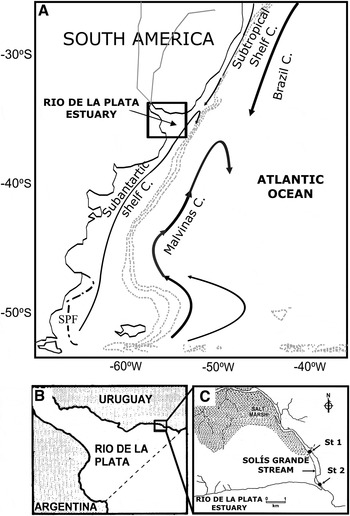
The southernmost distribution in the south-western Atlantic for Elops larvae is 19°S on the Brazilian central coast (Castro & Bonecker, Reference Castro and Bonecker2005). In summer 2010, one larval specimen of genus Elops was collected alive at the mouth of Solís Grande estuary (34 °S; Figure 1). This constituted the first record of this stage for Uruguay and the southernmost record for the south-western Atlantic. A partial description for the larval stage of Elops has been provided by Bonecker & Castro (Reference Bonecker and Castro2006). In the current study we present a detailed description of the larva and an estimation of its stage of development. We also provided information on the environmental conditions where the larva occurred.
Collection site: (A) south-western Atlantic and Río de la Plata estuary location (rectangle). Schematic ocean currents were indicated; (B) Solís Grande Stream location (rectangle) at Río de la Plata; (C) sampling stations (station 1 and station 2) at Solis Grande Stream; adapted from Gómez-Erache et al. (Reference Gómez-Erache, Norbis and Bastreri2000).

MATERIALS AND METHODS
Study area and sampling
Solís Grande (34°45′59.4″S 55°24′29.8″; Figure 1) is a stream 90 km long, with a mean flow of 14.5 m3s−1 that runs into the Río de la Plata estuary. Its lower reaches constitute a shallow and small scale sub-estuary where brackish waters entering from the Río de la Plata estuary reach ~10 km upstream (Bastreri, Reference Bastreri1991). Salinity varies between 2 and 30 according to winds and runoff, and temperature is under a typical seasonal influence for subtropical systems. Zooplankton community is dominated by copepods (Acartia tonsa, Paracalanus spp. and Oithona spp.) and also chaetognaths (Sagitta friderici), mysids (Neomysis americana) and barnacles nauplii (Balanus improvisus) (Gómez-Erache et al., 2000; Calliari et al., Reference Calliari, Cervetto, Gómez-Erache and Bastreri2001). This sub-estuary has been proposed as a nursery area for valuable fish species such as sciaenids and sardines (Defeo et al., Reference Defeo, Horta, Carranza, Lercari, de Álava, Gómez, Martínez, Lozoya and Celentano2009).
This study was part of a major project that aimed to describe the occurrence and abundance of ichthyoplankton in Solís Grande, and that included sampling collection at two stations during the main fish reproductive season (September 2009–March 2010). Ichthyoplankton sampling was performed with a sled plankton net (mesh pore size 500 µm) specifically designed for shallow systems (La Bolle et al., Reference La Bolle, Li and Mundy1985). Depth (m), temperature (°C), dissolved oxygen (mg l−1) and salinity were recorded at the sampling station with an YSI ProPlus probe. Salinity was measured based on conductivity; values correspond to the practical salinity unit and are reported without units.
The larva was first anaesthetized with MS-222 and then preserved in 4% buffered formaldehyde. Taxonomic identification was based on Bonecker & Castro (Reference Bonecker and Castro2006) and McBride et al. (Reference McBride, Rocha, Ruiz-Carus and Bowen2010). The specimen was measured (mm, total and standard length) with a 0.1 mm resolution micrometer and myomeres were counted under stereomicroscope. Drawings were prepared with a camera lucida and photographs were taken with digital camera and the software Infinity Capture®.
RESULTS
The larva was collected alive on 24 March 2010, 1.5 km upstream from the estuarine mouth (station 1; Figure 1C). The specimen was captured in a shallow region (depth = 0.9 m) next to a salt marsh. Water temperature at the time of collection was 21.7°C and salinity was 12.3. Oxygen concentration was 7.75 mg l−1 corresponding to near saturation levels (96.2%).
Larval description
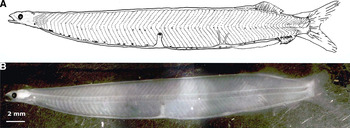
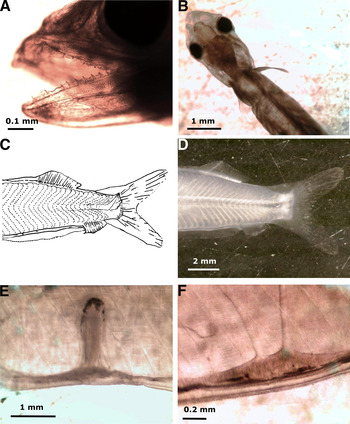
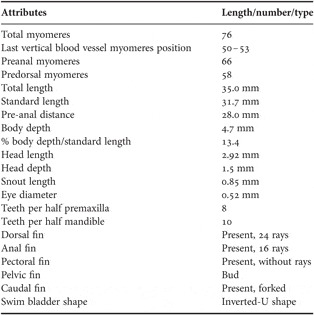
As is usual in leptocephali, the body was very laterally compressed (body depth 13.4% of standard length (SL)), transparent and elongated (SL = 31.7 mm, total length = 35 mm) (Table 1; Figure 2). According to the presence of a forked caudal fin with equal lobes, the absence of overlap between dorsal and anal fins (Figure 3C, D), and total number of myomeres (76), we corroborated that the specimen corresponded to Elops smithi (McBride et al., 2010). The head was shallower in depth than the body, but relatively large (head length 9.2% of SL). Eyes were pigmented and relatively big (eye diameter 1.8% of head length). The half premaxilla had a total of 8 teeth and the half mandible had 10 teeth, all of them similar in size and appearance (Figure 3A). The caudal fin was completely developed, while pectoral and pelvic fins were in an early developmental stage: the first one without rays and the second one as a small protuberance (bud) (Figure 3B, C, D). The larva had a conspicuous swim bladder shaped as an inverted U (Figure 3E). The kidney was evident as a mass of tissue in the dorsal wall of digestive tract posterior to the swim bladder location. Two large blood vessels extended from the kidney toward the notochord region (Figure 3F). Two lines of punctuate melanophores were distinguished. One of them was distributed along the ventral line from the thorax to anus and the other set of melanophores was located just below the midline from trunk to caudal peduncle (Figure 2A). The upper part of the swim bladder also had branched melanophores (Figure 3E).
Elops smithi larva: (A) general scheme of the specimen; (B) panoramic photograph.

Elops smithi larva: (A) photograph of half premaxilla and half mandible; (B) pectoral fin; (C) scheme; (D) photograph of dorsal and anal fins; (E) photograph of swim bladder; (F) photograph of kidney with blood vessels.

Elops smithi: morphometric and meristic data of the specimen collected at Solís Grande.

DISCUSSION
Before the description of the new species of Elops by McBride et al. (Reference McBride, Rocha, Ruiz-Carus and Bowen2010) most studies reported ladyfish on the South American coast as Elops sp. (e.g. McBride & Horodysky, Reference McBride and Horodysky2004; Richardson & Cowen, Reference Richardson and Cowen2004; Bonecker & Castro, Reference Bonecker and Castro2006) or Elops saurus (e.g. Goch et al., Reference Goch, Krumme, Saint-Paul and Zuanon2006; Azevedo et al., 2007). If we consider these previous records as Elops smithi, the distribution of this species could be inferred to extend from the Caribbean Sea to central Brazilian coasts (Richardson & Cowen, Reference Richardson and Cowen2004; Bonecker & Castro Reference Bonecker and Castro2006; Bonecker et al., Reference Bonecker, Castro and Bonecker2009; Vasconcellos et al., 2011). The southernmost record available so far for E. smithi ( = Elops sp.) was 19°S on the coasts of Rio de Janeiro State, Brazil (Castro & Bonecker, Reference Castro and Bonecker2005).
The current report represents an extension in the distribution of this species of 16° latitude, or nearly 2700 km of coastline stretch, and also evidences occurrence under a wider range of climatic regions than previously known, encompassing subtropical/temperate transition systems besides tropical and subtropical systems. During the same season when the current larva of E. smithi was collected in Solís Grande, juveniles of E. smithi were also found in the Río de la Plata and in a coastal lagoon along the Uruguayan coast by independent research groups according to preliminary communications (Caballero et al., Reference Caballero, Segura and Loureiro2010; Fabiano et al., Reference Fabiano, Santana, Silveira and Nieddu2010).
Previous studies report low abundances of Elops sp. larvae in both oceanic and estuarine waters. Near Barbados Island (~13°N) catch rates ranged between 0.99 and 3.6 ind 105 m3 (Richardson & Cowen, Reference Richardson and Cowen2004). In the eastern Brazilian continental shelf (16–19°S), 4 individuals were captured during 3 cruises involving a high sampling effort (300 tows; Castro & Bonecker, Reference Castro and Bonecker2005). In a tropical river estuary on the eastern South America coast (~19°S) Elops sp. larvae were present with a mean abundance of 43.4 ± 101.5 ind 105 m3 (Joyeux et al., 2004), mainly during flood tide (Bonecker et al., 2009). According to Miller (Reference Miller2009), samplers with a larger mouth opening than common ichthyoplankton nets (e.g. 8 m2) are recommended for successful capture of leptocephali. We collected one Elops smithi larva with an epibenthic sled (0.75 m high and 1m2). Based on the characteristic of the study site (average depth = 2.0 m, width of stream < 150 m) and sampling gear and effort (a total of 43 tows and 2500 m3 of seawater filtered) it is highly likely that collection of a single specimen also reflected a natural low abundance of E. smithi in the Solís Grande estuary.
The environmental characteristics (temperature, salinity and dissolved oxygen) of the Solís Grande estuary were typical for the system and season sampled (Gómez-Erache et al., 2000; Calliari et al., 2001; Acuña et al., Reference Acuña, Passadore and Giménez2010). However, on a broader scale and according to the Oceanic Niño Index, the sampling period coincided with a strong El Niño event (2009–2010) (http://ggweather.com/enso/oni.htm). These events are associated with positive sea surface temperature anomalies in the south-western Atlantic and with northerly wind anomalies over the Brazilian and Uruguayan continental shelf (Alexander et al., Reference Alexander, Blade, Newman, Lanzante, Ngar-Cheung and Scott2002; Piola et al., Reference Piola, Matano, Palma, Möller and Campos2005). We hypothesize that such conditions may have resulted in an enhanced southern transport of the warm subtropical shelf current (Figure 1A). Since E. smithi larvae ( = Elops sp.) occur in warm waters (T > 23°C; Richardson & Cowen, Reference Richardson and Cowen2004; Bonecker et al., 2009) its presence on the Uruguayan coast (i.e. Solís Grande (this study), Río de la Plata (Caballero et al., 2010) and coastal lagoons (Fabiano et al., 2010)) could be a consequence of the large scale oceanographic anomalies that prevailed along this period. More data are needed to clarify this issue.
The congeneric Elops saurus exhibits a larval development divided in four stages: premetamorphic, early, mid and late metamorphic (Gehringer, Reference Gehringer1959). Based on this description, the larva we collected corresponded to an early metamorphic stage according to total length, swim bladder and kidney shape, and teeth appearance. This stage of development of Elops is commonly found in coastal areas and entering into the estuarine systems (Gehringer, Reference Gehringer1959; McBride & Horodysky, Reference McBride and Horodysky2004).
This is the first time a larva of this group has been collected on the Uruguayan coast, but collections and studies of ichthyoplankton are rather scarce over that area and particularly in small sub-estuaries of the Rio de la Plata. Future surveys should clarify the meridional limits in the distribution of this species, and discern whether the occurrence of E. smithi in this region was a result of atypical environmental conditions.
ACKNOWLEDGEMENTS
We thank all colleagues involved in the field surveys and Sección Limnología (UDELAR). We thank David G. Smith for providing us with valuable literature and we thank the anonymous referees for their comments. This research was funded by Marie-Curie Incoming Fellowship (MIF2-CT-2006-980072) and CSIC I+D Groups Program Grant No. 1037.