Anyone can … give or spend money. But it is not easy to decide to whom to give how much, when, for what purpose, and how.
—AristotleFootnote 1
Private donations accounted for more than 60 percent of the estimated $26.9 billion worldwide budget of international humanitarian and development nongovernmental organizations (NGOs) for 2005.Footnote 2 Private money—raised and allocated by transnational NGOs such as CARE, Catholic Relief Services, Médecins Sans Frontières, and World Vision—thus increasingly enables the delivery of services and investments in health, education, and infrastructure in poor countries.Footnote 3 Yet, we know surprisingly little about the humanitarian and development aid raised and allocated by NGOs. Previous research on foreign aid scarcely mentions private-source aid. We do not even know how much private aid is going where, not to mention why and with what effects. This article presents a new data set of U.S. private-source foreign aid, which allows us to map such aid for the first time—and attempt to explain it.
While there is a vast literature that seeks to explain the allocation of bilateral foreign aid by governments and substantial work on aid allocation by multilateral institutions such as the World Bank, this article is, to the best of our knowledge, the first attempt to systematically analyze private aid allocation. We therefore develop a set of original hypotheses about NGO allocation from general theories as well as practitioner accounts.
Constructivist scholars of international relations argue that behavior is in large part a function of identities and shared norms, which shape actors' very definition of their interests. The density of interaction among aid NGOs, through which a common identity can be shaped and reinforced, suggests that these NGOs should be a prime example of a “principled issue-network” whose members are “motivated by values rather than by material concerns.”Footnote 4 Yet, what exactly is the substantive content of the discourses that shape aid NGOs' identity? We distinguish two variants of altruism: a humanitarian discourse, centered upon a normative commitment to “serv[ing] underdeveloped or neglected populations … and provid[ing] services to those in need”;Footnote 5 and a development discourse, focused on the “root causes” of poverty and sustainable, long-term improvements. These discourses, both found within and among NGOs, imply distinct explanations of private aid allocation. The humanitarian discourse suggests that private-source aid allocation by NGOs should be above all a function of potential recipients' objective need. The development discourse suggests that allocation should (additionally or instead) be guided by where aid can most efficiently contribute to sustained economic or social development.
We derive a third explanation of how NGOs allocate private-source aid from organization-theoretic and systemic perspectives, supplemented by the accounts of prominent NGO-practitioner-critics. Here, market-like competition for resources causes even genuinely humanitarian NGOs to put the financial interests of the organization first, possibly at the expense of their altruistic missions. The logic of this argument implies that NGOs allocate funds with an eye to fundraising opportunities—specifically that aid allocation is driven by the often volatile perception of developing countries' need among the donating public and thus is, in turn, a function of the countries' portrayal in the media.
The three contrasting views are not necessarily mutually exclusive.Footnote 6 Behavioral economics suggests, however, that the market norms underpinning the third explanation might crowd out ethical and social norms and thus undercut humanitarian principled behavior in particular. Yet social identities and norms based on the “humanitarian” discourse should be particularly likely to temper or counteract materialistic institutional incentives in aid NGOs.Footnote 7 We therefore expect recipients' objective need to be a stronger explanation of NGO aid allocation than anticipated efficacy or the donating public's perceptions of need.
After developing these arguments, we use our new data set to assess the resulting hypotheses in statistical analyses that also consider numerous other possible explanations of NGO aid allocation. In a research design allowing for mixed motives, we find strong support for the hypothesis that aid NGOs allocate funds in accordance with humanitarian principles, but only limited support for the hypothesis that they follow the postulates of the development discourse, and virtually no support for the stipulation that allocation is driven by fundraising considerations. These findings are robust to a broad range of model specifications and the use of multiple alternative measures of the key variables.
Our research seeks to make theoretical and empirical contributions; it also has significant implications for public policy. Theoretically, we seek to advance the rationalist-constructivist debate in international relations theory by suggesting a set of scope conditions under which global governance by normatively motivated “principled” nonstate actors is most likely to be distinctive in the way constructivists expect it to be. We also seek to contribute to the literatures on the distinctiveness of transnational governance and “nonstate actors” in world politics.Footnote 8 Our finding that recipients' objective need is a major determinant of private aid allocation by transnational humanitarian and development NGOs contrasts with findings in the government aid literature, where “the relationship between aid flows and level of development is highly sensitive to variations in model and data coverage.”Footnote 9
Empirically, we introduce a new data set, based on detailed financial records gathered from forty leading transnational, U.S.-based NGOs. These data allow us to map for the first time the allocation of U.S. private-source aid across the 119 countries classified by the World Bank as “least developed” or “lower-middle-income” countries—and to analyze that allocation. The private aid raised by these NGOs, mainly through a large number of small donations from private individuals, amounts to more than $1.6 billion per year. This makes our research intrinsically important, especially because these NGOs focus on issues where the potential for making a difference is tremendous, such as building and improving infrastructure for safe drinking water, sanitation, and sewerage. As the managing director of the Rockefeller Foundation put it pointedly, the lack of clean water and sanitation is killing children in the developing world “at a rate equivalent to having a jumbo jet full of kids crash every four hours.”Footnote 10
Finally, we seek to contribute to the emergent literature that uses statistical or quantitative methods to examine constructivist hypotheses, which is still rare in international political economy (IPE).Footnote 11 In doing so, we make no claim that any particular methodological approach is superior to others, but support Büthe's argument that one's position in meta-theoretical debates need not predetermine one's choice of empirical-analytical methods.Footnote 12
What Motivates NGOs and Explains Their Aid Allocation?
Much of the literature on foreign aid shows that donor governments use their discretion in allocating ostensibly altruistic aid to advance their own political-economic interests.Footnote 13 While recipients' level of economic development matters in a number of statistical analyses of government aid allocation, it is often secondary to political or strategic motivations or is significant due only to the inclusion of high-income countries that receive (almost) no aid.Footnote 14 Analyses that are, similar to ours, restricted to poor recipient countries often find that recipients' per capita gross domestic product (GDP) has no significant effect on the amounts of government aid allocated to developing countries,Footnote 15 that wealthier developing countries actually get significantly more aid,Footnote 16 even if at a declining rate,Footnote 17 or that the significance and even the sign of the estimated effect is unstable.Footnote 18 Studies that consider measures of recipient need other than per capita GDP usually find them to be statistically insignificant predictors of government aid allocation.Footnote 19 At the same time, empirical analyses show advanced industrialized countries' aid has been allocated based on geopolitical considerations,Footnote 20 the desire of producers from the donor country to have guaranteed export markets,Footnote 21 or political leaders' desire to please certain domestic political constituencies.Footnote 22
Does NGO aid allocation follow a different logic from government aid allocation? Although no previous study has, to our knowledge, specifically theorized NGO aid allocation, we can deduce possible answers from theoretical traditions such as sociological institutionalism and from the broader literature on NGOs by scholars and practitioners.
Norms and Identities as Drivers of Allocation Decisions
We derive the first two explanations of private aid allocation from the constructivist approach to the study of international relations and international organizations. Constructivist scholars focus on how social institutions, such as shared norms, constitute actor interests by providing individual and collective actors with identities or roles, such as “humanitarian NGO.”Footnote 23 Although constructivists do not assume that roles are “played in mechanical fashion,”Footnote 24 they expect these roles to exert a strong normative demand upon actors to behave in ways that are consistent with their respective roles. This analytical approach yields distinctive hypotheses about behavior and aggregate outcomes in world politics, such as the allocation of private aid by NGOs, because it suggests that the key criterion for choosing an action is not whether the consequences are most beneficial to the actor but rather whether the action itself is appropriate, given the specific social norms that define the actor's role.Footnote 25
Since roles create expectations for behavior only when the understanding about the corresponding “appropriate” behavior is shared, they are at any given moment “beyond the discretion of any individual participant”Footnote 26 and can therefore analytically be treated as fixed in the short term. Hence constructivists emphasize “social, spatial, and historical context”Footnote 27 and the “discourses” through which actors collectively create identities and define or redefine social roles.Footnote 28 Context and discourse thus shape the very definition of the interests that individuals and groups are then expected to pursue following this “logic of appropriateness.”
Discourses within a coherent group—such as within a community of NGOs that see each other as devoted to a common cause—should be particularly promising for generating coherent and stable identities and roles, thus defining a mission for such organizations. But constructivism as such makes no substantive assumptions; it must be supplemented by information or assumptions about the specific content of the norms and identities in any particular case to yield a prediction about outcomes.Footnote 29 What then is the content of the pertinent discourses? For analytical purposes, we differentiate between a humanitarian and a development discourse, because these two ideal types imply “different understandings [and] principles”Footnote 30 and yield distinct hypotheses concerning aid allocation. Although it might be possible to categorize some aid NGOs as primarily humanitarian and others as primarily development organizations, most have had among their ranks proponents of either vision, and both discourses have been prevalent among aid NGOs for many years.Footnote 31
The Humanitarian Discourse: Altruistically Addressing Objective Recipient Needs
The humanitarian discourse is organized around an ethical obligation to relieve human suffering.Footnote 32 Among its core guiding principles of impartiality, neutrality, and independence, the first is most pertinent to aid allocation. Impartiality, as defined in the Preamble to the Statutes of the International Red Cross and Red Crescent Movement, calls for giving aid “to relieve the suffering of individuals, solely guided by their needs,” without consideration of other criteria such as “nationality, race, religious beliefs, class or political opinions”—and to “give priority to the most urgent cases of distress.”Footnote 33
This discourse permeates many aid NGOs' websites, printed brochures, audio and video advertisements, and internal communications. Save the Children, for instance, was founded in the UK in the aftermath of World War I to literally save children in Austria and Germany from starvation in the belief that compassion dictated extending a helping hand to these most “defenseless” among those who until a few weeks earlier had been the enemies in a bitter war.Footnote 34 Catholic Relief Services (U.S.) emphasizes that it seeks to help the “impoverished and disadvantaged … based solely on need, regardless of their race, religion or ethnicity.”Footnote 35 Similarly, World Vision USA sees itself as “serving the world's poorest” and “most vulnerable.”Footnote 36 Even CARE USA emphasizes how its new developmentalist focus on “underlying causes” and rights is in addition to, rather than instead of, the focus on “needs” and on serving “the poorest communities in the world,” which has traditionally been at the organization's heart.Footnote 37 In sum, the humanitarian discourse is pervasive among aid NGOs.
This “immediate ethical imperative of reducing suffering” has a “sense of urgency” that allows putting consideration of long-term consequences to the side.Footnote 38 It is not just that humanitarian organizations used to assume “that good intentions [in the provision of assistance] were evidence of good outcomes,”Footnote 39 but many consciously reject any criteria other than the “ethic of obligation.”Footnote 40 The morality of the aid-givers and hence the intentions are thus central to the humanitarian project defined by this discourse. Reinforced by the density of interaction among aid NGOs, this discourse should shape the identity of NGO decision makers, making them strong candidates to be “principled” actors.Footnote 41 The content of the humanitarian discourse, combined with the behavioral logic of constructivism, yields our “humanitarian hypothesis”:
H1: The greater the recipients' objective need, the higher the aid allocation.
The Development Discourse: Eliminating or Curbing the Root Causes of Suffering
What we call the development discourse is related to, but analytically quite distinct from the humanitarian discourse. Motivated by what Weber called an “ethic of responsibility” or an “ethic of consequences,”Footnote 42 this discourse also approaches aid as an altruistic endeavor but has little concern for intentions; it is above all concerned with outcomes. Here, development NGOs seek a lasting impact on the “root causes” of suffering, rather than alleviating suffering in the short term. It implies building an irrigation system and training local stakeholders in operating that system, for instance, rather than—or in addition to—handing out food aid when drought destroys the crop. The development discourse implies that aid should be allocated and assessed as an instrumental strategy to achieve tangible, persistent gains in recipients' socioeconomic, physical, or political well-being.
This discourse can be found in many aid NGOs, for instance when they describe their goal as not just relieving the effects of poverty, but also setting the recipients on a trajectory toward long-term improvements in their human and economic conditions. World Vision USA, for instance, not only talks of prioritizing the neediest but presents itself as “your partner in enabling the world's children to realize their God-given potential by tackling the root causes of poverty.”Footnote 43 And CARE claims that its programs specifically target children because it “strives to attack the underlying causes of poverty through health and education projects.”Footnote 44
The core ideas of the development discourse imply that the likelihood of efficient use and success are important criteria for aid allocation. This suggests that an ideal-typical development aid NGO must take not just recipient need into account but also other factors that bear on the aid's likely effectiveness and efficiency. A weak form of this argument suggests that the expected efficacy of aid affects aid allocation independently of other factors (H2a). A strong form suggests a conditional or “interactive” effect (H2b), where the effect of need is conditioned by expected efficacy, so that even high need prompts little allocation when the conditions for aid effectiveness are poor, but need has a strong effect where conditions for aid effectiveness are good:
H2a: The more conducive the context in which potential recipients live is to effective and efficient use, the more development aid they will receive (controlling for, inter alia, objective need).
H2b: The more conducive the context is to aid effectiveness or efficiency, the more will recipients' objective need affect aid allocation.
While some elements of the development discourse can be found in virtually all major aid NGOs, and many aid projects combine short- and long-term elements, the development discourse has remained contested among aid NGOs (unlike the comparatively uncontested humanitarian discourse). Many humanitarians reject its consequentialist logic out of a concern that it might undermine the “ethic of obligation.”Footnote 45 This contestedness leaves us uncertain whether the development discourse should be expected to have generated sufficiently widely or deeply shared norms to guide behavior and thus explain patterns of outcomes.
Suffering Sells: Aid Allocation as a Fundraising Strategy
Very different patterns of private aid allocation are implied by two prominent critiques of humanitarian and development aid. These critiques have very different motivations and logics, but both portray aid NGOs as fundamentally similar to governments (or for-profit firms) in that their aid allocation is ostensibly driven by the pursuit of goals that have little to do with recipients' humanitarian needs or long-term development objectives.
Aid Allocation as a Fundraising Strategy (I): The Cynics
The first critique focuses on individual (mis)leaders of NGOs and questions whether they faithfully behave as suggested by the altruistic norms officially espoused by their organizations. Attributing far more selfish motives to them, several prominent accounts of disillusioned former NGO staffers portray NGO leaders as seeking to enrich themselves or hiding other motives behind a façade of humanitarianism.Footnote 46 Such views became widespread in the late 1990s and early 2000s: as transnational aid NGOs gained resources, confidence, and power, their operations also attracted increasing scrutiny. Widespread media reports of several cases of outright theft or misuse of donated funds to pay for foreign adventures, “excessive” salaries, or personal “lifestyle enhancement” of an organization's senior staff—and reports of activities “outside of the organization's purview”Footnote 47—created the impression that many NGO leaders care “more about constructing heroic images of themselves for donors than about the plight of victims.”Footnote 48 This cynical view of aid NGOs and their leaders also has considerable support—and is regularly discussed—in the scholarly literature because it fundamentally challenges (the ideal of) humanitarianism. Barnett, for instance, notes that among the approximately 200 ostensibly humanitarian agencies that flooded into Rwanda and Zaire after the Rwandan genocide, “many [were] simply there to fly the flag and impress prospective donors.”Footnote 49
What does this critique imply for aid allocation? Viewing humanitarian and development NGOs leaders as the “lords of poverty”Footnote 50 suggests that resource allocation will be driven by opportunities to generate even more resources (which can then be siphoned off). Such a fundraising objective implies that the NGO “must be in certain areas [to which] the donors are paying attention.”Footnote 51
Aid Allocation as a Fundraising Strategy (II): Institutional Pathologies and Competition
Equally important is a second critique that aid NGOs fail to achieve the core objective of development aid. There are two variants: one organizational, the other systemic. Both challenge the idea that aid NGOs' principled beliefs and nonmaterial interests cause them to behave differently from other political-economic actors, without relying on an assumption of selfishness or ill intent of NGO leaders or staff.Footnote 52 The former variant is grounded in organization theory, which underpins, for instance, Barnett and Finnemore's warning that the structure and internal dynamics of international organizations lead them “pathologically” to develop interests that run counter to their original aims or official mission statements.Footnote 53 This organizational logic implies that NGOs, too, will develop “institutional pathologies” that make them similar to business firms.Footnote 54 Two pathologies should be particularly pertinent. First, as critics of “managerialism” in corporations have shown, prestige, power, and opportunities for promotion of subordinates create “a strong organizational bias” to grow an organization “beyond the optimal size.”Footnote 55 Second, organizations—including firms, IOs, and NGOs—have been shown to put self-perpetuation ahead of all else.Footnote 56 These findings suggest that managers of NGOs, pursuing their organizations' growth as an end in itself, might “capitalize upon others' misery” to secure ever-increasing donations.Footnote 57 Opportunities for soliciting further donations should thus be an important consideration in the allocation of funds.
This hypothesis follows even more powerfully from a systemic perspective, which posits that humanitarian NGOs behave like revenue-maximizing private-sector firms because of the context in which they operate. The combination of a large number of NGOs and finite resources, according to this perspective, creates a structure that resembles “competitive markets” and forces NGOs to put “organizational survival and growth” first.Footnote 58 And while “organizational survival” might also require behavior consistent with the NGOs' constitutive principles,Footnote 59 scholars such as Bob posit that the “hard material truth” always comes first: NGOs generally “depend on donors” and hence have to be concerned above all with fundraising.Footnote 60
Cooley and Ron's work suggests a similarly structure-induced materialist preoccupation, specifically by humanitarian NGOs. Their primary concern is that short-term renewable, competitive-bid contracts, as a way to finance humanitarian or development work, can introduce or exacerbate destructive competition among NGOs. The logic underpinning this concern, however, is that competition for resources generally (and regardless of anyone's intent) induces a focus on material self-interest among such NGOs.Footnote 61 And as the number of aid NGOs increased rapidly in the 1990s, and NGOs “stretched the private donor base as far as they [could],” this materialistic competition should have intensified.Footnote 62 Indeed, by the mid-1990s Wallace observed—in explicit contrast with earlier decades—that “NGO spokesmen are not above taking a dig or two at other [aid NGOs].”Footnote 63 If NGO life is above all a structure-induced scramble for funds, then creating and maximizing opportunities for fundraising should be an important consideration in NGOs' allocation of private aid. As Bob writes, “donor preferences exert influence over [NGOs'] operations, including their choice of aggrieved groups on which to expend scarce resources.”Footnote 64
From Motivations, Incentives, and Constraints to Hypotheses
How might NGOs use aid allocation to maximize fundraising opportunities? Visibility of their actions and awareness of their specific causes among potential donors help NGO fundraising. But unlike advocacy NGOs, humanitarian and development NGOs generally have limited opportunities to draw attention to their already-chosen targets through the kind of daring, made-for-TV actions at which organizations such as Greenpeace excel. More promising as a general strategy is to rely on existing media coverage to prime potential donors for the compassion that “is the basis of fundraising for humanitarian agencies.”Footnote 65 Indeed, many observers explicitly claim that aid NGOs allocate funds to the places where they expect donors to want to see them engaged.Footnote 66 For the large number of small donors upon which they depend for nongovernmental funding, NGOs mostly look to coverage of the world in the news media to ascertain donor expectations. Even sympathetic observers suggest that humanitarian NGOs “cannot afford to be absent from a major crisis” if that crisis receives substantial attention in the media: “Fundraising, image, and relations with major donors may suffer if an agency is not seen to be present.”Footnote 67 Both critiques of humanitarian and development aid thus suggests that donor perceptions of need will be a major factor when NGOs decide where to allocate the aid resources from private contributors. We call this the allocation-for-fundraising hypothesis:
H3: The greater the (media-driven) donor perception of need, the higher will be the aid allocation.
Competing or Complementary Hypotheses?
Real sociopolitical actors often pursue multiple goals simultaneously, even if our analytical ideal types might not allow for it. Our empirical strategy therefore consciously allows for mixed motives. We are, however, not agnostic regarding the relationship between the hypotheses. We see the weak version of the developmental explanation (H2a) as largely complementary to the humanitarian explanation (H1). By contrast, finding significant support for the strong version (H2b) should imply less support for H1 insofar as responsiveness to need conditional on other factors is inconsistent with core humanitarian principles. And because the humanitarian discourse was dominant, whereas the development discourse was contested during the period analyzed, the former should provide a stronger explanation of NGO aid allocation than the latter.
Regarding our third hypothesis (H3), aid NGOs ultimately must pursue both altruistic and material objectives—not just because altruism may be inherently “impure,”Footnote 68 but also because even the most altruistic NGO needs resources to do good, and “people donate only when they are gripped by haunting images.”Footnote 69 Yet there may be limits to the compatibility of the fundraising imperative with genuine humanitarian or development objectives. Smillie warns that “an overactive interest in pleasing [the large number of small] ten-dollar donors” has consequences for NGOs' ability to achieve humanitarian and development objectives, not least because it skews which countries receive their attention and funds.Footnote 70 And if media-savvy NGOs race from one short-term project to the next in search of highly visible causes for fundraising purposes,Footnote 71 it may leave little opportunity for addressing the genuine and often persistent needs of the poor. Moreover, research in behavioral economics suggests that materialistic considerations or the “market norms” underpinning H3 can easily undercut and crowd out voluntaristic motivations such as altruism or other ethical or social norms of the kind underpinning both versions of H2 and, especially, H1.Footnote 72 This should make it unlikely to find support for H3 and at the same time for H1 and/or H2.
Empirical Analysis
A New Data Set of Private Aid Allocation
We can conduct a systematic analysis of these hypotheses thanks to a new data set, which we have constructed through a multiyear data-gathering effort. We started by identifying four major, intrinsically important issue areas that are closely connected—humanitarian or development NGOs active in one of them are often also active in one or more of the others:
• Emergency relief
• Water, sewerage, and sanitation
• Health
• Education
We then conducted surveys among academic and practitioner experts to identify the “most important” NGOs in each issue area. We limited consideration to organizations that (1) operate as not-for-profit entities, (2) carry out on-the-ground projects in developing countries, and (3) are U.S.-based, conduct most fundraising in the United States, or have a U.S. affiliate that allocates funds separately.Footnote 73
Based on the overlap between the lists the experts gave us for their respective issue areas, we identified forty-seven operational NGOs that were mentioned consistently by the experts and met the criteria for inclusion in our study, including many of the largest transnational NGOs.Footnote 74 We asked each NGO for the total annual monetary value of resources it had received from private sources. Our data thus exclude government funds and funds from multilateral agencies. Second, we asked each NGO for disaggregated financial records specifying the amount allocated to each recipient country. Forty of the forty-seven organizations (85 percent) supplied us with the requested data in usable form. Each of them is engaged in many countries; collectively, they have active aid projects in almost all developing countries. The worldwide total of U.S. private-source humanitarian or development aid allocated by the NGOs included in our empirical analysis was US$1.612 billion in 2001. This constitutes a very substantial amount of money in the large parts of the world where many survive on less than $1 a day.Footnote 75
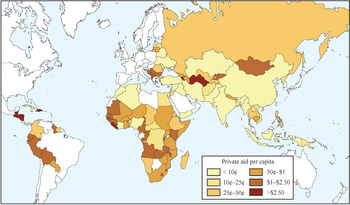
This original data set allows us to map the aggregate allocation of private aid for the first time. We calculate (and show in Figure 1) the per capita aid receipts for the 119 countries categorized by the World Bank as “low-income” or “lower-middle-income” countries.Footnote 76 The average (mean) per capita aid receipt for these countries is $1.09, but as Figure 1 shows, per capita private aid differs greatly across countries. Across the 119 countries, private aid in 2001 ranged from zero for Bhutan, Maldives, and the Marshall Islands to a maximum of $9.28 per person for El Salvador, with a skewed distribution and a standard deviation of $1.56.
Global distribution of private humanitarian and development aid
Source: Authors' original dataset of U.S.-source private aid allocation by the 40 transnational NGOs specified in the NGO Sample Appendix

Testing the Humanitarian Hypothesis
To test our key hypotheses, we conduct statistical analyses of the natural log of per capita aid, which gives us a dependent variable with an approximately normal distribution.Footnote 77 Our baseline model takes into account, first, the very persistent finding from analyses of governmental foreign aid allocation that larger countries receive more aid—but at a declining rateFootnote 78—by including recipient country population as a control variable in all models.Footnote 79 Second, many of the NGOs in our sample are explicitly motivated by Christian religious beliefs and ethics. Because much anecdotal evidence (including from our interviews) suggests that overtly Christian NGOs face greater obstacles establishing even short-term emergency projects among non-Christian populations,Footnote 80 we include the share of christians in the recipient country population.Footnote 81 Third, preliminary inspection of the data suggested that poor countries in Latin America and the Caribbean receive substantially more aid than poor countries elsewhere, so we include a dichotomous indicator for whether a country is in latin america or the Caribbean.Footnote 82 The estimated coefficients for this baseline model suggest that countries in Latin America indeed receive substantially more per capita private aid from U.S. sources than countries elsewhere, that countries with more Christians receive more private aid, and that larger countries receive less private aid per capita.
We operationalize the humanitarian hypothesis—according to which aid allocation is a function of potential recipients' need—using several alternative measures of “objective need.” Our initial measure of objective need is gdp per capita,Footnote 83 because it is available for almost all low- and lower-middle-income countries; it is also the most commonly used measure of recipient need in the broader literature on foreign aid in political science and economics.Footnote 84 If the humanitarian hypothesis is correct—namely that NGO aid allocation is a function of recipients' objective need—then gdp per capita should be a statistically and substantively very significant (inverse) predictor of NGO aid allocation.
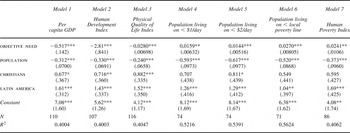
Indeed, when we add this measure of objective need to the baseline statistical model, we estimate a highly statistically significant negative coefficient for it (Model 1 in Table 1).Footnote 85 It suggests that the poorer a country's inhabitants are on average, the higher is the per capita private aid allocated to that country, supporting the humanitarian hypothesis. The variance explained by the model (R 2) increases from just under 32 percent for the baseline model to just over 40 percent for Model 1.Footnote 86
Initial tests of the humanitarian hypothesis (alternative measures of objective need)

Notes: Ordinary least squares (OLS) estimates with Huber-White robust standard errors in parentheses.
* p < .1;
** p < .05;
*** p < .01, in two-tailed tests.
Estimated coefficients for need not comparable across models since the measures are on different scales. R 2 information not fully comparable across models because of changes in sample.
There is a long-standing debate about the limits of per capita GDP as a measure of a country's development level.Footnote 87 Examining alternative measures of recipient need is particularly important for assessing the robustness of our findings since previous studies of government aid allocation have found little if any support for recipient need as a determinant of aid allocation when using measures other than per capita GDP.Footnote 88 We consider six alternative measures of recipient need. Since all of them are highly correlated with per capita GDP (0.47 < |ρ| < 0.77 in our sample) as well as with each other (0.43 < |ρ| < 0.93), we use them separately in Models 2 through 7.
We first consider the human development index (HDI), from the Human Development Report of the United Nations Development Program (UNDP). The HDI combines a purchasing power parity-based index of economic development with measures of life expectancy at birth, adult literacy, and enrollment ratios in primary, secondary, and tertiary education. Higher values indicate a higher level of “human development,” so the estimated coefficient should have a negative sign. When we use it as our measure of objective need in Model 2, we indeed estimate a highly significant negative coefficient (p < 0.001).
The physical quality of life index (PQLI) is based on slightly different components: literacy, infant mortality, and life expectancy at age one (no GDP component).Footnote 89 Higher values indicate a higher quality of life, so we expect a negative coefficient, which is what we find in Model 3 (p < 0.001).
The UNDP reports for many developing countries the percentages of the population (1) living on less than $1 per day, (2) living on less than $2 per day, and (3) living below the local (national) poverty line. These measures of need, used in Models 4–6, respectively, give a sense of the income distribution and hence the size of the neediest population. This makes them a good complement to gdp per capita, which measures the average level of economic development. Each measure is statistically significant with the expected positive sign.Footnote 90
Finally, the UN's human poverty index (HPI) is conceptually the inverse of the PQLI. It combines the probability at birth of not surviving to age forty (the “survival” component), the percentage of adults who are illiterate (the “knowledge” component), and the percentage of the population without access to safe drinking water, as well as the percentage of children below age five who are underweight (jointly considered the “decent standard of living” component of the index). The HPI uses data collected anytime between 1990 and 2004/2005 and is therefore an approximation rather than a precise measure of conditions in 2000 or 2001. Since higher values indicate greater need, we expect a positive coefficient, which is what we estimate in Model 7.
In sum, we estimate a statistically (and substantively) significant effect for every one of the seven measures of objective need on the allocation of private aid. This provides strong support for the humanitarian hypothesis.
Testing the Development Hypothesis
The development hypothesis posits that aid allocation will be a function of expected aid effectiveness. We operationalize this hypothesis by drawing on the literature on government-to-government aid and economic growth.Footnote 91 Many findings remain contested in that literature,Footnote 92 and few governments have a record of systematically allocating more aid to countries with better institutions or policies,Footnote 93 but most scholars and practitioners seem to agree that aid, if it actually seeks to foster economic development, should be allocated to the (needy) countries with the least corrupt governments. Since transnational aid NGOs need at least the acquiescence—and sometimes the direct support—of political leaders and local officials to carry out their projects, government corruption in recipient countries might also be an important factor in private aid allocation.
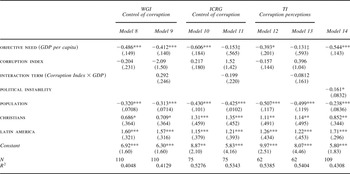
For our initial operationalization, we use the most comprehensive measure of government corruption, from the World Bank's World Governance Indicators (WGI) project. The WGI control of corruption (WGI-CC) index measures “the extent to which public power is [not] exercised for private gain, including both petty and grand forms of corruption, as well as ‘capture’ of the state by elites and private interests.”Footnote 94 Higher values indicate less corruption. What we call the weak version of the development hypothesis (H2a) posits that, among otherwise comparable potential recipient countries, NGOs prefer the less corrupt ones when allocating development funds, suggesting a significant positive coefficient for WGI-CC when it is added in Model 8 (compare to Model 1). The strong version of the hypothesis (H2b) suggests instead that the level of corruption in a country will condition need's effect on aid allocation: the less corrupt a country is (that is, the better its control of corruption), the greater the effect of objective need should be on aid allocation. In Model 9, we therefore include WGI-CC in interaction with GDP per capita as our (initial) measure of (objective) need, then calculate the resulting marginal effect of need across the range of control of corruption.
Neither version of the development hypothesis finds empirical support in the initial estimates: WGI-CC as such is statistically clearly insignificant, and it does not significantly modify the effect of GDP per capita, our measure of objective need: WGI-CC and the interaction term (wgi-cc × gdp per capita) fail tests for joint significance in Model 9 (p > F = 0.1469) and their inclusion does not improve the model fit, suggesting that they do not belong in the model.Footnote 95
Next, we consider alternative measures of corruption in potential recipient countries. First, we use the Political Risk Services Group's “assessment of corruption within [a country's] political system”—part of its International Country Risk Guide (ICRG)—which takes into account not just “demands for special payments and bribes” by government officials, but also “excessive patronage, nepotism, job reservations, ‘favor-for-favors,’ secret party funding, and suspiciously close ties between politics and business.”Footnote 96 The index is based on the work of ICRG country specialists and also constructed such that higher values indicate less corruption. Models 10 and 11 use ICRG's control of corruption. Then, in Models 12 and 13, we use the Corruption Perceptions Index from Transparency International (TI), which differs from the previous measures in that it is based on questions about experienced or perceived public sector corruption from at least three and up to fourteen different surveys, mostly among local and foreign business practitioners. Here, too, higher values indicate less corruption.
Neither the ICRG nor the TI measure of (control of) corruption is statistically significant as such, at least not for the subset of countries for which these measures exist (see Table 2). Moreover, neither measure conditions the effect of objective need to a statistically significant extent.Footnote 97 These findings essentially also hold when we use other measures of need instead of GDP per capita.Footnote 98 In sum, government corruption in potential recipient countries does not appear to affect U.S. private aid allocation systematically, offering no support for either version of the development hypothesis.
Tests of the development hypothesis (alternative measures of expected aid effectiveness)

Notes: ICRG = International Country Risk Guide; TI = Transparency International; WGI = World Governance Indicators. OLS estimates with Huber-White robust standard errors in parentheses.
* p < .1;
** p < .05;
*** p < .01, in two-tailed tests. ‡ significance obscured by correlation with interaction term; see text.
Other political or economic institutions or policies that might affect the expected efficacy of aid do not appear to significantly affect private allocation decisions, either: we consider WGI's and ICRG's measures of the rule of law, ICRG's measure of bureaucratic quality, Burnside and Dollar's “good policy index,” as well as the Polity Project's and Freedom House's measures of regime type. For none of these measures do we find a consistent, statistically significant effect in models of the type shown in Table 2.
Shifting our analytical attention from institutions to political behavior, we also consider political violence and political instability in potential recipient countries, which may increase humanitarian need, but make private aid less effective than in an otherwise comparable stable or peaceful country, endanger NGO aid workers, and increase the cost of service delivery. On balance, the logic underpinning the development hypothesis therefore suggests that such events should depress the allocation of private development aid. Specifically, we consider, individually or in combination, several measures of the existence or severity of civil war, internationalized internal war, and interstate war in aid-recipient countries,Footnote 99 as well as political instability, the sum of Banks and Wilson's event counts of coups, assassinations, general strikes, guerilla warfare, government crises, purges, riots, revolutions, and antigovernment demonstrations.Footnote 100 No measure of war is significant. political instability is the only measure for which we estimate a significant effect (Model 14 in Table 2). The negative coefficient suggests that it reduces NGO aid allocation, providing some support for H2a, while objective need remains statistically highly significant.Footnote 101
Testing the Allocation-for-Fundraising Hypothesis
According to H3, development NGOs are principally driven by a revenue motive (for individual, organizational, or systemic reasons), and they will use private aid to maximize future financial inflows. To test this allocation-for-fundraising hypothesis, we assume that the best means by which NGOs can secure further private donations is to be seen as active in situations of (seeming or real) need that get a large amount of public attention. This assumption is firmly empirically grounded: a number of practitioner accounts claim that it is exactly what NGOs do.Footnote 102 (Below, we also consider alternative ways for NGOs or their leaders to pursue revenue-maximization.) We use media coverage as our measure of public attention—consistent with studies of the determinants of U.S., Japanese, and French government aid allocation.Footnote 103
Our primary measure of media coverage is based on a qualitative content analysis of New York Times (NYTimes) coverage of the low- and lower-middle-income countries. We also consider TV news coverage (in robustness checks), but focus on print media and specifically the New York Times, for three reasons. First, numerous studies have shown that both local and regional papers across the United States systematically follow the New York Times as the “newspaper of record” in their choice of which issues to cover, and hundreds of papers across the country use its content.Footnote 104 Moreover, our preliminary analyses showed the New York Times's coverage of developing countries to be highly correlated with coverage in other major U.S. papers.Footnote 105 Second, while more Americans get their news from TV than from any other source, journalists, scholars, and observers of various political convictions have for many years noted the extent to which the New York Times also sets the agenda for television newscasts nationwide, especially regarding foreign affairs.Footnote 106 Third, although the Internet and especially political blogs are an increasingly important source of news for Americans, this trend had barely started in 2001, the year on which we focus in our empirical analysis, and even today print media, especially the New York Times, remain the primary source of news content.Footnote 107
We coded 25,463 New York Times articles, identified by keyword searches in Lexis-Nexis using each country's name(s) as the search term.Footnote 108 Each article was coded for its portrayal of the country: if the story conveyed an image of a place in need of humanitarian or development assistance, it was rated as contributing to a perception of “need.” We assigned a “no need” rating if the article portrayed the country as thriving or otherwise implied that it had little (or decreasing) need of outside assistance. A “neutral” rating was given to stories that drew attention to the country without providing substantive information about the human condition. Approximately 38 percent of the 25,463 articles fell into one of these three categories. The remaining 62 percent of the stories identified by Lexis-Nexis keyword searches did not contain any meaningful information about the developing country in question and were therefore rated “N/A” by our coders.Footnote 109
We use the content-coded data of New York Times coverage to create a primary index of media coverage (as well as four additional measures discussed below). For the media coverage index 1, we calculate the balance of “need” minus “no need” stories over twelve months to arrive at a single summary measure of net neediness portrayal in the American print media.Footnote 110 If the allocation-for-fundraising hypothesis (H3) is correct, NGO allocation of private humanitarian and development aid should be significantly predicted by this index (with a positive coefficient in the statistical analyses).
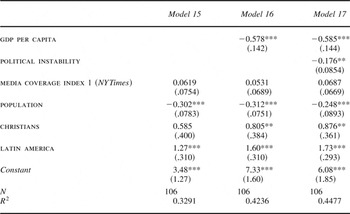
We add the media coverage index 1 directly to the baseline model, then to Model 1, and to Model 14, resulting in Models 15–17. In none of the three models is the estimated coefficient for media coverage statistically significant by any conventional standard (see Table 3). The index remains insignificant when we add it to Models 2–7, as well as when we add it to Models 8–13.
Tests of the allocation-for-fundraising hypothesis

Notes: OLS estimates with Huber-White robust standard errors in parentheses.
* p < .1;
** p < .05;
*** p < .01, in two-tailed tests.
Our analyses thus far yield strong support for the humanitarian hypothesis (H1), very limited support for the weak version of the development hypothesis (H2a), and no support for the allocation-for-fundraising hypothesis (H3). We scrutinize this surprising finding for H3 in greater detail below, but first want to provide a sense of the substantive significance of our findings, which may not be readily apparent from the coefficients since the dependent variable is logged.
Assessing the Substantive Effect
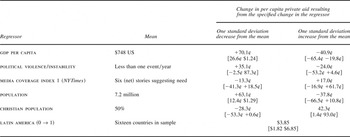
Table 4 shows, based on Model 17, the increase or decrease in the specific dollar amounts of per capita private aid from increasing or decreasing each independent variable by one standard deviation while holding the other regressors constant at their means. Using Tomz, Wittenberg, and King's Clarify software,Footnote 111 we also estimate the 95 percent confidence interval around each of the point estimates.
Predicted substantive effects, Model 17

Notes: Estimates based on Model 17 and simulations using Clarify in Stata 12. 95 percent confidence intervals in brackets.
The estimated per capita private aid for the “average country” with arithmetic mean scores on all the variables in Model 17 is $1.05. For the 106 countries for which we have data to estimate this model, the mean logged gdp per capita is equal to $748.Footnote 112 An otherwise identical (“average”) country with a level of economic development one standard deviation lower than this mean is estimated to receive an additional 70¢ ($1.75 instead of $1.05) in U.S. private aid per capita, a 67 percent increase. A country with a per capita GDP one standard deviation higher than the average would receive 41¢ less in per capita private aid (64¢ instead of $1.05), experiencing a 39 percent decrease. Objective need thus is not just statistically significant but also substantively very significant.
The comparison with the media coverage index 1 is particularly informative. Increasing the net number of need-portraying stories in the New York Times by one standard deviation above the mean of 6 would increase per capita U.S. private aid by 17¢. However, as indicated by the large standard error estimated for this variable, there is considerable uncertainty around this point estimate. Allowing for a 95 percent confidence interval, the actual effect may range from an increase of 62¢ to a decrease of 17¢. Conversely, a one standard deviation decrease in the media coverage index1 would decrease aid by 13¢, again with much uncertainty around it. The rest of Table 4 can be read accordingly.
Further Tests and Robustness Checks
Extensive additional analyses and robustness checks to further scrutinize these findings are reported and discussed in the online Empirical Appendix that accompanies this article. Here, we can provide only a brief overview. First, we consider alternative ways in which U.S.-based NGOs might use private aid allocation to boost their fundraising opportunities. One way to achieve this objective may be to give systematic preference to countries from which a large number of immigrants reside in the United States. We find, however, no evidence that immigrants have a significant effect on the allocation of private aid by U.S. NGOs.
Alternatively or in addition, U.S. aid NGOs might try to obtain more resources from the U.S. government by allocating private aid in accordance with its preferences. To examine this possibility, we consider various measures of the U.S. government's political priorities: sanctions, governmental humanitarian and development aid, military aid, troop deployment (U.S. military personnel stationed abroad), and six measures of the similarity between the military alliance portfolios of each aid recipient and the United States: Bueno de Mesquita's “taub”; the weighted global and the weighted and unweighted regional variants of Signorino and Ritter's “S” scores; a dichotomous alliance indicator; and Lake's composite index of U.S. security hierarchy (which measures the extent to which a country is linked to the United States in military and security affairs via troop deployments and alliance ties). A final possible statist variant of H3 is suggested by recent research showing a substantial temporary increase in government-source aid when a developing country serves for two years as a member of the UN Security Council (UNSC).
The findings for these ten possible operationalizations of an alternative, more governmental or statist interpretation of H3—focused on U.S. government interests—are mixed. The estimated coefficients for official development assistance, military aid, and two measures of common military and security interests suggest that there is no relationship; the findings for sanctions, military personnel, and three measures of common military and security interests support the hypothesis at least weakly; the findings for UNSC membership run directly counter to the hypothesis.
Two additional measures of U.S. interests may be considered further tests of H3, broadly conceived: the affinity of each country's UN votes with the votes of the United States, providing a broad-based measure of cultural and policy affinity, and the recipient country's level of trade with the United States, which provides an indication of commercial stakes in the bilateral relationship. We find that the former indeed increases the allocation of U.S. private aid, whereas trade actually decreases it to a statistically significant extent.
In sum, support for alternative operationalizations of the allocation-for-fundraising hypothesis is at best inconsistent. Some measures of U.S. national interest appear to have a significant effect on private aid allocation, but other measures of national interest are insignificant, and U.S. commercial ties (trade) with developing countries appear to prompt NGOs to allocate systematically less private aid to those countries. In the aggregate, these mixed findings provide little support for H3. At the same time, objective need (regardless of how it is measured) remains statistically and substantively highly significant with the addition of any of these variables, providing further support for the humanitarian hypothesis. The development hypothesis continues to have some support: political instability (only) is consistently at least weakly significant in all of these models.
The second extension further scrutinizes our surprising findings regarding media coverage. Specifically, we first consider four alternative ways of measuring (potential donors' perception of) the New York Times's coverage of developing countries: an alternative index that weighs the need-suggesting stories more heavily, a measure of need-suggesting stories only, a summary measure that records all of the stories with substantively relevant coverage, and the total number of New York Times articles identified by our initial keyword searches in Lexis-Nexis (“total raw hits”). In addition, we consider the possibility that media coverage might affect private aid allocation with a lag, allowing for a lag that ranges anywhere from zero to twelve months.Footnote 113 Combining the resulting thirteen variants of each of the five measures of media coverage with each of the seven alternative measures of recipient need leads us to estimate 455 (7 × 5 × 13) regressions. Recipient need remains significant (at p < 0.05) in all 455 regressions (100 percent), whereas media coverage is significant at the same level in only twenty-seven of the 455 regressions (5.9 percent).Footnote 114
Finally, we code the Vanderbilt TV News Archive's content summaries of the three major networks' major evening newscasts (ABC, CBS, NBC) as well as the two dominant cable news providers in 2001, CNN and Fox News. This yields five measures of TV news coverage, which parallel the five print media coverage measures (again with lags of zero to twelve months, each).Footnote 115 When we combine these measures of TV news media coverage with our seven measures of objective need in every possible way, objective need again remains consistently significant whereas TV news is significant in only twenty of the 455 regressions (4.4 percent), and two of those twenty statistically significant coefficients for TV news coverage have the “wrong” sign—they suggest that countries with more news coverage get less private aid. We thus find hardly any support for H3.Footnote 116
Additional robustness checks include examining numerous alternative explanations for the Latin America effect, such as geographic proximity, analyzing Latin American and non-Latin American countries separately, considering various other sample restrictions, and reestimating all models using total aid rather than per capita aid as the dependent variable. The results strongly confirm the findings reported here.Footnote 117
Conclusion
This article has presented the first systematic analysis of how humanitarian and development NGOs allocate funds raised from private sources. Based on detailed financial records from forty of the most prominent U.S.-based aid NGOs, we have examined the cross-national allocation of such private foreign aid to projects that provide or improve education, health care, safe drinking water, sanitation, sewerage, and emergency relief in poor countries throughout the world. We have shown that per capita private aid varies greatly across the countries categorized by the World Bank as low- or lower-middle-income countries, have deduced three possible explanations for this variation from major theoretical traditions in international relations, and have conducted a rigorous statistical analysis of the resulting hypotheses.
Our findings strongly support what we call the humanitarian hypothesis (H1), which posits that aid NGOs allocate private aid in accordance with the humanitarian principles that play a prominent role in their discourses. Regardless of whether we used per capita GDP, the human development index, the share of the population living below the poverty line, or any other of seven measures, we have found recipients' objective need to be a strong, statistically highly significant predictor of aid allocation. By contrast, we have found only limited support for what we call the weak development hypothesis (H2a), according to which conditions conducive to aid efficacy should increase aid allocation by NGOs, ceteris paribus. Potential recipient countries' institutional characteristics—such as the level of corruption or the rule of law—appear to have no effect on aid allocation, but political instability reduces private aid. We have found no support for the strong version of the development hypothesis (H2b): the extent to which need determines aid allocation is not conditional upon expected efficacy. Most strikingly, we have found virtually no support for the primary variant of the allocation-for-fundraising hypothesis (H3) according to which NGOs allocate funds based on media coverage to use potential donors' heightened awareness of recipient countries in fundraising appeals. Neither print media nor TV coverage appears to be a systematic driver of private aid allocation. Not even a more broadly conceived allocation-for-fundraising hypothesis finds robust empirical support.
Our work identifies a research frontier for scholars in international political economy, which is intrinsically important, theoretically interesting, and policy relevant. Private-source humanitarian and development aid, so far little studied by social scientists, matters substantively: the $1.6 billion per year in private funds raised in 2001 by the forty NGOs covered by our analysis—25 percent of that year's estimated total “economic engagement with developing countries by U.S. private and voluntary organizations”Footnote 118—amount to $1 per day for more than 4.3 million people. And much less than $1 per day can mean the difference between life and death in the developing world, where more than 1 billion people suffer from malnutrition, 1.1 billion have no access to safe drinking water, and millions die each year from easily prevented or treatable diseases.
This article takes a first step toward a better social-scientific understanding of private foreign aid. Our findings are cause for cautious optimism but do not conclusively show that private aid actually goes to the neediest within the recipient countries.Footnote 119 One important extension of our work will therefore be to conduct similar studies at the local level. Such research is particularly challenging due to the diversity of local NGO affiliates and the dearth of record-keeping at the local level,Footnote 120 but not impossible: Brass's detailed study of where NGOs locate projects within Kenya provides direct project-level evidence of recipients' objective need driving allocation at the local level, consistent with the arguments developed here.Footnote 121 Another crucial extension concerns assessing aid effectiveness. It is hardly surprising that government aid, allocated primarily to serve the donors' strategic, political, and commercial interests, has not alleviated underdevelopment in recipient countries. If private aid is allocated on the basis of recipient needs, then it has at least a chance of improving the conditions of aid recipients. Yet, well-intentioned aid allocation does not guarantee outcomes that benefit the recipients;Footnote 122 effects must be systematically studied rather than assumed.Footnote 123
Within theoretical debates in international relations, our findings are consistent with the position of constructivist scholars that norms guide the behavior of transnational NGOs. Others, however, have found that even among scientific experts or human rights advocates, material interests crowd out professional behavioral norms or principled motivationsFootnote 124—as an important research tradition in behavioral economics would also lead us to expect. Rather than debate which of these theoretical approaches is “right” or “wrong,” we advocate research that seeks to understand the conditions under which we should see principled beliefs and norms shape the behavior of actors even in the face of material or structural incentives to violate them. We conjecture that difficult work under often unpleasant conditions for modest salaries leads to self-selection so that those who make a career in transnational aid NGOs have particularly strong normative commitments, which are then effectively reinforced by the discursive processes in dense networks, as emphasized by constructivists. This would explain why aid NGOs appear to be distinctly committed to humanitarian principles, to the point where such commitments provide a safeguard against being crowded out by the fundraising imperative(s) they face.
Does this make private aid allocation a “weak” or “easy” test of our argument? Not at all. The theoretical logic of an argument implies scope conditions; testing an argument under conditions where the argument's logic suggests it should not hold is useful only if we suspect the argument is overspecified or if we seek to test alternative explanations that yield observationally equivalent predictions. We expect the humanitarianism-plus-constructivism logic to provide a good explanation for private aid allocation precisely because NGOs engaged in health, education, water/sanitation/sewerage, and emergency relief meet its scope conditions. At the same time, private aid allocation is a serious (or what George and Bennett call “tough”) test of the humanitarianism-plus-constructivism argument because the conditions under which we might expect alternative explanations to hold—especially the structurally induced and arguably countervailing allocation-for-fundraising logic—are also present in the realm of these aid NGOs.Footnote 125
Nonetheless, it would be particularly valuable for future research to explore this conjecture systematically by developing broadly comparable measures of the ex ante strength of discourses or of the relative normative force of social roles for important actors in world politics. Such measures would allow systematic comparisons of the extent to which variation in that strength has behavioral consequences—and the thresholds beyond which normative commitments are crowded out.Footnote 126 To disentangle the importance of social norms and self-selection, another promising avenue for future research would be to study organizations with similar normative discourses but lower probability that senior staff will have self-selected based on a strong prior normative commitment. Changes over time, for instance, in the degree of NGO “professionalization” and corresponding increases in pay and benefits, might allow such analyses even within aid NGOs.
Finally, our findings speak to the normative assessment of transnational politics. Given the increasing importance of private aid, questions about aid NGOs' accountability have appropriately been raised by scholars and practitioners. One key issue, beyond the scope of our analysis, is accountability vis-à-vis the supposed beneficiaries. Another is accountability vis-à-vis NGO donors. Aid NGOs in principle exhibit what Grant and Keohane call “fiscal accountability”—donors may withhold their support if they are dissatisfied with an NGO's performance—though in practice this is limited to donors who are well-informed or able to “demand reports.”Footnote 127 Vis-à-vis all others, an aid NGO is more in the position of a trustee than an agent, which requires the trustee to behave in a principled manner. Our findings suggest that such trust may generally be justified, at least with respect to the humanitarian discourse, though norms and identities underpinning principled behavior need to be reinforced on an ongoing basis, and as our analysis shows, a principled humanitarian ethic might lead to quite different results than a consequentialist ethic of responsibility. Private foreign aid thus raises its own normative and ethical questions.