Introduction
The overwhelming need to improve training for healthcare professionals caring for people with dementia continues to be highlighted (National Audit Office, 2007; House of Commons Committee of Public Accounts, 2008; Doyle, Reference Doyle2009; Department of Health, 2009). In the U.K., although communication skills training is an essential component for medical students (General Medical Council, 2003a), there is minimal training on dementia and older people's mental health in either undergraduate medical or nursing curricula. This area is an important competency in postgraduate old age psychiatry training and the use of certain communication skills in consultations with people with dementia, such as appropriate pacing of questions and the use of non-verbal communication has been emphasized (NICE/SCIE, 2006). However, most consultations with people with dementia involve their family carers and there is no postgraduate medical training on how to successfully facilitate such triadic consultations, in which both patient and carer concerns may need to be identified and addressed.
Currently, both statutory and non-statutory bodies in the U.K. recommend the provision of person-centered care in dementia (Department of Health, 2001; NICE/SCIE, 2006). To date, however, there has been a lack of theoretical consensus about the components of person-centered care (Brooker, Reference Brooker2004; Nolan et al., Reference Nolan, Davies, Brown, Keady and Nolan2004). Furthermore, it has been argued that relationship-centered care is a more appropriate approach in the context of dementia (Nolan et al., Reference Nolan, Davies, Brown, Keady and Nolan2004). In other contexts, concepts such as patient-, family- or client-centered care are more familiar (Rogers, Reference Rogers1951; Mead and Bower, Reference Mead and Bower2000; American Academy of Pediatrics Committee of Hospital Care, 2003). This “re-centering” of relations between professionals and patients is seen as a key way of improving communication, reducing the imbalance of power and knowledge, and increasing autonomy and choice (May and Mead, Reference May, Mead, Dowrick and Frith1999). A recent comparative analysis of the literature relating to different types of centeredness identified core components common to all types of centeredness (Hughes et al., Reference Hughes, Bamford and May2008). In this paper, we use the term “patient-centered care” since we are concerned with relations between doctors and people with dementia and their family members who consult them.
Despite the widespread emphasis on centered care, practical guidance for healthcare professionals on how to deliver such care to people with dementia remains limited (NICE/SCIE, 2006). Specific criteria to promote person-centered care, such as listening to older people, respecting their dignity, enabling them to make informed choices and involving them in their care planning, have been suggested (Department of Health, 2001). However, in consultations with people with dementia these may be difficult to achieve. A combination of factors increases the complexity of such interactions; for example, language impairment and memory problems due to cognitive deficit, and the presence of family carers who may require their own issues to be addressed. In such triadic consultations, older people tend to be less involved, and less assertive (Hasselkus, Reference Hasselkus1992; Greene et al., Reference Greene, Majerovitz, Adelman and Rizzo1994; Beisecker et al., Reference Beisecker, Chrisman and Wright1997). Carers themselves report that when they are present in medical consultations, people with dementia become increasingly marginalized and less involved in decision-making (Beisecker et al., Reference Beisecker, Chrisman and Wright1997; Hirschman et al., Reference Hirschman, Xie, Feudtner and Karlawish2004).
The recent National Dementia Strategy for England advocates that all health and social care staff involved in the care of people with dementia should possess the necessary skills to deliver best quality care, with a strong emphasis on patient-centeredness, through both basic and continuous professional training (Department of Health, 2009). There is an urgent need to identify the specific skills required to facilitate patient-centered care for people with dementia and to develop training, grounded in both a theoretical and empirical basis (Foy et al., Reference Foy2007), for healthcare professionals in this area (National Audit Office, 2007). This paper describes the background, development and evaluation of such an educational intervention, a workshop for old age psychiatrists to promote patient-centered care in their consultations with people with dementia and their carers. The educational intervention was a key output of a larger study, carried out in north-east England, exploring patient-centered care in medical consultations between old age psychiatrists, people with dementia and their carers (Bamford et al., Reference Bamford, Hughes and Robinson2007).
Methods
The main study comprised complementary approaches in order to synthesize existing evidence on patient-centered care and to explore how such care was delivered in practice for people with dementia (Bamford et al., Reference Bamford, Hughes and Robinson2007). These approaches included
• a literature review to achieve consensus on the theoretical concepts of patient-centered care;
• empirical research: (i) videotaping consultations between people with dementia, their carers and consultant old age psychiatrists, and (ii) follow-up interviews with participants from the videotaped consultations.
The aim of these two approaches was to develop an understanding of patient-centered care in practice and to identify the facilitators and barriers to the delivery of such care.
Ethical approval was secured from Newcastle and North Tyneside Ethics Committee (REC ref05/Q0905/77).
Literature review
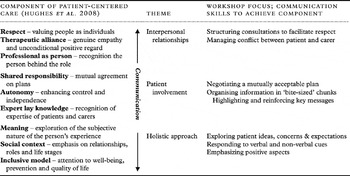
A detailed description of the search strategy, methods and results of the review have been published (Hughes et al., Reference Hughes, Bamford and May2008). The literature review revealed ten components that were common to all types of centeredness; these are listed in Table 1 (Hughes et al., Reference Hughes, Bamford and May2008). We considered communication to be fundamental to the achievement of all the other components and thus it represented an overarching theme; the remaining nine components were grouped into three broad themes: interpersonal relationships; patient involvement; and a holistic approach to care (Table 1).
Components of patient-centered care

Videotaped consultations and participant interviews
The study took place in outpatient clinics at two sites in north-east England. Seven of the ten consultant old age psychiatrists at the two sites agreed to participate. Eligible patients were those with dementia attending the clinics for routine review of their treatment with cholinesterase inhibitors, as were any carers who accompanied them. Most of the consultations were recorded using two cameras, with one focused on the doctor and one on the patient and carer. The cameras were positioned in such a way as to capture as much of the interaction as possible without altering the usual seating arrangements. The video recordings were subsequently transferred to computer and stored on external hard drives. A separate audio-recording of each consultation was transcribed verbatim.
Each participating clinician was interviewed at the outset of the project. The interview explored their professional background and training, how they organised their clinics and their views on patient-centered care and the barriers and facilitators to such care with people with dementia. Interviews with patients and carers were prompted interviews using extracts from their videotaped consultations; they were encouraged to stop the video at any point to comment on aspects of the interaction that were meaningful to them.
All interviews were electronically recorded and transcribed verbatim. Interview transcripts were reviewed by several members of the project team. Themes identified from the data were then discussed and interpreted at data workshops involving the project team. The coding frame was subsequently modified to incorporate the components of centered care identified in our literature review (Hughes et al., Reference Hughes, Bamford and May2008). The transcripts were coded and analysed using NVivo, allowing us to compare the relevance of different components to different stakeholders.
Fifty-three consultations were recorded, and prompted interviews were carried out with 7 consultants, 25 patients and 44 carers.
The development of the educational intervention was guided by both the theoretical consensus derived from the literature review and the empirical data from the videotaped consultations and participant interviews.
Development of the educational intervention: a workshop for old age psychiatrists
The format of the educational intervention was informed by a Cochrane Review of the various methods available for delivering continuing education; this found that interactive workshops could result in moderately large changes in professional practice in comparison to other methods such as lectures, conferences, symposia and seminars (O'Brien et al., Reference O'Brien, Freemantle, Oxman, Wolf, Davis and Herrin2001). We therefore decided to develop an interactive workshop.
In terms of determining the content of the workshop, the ten components of centeredness identified from the literature review provided a conceptual framework. However, the empirical data from the interviews and recorded consultations indicated that while achieving certain components of centeredness appeared to pose few difficulties in triadic consultations in actual practice (e.g. recognition of the professional as a person), achieving other components was more challenging (Bamford et al., Reference Bamford, Hughes and Robinson2007). These included
(i) Developing a therapeutic alliance. This could be difficult to achieve when patient-carer conflict was often exhibited in these consultations.
(ii) Facilitating shared responsibility whilst promoting patient autonomy. Presenting information in manageable amounts for people with dementia, so that they could make informed management decisions, was challenging for some of the consultants.
(iii) Exploring the person with dementia's experiences of living with dementia and promoting quality of life. People with dementia very rarely identified issues in response to direct questions regarding their worries; instead they raised their concerns obliquely through verbal cues which could be presented in a humourous way. In addition, consultations often focused on negative aspects of the patient's life, i.e things they couldn't do rather than emphasizing positive aspects (Bamford et al., Reference Bamford, Hughes and Robinson2007).
We concluded that the educational intervention should focus on the aspects of centeredness that were more difficult to achieve in practice and the skills required to achieve these (see Table 1). In order to allow participants to practice these skills, we identified examples from the video-recordings that demonstrated these areas and the specific communication skills needed to achieve them. In order to ensure anonymity for participants, professional actors and project team members acted out these scenarios as role plays, which were based closely on data from the original transcripts of the consultations. Twenty-four short video clips were professionally produced by Newcastle University Audiovisual Department.
Although not identified in the literature review, the videotaped consultations also revealed that the way in which doctors structured their consultations could be as important as the communication skills they used; for example, whether patient and carer were seen together or separately and how the seating was arranged in the consulting room (Bamford et al., Reference Bamford, Hughes and Robinson2007). The impact of organizational factors on the centeredness of consultations was also included in the content of the workshop.
Delivery of the workshops
The workshop was specifically aimed at old age psychiatrists to improve the patient-centeredness of their consultations with people with dementia. We advertised the workshops via local branches of the Royal College of Psychiatrists in England and Scotland, asking if they would disseminate details of the workshops to college members. The half day workshop included:
• a didactic presentation on the theorectical aspects of centered care, based on the literature review;
• interactive group work on the facilitators and barriers to centered care, using data from the interviews and participants' individual experience; and
• small group work in which participants practised specific comunication skills on the selected aspects of centeredness with feedback from their peers, using the developed video clips.
Before the workshop, participants were asked to identify a specific recent consultation which they considered was patient-centered and one that was not, and to reflect upon why they considered this to be, in order to inform the group work.
The workshops were facilitated by two or three of the project team (CB, RB, LR, JS) depending on the number of participants. Three workshops were delivered in the U.K.; two in England (Newcastle upon Tyne and London) and one in Scotland.
Evaluation of the workshops
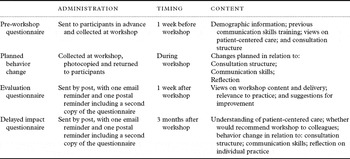
A number of questionnaires were developed, following established principles of questionnaire design (Dillman, Reference Dillman1991; McColl et al., Reference McColl2001) to ascertain the demographic characteristics of participants, the changes they planned to their consultations and those changes which they implemented after the workshop (delayed impact) (Table 2). Post-workshop evaluation questionnaires were sent out approximately one week after the workshop, with delayed impact questionnaires being sent out approximately three months later. Non-respondents were sent an initial email reminder, followed up by a second mailing of the questionnaire after approximately two weeks.
Components of workshop evaluation

The content of the delayed impact questionnaire was informed by the changes planned by participants at the workshop. Although we could have asked participants whether they had implemented the specific individual changes they had planned, we opted to include summary lists of the changes planned by all participants in relation to the three key areas (structure of consultations; skills; and reflection). For each of the changes listed, participants were asked to indicate whether they had implemented any change in this area, had not yet done so but intended to do so, or did not intend to change this aspect of their behavior.
Analysis of the questionnaires
A coding frame was developed for the planned changes, and comments made on open questions, following review and discussion of all responses by two members of the team (CB and LR). All questionnaires were then coded by CB and reviewed by LR. Any differences of opinion were discussed until consensus was reached. Data from the questionnaires were then entered into SPSSx for simple descriptive analysis. Since all questionnaires included an ID number, we examined whether planned changes had been implemented three-months after the workshop; the three digit ID number for participants consisted of a workshop code (i.e. 1, 2 or 3), followed by a two-digit participant ID number. Any differences between respondents and non-respondents to the workshop evaluation and delayed impact questionnaires were evaluated using χ2.
Results
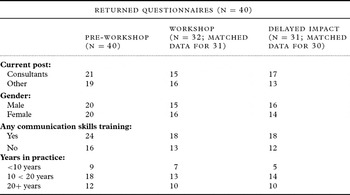
A total of 41 participants attended one of the three workshops. Forty (98%) pre-workshop questionnaires, 32 (80%) workshop evaluation questionnaires and 31 (78%) delayed impact questionnaires were obtained. One respondent completed the workshop evaluation and delayed impact questionnaires but not a pre-workshop questionnaire; therefore matched data on planned and implemented changes were available for 31 and 30 participants respectively (see Table 3).
Characteristics of participants attending the workshop and returning questionnaires

Pre-workshop
Of the 40 respondents, 21 (53%) were consultants, 10 (25%) were Specialist Registrars (SpRs) in old age psychiatry, 2 (5%) were SpRs in other specialties (e.g. neurology) and 7 (17%) included other grades (e.g. SHO/staff grades). Twenty (50%) were female. Most participants (77%) had been qualified for at least ten years, and almost a third (31%) had been qualified for more than 20 years.
Twenty three out of the 40 respondents (58%) had had some prior communication skills training, but only two (5%) and four (10%) respectively, had had specific training in communication with people with dementia and in triadic consultations.
The majority of old age psychiatrists often saw patients and carers together (72%), with only eight (20%) routinely involving another professional such as an Alzheimer's Society representative.
Workshop evaluation
Thirty-two out of 41 (78%) participants returned the questionnaires reporting high levels of satisfaction. Table 3 presents information about respondents and non-respondents in terms of current post (consultants vs others), gender, years since qualification and prior communication skills training (any post qualifying training vs none). There were no significant differences between the two groups (χ2 test).
The percentages reported below are based on the full number of participants, not only those who returned the questionnaires. The workshop achieved the stated outcomes for 30 participants (73%); was considered highly relevant/relevant to everyday practice by all 32 respondents (80%); and was considered by 29 people (71%) to have been delivered at a level appropriate to participant experience/need. Twenty-nine participants (71%) would recommend the workshop to colleagues, whilst 26 (62%) would recommend it to other medical specialities and nursing colleagues. Twenty-one (51%) felt it would be useful to medical students.
Analysis of free text comments revealed common areas of participant benefit.
• Time and ability to reflect on individual practice and consultations skills:
“Thought for the first time in many years about the structure of my consultations” (216)*
“Reflected on the process and able to see more clearly the roles/difficulties/impact on participants” (207)
• Sharing good practice and “learning from others”:
“Opportunity to discuss with colleagues about these issues” (102)
“Suggestions from other attendees as to how to vary practice” (317)
• How to involve patients more in consultations and identify their views and concerns:
“Listening to patients' concerns closely, sympathetically and communicating back appropriately” (110)
“To give more time to people with dementia during triadic consultations” (210)
• Improved knowledge and awareness of triadic consultations:
“Greater awareness of patient and carer experience in triadic consultations” (304)
“Awareness of problems with triadic consultations” (102)
*= three-digit participant ID number
Time constraints were identified as the most common barrier to participants' ability to reflect and improve upon their current practice. The two main suggestions for improving the workshop included extending the session to a full day and increasing the proportion of role play/skill rehearsal exercises.
Planned and reported behavior change
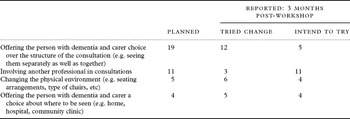
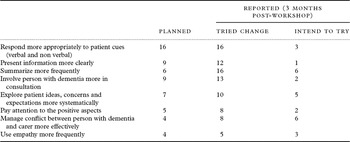
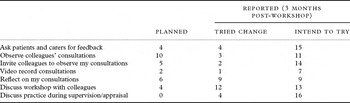
The delayed impact questionnaire provided information on behavior change and was returned by 31 participants. Findings reported in this section relate only to respondents for whom matched data on planned and implemented changes are available (n = 30). Details about specific planned and reported change relating to the structure of the consultation (Table 4), the communication skills used (Table 5) and reflection upon individual practice (Table 6) are shown below. Only changes which were planned by at least three people are included in the tables.
Changes to consultation structure (n = 30)

Changes to communication skills used (n = 30)

Changes to reflection on practice (n = 30)

The most common structural change reported by participants was that of offering a choice to the person with dementia and their families as to whether they wished to be seen separately or together for the consultation. Although few participants explicitly planned to increase the time spent preparing for consultations, six subsequently reported that they had done so.
In terms of communication skills, key changes reported by participants included identifying and responding to patient cues more appropriately, trying to present and summarize information for patients in more manageable chunks and attempting to involve the person with dementia more in the consultation. Eight participants reported that they had reduced the time spent reading/writing notes during the consultation, although initially only one person had planned to carry out such a change.
In terms of reflecting on practice, the most common planned changes were to observe colleagues' consultations (ten participants) and to reflect on individual consultations (six participants). Only three participants had observed their colleagues' practice by the time of the follow-up questionnaire whereas nine had reflected on their own consultations. Eleven and nine participants respectively were still intending to try these changes.
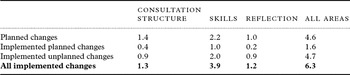
Among the participants who returned delayed impact questionnaires, a total of 139 changes were planned and 189 had been implemented. On average, each participant planned to make 4.6 changes, but only 1.6 of these (35%) had been implemented three months after the workshop (Table 7). However, many participants had tried making other changes to their practice; overall, participants reported an average of 6.3 changes on the delayed impact questionnaire. Participants appeared to be more successful in implementing skill changes (45% of planned changes were implemented) than changes relating to consultation structure or reflection (29% and 20% of planned changes respectively were implemented).
Average number of planned and implemented changes (n = 30)

Discussion
We have developed an interactive workshop, grounded in both theoretical and empirical work, for old age psychiatrists to enhance the patient centeredness of their consultations with people with dementia and their family carers. The theoretical framework of the intervention was derived from a literature review to identify the core components of centered care (Hughes et al., Reference Hughes, Bamford and May2008). The format of the intervention, an interactive workshop, was informed by existing evidence on the effectiveness of educational interventions (O'Brien et al., Reference O'Brien, Freemantle, Oxman, Wolf, Davis and Herrin2001), and the workshop content informed by empirical research data from observations of actual practice (Bamford et al., Reference Bamford, Hughes and Robinson2007). The workshop addresses an important competency in the postgraduate curriculum of old age psychiatry training and is focused on how best to communicate with people with cognitive impairment and to structure triadic consultations with them and thier carers. Although only 80% of respondents returned post-workhop questionnaires, they reported high satisfaction levels. Unfortunately, for obvious reasons, we cannot comment on how useful the non-respondents found the workshop.
Although this developmental pilot study attempted to identify behavior change as a result of participation in the workshop, we only assessed reported behavior and not actual change. The next step would be to assess the effects of the workshop on professional behavior using validated behavior change questionnaires, in order to identify specific effects and to assess the effects on the quality of patient care (Noble et al., Reference Noble, Kubacki, Martin and Lloyd2007; Cherry et al., Reference Cherry, Hahn and Vickery2009). Another limitation of the study is that the delayed impact questionnaire did not enquire about the frequency of changes so the results may be misleading; we were unable to interpret whether participants implemented a change only once or whether it was sustained and became embedded in their routine practice. However, the high number of unplanned changes highlights the importance of exploring all changes made, not only those identified by participants during the workshop.
A recent systematic review has confirmed that good quality health care education can directly and substantially benefit the quality of patient care (Mackinnon Partnership, 2007). Improvements in dementia care have been demonstrated in the U.S.A. via educational programs, although in combination with organizational change (Cherry et al., Reference Cherry, Hahn and Vickery2009). In the U.K., Skills for Health has estimated that £1.5 billion is spent annually on 2000 health care education programs. The rationale for this expenditure is the need to provide a safe, competent and flexible workforce. Good education will facilitate self-awareness and personal growth in terms of improved skills and competencies. As well as having the potential to improve communication and medical interactions with people with dementia, participation in the workshop also generated benefits for the doctors in providing a forum for reflection on individual practice, skill enhancement and a source of evidence for their annual appraisal. In the U.K., periodic revalidation, in order to continue to retain a licence to practise became compulsory for all doctors in 2005 (General Medical Council, 2003b; Department of Health, 2006). All medical practitioners must now undergo an annual appraisal of their clinical performance. This process should include the collection of evidence on current performance and documentation of reflection upon this and plans for improvement; participation in this intervention provided such evidence for individual doctors (Department of Health, 2008).
Although the workshop was developed specifically for old age psychiatrists, and was based on empirical research data from their consultations, it has the potential to be rolled out to other health and social care professionals in dementia care; further research is required to explore whether it would meet the needs of different professional groups such as nurses and social workers. It also addresses the obvious training gaps identified in several recent policy documents on dementia care in the U.K. (NICE/SCIE, 2006; National Audit Office, 2007) and meets one of the key recommendations of the National Dementia Strategy for England (Department of Health, 2009), namely to create and sustain an informed and effective workforce in dementia care. In addition, it could be generalizable to other health care settings such as primary care, geriatrics and cognitive neurology, where a high proportion of consultations involving older people are triadic.
Conflict of interest
None.
Description of authors' roles
The original study was devised by Claire Bamford; the workshop was developed, delivered and evaluated by Claire Bamford, Ruth Briel, Louise Robinson and John Spencer. All authors contributed to the paper; Louise Robinson was lead author and guarantor.
Acknowledgments
We gratefully acknowledge funding from the BUPA Foundation for the original study. We thank all the participants (people with dementia, their carers and the old age psychiatrists) who participated in the study and Linda Duckworth and Catherine Brennand for their secretarial expertise. We are grateful for the expertise of Jill Dales (Director) and the actors from Roleplay North and Newcastle University Audiovisual Department.