After Periods of Exile in Mongolia, China, and India between 1904 and 1912, the Thirteenth Dalai Lama Tupten Gyatso returned to Tibet to instigate several large-scale social, economic, political, legal, and religious reforms. These reforms were aimed at reviving the Gelukpa institution and transforming Tibet into a modern, independent nation-state, and included the establishment of major institutions (Tibet's military, currency, postal system, electricity network, and schools for medicine and astrology), the abolishment of capital punishment, and restorations of major temples and palaces in and around Lhasa.Footnote 1 But because the Thirteenth Dalai Lama's efforts were not ultimately met with political success, historians have attributed this failure to forces of imperialism and hindrances posed by conservative factions in his own government (Anand Reference Anand2009; Bell Reference Bell1946; Goldstein Reference Goldstein1989; Mehra Reference Mehra1976; Shakabpa Reference Shakabpa and Maher2010; Walt van Praag Reference Walt van Praag1987). This singular focus on the Dalai Lama's lack of political agency not only failed to understand his modern reforms on their own terms, but also undermined the importance of cultural and artistic patronage in the Dalai Lama's vision of a modern Tibet.Footnote 2
The Thirteenth Dalai Lama's scrupulous supervision of renovation projects of major monasteries and palaces in and around Lhasa is best documented in three catalogues of renovations of temples, paintings, and images he authored (Thub bstan rgya mtsho [1922] 1981–82, 4:761–96, 5:667–90, 5:691–708).Footnote 3 In them he emphasized repeatedly that his diligence toward temple restorations and reconsecrations were necessary measures to keep away harm, maintain the teachings of the Buddha, and fulfill the wishes of all Tibetan people during a time of tremendous change (Alexander Reference Alexander2005, 295–307; Phur lcog yongs ‘dzin 1940, 2:226b–227b).Footnote 4 In other words, temple renovation projects were part and parcel of the religious and institutional reform of the Thirteenth Dalai Lama.
Recognizing these projects as necessary foundations for the Dalai Lama's reforms, this essay examines two cosmological painting programs in the Potala and the Norbu Lingka, commissioned by the Thirteenth Dalai Lama between 1922 and 1928. It pays particular attention to two paintings of sacred sites, Bodh Gaya in India and Wutai Shan in China. While they belong to a familiar Buddhist cosmology of holy places, Bodh Gaya and Wutai Shan are also sites that the Thirteenth Dalai Lama visited during his exiles abroad. They are depicted in what I will call empirical modes of representation unprecedented in Tibetan Buddhist paintings, while all other paintings follow the precise iconographic prescriptions of an existing paradigm of vision, what I will call a visionary mode of representation. What gave rise to these new depictions, and how do they fit into the existing paradigm?
The question of how new modes of knowledge and production enter into and sustain an image-making tradition that is based on iconographic precision became especially relevant in early twentieth-century Tibet, when images often played an urgent role in both claiming and articulating authority in the climate of political uncertainty and ambiguity. In her recent study of a series of Panchen Lama portraits produced from mechanical looms in 1930s Hangzhou, Patricia Berger (Reference Berger and Esposito2008, 2:731) shows that “the precision of mechanical reproduction and its ability to reliably capture an extremely complicated past” invested modern textiles with the power and authority of the original icon. Similarly, the appearance of modern paradigms of vision and experience in the cosmological painting programs of the Thirteenth Dalai Lama further validated and articulated the visionary worldview in a time when it was greatly challenged. These painting programs skillfully wove the empirical system of knowledge and representation into an existing visionary world, rather than being altered by it. The selective employment of radically different modes of seeing and depicting reality in the sphere of artistic practice reveals what is otherwise buried in legal, institutional, and religious sources—the role of pilgrimage and sacred geography in the Thirteenth Dalai Lama's encounter with geopolitical transformations of the early twentieth century. Examining the pictorial programs in light of accounts of the Thirteenth Dalai Lama's travels, I argue that this particular mapping of a Buddhist universe may be seen as a direct response to modernity's technologies and vocabularies of identity and place-making, and that painting served as a medium through which the court of the Dalai Lama asserted his spiritual sovereignty and temporal authority. Centered on the reading of images and texts from within the tradition of Tibetan cosmological and biographical genres, this study reveals a sphere of agency and creativity in Tibet's nuanced negotiation with modernity that has evaded historical inquiries to date.
The Mural Program at the Eastern Sunlight Hall in the Potala
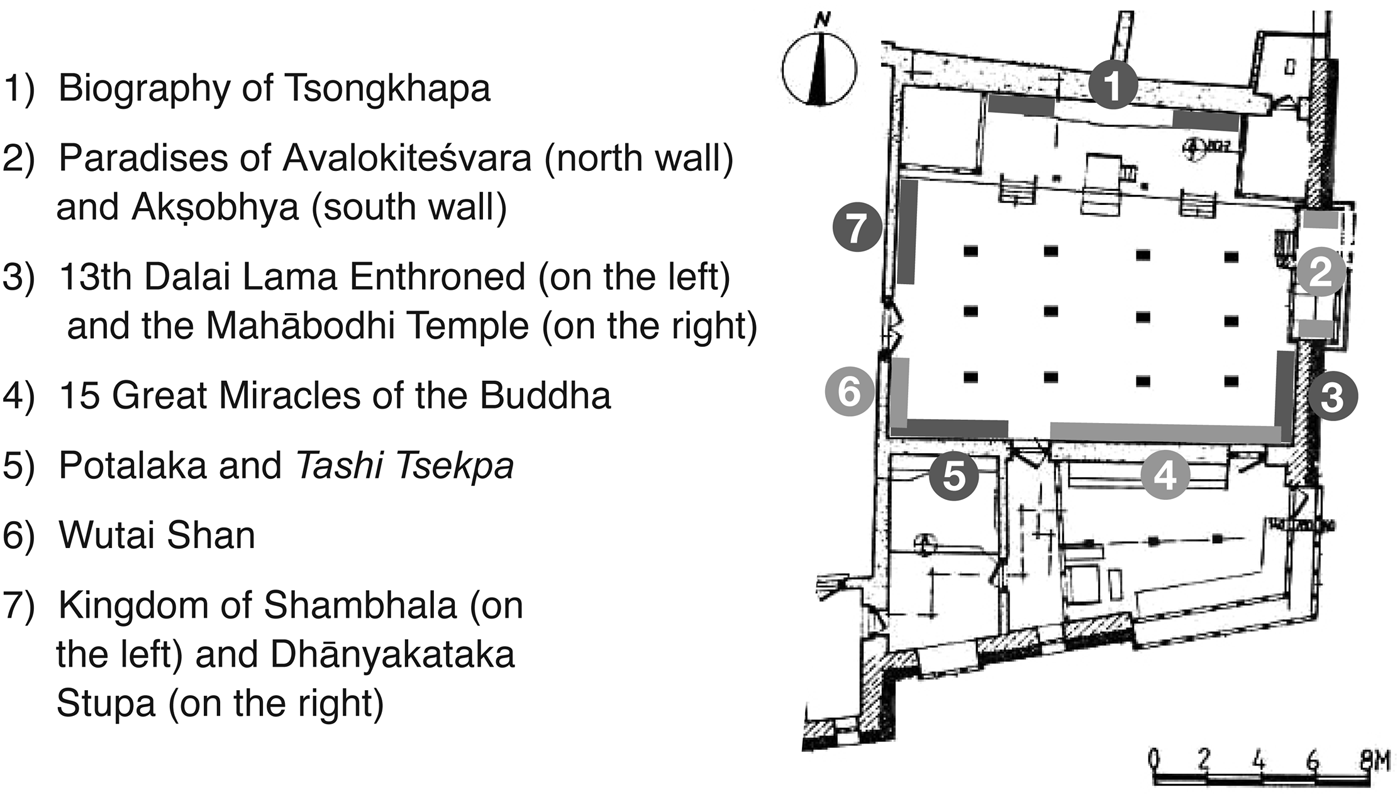
In 1923, the Thirteenth Dalai Lama personally dictated and supervised (Tib. ljags bkod kyi lam nas)Footnote 5 the rebuilding and enlargement of the upper part of the Eastern White Palace (Phur lcog yongs ‘dzin 1940, 2:231b). The main room on the top floor of the White Palace, known as the Eastern Sunlight Hall, served as the Thirteenth and later the Fourteenth Dalai Lamas’ audience hall, where state affairs and meetings with foreign representatives were conducted.Footnote 6 Attached to this hall are chapels of protector deities and living quarters of the Dalai Lama. An array of compositions and narratives covers the walls of the Eastern Sunlight Hall, each of them accompanied by small but neatly legible inscriptions identifying the main subject and its subsidiary details (see figure 1). On the south end of the west wall is the image of the sacred mountain range of Wutai Shan, the earthly abode of Mañjuśrī, the Bodhisattva of Wisdom, located in northeastern China. Adjacent to it on the other side of the entrance is the Kingdom of Shambhala, a mytho-historical kingdom famed for having preserved the profound teaching of the Kālacakra Tantra (lit. Time-Wheel Tantra). To its right on the northern end of the west wall is the Dhānyakataka Stūpa, a site in northern India where the Kālacakra Tantra is known to have been first taught by the Buddha Śākyamuni. The north wall features narratives of the life of Tsongkhapa (1357–1419), the founder of the Geluk school of Tibetan Buddhism. The paintings, displaying Tsongkhapa's eminent career as a teacher, philosopher, reformer, and prolific receiver of dharma transmissions, are visible on either side of the central throne and scripture cases. At the northeastern end of the hall is a small balcony, inside of which are images of Abhirati, the paradise of Buddha Akṣobhya of the Eastern Direction, and the paradise of Avalokiteśvara, the Bodhisattva of compassion. Along the east wall, there is a portrait of the enthroned Thirteenth Dalai Lama, and the Mahābodhi Temple in Bodh Gaya, where the Buddha Śākyamuni attained enlightenment (see figure 2). On the first and second stretches of the south wall are the fifteen miracles of Śākyamuni, events that have been celebrated at the annual Festival of Great Miracles on the fifteenth day of the Tibetan New Year in Lhasa since Tsongkhapa created the festival in 1409.Footnote 7 Completing the third stretch of the south wall is a visualization of the frequently recited Tashi Tsekpa from the Collection of Dharanis in the Tibetan Buddhist Canon.Footnote 8 In the middle of this painting, a palatial structure encloses a two-armed Avalokiteśvara, while a smaller palace on the upper left corner is presided over by his consort Tara. On the upper right section of the painting is a cosmological diagram of Mt. Meru and the Four Continents, the basic structure of the Buddhist universe.
Mural Program of the Eastern Sunlight Hall, Audience Room of the Dalai Lama, Potala Palace, Lhasa, 1922–24 (after Jiang Reference Jiang1996, 1:147).

Mural of the Mahābodhi Temple of Bodh Gaya, south end of East Wall, Eastern Sunlight Hall, Potala Palace, Lhasa, 1922–24 (Leoshko Reference Leoshko1988, 145).
The Mural Program at the Kelsang Dekyi Palace at Norbu Lingka
A similar array of heavenly realms and holy sites is found on the second story of Kelsang Dekyi Palace at Norbu Lingka, constructed a few years later, between 1926 and 1928 (Nor bu gling ga chags tshul, n.d., 66–67). Kelsang Dekyi Palace became one of the primary residence and reception spaces during the later years of the Thirteenth Dalai Lama's life. It is a small, two-story structure adjacent to the larger Chensel Palace, which the Thirteenth Dalai Lama also restored and expanded. The upper story of this structure contains almost identical but larger and more elaborate images of Wutai Shan, the Mahābodhi Temple, and Dhānyakataka Stūpa, Avalokiteśvara's Paradise, and more depictions of the life of Tsongkhapa. In addition to these is Maitreya's Preaching Ground in Tuṣita. The arrangement of the sacred abodes also differs from the tightly assembled panels in the Eastern Sunlight Hall. Largely conforming to the design of the space, each panel of sacred sites in the Eastern Sunlight Hall was rendered in identical sizes and shapes, while episodes from Śākyamuni and Tsongkhapa's careers mirror each other on long stretches of the south and north walls. In the Kelsang Dekyi Palace, these panels of sacred abodes are enlarged and expanded to cover a wall of their own. The effect is a more complete integration of the pictorial space of sacred sites and the physical space of the throne room.
Cosmological Schemes
The central theme that surfaced in the Eastern Sunlight Hall and at Kelsang Dekyi Palace is that of sacred time and place. While calendrical and hagiographical narratives chart the temporal axis, the assembly of sacred sites brings order and structure to the space of the Buddhist universe.Footnote 9 Among them, many sites depicted belong to a familiar, but rarely pictorialized, ensemble of five directional sites of empowerment that became firmly established in Tibetan sacred geography by the eighteenth century at the latest (Bka' ‘gyur ba blo bzang tshul khrims 1989, 1579–84; Lcang skya Reference Lcang skya1993, 1). According to this scheme, Mahābodhi Temple in Bodh Gaya occupies the center of earth (Jambudvīpa), while Wutai Shan of China stands as the most exalted place in the east, Shambhala in the north, the Potala Mountain in the south, and Uḍḍiyāna of the Land of Dakinis in the west. In the Potala and the Norbu Lingka, all but Uḍḍiyāna is depicted.
This cosmography itself is developed from the classical Indian Buddhist world system most widely studied in Tibet through Vasubandhu's Abhidharmakośabhāsyam, an extremely influential treatise that became one of the core texts in the Gelukpa monastic curriculum (Kloetzli Reference Kloetzli and Eliade1987, 4:114). The universe described therein centers around Mt. Meru rising from a Great Ocean. In each direction of Meru are four continents, of which only the southern one is accessible to humans. This southern continent, known as Jambudvīpa, corresponds to the physical earth that humans inhabit. It was within this system that Tibetan Buddhist exegetes further mapped the above-named five sacred places onto the five directions of Jambudvīpa. These exalted places are therefore both supreme and within worldly reach. This cosmological structure of Mt. Meru, which is frequently depicted by itself opposite the Wheel of Becoming at the entrance of temples and prayer halls, is also seen in the background of the image of Potalaka on the south wall of the Eastern Sunlight Hall, and directly adjacent to the Wutai Shan image, as if to serve as a locational coordinate for the two earthly paradises. Its pivotal location on the wall between the paradises of Avalokiteśvara and Mañjuśrī reinforces the coherence of this directional sacred scheme and underscores the geographical correspondence between two otherwise very different depictions. Even though the assembly of holy places did not always remain a fixed and stable set, the concept of empowered earthly sites can always be differentiated from paradises of Buddha depicted in the mural programs, such as Maitreya's Tuṣita, Amitabha's Sukhāvatī, or Akṣobhya's Abhirati, which are situated in other realms (Gomez Reference Gomez1996). Among them, Tuṣita bears the closest proximity to Jambudvīpa, since it is understood as situated within the deva realm of the Mt. Meru system, and it is to Jambudvīpa that this future Buddha Maitreya will descend (Kloetzli Reference Kloetzli and Eliade1987, 4:115). Akṣobhya and Amitabha's paradises would have been seen as belonging to the family of the Five Directional Buddhas located outside of the Mt. Meru system (Gomez Reference Gomez1996, 36; Nattier Reference Nattier2000).
A Panoramic Vision
Various holy places and momentous events in Buddhist history displayed in the Eastern Sunlight Hall and at the Kelsang Dekyi Palace represent the much-aspired-to and potentially traversable realms of the divine in an encyclopedic fashion, so that their appearance does not so much induce the experience of entering the realms or times as bring the time-space into an organized collection, in a way that is perfectly in keeping with the Buddhist penchant for categorizing knowledge. This practice can be seen in everything from the compilation of sacred texts and the creation of scriptural canons to the visualization of deity mandalas, the formation of pantheons that continue to incorporate indigenous and subjugated deities, and the Indian cakravartin ideal, in which a universal king, owing to his vast stores of spiritual merit, justly rules over expansive territories.Footnote 10 The ideal of a divine Buddhist sovereign, or a cakravartin, is precisely what gave rise to the depiction of cosmological diagrams and systems visible in the Eastern Sunlight Hall and at Kelsang Dekyi Palace. The court of the Thirteenth Dalai Lama, by articulating his connection to the marvelous deeds of the historical Buddha, and to those of Tsongkhapa, the founder of his religious lineage, and by bringing together sacred realms of different directions, illustrates the all-pervading domains of his religious sovereignty. In continuing this tradition of cosmography, however, the Thirteenth Dalai Lama seems to be attempting something very specific in bringing together these different worlds of Buddhas, Buddhist saints, and teachings.
Empirical Intrusions
While much of the pictorial program clearly followed the visual and textual templates of a received tradition, depictions of the Mahābodhi in Bodh Gaya in India and Wutai Shan in China appear in unprecedented manners. As the only two sacred abodes in a cosmology of sacred times and places that can be physically revisited, and, as I will show in the latter half of this essay, that the Dalai Lama had indeed visited a decade earlier, they employ visual strategies that are guided by modern, empirical concerns. The Mahābodhi Temple, or the Temple of Supreme Enlightenment, marks the place where Buddha's ultimate enlightenment was attained. Its depiction comprises several representational modes (see figure 2): the central temple itself en grisaille, a semi-monochrome painting, which at times seems to imitate the light and shadows in a photograph, and at others the translucent quality of the rocks that make up the stone monument; the temple is planted in a colorful rectangular garden of smaller funerary shrines, rendered in a combination of semi-profile and bird's-eye perspectives. The oversized Mahābodhi Temple, with its tip jutting out beyond the border of the garden enclosure, appears strikingly illusionistic in the company of rigid, color-coded trees, shrines, and Buddha images. Providing a clue is a framed early photograph of the Mahābodhi Temple, still propped up on a table as an object of devotion in the next room, capturing the stupa shrine from the same direction as the wall painting (see figure 3).Footnote 11 What is more revealing than the perspectival inconsistencies is that they both feature the western face of the Mahābodhi Temple, in front of which are the discernible diamantine throne of the Buddha and the then-young branches of the Bodhi tree reintroduced from Sri Lanka in the late nineteenth century.Footnote 12 The exact vantage point was reproduced in a later painting of the Thirteenth Dalai Lama's visit to the Mahābodhi Temple that appears in his mausoleum (see figure 4), a work that will be revisited at the end of this paper. Given its early date, the photograph was likely brought back from India by the Thirteenth Dalai Lama, and presumably served as a source for the painting. The lack of precedence for this photographically derived depiction stems from a fundamental shift in representation. Tibetan paintings of the Mahābodhi Temple had previously not aimed to reproduce the physical structure or capture the perceivable materiality of the temple.Footnote 13 Instead, such representations had been a way to mark and recall the event of the Buddha's ultimate awakening. In standard depictions of the Mahābodhi Temple, the Buddha is seated in the earth-touching gesture, calling the earth to witness his resolve to gain enlightenment. He is enshrined in a large funerary monument that vaguely carries the geometric semblance of the temple itself (see figure 5). They employ what can be referred to as a schematic mode of representation, in which a received template is rehearsed to describe both the site and the event of the Buddha's awakening. This conventional way of painting the Mahābodhi Temple was certainly known to the Thirteenth Dalai Lama's painters, as they still followed the tradition in part by rendering the garden itself in much the same fashion. But the effect of inserting a temple en grisaille into the familiarly anonymous garden enclosure is a stark juxtaposition between the central image and the ground. Employing two modes of representation, one photographically driven, the other schematic, this painting suggests a sacred place that is at once tangible and timeless. As the first representation of its kind seen in Tibet, it also invents for the viewer a notion that the iconicity of the site rests on the external, perceptual appearance of the stupa, as may be seen through a photographic lens, rather than on its conceptual and cosmological characteristics.
Early photograph of the Mahābodhi on display in the Zurchung Rabsel, Potala Palace. Approximately 25 x 18 inches. Photograph by L. N. Laurent.
Pilgrimage to Mahābodhi Temple in Bodh Gaya, Mausoleum of the Thirteenth Dalai Lama, Potala Palace, 1933–35 (Phun tshogs tshe brtan et al. 2000, 194).
Mahābodhi Temple of Bodh Gaya, colors on cloth. In the collection of the Potala Palace, eighteenth to nineteenth centuries, Central Tibet (Xizang zizhi qu wenwu guanli weiyuanwei 1985, 106).
An Eyewitness Representation of Wutai Shan
The Dalai Lama's first-hand knowledge and experience was translated into yet a different mode of representation in the Wutai Shan painting. The painting in the Eastern Sunlight Hall, which was repeated and expanded in the Kelsang Dekyi Palace to cover a larger stretch of wall a few years later, depicts a panoramic view of the mountain range filled with monasteries, landmarks, pilgrims, and apparitions, all precisely labeled with Tibetan inscriptions. Besides being larger and more completely inscribed, the layout and content of the Kelsang Dekyi Palace image are almost identical to those of the earlier painting in the Eastern Sunlight Hall, suggesting that the latter was based on the former, or that two paintings had both been copied from a source image. In the earlier painting from the Eastern Sunlight Hall, while the more than forty sites depicted were well-known at Wutai Shan through other representations and textual records, about thirty more names of monasteries had not appeared in earlier surviving gazetteers. These comprise sites with largely Tibetan names, some with alternate spellings, in marked contrast with the well-known names that were translations or transliterations of Chinese. In other words, this representation of the mountain range lay outside of the well-established Chinese canons.
This appears as an anomaly if one looks solely within the canonical Tibetan tradition of recording Wutai Shan from the eighteenth century onward, which was closely based on Chinese records.Footnote 14 But in fact, the inscriptions corroborate closely with a list of temples the Thirteenth Dalai Lama visited at Wutai, which has been recorded in his biography. Moreover, on the Wutai Shan mural in Kelsang Dekyi Palace, a monk figure inside a temple compound is labeled as “Yi ching si dge bshe sa ma,” or Master Sama from Yiching Temple. A Buryat lama by the name of Geshe “Sama” or “Soma” also appears frequently in the biography of the Thirteenth Dalai Lama (Phur lcog yongs ‘dzin 1940, 2:39b, 43b, 44a, 46b, 47a, 48b, 53b). According to the biography, Geshe Sama repeatedly came to meet with the Dalai Lama at Wutai Shan, and is said to have made elaborate offerings for temple constructions and restorations, which were finished in time for the Dalai Lama to bestow blessings and conduct consecration ceremonies while still at Wutai Shan. The inscription of alternate temple names and a contemporaneous figure point toward a representation of the mountain range that is closely linked to the Dalai Lama's personal experiences at Wutai Shan, some fifteen years before the paintings were commissioned.
A comparison between this “updated” picture of Wutai Shan and earlier Tibetan depictions of the mountain range at Samye reveals its unorthodoxy. The painting of Wutai Shan at Samye renders a landscape with five symmetrically arranged peaks, each topped with an image of a specific form of the resident deity Mañjuśrī (see figure 6). Here, the primacy of experience and first-hand encounter does not seem to play any role. Wutai Shan exists insofar as it completes a systematic rendering of the world in accordance with a Tibetan Buddhist cosmology. Such depictions of Wutai Shan are also frequently seen in Tibetan thangka paintings of the eighteenth and nineteenth centuries, where the same set of five Mañjuśrīs appear on five peaks with corresponding inscriptions. Because Wutai Shan is rendered in such generic and abstract terms, the mountain appears just as distant and out of this world as any other depictions of exalted places. By contrast, the Wutai Shan images commissioned by the Thirteenth Dalai Lama focus on the recollection of specific visions, persons, sites, and monasteries.
Mural of Wutai Shan, east-facing side of the outermost corridor, first floor of the main assembly hall, Samye Monastery, Central Tibet. Photograph by W. Chou.
As what might be considered the most direct testaments to his stay at Wutai Shan, the Thirteenth Dalai Lama composed two praise poems in honor of Mañjuśrī at the request of two visiting monk scholars toward the end of his six-month-long residence at Wutai Shan in 1908 (Phur lcog yongs ‘dzin 1940, 2:50a–50b; Thub bstan rgya mtsho [1922] 1981–82, 3:395.1–404.2, see also 3:392.1–394.7). The poems in fact capture very little “personalized experience” of the sort seen in the paintings at the Eastern Sunlight Hall and Kelsang Dekyi Palace. Like the Samye painting, the Thirteenth Dalai Lama's written poetry, though professing to record the sensory experience of his pilgrimage, emphasized the timeless quality of Wutai Shan. True to its genre, it rehearses earlier praises in ornate terms and reiterates the history of the founding of Wutai Shan with an abundance of references to early Chinese legends directly drawn from Rölpé Dorjé’s authoritative guidebook to Wutai Shan (Lcang skya Reference Lcang skya1993). The image of Wutai Shan it conjures up is of a wisdom paradise that seems impervious to historical transformations.
Elsewhere I have explored in depth the affinities between pictorial representations of Wutai Shan and their textual counterparts in Chinese and Tibetan languages, both in their visually evocative qualities and in their capacity as substitutes for the mountain range (Chou Reference Chou2011). Seen as an instance within a larger tradition of eulogizing the sacred mountain range in Tibetan Buddhism, the Wutai Shan paintings in the Eastern Sunlight Hall and Kelsang Dekyi Palace validated empirical experience in an unprecedented way by attending to contemporaneous geography and personalities.
Timeliness and Timelessness
In essence, the Dalai Lama incorporated his own encounter with the sacred sites, both by newly acquired photographically driven means and by the insertion of personal experience, into a tradition of sacred cosmography that saw these places as timeless, divine, and impervious to external transformations. This pictorial diversity and the decision not to follow schematic formulas suggest that the Thirteenth Dalai Lama was interested in not only rehearsals of familiar cosmology but also the specific reasons for the choice of scenes and sites. While it is easy to perceive the ability of these new, empirical modes of representation to evoke externally visible presence and personal experience, it is equally important to recognize that the existing rhetoric of vision and truth had always been imbued with multiple temporal and spatial layers. In contrast to empirical representations, the existing tradition follows precise visualizations of the prescriptions from guidebooks. This mode of representation, what I refer to in general as a visionary mode, is equally equipped with means to express physical and temporal proximity, and the choice to follow it reflected as much intention as did the choice to follow their empirical counterparts.
As a case in point, the paintings of the Fifteen Great Miracles (chontrül düchen) on the eastern stretch of the southern wall comprise fifteen episodes in which the Buddha performs miraculous deeds to overcome six Brahmanical heretics. The depictions simultaneously recall and collapse multiple instances of the Fifteen Great Miracles' history, commemoration, and celebration. They not only reiterate stories in the life of the Buddha Śākyamuni, but also recall Tsongkhapa, the illustrious founder of the Great Prayer festival (mönlam chenmo) who first created a public commemoration of these miracles, and whose biographical narrative is depicted on the opposite wall. They also recall the Fifth Dalai Lama, under whose rule the festival once came under the full control of the Gelukpa reign. Above all, contemporary viewers of the paintings would have recognized them as referring to the joyous occasion of the Great Prayer festival they themselves witnessed in the 1920s, owing to the Thirteenth Dalai Lama's own efforts to restore the festival to its former glory after his return from exile in 1913 (Bell Reference Bell1946, 57–58). The revival of the festival, centered on narratives of the Buddha overcoming heretics, is itself an evident reassertion of the Geluk monopoly of power and Buddhist victory over other religions (Huber Reference Huber2008, 361; Richardson Reference Richardson1993, 20–55; Rigzin Reference Rigzin1993, 8–14; Tucci Reference Tucci1980, 147–53). There is every reason to see a similar intention in the depiction of these narratives and the central message of the Great Prayer festival—to conflate Lhasa in the 1920s with previous moments of prosperity in the Gelukpa rule.
That the Thirteenth Dalai Lama saw his own work of renewing and reforming Tibet as a continuation of acts carried out by his greatest predecessor, the Fifth Dalai Lama, in an unbroken fashion through the various incarnations since the seventeenth century, is countlessly attested to in his own writings, in the well-circulated household legends in Lhasa, and in the very renovation projects these wall paintings were part of.Footnote 15 Images of the Fifteen Great Miracles can be seen as another form of this assertion. The Fifth Dalai Lama expressed in his autobiography that an aspiration to paint the Fifteen Great Miracles on the walls of the Red Palace in the Potala could not be realized (Ngag dbang blo bzang rgya mtsho 1979, 284:2). Having been deeply familiar with the writings of the Fifth Dalai Lama, and indeed having commissioned a reprinting of the autobiography in 1925, the Thirteenth Dalai Lama could have seen the paintings on the Eastern Sunlight Hall in part as a fulfillment of an aspiration of the Fifth Dalai Lama (Xizang wenshi ziliao xuanji 2004, 166).
Expressions of “historical time” are equally visible in depictions of timeless and semi-mythical places, such as the millennial kingdom of Shambhala and the Dhānyakataka Stūpa. Standard depictions of Shambhala usually feature the kingdom in the shape of an enormous eight-petaled lotus in the center of the composition, surrounded, in the lower corners, by the prophesized battle of the future Shambhalan king, and in the upper corners, by the Kālacakra deity and kings of Shambhala (see, e.g., Himalayan Art Resources 2014). But in the painting in the Eastern Sunlight Hall, the circular kingdom of Shambhala is relegated to the upper right corner, while the battle scene takes center stage (see figure 7) (Kollmar-Paulenz Reference Kollmar-Paulenz1992–93). The scene illustrates the promised descent of the twenty-fifth king of Shambhala who, leading an inconceivably large army, is to conquer all forces of evil in Jambudvīpa at a time when this world is overrun by greed and chaos (Bernbaum Reference Bernbaum2001, 205–55). Dominated in the foreground by a large figure of the king in shining armor, riding a flaming black horse, the composition transforms the promised hidden kingdom from what was once an iconic, devotional image to mere background scenery.Footnote 16 The kingdom now serves the purpose of illustrating the territory of the king's dominion, similar to the function of topographical landscapes in monumental tapestries of battle scenes commissioned by European aristocracy.
Mural of the Battle of Shambhala, northern side of west wall, Eastern Sunlight Hall, Potala Palace, 1922–24 (Phun tshogs tshe brtan et al. 2000, 186).
This image is placed side-by-side with the Dhānyakataka Stūpa, the site believed to be in present-day Andhra Pradesh, India (see Phun tshogs tshe brtan et al. 2000, 187).Footnote 17 It matches closely the description of the stūpa in an annotated record of labels of paintings and sculptures in selected rooms of Norbu Lingka, Potala, and the Ramoche, dating to the mid-1920s and attributed to the Thirteenth Dalai Lama (Thub bstan rgya mtsho [1922] 1981–82, 4:761–96). The text not only transcribes the labels of wall paintings, but also provides excursions into how the original Dhānyakataka Stūpa looked, adorned with marble pillars, vaidurya gems, and mandala arrangements, as well as the various devotional activities at the site shared by people of all faiths.Footnote 18 The description is followed by a chronology of the lineage of the kingdom's rulers, and their affinity to the Dalai Lamas through shared identity as the reincarnations of Avalokiteśvara.
The Dalai Lama's specific interest in the details of the Shambhalan myth coincided with a brief but widespread propagation of the idea that Shambhala was located in the Russian Empire, a belief that the Dalai Lama himself possibly shared in the decade of the 1900s (Berzin Reference Berzin2003; Kollmar-Paulenz Reference Kollmar-Paulenz1992–93, 86–87; Tada Reference Tada1965, 39–40). The Buryat Mongol monk Agvan Dorjiev (1854–1938), who became the Dalai Lama's master debate partner and at times a most trusted political advisor, argued for this belief based on the fact that the tsar was protecting the Geluk tradition among the Buryats, Kalmyks, and Tuvinian Turks of the Russian Empire.Footnote 19
Could the image of the apocalyptic battle depicted in the Potala be taken literally as affirming an aspiration for, or belief in, Tibet's eventual “liberation” through the triumph of a Buddhist holy war? It seems very likely given the explicit and worldly deployment of Kalacakra imageries in Mongolia and other parts of Buddhist Central Asia in the war-torn decades to follow (Berger and Bartholomew Reference Berger and Bartholomew1995; Berzin Reference Berzin2003). Regardless of how widely shared this belief was in early twentieth-century Lhasa, it suffices to say that images of the Kālacakra were brought forth, along with other previously discussed images in the Eastern Sunlight Hall, by a vested interest in reviving, remembering, and reconnecting with these specific moments, realms, and places. Together, the images represent a selection and a conflation of key moments and places that at once continued the tradition of Gelukpa Buddhism, and had acquired special urgency in the tumultuous period of the early twentieth century.
Toward New Temporalities
An in-depth consideration of selected paintings in the Eastern Sunlight Hall has revealed the coexistence of two epistemological realities. On the one hand is the new, empirical one—a method of affirming reality by the physiological eye via photographically driven and eyewitness representations.Footnote 20 Instead of resorting to more familiar schemas or templates, representations of Bodh Gaya and Wutai Shan incorporated empirical experiences into a system of knowledge that previously established itself on received texts and images. On the other hand, we witness the persistence and versatility of a visionary reality made up of depictions of cyclical festivals and the apparition of divine kingdoms and emanations. The question thus arises: if the existing system was perfectly capable of articulating the complexity of time and eternity, dimensions of space and specificity, then why did the new mode of vision surface at all? The remainder of this essay attempts to locate the primacy of empirical experience in the life of the Thirteenth Dalai Lama, to show that it was through a new form of contact with the world, namely his wandering exile, that this new cosmology was mapped.
An Accidental Pilgrim
Just as canonical depictions of the Fifteen Great Miracles convey Lhasa's peace and stability under the rule of the Dalai Lama in the 1920s, and paintings of the kingdom of Shambhala and the Dhānyakataka Stūpa express a real and timely aspiration for their discovery and recovery, representations of Bodh Gaya and Wutai Shan that embraced empirical observations served as a record or souvenir of the two pilgrimages the Thirteenth Dalai Lama undertook a decade earlier. If one goes back to accounts of the Thirteenth Dalai Lama's travels, one discovers that the pilgrimages themselves were as embroiled in the simultaneity of different epistemological realities as their pictorial counterparts. In 1904, then twenty-nine years of age, the Thirteenth Dalai Lama fled from Lhasa on the eve of the British military invasion. He and his entourage first traveled northeastward toward Mongolia in an attempt to secure protection from tsarist Russia, whose purported espionage in Lhasa was the justification for the British invasion of Tibet in the first place. But when the Russo-Japanese war that ended in 1905 stripped Russia of its military might and internal control, Russia slowly withdrew an already faint promise to bring Tibet under its protection (Andreyev Reference Andreyev2003, 43–45).Footnote 21 In a dramatic shift of the power balance, Britain and Russia jointly urged the Thirteenth Dalai Lama to return to Lhasa, to which the Dalai Lama responded by doing just the opposite—going eastward toward Beijing, the capital of the Manchu empire (Shakabpa Reference Shakabpa and Maher2010, 621–716).
At this juncture of uncertainty and compromise, Wutai Shan emerged as a supreme destination. As the earthly abode of Mañjuśrī, the mountain range is conveniently located some 200 miles southwest of the capital Beijing, just a few days’ journey away from the political activities and summer heat of the capital. It had become an important place of pilgrimage for all Tibetans and Mongolians traveling to and from the Yuan, Ming, and Qing courts in Beijing from the time when the capital was first established there by Khubilai Khan in the thirteenth century. From the early seventeenth century onward, Wutai Shan had served as the meeting place for Chinese court officials and representatives from the outlying Tibetan and Mongolian regions, because of its proximity to Mongolia and the capital in Beijing, its perennially cool climate, which was more tolerable for Tibetans and Mongolians, and most importantly, its distinction as a shared place of pilgrimage and devotion among these various groups of people (Tuttle and Elverskog Reference Tuttle and Elverskog2011).
Therefore, when the Thirteenth Dalai Lama arrived in Wutai Shan in 1908, it signaled to the Manchu court that he had tacitly accepted the court's invitation to visit Beijing, although he stayed for six more months at Wutai Shan, meeting with various delegations and paying visits to a mountain full of temples, until finally making his way to the Manchu court.Footnote 22 As soon as he arrived in Beijing, a big argument ensued between him and the Qing court as to whether the Dalai Lama should perform prostrations at the feet of the emperor.Footnote 23 A month after they finally settled on genuflection, a bending at the knees, the Guangxu Emperor and Empress-Dowager Cixi both died, but not before replacing the Dalai Lama's old title “The Most Excellent, Self-Existent Buddha of the West” (Chengshun zanhua xitian dashan zizai fo) with a new one—“The Sincerely Obedient, Reincarnation-helping, Most Excellent, Self-Existent Buddha of the West” (Xitian dashan zizai fo) (First National Archive of Beijing 2002, 168; Mehra Reference Mehra1976, 20).
The Dalai Lama witnessed the last gasp of the Qing Empire and saw neither reason nor facility to rekindle the priest-patron relationship between his forebears and the Manchu court that had been in place since the seventeenth century. He quickly left Beijing and arrived back in Lhasa in December 1909. What remained of any mutual understanding between the Qing court and the Dalai Lama dissolved when a Manchu army from the southwestern province of Sichuan invaded Lhasa that same year, forcing the Thirteenth Dalai Lama to flee again, this time to India with the aid of British Indian officers (Shakabpa Reference Shakabpa and Maher2010, 717–53). During his second forced exile, he visited important pilgrimage sites of the life of the Buddha Śākyamuni, including the Mahābodhi Temple in Bodh Gaya. He stayed in India until 1912, when the revolution that overthrew the Qing Empire also brought an end to Chinese control in central Tibet. The Dalai Lama returned to Lhasa in 1913, and governed central Tibet for two decades until his death in 1933 (Shakabpa Reference Shakabpa1967, 246–48).
Colliding Worlds at Wutai Shan
That the Dalai Lama's forced exodus and subsequent pilgrimages of convenience had been a product of modern imperialism meant they were closely observed by representatives and journalists of major powers. The multiplicity of narratives about the Thirteenth Dalai Lama's sojourn at Wutai Shan collectively expresses an unease symptomatic of the meeting of different worlds. When he arrived at Wutai Shan in March 1908, his retinue of around eighty was described by the New York Times as consisting of “priests, personal servitors, high officials of the church, and a motley crowd of doubtful-looking soldiers armed with rifles” and on another occasion as “a wild, disorderly, unkempt-looking crew, giving no impression of their religious affiliations” (New York Times, July 13, 1908; September 29, 1908).Footnote 24 Later, the Dalai Lama's six months at Wutai Shan would be recounted by his Tibetan biographer as having fulfilled prophecies of the previous centuries and conjured miraculous visions, by many visiting Europeans as curious spectacles belonging to an archaic time and place, by visiting monks from Japan as a feast of Buddhist scholasticism, and by the local Chinese officials as mostly a financial and administrative liability (Phur lcog yongs ‘dzin 1940, 2:40a–52b; Shenbao 1908; Shirasu Reference Shirasu2007).Footnote 25 But whether the excesses were of miracles, monastic learning, monetary burdens, or motley crowds, various versions of the Dalai Lama's exile at Wutai Shan as told from Tibetan, European, Japanese, and Chinese perspectives poignantly reveal the colliding worlds of the Thirteenth Dalai Lama. At once a divine incarnation held in the highest esteem and accorded with absolute temporal authority by his Tibetan and Mongolian subjects, the head of a religious order best known in Buddhist Asia for its scholarly rigor, and an astute politician struggling to gain support for his people from a world driven by imperial and nationalist agendas, the Thirteenth Dalai Lama resided in a mountain range that was as much endowed with timeless spiritual potency as it was plagued by poverty and political turmoil of an empire on the brink of collapse.Footnote 26
Still and all, the unique diplomatic promise that Wutai Shan afforded to the Thirteenth Dalai Lama can be witnessed in frequent meetings with representatives from the capital in Beijing, Tibetan and Mongolian regions, Great Britain, America, Russia, France, Germany, and Japan, who were able to meet with him without the close monitoring of the Qing court (Tada Reference Tada1965, 95).Footnote 27 Accounts by the American diplomat William Rockhill (1854–1914), who traveled from Beijing to Wutai Shan specifically to meet with the Dalai Lama, reveal that the latter was clearly aware of and fully utilized the fluid nature of the sacred grounds (Mehra Reference Mehra1976, 19). During their meetings, the Thirteenth Dalai Lama deeply impressed and later befriended Rockhill, who described him as a charismatic leader uncertain of his future, distrustful of his surroundings, and desperately seeking benevolent council (Rockhill Reference Rockhill1910; see also Meinheit Reference Meinheit2011; Sperling Reference Sperling2011). Rockhill's heartfelt sympathy and admiration for the Dalai Lama exposed the extraordinariness of the circumstances that allowed two different worlds to intersect.
Parallel to meetings of diplomatic urgency were gatherings of a different kind described only in the Tibetan biography. Throughout descriptions of the Dalai Lama's stay at Wutai Shan, what his biographer took the greatest poetic care to record were the miraculous and profound meetings between the two principal deities, Avalokiteśvara, the Bodhisattva of compassion, which refers to none other than the Dalai Lama himself, and Mañjuśrī, Wutai Shan's resident Bodhisattva of wisdom. In light of the fact that the Dalai Lama was on his way to see the Manchu emperor, and that this was seen as a continuation of a priest-patron relationship that had existed since the time of the Shunzhi emperor (r. 1638–61) and the Fifth Dalai Lama, one might consider both the religious and political potency of such a happy meeting. In the seventeenth century, this priest-patron relationship was established upon the acknowledgment that while the Dalai Lamas are the physical worldly embodiment or incarnations of Avalokiteśvara, the successive Manchu Qing emperors were in turn worldly manifestations of the Mañjuśrī of Wutai Shan (Farquhar Reference Farquhar1978).
A famous wall painting of the meeting between Shunzhi and the Fifth Dalai Lama illustrates well the Manchu-Tibetan understanding of the gathering as a mytho-historical one, in which two kingly deity-emanations animate the mandala-like space of the Forbidden City, demonstrating their dual role as rulers atop a worldly palace, and as deities at the center of the celestial palace of the mandala. As Phurchok Yongzin writes,
At the supreme pilgrimage place of the Five-Peaked Mountain, established by the magical play of Mañjuśrī . . . the Supreme Lotus Holder [epithet for Avalokiteśvara] and the Venerable One With Five Locks of Knotted Hair [epithet for Mañjuśrī], met face to face on their thrones, and engaged happily in a deep and wide dharmic debate and enjoyed delightfully the inconceivable display of the liberations of the three secret bodies. As though in the shapes of steps and lions, rainbows and clouds in the clean sky in front of the Mountain of the Great Black Deity were gathered as special adornments by the protector deities. And from the side of the rainbow clouds were emitted countless offering deities like an orderly procession of monks in golden robes. Such a multitude of breathtaking displays of cloud and rainbow light appeared to all Chinese and Tibetans. Having seen with their very eyes, truly, without doubt, these extremely strange and rare marvels, they exclaimed “a là là” and talked joyously. (Phur lcog yongs ‘dzin 1940, 2:40a–b)
In a later passage in the same text, the debate between the two was so excellent that even the dharma protectors rejoiced by sprinkling raining flowers down from the clear sky, thus making the occasion visible to all beings (45a–b).
Neither the ornamental style nor the wonderful content of Phurchok Yongzin's descriptions is unusual in Tibetan biographical writings. More akin to Christian hagiography than Western biographical writings that primarily recount historical events and characters in the life of an individual, the genre of Tibetan biographical writing often contains elaborate descriptions of miraculous visions that were highly experiential but no less open and public. Precisely because the marvelous qualities were witnessed by all, the account of the divine meeting can be considered real and authentic.
That the Dalai Lama's distressed and tortuous journeys across Asia in search of political allies were also seen and remembered as a spectacular religious pilgrimage and the realization of age-old prophecies indicates a fully operative visionary dimension even at a time when many other ways of seeing were present.Footnote 28 Indeed, it is important to note that during the visit to Wutai Shan, and throughout his time in Mongolia and China, the Thirteenth Dalai Lama staunchly refused to be photographed, even as he sought council from representatives of Western countries and graciously accepted their offerings of rifles and illustrated manuals of modern instruments of warfare.Footnote 29 Instead, many drawings of the Thirteenth Dalai Lama from this period survive in Western collections, such as those presented to Tsar Nicholas II in lieu of photographs (see Brauen Reference Brauen2005, 238).Footnote 30 This insistence upon preserving his more traditional forms of representation paralleled his refusal to engage in any direct dialogue with the British, whose goal was to pressure him into signing lengthy treatises that would delineate, albeit with maximum ambiguity, the identity of Tibet in accordance with the national interests of the British Empire (Anand Reference Anand2009, 236). This articulation of the new geopolitical status of Tibet was not one that the Thirteenth Dalai Lama wished to consent to, as he sought support instead in the more traditional and familiar model of a priest-patron relationship with powers like Russia, Japan, and China. It was only later in India, at the same time that the Dalai Lama eventually embraced the idea of building a modern nation, that he also finally accepted the truth-effects of photography (see Brauen Reference Brauen2005, 156).
This long and difficult shift to accepting new paradigms of vision and modern nationhood appeared as seamless and natural as any other transition in the Dalai Lama's biography. From the visionary perspective of the narrative, the Dalai Lama's encounter with Mañjuśrī and later pilgrimage to the sites of the Buddha Śākyamuni's life in India fulfilled the time-honored prophecies of treasure-revealers, deepened his karmic connection with the most important spiritual teachers of his lineage, and widened his sphere of discipleship outside of Tibet, all of which greatly enhanced the status and credibility of his religious persona.Footnote 31 The fact that his travels greatly exposed him to a world of rapid economic, technological, and political transformations only further legitimated his supreme omniscience—they armed him with a renewed understanding of the geopolitics of his time and allowed him to institute a number of instrumental reforms after his return to Tibet.
Pictorial Biography
Both the religious and political potency of the journeys were understood in his pictorial biography as well. Almost immediately after the death of the Thirteenth Dalai Lama in 1933, construction began on his mausoleum, the Serdung Gelek Döjo, or the Auspicious Wish-granting Golden Reliquary, which was completed in 1935 under the supervision of his chief minister Kalon Trimon Norbu Wangyal (1874–1945), a trusted senior cabinet official (Dhondup Reference Dhondup1986, 99–100; Phun tshogs tshe brtan et al. 2000, 294). Inside the mausoleum is an extraordinary array of wall paintings and inscriptions that document his life in 1,227 interlinked episodes on 175 square meters of wall space that envelops the central golden reliquary of the Thirteenth Dalai Lama (Phun tshogs tshe brtan et al. 2000). Each episode is defined by an appearance of the Thirteenth Dalai Lama and an accompanying inscription. As such, it constitutes the earliest postmortem retrospective on the life of the Thirteenth Dalai Lama, predating Phurchok Yongzin's biography by five years.
Regard for the truthfulness of the Dalai Lama's time in exile was so genuine that master painter Tsering Gyu (1872–1935), who was in the Dalai Lama's entourage during those wandering years in Mongolia, China, and India, was hired specifically to compose scenes from that period.Footnote 32 Published images of the murals reveal a clear juxtaposition between episodes from the period of exile and those from the rest of his life (see Phun tshogs tshe brtan et al. 2000, 194–207). Scenes from the period of his exile include the Thirteenth Dalai Lama's arrival in Beijing, his meetings with the Empress-Dowager Cixi and the Guangxu Emperor, and his performance of prayer offerings in front of the Mahābodhi Temple in Bodh Gaya, India (see figure 4).Footnote 33 Other sections of the pictorial biography include the prophecy at Lake Lhamo, by which the Thirteenth Dalai Lama was found and chosen, and various major holidays and religious events in the Tibetan calendar taking place at the Potala, Jokhang, Ramoche, and Norbu Lingka. While the appearances of gigantic torma offerings (butter-barley dough sculptures), operatic performances, mask dances, and parading deities are all familiar spectacles in Tibetan history painting, images of the Mongolia-China-India interlude appear like fantastical intrusions into the timeless web of temples, mountains, and worshipping crowds that dominate the rest of his biographical narrative.
Among the pageantry in Beijing to welcome the arrival of the Dalai Lama were rows of dandily clad Manchu soldiers with shiny, state-of-the art artillery. The Dalai Lama himself can be seen inside a caravan of festive four-wheeled automotive vehicles. Like the Mahābodhi Temple in the Eastern Sunlight Hall discussed earlier, the image of the Mahābodhi Temple in the biography strives for a perspectival shape and observes a pale gray stone color, while the surrounding figures, clouds, rivers, flora, and fauna are all saturated with color and motion (see figure 4). At the foot of the Mahābodhi Temple in Bodh Gaya, in front of the diamantine throne on which the Buddha sat until he gained enlightenment, a composition that clearly references the painting and photograph discussed earlier, the Dalai Lama is seen performing a prayer offering. The Dalai Lama and the four senior monks who traveled with him are dressed in royal robes, receiving Westerners in polka-dot pants and wide-brim hats, bearing white ceremonial scarves and presents. This echoes vividly detailed textual accounts of the Dalai Lama's 1910 pilgrimage to Bodh Gaya, where he is recorded to have conducted elaborate ritual offerings and recitations (Phur lcog yongs ‘dzin 1940, 2:98a–99b). In the scene of the ritual offering, illegible foreign characters adorn equally strange apparitions of buildings in the background. At the same time, there are also depictions of wild animals roaming in wooded areas, which would not have been present except in idealized descriptions of Bodh Gaya passed down from earlier texts, creating a simultaneously idealized and observed environment that serves to authenticate both the cosmic perfection of Bodh Gaya and the Dalai Lama's international travel and exposure.Footnote 34
The Dalai Lama's meetings with the Manchu Guangxu Emperor and Empress-Dowager Cixi are depicted separately in several episodes. Each time, the small assembly is enshrined and dwarfed by the imposing and rigid symmetry of the Chinese-looking architecture, in stark contrast with depictions of Tibetan buildings in and around Lhasa, which seems to stretch indefinitely and organically to embrace whatever festivities are taking place. In one scene, the Dalai Lama, who is easily recognizable by his dark complexion, is shown presenting the gift of a jeweled wheel of the law to Empress-Dowager Cixi. Turned toward Cixi in a three-quarter view, his figure is ever so slightly lower than Cixi, but his pointed hat saves the day by rising above the level of Cixi's floral headdress. Their meetings echo famous depictions of the Fifth Dalai Lama's visit with the Shunzhi Emperor in the Sizhi Phuntsok Hall of the Red Palace in the Potala, seen earlier, but share none of their mandala-like spaciousness and sundry gathering of supporting characters (see Jiang Reference Jiang1996, 362). However, busy patterns on every surface of the painting, from walls and tiles to foliage and clothing, allow no space for the eyes of the viewer to rest or to wander, making the Manchu capital appear as confining as it probably had been for the Thirteenth Dalai Lama during his visit.
This pictorial disjuncture between biographical representations of the Dalai Lama at home and abroad is essentially a disjuncture between, on the one hand, the stable, traditional, and indispensable elements of the narrative, and on the other, the unpredictable, foreign, and modern. The decision to render foreign sites using technologically modern modes of representation, such as photography, and the choice to locate the exiled moments materially in the technological modern (guns and motorcade) stand in stark contrast with an equally absorbing interest in capturing the material reality that defended a more traditional Tibet (sacred images and monuments, butter-dough offerings, colorful ritual masks, etc.). The entire pictorial biography culminated in the final image of the Dalai Lama as Avalokiteśvara, in a seamless transition between his political identity and duties, as pictured on the peripheries of the main icon by his various activities in Mongolia and Beijing, and in the center, as the divine, all-knowing, thousand-armed and thousand-eyed deity (see figure 8). Here again is a merging not only of two identities, but of two modes of representation, one absorbed in the details of the exterior vision, and the other, in the inner, but no less public vision of divine emanation, coming together to provide a full rendering of the Thirteenth Dalai Lama's life.
Mural of the Thirteenth Dalai Lama as the Thousand-eyed, Thousand-armed Avalokiteśvara, Mausoleum of the Thirteenth Dalai Lama, 1933–35 (Phun tshogs tshe brtan et al. 2000, 204).
Use of Biographical Sources
The seamless weaving together of the Dalai Lama's secular and religious identities by his chief disciples and officials in their textual and pictorial narratives explored above can be read as both “descriptive” and “prescriptive” of the Dalai Lama's life. It is with this double relation with their subject that these sources must be read and understood. The narratives not only reveal how the Dalai Lama's immediate successors saw and remembered his life, they also reflect the roles he was expected to fulfill and the identities he was required to assume by his people as the thirteenth incarnation of the Dalai Lama. While these sources cannot project the Dalai Lama's own voice, they serve as the framework within and guidelines by which the Dalai Lama was to fulfill expectations of his life and deeds, much like musical scores or dramatic scripts to be played by their performers. Therefore, even though they reveal the views or intentions of their writers, rather than those of the Thirteenth Dalai Lama, they provide coordinates for mapping out the intersecting dimensions of the Thirteenth Dalai Lama's life. In particular, the retrospective weight upon the Dalai Lama's sacred peregrinations and political exiles in his biographies reveals a correspondence between earthly geography and sacred cosmography that is fundamental to the worldviews of his contemporaries, and within the genre of Tibetan biographical writing and painting at large; they shed light on why Bodh Gaya and Wutai Shan were incorporated into cosmographical programs of the Thirteenth Dalai Lama's palaces in ways that display his personal connection with them.
Mapping a More Perfect World
The Dalai Lama's exposure to a vastly different world in his travels, as well as his recognition and incorporation of the photographic vision, prepared the way for the collage-like murals in the audience hall in the Potala, in which empirical representations are inserted into and juxtaposed with a visionary system of representation. As acts of collecting, remembering, reimagination, and self-fashioning, the mural projects reflect the Thirteenth Dalai Lama's awareness of the spatial and temporal disjunctions in his life. At a time when the Dalai Lama continuously sought help from, and at the same time guarded himself against, his potential allies or enemies in all directions—China and Japan to the East, Russia to the north, British India to the west, and Gurkhas (Nepal) to the south—it is no wonder that he mapped the cosmography of holy places to reiterate his own historical legitimacy over a vast stretch of territories that were both vulnerable to imperialist contests and inherently numinous. Mapping the distant and the divine onto the tangible experiences of here and now can be seen as a project through which the Dalai Lama asserted his spiritual sovereignty, his temporal omniscience, and ultimately his expanding worldview.
Acknowledgments
I am especially grateful to Patricia Berger, Raoul Birnbaum, Benjamin Bogin, Chokey Drolma, Giovanni Careri, Damchö Diana Finnegan, Fabienne Jagou, Lobsang Nyima Laurent, Kelsang Lhamo, Nancy Lin, Zhu Lishuang, the late Gene Smith, Jeff Wasserstrom, and an anonymous reader for their insights, help, and suggestions at various stages of research for this essay.