Introduction
Staurothele Norman is a genus of lichenized fungi forming crustose thalli on subneutral to alkaline silicate rocks. The species are found both in dry and amphibious conditions and are common in habitats including dry limestone outcrops or alkaline rocks along rivers and streams. This genus belongs to the Verrucariaceae Zenker, a fungal family whose members are predominantly lichen-forming. Although members of Verrucariaceae occur on various substrata, rock surfaces constitute the most common habitat. As with many genera within Verrucariaceae, Staurothele is most diverse in temperate climates, including the Mediterranean region, cold-temperate to subarctic regions (e.g., Alaska, Scandinavia) and high elevations (e.g., the Alps). It has occasionally been reported from wetter and warmer areas of the world, for example, Indonesia, (Groenhart Reference Groenhart1954), southern China (Harada & Wang Reference Harada and Wang1996, Reference Harada and Wang2006), but its diversity in subtropical and tropical regions remains understudied.
Staurothele currently comprises 72 species (Kirk et al. Reference Kirk, Cannon, Minter and Stalpers2008), all characterized by a crustose thallus and muriform ascospores. They also all possess a peculiar feature: algal cells, usually present only in the thallus in other lichens, are also found in the perithecia, between the asci. These stichococcoid algae, recently shown with molecular data to belong to the green-algal genus Diplosphaera Bial. (Thüs et al. Reference Thüs, Muggia, Pérez-Ortega, Favero-Longo, Joneson, O'Brien, Nelsen, Duque-Thüs, Grube and Friedl2011), are co-dispersed with large muriform fungal ascospores. This character is not unique to this genus, but is also found in Endocarpon Hedw., another genus of Verrucariaceae. Staurothele is morphologically similar to Endocarpon, but differs in the habit (squamulose in Endocarpon and crustose in Staurothele) and the structure of the upper cortex (eucortex in Endocarpon and pseudocortex in Staurothele). Within Staurothele, species-diagnostic features include the structure of the thallus, which can either be epilithic (growing on the rock surface) or endolithic (growing within the superficial layer of the rock), and the ascospore colour, which varies from pale to darkly pigmented. Other differences include the size and structure of the perithecia and the size of the ascospores. The shape of the algal cells present in the hymenium has also been used for species delimitation in the past (Malme Reference Malme1919; Vainio Reference Vainio1921). However, culture experiments showed that their shape may vary depending on the culture conditions and developmental stages (Ahmadjian & Heikkilä Reference Ahmadjian and Heikkila1970). This character was therefore suggested as being inappropriate for species delimitation in Staurothele and Endocarpon (Thomson Reference Thomson1991).
In the past, a number of genera have been segregated from Staurothele. Müller Argoviensis (Reference Müller Argoviensis1883) placed the species Staurothele diffractella (Nyl.) Tuck. in the new genus Willeya Müll. Arg. as its ascospores remain pale at maturity whereas they become dark brown in many other species of Staurothele. Later, the same author described a second species of Willeya, W. rimosa Müll. Arg., based on a specimen with pale ascospores collected by the French botanist P. Hariot in Tonkin, northern Vietnam (Müller Argoviensis Reference Müller Argoviensis1889). Clements (Reference Clements1909) described the genus Phalostauris Clem. for Staurothele with pale ascospores. These two genera were, however, not accepted by most authors and were considered as synonyms of Staurothele by Thomson (Reference Thomson1991) and Brodo et al. (Reference Brodo, Sharnoff and Sharnoff2001). Other synonyms of Staurothele listed in Species Fungorum (http://www.speciesfungorum.org, 27/05/2011) are Goidanichia Tomas. & Cif., Goidanichiomyces Cif. & Tomas., Paraphysorma A. Massal., Polyblastiomyces E. A. Thomas, Sphaeromphale A. Massal. and Stigmatomma Müll. Arg.
More recently, molecular phylogenetic studies have allowed the traditional generic delimitation in Verrucariaceae to be tested (Gueidan et al. Reference Gueidan, Roux and Lutzoni2007, Reference Gueidan, Savić, Thüs, Roux, Keller, Tibell, Prieto, Heiðmarsson, Breuss and Orange2009; Savić & Tibell Reference Savić and Tibell2008; Savić et al. Reference Savić, Tibell, Gueidan and Lutzoni2008; Muggia et al. Reference Muggia, Gueidan and Grube2010; Prieto et al. Reference Prieto, Martínez, Aragón and Otálora2010, Reference Prieto, Martínez, Aragón, Gueidan and Lutzoni2012). In studies supported by a good sampling of Staurothele species, the genus was shown to be polyphyletic (Gueidan et al. Reference Gueidan, Roux and Lutzoni2007, Reference Gueidan, Savić, Thüs, Roux, Keller, Tibell, Prieto, Heiðmarsson, Breuss and Orange2009; Savić et al. Reference Savić, Tibell, Gueidan and Lutzoni2008). One well-supported monophyletic lineage composed exclusively of crustose epilithic species of Staurothele is closely related to the genera Catapyrenium and Placidiopsis. This lineage includes Staurothele clopima (Wahlenb.) Th. Fr., the type of the genus, and is now considered as Staurothele s. str. Crustose endolithic species of Staurothele for which molecular data were obtained [S. immersa (A. Massal.) Dalla Torre & Sarnth. and S. rupifraga (A. Massal.) Arnold] did not cluster in this lineage, but in another group including species of Thelidium A. Massal. and Polyblastia A. Massal. Finally, one crustose epilithic species, Staurothele diffractella, was sister to the genus Endocarpon. This species, found in North America, was transferred to the genus Endocarpon. As a result, the definition of this genus was emended to include both squamulose and crustose species (Gueidan et al. Reference Gueidan, Roux and Lutzoni2007).
The genus Staurothele has been studied in various parts of the world. In North America, Thomson provided the most complete revision of the temperate and arctic species (Thomson & Murray Reference Thomson and Murray1988; Thomson Reference Thomson1991, Reference Thomson, Nash, Ryan, Gries and Bungartz2002). It has also been well studied in Japan (Bouly de Lesdain Reference Bouly de Lesdain1921; Harada & Iwatsuki Reference Harada and Iwatsuki1989; Harada Reference Harada1992), Australia (McCarthy Reference McCarthy1995, Reference McCarthy and McCarthy2001) and Europe (Malme Reference Malme1919; Servít Reference Servít1955; Swinscow Reference Swinscow1963; Clauzade & Roux Reference Clauzade and Roux1985; Thüs & Schultz Reference Thüs and Schultz2009). Few species of Staurothele have been described from South-East Asia: S. australis Groenh. from Java (Groenhart Reference Groenhart1954), S. malayensis Zahlbr. from Java and Sumatra (Zahlbruckner Reference Zahlbruckner1934), and S. rimosa (Müll. Arg.) Zahlbr. from Vietnam (Müller Argoviensis Reference Müller Argoviensis1889). Several species have been described from karst in southern China: S. chlorospora Zahlbr., S. honghensis H. Harada & Li S. Wang, S. kwapiensis Zahlbr., S. microlepis Zahlbr., S. muliensis Zahlbr., S. ochroplaca Zahlbr., S. sinensis Zahlbr., and S. yunnana H. Harada & Li S. Wang (Zahlbruckner Reference Zahlbruckner and Handel-Mazetti1930; Harada & Wang Reference Harada and Wang1996, Reference Harada and Wang2006). However, the species diversity of the genus in this part of the world remains understudied, as only a few localities have been explored. In the large karstic system of northern Vietnam, exposed calcareous outcrops and cliffs are very abundant and constitute a favourable habitat for Staurothele. Three main localities were therefore explored in this part of Vietnam in order to investigate the diversity of the genus in a wet tropical region. Two phylogenetic analyses were also carried out to investigate the placement of these Vietnamese species of Staurothele within the Endocarpon-group (as defined in Gueidan et al. Reference Gueidan, Roux and Lutzoni2007), as well as their species delimitation.
Materials and Methods
Morphological study
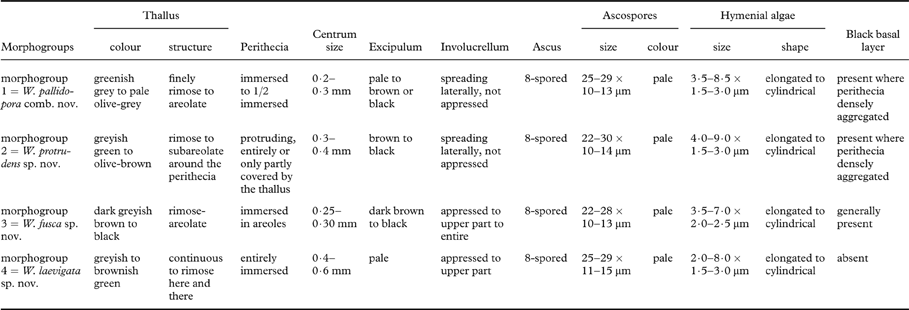
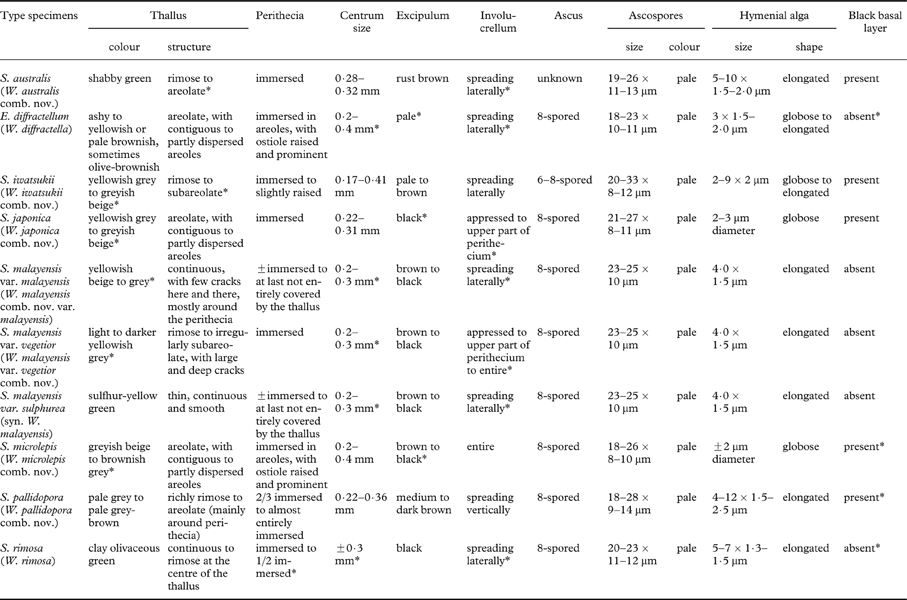
Twenty-six specimens of Staurothele were collected from limestone in three nature reserves in northern Vietnam: Bắc Mê (Hà Giang Province), Na Hang (Tuyên Quang Province) and Hang Kia-Pà Cò (Hòa Bình Province). No comprehensive identification key is available for tropical species of Staurothele. We therefore first used several floras and keys from Europe (Clauzade & Roux Reference Clauzade and Roux1985; Smith et al. Reference Smith, Aptroot, Coppins, Fletcher, Gilbert, James and Wolseley2009), North America (Thomson Reference Thomson1991, Reference Thomson, Nash, Ryan, Gries and Bungartz2002) and Australia (McCarthy Reference McCarthy and McCarthy2001) to identify our collections. Except for Staurothele pallidopora P. M. McCarthy, a species from Australia (McCarthy Reference McCarthy1995), our material did not match any previously described species. We then created a partial key from original descriptions of various earlier described but overlooked tropical to subtropical species of Staurothele, including also some more recently described species from Japan (Harada Reference Harada1992) and China (Harada & Wang Reference Harada and Wang2006). To create this key, we selected all species previously described from Asia or other subtropical to tropical regions of the world from the list of species names available for this genus in Index Fungorum (http://www.indexfungorum.org, 27/05/2011). These 19 species were S. acarosporoides Vain. (St. Vincent, Caribbean), S. arenaria Malme (Paraguay), S. australis (Java), S. chlorospora (Southern China), S. fauriei B. de Lesd. (Taiwan), S. honghensis (Southern China), S. iwatsukii H. Harada (Japan), S. japonica B. de Lesd. (Japan), S. kwapiensis (Southern China), S. malayensis (Java and Sumatra), S. microlepis (Southern China), S. muliensis (Southern China), S. ochroplaca (Southern China), S. pachystroma Müll. Arg. (Brasilia), S. pallidopora (Australia), S. paraguayensis Malme (Paraguay), S. rimosa (Vietnam), S. sinensis (Southern China), S. yunnana (Southern China). We classified them using the following morphological and anatomical characters: 1) thallus structure, 2) ascospore size, 3) the number of ascospores per ascus, 4) ascospore pigmentation. A complete key was not attempted because data obtained from original diagnoses were often vague or incomplete. However, the preliminary key presented below was an efficient tool for selecting taxa to compare to our material from Vietnam.
Preliminary key to tropical to subtropical Staurothele species based on their original descriptions
Staurothele australis appears twice in the key (as marked with asterisk) because the number of ascospores per ascus is not known.
-
1 Thallus endolithic ... S. chlorospora, S. muliensis
Thallus entirely or mostly epilithic ... 2
-
2(1) Ascospores >35 µm ... 3
Ascospores <35 µm ... 6
-
3(2) Ascospores 1–3 per ascus ... 4
Ascospores 6–8 per ascus ... 5
-
4(3) Ascospores pale ... S. arenaria
Ascospores dark ... S. pachystroma
-
5(3) Ascospores pale ... S. yunnana
Ascospores dark ... S. sinensis, S. ochroplaca
-
6(2) Ascospores 1–4 per ascus ... 7
Ascospores 6–8 per ascus, pale ... S. australis*, S. iwatsukii, S. japonica, S. malayensis, S. microlepis, S. pallidopora, S. rimosa
-
7(6) Ascospores dark ... S. acarosporoides var. acarosporoides
Ascospores pale ... S. acarosporoides var. pallescens, S. australis*, S. fauriei, S. honghensis, S. kwapiensis, S. paraguayensis
Seven species with a crustose epilithic thallus, 8-spored asci and pale ascospores less than 35 µm long, a set of features shared with all our material from Vietnam, were selected for comparison with our collections: S. australis, S. iwatsukii, S. japonica, S. malayensis, S. microlepis, S. pallidopora and S. rimosa. Type specimens were borrowed from G (S. rimosa), L (S. australis), HIRO (S. iwatsukii), KYO (S. japonica), MEL (S. pallidopora), W (S. malayensis) and WU (S. microlepis). The type material of S. diffractella was also requested from H as our molecular results showed that our Vietnamese specimens were closely related to this species.
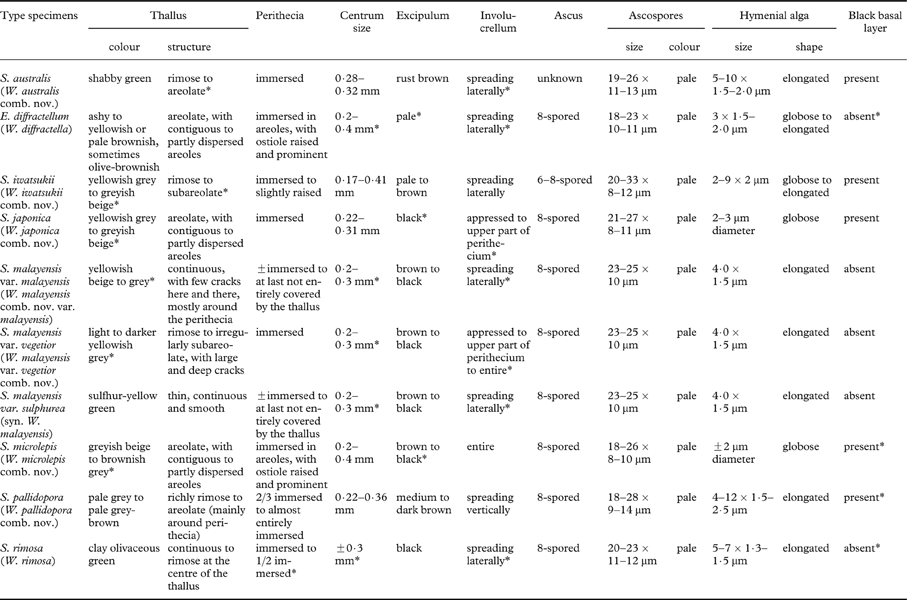
Morphological and anatomical characters were studied using a Zeiss Axioskop light microscope and illustrated using a drawing chamber. Sections were prepared by hand and mounted in water. Photographs of specimens were taken in the Sackler Biodiversity Imaging Laboratory at the Natural History Museum using a Zeiss Stemi SV11 stereomicroscope coupled with a Canon EOS imaging system. For a better depth of field, images were stacked using the software Helicon Focus (Helicon Soft, Kharkov, Ukraine). Characters studied were 1) thallus colour, 2) degree of cracking of thallus, 3) degree of immersion of perithecia, 4) size of the perithecia, 5) pigmentation of the excipulum, 6) structure of the involucrellum, 7) number of ascospores per ascus, 8) ascospore size, 9) ascospore pigmentation, 9) size of hymenial algae, 10) shape of hymenial algae, and 11) presence or absence of a black basal layer. These observations allowed us to classify the Vietnamese specimens into four morphological groups (Table 1), which were then compared to the seven previously selected species of Staurothele, as well as the North American species E. diffractellum (Table 2). Representatives of each morphological group were then selected for molecular study for a total of 17 specimens. The remaining eight specimens were not used for DNA extraction because of their small size or poor condition (e.g. old or covered with epiphytic algae or lichenicolous fungi). For the species descriptions, categories of plectenchymas followed Yoshimura & Shimada (Reference Yoshimura and Shimada1980). Thallus colours were described according to the Methuen Handbook of Colour (Kornerup & Wanscher Reference Kornerup and Wanscher1961). For the new species, the size of the ascospores or hymenial algae was based on 25 to 50 measurements and extreme values are indicated in parentheses.
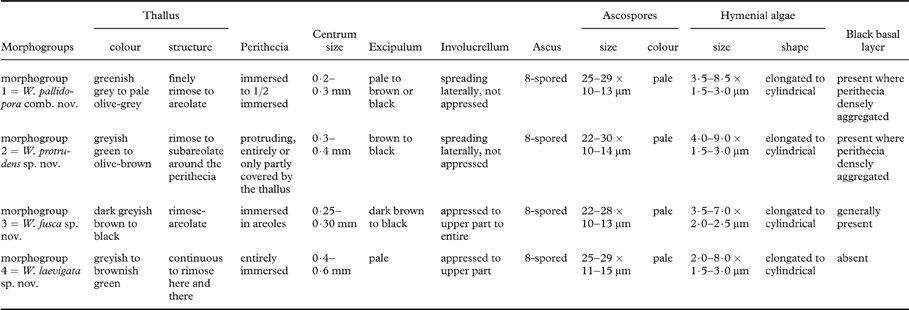
Main morphological and anatomical characteristics of specimens of Staurothele collected in Vietnam. Based on these characters, the material can be classified into four morphogroups, which correspond to four species of Willeya.
Main morphological and anatomical characteristics of nine tropical or subtropical Staurothele taxa with ascospore characters similar to our material from Vietnam. The North American species Endocarpon diffractellum was also included for comparison. Most data were obtained from original species descriptions. Data marked with a star were modified or completed from the original descriptions by studying the type material. W=Willeya
Taxon and gene sampling
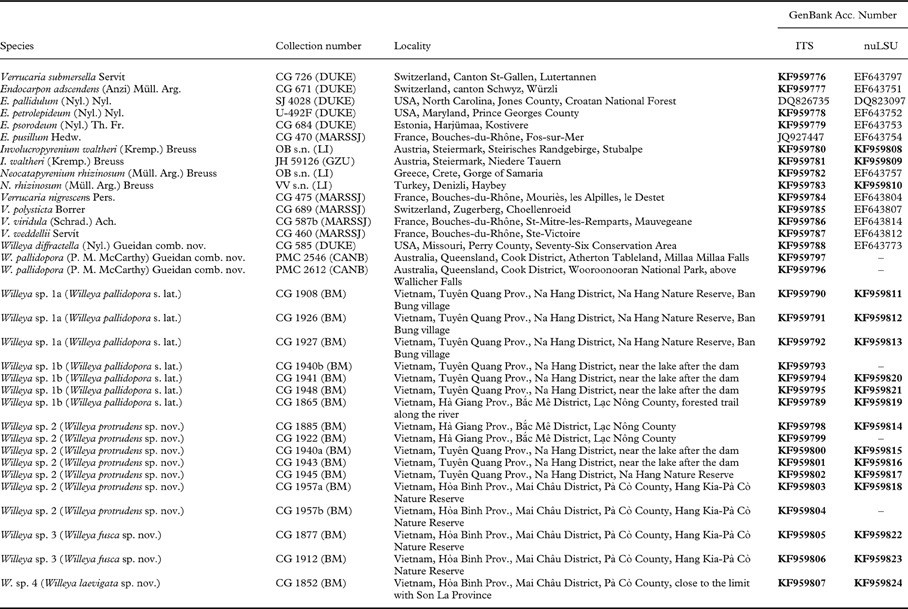
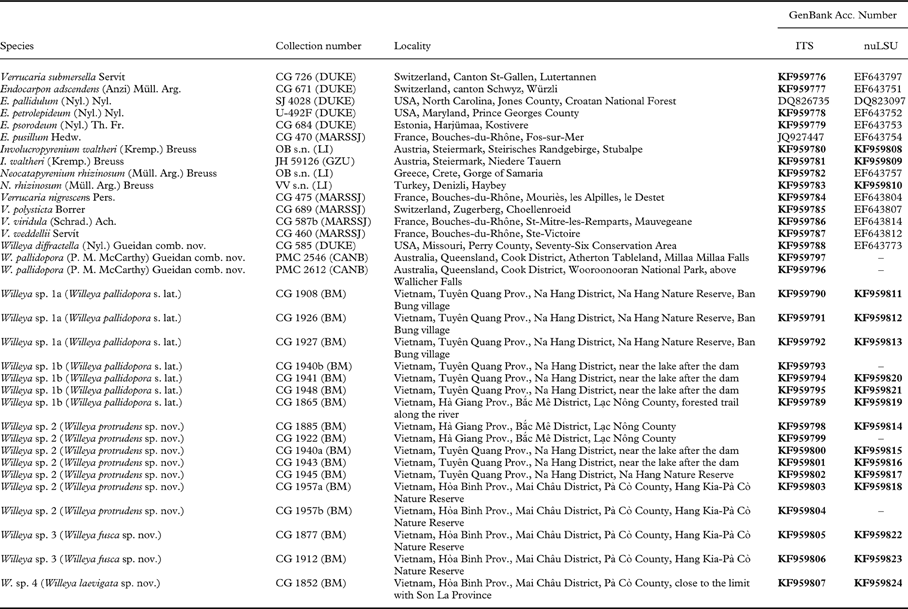
Seventeen specimens of Staurothele collected from Vietnam were used for molecular work. Additionally, two recent specimens of the Australian species S. pallidopora were borrowed from CANB and used in this study (Table 3). Recent material was not available for the six other species sharing morphological and anatomical similarities with our Vietnamese material. These 19 specimens were subjected to molecular analyses. For the first phylogenetic analysis, 15 taxa previously shown to belong to the Endocarpon-group (as defined in Gueidan et al. Reference Gueidan, Roux and Lutzoni2007) were added to the taxon sampling (six from Endocarpon, two from Involucropyrenium, two from Neocatapyrenium and five from Verrucaria). For these taxa, some sequences are newly published here and others were already available in GenBank (Table 3). Two nuclear ribosomal markers were used: 1) the internal transcribed spacer (ITS) region, which includes the intergeneric transcribed spaces 1 and 2 and the 5·85 subunit of the RNA gene, and 2) the large subunit of the RNA gene (nuLSU).
Collection number, locality and sequence data for the 34 taxa used in our molecular analyses. Corresponding herbaria are indicated in parentheses after the collection number (abbreviation as in Index Herbariorum). GenBank numbers highlighted in bold indicate sequences generated in this study. Missing sequences are represented by a dash.
DNA extraction, amplification and sequencing
Material was removed from dry specimens with a sterile razor blade and transferred to an Eppendorf tube. Genomic DNA was obtained using a protocol modified from Zolan & Pukkila (Reference Zolan and Pukkila1986), as described in Gueidan et al. (Reference Gueidan, Roux and Lutzoni2007). DNA extracts were checked with gel electrophoresis and for each sample the band intensity was used to choose the appropriate genomic DNA dilution for amplification. For the two gene regions, 1 µl of a 1/10 or 1/100 dilution of genomic DNA was added to the following PCR mix: 2·5 µl PCR buffer 10× NH4 (Bioline, London, UK), 1·5 µl of MgCl2 (50 mM), 0·5 µl dNTP (100 mM), 1 µl primers (10 µM), 0·5 µl DNA polymerase Bioline BioTaq (5 U µl–1), and water to a total volume of 25 µl. PCR was performed on a Techne TC-4000 PCR machine (Bibby Scientific Ltd, Stone, UK). The ITS region was amplified using the primers ITS1F (Gardes & Bruns Reference Gardes and Bruns1993) and ITS4 (White et al. Reference White, Bruns, Lee, Taylor, Innis, Gelfand, Sninsky and White1990). The marker nuLSU was amplified using LR0R (Rehner & Samuels Reference Rehner and Samuels1994) and LR7 (Vilgalys & Hester Reference Vilgalys and Hester1990). For ITS, the PCR program was as follows: 5 min at 94°C, followed by 35 cycles of 1 min at 94°C, 1 min at 53°C, 1 min at 72°C, and finally 7 min at 72°C. For nuLSU, the PCR program was: 1 min at 95°C, 35 cycles of 45 s at 95°C, 40 s at 52°C, 2 min 30 s at 72°C, followed by 10 min at 72°C. PCR product clean-up and sequencing were carried out by the sequencing facility of the Natural History Museum in London using PCR Clean-up Filter Plates (Millipore, Billerica, MA), BigDye chemistry and an ABI 3730xl sequencing machine (Applied Biosystems, Carlsbad, CA, USA). The internal primers ITS2 and ITS3 (White et al. Reference White, Bruns, Lee, Taylor, Innis, Gelfand, Sninsky and White1990) were used to sequence ITS, and LR3, LR5, LR6, LR3R, LR5R and LR6R (Vilgalys & Hester Reference Vilgalys and Hester1990) to sequence nuLSU.
Phylogenetic analyses
DNA sequences were edited and assembled using Sequencher version 4.8 (Gene Codes Corporation, Ann Arbor, MI). Sequences were manually aligned in MacClade version 4.08 (Maddison & Maddison Reference Maddison and Maddison2003). BLAST searches in GenBank (http://www.ncbi.nlm.nih.gov/genbank) suggested that all Vietnamese specimens belonged to the Endocarpon-group (as defined in Gueidan et al. Reference Gueidan, Roux and Lutzoni2007). Two phylogenetic analyses were therefore carried out: the first to investigate the placement of the Vietnamese Staurothele within the Endocarpon-group, and the second to reconstruct the phylogenetic relationships between the Vietnamese specimens and their related taxa. The first analysis included 29 taxa for which two gene regions, ITS and nuLSU, were available (Table 3). Ambiguous regions were delimited according to Lutzoni et al. (Reference Lutzoni, Wagner, Reeb and Zoller2000) and excluded from the alignments. Congruence between the two datasets was tested using a 70% reciprocal bootstrap criterion (Mason-Gamer & Kellogg Reference Mason-Gamer and Kellogg1996): the two matrices (ITS and nuLSU) were analyzed separately using 1000 rapid bootstrap pseudoreplicates and a GTRCAT model of molecular evolution with RAxML VI-HPC v. 7.4.4 (Stamatakis et al. Reference Stamatakis, Ludwig and Meier2005, Reference Stamatakis, Hoover and Rougemont2008) on the Cipres Web Portal (http://www.phylo.org; Miller et al. Reference Miller, Pfeiffer and Schwartz2010). After comparing the two resulting topologies, no conflicts were detected and the two datasets were combined. For this first analysis, Verrucaria submersella was selected as outgroup based on previous studies (Gueidan et al. Reference Gueidan, Roux and Lutzoni2007, Reference Gueidan, Savić, Thüs, Roux, Keller, Tibell, Prieto, Heiðmarsson, Breuss and Orange2009). The second analysis included only the ITS region from 20 taxa shown to belong to Willeya in the first analysis (Table 3), and two species of Endocarpon as an outgroup (E. petrolepideum and E. psorodeum). For this dataset, all characters were included as no ambiguously aligned regions were present.
For both analyses, phylogenetic relationships were investigated using a Bayesian approach with MrBayes version 3.1.2 (Ronquist & Huelsenbeck Reference Ronquist and Huelsenbeck2003), as implemented on the Cipres Web Portal. Models of molecular evolution were estimated for both ITS and nuLSU using the Akaike Information Criterion, as implemented in Modeltest version 3.7 (Posada & Crandall Reference Posada and Crandall1998): a GTR+I+G model was selected for both partitions. For each dataset, two analyses of four chains were run for 5 million generations and trees were sampled every 500 generations. All runs converged on the same average likelihood score and topology. A burn-in sample of 5000 trees was discarded for each run. The remaining 10 000 trees were used to estimate the posterior probabilities with the ‘compute consensus’ command in PAUP* version 4.0b10 (Swofford Reference Swofford1999). The most likely tree was computed with the sumt command in MrBayes and visualized in PAUP*. Additional support values were obtained using a maximum likelihood (ML) approach with the software RAxML VI-HPC version 7.4.4 as implemented on the Cipres Web Portal. The two-gene dataset (with the two partitions ITS and nuLSU) and the single gene dataset (ITS) were analyzed using a GTRCAT model. Support values were obtained using a fast bootstrap analysis of 1000 pseudoreplicates.
Results
Morphological study
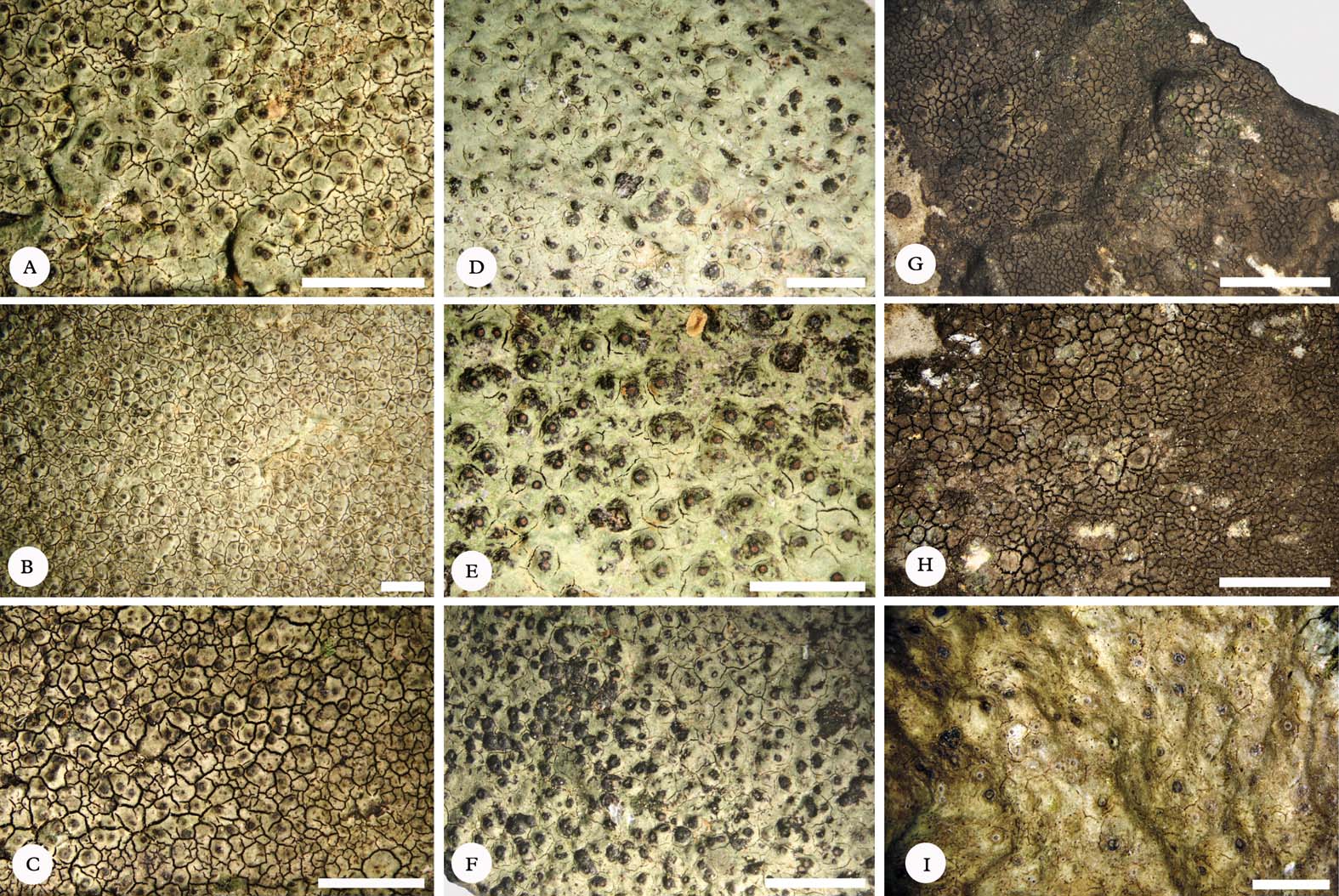
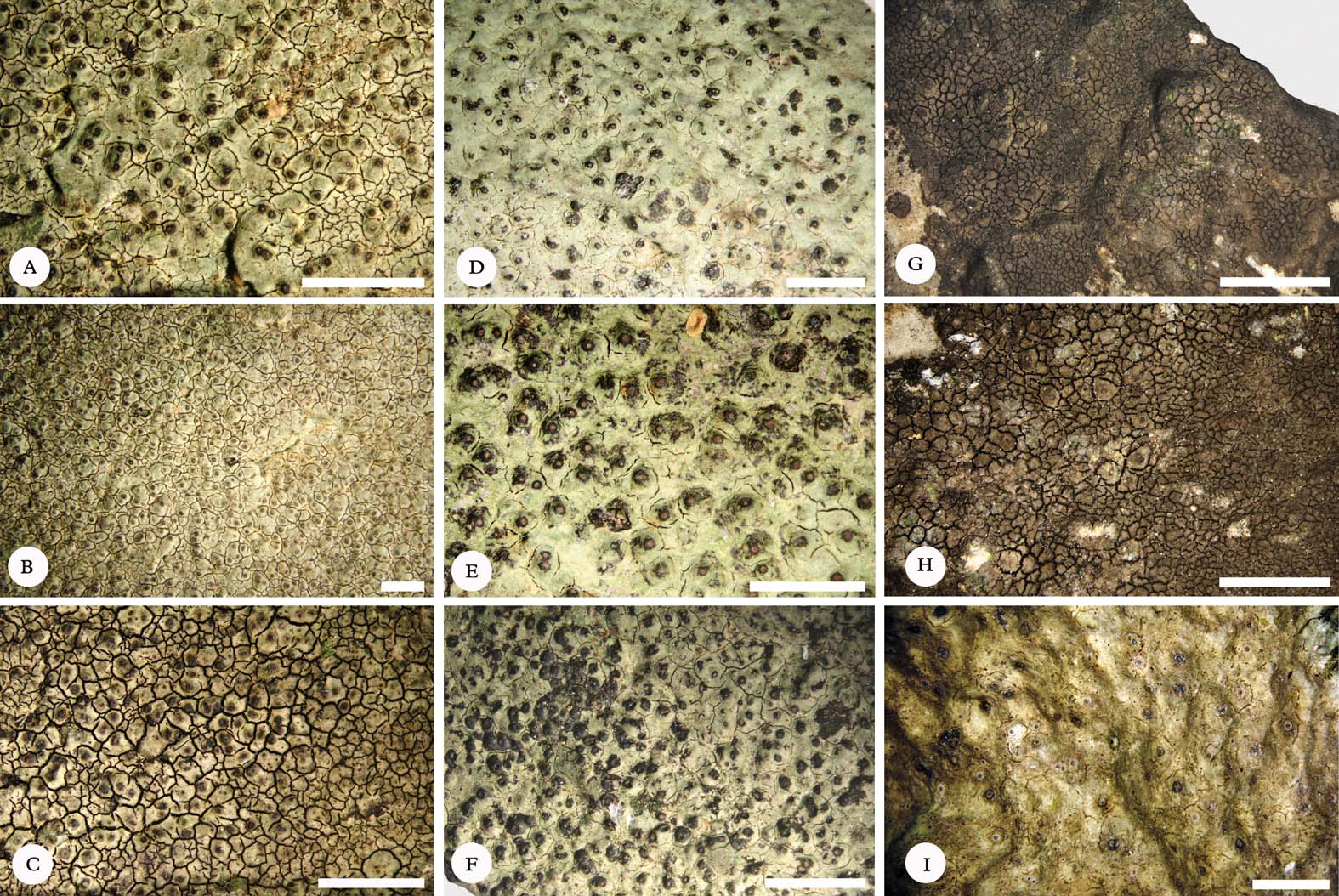
All 26 Vietnamese specimens had 8-spored asci, pale muriform ascospores and crustose epilithic thalli. They also had ascospores with similar and overlapping size ranges, and elongated to cylindrical hymenial algae. However, several differences could be used to classify them into four morphological groups (or morphogroups, Table 2). Morphogroup 1 (CG1850, CG1865, CG1868, CG1870, CG1908, CG1926, CG1927, CG1938, CG1940b, CG1941, CG1948; Fig. 1A–C) had a greenish grey to pale olive-grey thallus rather similar to morphogroup 2, but differing by immersed to semi-immersed perithecia (never protruding) and a thallus rimose to areolate up to the margin (morphogroup 2 tends to be rimose-areolate only in the centre of the thallus). Morphogroup 2 (CG1871, CG1874, CG1878, CG1885, CG1909, CG1922, CG1940a, CG1943, CG1945, CG1947, CG1957a, CG1957b; Fig. 1D–F) was characterized by protruding perithecia. Morphogroup 3 (CG1877 and CG1912; Fig. 1G & H) differed from all other morphogroups by its dark greyish brown to black and clearly areolate thallus, and its perithecia with an involucrellum appressed to the excipulum and covering the upper part of the perithecium down to half of its height or entirely surrounding the perithecium by fusing with the black basal layer. Morphogroup 4 (CG1852; Fig. 1I) had a continuous and rather thick thallus, whereas all other morphogroups had rimulose to areolate thalli.
Photographs showing the colour and structure of the thallus upper surface for the four morphogroups. A–C, greenish grey rimose to areolate thallus in morphogroup 1 (W. pallidopora); A, CG1926; B, CG1927; C, CG1865. D–F, greyish green rimose to subareolate thallus with protruding perithecia in morphogroup 2 (W. protrudens); D, CG1943; E, holotype CG1945; F, CG1885. G & H, dark greyish brown areolate thallus in morphogroup 3 (W. fusca); G, CG1912; H, holotype CG1877. I, greyish to brownish green continuous thallus with entirely immersed perithecia in morphogroup 4 (W. laevigata, holotype CG1852). Scales: A–I=3 mm.
The Vietnamese specimens were compared to the type material of the following eight species of Staurothele: S. australis, S. diffractella [syn. Endocarpon diffractellum (Nyl.) Gueidan & Cl. Roux], S. iwatsukii, S. japonica, S. malayensis, S. microlepis, S. pallidopora, S. rimosa. Morphogroup 2, with its dark brown areolate thallus, and morphogroup 3, with its protruding perithecia, did not match any of these species. Morphogroup 4 was rather similar to Staurothele malayensis (both var. malayensis and var. sulphurea Zahlbr.). These two species have immersed perithecia and a similar continuous thallus, only occasionally thinly cracked here and there. However, in S. malayensis, the perithecia were smaller (centrum only up to 0·2 mm wide for S. malayensis and up to 0·6 mm for morphogroup 4), the ascospores smaller (23–25×10 µm for S. malayensis and 25–29×11–15 µm for morphogroup 4), the involucrellum was spreading laterally and not appressed to the excipulum (closely appressed to the excipulum wall in morphogroup 4) and the thallus was thinner (50–100 µm for S. malayensis and 150–600 µm for morphogroup 4). Finally, morphogroup 1 could be matched with the Australian species S. pallidopora. In the same way as the types of S. diffractella, S. microlepis and S. japonica have a thallus with contiguous to partly dispersed areoles and globose hymenial algae.
Molecular study
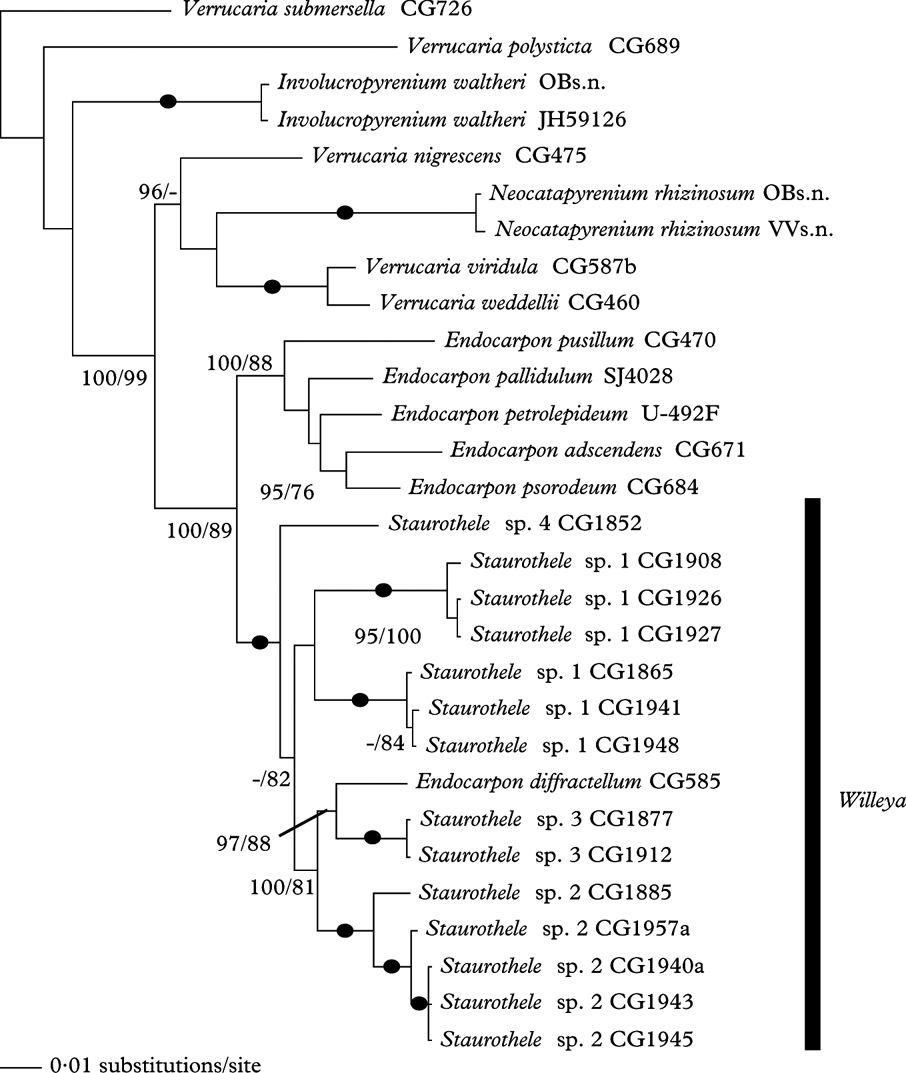
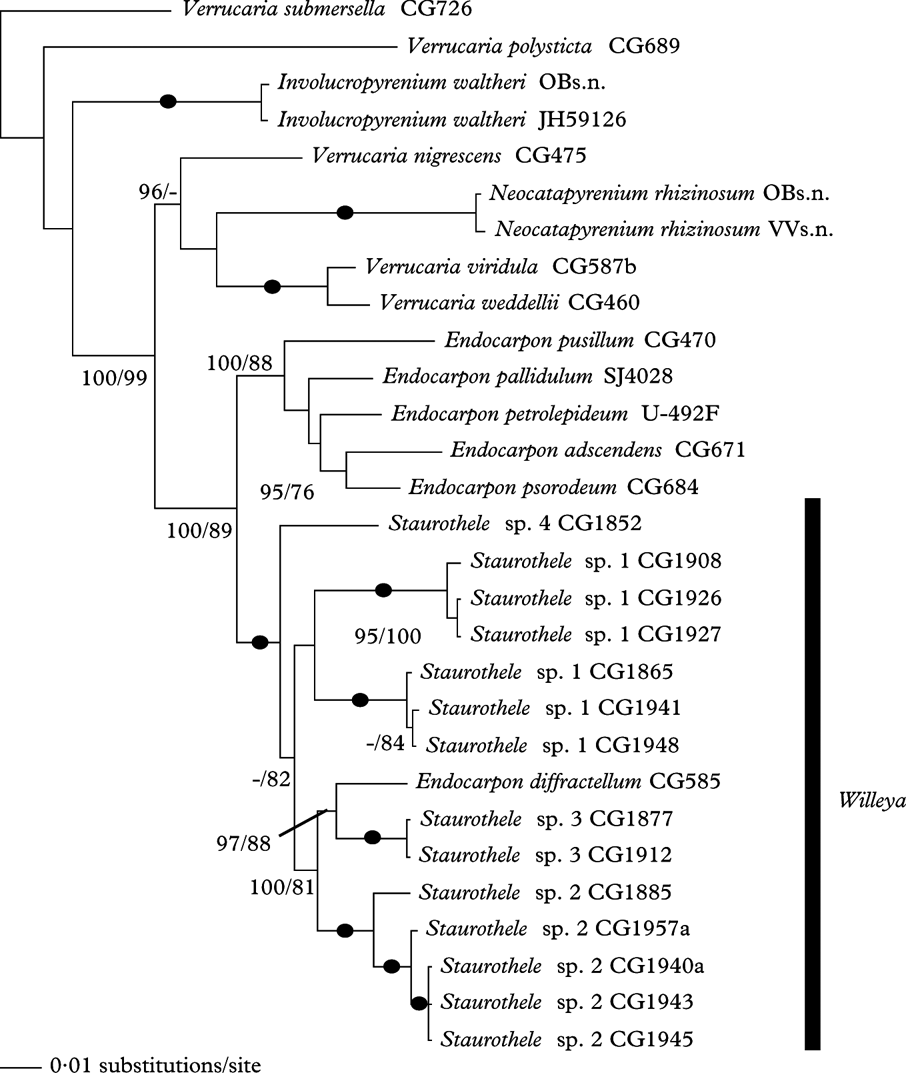
The combined dataset (ITS-nuLSU; first analysis) included 2165 characters (653 for ITS and 1512 for nuLSU), of which 1748 were constant and 295 were parsimony-informative. The most likely tree is presented in Figure 2 with posterior probabilities (PP) and RAxML bootstrap values (BS). All Vietnamese specimens cluster in a well-supported monophyletic group (100% PP and BS), together with E. diffractellum. This group is well supported as sister to the genus Endocarpon (100% PP and 89% BS). As E. diffractellum (previously S. diffractella) is the type of Willeya (Müller Argoviensis Reference Müller Argoviensis1883), the Vietnamese specimens are referred below to this genus.
Most likely tree of the Endocarpon-group obtained with a two-gene (ITS-nuLSU) dataset and a Bayesian approach (MrBayes). All specimens of Staurothele from Vietnam (morphogroups 1 to 4) belong to a clade sister to Endocarpon, thereafter named Willeya. Verrucaria submersella was selected as the outgroup. High support values (100% PP and BS) are indicated by a dot on branches, and other support values in the following order: PP/BS.
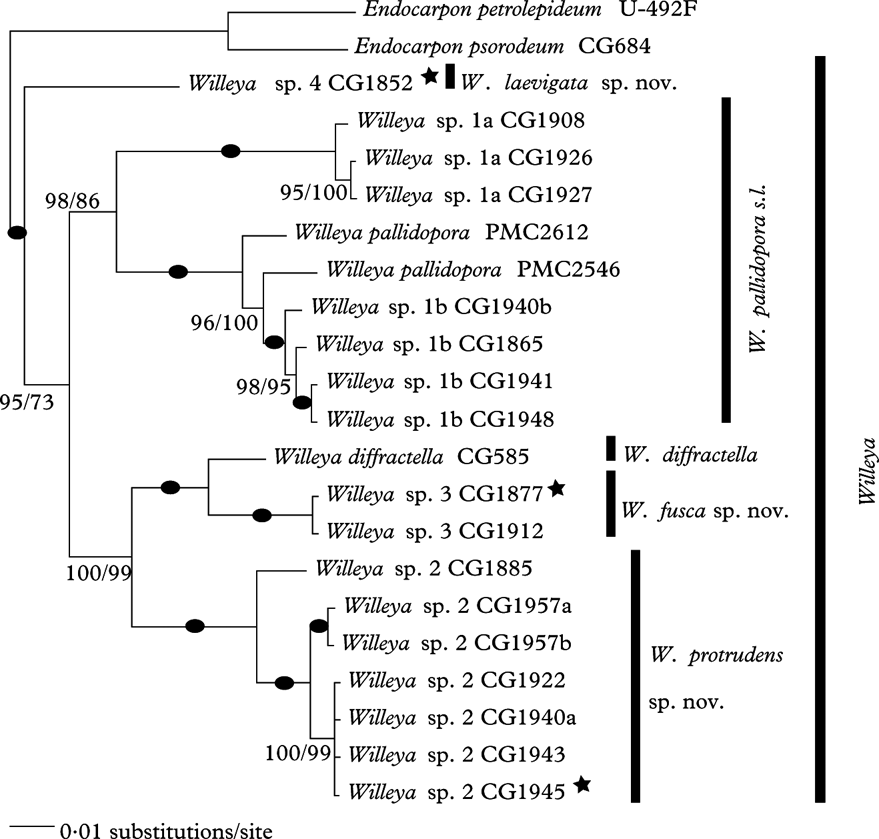
The ITS dataset (second analysis) included 852 characters, of which 191 were parsimony-informative and 598 were constant. The most likely tree is presented in Figure 3 with posterior probabilities and RAxML bootstrap values. The genus Willeya forms a well-supported monophyletic group (100% PP and BS). Although a few basal nodes were not supported, most other relationships obtained both high Bayesian and bootstrap support. Specimens attributed to morphogroup 1 formed a well-supported monophyletic lineage together with the two Australian specimens of S. pallidopora (98% PP and 86% BS). This group was divided into two well-supported and genetically distant groups, 1a and 1b (each with 100% PP and BS). The two Australian specimens of Staurothele pallidopora sequenced here are nested within group 1b. However, with our current taxon sampling, we were not able to clearly distinguish members of the two groups 1a and 1b using morphological and anatomical characters. Moreover, morphological variation was found amongst the four specimens of S. pallidopora studied (P. M. McCarthy 2612, P. M. McCarthy 2546, P. M. McCarthy 760 and the holotype P. M. McCarthy 768). This species therefore most probably corresponds to a species complex, which we will refer to as S. pallidopora s. lat. All specimens from morphogroup 2 cluster together in a well-supported monophyletic group (100% PP and BS). The two specimens of morphogroup 3 also cluster together (100% PP and BS). Finally, morphogroup 4 forms the earliest diverging species in Willeya.
Most likely tree of Willeya obtained with a single-gene (ITS) dataset and a Bayesian approach (MrBayes). Five species can be delimited, including W. pallidopora, W. diffractella and three new species from Vietnam. Two species of Endocarpon (E. petrolepideum and E. psorodeum) were used as the outgroup. High support values (100% PP and BS) are indicated by a dot on branches, and other support values in the following order: PP/BS. Type specimens are highlighted by a star.

Discussion
Recent studies on the lichen family Verrucariaceae have focused on testing generic boundaries using molecular data (Gueidan et al. Reference Gueidan, Roux and Lutzoni2007, Reference Gueidan, Savić, Thüs, Roux, Keller, Tibell, Prieto, Heiðmarsson, Breuss and Orange2009; Savić & Tibell Reference Savić and Tibell2008; Savić et al. Reference Savić, Tibell, Gueidan and Lutzoni2008; Muggia et al. Reference Muggia, Gueidan and Grube2010; Prieto et al. Reference Prieto, Martínez, Aragón and Otálora2010, Reference Prieto, Martínez, Aragón, Gueidan and Lutzoni2012). Most of the taxa studied were collected from temperate to cold-temperate areas, where they are known to be particularly diverse. However, several taxonomic studies have suggested that some genera of Verrucariaceae are also common in tropical and subtropical areas (McCarthy Reference McCarthy1995; Harada & Wang Reference Harada and Wang1996, Reference Harada and Wang2006). Our work on the lichen flora in Vietnam confirms that Verrucariaceae are present on limestone in northern Vietnam. In particular, the genus Staurothele s. lat. was commonly found on small calcareous rock outcrops, either exposed or under forest cover.
Molecular data obtained from these tropical Staurothele changed part of the current generic classification of the Verrucariaceae. Our results show that E. diffractellum is not the only Staurothele-like (and therefore crustose) species closely related to the genus Endocarpon. In fact, all Vietnamese specimens of Staurothele for which we obtained molecular data in this study cluster with E. diffractellum. Together with Staurothele pallidopora, these Vietnamese Staurothele and E. diffractellum form a well-supported monophyletic group, which is genetically rather diverse and sister to all other species of Endocarpon. As the type of Staurothele (S. clopima) belongs to a different group within Verrucariaceae (the Staurothele-group; Gueidan et al. Reference Gueidan, Roux and Lutzoni2007, Reference Gueidan, Savić, Thüs, Roux, Keller, Tibell, Prieto, Heiðmarsson, Breuss and Orange2009), it is necessary to rename S. pallidopora. It would be possible to transfer all these Staurothele to the genus Endocarpon, but because the two clades obtained in our phylogeny are both well supported by molecular data and morphologically well characterized by their thallus structure (crustose vs squamulose) and their upper cortex (pseudocortex vs eucortex), it is preferable to find a different genus name for the crustose clade. Because the genus Endocarpon was not officially emended when the crustose species Staurothele diffractella was transferred to this genus (Gueidan et al. Reference Gueidan, Roux and Lutzoni2007, Reference Gueidan, Savić, Thüs, Roux, Keller, Tibell, Prieto, Heiðmarsson, Breuss and Orange2009), no further emendation will be done here as this species is now placed in a different genus.
Several synonyms of Staurothele are available, but most of them were based on type material with dark ascospores (Goidanichia, Goidanichiomyces, Paraphysorma, Sphaeromphale and Stigmatomma). The type of Polyblastiomyces (P. catalepae Ach.) was shown to correspond to Verrucaria aethiobola and is therefore not available. Willeya, a genus described for Staurothele with pale ascospores based on S. diffractella (Müller Argoviensis Reference Müller Argoviensis1883), is available. Phalostauris was also based on S. diffractella (Clements Reference Clements1909), and is thus a later synonym of Willeya. We therefore decided to resurrect the genus Willeya, reinstate the name Willeya diffractella for E. diffractellum, and propose a new combination for S. pallidopora and for the seven other taxa for which the type material was studied. We also describe here three new species of Willeya from Vietnam and provide a key to Vietnamese species of Willeya.
Taxonomy
Willeya Müll. Arg.
Müll. Arg. (1883): 345; type: Willeya diffractella (Nyl.) Müll. Arg.
Phalostauris Clem. (1909): 39, 173; type: Phalostauris diffractella (Nyl.) Clem.
Description
The genus Willeya includes saxicolous lichenized species with a crustose epilithic thallus, a pseudocortex, perithecia characterized by the presence of algal cells in the hymenium and pale ascospores. As in all members of the family Verrucariaceae, the hamathecium consists of short pseudoparaphyses bordering the upper part of the perithecial cavity, and periphyses in the ostiolar canal. Based on one observation of Willeya iwatsukii (Harada Reference Harada1992), pycnidia are of the Endocarpon-type (sensu Janex-Favre & Wagner Reference Janex-Favre and Wagner1986). Species of Willeya are associated with stichococcoid algae from the green-algal genus Diplosphaera.
Notes
Willeya differs from the squamulose Endocarpon species by its crustose thallus and pseudocortex, and from other epilithic Staurothele by the hyaline to pale yellow or pale brown ascospores. Ascospores in Staurothele s. str. can be pale in the early stages of development, but become dark brown at maturity. We currently attribute the following 13 taxa to Willeya, but other epilithic Staurothele with pale ascospores (e.g., S. effigurata Thomson, S. lecideoides B. de Lesd., S. polygonia B. de Lesd.) might also belong to this genus. These species are not transferred to Willeya here because their type material was not studied. Except for Willeya diffractella, all species here placed within Willeya are from Asia or Australia. Although the biogeographical context of this group is poorly known, it is unlikely that Willeya is restricted to this part of the world. Similarly, although most species of Willeya studied here were found on calcareous rock, it is possible that some species can grow on other types of rock. A world revision of this group will be necessary to clarify the substratum preference, ecology and distribution of species within this genus.
Willeya australis (Groenh.) Gueidan comb. nov.
MycoBank No.: MB807218
Staurothele australis Groenh., Reinwardtia 2: 390 (1954); type: East Java, Malang, falls of the Brantas River near Sengguruh, c. 200 m, October 1936, Groenhart 94 (L—holotype!).
Note
Groenhart (Reference Groenhart1954) described this species as a Staurothele but also suggested that it might belong to Willeya.
Willeya diffractella (Nyl.) Müll. Arg. var. diffractella
Flora 66: 345 (1883).—Verrucaria diffractella Nyl., Mém. Soc. Acad. Maine-et-Loire 4: 33 (1858).—Staurothele diffractella (Nyl.) Tuck., Gen. Lich.: 258 (1872).—Endocarpon diffractellum (Nyl.) Gueidan & Cl. Roux, Mycological Research 111: 1157 (2007); type: Nova Anglia, ad schistes micaceas, Frost 44, ex Tuckerman 134 (H-NYL 3645—lectotype!).
Note
For a description of this species and additional taxonomic information, see Thomson (Reference Thomson1991) and Gueidan et al. (Reference Gueidan, Roux and Lutzoni2007).
Additional specimen examined. USA: Missouri: Perry County, Seventy-Six Conservation Area, 37°42′58″N, 89°36′59″W, alt. 125–150 m, on calcareous rocks, 2003, C. Gueidan 585 (NY).
Willeya diffractella (Müll. Arg.) Gueidan var. flavicans comb. nov.
MycoBank No.: MB807219
Staurothele diffractella var. flavicans Müll. Arg., Flora, Jena 71: 548 (1888); type: Brasilia, Iporanga ad fluvium Iguape, 1888, Puiggari s.n. (G—holotype!).
Note
The variety flavicans differs from the variety diffractella by its rimose to sub-areolate thallus. A further study of the species delimitation of W. diffractella is needed to confirm the status of these two varieties.
Additional specimens examined. Brazil: São Paulo: Apiahy, 1880, Puiggari s. n., (G); Apiahy, os Pinheyros, Octobre 1879, Puiggari s. n. (G); Iporanga ad fluvium Iguape, 1888, Puiggari s. n. (G 2227); Iporanga ad fluvium Iguape, 1888, Puiggari s. n. (G).—Costa Rica: dans le Rio Grande à Boruca, 1893, Tonduz s. n. (G).—USA: New York, 1976, H. Willey 1872 (G).—Tonkin: 1889, Hariot s. n. (G).
Willeya fusca Gueidan sp. nov.
MycoBank No.: MB807220
Differing from other species of Willeya by its dark brown areolate thallus.
Type: Vietnam, Hòa Bình Province, Mai Châu District, Pà Cò County, Hang Kia-Pà Cò Nature Reserve, on calcareous outcrops in a deforested area, 24 February 2011, C. Gueidan 1877 (BM—holotype). ITS barcode: KF959805
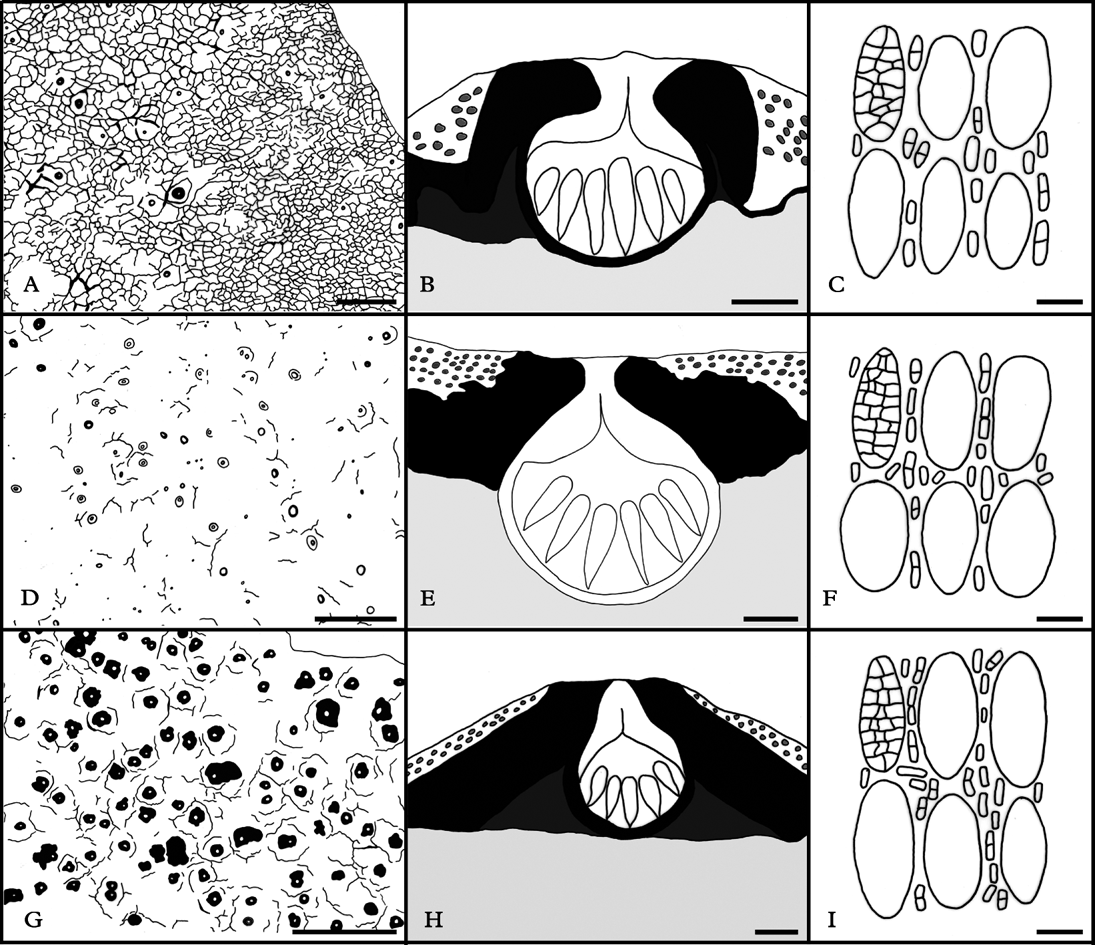
Drawings of the main diagnostic characters of the three new Willeya species from Vietnam. Willeya fusca CG1877 (holotype): A, areolate thallus; B, perithecium immersed in an areole; C, muriform ascopores and elongated to cylindrical hymenial algal cells. Willeya laevigata CG1852 (holotype): D, continuous to slightly rimose thallus; E, entirely immersed perithecium; F, muriform ascopores and elongated to cylindrical hymenial algal cells. Willeya protrudens CG1945 (holotype): G, rimose to subareolate thallus; H, protruding perithecia; I, muriform ascopores and elongated to cylindrical hymenial algal cells. Scales: A, D & G=3 mm; B, E & H=100 µm; C, F & I=10 µm.

Thallus crustose, epilithic, determinate, matt, sometimes greyish-pruinose due to the presence of an epinecral layer, smooth, dark greyish brown to black, becoming slightly darker when wet, rimose-areolate, 0·10–0·25 mm thick, areoles 0·1–0·5 mm diam., often larger when fertile (0·5–1·0 mm). Upper cortex absent to thin (<10 µm) and weakly differentiated from the algal layer (pseudocortex, as defined in Gueidan et al. Reference Gueidan, Roux and Lutzoni2007), with hyaline to pale brown rounded cells (4–6 µm diam.) and a thin (5–10 µm) epinecral layer. Algal layer 25–100 µm thick, with a green Diplosphaera-like alga, ± globose, 6–8 µm diam., single to clustered into pairs, scattered throughout the algal layer. Medulla mostly absent, but sometimes present, and then undifferentiated and formed of hyaline cells similar to those in the algal layer and upper cortex (5·0–7·5 µm diam.). Carbonaceous layer often present below the algal layer and the medulla and on the side of the areoles, as well as forming columns within the areoles. Prothallus sometimes apparent at the thallus margin, dark brownish to greenish grey.
Perithecia immersed in the thallus, 0·4–0·6 mm, one per areole, forming only slight projections, with only the black ostiole visible at the thallus surface. Involucrellum black, appressed to the excipulum wall and covering the upper part of the perithecium down to half the height to entirely covering the perithecium by fusing with the black basal layer, 50–150 µm thick, contiguous with the excipulum to spreading laterally at the base (space between involucrellum and excipulum then filled with cells with thick melanized walls, 4–7 µm diam.). Centrum ± globose, 250–300 µm diam. Excipulum dark brown to black, 10–25 µm thick. Periphyses present in ostiolar canal, pale brown, unbranched, septate, 30–40×2–3 µm. Pseudoparaphyses lining the upper part of the perithecial cavity, unbranched, septate, sometimes swollen at the apex, 20–45×1·5–3·0 µm. Interascal filaments absent at maturity, reduced to a KI+ blue hymenial gel. Hymenial algal cells elongated to cylindrical (2·5–)3·5–7·0(–8·0)×(1·8–)2·0–2·5(–3·0) µm. Asci clavate, fissitunicate, 8-spored, 75–90×15–20 µm. Ascospores colourless to pale yellow, narrowly to broadly ellipsoid, muriform, (20–)22–28(–30)×(9–)10–13(–15) µm.
Pycnidia not seen.
Etymology
The epithet fusca refers to the dark brown to black colour of the upper surface of this species.
Note
Two rather old perithecia from specimen CG1912 did not have hymenial algal cells.
Additional specimen examined. Vietnam: Hòa Bình Province: Mai Châu District, Pà Cò County, Hang Kia-Pà Cò Nature Reserve, on calcareous rocks, 2011, C. Gueidan 1912 (BM, VNMN).
Willeya iwatsukii (Harada) Gueidan comb. nov.
MycoBank No.: MB807222
Staurothele iwatsukii Harada, Natural History Research 2: 39 (Reference Harada1992); type: Japan, Shikoku, Kôchi-ken, Takaoka-gun, Yusushara-chô, Jôsei, 450 m alt., on rock at the edge of the stream, 2 August 1985, H. Harada 3401 (HIRO—holotype!; NMW—isotype; CBM—isotype).
Willeya japonica (B. de Lesd.) Gueidan comb. nov.
MycoBank No.: MB807223
Staurothele japonica B. de Lesd., Bull. Soc. Bot. Fr. 68: 494 (1921); type: Japan, Hokkaido, Kamuikotan, on rock, September 1904, U. Faurie 6213 (KYO—lectotype!).
Willeya laevigata Gueidan sp. nov.
MycoBank No.: MB807224
Differing from Willeya malayensis in having larger ascomata and spores, a thicker thallus and an involucrellum closely appressed to the excipulum wall, as opposed to not appressed to the excipulum wall and laterally spreading.
Type: Vietnam, Hòa Bình Province, Mai Châu District, Pà Cò County, close to the limit with Son La Province, on shaded calcareous outcrops within the rainforest, 25 February 2011, C. Gueidan 1852 (BM—holotype). ITS barcode: KF959807
Thallus crustose, semi-endolithic, determinate, matt, ± smooth, greyish to brownish green, becoming olive-green when wet, continuous to rimose here and there, thick (0·15–0·60 mm). Upper cortex thin (5–15 µm) and weakly differentiated from the algal layer (pseudocortex), with hyaline to pale brown rounded to angular cells (2–6 µm diam.). Algal layer 25–60 µm thick, with a green Diplosphaera-like alga, ± globose, 4–8 µm diam., single or clustered in pairs, ± organized in columns. Medulla thick (250–500 µm), endolithic, inspersed with rock crystals throughout, prosoplectenchymatous to paraplectenchymatous, with cells 5·0–7·5 µm diam. Basal carbonaceous layer absent. Prothallus not apparent.
Perithecia entirely immersed in the thallus, not forming projections, large (c. 0·6 mm wide), with an ostiole visible on the thallus surface. Ostiole pale brown, sometimes surrounded by a black involucrellar ring. In older perithecia, an additional brown ring, resulting from the pigmentation of the upper part of the excipulum, can also be seen inside the black involucrellar ring. Involucrellum black, appressed to the excipulum wall and covering the upper part of the perithecium down to a third or half of its height, enlarging laterally at the lower extremities, inspersed with rock crystals, up to 200–300 µm thick, scleroplectenchymatous, with melanized and thick-walled cells (7·5–10·0 µm diam.). Centrum globose, 400–600 µm diam. Excipulum pale, but becoming dark brown around the ostiole in older perithecia, 10–20 µm thick. Periphyses present in ostiolar canal, pale brown, unbranched, septate, 25–40×2–3 µm. Pseudoparaphyses lining the upper part of the perithecial cavity, unbranched, septate, 40–50×1·5–3·0 µm. Interascal filaments absent at maturity, reduced to a KI+ blue hymenial gel. Hymenial algal cells elongated to cylindrical, sometimes in pairs or short filaments, 2·0–8·0×1·5–3·0 µm. Asci clavate, fissitunicate, 8-spored, 90–100×20–30 µm. Ascospores colourless to pale, narrowly to broadly ellipsoid, muriform, (20–)25–29(–31)×11–15 µm.
Pycnidia not seen.
Etymology
The epithet laevigata refers to the rather smooth appearance of the upper surface of this species.
Willeya malayensis (Zahlbr.) Gueidan comb. nov. var. malayensis
MycoBank No.: MB807225
Staurothele malayensis Zahlbr. var. malayensis, Archiv für Hydrobiol. vol. suppl. 12: 732 (1934); type: Mittel-Java, Wasserfall des Kali Djumok bei Sarangan am Südost-Hang des Gunung Lawu, 1450 m, 10 December 1928, F. Ruttner s. n. (W 6035—lectotype designated here!).
Staurothele malayensis var. sulphurea Zahlbr., Archiv für Hydrobiol. vol. suppl. 12: 733 (1934); type: West-Java, Bach Kali Tjiwalen bei Tjibodas, 1350 m, auf Urgestein, 10 July 1929, F. Ruttner s. n. (W 6040—holotype!).
Note
The type material included five morphologically homogeneous specimens, except for two that had old and partially eroded thalli with deep cracks (W 6042, W 6037).
Additional specimens examined. Indonesia: West Java: Bach Kali Tjiwalen bei Tjibodas, 1350 m, 10 vii 1929, F. Ruttner s. n. (W 6042). Süd-Sumatra: Ranau-See, Felsblock am Hauptzufluss (Wai Warku), 550 m, 4 ii 1929, F. Ruttner s. n. (W 6036); Stromgebiet des Musi, Bachbett unterhalb des Wasserfalls Kapala Tjurup, 500 m, 5 v 1929, F. Ruttner s. n. (W 6039); Musi bei Moara Klingi, c. 50 m, Konglomeratbank am Ufer. an allen Standorten auf Urgestein, 10 v 1929, F. Ruttner s. n. (W 6037).
Willeya malayensis var. vegetior (Zahlbr.) Gueidan comb. nov.
MycoBank No.: MB807226
Staurothele malayensis var. vegetior Zahlbr., Archiv für Hydrobiol. vol. suppl. 12: 733 (1934); type: Süd-Sumatra, Musi, an Blöcken knap punter Wasser bei Aër Simpang, 700 m, 6 May 1929, F. Ruttner s. n. (W 6038—lectotype designated here!).
Note. This taxon is still recognized here as a variety of Willeya malayensis but might need to be raised to the species level in the future if molecular data confirm that it is a different species.
Additional specimen examined. Indonesia: Süd-Sumatra: Ranau-See, Felsblock am Hauptzufluss (Wai Warku), 550 m, 4 ii 1929, F. Ruttner s. n. (W 6041).
Willeya microlepis (Zahlbr.) Gueidan comb. nov.
MycoBank No.: MB807227
Staurothele microlepis Zahlbr. apud Handel-Mazzetti, Symbol. Sinic. pars III: 15 (1930); type: China, Yunnan, Kalksteine in der wtp. St. bei Hsinyingpan zwischen Yungbei und Yungning, 2750 m, 27 June 1914, A. Zahlbruckner 3247 (WU—holotype!).
Willeya pallidopora (P. M. McCarthy) Gueidan comb. nov.
MycoBank No.: MB807228
Staurothele pallidopora P. M. McCarthy, Muelleria 8: 275 (Reference McCarthy1995); type: Australia, Queensland, Darling Downs district, Bunya Mountains National Park, 50 m below Little Falls, 26°52′S, 151°35′E, on dry shaded siliceous rocks, 5 September 1993, P. M. McCarthy 768 (MEL—holotype!; BRI—isotype).
Note
High genetic and morphological diversity suggest that W. pallidopora is a species complex, and is therefore in need of revision.
Additional specimens examined. Australia: Queensland: Moreton district, Bunya Mountains National Park, between Paradise Falls and Little Falls, 26°52′S, 151°35′E, on deeply shaded aquatic and semi-aquatic rocks, 1993, P. M. McCarthy 760 (MEL); Cook district, Atherton Tableland, car park at Millaa Lillaa Falls, 750 m altitude, 17°29′44″S, 145°36′41″E, on damp, steep rock face, 2006, P. M. McCarthy 2546 (CANB); Cook district, Wooroonooran National Park, tributary of North Johnstone River, above Wallicher Falls, 35 km W of Innisfail, 300–350 m altitude, 17°36′18″S, 145°46′21″E, on moderately shaded riverside siliceous rocks, 2006, P. M. McCarthy 2612 (CANB).—Vietnam: Tuyên Quang Province: Na Hang District, Na Hang Nature Reserve, Ban Bung village, on calcareous outcrops, 2011, C. Gueidan 1908, 1926, 1927 (BM), 1938 (VNMN); Na Hang Nature Reserve, near the lake after the dam, on calcareous outcrops, 2011, C. Gueidan 1940b, 1941, 1948 (BM). Hà Giang Province: Bắc Mê District, Lạc Nông County, forested trail along the river, on calcareous outcrops, 2011, C. Gueidan 1865, 1868 (BM), 1870 (VNMN). Hòa Bình Province: Mai Châu District, Pà Cò County, close to the limit with Son La Province, on shaded calcareous outcrops within the rainforest, 2011, C. Gueidan 1850 (BM).
Willeya protrudens Gueidan sp. nov.
MycoBank No.: MB807229
Differing from other species of Willeya by its perithecia characteristically forming projections.
Type: Vietnam, Tuyên Quang Province, Na Hang District, Na Hang Nature Reserve, on calcareous outcrops, 4 March 2011, C. Gueidan 1945 (BM—holotype; VNMN—isotype). ITS barcode: KF959802
Thallus crustose epilithic, determinate, matt, smooth, greyish green to olive-brown, green to olive-green when wet, continuous to rimose at the periphery and rimose to sub-areolate at the centre. Irregular areoles and deeper cracks mostly found around the perithecia, with one perithecium per areole. Areoles 0·2–1·0 mm diam. Thallus thin at the margin (50–100 µm), but thicker around the perithecia (200–300 µm) due to the presence of a black basal layer. Upper cortex thin (10–20 µm) and weakly differentiated from the algal layer (pseudocortex), with hyaline cells rounded to angular, 4–6 µm diam. Algal layer 40–60 µm thick, with a green Diplosphaera-like alga, ± globose, 4–10 µm diam., single or by pair, scattered throughout the algal layer. Medulla absent. Black basal layer present at the centre of the thallus when perithecia densely aggregated, 200–250 µm thick, possibly deriving from laterally spreading involuvrellae. Prothallus pale but becoming dark brown when contiguous with other lichen thalli.
Perithecia protruding, entirely or only partly covered by the thallus, 0·3–0·8 mm, characteristically forming projections. Ostiole visible, brown, often surrounded by a ± large black involucrellar ring. Involucrellum black, spreading laterally and not contiguous with the excipulum, 75–175 µm thick. Space between involucrellum and excipulum filled with cells with thick melanized walls, cells 4–8 µm diam. Centrum ± globose, 300–400 µm diam. Excipulum brown to black, 10–25 µm thick. Periphyses present in the ostiolar canal, pale brown, unbranched, septate, 30–40×2–3 µm. Pseudoparaphyses lining the upper part of the perithecial cavity, unbranched, septate, 25–100×2–3 µm. Interascal filaments absent at maturity, reduced to a KI+ blue hymenial gel. Hymenial algal cells elongated to cylindrical, sometimes in pairs or short filaments, (3–)4–9(–12)×1·5–3·0 µm. Asci clavate, fissitunicate, 8-spored, 60–90×20–30 µm. Ascospores colourless to pale, narrowly to broadly ellipsoid, muriform, (20–)22–30(–32)×(9–)10–14(–15) µm.
Pycnidia not seen.
Etymology
The epithet protrudens refers to the projecting perithecia characteristic of this species.
Additional specimens examined. Vietnam: Tuyên Quang Province: Na Hang District, Na Hang Nature Reserve, Ban Bung village, on calcareous outcrops, 2011, C. Gueidan 1909 (BM); Na Hang Nature Reserve, near the lake after the dam, on calcareous outcrops, 2011, C. Gueidan 1940a, 1943, 1947 (BM). Hòa Bình Province: Mai Châu District, Pà Cò County, Hang Kia-Pà Cò Nature Reserve, on calcareous outcrops in small deforested valley, 2011, C. Gueidan 1957a, 1957b, 1871 (BM), 1874, 1878 (VNMN). Hà Giang Province: Bắc Mê District, Lạc Nông County, on calcareous outcrops, 2011, C. Gueidan 1885, 1922 (BM).
Willeya rimosa Müll. Arg.
Flora 72: 146 (1889).—Staurothele rimosa (Müll. Arg.) Zahlbr., Cat. Lich. Univers. 1: 176 (1921); type: ad saxa compacto-calcarea in territorio asiatico Tonkin, benevole commun. cl. Hariot sub n. 3463 (G—holotype!).
Key to species of Willeya from Vietnam
-
1 Thallus dark brown, rimose-areolate ... W. fusca
Thallus greenish grey to olive-brown, usually pale, continuous to areolate ... 2
-
2(1) Thallus continuous, rimose only here and there. Perithecia entirely immersed, 0·4–0·6 mm diam ... W. laevigata
Thallus finely rimose to sub-areolate or areolate. Perithecia immersed to protruding, 0·2–0·4 mm diam ... 3
-
3(2) Perithecia projecting above the thallus level, with an involucrellum often only basally covered by the thallus ... W. protrudens
Perithecia immersed to half immersed, with involucrellum covered by the thallus up to the ostiole ... W. pallidopora
The authors are greatly indebted to the curatorial staff of CANB, G, H, HIRO, KYO, L, MEL and WU for providing specimens, as well as to James Lendemer and Richard Harris for allowing a visit to NY. They would also like to thank Michèle and Claude Roux for the translation of Latin descriptions and Lucia Muggia for providing some literature. Fieldwork was made possible thanks to Prof. Pham Van Luc from the Vietnam National Museum of Nature in Hanoi, Harald Schneider from the NHM in London and the staff from Bắc Mê, Na Hang and Hang Kia-Pà Cò Nature Reserves. This work was funded by the Collection Enhancement and Molecular Support Funds from the NHM in London.