

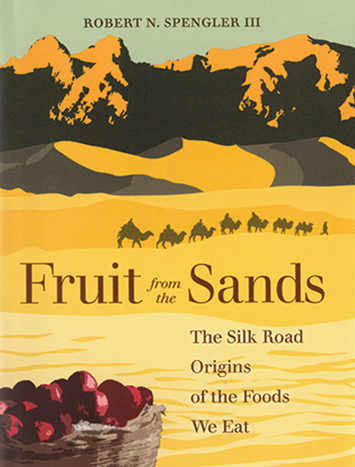
This monograph has two main foci: the early origin of long-distance exchanges of foods, which many have regarded as a relatively modern phenomenon, and the crucial role that Central Asia played in the transfer of foodstuffs travelling along the Silk Road from East to West and from West to East. Far from being only concerned with silk, this route saw a varied range of foods exchanged, including wheat, rice, grapes and apples. Using archaeobotanical remains preserved on archaeological sites, Spengler highlights how these exchanges started as early as 5000 years ago, and went on to shape the course of human history and transform cuisines from China to Europe and beyond.
The book is divided into two parts: Part I consists of a few short introductory chapters. Here, Spengler defines the regions that the book includes and offers a brief history of them. He defines Central Asia as the geographic area encompassing Kazakhstan, Kyrgyzstan, Tajikistan, Turkmenistan and Uzbekistan, while Central Eurasia includes adjacent regions to the north and east, such as western Mongolia, the Tuva region of Russia and Xinjiang, Qinghai and Tibet in China. He also emphasises that the Silk Road is not one road, but a complex network of exchange routes linking China with the Mediterranean, while the Spice Routes ran farther south, linking South Asia with the Mediterranean. If the Silk Road involved more than just silk, so the Spice Routes exchanged more than simply spices. Both routes were part of the same social process.
Part II comprises nine chapters on different plant-based foods including: millets; rice and other ancient grains; barley; wheats; legumes; grapes and apples; other fruits and nuts; leafy vegetables, roots and stems; spices, oils and tea. In each of these, Spengler explores the evidence for the origin of the crops, the complex histories of their earliest domestication and the chronology for their geographic dispersal. The strength of the book lies in Spengler's ability to combine his extensive knowledge of the archaeology and archaeobotany of Central Eurasia with not only surviving historical texts about the region and existing archaeobotanical literature from China, South Asia and the Middle East, but also with the latest genetic research. His systematic and detailed discussions, coupled with a comprehensive bibliography, have opened up this fascinating but still unfamiliar world to a wider audience. We learn of the rich cultural and environmental history of these oases, valleys, gardens, rivers and deserts, of medieval caravans and of cities such as Samarkand and Bukhara, whose markets offered a huge variety of fruits, vegetables and spices to travellers and residents alike.
The star performers in this volume are the plants themselves, having survived millennia in the ground before revealing their story; a story of farmers, merchants and market vendors, but also a story of food, of cuisines and of cultural diversity. It is fascinating to learn how often the culinary roles of foods were transformed during their journeys East or West. For example, in the West and in Central Asia, wheat is used primarily for making bread; in China it was turned into noodles and steamed dumplings. Millet was consumed as a gruel in China, but baked into a hard bread in Central Asia. Rice, one of the three main food grains today, was domesticated in China some 6000 years ago, but it did not reach the Middle East until probably the fifth century BC. Even then it was not widely grown or used, with various Classical authors mentioning rice primarily in a medicinal context. In Central Asia, where plov (pilof, pilaf), a dish containing rice, dried fruits or carrots, onions and sometimes meat, is regarded as an important part of national identity, rice did not become widely available until probably the thirteenth century AD. Noodles and flatbreads were introduced to Italy by Arab merchants around a thousand years ago, but it took another 500 years to acquire the tomato that helped make pizza and pasta Italy's national cuisine.
This review would not be complete without a brief mention of the apple, a fruit so integrated in Western foodways that many assumed it a native of Europe. In fact, all domestic apples derive from one (Malus sieversii) native to the river valleys in the Tien Shan Mountains in eastern Tajikistan and south-eastern Kazakhstan. During its travels westwards, it hybridised with local crab apples and ultimately became one of the most widespread and loved fruits across the world.
I do have a few quibbles. There is no figure list and the text does not clearly signpost maps. While Samarkand and Bukhara are mentioned early in the text, a map with their location does not appear until page 177. The volume begins with a map of the key archaeological sites that provided the archaeobotanical evidence used by the author to trace the spread of agricultural crops across the wider region. One of these sites, however, Tashbulak, the first archaeological site mentioned and referred to time and again, does not feature on the initial map but only on the one on page 177. I hope this may be rectified in a second edition. I would also have liked to see a table included to set out clearly which foods originated in the East and travelled West (e.g. rice, broomcorn millet, peach, orange), which originated in the West and travelled East (e.g. wheat, barley, grapes) and which originated in Central Eurasia (e.g. apples, pistachios, quince) and approximately when these transfers occurred. While this information is available in the text, it is difficult to appreciate without regular recourse to a table, such is the richness of the book. The volume is truly a mine of information.
This book is a must for anybody interested in food, cultural diversity, archaeology, exchange networks and the impact of modern globalisation on food and cultural homogenisation.


