INTRODUCTION
Traumatic brain injury (TBI) remains a major cause of neurological disability worldwide, with an annual incidence estimated from emergency department visits of up to 403 per 100,000 population (Maas, Stocchetti, & Bullock, Reference Maas, Stocchetti and Bullock2008). Although TBI is most common in young adults following motor vehicle accidents, older adults (65 years+) represent an increasingly important group presenting to trauma services, but notably as a result of falls more often than road trauma (Faul, Xu, Wald, & Coronado, Reference Faul, Xu, Wald and Coronado2010; Harrison, Henley, & Helps, Reference Harrison, Henley and Helps2008). Despite this secondary peak in TBI, few studies have explored outcomes for older adults. This scarcity of research is concerning within the context of aging communities worldwide (United Nations, 2012), escalating health service costs associated with falls in the older population (Scuffham, Chaplin, & Legood, Reference Scuffham, Chaplin and Legood2003; Stevens, Corso, Finkelstein, & Miller, Reference Stevens, Corso, Finkelstein and Miller2006), and a report from a recent survey of older patients hospitalized due to falls which found that the most common falls-related diagnosis following hip/lower limb injury was head injury (20% of cases) (Bradley, Reference Bradley2013).
What we do know about TBI in older adults is that increasing age is consistently identified with high rates of disability and mortality following severe injury (Hukkelhoven, et al., Reference Hukkelhoven, Steyerberg, Rampen, Farace, Habbema, Marshall and Maas2003; McIntyre, Mehta, Aubut, Dijkers, & Teasell, Reference McIntyre, Mehta, Aubut, Dijkers and Teasell2013; Mosenthal et al., Reference Mosenthal, Lavery, Addis, Kaul, Ross, Marburger and Livingston2002; MRC CRASH Trial Collaborators, 2008; Senathi-Raja, Ponsford, & Schonberger, Reference Senathi-Raja, Ponsford and Schonberger2010; Utomo, Gabbe, Simpson, & Cameron, Reference Utomo, Gabbe, Simpson and Cameron2009). Nevertheless, 70–90% of all treated TBIs are “mild” in severity (Cassidy et al., Reference Cassidy, Carroll, Peloso, Borg, von Holst and Holm2004) and encouragingly in young adults, a good if not complete recovery is expected from mild TBI (mTBI) by 3 months post-injury, including normative cognitive performance (Belanger, Curtiss, Demery, Lebowitz, & Vanderploeg, Reference Belanger, Curtiss, Demery, Lebowitz and Vanderploeg2005; McCrae, Reference McCrae2008). As yet, this positive outcome for mTBI has not been established for older adults, as the limited literature that does exist is mixed, focusing on general functional outcome rather than cognitive capacity, and often lacking age-appropriate control groups (see review by Thompson, McCormick, & Kagan, Reference Thompson, McCormick and Kagan2006). There are several reasons to investigate older age recovery separately to younger samples, including: (i) older adults sustain more secondary intracranial injuries possibly related to pre-existing cerebral deterioration associated with normal aging (Rathlev et al., Reference Rathlev, Medzon, Lowery, Pollack, Bracken, Barest and Mower2006), although, whether this translates into poorer cognitive recovery in older adults as found in younger age mTBI samples (Dikmen, Machamer, Fann, & Temkin, Reference Dikmen, Machamer, Fann and Temkin2010; Levin et al., Reference Levin, Hanten, Roberson, Li, Ewing-Cobbs, Dennis and Swank2008) has not been investigated; and (ii) aging can lead to lowered cognitive reserve as a function of age-related neural changes (Grady, Reference Grady2012), thereby compounding any cognitive effects of TBI. Taken together, in the event of even mTBI, older adults may be expected to be more at risk of persisting cognitive difficulties than younger adults. Nevertheless, two studies have reported good cognitive recovery following mTBI (Goldstein, Levin, Goldman, Clark, & Altonen, Reference Goldstein, Levin, Goldman, Clark and Altonen2001; Rapoport et al., Reference Rapoport, Herrmann, Shammi, Kiss, Phillips and Feinstein2006). However, in both studies, the small mTBI samples (n=18 and 29, respectively) consisted of participants aged 50 years+ and, as acknowledged by the researchers, this demographic is younger than the chronological age usually used to investigate older age effects in health. An older age group may be less likely to demonstrate such good cognitive recovery following TBI.
Measurement of cognitive outcome in older adults is challenging as many neuropsychological tests suffer from ecological validity in respect to everyday cognition. Furthermore, functional measures reflecting cognitive ability and typically used in younger samples (i.e., academic achievement or return to employment) are not as relevant for older adults. An alternative approach is to assess everyday memory through prospective memory, or the ability to remember to perform previously intended actions (McDaniel & Einstein, Reference McDaniel and Einstein2000), which has been reported in healthy older adults to strongly relate to independence in daily living activities (Woods, Weinborn, Velnoweth, Rooney, & Bucks, Reference Woods, Weinborn, Velnoweth, Rooney and Bucks2011); for example, remembering to replace the battery in a smoke detector. This assumes special importance following traumatic injury if an older patient is required, for example, to maintain adherence to prescribed health programs or new medication regimens. Prospective memory is a complex behavior based on an interaction of cognitive skills and, therefore, highly vulnerable to diffuse brain trauma (Shum, Levin, & Chan, Reference Shum, Levin and Chan2011), and has been gaining in popularity as an outcome measure following TBI (Fleming et al., Reference Fleming, Riley, Gill, Gullo, Strong and Shum2008; Shum, Levin, & Chan, Reference Shum, Levin and Chan2011; Tay, Ang, Lau, Meyyappan, & Collinson, Reference Tay, Ang, Lau, Meyyappan and Collinson2010).
A final issue to consider is the extent to which both predisposition to injury and response to the general effects of traumatic injury might influence cognitive performance. Inclusion of a demographically similar control group who have been traumatically injured (e.g., orthopedic injury) but without head injury would allow these issues to be addressed (Dikmen, Machamer, Winn, & Temkin, Reference Dikmen, Machamer, Winn and Temkin1995; Larrabee, Binder, Rohling, & Ploetz, Reference Larrabee, Binder, Rohling and Ploetz2013). In an early study (Aharon-Peretz, et al., Reference Aharon-Peretz, Kliot, Amyel-Zvi, Tomer, Rakier and Feinsod1997), differences were found between older age survivors of mild-moderate TBI and healthy controls, but no differences were found to orthopedic controls. Although the orthopedic group was small (n=10) and the severity of injury and timing of assessment post-injury was variable, these findings suggest the importance of controlling for predisposition to injury and general trauma factors when evaluating outcome post-trauma in older people.
Our study objective was to extend investigation of the impact of mTBI for older adults by detailing cognitive outcome at 3 months post-injury which is the time-point after mTBI when recovery is typically considered to be complete in younger samples (McCrae, Reference McCrae2008). We accounted for the effects of predisposition to injury and general trauma (Aharon-Peretz et al., Reference Aharon-Peretz, Kliot, Amyel-Zvi, Tomer, Rakier and Feinsod1997) by including an orthopedic injury only control group and, first, compared the performance of both trauma groups (orthopedic injury and mTBI) to a community control group; second, we evaluated specific brain injury effects by comparing the orthopedic injury and mTBI groups. We expected that a measure of everyday memory behavior, prospective memory, which requires an interaction of cognitive skills, would be especially sensitive to any residual brain impairment. As the presence of injury-related neuropathology on computed tomography (CT) scan has been found to be predictive of cognitive recovery following mTBI in younger samples (Levin et al., Reference Levin, Hanten, Roberson, Li, Ewing-Cobbs, Dennis and Swank2008), we explored through secondary analyses whether the presence of intracranial abnormalities (i.e., complicated mTBI) influences cognitive outcome in this older age sample. Lastly, although we primarily focused on prospective memory as it is important for maintaining functional independence in older adults (Woods et al., 2011), we extended our investigation to additional measures of cognition which are frequently associated with TBI in younger samples and also included quality of life measures.
METHODS
Participants
The study was approved by the La Trobe University Ethics Committee and the Alfred Hospital Ethics Committee (Melbourne, Australia). Between 2008 and 2011, 2490 patients aged 65 years+ were admitted to trauma services, Alfred Hospital, Melbourne, as a result of a traumatic accident and survived acute admission. These patients were assessed for study eligibility.
General inclusion criteria for all trauma participants, based on self-report, close other report if available, and medical records, were (i) fluency in English, (ii) resident within 3 hr of the hospital, and (iii) functionally independent pre-injury (i.e., no more than one minimally impaired item on the Lawton & Brody activities of daily living scale (Gallo & Pavesa, Reference Gallo and Pavesa2006). Exclusion criteria were (i) significant co-morbidity likely to impair cognition (e.g., Alzheimer’s dementia, history of previous hospital admission for head injury), or currently receiving treatment for a life-threatening medical condition; (ii) severity of head injury [<13 on the Glasgow Coma Scale (GCS), Teasdale & Jennett, Reference Teasdale and Jennett1974], and/or severe extra-cranial injuries [any Abbreviated Injury Scale (AIS; Gennarelli & Wodzin, Reference Gennarelli and Wodzin2008) score of >3]; (iv) not contactable; and (v) declined to participate.
Based on the WHO Collaborating Task Force on mTBI (Carroll, Cassidy, Holm, Kraus, & Coronado, Reference Carroll, Cassidy, Holm, Kraus and Coronado2004), patients were included in the mTBI group if the accident involved blunt head trauma (i.e., head strike or acceleration/deceleration injury) resulting in cognitive confusion, disorientation, or loss of consciousness<30 min, post-traumatic amnesia<24 hr, and a GCS score on admission of 13–15 (or in one case of sedation the closest pre-sedation GCS score was used). The mTBI group included participants with abnormal CT brain imaging findings (complicated mTBI, Levin et al., Reference Levin, Hanten, Roberson, Li, Ewing-Cobbs, Dennis and Swank2008). Using the general inclusion/exclusion criteria described above, an orthopedic injury group (OC group) was identified from patients with an extra-cranial injury (but those with AIS scores>3 were excluded), an absence of confusion surrounding the accident, and a GCS of 15. To reduce the risk of an undetected mTBI, OC participants were additionally excluded if they suffered a head strike, facial injuries, or if the injury resulted from a significant acceleration/deceleration event (e.g., high speed traffic accident), or fall from more than 3 meters. Lastly, and again using the same general inclusion/exclusion criteria based on self- and close-other report, a group of non-injured older adults aged over 65 years who were living independently in the community (CC group) were recruited from community clubs and societies.
Outcome Assessments
Outcome assessments were conducted at 3 months post-injury. The primary outcome was a standardized measure of prospective memory (Cambridge Prospective Memory Test – CAMPROMPT; Wilson et al., Reference Wilson, Emslie, Foley, Shiel, Watson, Hawkins and Evans2005) which is conducted in the clinic environment but analogous to everyday memory behavior and has been found to be sensitive to TBI-related cognitive deficits (Fleming et al., Reference Fleming, Riley, Gill, Gullo, Strong and Shum2008; Shum et al., Reference Shum, Levin and Chan2011; Tay, Ang, Lau, Meyyappan, & Collinson, Reference Tay, Ang, Lau, Meyyappan and Collinson2010). Participants are engaged over twenty minutes in several ongoing “background” distracter activities, for example, a general knowledge quiz, but, in addition, are required to perform tasks of prospective memory—remembering to complete intended actions without prompting by the examiner, such as reminding the examiner to not forget her keys near the completion of the assessment. Three tasks are activated in response to when an event occurs (event-based), while the other three tasks are activated at a particular specified time (time-based), that is, requiring high-cognitive demand through increased strategic attention and monitoring of the environment to effectively respond at the right opportunity (McDaniel & Einstein, Reference McDaniel and Einstein2011). As in everyday life, any memory strategy can be used to assist remembering and performance is scored according to accuracy and timeliness in completing the prospective memory tasks.
Secondary outcomes were included to determine if traumatic injury had an effect on additional cognitive domains frequently compromised post-TBI. Neuropsychological tests (see Lezak, Howieson, Bigler, & Tranel, Reference Lezak, Howieson, Bigler and Tranel2012, for test details) included: (i) Speed of Information Processing - the Symbol Search subtest from the Wechsler Adult Intelligence Scale (WAIS-III SS; Wechsler, Reference Wechsler1997); (ii) Verbal Memory - the Hopkins Verbal Learning Test (HVLT-R Delayed Recall; Brandt & Benedict, Reference Brandt and Benedict2001); (iii) Working Memory and Executive Attention – (a) Attention set-shifting - the Trail Making Test (TMT B-A; Reitan & Wolfson, Reference Reitan and Wolfson1995), (b) Attention monitoring and updating - Verbal Fluency - Letter (D-KEFS letter fluency; Delis, Kaplan, & Kramer, Reference Delis, Kaplan and Kramer2001), and (c) Attention inhibition - the Color-Word Interference test (D-KEFS Color-Word; Delis, Kaplan, & Kramer, Reference Delis, Kaplan and Kramer2001). We also included self-report measures of quality of life – (i) The Community Integration Questionnaire (CIQ; Willer, Rosenthal, Kreutzer, Gordon, & Rempel, Reference Willer, Rosenthal, Kreutzer, Gordon and Rempel1993) quantified integration into home life (CIQ Home) and social activity (CIQ Social); and, (ii) The SF-12v2TM Health Survey (Ware, Kosinski, Turner-Bowker, & Gandek, Reference Ware, Kosinski, Turner-Bowker and Gandek2002) measured health-related quality of life through the Physical and Mental Component summary scales (SF-12v2 PCS and SF-12v2 MCS).
Statistical Analysis
All analyses were undertaken using IBM SPSS v. 21. As the primary comparisons of interest were group differences on the primary and secondary outcome measures at 3 months post-injury, multivariate analyses of variance (MANOVAs) were conducted to test group differences. Multivariate group differences were followed up by univariate ANOVAs with Bonferroni adjustments of α on measures within each set; and, where significant, by post hoc pairwise Tukey tests. A hierarchical regression in the combined trauma group evaluated whether acute injury variables (including presence of intracranial abnormalities) could predict 3-month cognitive performance, after accounting for the effect of demographic variables. Effect sizes are given in Cohen’s d or R 2, where values of .20, .50 and .80 or .01, .09, and .25, respectively, are typically described as small, medium, and large effect sizes (Cohen, Reference Cohen1988).
RESULTS
Participant Characteristics
Of a total of 2490 patients who were aged over 65 years, 2345 were excluded; and not unexpectedly, most of these exclusions related to presentation of functional dependence pre-injury (417 patients) and significant co-morbidity (875 patients)—see Figure 1. The remaining 145 trauma patients were recruited into the study within two weeks of the accident, and 108 participants (58 OC, 50 mTBI) undertook 3 month assessment. A total of 128 healthy older adults (CC group) were recruited from the community, and 123 were assessed 3 months later.
Flow of participants through the study.
Note. CC=Community Control group; OC=Orthopaedic Control group; mTBI=mild Traumatic Brain Injury group. Withdrawals=participants who either were no long able to participate (moved interstate, ill health) or no longer wished to participate.

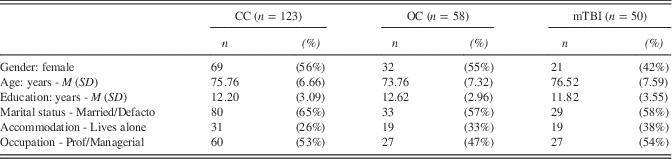
The demographic data of the three groups (CC, OC, mTBI) as well as the combined trauma group (OC, mTBI) are summarized in Table 1. The age range of the total sample was between 61 and 91 years and all were living independently at time of injury. The groups did not differ significantly in gender, χ2(2, N=231)=3.01, p=.22, F(2,228)=2.37, p=.10, education, F(2, 228)=0.87, p=.42, marital status, χ2(2, N=231)=1.43, p=.49, accommodation, χ2(2, N=231)=3.09, p=.21, and occupation, χ2(2, N=231)=0.63, p=.72.
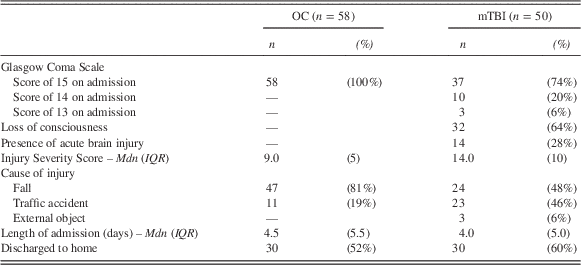
Descriptive injury characteristics for the OC and mTBI groups are presented in Table 2. The mTBI group displayed greater overall injury severity, or multi-system trauma, as measured by the Injury Severity Score (ISS; Copes et al., Reference Copes, Champion, Sacco, Lawnick, Keast and Bain1988) which is calculated from the sum of squares of the three most severely injured body regions contributing to AIS scores; however, it should be noted that this reflects the inclusion of the brain injury for the mTBI group. Fourteen (28%) of the mTBI group showed abnormal brain imaging findings on CT scan within 24 hr, including contusions, edema, hematomas, subarachnoid hemorrhage, and depressed skull fractures (linear skull fractures were not included). Ten participants did not receive CT scanning due to clinical consensus by the hospital treating team as not indicated based on clinical observations and findings. Most injuries in the OC group resulted from falls (81%), whereas in the mTBI group there was a more even balance between falls (46%) and traffic accidents (48%). There was no difference between groups in length of acute admission, Mann-Whitney U (z)=−0.73; p=.47, and discharge destination, χ2(1, N=108)=0.75; p=.39.
Socio-demographic characteristics of community and trauma groups
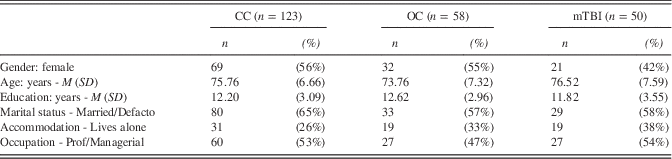
Note. CC=community control; OC=orthopedic control; mTBI=mild traumatic brain injury. Occupation (Professional/Managerial) classification as defined by the Australian Bureau of Statistics (ABS; 2009), using the longest occupation (pre-retirement or current).
Injury characteristics of trauma groups
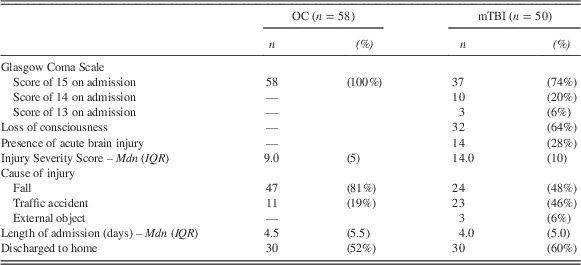
Note. OC=orthopedic control; mTBI=mild traumatic brain injury.
Primary Outcome: Prospective Memory
The MANOVA between groups on measures of prospective memory was significant, F(4,446)=16.88, p<.01, η2=.13, with significant differences between groups (at a Bonferroni-adjusted α of .05/2) on the event-based component, F(2,223)=22.94, p<.01, η2=.17, and the time-based component, F(2,223)=28.72, p<.01, η2=.21 (see Table 3). Post hoc pairwise TUKEY tests indicated that the trauma groups performed significantly worse than community controls (d=0.82–1.18), with no significant differences between the two trauma groups, although there was a small to moderate, but non-significant, effect on the time-based measure of prospective memory (CAMPROMPT-time) (d=0.37).
Prospective memory performance for community and trauma groups at 3 month post-injury

Note. CC=community control; OC=orthopedic control; mTBI=mild traumatic brain injury. Cohen’s d for CC vs. OC (d 12), CC vs. mTBI (d 13), and OC vs. mTBI (d 23). Tukey test significance at *p<.025.
A hierarchical regression was conducted on the combined trauma groups, using selected acute injury variables (presence of intracranial abnormalities, GCS score on admission, severity of multi-system trauma—ISS, and cause of injury—fall vs. other) to predict 3 month cognitive performance (CAMPROMPT-time). In Step 1, we co-varied for three demographic variables (age, gender, years of education) which contributed significantly to the prediction, accounting for 20.4% of the variance in 3 month cognitive performance, F(3,84)=7.19, p<.01. In Step 2, the only predictor selected by the forward selection algorithm was presence of intracranial abnormalities, F(1,83)=5.51, p=.02, explaining an additional 5.0% of variance in prospective memory. With four predictors in the regression model, the only two significant predictors were age (sr=−.30) and presence of intracranial abnormalities (sr=−.22).
Secondary Outcomes
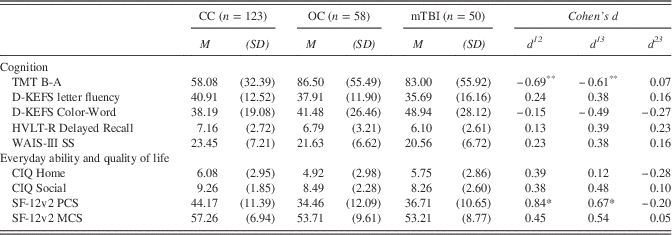
Additional neuropsychological test performances followed a similar pattern to prospective memory. A MANOVA on neuropsychological measures between groups was significant, F(10,428)=2.66, p<.01, η2=.06, with a significant difference between groups (at a Bonferroni-adjusted α of .05/5) on attention set-shifting (TMT B-A), F(2,217)=10.44, p<.01, η2=.09 (see Table 4). Post hoc pairwise TUKEY tests indicated that both trauma groups were significantly slower to shift attention than the CC group (CC vs. OC d=−0.69, CC vs. mTBI d=−0.61), with no significant difference between the two trauma groups. It is also interesting to note small to moderate but non-significant effects in lower performances by the mTBI group in comparison to the CC group in attention inhibition (D-KEFS Color-Word) (CC vs. mTBI d=0.49), attention monitoring (D-KEFS letter fluency) (CC vs. mTBI d=0.38), verbal memory (HVLT-R) (CC vs. mTBI d=0.39), and speed of processing (WAIS-III SS) (CC vs. mTBI d=0.38) (see Table 4).
Secondary outcome variables at 3 month post-injury
Note. CC=community control; OC=orthopedic control; mTBI=mild traumatic brain injury. Cohen’s d for CC vs. OC (d 12), CC vs. mTBI (d 13), and OC vs. mTBI (d 23). Tukey test significance at *p<.0125 and **p<.010.
A MANOVA on quality of life measures between groups was significant, F(8,440)=6.09, p<.01, η2=.10, with a significant difference between groups (at a Bonferroni-adjusted α of .05/4) in physical quality of life (SF-12v2 PCS), F(2,222)=16.96, p<.01, η2=.12. Post hoc pairwise TUKEY tests indicated that both trauma groups reported significantly lower physical quality of life than the CC group (CC vs. OC d=0.84, CC vs. mTBI d=0.67), but with no significant difference between the two trauma groups. There was no significant difference between groups in mental quality of life (SF-12v2 MCS), nor in community integration (CIQ Home, CIQ Social), although the effect sizes between the CC group and both trauma groups ranged between small and moderate (see Table 4).
DISCUSSION
Increasing evidence has accumulated that cognitive recovery following mTBI is generally complete by 3 months following injury (Belanger et al., Reference Belanger, Curtiss, Demery, Lebowitz and Vanderploeg2005; McCrae, Reference McCrae2008). However, it is not established whether older patients achieve these positive outcomes. This study investigated this issue, incorporating two important design features. First, our measure of cognitive outcome—prospective memory, or remembering to carry out intentions—has relevance to the everyday lives of older people (Woods et al., Reference Woods, Weinborn, Velnoweth, Rooney and Bucks2011); and second, we used two comparison groups—a sample of older people who had not experienced traumatic injury (CC group) and a group of older people who had suffered orthopedic injury but without TBI (OC group). This allowed us to estimate the effect of mTBI after any predisposition to injury or general trauma effects had been accounted for in cognition.
This approach revealed some interesting findings. Both trauma groups performed substantially less effectively on all measures of prospective memory than the CC group; and yet, in comparison to the OC group, the mTBI group performance was not significantly different apart from a small, but non-significant effect on the more cognitively demanding measure of prospective memory (CAMPROMPT-Time). Furthermore, this differential pattern was repeated in relation to the secondary measures of cognition—in comparing both trauma groups and the CC group, there was a significant difference in attention set-shifting ability; whereas in comparing the mTBI and OC groups, there were no significant differences. Therefore, the main finding from the study was the surprising impairment in cognitive performance following mild traumatic injury, regardless of brain injury.
Two explanations need considering. First, older adults presenting to emergency departments may be predisposed to injury due to pre-existing cognitive impairment. Indeed, functional dependence and significant co-morbidities are both established risk factors for falls in older adults (Bradley, Reference Bradley2013; Coronado, Thomas, Sattin, & Johnson, Reference Coronado, Thomas, Sattin and Johnson2005). However, in our present study, these risk factors were excluded from the sample, as evidenced by the large exclusion rate on the basis of these criteria (see Figure 1). Therefore, our findings are unlikely to simply represent major co-morbidities impacting cognition. Nevertheless, the potential for both trauma groups presenting with an increased risk of subtle cognitive impairment associated with emerging neurodegenerative disease (e.g., mild cognitive impairment of Alzheimer’s disease) cannot be excluded. In this respect, it is relevant that in addition to memory impairment, disrupted attention control (which was impaired in our trauma samples) has been found to be an early predictor of Alzheimer’s disease in a large longitudinal study of older people (Albert, Moss, Tanzi, & Jones, Reference Albert, Moss, Tanzi and Jones2001). However, an alternative explanation is that trauma sequelae (e.g., distracting pain or secondary effects of pain medication and disrupted sleep patterns) may intrude on performance of cognitive tasks which require sustained attention. Furthermore, heightened levels of anxiety related to the trauma have been recognized as capable of significantly interfering with performance on attention-challenging tasks, even in younger TBI samples (Ponsford et al., Reference Ponsford, Willmott, Rothwell, Cameron, Kelly, Nelms and Ng2000; Williams, Potter, & Ryland, Reference Williams, Potter and Ryland2010). It will be a critical element of further research to monitor the impact of these variables on cognitive performance post-trauma in older people.
By comparison to the significant effects on cognition in both trauma groups, the specific contribution of mTBI to persisting cognitive deficits appeared more modest. This concurs with Aharon-Peretz et al. (Reference Aharon-Peretz, Kliot, Amyel-Zvi, Tomer, Rakier and Feinsod1997) who reported that a mixed-severity sample of older people following TBI (n=18) displayed a range of cognitive difficulties when compared with a small group of community controls (n=10) but no differences when compared to orthopedic controls (n=10). Indeed, it was notable that presence of intracranial abnormalities was the only acute injury variable that added to age in predicting prospective memory performance at 3 month assessment. Similar to younger age samples (Levin et al., Reference Levin, Hanten, Roberson, Li, Ewing-Cobbs, Dennis and Swank2008), intracranial abnormalities indicating complicated mTBI identifies those older age patients presenting with mTBI who will need targeted follow-up management. This is especially relevant as it has been reported that the proportion of subdural hematomas following a head injury increases with age (Stocchetti, Paterno, Citerio, Beretta, & Colombo, Reference Stocchetti, Paterno, Citerio, Beretta and Colombo2012). The frequency of complicated mTBI (28%) in our consecutive series of mTBI older age patients is similar to that reported by Rapoport et al. (Reference Rapoport, Herrmann, Shammi, Kiss, Phillips and Feinstein2006) (33%) in an older age series and notably higher than that reported by Yeates et al. (Reference Yeates, Taylor, Rusin, Bangert, Dietrich, Nuss and Jones2009) for a childhood series (18%).
By focusing our primary outcome assessment on prospective memory we were able to identify post-injury difficulties in both trauma groups. Successful prospective remembering requires an interaction of cognitive domains, notably executive attention allocation, planning, strategic monitoring, and retrospective memory (Einstein & McDaniel, Reference Einstein and McDaniel2005; McDaniel & Einstein, Reference McDaniel and Einstein2011). This integrative skill is used in many everyday situations, such as remembering to collect the grandchildren from their swimming lesson. Furthermore, the importance of these post-trauma prospective memory deficits is highlighted by recent research that has identified prospective memory capacity as an important predictor of functional independence in healthy older people (Woods et al., Reference Woods, Weinborn, Velnoweth, Rooney and Bucks2011). Therefore, prospective memory difficulties post-trauma, as well as associated cognitive challenges, have potential to engender frailty in capacity for independent living and limited capacity to adhere to health intervention programs; for example, failure to remember to regularly practice physiotherapy exercise schedules, or failure to independently maintain compliance with complex medication regimens.
Our findings of cognitive difficulties (with or without mTBI) post-trauma suggest that more guidance is needed for older people, following even mild trauma, in resuming everyday activities. Simple interventions which have been found to be effective for mild cognitive impairment in older people (Kinsella et al., Reference Kinsella, Mullaly, Rand, Ong, Burton, Price and Storey2009), and can be integrated at low cost into existing multiple-component rehabilitation programs (Gillespie et al., Reference Gillespie, Robertson, Gillespie, Sherrington, Gates, Clemson and Lamb2012), may assist in reducing the “revolving door” situation in which an episode of a fall increases risk for further falls (Pluijm et al., Reference Pluijm, Smit, Tromp, Stel, Deeg, Bouter and Lips2006; Tinetti, Reference Tinetti2003).
Methodological issues to be considered in our study include our strategy of only including patients who were functionally independent pre-injury and without a significant co-morbidity. This allowed us to investigate the specific effect of TBI. However, over 50% of older adults who presented to trauma services were excluded from further investigation on the basis of these factors, and this may have led to a significant under-estimation of cognitive impairment following injury. Although our targeted approach was appropriate as an initial investigation, further studies are needed to investigate the potential interactional effects of pre-existing health problems and injury-related impairments that will “tip the balance” in regaining cognitive capacity and functional independence post-injury. These data will be critical when considering future planning of health service resources. A further issue is that we focused on 3 month outcome as it is benchmarked for younger samples as the point when recovery is expected following mTBI. Nevertheless, it will be important to establish cognitive capacity at later stages post-trauma as the time-scale for older age recovery may be delayed. Finally, our measurement of prospective memory (CAMPROMPT) provided only a limited range of test items (six items), and this may have contributed to our failure to identify more than small but non-significant brain injury effects. If prospective memory measures are to be used routinely in clinical neuropsychological assessment, there needs to be further development of reliable and well-normed clinical tests.
In conclusion, 3 months following mild traumatic injury (with or without mTBI), older age patients are at risk of poor cognitive performance. This profile appears to be largely accounted by pre-existing cognitive status or the general negative effects of multi-system trauma. Given the increased risk of further accidental injury in the context of these cognitive limitations, intervention and community support aimed at improving cognitive outcome should be considered to maintain robust functional status in older adults.
ACKNOWLEDGMENTS
The authors acknowledge the contribution to the research by Dr. Evrim March, Samuel Parsons, Dr. Bethan Potter, and Dr. Sarah Price; and the enthusiastic involvement of the participants in the assessment process. Conflicts of Interest: There are no conflicts of interest. Funding statement: This project was supported by a research grant from the Victorian Neurotrauma Initiative (GJK, J.O., B.O., grant number DP 042), and the Transport Accident Commission.