Who has more power in the socialization process, the parent or the child? The issue of agency and direction of influence in the socialization of children has long been a key point of reflection in developmental psychology and psychopathology, addressed at both empirical and conceptual levels (Kuczynski & De Mol, Reference Kuczynski, De Mol, Overton and Molenaar2015; Maccoby, Reference Maccoby1992; Maccoby & Martin, Reference Maccoby, Martin, Mussen and Hetherington1983).
Conceptual views have progressed through relatively distinct stages (Maccoby, Reference Maccoby1992). The earliest psychoanalytic and behavioral approaches afforded influence and power to parents, portrayed as the dominant agents in the socialization process, whereas children were depicted as passive recipients of influence, shaped by the caregivers, or as “empty vessels” waiting to be filled with messages and rules flowing from the parents. Hoffman (Reference Hoffman1975) argued that because of the striking asymmetry in power and competence between children and parents, the portrayal of parents as the more influential agents was accurate.
Then, largely in response to Bell's work on the direction of effects in socialization (Bell, Reference Bell1968; Bell & Chapman, Reference Bell and Chapman1986), and more generally, the concept of evocative effects (Scarr & McCartney, Reference Scarr and McCartney1983), attention shifted to the child, now seen as the source of substantial influence. Children with aversive, difficult temperaments were viewed as eliciting forceful, coercive parenting (Bates, Schermerhorn, & Petersen, Reference Bates, Schermerhorn, Petersen, Zentner and Shiner2012; Dadds & Salmon, Reference Dadds and Salmon2003; Putnam, Sanson, & Rothbart, Reference Putnam, Sanson, Rothbart and Bornstein2002). Children's aversive characteristics were seen as launching coercive parent–child interactions, leading ultimately to antisocial or externalizing outcomes. Extending those views, Lytton (Reference Lytton1990) concluded that child effects play a major role in the origins of conduct disorder.
In a modified approach, Kuczynski and colleagues (Kuczynski & Kochanska, Reference Kuczynski and Kochanska1990; Kuczynski, Kochanska, Radke-Yarrow, & Girnius-Brown, Reference Kuczynski, Kochanska, Radke-Yarrow and Girnius-Brown1987), focusing on child aversive resistance strategies (passive noncompliance, defiance) rather than temperament traits, found that such strategies elicited maternal coercion and ultimately led to more externalizing problems. Braungart-Rieker, Garwood, and Stifter (Reference Braungart-Rieker, Garwood and Stifter1997) showed that maternal use of control pressure mediated the link between child negative temperament and aversive noncompliance.
Those views have gradually evolved into conceptually and methodologically sophisticated transactional perspectives that emphasize reciprocal coercion and a growing adversarial nature of the parent–child relationship over time (Dishion & Patterson, Reference Dishion, Patterson, Cicchetti and Cohen2006; Martin, Reference Martin1981; Pardini, Reference Pardini2008; Patterson, DeBaryshe, & Ramsey, Reference Patterson, DeBaryshe and Ramsey1989; Pettit & Arsiwalla, Reference Pettit and Arsiwalla2008; Reid & Patterson, Reference Reid and Patterson1989; Shaw & Bell, Reference Shaw and Bell1993). While examining the evolving, mutually adversarial, coercive parent–child transactions, researchers assign varying degrees of causality to the parent and to the child (e.g., Bradley & Corwyn, Reference Bradley and Corwyn2013; Lipscomb et al., Reference Lipscomb, Leve, Harold, Neiderhiser, Shaw and Ge2011; Lorber & Egeland, Reference Lorber and Egeland2011; Smith et al., Reference Smith, Dishion, Shaw, Wilson, Winter and Patterson2014).
However, most, if not all, of those studies pertain to children's negative, aversive characteristics and behaviors, such as difficult temperament, unskillful, hard to manage, angry noncompliance, defiance, poorly regulated negative emotions, and insensitivity to punishment, as the sources of causal influence in socialization. Perhaps naturally, the most commonly studied outcomes of interest are the resulting coercive parental behaviors and maladaptive, adversarial, negative cycles that evolve within the parent–child relationship leading ultimately to children's behavior problems and other forms of maladaptation. The parent–child socialization process, now seen as a bidirectional spiral with a strong input from the child, continues to be implicitly or explicitly portrayed as an antagonistic, adversarial enterprise.
We have argued (Forman, Aksan, & Kochanska, Reference Forman, Aksan and Kochanska2004; Kochanska, Aksan, & Carlson, Reference Kochanska, Aksan and Carlson2005; Kochanska, Barry, Aksan, & Boldt, Reference Kochanska, Barry, Aksan and Boldt2008; Kochanska, Kim, & Boldt, Reference Kochanska, Kim and Boldt2013) that those accounts and the extant research, although undoubtedly accurate and valuable, yield an incomplete portrayal of the socialization process. By and large, they ignore children's positive agentic role in socialization and its adaptive potential for promoting resilience.
The relative lack of attention to the child's active positive role is surprising, given the growing interest in positive socialization mechanisms as protecting from developmental risks, mostly externalizing problems (Criss, Shaw, & Ingoldsby, Reference Criss, Shaw and Ingoldsby2003; Deater-Deckard & Petrill, Reference Deater-Deckard and Petrill2004; Shaw, Reference Shaw2003). That interest has been fueled by relational approaches to socialization and the flourishing relationship science, where children's (and other social partners’) positive, receptive cooperation has been long recognized (Clark, Reference Clark1984; Thompson, Reference Thompson, Killen and Smetana2014, Reference Thompson, Lamb and Garcia Coll2015).
Maccoby argues that, in the context of a positively reciprocal, mutually accommodating relationship, children develop a receptive, willing orientation toward their parents (Maccoby, Reference Maccoby, Collins and Laursen1999, Reference Maccoby, Grusec and Hastings2007; Maccoby & Martin, Reference Maccoby, Martin, Mussen and Hetherington1983) and become actively willing partners in the mutually positive and effective process of socialization. Studies inspired by the rapidly ascending attachment theory have documented young children's positive identification with warm, emotionally available parents (Emde, Biringen, Clyman, & Oppenheim, Reference Emde, Biringen, Clyman and Oppenheim1991), their active embrace of parental rules and agendas, and enthusiastic, willing compliance with parental rules in secure relationships (Bretherton, Golby, & Cho, Reference Bretherton, Golby, Cho, Grusec and Kuczynski1997; Londerville & Main, Reference Londerville and Main1981; Stayton, Hogan, & Ainsworth, Reference Stayton, Hogan and Ainsworth1971; Thompson, Reference Thompson, Damon, Lerner and Eisenberg2006a, Reference Thompson, Killen and Smetana2014, Reference Thompson, Lamb and Garcia Coll2015; van IJzendoorn, Reference van IJzendoorn1997; Waters, Hay, & Richters, Reference Waters, Hay, Richters, Olweus, Block and Radke-Yarrow1986). All of those approaches have considered such willing stance or receptive compliance to be a powerful force for successful socialization. Although less often studied, willing or receptive stance is a robust factor protective from maladaptive trajectories, particularly by reducing risk for antisocial behavior (Kochanska, Kim, & Boldt, Reference Kochanska, Kim and Boldt2013).
In our view, children can act as positive, willing, even enthusiastic agents, willingly cooperating in and contributing to their own socialization. The socialization process is depicted as a potentially mutually cooperative enterprise. The parent and the child take turns in responding positively to one another, with each being at times in charge of interaction and the other willingly complying (Maccoby & Martin, Reference Maccoby, Martin, Mussen and Hetherington1983). Parents who allow the child to act as a positive agent, merge with the child's focus of attention, and follow the child's lead in interaction and play have children who are less likely to show behavior problems and more likely to comply. Schaffer and Crook (Reference Schaffer and Crook1980) showed that mothers’ “merging” with the child's attention focus enhanced child compliance. Westerman (Reference Westerman1990) found that mothers of children with serious compliance problems had more difficulty coordinating their behavior with the child's behavior than mothers of problem-free children. Strand (Reference Strand2002) reported that children whose mothers were taught how to let the child lead the play were more compliant.
We proposed that child-willing, enthusiastic stance toward the mother is the “missing link” that is directly associated with conduct problems (Kochanska, Kim, & Boldt, Reference Kochanska, Kim and Boldt2013). When present, it serves as a protective factor, and if compromised, it is directly associated with the child's externalizing behavior problems. The child's willing stance can be seen as a marker of adaptive development and as a factor protective of antisocial behavior problems. Consequently, the study of willing stance should encompass a broad range of child outcomes, including multiple aspects of positive adaptation and competence as well as behavior problems. The child's willing stance, “positive power,” influence, and agency, situated within the child, may have substantial implications for the future parent–child relationship. Maccoby and Martin (Reference Maccoby, Martin, Mussen and Hetherington1983) showed that the child's positive response to the parent elicits parent future responsiveness to and cooperation with the child. That chain of positive reciprocity is in stark contrast with a chain of mutual aversive behaviors in adversarial, coercive parent–child relationships, typically described in developmental psychopathology (Pardini, Reference Pardini2008; Patterson, Dishion, & Bank, Reference Patterson, Dishion and Bank1984).
The study of willing stance has substantial promise in developmental psychopathology, consistent with the recent emphasis on positive socialization forces deployed in prevention and intervention efforts (Shaw, Reference Shaw2003). However, despite its potential importance, very few longitudinal studies in developmental psychology and psychopathology have focused on children's positive influence. We have investigated such influence in multiple contexts and across a broad age range. In parent–child discipline encounters, we have studied committed compliance, a receptive, enthusiastic, self-regulated form of compliance that reflects the child's genuine embrace of the parent's agenda (Kochanska & Aksan, Reference Kochanska and Aksan1995). In parent–child teaching encounters, we have observed the child's responsive, eager, enthusiastic imitation (Forman et al., Reference Forman, Aksan and Kochanska2004). In naturally flowing parent–child interactions, we have coded the child's responsiveness to the parent's social cues and overtures (Kochanska et al., Reference Kochanska, Barry, Aksan and Boldt2008; Kochanska, Kim, & Boldt, Reference Kochanska, Kim and Boldt2013).
The findings have been straightforward and robustly replicated across several studies, with community families and with a high-risk sample (exclusively low-income mothers, all receiving or eligible for federal or state assistance). They have also been replicated across multiple measures of observed and parent-rated adaptive and maladaptive child outcomes, including various measures of internalization of parental values (restraint without surveillance, discomfort after transgressions, rule-compatible conduct, prosocial moral reasoning) and measures of disruptive, antisocial behavior (oppositional defiant disorder, conduct disorder, disregard for rules, peer aggression; Forman et al., Reference Forman, Aksan and Kochanska2004; Kochanska et al., Reference Kochanska, Barry, Aksan and Boldt2008; Kochanska, Kim, & Boldt, Reference Kochanska, Kim and Boldt2013). Children's willing, receptive stance clearly reflects powerful positive agency, situated in the child, with significant implications for the future socialization process. It launches positive developmental cascades toward adaptive outcomes and decreases the risk of externalizing behavior problems.
The child's compromised willing stance may also play a significant role in negative cascades set in motion by adversity impinging on the family. In the sample of low-income mothers, we tested a model in which ecological adversity, a form of cumulative risk index (e.g., maternal young age, low education, low income, multiple stressful life events, single parent) undermined maternal responsiveness, and responsiveness in turn was linked to children's willing stance. A compromised willing stance predicted externalizing behavior problems 10 months later (Kochanska, Kim, & Boldt, Reference Kochanska, Kim and Boldt2013) and fully mediated the links between responsiveness and those outcomes. We can thus conceive of willing stance as a key link in a negative developmental cascade from contextual adversity to parenting to child behavior problems.
What are the origins of such positive, willing orientation? Typically, reflecting the influence of attachment theory, such receptive orientation is seen as evolving within a secure, positive, mutually responsive parent–child relationship, part of the unfolding positive reciprocity between the caregiver and the child (Kochanska, Reference Kochanska2002; Kochanska, Kim, & Boldt, Reference Kochanska, Kim and Boldt2013; Kochanska, Forman, & Coy, Reference Kochanska, Forman and Coy1999; Londerville & Main, Reference Londerville and Main1981; Lytton, Reference Lytton1977; Martin, Reference Martin1981; Matas, Arend, & Sroufe, Reference Matas, Arend and Sroufe1978). It is remarkable that even a brief period of maternal responsiveness has been shown to increase the child's willingness to comply with the mother (Parpal & Maccoby, Reference Parpal and Maccoby1985), perhaps due to the child's enhanced positive mood (Lay, Waters, & Park, Reference Lay, Waters and Park1989).
In the present article, we address two main goals. One, we focus on willing stance itself. We expand the willing stance construct beyond control encounters and naturalistic interactions to another socialization context: the parent–child discourse about the child's actual recent transgression. Parent–child conversations about the child's misbehaviors have been increasingly recognized as an understudied but important arena in which socialization occurs and which may promote children's developing embrace and internalization of family values (Kochanska, Aksan, & Nichols, Reference Kochanska, Aksan and Nichols2003; Laible, Reference Laible2004a, Reference Laible2004b; Laible & Thompson, Reference Laible and Thompson2000; Thompson, Reference Thompson, Damon, Lerner and Eisenberg2006a, Reference Thompson2006b, Reference Thompson, Killen and Smetana2014, Reference Thompson, Lamb and Garcia Coll2015). We have designed a paradigm for parent–child discussion of a recent misbehavior and coded the child's willing, open, receptive attitude toward the parent during such encounters.
We further aim to demonstrate that the diverse, behaviorally coded manifestations of children's willing stance across several socialization domains (committed compliance, responsiveness in naturally flowing social interaction, and a receptive, open attitude in the discourse context) all reflect a latent unifying factor of the child's positive, eager orientation toward the parent and the socialization process. We examine the longitudinal stability of willing stance, conceptualized and assessed as a latent construct from age 3 to 5.5, anticipating such willing stance to be a traitlike characteristic that unfolds and endures over time within the parent–child relationship. In another sample, confirmatory factor analysis supported a notion that various behavioral manifestations of willing stance coded in parent–child contexts reflect an underlying unitary latent construct of the child's generalized positive, receptive orientation toward the parent; however, we examined only concurrent observations (Kochanska, Kim, & Boldt, Reference Kochanska, Kim and Boldt2013). Whether such latent construct is longitudinally stable in childhood is not known, although earlier studies of several samples revealed significant correlations for specific observed willing stance variables over time (Forman & Kochanska, Reference Forman and Kochanska2001; Kochanska et al., Reference Kochanska, Barry, Aksan and Boldt2008).
The second general goal is to investigate the child's willing stance as embedded within a longitudinal positive developmental cascade. Toward that end, we examine the origins of the willing stance in the early parent–child relationship and its long-term outcomes in the socialization process, for both the parent and the child. Willing stance is conceptualized as a causal mechanism that mediates links between the early relationship and future outcomes.
Because we see the origins of the child's willing stance as rooted in responsive parenting, and more generally in a secure, positive early parent–child relationship, a legitimate question is how this approach conceptualizes the child's influential and active role in the socialization process. We do acknowledge the key role the parent plays in the formation of the early parent–child relationship. However, consistent with the general tenets of attachment theory, we view the caregiver's early responsiveness to the child's cues and provision of support and reliable protection as promoting and enhancing the child's emerging autonomy, independence, positive agency, and an increasingly active role as a partner in reciprocal positive transactions (Sroufe, Reference Sroufe1997). This view is consistent with research on receptive compliance (Maccoby & Martin, Reference Maccoby, Martin, Mussen and Hetherington1983; Parpal & Maccoby, Reference Parpal and Maccoby1985) that has repeatedly shown that the parent's compliance to the child and following child lead substantially contribute to the child's subsequently taking on an active, positive, influential role as a cooperative partner in socialization.
Attachment theory has been key in fueling the interest in origins of the child's receptive, willing compliance and more generally in positive forces in socialization (van IJzendoorn, Reference van IJzendoorn1997; Waters et al., Reference Waters, Hay, Richters, Olweus, Block and Radke-Yarrow1986). We have shown across multiple samples that, consistent with attachment theory, willing stance originates in positive early parent–child relationship contexts. For example, maternal responsiveness and shared positive affect between the mother and the young child predicts aspects of the child's future willing stance, be it committed compliance in control encounters (Kochanska & Aksan, Reference Kochanska and Aksan1995), eager imitation in the teaching context (Kochanska et al., Reference Kochanska, Forman and Coy1999), responsiveness in social interactions (Kochanska et al., Reference Kochanska, Barry, Aksan and Boldt2008), or traitlike latent construct of willing, receptive stance (Kochanska, Kim, & Boldt, Reference Kochanska, Kim and Boldt2013). We have not, however, formally tested the role of attachment security in setting in motion the development of willing stance. In the present article, we now examine parent–child attachment security at toddler age as a predictor of the child's future willing, receptive, positive orientation toward the parent.
Our model also assumes that, once established, the child's willing stance is a powerful positive force in the parent–child relationship that leads to adaptive socialization outcomes several years later. Perhaps of the most importance, in a portrayal that is complementary to, or competing with, models that depict the child as an active agent of resistance who elicits the parent's coercive and negative parenting, we propose that the willing, receptive, cooperative child elicits future positive, responsive, cooperative behaviors on the part of the parent. This is perhaps the clearest demonstration of the child's influence on the socialization process. To examine this hypothesis, we test the effects of the child's willing stance, assessed from age 3 to 5.5 years, on mothers’ and fathers’ responsive parenting at age 10, assessed using observations of parenting and child reports of the parent as a trustworthy attachment figure. Both observed and child-reported positive parenting are likely outcomes of the positive, mutual, bidirectional spiral evolving within the dyad (Grusec & Davidov, Reference Grusec, Davidov, Grusec and Hastings2007). Although parental trustworthiness is assessed via children's perceptions probed in interviews, those measures provide a window into positive parenting, reflecting parents’ helping the child with problems, accepting and respecting him or her, or paying attention to the child.
The concept of willing stance is strongly relevant to developmental psychopathology, particularly because it prevents—or when compromised or weakened, promotes—antisocial externalizing, disruptive trajectories. In particular, the transition from middle childhood to preadolescence involves many salient issues of adaptation and rising developmental risks and challenges. Peer influences often contradict the family's socialization messages, and children navigate increased pressures toward high-risk behaviors (Allen, Chango, Szwedo, Schad, & Marston, Reference Allen, Chango, Szwedo, Schad and Marston2012; Brody et al., Reference Brody, Beach, Philibert, Chen, Lei and Murry2009; Sroufe, Egeland, Carlson, & Collins, Reference Sroufe, Egeland, Carlson and Collins2005; Steinberg & Morris, Reference Steinberg and Morris2001). At the same time, parenting shifts from direct control and guidance to distal supervision and monitoring. Consequently, the child becomes actively responsible for the success of socialization; his or her own accepting, internalized stance toward parental values and embrace of internal obligation to obey parental rules are key to successful adaptation (Stattin & Kerr, Reference Stattin and Kerr2000). A lacking or impoverished willing stance leads to defiance, hostility, disregard for rules and standards of conduct, and other externalizing behavior problems (Kochanska, Kim, & Boldt, Reference Kochanska, Kim and Boldt2013). Therefore, we included measures of children's internal commitment to the parent's rules and of externalizing problems, derived from an established clinical instrument.
Despite multiple calls for including fathers in the study of socialization (Cabrera, Tamis-LeMonda, Bradley, Hofferth, & Lamb, Reference Cabrera, Tamis-LeMonda, Bradley, Hofferth and Lamb2000; Pleck, Reference Pleck and Lamb2010), a great majority of the extant studies, particularly observational studies, include only mothers and children. As a consequence, the available account of the socialization process in developmental psychology and psychopathology is far from complete. For example, some evidence suggests that implications of early attachment may differ in mother–child and father–child dyads (Grossmann, Grossmann et al., Reference Grossmann, Grossmann, Fremmer-Bombik, Kindler, Scheuerer-Englisch and Zimmermann2002; Grossmann, Grossmann, Kindler, & Zimmerman, Reference Grossmann, Grossmann, Kindler, Zimmerman, Cassidy and Shaver2008; Parke & Buriel, Reference Parke, Buriel, Eisenberg, Damon and Lerner2006; Thompson, Reference Thompson, Damon, Lerner and Eisenberg2006a). To address this gap, we have collected all of the measures in both the mother–child and father–child relationships.
Method
Participants
This longitudinal study involved 100 two-parent community families from a college town, a small city, and rural areas and towns in the US Midwest (102 entered originally, when the children were infants; this report uses data collected from 25 months onward). Parents of normally developing infants volunteered in response to flyers and ads. In terms of the ethnicity, 90% of mothers were White, 3% Hispanic, 2% African American, 1% Asian, 1% Pacific Islander, and 3% other non-White. Among fathers, 84% were White, 8% Hispanic, 3% African American, 3% Asian, and 2% other. In 20% of families, one or both parents were non-White. The families represented a relatively broad range of education and income. Among mothers, approximately 25% had a high school education (or less), 54% had an associate or college degree, and 21% had a postgraduate education (for fathers, the respective figures were approximately 30%, 51%, and 20%). The annual family incomes ranged from less than $20,000 (8%), to $20,000–$40,000 (17%), to $40,000–$60,000 (26%), to over $60,000 (49%).
Overview
Families entered the study when the children were infants. In this article, we report data collected at five time points: at 25 months (N = 100, 50 girls), at 38 months (N = 100, 50 girls), at 52 months (N = 99, 49 girls), at 67 months (N = 91, 45 girls), and at 123 months (age 10, N = 82, 37 girls). At each time, female experimenters conducted two 1.5- to 3-hr laboratory sessions, one with each parent (at 38 months, there was one home and one laboratory session, with each parent participating in half of each). All sessions were video recorded. The laboratory included a naturalistically furnished living room and a sparsely furnished playroom. At 38, 52, and 67 months, the living room contained a low shelf with extremely attractive toys and objects designated as off-limits to the child; at the outset, the parent was asked to convey the prohibition and keep the child from touching those objects throughout the session.
Children's attachment security with mothers and fathers was assessed at 25 months, using Attachment Q-Sort (AQS; Waters, Reference Waters1987; Waters & Deane, Reference Waters and Deane1985), performed by highly trained coders who observed the whole session with each parent. At 38, 52, and 67 months, the manifestations of the child's willing stance toward each parent were observed in three types of lengthy naturalistic parent–child contexts, parallel at all assessments: (a) discipline, (b) social interactions, and (c) a discourse focused on the child's recent transgression. At age 10, the outcomes were assessed. Each parent's positive, responsive parenting was observed in a laboratory session, and each child was individually interviewed about his or her perception of the parent as a trustworthy attachment figure and his or her sense of internal obligation to obey the parent. Each parent also reported on the child's externalizing behavior problems.
Behavioral data were coded by multiple teams. Reliability (κs, weighted κs, and αs or intraclass correlations) was established on approximately 15%–20% of cases, and frequent realignments followed. Some of the constructs have been published previously and their descriptions will be abbreviated (e.g., Boldt, Kochanska, Yoon, & Nordling, Reference Boldt, Kochanska, Yoon and Nordling2014; Kochanska, Kim, & Boldt, Reference Kochanska, Kim and Boldt2013).
Measures
Children's attachment security with parents, 25 months
Observer-reported AQS
Trained coders observed each mother–child and father–child dyad in the entire 2.5-hr laboratory session in multiple, psychologically diverse contexts, scripted, and standard across the dyads, yet naturalistic. The contexts encompassed situations that were relaxed and pleasurable (e.g., play, opening gifts, eating snacks), mildly stressful (e.g., toy cleanup, prohibition contexts with the off-limit toys, an unfamiliar environment, and a stranger), and involving interactions with a friendly experimenter in the context of games and tasks varying in difficulty. Only one parent (with the child) was present during a session. The coders completed AQS (Version 3; Waters, Reference Waters1987) for each dyad, sorting 90 cards into nine 10-card piles ranging from 1 (most uncharacteristic) to 9 (most characteristic). The final security scores were created according to the standard instructions, correlating the sort for each dyad with the criterion sort representing the “ideal secure child.” Interobserver reliability, intraclass correlation, was 0.85.
Children's willing stance toward parents, 38, 52, and 67 months: Committed compliance during parent–child discipline
Observed contexts
At each time of assessment, each mother–child and father–child dyad was observed in two separate contexts “saturated” with typical control and discipline issues: toy cleanup and the prohibition pertaining to the off-limit objects. At 38, 52, and 67 months, respectively, the durations (with each parent) were, for toy cleanup, 15 min, 10 min, and 10 min, and for prohibition, 27 min, 65 min, and 65 min.
Coding, reliability, and data aggregation
The child's behavior in the control and discipline contexts was coded for each 30-s segment. In toy cleanups, all segments were coded. In the prohibition contexts (all taking place in the living room, near the shelf with the off-limit objects), coders first identified all episodes in which the child's attention was on those objects; then, every 30-s segment was coded, until his or her attention shifted away.
Several forms of compliance and noncompliance were coded. For the present purpose, we focus on behavior reflecting the willing stance: committed compliance, enthusiastic, willing, self-regulated compliance that appeared to originate from within the child and did not require parental sustained control. The child appeared to embrace the parent's agenda (e.g., picking up toys happily and quickly, clapping hands with enthusiasm, looking at the prohibited objects without an attempt to touch, shaking head, spontaneously articulating the rule). Kappa reliability for toy cleanup ranged from 0.77 to 0.88 and for prohibition ranged from 0.73 to 0.80.
All instances of committed compliance in each context (cleanup and prohibition) were tallied and divided by the number of coded segments in that context, at 38, 52, and 67, respectively: with mothers, for cleanup (M = 0.09, SD = 0.11; M = 0.14, SD = 0.17; M = 0.34, SD = 0.26) and for prohibition (M = 0.63, SD = 0.30; M = 0.89, SD = 0.16; M = 0.93, SD = 0.16) and with fathers, for cleanup (M = 0.13, SD = 0.15; M = 0.17, SD = 0.20; M = 0.36, SD = 0.26) and for prohibition (M = 0.72, SD = 0.26; M = 0.93, SD = 0.14; M = 0.94, SD = 0.12). The cleanup and prohibition committed compliance scores were standardized and averaged across the two contexts, into a committed compliance score with each parent at each assessment.
Responsiveness in parent–child social interactions
Observed contexts
Each mother–child and father–child dyad was observed in multiple scripted but naturalistic interactions (e.g., snack, play, a craft-making project, opening gift). The observed total times (and the numbers of the contexts), with each parent at 38, 52, and 67 months: 77 min (four home, five laboratory contexts), 65 min (six), and 60 min (six), respectively.
Coding, reliability, and data aggregation
The child's behavior reflecting the willing stance in social interactions was coded as responsiveness to the parent's social cues, bids, and overtures. For each context (e.g., snack, play), coders rated the child's responsiveness to the parent, from 1 (highly unresponsive) to 7 (highly responsive). Coders integrated the child's detection and promptness in responding to the parent's cues, positive attention and orientation toward the parent, enjoyment of the interaction, cooperation with the parent's bids, and generally, the likelihood that the child's responses would please the parent. Weighted kappa reliability among the coders ranged from 0.70 to 0.91.
The scores cohered across the observed contexts; Cronbach αs at 38, 52, and 67 months with mother and father were 0.72 and 0.81, 0.74 and 0.68, and 0.74 and 0.66, respectively. Thus, at each assessment, the scores were averaged across all contexts into the child's overall responsiveness score toward each parent.
Open, receptive stance during parent–child discourse about transgressions
Observed contexts
The discourse, lasting for up to 5 min, focused on the child's recent transgression or misbehavior (selected by the parent from the diary he or she had kept for a week before the session). The parent was instructed to prompt the child's recollection of the incident, discuss how the child had felt, talk about the implications of misbehavior, and so forth. That part of the discourse was followed by a parallel conversation about an example of good behavior, to ease the child's discomfort (not coded).
Coding, reliability, and data aggregation
The child's behavior was coded for every 20-s segment at 38 and 52 months and 30-s segment at 67 months (note that the number of coded segments was used as the denominator when creating the final variables to make them comparable). Coders rated the child's attempts for physical avoidance of the conversation, reflected in the child's turning away from the parent, avoiding eye contact, playing with objects or clothing, “silly” behavior whose function was to avoid the conversation, such as humming, tickling parent, and jumping, as 1 (not present), 2 (low to moderate), and 3 (strong or intense). Reliabilities (αs at 38 and 52 months and intraclass correlations at 67 months) ranged from 0.90 to 0.98. All instances of each code were tallied and divided by the number of segments. The scores at 38, 52, and 67 months with mothers were M = 2.19, SD = 0.55; M = 2.10, SD = 0.55; M = 2.26, SD = 0.48, and with fathers M = 2.15, SD = 0.56; M = 1.99, SD = 0.57; M = 2.24, SD = 0.51, respectively.
Coders also rated the child's overall willingness to engage, be open to, and cooperate productively in the conversation, as 1 (child actively reluctant, unwilling, attempting to change topic, denying event, etc.), 2 (child passively engaged, silent, delaying answers, pretending not to hear, participating in a perfunctory fashion); and 3 (child cooperative and willing, contributing actively and easily, engaged, sincere, open to and accepting of the parent's messages). Reliabilities (αs at 38 and 52 months and intraclass correlations at 67 months) ranged from 0.88 to 0.97. All instances of each code were tallied and divided by the number of segments. The scores with mothers at 38, 52, and 67 months were M = 1.88, SD = 0.46; M = 1.79, SD = 0.34; M = 2.08, SD = 0.51, and with fathers, M = 1.85, SD = 0.48; M = 1.79, SD = 0.40; M = 1.96, SD = 0.49, respectively.
Finally, at each age, the (standardized) physical avoidance score was then reversed and aggregated with the (standardized) willingness score (those two scores correlated, for children with mothers, rs = .61, .33, and .37, and for children with fathers, rs = .41, .31, and .35, at 38, 52, and 67 months, respectively, all ps < .005). That final score was the measure of the child's open, receptive stance toward each parent during the discourse about misbehavior.
Outcome measures at age 10
Observations of mothers’ and fathers’ positive parenting
Observed contexts
Each mother–child and father–child dyad was observed in the laboratory in 15 interactive contexts (total time 81 min with each parent). The contexts included paradigms adapted from the Minnesota Longitudinal Study (Sroufe et al., Reference Sroufe, Egeland, Carlson and Collins2005), such as discussions of imaginary happenings, holiday plans, campaigns to promote fitness and good nutrition or responsible cell phone use, and interactive puzzles, and from research by Allen and colleagues (Allen et al., Reference Allen, McElhaney, Land, Kuperminc, Moore and O'Beirne-Kelley2003; Hare, Marston, & Allen, Reference Hare, Marston and Allen2011), such as discussions of conflict-producing issues, issues the child needed help with, or hypothetical decision scenarios. Having a snack and opening gifts together were also included.
Coding
For each context (e.g., puzzle, snack), coders rated the parent's responsiveness, using an upward extension of coding we had used frequently at younger ages (e.g., Kochanska & Aksan, Reference Kochanska and Aksan2004). Developmentally appropriate adjustments incorporated elements of the coding systems by Allen and colleagues (e.g., Allen et al., Reference Allen, McElhaney, Land, Kuperminc, Moore and O'Beirne-Kelley2003). Coders considered promptness and willingness to respond to the child's social bids, awareness of and interest in the child's feelings, appropriateness and sensitivity of response, willingness to engage with the child, and supporting and respecting the child, and they integrated those judgments into one overall score for each context, from 1 (highly unresponsive) to 7 (highly responsive). Reliability κs ranged from 0.63 to 0.79.
Data aggregation
The scores cohered robustly across all 15 contexts (αs 0.89 for mother–child, 0.89 for father–child dyads), and for each parent, they were averaged into one score of positive, responsive parenting.
Parent-reported children's externalizing behavior problems
Parents completed the Child Symptom Inventory—4 (CSI-4; Gadow & Sprafkin, Reference Gadow and Sprafkin2002; Sprafkin, Gadow, Salisbury, Schneider, & Loney, Reference Sprafkin, Gadow, Salisbury, Schneider and Loney2002). Two scores were selected: oppositional defiant disorder (αs = 0.85 for mother rated, 0.89 for father rated) and conduct disorder (αs = 0.77 for mother rated, 0.59 for father rated), both based on the symptom severity scoring, with each item rated from 0 (never) to 3 = (very often). Those two scores were added to create externalizing behavior problem scores (one for the mother and one for the father).
Child-reported perceived obligation to obey mothers and fathers
Children were interviewed regarding their attitudes toward their parents’ rules (separately about maternal and paternal rules), using the Strategic Disclosure Questionnaire (Darling, Cumsille, & Martínez, Reference Darling, Cumsille and Martínez2008). Children were given 19 items describing issues that are common sources of disagreement (e.g., clothes, homework). Children replied whether they felt obligated to comply with the parent's rules, even if they disagreed with the parent, rated as 0 (no), 1 (sometimes), or 2 (yes). All answers were averaged into the score of the child's perceived obligation to obey, one for the mother, α = 0.94, and one for the father, α = 0.95.
Child-reported positive parenting: Perceived trustworthiness of mothers and fathers as attachment figures
Children were also individually interviewed with regard to their perception of the parents as attachment figures, using People in My Life (Ridenour, Greenberg, & Cook, Reference Ridenour, Greenberg and Cook2006), a well-validated 21-item measure for that age group. The child reported his or her feelings toward each parent (during separate sessions), rating each item from 1 (almost never or never true) to 4 (almost always or always true). We focused on the 10-item scale of Trust (e.g., ‘I trust my mom,” “I can count on my mom to help me when I have a problem”), the key scale for the instrument (Ridenour et al., Reference Ridenour, Greenberg and Cook2006). The 10 items were summed to create the measure of each parent's trustworthiness as the attachment figure, as perceived by the child. Cronbach αs for the children's descriptions of mothers and fathers were 0.85 and 0.88, respectively, fully comparable to Ridenour et al. (Reference Ridenour, Greenberg and Cook2006).
Control variables
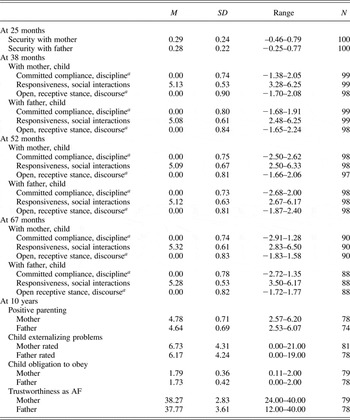
To increase our confidence in the child's willing stance as a factor that promoted positive outcomes beyond a simple continuity of those outcomes, we residualized pertinent earlier measures (at 38 months, the point of the first willing stance assessment) out of two outcomes for which such scores were available. Those included the parent's observed positive parenting, removed from the observed positive parenting at age 10, and the child's difficult temperament, removed from the measure of externalizing behavior at age 10. Positive parenting was assessed as responsiveness to the child, scored for four home and five laboratory contexts (coders were not the same as the coders of child responsiveness). Difficult temperament was operationalized as anger proneness, observed in a standard anger-eliciting laboratory episode of toy retraction. All descriptive data are in Table 1.
Descriptive data for all measures

Note: AF, Attachment figure
a A composite of standardized constituent variables.
Results
Overview
The analyses progressed in three stages. First, in the preliminary analyses, we examined the correlations among the aspects of children's willing stance and among children's security, willing stance, and outcomes. Second, we conducted initial confirmatory factor analyses to examine whether the proposed observed indicators of children's willing stance toward the parent reflected a single latent factor at each measurement time point (at 38, 52, and 67 months) in the mother–child and father–child dyads, respectively. We further examined the longitudinal continuity of those factors.
Third, we constructed a series of full structural equation models to estimate the entire developmental cascade from the child's attachment security at 25 months to the longitudinal latent factor of willing stance to the four outcomes at age 10 (the parent's observed positive parenting, the child's externalizing behavior problems, the child's perceived obligation to obey the parent, and perceived trustworthiness of the parent). In all analyses in the two latter stages, we applied the full information maximum likelihood method to treat missing values of the data. All analyses were conducted within the given relationship (mother–child or father–child), using the relationship-specific variables.
Preliminary analyses: Correlations among the measures
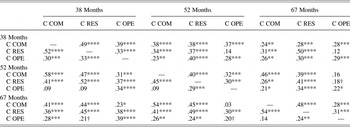
The intercorrelations among the aspects of the children's willing stance are depicted in Table 2. By and large, with just a few exceptions, children's committed compliance in discipline contexts, responsiveness in social interactions, and open, receptive stance in discourse about transgressions were significantly positively related at each age (38, 52, and 67 months) and longitudinally stable across the three assessments. The patterns were essentially similar in the two relationships, mother–child and father–child.
Intercorrelations among the measures of the child's willing stance toward the parent (38–67 months)

Note: C COM, Child committed compliance in discipline; C RES, child responsiveness in social interactions; C OPE, child open, receptive stance in discourse. Correlations for mother–child dyads are above the diagonal and for father–child dyads are below the diagonal.
†p < .10. *p < .05. **p < .025. ***p < .01. ****p < .001.
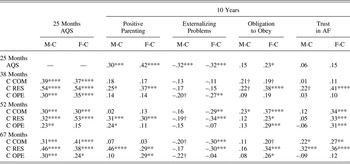
The correlations between security and children's willing stance, security and the outcomes, and willing stance and the outcomes (presented within each relationship, mother–child and father–child) are in Table 3. By and large, the child's security with the given parent at age 2 was positively associated with all aspects of willing stance at all three assessments (38, 52, and 67 months). Higher security was also associated with several outcomes at age 10: more positive parenting and fewer child behavior problems (for both mother–child and father–child relationships) and more internal obligation to obey for father–child relationships.
Correlations among the measures of the child's security at 25 months, willing stance toward the parent (38–67 months), and socioemotional outcomes at age 10

Note: C COM child committed compliance in discipline; C RES, child responsiveness in social interactions; C OPE, child open, receptive stance in discourse; M-C, mother–child dyad; F-C, father–child dyad; AQS, Attachment Q-Set security score; AF, attachment figure. All correlations are within the same dyad (mother–child or father–child).
†p < .10. *p < .05. **p < .025. ***p < .01. ****p < .001.
In terms of the overall patterns, there were several expected positive associations between children's willing stance and outcomes at age 10. The measures of children's responsiveness to the parent in naturalistic interactions, at all three assessments (38, 52, and 67 months), were associated with the outcomes at age 10 in the predicted directions (higher responsiveness predicting more positive parenting, fewer behavior problems, higher obligation to obey the fathers, and more trust in the parent). The predictions from child committed compliance and his or her open stance in discourse were less consistent; but when significant, they were in the predicted direction. For example, committed compliance at 52 months was associated with fewer behavior problems and more obligation to obey; compliance at 67 months was associated with fewer problems and more trust in the parent as attachment figure. Open stance in discourse at 52 and 67 months predicted more obligation to obey the father; open stance at 52 months predicted the mother's positive parenting and at 67 months the father's positive parenting.
Measurement models: The Child's willing stance toward the parent at 38, 52, and 67 months
Mother–child dyads
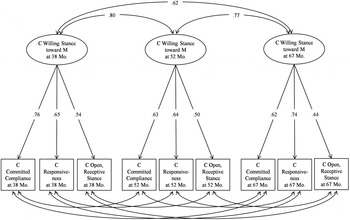
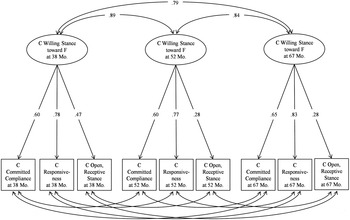
Figure 1 represents the measurement model in which the three observed indicators (the child's committed compliance during mother–child discipline, responsiveness in mother–child interactions, and open, receptive stance during discourse) were proposed to measure the single latent factor, the child's willing stance toward the mother at 38, 52, and 67 months. Because the same indictors were measured at more than one time point, we allowed the correlations of the residual variances of the corresponding indicators over time. We used maximum likelihood estimation because the sample size was moderate in this study, and the distributions of all the indicators were not substantively nonnormal (West, Finch, & Curran, Reference West, Finch, Curran and Hoyle1995): Skewness of the indicators ranges from –1.41 to 0.52, and kurtosis of the indicators ranges from –0.65 to 3.71.
A confirmatory factor analysis model testing the measurement structure of the latent factor (the child's willing stance toward the mother) based on the observed indicators (committed compliance in discipline, responsiveness in social interactions, and open, receptive stance in discourse). Factor loadings are standardized scores. M, Mother; C, child.

Overall, the measurement model for the mother–child dyad produced good model fit. Chi-square test indicated that the model was acceptable at 0.05 α level (χ2 = 17.42, df = 16, p = .36). Comparative fit index (CFI = 0.99), Tucker–Lewis index (TLI = 0.98), root mean square error of approximation (RMSEA = 0.03), and standardized root mean square residual (SRMR = 0.04) also indicated that the model fit our data well by satisfying the conventional model-fit criteria (Bentler, Reference Bentler1990; Hu & Bentler, Reference Hu and Bentler1999; Steiger & Lind, Reference Steiger and Lind1980). The standardized factor loadings of the nine indicators ranged from 0.44 to 0.76, and all were significant at a 0.01 alpha level. The correlations of the three latent factors were also significant (ps < .01). Although not all the correlated residuals were significant, we left them as free parameters, because some amount of misfit would be produced by not estimating them, specifically when the estimators are not close to zero in a longitudinal model (Little, Reference Little2013). Consequently, we concluded that the three child behavior measures in the mother–child dyad reflected a latent construct of the child's willing stance toward the mother at each time point, and moreover, that the latent construct was longitudinally stable across all three assessments.
Father–child dyads
An analogous strategy was adopted for father–child dyads. Figure 2 represents the similar measurement model in which the three observed indicators in the father–child dyad were assumed to measure the child's willing stance toward the father at 38, 52, and 67 months. Again, we allowed the correlations of the residuals of the corresponding indicators over time and used maximum likelihood estimation after checking the distributions of the nine indicators: skewness of the indicators ranged from –1.46 to 0.32, and kurtosis of the indicators ranged from –0.72 to 3.54.
A confirmatory factor analysis model testing the measurement structure of the latent factor (the child's willing stance toward the father) based on the observed indicators (committed compliance in discipline, responsiveness in social interactions, and open, receptive stance in discourse). Factor loadings are standardized scores. F, Father; C, child.

The model fit indices again indicated that the measurement model fit the data well. Chi-square statistic was not significant at the .05 alpha level (χ2 = 16.79, df =16, p = .40). The CFI (1.00), TLI (0.99), RMSEA (0.02), and SRMR (0.05) also indicated that the model satisfied the conventional model fit criteria of a good model (Bentler, Reference Bentler1990; Hu & Bentler, Reference Hu and Bentler1999; Steiger & Lind, Reference Steiger and Lind1980). The standardized factor loadings of the nine indicators ranged from 0.28 to 0.83 and all were significant at a .01 alpha level. The correlations of the three latent factors were significant (ps < .01). Again, we estimated all the residual correlations of the indicators, although not all were significant. In this model, we also concluded that the three child behavior measures in the father–child dyad reflected a latent construct of the child's willing stance toward the father at each time point and the latent construct was longitudinally stable.
Full structural equation models: From attachment security at 25 months to willing stance at 38, 52, and 67 months to outcomes at age 10
Mother–child dyads
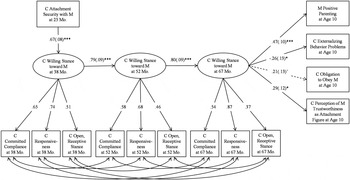
Figure 3 represents the structural model, including the latent factors we constructed in Figure 1. This model assumes that (a) the child's attachment security at 25 months predicts the child's willing stance toward the mother at 38 months, (b) the child's willing stance as a latent factor is longitudinally stable from 38 to 67 months, and (c) the willing stance at 67 months predicts the outcomes at age 10 (the mother's observed positive parenting, the child's externalizing problems, obligation to obey the mother, and the child-rated mother trustworthiness as attachment figure). Recall that the mothers’ positive parenting at 38 months was removed from her positive parenting at age 10, and the child's difficult temperament at 38 months was removed from the measure of externalizing behavior at age 10.
A structural equation model estimating the effect of the child's willing stance toward the mother on outcomes: the mother's positive parenting (a residual score with the 38-month positive parenting removed), the child's mother-rated externalizing problems (a residual score with the 38-month child difficult temperament removed), obligation to obey the mother, and the perception of her as a trustworthy attachment figure. Factor loadings and structural coefficients are standardized scores (standard errors). Solid lines represent significant effects (*p < .05, ***p < .001). Dashed lines represent nonsignificant effects. M, Mother; C, child.

The model fit indices indicated that the proposed model was acceptable. The chi-square statistic was not significant at a .05 alpha level (χ2 = 63.83, df = 60, p = .34). The other indices such as CFI (0.98), TLI (0.98), RMSEA (0.03), and SRMR (0.07) also indicated that the model was acceptable by the conventional model fit criteria.
The secure mother–child relationship measured at 25 months had a significant effect on the child's willing stance toward the mother at 38 months. As expected based on the measurement model, the level of the child's willing stance measured at the prior time point significantly predicted that at the next time points. Finally, child willing stance at 67 months led to significant positive outcomes at age 10, with one at marginal level (the child's obligation to obey). As the level of child willing stance increased, the mother's observed positive parenting and child-rated trust in the mother increased, and child externalizing behavior problems decreased.
Father–child dyads
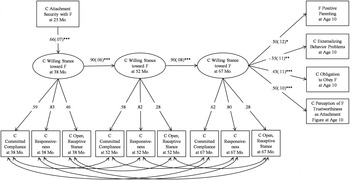
We subsequently tested a similar structural model for father–child dyads, including the latent factors from Figure 2. We again assumed (a) the causal path from the child's attachment security with the father at 25 months to the child's willing stance toward the father at 38 months, (b) the longitudinal stability of the child's willing stance from 38 to 67 months, and (c) the causal path from the child's willing stance at 67 months to the outcomes at age 10 (the father's observed positive parenting, the child's externalizing problems, obligation to obey the father, and the child-rated father trustworthiness as attachment figure). The findings are in Figure 4. As with mother–child dyads, the father's positive parenting at 38 months was removed from his positive parenting at age 10, and the child's difficult temperament at 38 months was removed from the measure of externalizing behavior at age 10.
A structural equation model estimating the effect of the child's willing stance toward the father on outcomes: the father's positive parenting (a residual score with the 38-month positive parenting removed), the child's father-rated externalizing problems (a residual score with the 38-month child difficult temperament removed), obligation to obey the father, and the perception of him as a trustworthy attachment figure. Factor loadings and structural coefficients are standardized scores (standard errors). Solid lines represent significant effects (*p < .05, **p < .01, ***p < .001). F, Father; C, child.

The model fit indices provided somewhat mixed findings. Although chi-square statistic was significant at a 0.05 alpha level (χ2 = 86.91, df = 60, p = .01), all the other indices indicated acceptable model fit (CFI = 0.92, TLI = 0.88, RMSEA = 0.07, and SRMR = 0.08). The approximate fit indices, instead of chi-square test, are generally used to evaluate model fit, but this approach is not unanimously supported (Barrett, Reference Barrett2007; Bentler, Reference Bentler2007; Markland, Reference Markland2007). Consequently, the following interpretation of the developmental cascade for the father–child relationships has to be treated with considerably more caution than that for the mother–child relationships. Keeping all the needed caution in mind, we tentatively conclude that the developmental cascade is similar to that described for the mother–child relationship. Security of the father–child attachment at 25 months had a significant effect on the child's willing stance toward the father at 38 months. As also expected, the level of the child's willing stance measured at the prior time point significantly predicted that at the next time points. As the level of the child's willing stance at 67 months increased, the father's observed positive parenting, the child-rated trust in the father, and the child's obligation to obey increased, and the child's externalizing behavior problems decreased.
Discussion
The perennial question of the parent's versus the child's influence in the process of socialization has attracted renewed research attention. The field has reached a consensus that children can and do behave as active agents, engaged in the bidirectional socialization process (Kuczynski & De Mol, Reference Kuczynski, De Mol, Overton and Molenaar2015; Maccoby, Reference Maccoby1992). Nevertheless, most of the extant research on child agency has produced an overly one-sided picture of the child's role in the socialization process. That work, by and large, has tended to focus on the child's active resistance toward the parent; oppositional noncompliance strategies; difficult, hard to manage temperament; and in general, the child's acting as an antagonist in the socialization process. In that view, the child is “influential” because he or she elicits a host of negative emotions and harsh and maladaptive behaviors on the part of the parent and thus contributes to adversarial cascades evolving in the parent–child relationship, leading naturally to poor outcomes.
We see such portrayal of the child's agency and influence, although certainly accurate, as far from complete. We propose that children can also be active and influential agents in a positive sense, and that they can and do willingly and eagerly embrace and cooperate with the parent's socialization efforts. Consequently, cooperative, willing children elicit positive emotions and supportive, responsive parenting behaviors and thus contribute to a reciprocally positive, cooperative, and successful socialization enterprise evolving within the parent–child relationship. To that effect, we have proposed a construct of the child's willing stance, developed observational methodologies to assess its reflections in multiple socialization contexts, and demonstrated its positive implications for socialization.
Several elements are new to this article. We expanded the assessments of willing stance to a new socialization context, parent–child discourse about child transgressions; we demonstrated that all assessments reflect a unitary latent construct, comparable for mother–child and father–child dyads and longitudinally stable; we examined the role of early attachment security in launching a willing stance trajectory within the parent–child relationship; and we formally tested the entire causal chain from early attachment to willing stance to outcomes. For the first time, we examined whether the child's willing stance can influence the parent's future positive behavior toward the child, and found that it can, for both mother–child and father–child relationships.
With regard to the construct of willing stance, the findings of this study are straightforward, consistent with expectations, and remarkably replicated across both mother–child and father–child relationships. As expected, young children's manifestations of an eager, enthusiastic, receptive orientation toward the parent can be observed, from age 3 to 5.5 years, in discipline contexts as committed compliance and in naturalistic interactions as responsiveness to the parent's cues. We also examined a new socialization context, conversations about the child's transgressions, and successfully coded willing stance as an open, receptive attitude toward the parent. It is more important that the confirmatory factor analyses supported our expectations that in both mother–child and father–child relationships, all those observed behaviors reflect a unitary construct, a general willing stance, a traitlike orientation toward the parent, similar across concurrent socialization contexts (as in Kochanska, Kim, & Boldt, Reference Kochanska, Kim and Boldt2013, in another sample). As a new direction, we examined the longitudinal continuity of children's willing stance, and found that its manifestations, across all contexts, form a longitudinally stable sequence from toddler to kindergarten age.
In line with previous research (Kochanska et al., Reference Kochanska, Barry, Aksan and Boldt2008; Kochanska, Kim, & Boldt, Reference Kochanska, Kim and Boldt2013), this study has clearly demonstrated, over the period of 8 years (age 3 to 10), that even young children can have powerful positive influence in socialization. The child's willing stance is a potent vehicle for successful socialization and a key component of an adaptive developmental cascade (Masten & Cicchetti, Reference Masten and Cicchetti2010). That said, we also believe that the child's active willing stance has its early roots in the parent–child relationship in infancy, when the parent does play an influential role in promoting the child's security. Early attachment security has long been conceptualized not only as the source of the child's confidence in parental protection, but also as a critical foundation for the future adaptive socialization trajectory because of the child's early-instilled trust in and a positive orientation toward the parent (Kochanska et al., Reference Kochanska, Aksan and Carlson2005; Londerville & Main, Reference Londerville and Main1981; Stayton et al., Reference Stayton, Hogan and Ainsworth1971; Thompson, Reference Thompson, Damon, Lerner and Eisenberg2006a, Reference Thompson, Killen and Smetana2014, Reference Thompson, Lamb and Garcia Coll2015; van IJzendoorn, Reference van IJzendoorn1997; Waters et al., Reference Waters, Hay, Richters, Olweus, Block and Radke-Yarrow1986). That positive orientation, in turn, leads to a cycle of mutual cooperation, characterized by the parent's supportive, adaptive care and the child's embracing and internalizing of the parent's values and socialization messages. In this view, consistent with the fundamental perspective of attachment theory, the “influential parent” begins the cascade of positive influence in infancy, gradually empowering the child to become the “influential child”: an autonomous, positive, active partner in socialization.
In this study, for the first time, we formally tested such a view, informed by attachment theory. Our findings are fully consistent with the portrayal of a long-term developmental cascade from early security at age 2 to the child's willing stance toward the parent from age 3 to 5.5, to the host of positive outcomes at age 10. In perhaps the clearest demonstration of the “influential child” model, the child's history of willing stance influenced the parent's future observed positive, responsive behavior toward the child. A parallel child self-reported finding also supported the role of willing stance as a predictor of the parent's positive parenting in his or her role as a trustworthy attachment figure.
In addition, willing stance predicted the child's internal sense of obligation to obey the parent, often considered key in middle childhood, when the child is seen as actively controlling the success of socialization (Darling et al., Reference Darling, Cumsille and Martínez2008; Stattin & Kerr, Reference Stattin and Kerr2000), and it predicted fewer externalizing behavior problems. Although willing stance and internal obligation to obey may appear similar constructs, we conceive of them as distinct. Willing, receptive stance applies to the parent–child ongoing interaction. Enthusiastic, committed compliance, eager responsiveness to the parent's cues, open approach to discourse are all defined and observed as the child's willing orientation toward the parent during the flow of the parent–child interaction. By contrast, we conceive of internal obligation to comply with the parent's rules, values, and socialization agenda, and regard for rules, authority figures, and feelings of others as constructs measured outside of the immediate interaction, in the absence of parental monitoring. To be sure, we believe that internalization and the sense of internal obligation evolve developmentally out of the earlier willing stance (Maccoby & Martin, Reference Maccoby, Martin, Mussen and Hetherington1983), but we argue that the two constructs are conceptually and empirically distinct.
The process appeared generally comparable in mother–child and father–child relationships, but some results should be interpreted with caution. Our model depicting a cascade from early child security at toddler age to willing stance from age 3 to 5.5 to socialization outcomes at age 10 fit the data for mothers and children very well. The fit indices for fathers and children, however, called for caution, although overall, the findings were comparable to the mother–child model. Future replications of long-term links between early attachment and future developmental cascades in the two relationships are certainly needed.
Consistent with attachment theory, we believe (and found) that early parenting likely plays a primary causal role in empowering the child further to pursue socialization goals in an active, willing cooperation with the parent. Such willing cooperation in turn influences the parent to behave more positively toward the child. It would be important to consider the complete cycle over time, and examine developmentally unfolding future transactions from “influential parent” to “influential child” to influential parent, and so forth. In such a mutually positive cycle, the roles of the parent and child are surely interwoven, just as they are in unfolding, mutually coercive cascades typically studied in developmental psychopathology.
Limitations
This study has several limitations. Despite very low attrition over 10 years, the final size of the sample was modest. Consequently, we could not examine the developmental cascades in mother–child and father–child relationships simultaneously. Future studies with larger samples should consider such relationships together, as they are interwoven at many levels.
The sample included relatively homogenous two-parent community families (although note that 20% of families had at least one non-White parent). By and large, mothers and fathers functioned well in their parenting roles and children were typically developing and overall well socialized. In future studies, high-risk families and children with elevated levels of problematic behaviors should be included. We note, however, that several current findings robustly replicate our work with a high-risk, exclusively low-income, highly diverse sample of mothers and toddlers who lived under conditions of ecological adversity and included a substantial proportion of single mothers (Kochanska, Kim, & Boldt, Reference Kochanska, Kim and Boldt2013).
Future directions for translating research on the influential child into preventive interventions
Although the term willing, receptive stance is rarely used in intervention research, many successful parental intervention programs with children at risk for behavior problems capitalize on children's capacity to assume an active, eager, willing role in parent–child interaction. They also train parents to promote opportunities for children to exercise that capacity through techniques that focus the parent's positive attention on the child and support the child in taking on the agentic, active, willing, positive role.
For example, in “special time” (Barkley, Reference Barkley1981), the parent lets the child take charge of the play and interaction and positively comments on the child's behaviors. Parent–child interaction therapy (Eyberg & Bussing, Reference Eyberg, Bussing, Murrihy, Kidman and Ollendick2010) emphasizes child-directed interaction as a key component in interventions. Child-directed interaction includes several strategies that assign an active role to the child and reinforce child agentic behaviors (e.g., labeled praises, reflections, behavior descriptions by the parent). Child's Game (Forehand & McMahon, Reference Forehand and McMahon1981; McMahon & Forehand, Reference McMahon and Forehand2003) adopts a similar strategy that places the child in charge of the interaction and supports his or her positive agency through parental techniques such as attending, following child lead, and reinforcing child behavior. The Incredible Years (Webster-Stratton & Reid, Reference Webster-Stratton, Reid, Murrihy, Kidman and Ollendick2011) includes child-directed play, with the parent following child lead and acting as “an appreciative audience.” Moss and colleagues (Moss et al., Reference Moss, Dubois-Comtois, Cyr, Tarabulsy, St-Laurent and Bernier2011) encouraged parents to follow child lead during play as part of a broader intervention with maltreated children and found significant improvements for the intervention group in parental sensitivity and child attachment security, and a reduction in child disorganized attachment and behavior problems. We have implemented such child-oriented techniques in a play-based intervention study and found clear dose–response relations for positive social development outcomes (Kochanska, Kim, Boldt, & Nordling, Reference Kochanska, Kim, Boldt and Nordling2013).
To date, basic research on children's willing stance and intervention research that has employed techniques designed to capitalize on and enhance young children's positive influence have largely progressed along separate paths, unfortunately. This may be due to the fact that whereas many successful parent training programs comprise such techniques, basic research that elucidates the nature and origins of willing stance is very underdeveloped, and there is little conceptual and empirical evidence to inform prevention and intervention efforts. In our view, consistent with the tenets of developmental psychopathology, not only does the concept of willing stance have implications for our understanding of basic adaptive socialization processes, but it also has a potential to elucidate maladaptive developmental cascades and to inform interventions. Children's own willing, enthusiastic agency may hold substantial promise as a factor that protects the socialization process from external risks, promotes resilience, and can perhaps even reorient a parent–child relationship from adversarial to mutually cooperative, shifting its trajectory toward a more adaptive path.
We have shown in a stressed, high-risk sample of low-income mothers that ecological adversity undermined maternal responsiveness, and poor responsiveness, in turn, led to toddlers’ compromised willing stance. Notably, such compromised willing stance fully mediated the links between poor maternal responsiveness and children's future externalizing behavior problems, highlighting the key role of child willing stance in the risk for psychopathology (or lack thereof), a role that appears more proximal than the typically studied role of parenting. Consequently, theory-informed interventions that would effectively increase young children's willing stance may be particularly important for children in families experiencing high ecological adversity.
Furthermore, in that same high-risk sample, we implemented an intervention consisting solely of teaching mothers how to engage in child-oriented play that capitalized on and enhanced children's positive agency (by following the child's lead, commenting positively on the child's behavior, etc.). Compared to children of mothers who played with their children in the usual manner, willing cooperation in toddlers of the mothers who engaged in such play appeared longer lasting (up to the 6-month follow-up, Kochanska, Kim, Boldt, & Nordling, Reference Kochanska, Kim, Boldt and Nordling2013).
Techniques that capitalize on the child's positive agency have been part of successful interventions even in very high risk mother–child dyads. Moss et al. (Reference Moss, Dubois-Comtois, Cyr, Tarabulsy, St-Laurent and Bernier2011), whose intervention with families of maltreated children included similar techniques, found improvements in mothers’ parenting and children's attachment and reduction in behavior problems. However, that study also included other techniques (e.g., discussions of attachment themes), and consequently, the specific effects of supporting child willing stance cannot be determined. This is typically the case with many popular and effective parenting interventions: Most of them target parents’ negative behaviors, such as coercion, along with enhancing positive interactions and the child's positive agency (Patterson, Forgatch, & DeGarmo, Reference Patterson, Forgatch and Degarmo2010). Typically, only child compliance is assessed as a measure of the willing, receptive stance, and it is assessed as one of the outcomes of the intervention rather than as a potential key mediator or part of the positive cascade that can have potent effects on its own. Therefore, it is difficult to discern the specific role that children's willing stance plays in influencing the process of socialization.
Several new directions may be promising. To design interventions that target children's willing stance, we need to understand better the parent's and the child's characteristics that might moderate their effectiveness. For example, in the aforementioned study that implemented child-oriented play, the intervention led to increased willing stance in dyads in which mothers reported high life satisfaction but not in those in which mothers felt relatively unhappy and unfulfilled (Brock, Kochanska, O'Hara, & Grekin, Reference Brock, Kochanska, O'Hara and Grekin2015). Child temperament, particularly positive emotionality, may play an important role in the development of willing stance. Children's joy and enthusiasm are important components of that construct, captured in our coding systems. Perhaps intervention techniques that capitalize on humor, enjoyable parent–child activities, and shared fun can be effective tools for promoting more generalized willing stance (Lay et al., Reference Lay, Waters and Park1989). Further, we may consider not only the mostly receptive aspect of the willing stance but also its proactive aspect. This would include the coding of the child-initiated positive social bids and overtures toward the parent and affectively positive attempts to engage the parent, both likely influenced by child positive emotionality. In addition, the child's capacity for effortful control typically is positively associated with multiple forms of children's cooperation with caregivers.
Fueled and informed by an increasing focus on relationships as developmental contexts (Collins & Laursen, Reference Collins and Laursen1999; Kuczynski & De Mol, Reference Kuczynski, De Mol, Overton and Molenaar2015; Thompson, Reference Thompson, Damon, Lerner and Eisenberg2006a, Reference Thompson, Killen and Smetana2014, Reference Thompson, Lamb and Garcia Coll2015), the study of the parent's and the child's effects in socialization and psychopathology has reached an exciting new phase. The child's capacity to act as a willing, receptive agent has been underexplored as an important mechanism of adaptation and resilience. A compromised capacity to assume such willing stance may be an important marker of developmental risk for the child's developmental outcomes and for the parent–child relationship. Future research promises to elucidate the unique yet interwoven roles of the parent and the child in evolving adaptive and maladaptive cascades and to inform prevention and intervention efforts.