Introduction
The majority of people with dementia are cared for at home by informal caregivers, normally someone who knew the care-recipient beforehand. The influences on the caregiver's decision to take on the caregiving role, and the changing nature of the relationship with the care-recipient may affect the outcomes of caregiving. In addition, caregivers’ ability to find meaning in caregiving, to identify positive aspects, could reinforce their desire to provide care. In this study, we aim to investigate how these three factors of motivations for caregiving, the relationship between the caregiver and care-recipient, and the meanings attributed to caregiving impact on the caregiving experience. In the current study, we will examine whether and in what way these factors are related to each other and explore the individual and combined impact of these factors on caregiving outcomes.
There have been numerous theoretical models developed to explain the process of caregiving (e.g. Pearlin et al., Reference Pearlin, Mullan, Semple and Skaff1990). One major commonality between these models is that the outcomes of this process concern the impact of caregiving upon caregivers’ wellbeing. Traditionally, there has been a tendency for research to focus on the negative impact of caregiving on caregivers’ health and wellbeing; however, some caregivers may be able to derive something positive out of providing care. One way in which caregivers can positively appraise the caregiving situation is to find meaning in the caregiving role. There have been different conceptualizations of meaning and the term has primarily been used to describe coping-related phenomena (Folkman, Reference Folkman1997). Folkman (Reference Folkman1997) proposed that “meaning is created by finding a redeeming value in loss” (p. 1215). During stressful circumstances, such as providing care, a person may search for meaning as a way to cope with this stress. For instance, a caregiver may positively reappraise the situation in order to identify benefits or positive changes. Meaning has been viewed as being multidimensional, with several components. Reker and Wong (Reference Reker, Wong, Birren and Bengtson1988) propose that meaning has a cognitive component, as it is a way of making sense of one's experiences, and an emotional component, as it is linked to feelings of satisfaction and fulfillment. Meaning also has a motivational component, since finding meaning may help motivate the person to sustain coping. Despite its relevance in understanding adaptation to stressful events, there has been little research exploring the role of finding meaning in dementia caregiving. A systematic review identified only a limited number of studies, but the results indicated that finding meaning can have a positive impact on dementia caregivers’ wellbeing (Quinn et al., Reference Quinn, Clare and Woods2010).
Some caregivers may be able to derive meaning through the relational aspects of providing care. Caregiving can affect the quality of the relationship for both the caregiver and care-recipient; however, relationship quality has tended to be neglected in models of stress and coping. Some models, such as the Stress Process Model (Pearlin et al., Reference Pearlin, Mullan, Semple and Skaff1990), have viewed the relationship between the caregiver and care-recipient as just a background factor, yet this relationship will gradually alter throughout the caregiving process. This transformation in the relationship is likely to impact on the experiences of the caregiver and care-recipient. A better quality of relationship has been linked to higher wellbeing in caregivers and care-recipients (e.g. Clare et al., Reference Clare2012), and a slower decline in the care-recipient's cognitive and functional abilities (Norton et al., Reference Norton2009). A systematic review on relationship quality (Quinn et al., Reference Quinn, Clare and Woods2009) found that studies exploring the differences in ratings of pre-caregiving and current relationship quality had inconsistent findings. Therefore, in this review it was recommended that more research is needed to explore the impact of both pre-caregiving and current relationship quality on caregiving outcomes.
While it has been argued that the relationship between the caregiver and care-recipient can influence the caregiving experience, this relationship will also have an important role in the commencement of caregiving. It is often the relational connection or history that prompts relatives or friends to begin caregiving; for instance, research by Kolmer et al. (Reference Kolmer, Tellings, Gelissen, Garretsen and Bongers2008) indicated that caregivers were primarily motivated to care because of their relationship with the care-recipient. There has been limited research into dementia caregivers’ motivations to provide care and the way in which these motivations influence caregiving outcomes. However, some studies have explored the role of cultural motivations, such as familism, in caregiving (e.g. Knight and Sayegh, Reference Knight and Sayegh2010; Romero-Moreno et al., Reference Romero-Moreno, González, Losada and López2011). It has been argued that, since effective caregiving requires the caregiver to be motivated to accept the responsibility and effort required in providing care, inadequate motivation on the part of the caregiver may result in provision of ineffective or low levels of support (Feeney and Collins, Reference Feeney and Collins2003). A systematic review indicated that motivations to provide care can indeed impact on wellbeing (Quinn et al., Reference Quinn, Clare and Woods2010). Yet, the studies reviewed did not conceptualize motivations within a theoretical framework. There are different types of motivations; intrinsic motivations relate to internal desires to provide care, while extrinsic motivations relate to extrinsic pressures to provide care. Utilizing appropriate conceptual frameworks can further illuminate how different motivations can influence caregiving outcomes.
The available evidence suggests that relationship quality, motivations, and meaning can impact on dementia caregiving. However, there has been no quantitative exploration of the way in which motivations for caregiving, the meanings attributed to caregiving, and the evolving nature of the relationship between the caregiver and care-recipient are potentially related to and influence each other. In a previous study, exploring the predictors of finding meaning we found that both relationship quality and caregiving motivations were correlated with finding meaning (Quinn et al., Reference Quinn, Clare and Woods2012). In the current study, we will explore the relationship between these three factors and the way in which they influence caregiving outcomes. Developing a greater understanding of the factors that can influence the caregiving experience will aid the development of better interventions for caregivers.
Research aims
-
1 To explore whether intrinsic and extrinsic motivations, meaning, and pre-caregiving and current relationship quality are related to each other, and if so in what way.
-
2 To examine whether intrinsic and extrinsic motivations, meaning, and pre-caregiving and current relationship quality are related to caregiving outcomes.
Methods
Design
This was a large-scale cross-sectional postal questionnaire survey exploring the relationship between meanings, motivations, relationship quality, and caregiving outcomes. The respondents were in receipt of a specialist nursing service, provided by Admiral Nurses.
Ethical issues
Ethical approval for this study was obtained from the relevant National Health Service Multi-Centre Research Ethics Committee. In order to ensure participant confidentiality, selected Admiral Nurses acted as local collaborators on this project, and they alone had access to the participants’ contact details.
Participants
The participants in this study were informal caregivers of people with dementia. These caregivers were identified from the caseloads of 12 Admiral Nurse teams across England. The Admiral Nurse service is a UK-based specialist mental health nursing service, supported by the charity Dementia UK, which aims to improve the quality of life of all people affected by dementia with a focus on the needs of caregivers. Admiral Nurses work with the caregiver/care-recipient dyad to identify dementia care services appropriate to their needs. They also provide practical advice, emotional support, and information about dementia. Caregivers were included in this study if, at the time of the study, they were currently in receipt of the Admiral Nurse Service or had been discharged from the Service within the past six months. Caregivers were excluded from the study if the care-recipient had died.
Measures
Demographic characteristics
The caregivers were asked to complete basic demographic information about themselves, the care-recipient, and the caregiving situation, and to rate their health on a 5-point scale ranging from 1 (Poor) to 5 (Excellent).
Meaning
Meaning was measured using the 12-item Meaning in Caregiving Scale (Noonan and Tennstedt, Reference Noonan and Tennstedt1997). This explores the positive aspects of care and ways in which caregivers can find meaning through the caregiving experience, for example “I've learned a lot about myself as a result of caring.” The questions were rated on a 5-point scale ranging from 1 (Strongly disagree) to 5 (Strongly agree). Possible scores ranged from 12 to 60, with a higher score indicating a greater sense of finding meaning in caregiving. The Cronbach's α coefficient for this measure was 0.88.
Motivations to provide care
The caregivers’ motivations to provide care were measured by the Motivations in Elder Care Scale (Lyonette and Yardley, Reference Lyonette and Yardley2003), which is comprised of two subscales: Extrinsic Motivations to Care (EXMECS) and Intrinsic Motivations to Care (INMECS). As the measure was designed for caregivers of older adults, the wording of the questions was slightly altered to be appropriate for caregivers of people with dementia. The INMECS subscale measured intrinsic motivations, for example “it is part of my nature to provide care for others.” The subscale consists of seven questions which were rated on a 5-point scale ranging from 1 (Strongly disagree) to 5 (Strongly agree). Possible scores ranged from 7 to 35, with a higher score indicating greater intrinsic motivations to provide care. The Cronbach's α coefficient for this measure was 0.81.
The EXMECS subscale measured extrinsic reasons for providing care, for example “the person I care for expected me to care for him/her.” The subscale consists of six questions which caregivers rated on a 5-point scale ranging from 1 (Strongly disagree) to 5 (Strongly agree). Possible scores ranged from 6 to 30, with a higher score indicating greater extrinsic motivations to provide care. Analysis of the reliability of the scale using the present dataset found that one question (“person was gradually becoming more dependent on me”) correlated poorly with the other items. Pallant (Reference Pallant2005) recommends that items which have correlations below 0.3 should be removed from the scale. Thus, this item was removed prior to further analysis, increasing the Cronbach's α coefficient from 0.76 to 0.78.
Relationship quality
Current and pre-caregiving relationship quality was measured using the Positive Affect Index (Bengtson and Schrader, Reference Bengtson, Schrader, Mangen and Peterson1982). The measure consists of five items which assess the closeness of the relationship, communication, similarity in views, getting along, and shared activities. The phrasing of these questions was amended to assess both pre-caregiving and current relationship quality. In each case, responses were rated on a 6-point scale ranging from 1 to 6. Possible scores ranged from 1 to 30, with higher scores indicating greater relationship quality. The Cronbach's α coefficient for pre-caregiving relationship quality was 0.88, and for current relationship quality was 0.76.
Burden
Burden was measured using the short version of the Zarit Burden Interview (Bédard et al., Reference Bédard, Molloy, Squire, Dubois, Lever and O'Donnell2001). The scale measures caregivers’ appraisal of the impact caregiving has had on their lives. The measure consists of 12 questions rated on a 5-point scale ranging from 0 (Never) to 4 (Nearly always). Possible scores ranged from 0 to 48, with higher scores indicating greater burden. The Cronbach's α coefficient for this measure was 0.87.
Role captivity
Role captivity was measured using a 3-item scale (Pearlin et al., Reference Pearlin, Mullan, Semple and Skaff1990). The caregivers rated the extent to which they felt trapped in their role on a 5-point scale ranging from 1 (Strongly disagree) to 5 (Strongly agree). Possible scores ranged from 3 to 15, with higher scores indicating more role captivity. The Cronbach's α coefficient for this measure was 0.84.
Competence
Competence was measured using the 3-item Caregiving Competence scale reported by Robertson et al. (Reference Robertson, Zarit, Duncan, Rovine and Femia2007). The caregivers evaluated the adequacy of their role as a caregiver on a 5-point scale ranging from 1 (Strongly disagree) to 5 (Strongly agree). Possible scores ranged from 3 to 15, with higher scores indicating greater competence. The Cronbach's α coefficient for this measure was 0.86.
Procedure
Acting as local collaborators, the Admiral Nurses accessed the Admiral Nurse client database and utilized the inclusion criteria to identify participants. Participants’ names and addresses were collected and the questionnaires were posted out to the participants. The participants were provided with a freepost envelope in which to return the completed anonymous questionnaire to the researcher. Upon receipt, the researcher numbered the questionnaires and entered the data into an SPSS (Statistical Package for the Social Sciences) database version 16 for Windows Vista.
Planned statistical analysis
Prior to analysis, the data were examined for normality of distribution and the presence of outliers. Examination of histograms, plots of normality, and box plots indicated that some of the measures were skewed and so the most appropriate method of transformation was chosen for each measure. Competence, pre-caregiving relationship quality, INMECS, and EXMECS were all negatively skewed. Competence was reflected and then a square root transformation was applied. Pre-caregiving relationship quality, EXMECS, and INMECS were reflected and then logarithmically transformed. As these transformations reversed the direction of the variable, the variables were subsequently re-reflected to return them back to their original direction (Munro, Reference Munro2005). Since role captivity was positively skewed, it was transformed using a square-root transformation. These transformations were effective in reducing the skew in these measures. In preparation for the hierarchical regressions, the data were checked for linearity, multicollinearity, and homoscedasticity. No changes were made to the data.
A Wilcoxon signed-rank test was performed to determine whether there was a significant difference between scores of pre-caregiving and current relationship quality. Correlational analyses were conducted to indicate whether and in what way there was a relationship between INMECS, EXMECS, meaning, and current relationship quality and pre-caregiving relationship quality. Correlational analyses were also performed to explore the relationship between these factors, selected demographic factors, and the measures of caregiving outcomes. Hierarchical regression analysis was employed to determine how much of the variance in caregiving outcomes scores could be explained by meaning, intrinsic and extrinsic motivations, and pre-caregiving and current relationship quality, beyond that accounted for by demographic factors. For each of these analyses, demographic characteristics were entered in the first step, followed by pre-caregiving and current relationship quality, meaning, INMECS, and EXMECS in the next step.
Results
In total, 1,228 questionnaires were sent out to caregivers, and 460 completed questionnaires were returned, a response rate of 37.5%. Of these questionnaires, 13 were not included in the analysis as they came from caregivers where the care-recipient had died. Therefore, data from 447 questionnaires were included in the analysis.
Sample characteristics
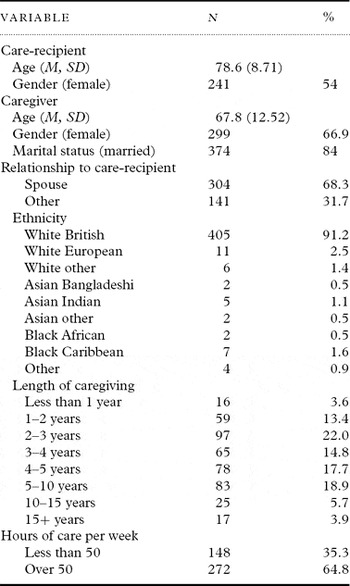
The characteristics of the caregivers and care-recipients are described in Table 1. The mean age of the care-recipients was 78.6 (range 25–95) and 54% were female. The mean age of the caregivers was 67.8 (range 25–95), 66.9% were female, and 68.3% were spouses. The majority of the caregivers were White British and were married. The length of caregiving varied, with 22% reporting that they have been providing care for between 2 and 3 years and 18.9% providing care for 5–10 years. Sixty-four percent of the caregivers reported that they provided care for over 50 hours per week.
Characteristics of the caregivers, care-recipients, and caregiving situation

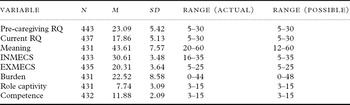
Information on the caregivers’ scores on the measures is provided in Table 2. Ratings of pre-caregiving relationship quality (M = 23.09, SD = 5.42) were higher than those for current relationship quality (M = 17.86, SD = 5.13). Analysis using a Wilcoxon signed-ranks test shows that this difference was significant, T = 95.30, p < 0.001, r = –0.52.
Mean scores on all the measures

Note: RQ = Relationship Quality, INMECS = Intrinsic Motivations, EXMECS = Extrinsic Motivations.
Relationships between variables and caregiver characteristics
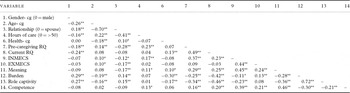
The intercorrelations between intrinsic motivations, extrinsic motivations, meaning, pre-caregiving and current relationship quality, caregiver characteristics, and type of relationship to the care-recipient are shown in Table 3. Gender was associated with both pre-caregiving and current relationship quality, such that being a male caregiver was associated with higher pre-caregiving and current relationship quality. Spousal caregivers reported higher pre-caregiving relationship quality, intrinsic and extrinsic motivations, and meaning.
Intercorrelations between study variables

Note: RQ = Relationship Quality, INMECS = Intrinsic Motivations, EXMECS = Extrinsic Motivations, cg = caregiver.
*p < 0.05, **p < 0.001.
Associations between motivations, meaning, and relationship quality
Table 3 contains the intercorrelations between these variables. There was a medium positive association between pre-caregiving and current relationship quality. There were small positive associations between the quality of the relationship, both pre-caregiving and current, and meaning. There was a medium positive association between pre-caregiving relationship quality and intrinsic motivations, and a small positive association between current relationship quality and intrinsic motivations. Thus, higher pre-caregiving and current relationship quality were related to higher meaning and higher intrinsic motivations. There was a medium positive correlation between intrinsic motivations and meaning, with higher intrinsic motivations associated with higher meaning. Extrinsic motivations were significantly related only to intrinsic motivations and meaning. There was a medium positive correlation between extrinsic and intrinsic motivations and a small positive correlation between extrinsic motivations and meaning. Higher extrinsic motivations were associated with higher meaning and higher intrinsic motivations.
Relationships between motivations, meaning, relationship quality, and caregiving outcomes
Table 3 contains the intercorrelations between these variables. Meaning had a small negative correlation with burden, a medium negative correlation with role captivity, and a medium positive correlation with competence. Thus, higher meaning was associated with lower burden and role captivity, and with higher competence. Pre-caregiving relationship quality had a small negative correlation with burden, a medium negative correlation with role captivity, and a small positive correlation with competence. Current relationship quality had medium negative correlations with burden and role captivity, and a small positive correlation with competence. Thus, both a better pre-caregiving relationship and a better current relationship were associated with lower burden and role captivity, and higher competence. Extrinsic motivations had small positive correlations with burden and competence. Intrinsic motivations had small negative correlations with burden and role captivity, and a medium positive correlation with competence. Thus, higher intrinsic motivations were associated with lower burden and role captivity, and higher competence, while higher extrinsic motivations were associated with higher burden and competence.
Hierarchical regressions
Burden
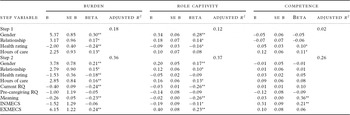
Table 4 indicates the percentage variance in burden accounted for by the independent variables. In the first step of the model, demographic characteristics explained 18% of the variance in burden (Adjusted R 2 = 0.18, F(4, 372) = 21.77, p < 0.001). All the variables made a significant contribution: gender, relationship, health status, and hours of care. Thus, being a female or a non-spousal caregiver, having poor health, and providing long hours of care predicted higher levels of burden. The inclusion of pre-caregiving and current relationship quality, meaning, intrinsic motivations, and extrinsic motivations uniquely explained an additional 18% of the variance in burden, significantly increasing the variance explained to 36% (Adjusted R 2 = 0.36, F change (5, 367) = 21.72, p < 0.001). Current relationship quality, meaning, and extrinsic motivations were all significant predictors of variance in burden. Thus, a poorer current relationship, lower meaning, and higher extrinsic motivations were significant predictors of greater burden.
Hierarchical multiple regressions predicting burden, role captivity, and competence

Note: RQ = Relationship Quality, INMECS = Intrinsic Motivations, EXMECS = Extrinsic Motivations.
*p < 0.05, **p < 0.001.
Role captivity
Table 4 provides the percentage variance in role captivity accounted for by the independent variables. In the first step of the model, demographic characteristics explained 12% of the variance in role captivity (Adjusted R 2 = 0.12, F(4, 372) = 13.37, p < 0.001). Gender, relationship, and health ratings made significant contributions to the variance. This indicates that being a female or a non-spousal caregiver and having poor health accounted for higher role captivity. The inclusion of pre-caregiving and current relationship quality, meaning, intrinsic motivations, and extrinsic motivations uniquely explained an additional 25% in variance, increasing the total variance explained to 37% (Adjusted R 2 = 0.37, F change (5, 367) = 30.21, p < 0.001). Current relationship quality, meaning, and intrinsic and extrinsic motivations all significantly explained variance in role captivity. Thus, a poorer current relationship, lower meaning, lower intrinsic motivations, and higher extrinsic motivations were significant predictors of greater role captivity.
Competence
Table 4 provides the percentage variance accounted for in competence by the independent variables. In the first step of the model, demographic characteristics explained only 2% of the variance in competence, with hours of care alone making a significant contribution (Adjusted R 2 = 0.02, F(4, 371) = 2.98, p < 0.05). This indicates that providing greater hours of care was associated with higher competence. The inclusion of pre-caregiving and current relationship quality, meaning, and intrinsic and extrinsic motivations uniquely explained an additional 24% in variance, significantly increasing the total variance explained to 26% (Adjusted R 2 = 0.26, F change (5, 366) = 24.65, p < 0.001). Only intrinsic motivations and meaning were significant predictors. Thus, higher intrinsic motivations and higher meaning were significant predictors of greater competence.
Discussion
In the current study, we aimed to explore the linkages between relationship quality, motivations to provide care, and the meaning caregivers find in caregiving. The findings indicate that intrinsic motivations, meaning, and pre-caregiving and current relationship quality were significantly positively related to each other. Extrinsic motivations were only positively related to intrinsic motivations and meaning. Both higher pre-caregiving and current relationship quality were associated with greater ability to find meaning. Some studies have found that relationship quality can be linked to positive aspects of providing care; for instance, a good pre-caregiving relationship has been linked to higher caregiving satisfaction (e.g. López et al., Reference López, López-Arrieta and Crespo2005). Similarly, Lyonette and Yardley (Reference Lyonette and Yardley2003) found that, for caregivers of older people, a better relationship and greater intrinsic motivations were linked to higher caregiving satisfaction. However, the measure of relationship quality used in that study contained a mixture of questions on both pre-caregiving and current relationship quality. In the current study, both high pre-caregiving and high current relationship quality were associated with high intrinsic motivations. Given that these intrinsic motivations emerge from internal desires for providing care, then it is likely that affection for the care-recipient would be linked to these motives. Lyonette and Yardley (Reference Lyonette and Yardley2003) also found an association between high relationship quality and low extrinsic motivations. However, in the current study there was no significant relationship between extrinsic motivations and pre-caregiving or current relationship quality. Both intrinsic and extrinsic motivations were linked to higher ability to find meaning; however, intrinsic motivations had a stronger relationship with meaning. It was expected that, given the links to better wellbeing, intrinsic motivations would be linked to meaning. The unexpected finding of the link between extrinsic motivations and meaning indicates that perhaps it is the caregivers’ awareness of their reasons for providing care that helps them find meaning in their role. Levine et al. (Reference Levine1984) argued that caregivers need to find meaning in the choices they have made, for instance, commencing and continuing caregiving.
The findings from correlational analyses indicate that intrinsic and extrinsic motivations, meaning, and pre-caregiving and current relationship quality were individually related to the measures of caregiving outcomes. Both a better pre-caregiving and current relationship were linked to better outcomes. This supports the view that having a good pre-caregiving relationship with the care-recipient is beneficial for the caregiver. Other studies have found that a good pre-caregiving relationship was related to lower burden (Steadman et al., Reference Steadman, Tremont and Davis2007). The findings of the current study also indicate that a good relationship is linked to feelings of competence in caregiving. A study with adult-child caregivers of older adults found that greater closeness in the current relationship was related to greater feelings of subjective effectiveness (Townsend and Franks, Reference Townsend and Franks1995). In addition, it is possible that feelings of competency in providing care can help caregivers to feel more positive about their relationship with the care-recipient. In the current study, higher meaning was associated with better outcomes, and other studies have found higher meaning is associated with lower role strain and burden (e.g. McLennon et al., Reference McLennon, Habermann and Rice2011; Quinn et al., Reference Quinn, Clare and Woods2010). The link between meaning and competence indicates that finding meaning may have a positive influence on the way in which caregivers appraise their role. The findings of the current study suggest that intrinsic and extrinsic motivations can have differential impacts on caregiving outcomes. Higher intrinsic motivations were associated with lower burden, role captivity, and higher competence, whereas higher extrinsic motivations were associated with higher burden. Thus, intrinsic motivations were associated with better outcomes and extrinsic motivations were linked to poorer outcomes. Studies have found this effect with other types of motivations. In a study with adult-child caregivers of older adults, Cicirelli (Reference Cicirelli1993) reported that feelings of obligation to provide care were linked to greater burden, and motivations to provide care based on feelings of attachment to the care-recipient were related to lower burden. In the current study, higher extrinsic motivations were also linked to higher competence. It is possible that the caregivers being aware of the reasons why they were providing care contributed to them feeling competent in their role.
This study also sought to examine the combined impact of meanings, motivations, and relationship quality on caregiving outcomes. When combined, these factors significantly explained 18% of the variance in burden, 25% of the variance in role captivity, and 24% of the variance in competence. Overall, pre-caregiving and current relationship quality, meaning, and intrinsic and extrinsic motivations made a significant contribution to the caregiving outcome measures, even when demographic characteristics were controlled. Meaning was the most consistent predictor of these variables. Pre-caregiving relationship quality did not significantly predict scores on any of the outcome measures. It is possible that there is some shared variance between pre-caregiving and current relationship quality which resulted in only current relationship quality being a significant predictor of burden and role captivity. The selected predictor variables only explained a proportion of variance in caregiving outcomes and there are other variables could explain the rest. For instance, Pinquart and Sörensen (Reference Pinquart and Sörensen2003) conducted a meta-analysis of studies on caregiving stressors. They identified that caregiving burden and depression were linked to the physical and cognitive impairment of the care-recipient, and the number of caregiving tasks. Harwood et al. (Reference Harwood, Barker, Ownby, Bravo, Aguero and Duara2000) reported that both caregiving burden and satisfaction were predicted by social support.
The findings of the current study indicate that theoretical models exploring predictors of caregiving outcomes should incorporate meanings, motivations, and relationship quality. Some models have begun to include these factors; for instance, the theoretical model proposed by Sörensen et al. (Reference Sörensen, Duberstein, Gill and Pinquart2006) included both relationship quality and meaning. The present findings also indicate that both positive and negative aspects of providing care can influence caregiving outcomes. Meaning significantly explained variance in both negative and positive outcomes. It is important for models of caregiving to recognize that positive aspects of care can influence both positive and negative affect, as with the Folkman (Reference Folkman1997) revised model of coping, which indicates that meaning-based coping can influence both positive emotions and distress.
Given the link between motivations, meanings, relationship quality, and caregiving outcomes, interventions aimed at reducing caregiving stress and promoting feelings of caregiving competence should take into account the impact of these factors. Although interventions may not be able to directly affect motivations for caregiving, understanding the influence of motivations on caregiving outcomes would aid the provision of more effective support. For instance, caregivers who have higher extrinsic than intrinsic motivations may require more support to help them cope with caregiving. Interventions that address caregivers’ perceptions of relationship quality, for instance through counseling, and that aim to help caregivers cope with their changing relationship with the care-recipient, are likely to be helpful. Given the implications of a good pre-caregiving relationship for caregiving outcomes, caregivers with a poor pre-caregiving relationship with the care-recipient may need additional support. Finally, although finding meaning is an individual process, interventions could aim to help caregivers to identify positive aspects of providing care. Psychoeducational interventions have been used to enhance caregivers’ feelings of self-efficacy and satisfaction (e.g. Ducharme et al., Reference Ducharme2011).
In considering the findings, it is important to take into account the limitations of the present study. The caregivers were recruited through the Admiral Nurse Service and thus may not be representative of the caregivers who do not have access to this kind of specialist service. There are only a limited number of Admiral Nurses within the UK and so not all caregivers will have access to this service. In this study, as 91.2% of the caregivers were White British it was not possible to include the caregivers’ ethnicity as a variable in the analyses. Some studies have found that ethnicity can have an impact on caregiving motives and the meaning caregivers find in caregiving (Quinn et al., Reference Quinn, Clare and Woods2010). The pre-caregiving relationship quality was examined retrospectively and it is possible that the caregivers’ current mood may have had an impact on the ratings of this relationship. It is recognized that caregiving is not a static process and that there is a dynamic relationship between stressors and resources (Zarit and Edwards, Reference Zarit, Edwards, Woods and Clare2008). Longitudinal studies would make it possible to explore how meanings, motivations, and relationship quality change over the caregiving career, and how they continue to influence or be influenced by caregiving outcomes. Longitudinal studies would also be able to explore how these factors influence nursing home placement; for instance, Wright (Reference Wright1998) found that caregivers who had lower affection for the care-recipient were subsequently more likely to place the care-recipient in a nursing home. Camden et al. (Reference Camden, Livingston and Cooper2011) reported that caregivers who had a more “negative” reason for providing care were more likely to place the care-recipient into full-time care.
In conclusion, the findings of this study demonstrate that there were significant associations between meanings, motivations, and relationship quality, and these factors could influence caregiving outcomes. It is recognized that longitudinal research is needed to discover how meanings, motivations, and relationship quality change over the caregiving career. However, the findings of the present study indicate that these factors play an important role in shaping the caregiver's experience of caregiving.
Conflict of interest
None.
Description of authors’ roles
CQ designed the study and the questionnaire, was responsible for data entry and analysis, and had primary responsibility for writing the paper. LC contributed to the design of the study, the interpretation of the findings, and assisted in the revising of the paper. TM contributed to the design of the study, supervised the recruitment of participants, and commented on the paper. RW contributed to the design of the study and assisted in the revising of the paper.
Acknowledgments
This work was supported by an ESRC-CASE PhD Studentship in conjunction with the charity “Dementia UK.” The authors would like to thank the Admiral Nurses who assisted with the identification of participants and to all the caregivers who took the time to complete the questionnaire. The authors would like to thank Chris Whittaker for his assistance with the formulation of the statistical analysis plan.