A history of forgetting
Paul Landormy: You achieved universal glory with extraordinary rapidity, and inaugurated a new era. You made us forget Debussyan suavity. Petrushka was a clap of thunder in the musical sky. No more blur, no more enveloping vapours as in Pélléas. Strength and hardness; the clarity and transparency of a diamond.
Igor Stravinsky: It is not for me to know, nor to judge, whether I opened a new era with Petrushka. That is the domain of music history. And why forget all that was good in impressionism? It is enough to forget what was bad.
–Interview of 19 January 1936Footnote 1
Petrushka over Pelléas, strength over suavity, diamond-like clarity over vaporous blur – in the exchange above, it is the French musicologist who is the more dogmatically partisan about the defining features of the ‘new era’ the Russian composer had supposedly launched almost three decades before. Beyond a surprising humility about music history, Stravinsky is able to draw in reply on a certain suavity of his own. It is not quite clear, in the first place, whether he is implicitly chiding his interviewer for including Pelléas under that blanket condemnation – though that would fit with his tetchy claim to the Daily Mail back in 1913: ‘What operas have been written since Parsifal? Only two that count: Elektra by Richard Strauss and Pelléas by Claude Debussy.’Footnote 2 The near-exceptional opera aside, however, a more basic question remains. What ‘good’ aspects of Debussy's music, precisely, did Stravinsky think Landormy and his ilk were too quick to forget when casually relegating a multifarious oeuvre to outmoded history under familiar clichés about all that was ‘bad’?
The question becomes more pressing once we recall, first, that Stravinsky had honoured Debussy shortly after his death with a major composition – À la mémoire de Claude Achille Debussy, reads the title page of the 1920 Symphonies d'instruments à vent – and then note just how little the vast literature that has sprung up around this iconic work has to say about any specifically musical memorialization of its dedicatee. Of course, the basic fact of its funerary cast, as signalled most clearly by the closing chorale Stravinsky contributed separately (alongside offerings from many others) to the Debussy tombeau in the inaugural 1920 issue of La Revue musicale, has become one of the most widely discussed aspects of the Symphonies as a whole.Footnote 3 But whichever of the two main ‘interpretive traditions’ we revisit (borrowing from Tamara Levitz's introduction to Stravinsky and His World), we soon find that the result of this long focus on the most patently mournful component of a rambunctiously multi-hued work has ironically been a near-complete effacement of any Debussyan hommage from Stravinsky's memorial.Footnote 4
To retrace the first of these paths, which begins with a classic 1962 article by Edward T. Cone and continues through successive music-theoretical offerings by Jonathan Kramer, Christopher Hasty, Joseph Straus, Alexander Rehding, and Gretchen Horlacher, among others, is to find Landormy's wilful forgetting accomplished again and again from the first step almost to the last.Footnote 5 Effectively freeing the Symphonies from any taint of retrospection in order to grapple with the challenges posed by its radically ‘discontinuous’ form, this line of response – with one exception, considered later – largely enshrines the work as a future-facing beacon of modernity: the ‘prime exemplar’ for the ‘truly modern music of the postwar period’, as Allen Forte once put it; ‘the structural paradigm for the twentieth century’, in the even more extravagant opinion of Jonathan Cross.Footnote 6
Lost from this strand of modernist myth-making is the possibility that Stravinsky may have used his memorial to acknowledge anything he had learned about form (or anything else) from Debussy – along with the lack of consensus that soon emerges, with a sidestep into composers’ testimony, about which forebear had actually exerted the most fertile influence. If Cross, grudgingly downplaying the well-known post-war fascination for Jeux, can adduce Harrison Birtwistle in support of his wild claim for the Symphonies, we find the opposite view voiced, for example, by György Ligeti, who explicitly placed ‘Debussy's late works’ over Stravinsky as the inspiration that helped him move beyond early Bartókian models.Footnote 7 And most ‘truly modern’ composers did not really need to choose. After all, Pierre Boulez was able (extravagantly) to locate the ‘awakening’ of modern music back in the 1894 Prélude à l'après-midi d'un faune some years after arguing, at much greater length, that the Stravinsky of Le Sacre du printemps – not the Symphonies, and not Schoenberg, whose death he so brazenly hailed – ‘remained’ a relevant, up-to-date creative force.Footnote 8
Composers, as Stravinsky drily acknowledged, can prove unreliable guides to music history. But to turn to the critics and musicologists is to find no clearer consensus about the revolutionary bona fides of his Symphonies. One of the strongest reactions came from Ernest Newman, whose baffled Reference Newman1924 query provides Stephen Walsh the epigraph for his meticulous 1996 account of the work's complex creative process:
There is no problem about the ‘Sacre’ for any moderately intelligent musician, but to every musician the ‘Symphonies’ presents a problem that we shall probably not be able to solve until we can get the score for prolonged study. The problem is, what happened to Stravinsky's mind in the interval between the ‘Sacre’ and the ‘Symphonies’?Footnote 9
All ephemeral effects of Serge Koussevitzky's ‘botched’ 1921 London premiere aside, Walsh finds Newman's confusion perfectly understandable. ‘Stravinsky's music had indeed undergone a change’, he writes. ‘From a comprehensible madness it had proceeded to an incomprehensible incoherence, and nobody seemed to have the slightest idea how it had got there.’Footnote 10 But this is just another oversimplification. ‘Incomprehensible incoherence’ echoes the concerns of Walsh's theorist contemporaries, but that ‘nobody’ blithely suppresses the full range of early hearing.
For a contrary view, consider Eric Walter White, writing just six years after Newman:
[I]t is astonishing how retrogressive the Symphonies really are. Such tunes as are found in the first Più Mosso section, with their accompanying sevenths and seconds, might have come directly out of The Song of the Nightingale. The metrical scheme of the Ancora Più Mosso section and the climactic conflict between parallel major and minor musical lines are very reminiscent of the Evocation des Ancêtres and the Jeux des Cités Rivales in The Rite of Spring.Footnote 11
The difference here arises in part from a shift in perspective. As he makes clear in terms at odds with all bluster about baffling ‘discontinuity’, White only finds the Symphonies ‘retrogressive’ in light of the truly ‘progressive’ retrospective turn (so to speak) he heard in the works from soon after: ‘[t]he musical content of the Symphonies is quite well ordered and dovetailed together, but the work as a whole has no vestige of the classical form that distinguishes the Octet’.Footnote 12 This anomalous sense of a ‘well ordered and dovetailed’ work will repay closer scrutiny. But White has not been alone in discerning traces of the ‘Russian period’. Indeed, it is from Richard Taruskin's arguments for the Symphonies as a last summation of the quintessentially Russian tendencies he finds in all prior works that Levitz extrapolates her second main line of reception – one whose backwards-facing stance has ironically proven just as effective as any ultra-modernist hyperbole in erasing Debussyan shades from Stravinsky's memorial.
The bifurcation has never been clean: Taruskin has served the ‘modernist’ account, too, by offering up (among other things) the Russian aesthetic of drobnost’ – ‘fragmentation’ or ‘splinteredness’ – as an indigenous source for the formal proclivities that have so exercised Stravinsky analysts.Footnote 13 But the central, retrospective thrust of his account rests on two different pillars. The first is a claim that both the form and much local unfolding of the Symphonies follow the generic outlines of the panikhida, the Russian Orthodox liturgies for the dead – a lineage that seems all the more appropriate in light of his reasonable assumption, from written accounts of a work then still lost to view, that the same model had once informed Stravinsky's 1908 Pogrebal'naya pesn’ (‘Funeral Songs’) for his teacher, Nikolai Rimsky-Korsakov.Footnote 14 Taruskin buttresses this genre-historical argument with a second, equally ‘Russifying’ theoretical one, which has received strong support from the independent investigations of Pieter C. van den Toorn.Footnote 15 Deeming the musical language of the Symphonies the final refinement of the systematized octatonic–diatonic interactions Stravinsky had extrapolated from Rimsky-Korsakov and developed to maximal organizing force in Les Noces, he is able to characterize the work, not as the valediction to Debussy that its dedication suggests, but as his ultimate ‘Russian valedictory’.Footnote 16
Neither of these proposals is without problems. For one thing, if the ‘re-premiere’ of the Pogrebal'naya pesn’ in late 2016 (after its rediscovery in 2015) largely confirmed expectations about overall shape and content, it also exposed a vast aesthetic gulf between those pervasively ponderous and sepulchral post-Rimskyan tones and the more varied, often lightly scored and energetic interactions that ripple through the post-Debussyan Symphonies.Footnote 17 Further, while Taruskin grants that ‘it would be silly to insist that every detail of the composition should correlate with the liturgical model’, his dismissal – as ‘incomprehensible’ – of Koussevitzky's claim to hear ‘reminiscences of Petrushka and Le Sacre’ betrays an a priori determination to protect the panikhida ‘model’ against profane pollution.Footnote 18 On this point, recalling the echo of Koussevitzky in White's response above, we might also compare the words of Russian musicologist Boris Asafyev on first hearing the Symphonies in Moscow in 1928. After hailing, at first, the ‘doleful wails and laments’ that could easily fit a liturgical conceit, Asafyev's sense of this ‘pagan music’ soon opens out to embrace its full, profane multiplicity, in references to ‘an instrumentalism derived from the dance tune and improvisation and colored by the grotesque nuances of native buffoonery’ and to a pervasive flavour of ‘the show-booth, the fair, streets and boulevards, city parks and country lanes’.Footnote 19
Clearly, whatever Taruskin has elsewhere claimed for ‘evolutionist’ (i.e. historical) over ‘creationist’ (theoretical) approaches, cultural-contextual fundamentalism can sometimes traduce musical variety as woefully as the most absolute formalism. But if anything, the argument has proven more contentious on narrowly theoretical grounds, where a subsidiary debate has arisen about the pitch materials that, for Taruskin and van den Toorn alike, tie Stravinsky so firmly to ‘Russian traditions’. At one level, the problem concerns the exclusive emphasis on an unadulterated Rimskyan lineage – which flies in the face, for instance, of these words from Stravinsky to a 1934 interviewer:
You ask me under which influences I began to compose twenty-five years ago? The great living masters of Russia, Germany, and France – Rimsky-Korsakov, Strauss, and Debussy – were my first inspiration – those, and also the influence of my father who was an excellent bass singer.Footnote 20
But beyond the arbitrary restriction of formative influences to the Russian master alone, some theorists have even questioned whether octatonicism should be deemed a pervasive feature of Stravinsky's language at all.Footnote 21
Finding that the back-and-forth on this issue sheds more heat than light on the music in question, I will adduce only one remark from a brief Reference Agawu2011 essay on ‘Taruskin's Problem(s)’ by Kofi Agawu. In the face of all claims for the octatonic scale as a kind of DNA that binds Stravinsky's music firmly to Russian roots, Agawu mildly suggests that ‘[i]t is not the fact of the scale's origins that is in dispute; rather, it is the significance of that fact for listening, understanding, and analysis that remains insufficiently explained’.Footnote 22 While the context of this remark raises a few problems of its own, Agawu's distinction between what may (undoubtedly) be true and what might be shown (contentiously) to matter – for ‘listening, understanding, and analysis’ – nicely overlaps with the several concerns that have led me to title this article with a variant of the famous question – ‘Sonate, que me veux-tu?’ (‘Sonata, what do you want of me?’) – first attributed to the philosopher Bernard Le Bovier de Fontenelle in Jean-Jacques Rousseau's Dictionnaire de musique of Reference Rousseau1768, and later appropriated by Boulez for the title of a 1963 essay on his Third Piano Sonata.Footnote 23
It is the earlier exasperation of an eighteenth-century listener before the newly ascendant art of ‘absolute’ instrumental music that seems most apposite here, in the face of so many analyses that all – theoretically erudite as they may be – leave unanswered or unaddressed myriad questions about their possible significance for a hearing and understanding of Stravinsky's memorial Symphonies. In what follows, I will touch briefly on one or two more recent precursors in this line of meta-analytical concern before presenting several fresh analytical observations. These will conceivably serve to foster new appreciation of the musical substance behind the dedication to Debussy, while also suggesting a few provisional lines of response to my titular query.
Metacritical perspectives
Agawu's little essay on octatonicism follows upon several prior interventions that notably include the lengthier response, in his Reference Agawu2004 article ‘How We Got Out of Analysis, and How to Get Back in Again’, to a well-known Reference Kerman1980 essay by Joseph Kerman.Footnote 24 Some features of this metacritical lineage may seem, by now, over-familiar. But with a view to my titular question, I cannot help noting how far Kerman's charges about the critical poverty of an analytical tradition devoted wholly to ‘the technical demonstration of the coherence of individual pieces of music’ still apply to most literature on the Symphonies – whether written before or after his polemical sally. Put more precisely: a presumed, extremely narrow definition of just what counts as a ‘technical’ demonstration of ‘coherence’ has persisted unchallenged through this whole series of analyses, deflecting attention from aspects arguably much more central to the aesthetic and historical identity of Stravinsky's memorial.Footnote 25
To summarize briefly: back in 1962 Cone, after a highly imaginative illustration of what he deemed the quintessential Stravinskyan formal method of ‘stratification’ and ‘interlock’, concluded by hailing the closing chorale as a (necessary) ‘synthesis’ of all preceding pitch elements.Footnote 26 As Hasty later noted, however, Cone gave this claim no substantive analytical support. But Hasty then emerged from the acute philosophical musings on musical time in his 1986 analysis of the Symphonies with yet another largely unsupported assertion of a ‘progressive development toward completion and wholeness’.Footnote 27 Perhaps predictably, the years after Kerman's challenge did not bring much change of emphasis. In Reference Walsh, Ayrey and Everist1996, Taruskin responded to a more traditional motivic-organicist argument from Laszlo Somfai by hailing the octatonic-diatonic schemas, instead, as the true basis of the work's organic unity.Footnote 28 Around the same time Rehding built his conventionally organicist account of melodic motives and structural voice leading to the grandly Goethean conclusion that the work ‘grows back towards its origin’ (i.e. the chorale) – which mischaracterizes the tangled origins Walsh was even then tracing in the sketch study published the same year.Footnote 29
Agawu offers somewhat mixed help to an attempt to reconceive analysis under different priorities. Back in Reference Agawu2004, he largely sidestepped questions of music-theoretical organicism in order to challenge, instead, the relationship between analysis and musicology – taking the latter, very narrowly, to mean a positivistic accumulation of securely evidenced knowledge. Proposing performance and composition as better parallels, and provocatively suggesting that the knowledge analysis produces ‘is not necessarily replicable, like an archival report, but subjective, an invitation to a way of perceiving’, he added a starkly contradictory Adornian notion of analysis as a path towards musical ‘truth value’ that ‘must bring out the problem, or – as we would say today, perhaps – the unique problematic of each work’.Footnote 30 Later, when replacing the notional double foil of performance and composition with a more embracing distinction between ‘musical’ and ‘musicological’ motivations, he hardly resolved the glaring disparity.Footnote 31
Postponing any further debate over ‘musical’ and ‘musicological’ approaches, I find that a finer understanding of the compositional problematics (plural) at issue in Stravinsky's Symphonies begins to emerge if we bring more precision to Agawu's vague invocations of performance. A useful place to start is with Stravinsky's famous distinction, in the Poetics of Music, between two kinds of performer from whom a composer can expect different results:
One can only demand from the exécutant a material translation of his score, which he will provide with good will or in bad humour, whereas one has the right to obtain from the interprète, beyond the perfection of that material translation, a loving care [complaisance amoureuse].Footnote 32
If that complaisance amoureuse will surely prove as hard to delimit as much else perennially smuggled under the contentious adjective ‘musical’, Stravinsky's distinction conceivably proves more fruitful for the opposite reason – that is, for its clear reminder that there is, at the very least, a score available even for the dogged realization of a loveless exécutant, and that whatever complaisance a loving interprète (or critical analyst) might wish to add, they must first present its ‘material translation’ to ‘perfection’.
The point, which may seem obvious, is worth reiterating in the face of the more extreme recent concessions to postmodernistic relativism. If, however, it is to guide an interprète towards more loving complaisance, we also need to specify more boldly the ways in which a performer's perspective might differ from that of a theorist trained to treat much musical material as a dispensable epiphenomenon of underlying unity. Even thoughtful analysts have too quickly accepted that such selectivity is something of a procedural necessity, unavoidable whatever theoretical motivation is in play. Within a suggestive Reference Walser and Moore2007 set of ‘apothegms’ on the analysis of popular music, for instance, Robert Walser asserts:
Analysis is inevitably reductive, which is precisely why it's useful . . . Analysis maps, and like any map, it reduces and abstracts in order to show particular relationships more clearly . . . Maps are useful because they conceal certain relationships in order to reveal others.Footnote 33
The simile seems compelling at first blush. But Walser's sweeping certainty about the ‘reduction’ and ‘abstraction’ inevitable both to musical analysis and to geographical mapping begs some large questions about the possibly disparate aims of each. And any serious attempt to reconceive analysis in light of performance will find that such assumptions about what might be similarly useful to either practice require significant qualification.
Performers will inevitably make decisions of priority and emphasis. But that hardly need imply ‘concealing certain relationships in order to reveal others’. Indeed, recalling Stravinsky's requirements from his exécutant, we might frame the obligation of analysis-as-performance as quite the opposite: to present all the relationships a score suggests as fully as possible – selectively emphasized, but leaving all others available for alternative understanding. At basis, this could simply imply incorporating into analysis as complete as possible a representation of the musical material from within which one isolates certain points for the purpose of argument. But Stravinsky's Symphonies can serve to exemplify some more profound implications for any robust, caring pursuit of analysis-as-performance.
I will note only two. The first concerns the preliminary acts of abstraction by which analysts decide which aspects of a complete musical conception might reasonably be stripped away to expose ‘structural’ underpinnings. The most glaring imbalances endemic to the modern Western tradition behind such decisions have by now been amply attested – and I will show how poorly a work of exemplary rhythmic interest has fared under the near-universal obsession, so far, with pitch structures alone.Footnote 34 But as a preliminary step towards a rhythmic analysis of the Symphonies, I will highlight a different textual material that has proven even easier prey to reductive excision. Its importance appears clearly in this further passage from Stravinsky's Poetics:
However scrupulously a music is notated, and however well secured against any ambiguity by the indications of tempi, nuances, slurs, accents, etc, it always contains secret elements that cannot be defined, because verbal dialectic is powerless to define musical dialectic in its totality.Footnote 35
Storing those ‘secret elements’ away with the complaisance amoureuse, I will highlight the little list of devices intended to secure written music, as much as possible, against ambiguity: ‘the indications of tempi, nuances, slurs, accents, etc’. Here, Stravinsky casually pinpoints a diacritical element of Western notation all too easily ignored in reductive pitch analysis, but crucial to the efforts of any experienced performer to realize ‘musical’ implications.
While an emphasis on musical diacritics will serve my approach to Stravinsky's finest rhythmic nuances, my second performative focus opens out to embrace the very identity of his Debussy memorial. Consider, for background, the cultural–historical reduction that closes Taruskin's annexation of the Symphonies as a ‘Russian valedictory’. Earlier, noting the sectional deployment of ‘discrete diatonic segments’ from an octatonic pitch substrate, he remarks that ‘[t]he total texture is thus not so much a harmonic one as a traditional Slavic multilevel monophony or heterophony’. Later, the double description gives way to a monolithic peroration:
Just as in Svadebka, the essential structure of the Symphonies inheres in its melodic dimension, the harmony (the thematically significant refrain chord alone excepted) being for the most part a decorative accessory. Thus did the Symphonies bring Stravinsky's Eurasian manner to final fruition, marking the peak of what is surely the most highly developed art of monophony the West had seen in centuries.Footnote 36
On the contrary: as is clear from the title given twice in this paragraph, the ‘essential identity’ of this work (to put it slightly differently) does not inhere in its ‘melodic dimension’, nor its deployment of ‘monophonies’ or ‘héterophonies’ (nor indeed ‘liturgies’), but in its ‘Symphonies’ – meaning, literally, its ways of ‘sounding together’.Footnote 37 And the possibility that such ‘sounding together’ might prove essential to its conception or significance falls away from Taruskin's ‘highly developed art of monophony’ as fully as it does from any organicist excision of rhythms – and ‘nuances, slurs, accents, etc’ – from a pursuit of unifying pitch motives or structural Urlinien.
In what follows, even in presenting excerpts from the full score of the corrected and revised 1920 version (prepared by Robert Craft in 2000), I cannot claim to offer an analysis wholly free of reduction. My initial focus on the six varied iterations of what many (following White) have called the opening ‘bell motive’ effects a reduction simply by extracting these fragments from their surrounds.Footnote 38 A second, more extensive venture, which fills in all the music between two of the six iterations, more closely approaches a non-reductive analysis of one large span – within which, I show, fresh attention to rhythm and metre gives new substance to White's sense of a ‘well ordered and dovetailed’ work. Finally, some observations about a more loosely ordered selection of music from before and after will guide my closing suggestions about the broadest meta-analytical implications of this approach, along with new ways of hearing Stravinsky's musical hommage to Debussy.
Analysis part I: the clarion theme, renamed and reheard
Agawu's claim, back in Reference Agawu2004, that ‘[a]nalysis is at its most vital when it denies history and precedent’ will seem touchingly idealistic to anyone familiar with the reactionary gauntlets of academic peer review.Footnote 39 But one precedent well worth denying is the widespread acceptance of White's label ‘bell motive’ for the first recurring idea of the Symphonies. By reifying the superficial echoes he heard of the opening ‘Bride's lament’ of Les Noces, this label has only further supported the temptation to settle for monolithic liturgical (or ‘holy’) hearings.Footnote 40 But any superficial similarity between the ultra-high piano chimes (with cymbals) that open Les Noces and the tune that launches the Symphonies, a full octave lower, can hardly survive the first clarinet's shrill, folk-like acciaccaturas in bar 3 (see Example 1a). With its lurching accompanimental syncopations, this opening symphonie evokes Asafyev's rustic streets and parks far more vividly than any austere nuptial ritual.
Stravinsky, Symphonies, bb. 1-3. The first ‘clarion’.

Taking a lead from the prominent brass (and recalling Roger Shattuck's long-ago sense of a ‘summons to action’), I will call this material the ‘clarion theme’.Footnote 41 Because (as Walsh observes) it was this leading idea – not the closing chorale – that actually first emerged in Stravinsky's sketches, I will map its ‘sounding together’ in particular detail, with the help of a timeline that tots up instrumental attacks quaver by quaver.Footnote 42 Such a quantitative ‘event weighting’ can help bring focus to a panoply of rhythmic questions, projected throughout the texture, that prove generative for the whole subsequent unfolding.
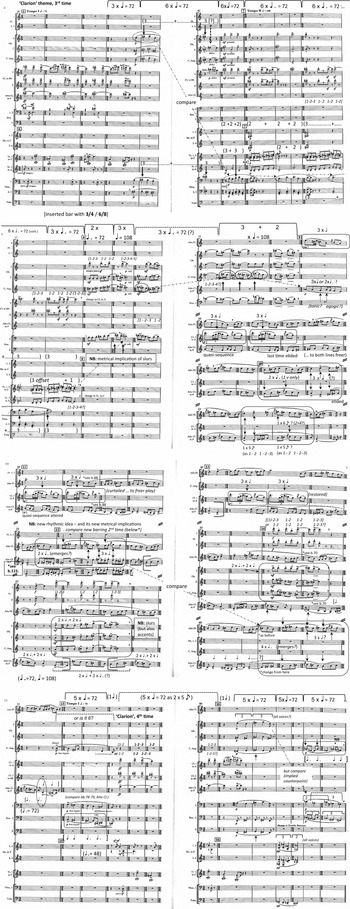
On the timeline itself, first of all, square brackets mark one hint of underlying regularity in three near-exact iterations of what reads (from weighting alone) as a ‘strong–weak–weak’ quaver sequence. But as noted, only the second of these fits comfortably with all implications of the material. The first contradicts the second (strong) accented crotchet in the main tune; the third crosses the ‘strong–weak’ quaver subdivisions of the 3/4 bar. There can be no doubt, furthermore, about the compositional importance of the notated bars, for as shown with dotted ellipses on the timeline, a second, ‘weak–strong’ recurrence falls across the two bar lines like two identically weighted anacruses. The downbeats may seem gently reinforced by comparison with the strongest events, but both gain tonic accentual strength from the falling melodic thirds and the B–B♭ dissonances between high clarinet and low trumpet.
Several further annotations in the score itself highlight other, more localized accentual implications. The three rectangles around the three lower voices, for a start, indicate a further suggestion, and alteration, of rhythmic regularity. Beyond its role in the overall event weighting, the broken major ninth G–F, scored for two bassoons doubled by trumpet and trombone, marks a key proportional relationship at the level of the referential pulse or tactus. Seeming through two iterations (the second one shifted within the 5/8 bar) a clear marker of the ‘strong–weak’ quavers of the crotchet tactus identified above with the first of Stravinsky's precisely proportional ‘indications of tempi’, its third iteration beneath the last melodic gesture stretches unexpectedly to carry through the tied clarinet D and articulate a three-quaver (dotted crotchet) span instead. Here, I suggest, we glimpse the first subtle sign of the local, rhythmic proportions destined to interact minutely with the tempo relations that define major structural sections.
Stravinsky's casual reference to ‘nuances, slurs, accents, etc’ can serve to direct attention to a further rhythmic subtlety in the upper, melodic voices. The scoring of the opening tune for two F clarinets, exchanging the falling third bar by bar, can only seem irrelevant to conventional motivic analysis. But to show the two instruments separately exposes a crafty detail of rhythmic play: a conflict or ambiguity, across the bar line, about the metrical implication of the accent and slur – at first integral to the anacrusis effect, later colliding on the two clarinets’ differently nuanced downbeats (see the overlapping boxes). To deepen the hint of rhythmic-diacritical instability, after a quaver rest leaves the rise to high F unsupported the second clarinet resumes doubling (E–D) on the opposite (strong–weak) accentuation of the markings played just before.
If such diacritical nuance would be vividly apparent to any clarinettists charged with realizing this duet, a further, numerical annotation to the Example extends the same sort of point across the full symphonie. Taking the ‘bar’ as one temporal field in play, note how the implied five-quaver parsing of the first clarinet's first bar (2+3) conjoins with the alternative (3+2) in the trumpet. The two come briefly together (2+3) in the second bar, before the 3/4 bar brings new ambiguities with the tie and temporally stretched major ninth. But we might also consider whether all the competing accentuation partly undermines (or complicates) the bar in much the same way as it does the tactus. As indicated above, even the falling third written twice as an anacrusis can be heard, based on its slightly contradictory diacritics, as a ‘strong–weak–weak’ quaver grouping, bringing yet further temporal subtleties to the opening clarion.
We now have enough detail in view to explore just what, from this opening constellation of problematics, proves germane to later variants of the theme. Example 1b shows the second appearance at bars 9–11, slightly rewritten to facilitate comparison (Stravinsky gives bar 9 in 3/8). As shown below, the main change is an excision, from either end, of a crotchet and a crotchet plus one semiquaver respectively. To retain the strongly accented beginning, perhaps, Stravinsky shifts the first bassoon G (but not the F) forward one crotchet, and doubles it with a horn. Only the second of the original G–F ‘strong–weak’ pairings survives, for the later excision leaves the first bassoon and trumpet without their lower companions. Everything else recurs unchanged – save for a detail that may seem so trivial as to be beneath notice.
Symphonies, bb. 9–11. Second ‘clarion’. Reproduced by permission of Boosey & Hawkes Music Publishers Ltd.

Conversely, the seeming gratuitousness of the single quaver rest inserted in bar 10 in place of a previously unbroken crotchet could be taken as a keen sign of undiagnosed compositional motivations. I indicate above one possible rhythmic parsing of the whole shortened tune, as an overlapped pair of five-quaver bars, i.e. {3+[2}+3], followed by a single bar of 2/4. But recalling the ambiguity of the accented slur, I also show a different hearing, as a newly regular series of three 2/4 (or four-quaver) ‘bars’. (To hear the new rest, counter-intuitively, as a second ‘downbeat’ is simply to sense a clarified bar of melodic syncopation.) The immediate context offers ambiguous support for this hearing, but to look back to Example 1a is to glimpse larger implications. For if the second clarion gives us twelve events conceivably heard as three groups of four, the unmarked (i.e. tied and silent) last event of the first might now be seen as a wholly virtual add-on to a similarly regular ‘5+5+5’ sequence of fifteen weighted attacks, rather than the ‘5+5+6’ suggested by the notated metres.
In other words, a diagnosis of the evolving temporal problematics begins to emerge, hinging on the relationship between additive and metrical processes, as projected (possibly ambiguously) through calibrated combinations of diacritically inflected two- and three-quaver cells. Looking ahead to the next stage, we find that the third clarion at bars 36–39 (transposed down a semitone) brings yet further nuance to such evolving questions (Example 1c). As if to compensate for the prior truncation, Stravinsky now extends the little symphonie by inserting a single 3/4 bar, bearing the melodic flourish from bar 3, between the two 5/8 bars. A second trumpet enters in unpredictable interaction with the first; the bassoon major ninth shifts forward, in the inserted bar, by one quaver against the melody. The result is a new succession of four-attack ‘events’, juxtaposed to give equal weight precisely to the two quavers most crucial to the parsing of six either as simple or compound time (i.e. 2+2+2 or 3+3). Perhaps this new metrical shading informs Stravinsky's decision to simplify the tune, now, by scoring it for a single clarinet and removing two downbeat slurs. But one further change seems harder to explain. An ‘early’ arrival of the first trumpet on the high F♯ in bar 38 (compare bars 2 and 10) adds a new metrical instability to the major ninth, whose interpretation profits from a glance ahead to Example 1d.
Symphonies, bb. 36–9. Third ‘clarion’. Reproduced by permission of Boosey & Hawkes Music Publishers Ltd.

Symphonies, bb. 96–100. Fourth ‘clarion’. Reproduced by permission of Boosey & Hawkes Music Publishers Ltd.

Symphonies, bb. 132–4. Fifth ‘clarion’. Reproduced by permission of Boosey & Hawkes Music Publishers Ltd.

Symphonies, bb. 142–4. Sixth ‘clarion’. Reproduced by permission of Boosey & Hawkes Music Publishers Ltd.

Transposed down a further whole tone, the fourth clarion offers a partial return to temporal normality. Indeed, Stravinsky's decision to break up the 5/8 bars of the previous variants into 2/8s and 3/8s seems an explicit acknowledgement of questions so far articulated only implicitly, through ‘nuances, slurs and accents’ alone. The two high clarinets regain their independence and diacritical conflict. But in a significant change, the stretched, three-quaver version of the major ninth, in a new scoring for horns, now shifts forward from the last bar to launch the little symphonie with a new quaver anacrusis. The resultant flattening out of the whole event sequence – as is clear from a glance across the timeline – conveys the sense of a settled return after more unstable ventures. But one open question remains. Given that the three-quaver major ninth span seems to have ‘come into its own’ here, it is puzzling to find it excised from its original position in the last bar (i.e. bar 100).
The last two clarions close the series with a last compression followed by a more fully normalized return. As shown by the letter sequences assigned to the trumpet part in Examples 1e and f (now recognizable as a kind of talea), this time Stravinsky excises one bar from the middle of the fragment, even as he makes up for the earlier omission by restoring the three-quaver major ninth to the last bar. One or two diacritical details also seem worthy of note. Having relieved the first clarinet of the strong–beat accents on its final flourishes, Stravinsky also re-notates the second clarinet in bar 134, to give it two accents without slur. Looking ahead to the sixth and last clarion, which finally gives the three-quaver major ninth three full iterations, we find the diacritical notation only partially restored to its original form. One possible interpretation arises with the recognition that the new ‘pick-up’ identity of the stretched ninth – as is clear for two iterations – contradicts the clearest metrical implication of the last melodic quavers (strong–weak, C♯–B). In other words, the clarion sequence ends with at least some rhythmic-metrical questions still open for exploration through the several remaining sections of the piece.
Analysis part II: connecting the fragments
Even to extract this widely distributed sequence from the Symphonies is to discover how close attention to ‘nuances, slurs, accents, etc’ can regain for the ear various rhythmic and metrical questions long lost to the reductive habits of pitch-focused analysis. To turn now to the continuous span that links the third clarion to the fourth, with its brief codetta (i.e. bars 36–105), is to discover just how deeply such questions inform the interplay of every main idea of Stravinsky's Symphonies. Indeed, we are now in a position to recognize the initial interactions of this particular section as a pointed demonstration, near didactic in its clarity, of the substantive, material significance of the proportionally precise ‘indications of tempi’ so far noted by analysts largely in over-arching, rhythmically abstracted terms.Footnote 43
Extending from the beginning of the third clarion at bar 36 through the cadential gestures for double reeds at bars 53–4, and including the second of the work's tempo changes from ♩ = 72 to ♩ = 108, the first large episode of the continuous Example 2 features the emergence of an idea whose neglect by most previous analysts may owe something to White's breezily inaccurate 1966 description of ‘a kind of interjection’ that ‘never appears on its own’.Footnote 44 On the contrary, from its inchoate initial form this idea here emerges incrementally to deliver a prominent distillation of the same sort of rhythmic and metrical question already traced through the clarion variants. The lengthier episode that follows, which begins with the first appearance of the leisurely duet White calls a ‘Pastorale’ for alto flute and F clarinet (bar 55), brings this same idea back in a manner more aptly deemed an ‘interjection’. But here too, closer attention to diacritical nuance brings new appreciation of its key role within the unfolding rhythmic and metrical problematics.
Symphonies, bb. 36–105. From third to fourth ‘clarions’ (+ codetta). Reproduced by permission of Boosey & Hawkes Music Publishers Ltd.

Beginning from what is now the second of two 3/4 bars, my brackets mark the palindromic procedure that unfolds across the tempo change. Put simply, we pass through a series of four differently parsed six-beat spans: two, before the change, at the original ♩ = 72; two, after, at the new ♩. = 72 that results from the change to ♩ = 108 (i.e. one and a half times faster). Finer metrical detail reinforces the palindromic structure: on one side we find six crotchets notated first as two 3/4 bars (3+3) and then as a 6/4 bar with three accented minims (2+2+2); on the other, six dotted crotchets parsed first as three bars of 6/8 (2+2+2) then two of 9/8 (3+3). A last 9/8 bar closes this whole pivotal venture with what we might read as a balancing three-beat response, with the new pulse, to the last 3/4 of the clarion.
If this overview suggests a block-like succession, a closer look discerns finer detail that lends the passage all the subtlety of a true metrical ‘modulation’. The initial pair of 3/4 bars may begin with clear tonic-accentual clarity – a quasi-leading-tone move for oboe, supported by even simpler melodic outline in trombone – that delivers strong downbeats on bars 40 and 41. But the second of these is followed by a little accentual hint (like a dolce foretaste of the alternative) on the second beat of bar 41. Then, the pesante minims could hardly parse the 6/4 bar 42 more clearly – but the accompanying, slightly expanded trombone echo of the crotchet motive retains a hint of the ‘compound’ alternative (as shown). After the tempo change, it is clear from the oboe chords in bars 44–45 (compare 42) that the first, inchoate appearance of the new triplet motive marks an ‘interjected’ bar. But at the same time, the tonic accents of the crotchet motive (now dotted and truncated), retaining its former position in the six-beat bar, come to fit the ‘duple’ barring quite comfortably. Approaching the last stage of this deft modulation, finally, bar 46 brings with its new, 9/8 metre a three-beat expansion (plus tie) of the triplet motive, along with at least a partial restoration of the ‘triple’ downbeat of the (now dotted) crotchet motive (slightly softened, metrically, by a new stepwise upbeat).
Given how crucial – indeed definitional – the two- and three-tactus groupings are to the articulation of simple and compound metres here, it also seems important to note Stravinsky's canny play with additive groupings of two- and three-quaver subdivisions – as indicated in the accompanying high clarinet of bars 43 and 46. Perhaps no more than a local nicety at first, this rhythmic detail takes on more significance further on, when it sets up the culmination of the whole rhythmic-metrical modulation. In bars 47–8, the last trumpet statement of the triplet motive brings a metrical oddity. Offset to begin on the last beat of three, it also ends with a tie to the last beat of bar 48. The high clarinet's hints at additive five-quaver groupings may offer little help in understanding this displacement, for all that they play suggestively against the trumpet's ambiguous tonic accents. But the more telling point appears with the ultimate arrival on a tied note four quavers in length. This ‘minim’, an alien entity in 9/8, marks the last trumpet statement as a prefatory anticipation of the true goal: the recasting of the same motive as a direct juxtaposition of 6/8 and 3/4 for a new double reed trio (bassoon, oboe, and cor anglais) in the next two bars, which allows the same minim, correctly notated, to complete the motive in its native metrical environment.
The minim may be the clearest notational marker of metre here, but the audibly revealed character of this two-bar motive also depends upon diacritical detail. After having introduced, expanded, and reiterated the prior variants in undifferentiated staccatos, it is only for this final statement that Stravinsky adds the accents and slurs that lend a palpable swing to its shift from three- to two-quaver groupings.Footnote 45 But strangely, he then undercuts the minim arrival with a piano subito. We might recognize some yet-undiagnosed temporal instability here even as we also note the clear kinship with questions first encountered in the anacruses of the clarion theme. Indeed strong support for this close relationship emerges with another glance at Walsh's sketch study, where we read that this final form of ‘the compound time [sic] quaver figure’ was in fact just the second thematic fragment to appear in Stravinsky's sketchbooks, soon after the clarion theme itself.Footnote 46
Linking this first section of Example 2 to the next, we find a passage whose more elusive initial parsing is reflected by my dotted bracket. The provisional indication ‘3 × ♩. = 72’ does not arise from any clear implication in the material, but rather from the family resemblance between this span and the nine quavers of bar 48 (note, again, the ‘minim’ that closes both). More clearly, when the semiquaver/quaver figure that marks the downbeat of 51 returns to settle into a new repetitive series at the end of 52 (as indicated) it strongly establishes a ‘quasi-cadential’ span of five crotchets at the new tempo of ♩ = 108. But my sense that this span – whose recognition requires reading through the written barring – bears a distinct closural weight springs in part from its relationships with other ‘five-beat’ moments yet to be considered, so it is best saved for later discussion.
What is beyond question is that the collective Luftpause at the end of bar 54 marks the beginning of a section that has received far less analytical attention than the clarion material, even though it is much longer in total length. According to Walsh, this ‘winding, serpentine’ duet was also one of the earliest ideas for the work, as evidenced by a ‘more inchoate sketch (for two violins)’ that follows closely, in the sketchbook, from the triplet motive just discussed. Indeed, from a ‘further group of sketches, partly for string quartet’ it appears that Stravinsky had already begun developing this next idea in the summer of 1919.Footnote 47 Still, if this genetic account conclusively debunks any sense of the chorale as the work's generative origin, Walsh's discussion of the evolving duet material also perfectly exemplifies, once again, the pervasive analytical imbalances that have long forestalled appreciation of Stravinsky's hommage. Referring to rhythm only for purposes of identification, Walsh focuses almost exclusively on the evolution of the ‘false relation’ (G♯–G) and its harmonization (from ‘dissonant’ to ‘more consonant’), which he finds a crucial sign of Stravinsky's difficulties with ‘harmony and chord-voicing’.Footnote 48 We might well ask whether an unquestioned assumption about the compositional primacy of such concerns reflects deeply ingrained theoretical habit rather than clearly evidenced creative investment.
To me, the most striking thing about the theme first announced by alto flute at bar 54 and then twice echoed, with slight variation, by the A clarinet that briefly joins the duet, is its emphatic, unambiguous statement of the 3/4 bar. To spell it out: as the longest single duration, the first dotted quaver carries a strong agogic accent; the quasi-ornamental flourish (duplet in 55, triplet in 56–7) imparts a different agogic clarity to the second beat, which also gains tonic accentuation through the ‘false relation’; the third beat receives yet another kind of accentuation from the acciaccatura. But we should also note how this one-bar beacon of 3/4 – as I will call it – combines, through two iterations (and more), with a more ambiguous accompaniment, whose serpentine coiling draws on both implicit tonic (i.e. melodic) suggestion and agogic precedent (i.e. the semiquaver-quaver figure) to project, at once, both ‘simple’ and ‘compound’ possibilities (as shown). Whatever problems it raises for ‘harmony and chord-voicing’, in other words, the ‘sounding together’ of this little duet (and trio) presents a vertical distillation of the very same metrical questions recently projected into the foreground with that vivid horizontal juxtaposition of 6/8 and 3/4, at the climactic emergence of the triplet theme.
To listen on, past the freer counterpoint after the clarinet's third 3/4 bar, is to find a whole ensuing section that unfolds as a continuous circling back, via temporally freer contrapuntal departures, to variants of precisely the same sort of metrical question. Bar 62, first of all, features in the alto clarinet the first instance of what will become another main recurring element: a clear articulation of 6/8 by means of a stepwise melodic arc with acciaccatura on the high point. The accompanying flute, freer in rhythm at first, comes into metrical conformity only for the two crotchets that follow, strongly marking the shift to 3/4. Metrical clarity then dissipates again, before a teasing taste of crotchet homophony re-emerges to launch a pair of 5/8 bars (65–6) that can be heard (in one parsing of the accentual acciaccaturas) as two ‘2+3’ structures, but which overspill slightly (see the phrasing) to leave a more contingent sense of ‘5+6’quavers prior to the last quasi-cadential flourish – and thus a sense of progressive compression (from twelve quavers to eleven) that will bear ultimate fruit later on.
If these local re-engagements with the 3/4–6/8 metrical alternative, as shaded with an additive 5/8, emerge somewhat ambiguously from the surrounding interplay, the ultimate goal – I would even say the compositional raison d’être – of the whole process comes more plainly into focus through the next large paragraph. Launched again in bar 69 with the accompanying A clarinet (now more quickly curtailed), the duet soon introduces a new set of rhythmic characters whose metrical identity, somewhat concealed at this first appearance, become much clearer when, during the second, lengthy return of much of the duet material, Stravinsky alters the barring (i.e. the thirty-nine-bar section from 55–93 recurs, shortened, as the twenty-four bars from 106–29; I give 115–16 beneath 75–6 for comparison). But this rewriting only clarifies implications most clear, the first time round, in the clarinet's new semiquaver figures, whose melodic shape marks 3/4 crotchets even as the alto flute takes its turn to combine, in a single line, suggestions of 6/8 (in the recurring semiquaver–quaver figure) with countervailing hints of 3/4 (in the melodic shape and acciaccaturas). But this further deft counterpoint of metrical flavours only prepares the true goal: the interjection, by a trio of double reeds, of the previously climactic form of the triplet motive (bars 77–9).
Stravinsky's puzzling 5/8 barring cannot conceal the exact return here, a perfect fourth higher, of that vividly accented and slurred shift from 6/8 to 3/4. But a second metrical change seems more significant. This time, no subito piano undercuts the arrival – now truncated from minim to crotchet, in 2/4 rather than 3/4. The ultimate version of this idea thus juxtaposes, across a ten-quaver span parsed as (2 × ♩.) + (2 × ♩), the two alternatives for a referential tactus that arise from Stravinsky's proportional tempi for his main sections: ♩ = 72 and ♩ = 108 (i.e. ♩. = 72). Taking a wider view we find, further, that the double-reed trio actually serves as a pivotal marker within a dovetailed chain of reiterations (as indicated with brackets on the alto clarinet) of the same metrical sequence, presented plainly by the stepwise arc motive with its 6/8 acciaccatura and 3/4 crotchets.
The final paragraph of the section brings back the familiar 3/4 beacon against even freer counterpoint, before closing with yet further metrical questions. The last double-reed interjection in bars 87–8, with a new variant of the triplet motive, revisits the explicitly barred 6/8–3/4 juxtaposition even as the Luftpause and third-beat rest effectively retain the prior ‘2/4’ arrival. The excised first quaver delivers a further compression in length (I suggest two possible parsings of the nine quavers above) before the paragraph coils to a close through a partial recapitulation of the material with which it began back in bar 70 – phrasing slightly varied to clarify the steady crotchet groupings that precede a last reminder, in bars 91–2, of the ‘compound’ and ‘simple’ interplay. Finally, the accentual shadings of the duet's last bar conceivably extend (with an ear to the ‘strong’ alto clarinet A) to a craftily compressed version, across eight quavers, of the pivotal parsing of ten quavers as two dotted and two undotted crotchets.
While this last suggestion may seem forced, it reflects but one extrapolation from the most important proposal to emerge from the analysis so far. Bluntly, whatever we might observe about melodic motives, harmonies, or voice-leading, the more central ‘thematic’ concern of these Symphonies, I would argue, is a set of rhythmic and metrical problematics, projected through an interplay of explicit and implicit accents (tonic, agogic, dynamic, ornamental) in all dimensions of the instrumental ‘sounding together’. These temporal problematics centre, precisely, on the possible parsing of a ten-quaver span – which notably includes a juxtaposition of two dotted crotchets with two crotchets that distils into local rhythm the work's proportional tempo relations. A last glance to the material that precedes and follows the fourth clarion (see again Example 2) can adumbrate a few further implications.
In truth, while the two pivotal bars that re-establish ‘Tempo I’ (94–5) might seem, in their five-crotchet foundation, a clear illustration of the point, the case is not helped by the elisions across the bar lines that might pedantically be taken to render the cor anglais line twelve quavers in length (over an eleven-quaver span in bassoons). But this is the sort of question that continually arises from Stravinsky's flexible combination of ideas whose metrical identity remains implicit (i.e. articulated in the material itself, however barred) with others more plainly conforming to the written metre. Here, the bassoon's stepwise descending crotchets seem a baldly schematic articulation of ‘5/4’ (akin to the five quavers that traced a similarly schematic – and unnotated – ‘5/8’ against the double reed ‘interjection’ back in bars 78–9), but to say so is simply to ignore the ‘extra’ downbeat arrival. More suggestively, I indicate below the second bassoon part how its rhythm, melody and (editorial) Luftpause combine to project a reversal of the main, additive ten-quaver idea – again overlooking the ‘extra’ eleventh.
The need for such hedging falls away once we look ahead, past the clarion, to the codetta of Example 2. Here, dovetailed with the last 3/4 bar of the theme, we find three unclouded statements of the five-crotchet span, the last composed to overlay three different rhythmic parsings (bars 104–5). The cor anglais here clearly revisits, in rhythmic-melodic shape (i.e. the repeated falling fourth), the additive ten-quaver idea I find thematic for the work as a whole, before pinning down the last of five crotchet beats with a two-note acciaccatura.
Analysis part III: selected further material
One thing I have left unexplained above is the bracketing of the fourth clarion itself as a ‘five-crotchet’ span embracing all the newly explicit 2/8 and 3/8 barring (bars 96–100). Again, while questions of extension and overlap bring some slight complication (see, for example, the framing crotchets at either end), the main point remains clear: the investigation of neglected aspects of the duet section has delivered, via a hermeneutic circle, deeper appreciation of the questions at issue in the main theme. Characterized above somewhat generally in terms of the difference between additive and metrical musical time, we can now recognize these questions, too, as more precisely oriented around the rhythmic parsing of ten quavers within a tradition that admits of both options. The same hermeneutic circularity can now inform a brief look into some of the material before and after the lengthy duet sections, to see whether the same focus inflects the connective tissue that binds the work into what White, uniquely, once heard as a ‘well-ordered and dovetailed’ form.
Looking backward, first, I show in Example 3 the several short sections that immediately precede Example 2 (bars 16–35). At the start, I insert for reference the earlier four-bar passage (5–8) that first introduces (just after the first clarion) the crotchet motive central to the palindromic tempo transition of bars 39–48, which will eventually find its proper home in the chorale. As shown, this first appearance, a semitone lower than the next, also bears the ‘quasi-leading-note’ melodic shape that gives its four identical pulses a clear metrical profile (‘pickup to 3’).
Symphonies, bb. 16–35; plus bb. 5–8 (two lines only). Reproduced by permission of Boosey & Hawkes Music Publishers Ltd.

Reading into Example 3 itself, through the recurrence of the tied chords from bar 4 at bar 16, we find a first melodic and textural expansion of this motive that vividly illustrates the importance of the composed ‘sounding together’ to the temporal conception. If the oboe's six crotchets might now be heard (on the model of the shorter antecedent) as a melodic ‘pickup to five’, a scan through all accompanying parts discovers a layered articulation, by various tonic accents and ties, of all other possible parsings of six crotchets: 3+3, 2+4, 4+2, 2+2+2, and again 1+5 (some with the last quaver excised). And if we glance ahead, past the single 5/8 bar, we arrive in turn at a different, now-familiar layering: a clear prefiguration, in bars 21–22, of the combined five-crotchet parsings destined to return in the codetta of bars 104–5. Here already we recognize two slightly blurring overlaps (oboe and cor anglais), as well as the first statement (clarinet) of the thematic ten-quaver span, (2 × ♩.) + (2 × ♩).
While I am hard put to imagine any grounds on which to dismiss the significance of these temporal aggregates, I cannot pretend to understand fully their formal logic. Perhaps my discernment of another little palindromic structure of five-quaver units on either side of five crotchets forces a ‘ten-quaver’ reading over haphazard fragments (bars 17–20); perhaps the idea that the finicky triplet notation for the one-note after-echoes of the tied chords foreshadows the ‘Tempo II’ quaver also stretches a case for intricate rhythmic interweaving. But the more surprising puzzle comes with the two fragments that intervene between the multiply overlaid ‘5/4s’ of bars 21–2 and the third clarion at bar 36. Here, precisely for the first tempo change, we hear two passages built on typical Stravinskyan ostinati: one of four crotchets in length, the other of two. That is, the shift from ♩ = 72 to ♩ = 108, when it first appears over a foursquare temporal foundation, seems to have little to do with the duple-triple play (i.e. ♩. = 72) central to later ‘Tempo II’ sections.
Still, my several indications suggest some foretastes of central problematics even in these seemingly anomalous fields. Most plainly, vertical brackets frame the succession of ostinato figures that, after crossing bar lines through all four statements of ‘Ostinato 1’ (in two variants), then shrink briefly to three crotchets for a single 3/4 bar before settling onto the two-crotchet ‘Ostinato 2’. Within this most basic level of the material, we might discern the later stages of a long-range progression from the six-crotchet aggregates of bars 17–19, through the layered ‘5/4’ of 21–2, and into these four-, three-, and two-beat spans (though the tempo change complicates the incremental process). With further annotations I suggest how the complete ‘sounding together’ further enriches this foundation, by imparting some of the transitional subtlety previously noted for the triplet motive.
The few solid brackets atop bars 23–8, first of all, indicate both the earliest and the later emergences of the strongest melodic marker of ‘3/4’ in the ‘Ostinato 1’ section. ‘*NB’ markings highlight a recurring triplet turn on the last of three beats, which seems the crucial element that establishes this metrical identity within contingent phrasing (hence my sense of its inchoate appearances within two five-beat spans prior to the metrically notated clarity at 27–8). If there is thus something deftly transitional in this initial layered interaction of five, four and three crotchets, however, it is with the later two-crotchet ostinato that the section as a whole more closely approaches, and renders more precisely transitional, the kind of rhythmic interplay previously deemed thematic.
As shown, at bar 29 the alto flute begins its cantabile solo over ‘Ostinato 2’ in conformity with the third flute's marcato 2/4. But through the next bars, melodic ties begin establishing ‘dotted crotchet’ lengths against the steady crotchets. The reinforcement of this temporal counterpoint by the other two flutes justifies the indication, above, of a more subtle transition than the one just described. The pivotal 3/4 at bar 28 actually sets up six beats parsed first as three crotchets at ♩ = 108, then two dotted crotchets at ♩. = 72. And the section closes, as indicated, with a repeated additive parsing of eight quavers that twice poses ♩. = 72 over the ostinato ♩ = 108, in what we might well hear as a further rhythmic-contrapuntal transition back to the ♩ = 72 of the third clarion.
My provisional tone here does not reflect any doubt about the indicated rhythmic details, rather a slight uncertainty about how best to understand their relation to thematic temporal concerns exposed more clearly in other sections. But I would nonetheless reaffirm: however fragmentary and discontinuous the elusive harmonic/melodic logic may seem, the more richly and thoroughly ‘developmental’ aspect of this music is best sought in the fine fluctuations of rhythmic-metrical implication, which impart a consistency of compositional focus to – and through – all its discrete, juxtaposed temporal fragments. My examples have by now accounted for almost all the material in the first of three large sections (i.e. before the central ‘wild dance’ – as White calls it – and the chorale). A brief look to the only two early fragments not yet discussed can buttress the point while further preparing the ground for closing reflections.
The top staff of Example 4 shows what Taruskin describes as ‘the surprising little high-speed motive that intrudes in the oboes just before fig. 3’ (i.e. just after the second clarion). As he further notes, ‘[n]ot only the melody, but the characteristic doubling at the fourth/fifth, is taken over for elaboration’ in the later, central section – that is, the ‘Kanon’ of his panikhida (White's ‘wild dance’).Footnote 49 But much like Walsh's account of the ‘Pastorale’ above, the narrow musical purview of this remark perfectly illustrates how received analytical methodology can deflect attention from significant aspects of the material. What most strikes the ear about the top fragment in Example 4 (bb. 12–15) is neither its tune nor its doubling, but rather the startling ‘high-speed’ energy itself, which stands out even against the shrill clarion as a rustically antic ‘intrusion’.
Symphonies, bb. 12–15, 162–4, and 221–3. A small instance of rhythmic ‘stratification and interlock’. Reproduced by permission of Boosey & Hawkes Music Publishers Ltd.

Looking more closely to this moment and its later offshoots (Example 4) we find, first of all, that the notated metrical identity – alien semiquavers; anomalous 3/16 and 5/16 time signatures – pointedly inserts a first anticipatory glimpse of the ‘Tempo III’ that will eventually follow ‘Tempo II’ with a further proportional acceleration to ♩ = 144 (audible here in quavers at ♩ = 72). And Taruskin's exclusive focus on the ‘pitch class’ relations overlooks the finer craft that renders this intrusion an exquisite illustration of the rhythmic-metrical development of ten-quaver parsings I have proposed as a thematic temporal focus. As my brackets and numbers show, the original fourteen-semiquaver intrusion combines – that is, overlaps and elides – two distinct, five-beat gestures, later to be separated and recast, at widely disparate points of the ‘wild dance’, in the five crotchets/ ten quavers of ‘Tempo III’.
Perhaps we glimpse here in nuce the potential to reframe, in rhythmic terms, the Stravinskyan ‘stratification and interlock’ that Cone, effacing almost all temporal properties, could only illustrate with a (largely notional) voice-leading reduction. Impractical as it is to pursue this idea further here, I will bring the analysis to a provisional close with a brief look to the last early material not yet considered. As shown in Example 5, the near-tutti passage at fig. 24 (bar 152) first enters after a slightly varied recurrence of both ostinati (in reverse order on either side of the sixth clarion) and before the first literal anticipation of the chorale's first bars (with the five-crotchet motive finally ‘at home’). Given that several variants of this new material will subsequently interweave with the ‘wild dance’, it may be misleading to consider one instance in isolation. But a few preliminary observations will suffice to open some last temporal concerns that can best be pursued in more detail at a later time, ideally together with those native to the dance and chorale.
Symphonies, bb. 150–8. Reproduced by permission of Boosey & Hawkes Music Publishers Ltd.

As shown atop the example, this brief, near-homorhythmic passage proceeds as a melodically repetitive, incrementally expanding series of ‘anacrusis-arrival’ oscillations, separated by Luftpausen. No doubt the layering of multiple melodic intervals – various ascending and descending seconds, thirds, and fourths – poses, on aggregate, an intriguing challenge to analytical understanding. But whatever we ultimately make of this pitch content, what has always seemed most vivid to the ear is the ‘cadential’ implication projected by the whole chain of oscillations, and made most overt by the final long-note arrival with its decrescendo and slight rallentando.
My annotations further suggest how this ‘closing theme’ (for the first large section) might also be heard as a pivotal summary (just before the second) of the temporal proportions of the entire work. Taking the total length of twenty quavers as a cadential doubling of the ten-quaver span, we find beneath the local rhythmic oscillations two different pedal tones, dividing the temporal ‘middle-ground’ into two proportional ratios. The bass clarinet marks out 8 + 12 quavers – that is, a 2:3 ratio that recalls both the relation between ‘Tempo 1’ and ‘Tempo 2’ (♩ = 72 and ♩ = 108) and the five-unit structure (‘2+3’) that often distils the same proportions into local rhythm. But at the same time the tuba, curtailed, instead marks 8 + 6 quavers – a 4:3 ratio that captures the proportions between ‘Tempo III’ and ‘Tempo II’ (♩ = 144 and ♩ = 108), soon to appear with the trumpet declaration of bar 162 (Example 4, second fragment). This precisely calibrated temporal foundation, no logical product of harmony or voice leading, underlines, at a pivotal point, the thematic importance to these Symphonies of musical time – whether articulated as rhythm, metre, or duration.
Conclusion: methodological and memorial implications
I can best broach my concluding reflections with a candid question. Having bemoaned the perennial failure to consider how the musical detail of the Symphonies might relate to its memorial dedication, why would I offer a close analysis that, once again, makes no specific reference to Debussy? In partial answer, we might first acknowledge how shallow – and rife with confirmation bias – it would seem to try to spot, here and there, what could only be trivial or forced echoes of Debussy's music, given that they have so far passed unnoticed. But I can approach a more substantial response, built on a sense that the implications of Stravinsky's dedication extend deeper than the most successful hunt for superficial hommage could unearth, with a glance to the one analyst who has even tried to hear the work as a musical memorial.
To end her Reference Horlacher2011 book on ‘repetition and continuity’ in Stravinsky, Gretchen Horlacher caps a wide-ranging investigation of the technique she calls ‘ordered succession’ with a chapter-length discussion of the Symphonies. Largely guided by pitch-based concerns, but rejecting all assumptions about ‘goal-driven structure’, this last venture also evinces fine sensibility to the work's ‘variety of temporal effects’. Ultimately, this variety inspires her symbolic interpretation:
The closure reached at the end of the chorale is not a grand event arising from multiple levels of completion, but rather the suitable conclusion of many kinds of succession and passage, an appropriate moment in which explorations of ‘sounding together’ may properly cease. As such, it may symbolize the end of the liturgical ritual memorializing the end of a human life – the noble commemoration of Debussy – as well.Footnote 50
The replacement, here, of portentous claims to a final ‘synthesis’ with the humbler ‘suitable conclusion’ admirably serves Horlacher's invitation to rehear memorial implications. But even so, her general terms of description elude reflection about why this array of ‘succession and passage’ may have emerged in memory of that forebear. That is, to claim that Stravinsky's ‘majestic portrayal of contiguity and separation, of fixity and evolution, of reiteration and absence sets forth the essence of temporality as passage’ risks reducing the work to an ‘essence’ that could have been instantiated in many other ways, thus rendering near irrelevant the unique temporal unfolding of the commemoration Stravinsky actually wrote.Footnote 51
Maybe there is little more to say: others have been happy to proceed as if there were nothing Debussyan about the Symphonies at all. But in oblique support for the contrary sense that emerges from my analysis, I will borrow from Carl Dahlhaus's characterization of certain well-known musical debates in the different context of fin-de-siècle Vienna. ‘The anti-Bruckner polemics indulged by the Brahms party in the 1880s’, he suggests late in Nineteenth-Century Music, arose from the sense of a threat to the ‘basic axioms of musical thought’. His elaboration strikes me as directly relevant to this case:
Musical logic, the ‘developing variation’ of musical ideas (as it was called by Schoenberg, who admired Brahms and belittled Bruckner), rested on a premise considered so self-evident as to be beneath mention: that the central parameter of art music is its ‘diastematic’, or pitch, structure. (Anyone trying to discover how a piece of music coheres internally will automatically look for what Hans Mersmann called a ‘relationship of substance’ between its ostensibly divergent parts, where ‘substance’ is almost invariably taken to mean pitch structures.) Bruckner's symphonic style, however, unlike that of Brahms's chamber music or Wagner's music dramas, is primarily rhythmic rather than diastematic, and thus seems to stand the usual hierarchy of tonal properties on its head.Footnote 52
Has not the same self-evident diastematic premise long ensured that analysts could only seek ‘coherence’ in Stravinsky's Symphonies through some forced application of patently post-Schoenbergian ‘musical logic’? Of course I am not implying a direct compositional lineage, but a parallel at the level of methodological reflex (though it is suggestive to read Dahlhaus on Bruckner's ‘conception of form based on rhythmically distinct “blocks”’). At the same time, the fact that the same reflex has long operated just as strongly on Debussy, masking much musical thought potentially worthy of commemoration, renders it difficult to muster much secondary support for a proposal that some deliberate scepticism about ‘the usual hierarchy of tonal properties’ might valuably guide a refined hearing of Stravinsky's ‘noble commemoration’.
Still, if we take Debussy's famous 1907 definition of music as ‘de couleurs et de temps rythmés’ (‘rhythmicized colours and time’, or ‘colours and time given rhythm’) as a hint at musical thought oriented around other basic axioms, we might also recognize a sense of exactly similar priorities in his question to a Swiss friend in 1911: ‘[d]o you know that very close to you, in Clarens, there is a young Russian musician: Igor Stravinsky, who has an instinctive genius for colour and rhythm [le génie instinctif de la couleur et du rythme]?’Footnote 53 Maybe it seems coincidental that he did not instead hail the young Russian's ‘scales, chords, and motives’ or ‘folk-like melodies and pungent dissonance’. But perhaps (recalling, too, their four-hand read-through of Le Sacre a few months later) the hearing and understanding of both composers can benefit from a decision to take that repeated emphasis on ‘colour and rhythm’ more seriously, and seek ‘relationships of substance’ beyond pitch structure alone.
Few models for such a search having appeared in print, I can only refer briefly here to two studies of my own. In the first, a detailed analysis of the rhythmic, metrical, and proportional structure of ‘The Augurs of Spring’, I challenged the quasi-serial, metrically abstracted approach of Boulez (among others) to interpret this one dance as an intricate ‘synthesis of rhythms’ – as Stravinsky described Le Sacre – rooted in very similar accentual, metrical, and hierarchical principles as those shown above in the Symphonies.Footnote 54 But if it is hardly surprising to find such consistency of rhythmic thought across Stravinsky's oeuvre, it is trickier to suggest that the same mindset would later attain an unsurpassed extreme in the Symphonies written to honour a composer whose craft with couleurs et temps rythmés has so long been even more sadly neglected under received methodological bias.
A brief review of a second analysis can offer preliminary support. In a recent study of Debussy's orchestral Nocturnes (1897–9), I turn from the usual emphasis on ‘tonal ambiguity’ and ‘symmetrical pitch structures’ to offer a close analysis of the continuous play with rhythmic and metrical inflection across the whole cyclic triptych.Footnote 55 A few examples will suffice to adumbrate the parallel that emerges. Example 6a shows how the opening theme of ‘Nuages’ combines two melodic lines that, through tonic accentuation, simultaneously suggest ‘simple’ and ‘compound’ parsings of six beats. Later – in a kind of proto-stratification – the two alternatives recur more clearly to set up the two early reprises of the cor anglais ‘arabesque’ (Examples 6b and 6c; compare Example 4). By contrast, the ‘pentatonic theme’ for flute and harp at the heart of the piece articulates an (ambiguous) additive structure of 2- and 3-beat cells (Example 6d). Later, the second Nocturne, ‘Fêtes’, transmutes the ‘cloud’ theme to an additive (‘2+3’) five beats (Example 6e), juxtaposed with a triplet flourish that traces a decorated variant of the ‘pentatonic theme’ before playing briefly, in closing, across the written downbeats.
(a) Debussy, ‘Nuages’, bb. 1–5, with ‘compound’ and ‘simple’ rhythmic parsing. (b) ‘Nuages’, bb. 17–21. ‘Simple’ parsing of six crotchets to set up first ‘arabesque’ reprise. (c) ‘Nuages’, bb. 17–21. ‘Compound’ parsing of six crotchets to set up second ‘arabesque’ reprise.

(d) ‘Nuages’, bb. 57–63, the ‘pentatonic theme’, in additive rhythm. (e) ‘Fêtes’, bb. 27–32, showing ‘cyclic’ relations to ‘Nuages’ material.

To illustrate further might risk implying some specific importance of the Nocturnes to Stravinsky's much later commemoration. My broader point can begin to come into focus if we recall Debussy's famous 1889 exchange with his Conservatoire teacher Ernest Guiraud (as transcribed by fellow alumnus Maurice Emmanuel).Footnote 56 One suggestive fact, long obscured by an oft-quoted mistranslation, is that Debussy directs one of his polemical barbs at what he calls the ‘suffocating’ traditional distinction between ‘simple’ and ‘compound’ metre, and the ‘foolish’ convention of ‘writing endless chains of one or the other’ – against which he asserts the importance of continually ‘varying the rhythmic figures’.Footnote 57 But beyond the obvious relevance of this one explicitly rhythmic venture, there remains even greater, implicit significance in Guiraud's better-known bafflement before the young composer's parallel ‘streaming’ of triads and seventh chords in blithe disregard for ‘correct’ voice leading.
Familiar as this passage may seem, I wonder if enough has yet been made of the profound rhythmic implications carried by well-known techniques largely appreciated, across many decades, in diastematic terms alone. Debussyan parallelism did not just free chords, as vertical simultaneities, from time-honoured demands of harmonic progression – it released individual voices from all temporal imperatives previously intrinsic to those same pitch structures, as in everything from melodic ‘tendency tones’ to the metrical conventions of dissonance resolution. This unbinding of musical texture from temporal obligations, we might now recognize, fundamentally enabled the multi-layered ‘synthesis of rhythms’ in ‘Augurs’ – and thus richly deserved commemoration through the dovetailed ‘sounding together’ of rhythms and proportions across the ‘discontinuous’ pitch fragments of the Symphonies.
To hear and understand the memorial in these terms is also to recall a familiar meta-analytical ‘paradox’, as aptly characterized by Mark Delaere within a Reference Delaere and Crispin2009 volume on ‘Temporality in Twentieth-Century Music’: ‘music is said to be the quintessential temporal art form, whereas the far greater portion of the theoretical and analytical literature on art music deals with pitch independently of temporal factors’.Footnote 58 There is perhaps some grounds for optimism about the possibility for future shifts of priority in Jonathan Bernard's plaintive suggestion, late in a centenary essay collection, that future analyses of Le Sacre will likely focus on ‘rhythm, rather than pitch’.Footnote 59 But whether or not such optimism proves well founded, it may help, in the attempt to draw these closing reflections closer to my titular query, to consider one last important distinction, and one final caution about reflexive habits.
First, the distinction: any attempt to escape or challenge the diastematic regime should probably respect the difference between, on one hand, a general ideal of restoring balance to the analysis of any art music, and, on the other, the more contentious possibility that a focus on pitch structure actually misconceives the core creative principles behind at least some music, better understood as ‘primarily rhythmic’ in conception. This idea will seem problematic only if we assume a priori that it is inappropriate to replace one kind of analytical imbalance with another. But once we accept, with Kerman, that the conventional, diastematic version of analytical organicism arose ‘for the purpose of validating a certain body of works of art’, we might also begin opening avenues to hear and understand the conceivably different priorities on offer in many other ‘bodies’ of music – notably including much in the Debussy–Stravinsky lineage.Footnote 60
For a final caution, however, note that even Kerman could not quite escape the unconscious sway of diastematic bias. His early reference, in his 1980 polemic, to ‘analytical thinking’ as defined by ‘the model of an overriding system of relationships between all musical elements’ already gives pause: has such a system ever habitually included rhythm, texture and timbre as ‘musical elements’ on an equal footing with pitch? The point becomes yet clearer when, to illustrate the kind of thing that might ‘strike a critic’, Kerman casually mentions ‘ambiguities such as those set up by Schumann's cadences’.Footnote 61 Clearly, he means harmonic ambiguities – and he has hardly been alone in such easy assumptions about what most ‘counts’ for analysis or criticism. But this relatively casual kind of ‘diastematicism’ aside, I will direct my closing caution at a more distinct variety, which comes plainly into view in the debate about octatonicism that has already touched directly on the Symphonies.
At one point in ‘Taruskin's Problems’, Agawu draws on Arnold Whittall for a simile even more questionable than Walser's ‘map’:
[W]ithout some sort of temporal projection or constraint, the constructive power of the octatonic remains to be demonstrated. As Arnold Whittall put it in a related discussion, ‘[W]hatever else demonstrations of octatonicism in Stravinsky's music have done, they have so far led not to the definition of a consistent octatonic syntax – a fully worked-out explication of directed motion – but rather to demonstrations of consistent vocabulary’. [Both emphases added.]
‘Constructive power’ – something only possessed by human agents – may be problematic enough; Whittall's reference to ‘syntax’, as tied to ‘directed motion’, is even more so. Agawu later claims this idea in his own words:
To say that we can ‘think octatonic’ confers no more than possibility on the behaviour – not pertinence, and certainly not exclusive apprehension. To say that we should makes no sense, given competing ways of taking in Stravinsky's music and the absence of an independent syntax associated with octatonicism. [The last emphasis added.]Footnote 62
‘A consistent octatonic syntax’, ‘an independent syntax associated with octatonicism’ – such chimeras forestall thought about the possibility that no scale is best understood either as ‘syntax’ or ‘vocabulary’, because the parallel between linguistic and musical process is at basis profoundly misleading.
The point should hardly be contentious after all the compositional experiments of the twentieth century. Would anyone seek a ‘constructive power of modality’ in Steve Reich's ‘process’ music, where temporal concerns so obviously outweigh others? What about Schoenberg's twelve-tone music – whose pre-compositional pitch organization leaves ‘temporal projection’ to be conceived afresh for each work? Is it not thus profoundly ironic that the narrowest obligations derived from the Brahms–Schoenberg–Adorno lineage – the diastematic premise, the linguistic parallel, the ‘unique problematic’, developing variation – have so long deflected analytical attention from Stravinsky's primarily rhythmic musical thought, as projected through scalar fields reconceived, after Debussy, to elude quasi-linguistic parallel almost entirely? After all, we have long possessed a few models for more fruitful hearing – for instance, in Asafyev's response to the Introduction of Le Sacre:
It is difficult to describe this kind of form because one must describe an aspect of movement itself, a texture ceaselessly changing, growing, expanding and contracting, in which the flow and ebb of sonorities produce a constant alteration of colors and densities. It is as if the texture breathes, now filling itself with air and expanding, now exhaling and reducing its substance to a single line.Footnote 63
‘Difficult’, but worth the effort, if this sense of music as ‘texture’ and ‘substance’ or ‘colours and densities’ brings us closer to the ‘génie instinctif de la couleur et du rythme’ Debussy heard back in 1911, and invites new sensitivity to the diacritical detail, accentual inflections, and instrumental interactions that fundamentally define the memorial Stravinsky created only a few years later.
Some answers have already emerged here, if not precisely to my titular question – for ‘analysis’ can no more ‘want’ than musical scales can ‘construct’ – at least to its more appropriate reversal: Qu'est-ce que je veux de l'analyse? But perhaps a further question remains. By identifying a quintessentially temporal ‘thematic’ idea – that is, the rhythmic parsing of ten quavers, within an environment that admits of both metrical and additive constructs – have I not simply shifted a classically organicist approach onto a different musical dimension? To some degree, I am happy to answer in the affirmative, insofar as I think it possible to argue that the finest understanding of some ‘musical thought’ might require clear recognition of differently balanced creative priorities. But I also wonder if it is possible to discern a telling difference in kind between, on the one hand, a definition of motive or theme in traditional diastematic terms (as generalized interval or pitch set) and, on the other, in the terms of activated temporal questions.
I think there may be something more irreducibly multifarious and proliferative (as opposed to structural and normative) about a rhythmic, rather than a diastematic, conception of generative creative principles. For any series of open questions about temporal articulation, as described here, simply requires flexible and varied activation and projection – which is to say accentuation and inflection – in order to become recognizably ‘thematic’ at all. It is on this inchoate basis that I would posit a different interpretation of Stravinsky's memorial Symphonies, not focused primarily on the funereal chorale but rather on all the rustic rhythmic interplay that comes before. These livelier sections enact a ‘noble commemoration’ of Debussy for having shown, not how to create a modern alternative to musical ‘unity’ or ‘coherence’ conventionally defined, but how to draw on the abundant rhythmic possibilities available in a pitch field newly freed from quasi-syntactical temporal obligation, in order to bring a multifarious symphonie of sounding characters to infectious life, together.