Clostridium difficile is one of most common healthcare-acquired infections in the United States and is associated with serious complications, increased risk of death, and direct costs.Reference Dubberke, Carling and Carrico 1 Clostridium difficile forms spores that are resistant to many surface disinfectants and can persist on environmental surfaces for months, contributing to an ongoing risk of transmission. Admission to the room following discharge of a previous occupant with C. difficile is associated with an increased risk of C. difficile infection.Reference Shaughnessy, Micielli and DePestel 2
Interrupting transmission of C. difficile has increasingly focused on reducing room surface contamination through the use of no-touch terminal room disinfection methods, including hydrogen peroxide vapor, ultraviolet pulsed xenon, and ultraviolet wavelength C light. These methods have been recently reviewed with regard to in vitro biocidal activity, room precleaning and staging requirements, and room turnaround time.Reference Rutala and Weber 3 , Reference Weber, Rutala, Anderson, Chen, Sickbert-Bennett and Boyce 4 A recent comparative effectiveness review found only limited low-strength evidence to support the use of these methods to reduce the risk of CDI.Reference Butler, Olson and Drekonja 5 We now report a 12-month before-and-after evaluation of terminal room disinfection using ultraviolet wavelength C germicidal irradiation (UVGI) on C. difficile infection (CDI) rates and room turnaround on 3 hematology-oncology units with persistently high rates of healthcare onset CDI despite high compliance with other evidence-based CDI control measures.
METHODS
The Hospital of the University of Pennsylvania is a 789-bed tertiary-care hospital with a large hematology-oncology patient population, with an average of 3,200 inpatient admissions per year to this service. Patients with leukemia and lymphoma, including allogeneic and autologous stem-cell transplant recipients, are cared for on 3 inpatient units located within the same 7-floor patient care tower. Because of rates of CDI that were persistently higher than in the other inpatient units and the clinical impact of CDI in this population, we selected these 3 units for the evaluation of terminal room cleaning with UVGI. The units included a total of 75 private and 7 semiprivate rooms. In the 2 years before this evaluation, hospital-wide evidence-based interventions to reduce C. difficile incidence and transmission included the following: (1) antimicrobial stewardship utilizing both restriction and prospective audit and feedback; (2) empiric contact precautions and private room placement pending C. difficile test results and extending the duration of contact precautions for the duration of hospitalization; (3) daily patient bathing/showering with chlorhexidine gluconate; (4) use of antimicrobial soap for hand hygiene when caring for patients with CDI; (5) use of bleach for daily and terminal room cleaning of CDI room surfaces; (6) changing privacy curtains with terminal cleaning of contact isolation rooms; and (7) process monitoring of and feedback regarding terminal room cleaning effectiveness using visual inspection of 30 room surfaces and ATPase bioluminescence (Clean-Trace, 3M, St. Paul, MN) of 6 high-touch room surfaces following routine terminal cleaning of C. difficile rooms.
UVGI Deployment
A UVGI device (Optimum-UV, Clorox Healthcare, Oakland, CA) was used for terminal cleaning of patient rooms, primarily targeting those rooms where patients were on contact precautions for CDI. Rooms of patients on contact precautions for methicillin-resistant Staphylococcus aureus (MRSA) or vancomycin-resistant enterococcus (VRE) received secondary priority for UVGI deployment. Rooms eligible for use of UVGI were identified using a special UV icon created in an electronic patient flow system (Orchestrate, TeleTracking Technologies, Pittsburgh, PA). The 7 semi-private rooms were excluded from UVGI deployment unless the room was occupied by only a single patient who was being discharged.
Following routine terminal cleaning of room surfaces with bleach disinfectant (Dispatch, Clorox Healthcare, Oakland, CA), UVGI was deployed for two 8-minute cycles on either side of the foot of the patient bed. Because the UVGI device could not be fully placed inside the patient bathroom due to the configuration of the door and toilet, the UVGI device was placed within 3–5 feet of the bathroom threshold with the door open. Colorimetric UV dose cards placed throughout the patient room were used to verify the cycle time and adequate exposure of the bathroom to ultraviolet UV C light. Privacy curtains were removed before deployment of the UVGI device and were replaced with clean curtains following the completion of 2 UVGI cycles.
This study was undertaken primarily as a quality improvement evaluation of the impact of UVGI on CDI incidence and room-cleaning and turnaround times. A single UVGI device was loaned from the manufacturer for this 12-month evaluation. Subsequently, a second UVGI device was loaned at month 7. No additional environmental service (EVS) personnel were hired for this evaluation. UVGI was routinely deployed using EVS staff assigned to each unit for daily and terminal room clean duties periodically supplemented by assistance from the EVS building supervisor and EVS staff on light-duty assignment. Nurse managers interacted with EVS staff to prioritize rooms for terminal cleaning, but EVS dispatchers primarily directed deployment of UVGI. During the 12-month evaluation, turnover among nursing leadership and EVS staff on the study units was low. The study was approved by the University of Pennsylvania Institutional Review Board with waiver of a requirement for patient informed consent.
Surveillance
The clinical microbiology laboratory used a C. difficile testing algorithm that included enzyme immunoassay (EIA) for glutamate dehydrogenase and toxins A/B (Techlab C. Diff Chek Complete; Alere, Orlando, FL), followed by a nucleic acid amplification test (NAAT; Illumigene, Meridian Bioscience, Cincinnati, OH; changed to BD Max Cdiff Assay, Becton, Dickinson and Company, Sparks, MD, in August 2013) for indeterminate EIA results (glutamate dehydrogenase positive but toxin A/B negative). The switch from Illumigene to BD Max Cdiff NAAT assay in August 2013 had minimal impact on the proportion of stool specimens with C. difficile detected by molecular assay, with 6.3%, 5.9%, and 6.3% of specimens positive by NAAT in 2012, 2013, and 2014, respectively.
Cases of C. difficile were documented in the surveillance program Theradoc (Hospira, Salt Lake City, UT) and the National Healthcare Safety Network (NHSN) database for mandatory Pennsylvania state and federal public reporting requirements. During the baseline and intervention periods, we detected no spatial clustering of C. difficile infection on the study units. For positive C. difficile assays sent ≥48 h after hospital admission and from patients readmitted within 14 days of a previous discharge, we determined whether NHSN criteria were met for a gastroenteritis event. 6
Statistical Analysis
We performed a quasi-experimental, interrupted time-series analysis of CDI rates on study units and non-study units. We prospectively calculated rates of healthcare onset CDI per 10,000 patient days on the 3 study units and on the other inpatient units combined (ie, non-study units). CDI rates for the 12-month baseline period (January–December 2013) and UVGI intervention period (February 2014–January 2015) were compared using incidence rate ratios and 95% confidence intervals. January 2014 was excluded as a wash-in period during which the UVGI device was being implemented.
The effect of the UVGI intervention was assessed using segmented regression analysis. The analysis included 12 monthly data points for the pre-intervention period and 12 monthly data points for the post-intervention period. A mixed-effects Poisson regression model was developed to estimate the incidence rate ratio (IRR) associated with the intervention to model multiple time series (ie, hospital unit, study and non-study units) and to allow for random effects for both unit and time in months. Interaction terms for unit-by-time and unit-by-intervention were not included because tests of interaction for these were not significant. The natural logarithm of the total number of patient days was used as an offset in the regression model, allowing for the modeling of CDI incidence rates rather than the number of CDI cases. A secondary analysis was performed with CDI incidence rates on non-study units as the outcome of interest.
We calculated the proportion of weekly room discharges on the study units for which two 8-minute UVGI treatment was utilized. We compared mean weekly number of rooms that were terminally cleaned, room terminal cleaning time, and room turnaround time for the baseline and intervention periods using the Wilcoxon rank sum test. Hand hygiene compliance rates before and after patient contact were assessed by monthly blinded observations as part of the hospital’s standing hand hygiene program. We assessed terminal room cleaning effectiveness over time by comparing mean monthly ATPase bioluminescence relative light unit (RLU) values for 6 high-touch surfaces and overall following routine terminal room cleaning of rooms occupied by patients with CDI, including both study units and non-study units. We also assessed monthly monitoring of visual cleanliness of 30 high-touch terminally cleaned surfaces on study units that was performed by EVS supervisors using a standardized check list. Mean monthly length of stay on the study units was calculated using mean monthly admissions and patient days. We calculated mean monthly broad-spectrum antimicrobial use on both study and non-study units by summing meropenem, cefepime, piperacillin/tazobactam, and levofloxacin monthly days of therapy. For all calculations, a 2-tailed P value <.05 was considered significant. Statistical calculations were performed using STATA version 13.0 (StataCorp, College Station, TX).
RESULTS
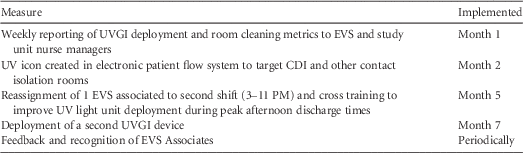
During the 12-month intervention period, UVGI was deployed for 541 of 2,569 patient discharges (21.6%) on the 3 study units (mean, 10.4 deployments per week; range, 1–25 deployments per week). (Table 1) summarizes the process improvement measures that were implemented to increase deployment of UVGI for no-touch terminal room disinfection during the 12-month evaluation. Notably, reassignment of 1 additional EVS associate to second shift (3 PM–11 AM) on the study units at month 5 and the addition of a second UVGI device at month 7 did not appreciably improve second shift or mean weekly UVGI deployment metrics (data not shown).
Environmental Process Improvement Measures Implemented During the Intervention

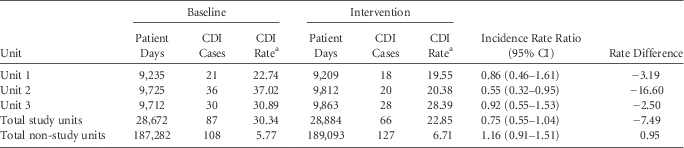
On unadjusted analyses, compared to the baseline period, UVGI was associated with a 25% reduction in CDI incidence rates (22.85 vs 30.34 per 10,000 patient days; incidence rate ratio [IRR], 0.75; 95% confidence interval [95% CI], 0.55–1.04; P=.08) on the 3 study units combined (Table 2). In comparison, CDI incidence rates increased 16% on the non-study units during this period compared to baseline (6.71 vs 5.77 per 10,000 patient days; IRR, 1.16; 95% CI, 0.91–1.51; P=.24). There was no apparent effect of UVGI no-touch terminal room disinfection on rates of other healthcare-associated infections, including central-line–associated bloodstream infections and methicillin-resistant Staphylococcus aureus (MRSA) bacteremia (data not shown).
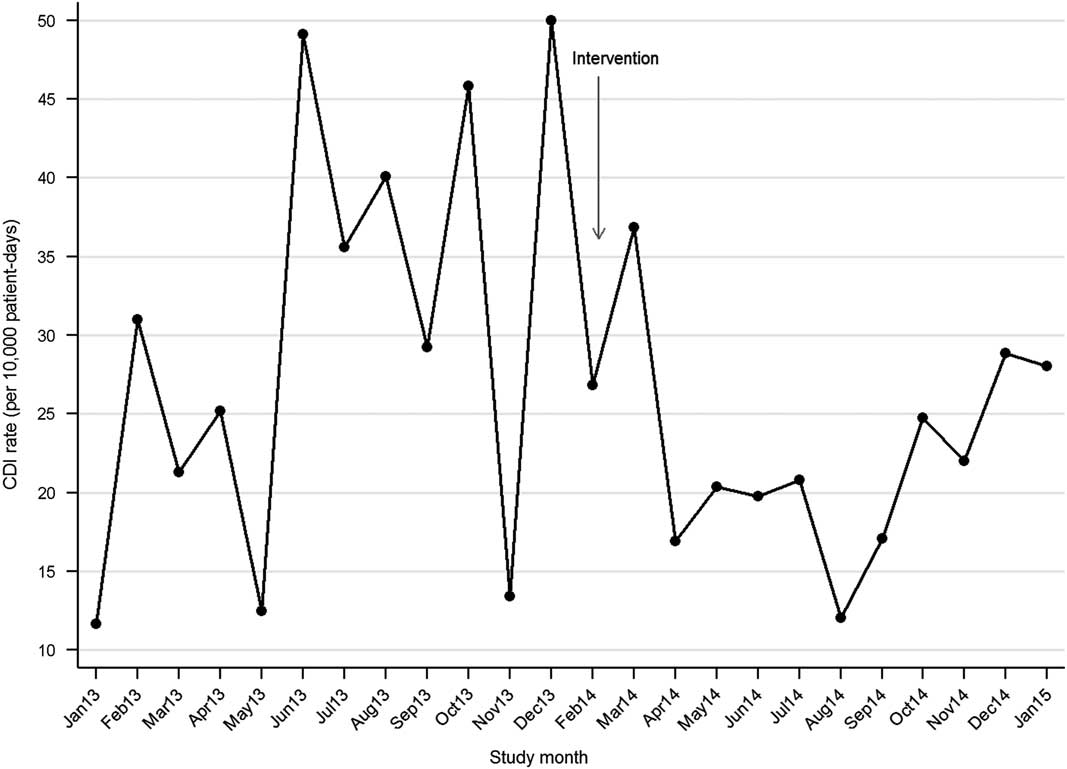
On mixed-effects Poisson regression analysis for the primary outcome of healthcare onset CDI, the UVGI intervention was associated with a significant downward trend in CDI incidence on the 3 combined study units (IRR, 0.49; 95% CI, 0.26–0.94; P=.03) (Figure 1). The impact of the UVGI intervention was driven primarily by the reduction in CDI on study unit 2 (IRR, 0.34; 95% CI, 0.12–0.99; P=.049). Notably, the UVGI intervention had no significant impact on CDI incidence rates on the combined non-study units (IRR, 0.63; 95% CI, 0.38–1.06; P=.08).
The mean number of terminal room cleanings on the 3 study units combined increased from 44.7 per week (standard deviation [SD], 10.5) during the baseline period to 48.2 per week (SD, 8.6) during the intervention period (P=.12). However, there was no significant difference in mean length of stay (days) on the study units between the baseline and intervention periods, 8.63 days (SD, 1.07) and 8.62 days (SD, 0.63), respectively (P=.75). On the 3 study units, weekly mean room-cleaning time (baseline vs intervention: 36.0 minutes vs 36.3 minutes; P=.91) and room turnaround time (67.9 minutes vs 66.7 minutes; P=.53) showed little change with the UVGI no-touch disinfection intervention compared to baseline. Compared with non-study units during the intervention period, UVGI no-touch disinfection was associated with 5.2 additional minutes in weekly mean room-cleaning time (study units vs non-study units: 36.3 minutes vs 31.1 minutes; P<.001) and 6.9 additional minutes in turnaround time (study units vs non-study units: 66.7 minutes vs 59.8 minutes; P<.001). There was no significant difference in visual monitoring scores on the study units in the baseline and intervention periods, with a mean score of 0.93 (SD, 0.02) and 0.93 (SD, 0.03), respectively (P=.45). In addition, there was no significant difference in ATPase assessment scores following terminal room cleaning for all rooms occupied by a patient with CDI (study units and non-study units) in the baseline and intervention periods, with a mean score of 271 relative light units (RLU; SD, 75) and 288 RLU (SD, 63), respectively (P=.75). No significant difference in hand hygiene compliance on the study units was observed between the baseline and intervention periods, with a mean compliance rate of 0.84 (SD, 0.02) and 0.84 (SD, 0.04), respectively (P=.51). Finally, there was no significant difference in mean use of broad-spectrum antibiotics on study units between the baseline and intervention periods, 1,257 days of therapy (DOT; SD, 265) and 1,348 DOT (SD, 213), respectively (P=.73). For the non-study units, no significant difference in mean use of broad-spectrum antibiotics between the baseline and intervention periods was observed, 2,441 DOT (SD, 396) and 2,477 DOT (SD, 168), respectively (P=.64).
DISCUSSION
No-touch terminal room disinfection with UVGI was associated with a significant reduction in CDI incidence among patients on 3 hematology-oncology units with high baseline rates of CDI. This effect was observed when UVGI was added to an existing multicomponent C. difficile control program. Although rates of CDI declined on each of the 3 study units associated with the intervention, the impact of UVGI on decreasing CDI incidence was variable, ranging from −2.50 to −16.60 fewer cases per 10,000 patient days compared to baseline. Notably, the reduction in CDI incidence was highest on study unit 2, where the first UVGI device was stored throughout the evaluation. This finding suggests that proximity of the UVGI device may have contributed to the greater observed effect on this unit. Adding a second UVGI device (stored on unit 1) at month 7 had no impact on average weekly use metrics. These observations emphasize that optimizing deployment of a no-touch terminal room-cleaning technology, such as UVGI, should include consideration of staging logistics in addition to staffing level and equipment needs.
The reduction of CDI incidence was observed with targeted use of UVGI no-touch terminal disinfection for contact isolation rooms, with use in only 1 in 5 room discharges. Reflecting the targeted deployment and short cycle times, UVGI had a limited impact on room turnaround time. Because no additional environmental services staff were hired for the evaluation, administrative and technical solutions were developed, including redeployment of existing environmental service staff to target peak afternoon discharge hours and electronic tracking of room disinfection with UVGI. We selected UVGI rather than a hydrogen peroxide–based method for terminal room cleaning based, in part, on substantially lower time to achieve room disinfection with this method.Reference Rutala and Weber 3 , Reference Weber, Rutala, Anderson, Chen, Sickbert-Bennett and Boyce 4 We were especially sensitive to the impact of the terminal disinfection method on room turnaround time, given a high average daily hospital census (>95%) and increasing annual admissions to the hematology-oncology service. With an estimated additional 30 minutes per room to stage and deploy UVGI for no-touch terminal disinfection and targeted deployment, we observed only a 5-minute longer average room cleaning time on the study units compared with non-study units. The negligible observed increase in room cleaning time with the UVGI intervention compared to baseline (0.3 minutes) on study units also likely reflected hospital-wide improvement in EVS efficiency, as suggested by a 1.5-minute faster cleaning time on the non-study units for the intervention compared to baseline period.
No-touch room disinfection methods are effective in reducing environmental contamination with C. difficile and multidrug-resistant (MDR) organisms in model hospital rooms systems, but the clinical effectiveness of these technologies has been variable, and comparative studies of methods are lacking.Reference Leas, Sullivan, Han, Pegues, Kaczmarek and Umscheid 7 Most published clinical trials have evaluated the impact of hydrogen peroxide vapor or UV-pulsed xenon devices on CDI or composite healthcare-associated infection rates using a before-and-after study design.Reference Weber, Rutala, Anderson, Chen, Sickbert-Bennett and Boyce 4 In a recent cluster, randomized, crossover trial, enhanced terminal room disinfection using a UV-C emitting device reduced the clinical acquisition of all target multidrug-resistant organisms (ie, MRSA, VRE, C. difficile, and MDR Acinetobacter) by approximately 30%.Reference Anderson, Chen and Weber 8 None of these studies used active surveillance cultures to detect prevalent colonization with C. difficile or other target organisms. Room disinfection would not be expected to reduce the risk infection in patients previously colonized with a target pathogen. In our evaluation, we used surveillance data to identify incident cases of CDI, but we did not account for episodes of CDI outside the repeat-infection time frame, nor did we screen for prevalent carriage of C. difficile toxin by NAAT, nor did we assess other patient-level risk factors for CDI.
Our study has several other limitations. We used a quasi-experimental design, where selection of the units for evaluation and allocation of the UVGI intervention were non-randomized. We adjusted for the effect of the UVGI intervention over time using interrupted time series analysis with a comparison arm, but other unmeasured factors may have contributed to the observed results. However, we observed no change in the effectiveness of routine terminal room-cleaning practices, as assessed by visual inspection and ATP bioluminescence assay, or in provider hand hygiene compliance over time. In addition, there was no change in length of stay on the study units or in days of broad-spectrum antimicrobial therapy that could impact the incidence of CDI. We also were unable to accurately track the proportion of high-risk contact isolation rooms terminally cleaned with UVGI, as no tracking software was provided with the units loaned for this evaluation. UVGI devices vary in UV wavelength, bulb configuration, energy output, and exposure time. Other characteristics, such as thoroughness of terminal room cleaning, room staging, and device placement, are also likely to impact clinical efficacy in reducing CDI.Reference Weber, Rutala, Anderson, Chen, Sickbert-Bennett and Boyce 4 , Reference Cadnum, Tomas and Sankar 9 – Reference Anderson, Gergen and Smathers 11 UVGI devices can only inactivate pathogens in direct or indirect line of site. In this evaluation, UVGI may not have effectively decontaminated all surfaces in the bathroom because of the inability to place the device inside the bathroom.
Based on this 12-month evaluation, beginning in July 2015, we implemented hospital-wide use of UVGI for the terminal disinfection of rooms of patients on contact precautions. This infection control measure included the purchase of 3 UVGI devices and the hiring of 3.5 environmental services associates dedicated to the program. Annual costs for the first year of operation are estimated to be $294,342, including personnel and equipment acquisition, and $194,250 for year 2. Although we have not yet performed a formal cost-effectiveness analysis, for the first year (FY16) of hospital-wide deployment of UVGI terminal disinfection, we observed 53 fewer cases of hospital-onset C. difficile than in fiscal year 2014, with an estimated annual direct cost averted of US$348,528 to $1,537,000.Reference Gabriel and Mathiot 12
Monthly incidence of C. difficile infection on 3 study units.

Rates of C. difficile Infection for the Baseline and Intervention Period on the 3 Study Units and Non-study Units

NOTE. CDI, healthcare-onset C. difficile infection
a Rate per 10,000 patient days.
ACKNOWLEDGMENTS
We thank providers on the hematology-oncology units, EVS associates, and bed management staff for their help in facilitating UVGI deployment. We also thank Joseph Hahn for assistance with EVS process measure data.
Financial support: No financial support was provided relevant to this article.
Potential conflicts of interest: All authors report no conflicts of interest relevant to this article.