I. INTRODUCTION
In the last decades, there has been an increasing amount of efforts, exemplified by many experimental and theoretical studies in the literature, in searching for new high-performance lead-free piezoelectrics.Reference Li, Wang, Zhu, Cheng and Yao1–Reference Hollenstein, Davis, Damjanovic and Setter6 Among all kinds of lead-free piezoceramics candidates, alkali niobate ceramics based on (K0.5Na0.5)NbO3 (KNN) have received more attention after Saito et al. made a breakthrough in the textured (Li,Ta,Sb)-modified KNN ceramics,Reference Saito, Takao, Tani, Nonoyama, Takatori, Homma, Nagaya and Nakamura3 which exhibited an excellent piezoelectric response. Very recently, the research group of Sichuan UniversityReference Wang, Wu, Xiao, Zhu, Cheng, Zheng, Zhang, Lou and Wang4,Reference Cheng, Wu, Lou, Wang, Wang, Xiao and Zhu5 made a significant breakthrough in nontextured KNN-based ceramics, which showed giant piezoelectricity with an extremely large piezoelectric constant d 33 > 360 pC/N. Generally, the excellent properties in KNN-based systems were believed to originate from the complex and tunable phase boundaries,Reference Wang, Wu, Xiao, Zhu, Cheng, Zheng, Zhang, Lou and Wang4–Reference Hollenstein, Davis, Damjanovic and Setter6 which is actually considered as a successive polymorphic phase transition (PPT) that can be appropriately tuned.Reference Hollenstein, Davis, Damjanovic and Setter6–Reference Fu, Zuo and Gao9
It is indicated that the addition of a small amount of LiSbO3 (LS), LiTaO3 (LT), (Bi0.5Na0.5)TiO3 (BNT), etc. could help generate orthorhombic (O)–tetragonal (T) coexisted phases near room temperature (RT), where highest piezoelectric coefficients d 33 > 200 pC/N were obtained.Reference Saito, Takao, Tani, Nonoyama, Takatori, Homma, Nagaya and Nakamura3,Reference Hollenstein, Davis, Damjanovic and Setter6,Reference Zhang, Xia and Shrout7,Reference Zang, Wang, Chen, Su, Wang, Qi, Ming, Du, Zheng, Zhang and Shrout10–Reference Zhang, Xia, Hao, Liu and Shrout13 However, some issues always hinder the practical applications of the high-performance KNN-based ceramics, for example, the contradiction between the piezoelectric constant d 33 and the Curie temperature T C,Reference Akdogan, Kerman, Abazari and Safari12 the distinct fatigue behavior,Reference Zhang, Xia, Hao, Liu and Shrout13 and especially the poor temperature stability.Reference Yao, Wang and Li14 Owing to the distinctly different domain configurations near PPT, the domains are unstable and properties vary greatly during thermal cycling,Reference Zhang, Xia and Shrout7 leading to low temperature stability for PPT compositions.Reference Zhang, Xia, Hao, Liu and Shrout13 Based on the above, it is desirable to shift the PPT out of the application temperature range, to improve thermal stability of the high-performance ceramics. Previous reportsReference Wu, Xiao, Wang, Wu, Zhang, Li and Zhu15–Reference Hao, Xu, Chu, Zhang, Chen, Li, Fu, Zang, Li and Yin17 disclosed that the addition of other solid solutions, such as CaTiO3 (CT), LiTaO3 (LT), (Bi0.5Na0.5) TiO3 (BNT), etc., can shift the PPT of KNN ceramics downward to below RT, achieving a more temperature stable behavior. On the other hand, practical applications also demand the reliability and long-term stability during cyclic electric loading to ensure successful industrial implementation.Reference Lupascu and Rödel18 It is known that high-performance KNN-based ceramics near the PPT exhibit quite poor piezoelectric fatigue properties, with relatively severe degradation in strain behavior after only a few millions of cycles of applied field.Reference Zhang, Xia, Hao, Liu and Shrout13 Therefore, it is also need to improve the fatigue characteristics while maintaining good temperature stability.
(Bi0.5K0.5)TiO3 (BKT) is known to be a tetragonal ferroelectric at RT and possesses a high-Curie temperature.Reference Hiruma, Aoyagi, Nagata and Takenaka19 Recently, BKT has been selected as an addition to the KNN-based materialsReference Du, Zhou, Luo, Zhu, Qu, Li and Pei11 and shifted the PPT temperature of KNN ceramics down to low temperature due to the presence of tetragonal structures at a BKT doping level of 3.0 mol% and above. Based on the above, it is expected that the addition of BKT in KNN-based lead-free materials will expand their usage temperature range due to the downward shift of PPT temperature. In this study, we selected 0.94(K0.5Na0.5) NbO3–0.06LiNbO3 (KNLN6), which is known to have excellent piezoelectric properties with a RT PPT, as a base material with small amounts of BKT being introduced as doping species. The temperature stability and fatigue behavior of BKT-modified KNLN6 ceramics were fully studied. In addition, the influences of BKT on the phase structure, microstructure, and electrical properties of the ceramics were investigated.
II. EXPERIMENTAL
(1 − x)[0.94(K0.5Na0.5)NbO3–0.06LiNbO3]–x(Bi0.5K0.5)TiO3 (abbreviated as: KNLN6–xBKT, x = 0–0.05) ceramics were prepared by the conventional sintering technique using analytical-grade metal oxides or carbonate powders: Na2CO3 (99.95%), K2CO3 (99.5%), Li2CO3 (99.0%), Nb2O5 (99%), TiO2 (99.6%), and Bi2O3 (99.975%). The stoichiometric KNLN6 and BKT powders were first synthesized at 850 °C for 4 h and 800 °C for 4 h, respectively. After the calcination, KNLN6 and BKT powders were weighed according to the formulas and then ball milled for 24 h. The dried mixtures were pressed to form disks using 8 wt% polyvinyl alcohol as a binder. The disk samples were finally sintered at 1070–1170 °C for 3 h in air. The crystal structures of the sintered ceramics were determined by x-ray powder diffraction analysis (XRD) (D8 Advance, Bruker Inc., Karlsruhe, Germany). For the temperature-dependent structural analysis, a reflective XRD apparatus (Bruker D8 Advance) equipped with a furnace (XRK900) was used using Cu Kα radiation. The surface and fracture surface morphology of the ceramics was studied by scanning electron microscope (JSM-5900, JEOL Ltd., Tokyo, Japan).
For the electrical measurements, silver paste was coated on both sides of the sintered samples and fired at 600 °C for 10 min to form electrodes. The temperature dependences of the dielectric properties were measured using an Agilent 4294A precision impedance analyzer (Agilent Inc., Palo Alto, CA). Impedance spectroscopy of the samples was performed using a broad frequency dielectric spectrometer (Concept 80, Novocontrol Technologies GmbH & Co. KG, Montabaur, Germany) in the 0.01 Hz–20 MHz frequency range at various temperatures. The electric field-induced polarization (P–E) and strain (S–E) measurements were carried out using an aix-ACCT TF2000FE-HV ferroelectric test unit (aixACCT Systems GmbH, Aachen, Germany) connected with a miniature plane mirror interferometer and the accessory laser interferometer vibrometer (SP-S 120/500; SIOS Mebtechnik GmbH, llmenau, Germany). To study the fatigue behavior of the ceramics, the samples were fatigued with a positive unipolar/bipolar sine electric signal with the amplitude of 50 kV/cm (for pure KNLN6) and 60 kV/cm (for 5 mol% BKT-modified KNLN6) at 10 Hz up to 105 cycles. For the measurement of piezoelectric properties, samples were poled in silicone oil at RT under a dc electric field from 50 to 60 kV/cm for about 30 min. The piezoelectric constant d 33 was measured using a quasi-static d 33 meter (YE2730 SINOCERA, China).
III. RESULTS AND DISCUSSION
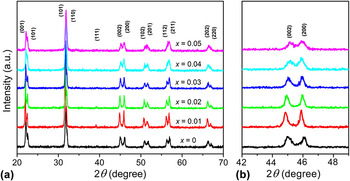
Figure 1 shows the XRD patterns of KNLN6–xBKT ceramics in the 2θ range of 20–70°. A stable solid solution among KNLN6 and BKT with a pure perovskite structure is formed in all compositions. The KNLN6 ceramic has a typical mixed phase of O–T, where the PPT temperature (T O–T, see Fig. 3) is close to RT, which is in good agreement with the previous study.Reference Hao, Bai, Shen and Zhai20 As a certain BKT is added into KNLN6, the XRD patterns of BKT-modified samples keep almost unchanged, which seem to indicate the modified samples still maintain mixed phase of O–T. However, since the T O–T is shifted down to below RT by the BKT addition as presented in Fig. 3, so we think T phase should be the RT dominant phase.Reference Cheng, Wu, Wang, Zhang, Zhu, Xiao, Wang, Lou and Liang21
(a) XRD patterns of KNLN6–xBKT ceramics in the 2θ range of 20–70°. (b) The expanded XRD patterns of KNLN6–xBKT ceramics in the 2θ range of 42–49°.

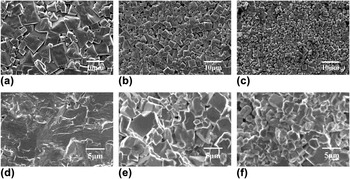
Figure 2 provides the micrographs of KNLN6–xBKT (x = 0, 0.01, 0.03) ceramics microstructure observed on the (a–c) surface and (d–f) fracture surface of the compositions. It is found that all the indicated ceramics were well sintered and considerably dense (by applying the Archimedes method, all samples have a large relative density >96%) The average grain size decreases monotonically as the BKT content increases, implies that the role of BKT in KNN-based system is a grain growth inhibiter. Similar grain growth inhibition has also been reported for BNT or BKT-modified KNN-based ceramics.Reference Du, Zhou, Luo, Zhu, Qu, Li and Pei11,Reference Hao, Xu, Chu, Zhang, Chen, Li, Fu, Zang, Li and Yin17 In addition, it is noted that, for the pure KNLN6 ceramic, the grain sizes are not very homogeneous, which consists of coarse and fine grains, corresponding to about 10 and 2 µm, respectively. By contrast, BKT-modified samples have uniform grains with a relative small grain size, which is only about 3 and 2 µm, for samples with x = 0.01 and x = 0.03, respectively. For the microstructure observed on the fracture surface, it can be noted that the fracture surface is the typical transgranular fracture mode for the pure KNLN6 samples. Liquid phase sintering induced by LiNbO3 should be responsible for the transgranular fracture. As BKT is added into KNLN6, the fracture surface becomes mainly intergranular fracture, which indicates that the BKT addition breaks the liquid phase sintering mechanisms.
The micrographs of KNLN6–xBKT (x = 0, 0.01, 0.03) ceramic microstructures observed on (a–c) the surface and (d–f) fracture surface of the compositions.

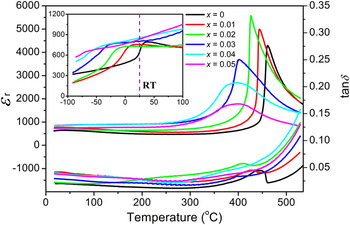
Figure 3 shows temperature dependence of dielectric permittivity εr and loss tangent tan δ for KNLN6–xBKT samples at a measuring frequency of 10 kHz. Two phase transitions, i.e., a Curie temperature T C at the temperature of ∼460 °C and a polymorphic orthorhombic–tetragonal phase transition temperature T O–T around RT are observed in pure KNLN6. With the addition of BKT, both the T C and T O–T are found to shift downward. For BKT-modified samples (x > 0.01), the T O–T of the ceramics disappears (is shifted to below RT), and only the cubic–tetragonal phase transition is observed above RT, as shown in the inset of this figure. In this work, the addition of BKT in the ceramics decreases the T C and shifts the PPT below RT. It is reasonable to believe that the temperature stability of KNLN6–xBKT ceramics could be improved due to the disappearance of PPT.Reference Zhang, Xia, Hao, Liu and Shrout13,Reference Wu, Xiao, Wang, Wu, Zhang, Li and Zhu15,Reference Hao, Xu, Chu, Zhang, Chen, Li, Fu, Zang, Li and Yin17 Moreover, it is found that the dielectric maxima drops down rapidly, and the dielectric peaks become extremely broad with the addition of BKT, which indicates that the relaxor behavior is enhanced by the addition of BKT. In addition, the dielectric loss tangent (tan δ) of the BKT-modified samples is lower than 5.5%, even at a temperature as high as 400 °C.
Temperature dependence of dielectric permittivity εr and loss tangent tan δ for KNLN6–xBKT samples at a measuring frequency of 10 kHz (inset figure gives the temperature dependence of εr in the temperature range of −100 °C to RT).

To further characterize the dielectric diffuseness and the relaxor behavior of the phase transition of KNLN6–xBKT system, quantitative characterizations as described in the following have been done. It is known that for a normal ferroelectric, the dielectric constant above the Curie point follows the Curie–Weiss law described by:
 $${\varepsilon _{\rm{r}}} = C{(T - {T_{\rm{0}}})^{ - 1}}(T > {T_{\rm{0}}})\quad ,$$
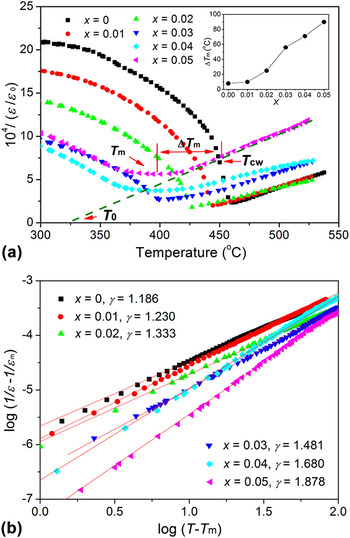
where C is the Curie–Weiss constant, and T 0 is the Curie–Weiss temperature. The Curie–Weiss constant C reflects the nature of the ferroelectric transition. In KNLN6–xBKT system, all C are 105 °C order, indicating that the high-temperature paraelectric phase is driven by a displacive transition.Reference Nakamura, Mitsui and Furuichi22 To make the value of T 0 certain, the plot of the inverse dielectric constant versus temperature at 10 kHz is provided in Fig. 4(a). It is found that εr of all samples deviates from the Curie–Weiss law above the Curie temperature, and as the BKT content increases, the deviation ΔT m as defined by the following [Eq. (2)] increases continually as shown in the inset of Fig. 4(a),
 $$\Delta {T_{\rm{m}}} = {T_{{\rm{CW}}}} - {T_{\rm{m}}}\,\left( {^\circ {\rm{C}}} \right)\quad ,$$
where T CW represents the temperature from which εr starts to follow the Curie–Weiss law, and T m denotes the temperature at which εr value reaches the maximum. This result indicates that the diffuse phase transition behavior of KNLN6 is obviously enhanced by BKT addition, which corresponds to the broader and diffused dielectric peak in BKT-modified samples.
(a) Inverse dielectric permittivity at 10 kHz as a function of temperature for KNLN6–xBKT ceramics. (b) Plot of log(1/ε − 1/εm) as a function of log (T − T m) for KNLN6–xBKT ceramics at 10 kHz [symbol: experimental data; solid line: fitting to Eq. (3)].

Furthermore, a modified empirical expressionReference Uchino and Nomura23 was used in the present work to further characterize the dielectric dispersion and diffuseness of the phase transition.
 $${1 \mathord{\left/ {\vphantom {1 {{\varepsilon _{\rm{r}}}}}} \right. \kern-\nulldelimiterspace} {{\varepsilon _{\rm{r}}}}} - {{1 \mathord{\left/ {\vphantom {1 {\left( {{\varepsilon _{\rm{r}}}} \right)}}} \right. \kern-\nulldelimiterspace} {\left( {{\varepsilon _{\rm{r}}}} \right)}}_{\rm{m}}} = {{{{(T - {T_{\rm{m}}})}^\gamma }} \mathord{\left/ {\vphantom {{{{(T - {T_{\rm{m}}})}^\gamma }} C}} \right. \kern-\nulldelimiterspace} C}\quad ,$$
where γ and C are all constants, and the γ value is between 1 and 2. The limiting values γ = 1 and γ = 2 obey the equation to Curie–Weiss law, which are the character for the case of normal ferroelectric and for an ideal relaxor ferroelectric, respectively. The logarithmic plots related to this equation for the KNLN6–xBKT samples are shown in Fig. 4(b). A linear relationship is obtained for these samples. The slope of the fitting curves used to determine the γ value of the KNLN6–xBKT ceramics increases gradually with the increasing BKT content, and the fitting value γ reaches 1.878 for samples with x = 0.05, suggesting the occurrence of a typical relaxor behavior. The enhanced relaxor behavior in BKT-modified KNLN6 should be ascribed to the disorder in the perovskite unit cell induced by BKT substitutions.Reference Guo, Kakimoto and Ohsato24
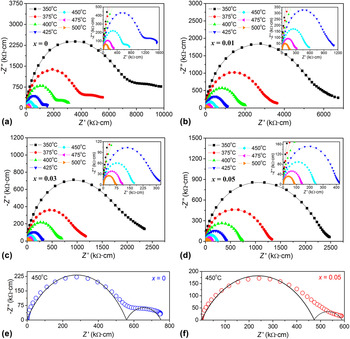
Figure 5 gives the complex impedance spectra of the KNLN6–xBKT ceramics with x = 0, 0.01, 0.03, and 0.05 in the frequency range of 0.01 Hz–20 MHz over 350–500 °C. Commonly, electrode, grain boundary, and grain components contribute to the conductivities of the polycrystalline materials, and their effects on conduction can be segregated into three parallel RC elements connected in series in an equivalent circuit, from low frequency to high frequency.Reference Irvine, Sinclair and West25 For the KNLN6–xBKT system, the Debye-like semicircles at variable temperatures become distorted, and the distorted semicircles at each temperature can be segregated into two natural electrical components corresponding to the two fitting semicircles in the impedance plots [Figs. 5(a)–5(f)]. The bigger semicircle in the higher frequency range is ascribed to the grain effect, while the grain boundary response contributes to the smaller semicircle in the lower frequency range.Reference Atamanik and Thangadurai26
(a)–(d) The complex impedance spectra of the KNLN6–xBKT ceramics with x = 0, 0.01, 0.03, and 0.05 in the frequency range of 0.01 Hz–20 MHz over 350–500 °C. (e), (f) The fitting semicircles in the impedance plots of the KNLN6–xBKT ceramics (x = 0 and 0.05).

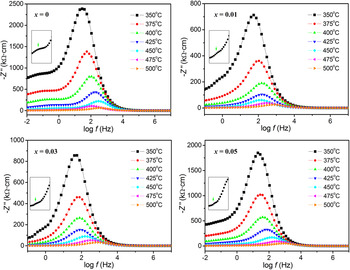
Figure 6 represents the imaginary part of impedance as a function of frequency at different temperatures, for the KNLN6–xBKT ceramics. It is worth noting that two peaks appeared in the imaginary part of impedance spectrum for all compositions, which correspond to the two Debye-like semicircles. This result further confirms that two components (grain boundary and grain) contribute to the conductivities of the materials. In addition, the appearance of the peaks in the spectrum is an indication of the beginning of electrical relaxation in the material at different temperatures. The peaks that appear are asymmetric, and their positions appear to be shifting toward the higher frequency side with increasing temperature. The asymmetric broadening of the peaks confirms the presence of electrical processes in the material with a difference of relaxation time.Reference Boukriba, Sediri and Gharbi27 Furthermore, it can also found that as the temperature reaches up to a certain value, the peak remains unmoving or even shifts to the lower frequency side. This can be ascribed to the cubic–tetragonal phase transition near the Curie temperature at which the relaxation time increases.Reference Cheng, Shi, Qi, Chen and Yu28
The imaginary part of impedance as a function of frequency at different temperatures, for the KNLN6–xBKT ceramics.

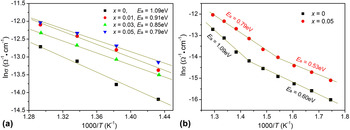
Moreover, the total conductivities (σ) of the ceramics can be detected from the complex impedance data, and variable-temperature conductivities of the KNLN6–xBKT ceramics are shown in Fig. 7(a). It is observed that the BKT substitution leads to the increased conductivities of the KNLN6 ceramics. Besides, the activation energy (E a) for electrical conduction can be detected by using the Arrhenius equation:
 $$\sigma = {\sigma _0}\exp \left( {{{ - {E_{\rm{a}}}} \mathord{\left/ {\vphantom {{ - {E_{\rm{a}}}} {kT}}} \right. \kern-\nulldelimiterspace} {kT}}} \right)\quad ,$$
where σ and σ0 are the dc conductivity and the pre-exponent constant, respectively, E a is the dc activation energy, k is the Boltzmann's constant, and T is the absolute temperature. The values of E a of the KNLN6–xBKT ceramics are in the range of 0.79–1.09 eV, which are closely related to the oxygen ion/vacancy migration.Reference Li, Fan, Long, Dong and Sun29 From Fig. 7(a), it is clear that the introduction of the BKT causes a decrease in E a, and the decreased E a of the BKT-substituted KNLN6 ceramics should be attributed to an increase in the number of oxygen vacancies in the lattice positions due to replacement of Nb5+ by Ti4+ at the B-site, which can be described as:  $2{\rm{TiO}}_2 \buildrel {{\rm{Nb}}_2 {\rm{O}}_5 } \over \longrightarrow 2{\rm{Ti\prime}}_{{\rm{Nb}}} + {\rm{\ddot V^{\bullet\bullet}}}_{\rm{o}} + 4{\rm{{\rm O}}}_{\rm{o}}$.
(a) Arrhenius plots of dc electrical conductivity (σ) of KNLN6–xBKT ceramics with various BKT amounts. (b) Temperature dependence of logarithmic conductivity for KNLN6–xBKT (x = 0, 0.05) ceramics in the temperature range of 300–500 °C.

Figure 7(b) shows the logarithmic variable-temperature conductivity of the KNLN6–xBKT (x = 0, 0.05) ceramics in the temperature range of 300–500 °C. The curve could be fitted with two linear lines at low- and high-temperature ranges. The obtained corresponding activation energies E a of KNLN6 were 0.60 and 1.09 eV for two ranges. The activation energy 0.60 eV for the dc electrical conductivities suggested an extrinsic conduction mechanism, which was most probably p-type conduction. As the temperature increased, the activation energy increased to 1.09 eV, which was associated with a change from extrinsic to intrinsic conductivity.Reference Zhang, Yan and Reece30
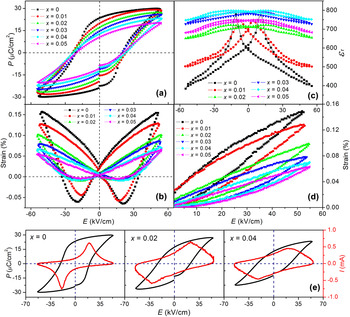
Figure 8 shows the (a) P–E hysteresis loops, (b) bipolar S–E curves, (c) εr–E curves, (d) unipolar S–E curves, and (e) I–E curves of KNLN6–xBKT ceramics as a function of BKT content, measured at RT and 10 Hz. A typical ferroelectric loop has been demonstrated in all samples. The P–E and bipolar S–E loops present fleet changes of polarization and strain in the region near the coercive field E c [Figs. 8(a) and 8(b)], which is the electric field corresponding to the current peak [Fig. 8(e)], and the current peak is coincident with the fields corresponding to P = 0, suggesting that all samples are under complete saturation conditions.Reference Viola, Saunders, Wei, Chong, Luo, Reece and Yan31,Reference Yan, Inam, Viola, Ning, Zhang, Jiang, Zeng, Gao and Reece32 With increasing BKT content, the loops of the ceramics become much narrower, suggesting that BKT addition hinders the domain-wall switching,Reference Cheng, Wu, Wang, Zhang, Zhu, Xiao, Wang, Lou and Liang21 evident by the much broader current peak (domain switching peak). Change of the shape in P–E loops from “well saturated” to “slim” implies that the domain structure of the ceramics undergoes a macrodomain–microdomain transition with the addition of BKT,Reference George33 which also confirms the appearance of a typical relaxor behavior at high content of BKT.Reference Guo, Kakimoto and Ohsato24,Reference Tan and Viehland34 The normal to relaxor ferroelectric transformation induced by BKT can also be well confirmed by the bipolar S–E curves. For samples with low-BKT content (x = 0, 0.01), they show “butterfly”-shaped strain hysteresis loops with relative large negative strain S neg, which is typical for normal ferroelectrics. With further increasing BKT content, the S–E loop exhibits the so-called “sprout shape” (with a diminished S neg), recently defined for relaxor lead-free ceramics related to the presence of near nonpolar phases at zero electric field.Reference Viola, Saunders, Wei, Chong, Luo, Reece and Yan31 For the unipolar strain curve as shown in Fig. 8(d), all samples show small hysteresis, which indicates both the piezoelectric effect, and the domain wall motions contribute to the strain level. The large signal d 33* (S max/E max) determined from the unipolar strain curve deceases linearly from 300 pm/V to 127 pm/V with the addition of BKT, implying that the addition of BKT weakens the piezoelectricity of the ceramics. The in situ measurements of relative permittivity εr as a function of bias field are shown in Fig. 8(c), compositions with x ≤ 0.01 exhibit notable hysteretic behavior, which is closely connected to switching of ferroelectric domains. By contrast, xBKT samples (x > 0.03) display indiscernible hysteretic behavior, also confirming BKT addition hinders the domain-wall switching.Reference Dittmer, Anton, Jo, Simons, Daniels, Hoffman, Pokorny, Reaney and Rödel35
(a) P–E hysteresis loops, (b) bipolar S–E curves, (c) εr–E curves, (d) unipolar S–E, (e) I–E curves of KNLN6–xBKT ceramics as a function of BKT content, measured at RT and 10 Hz.

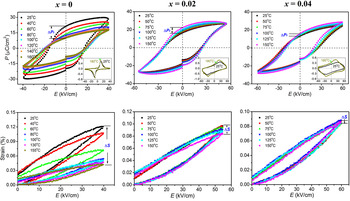
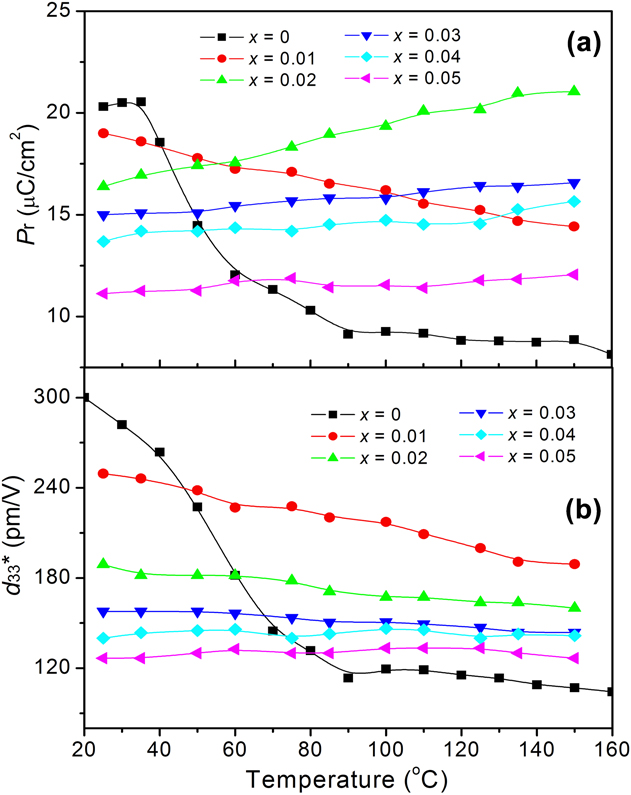
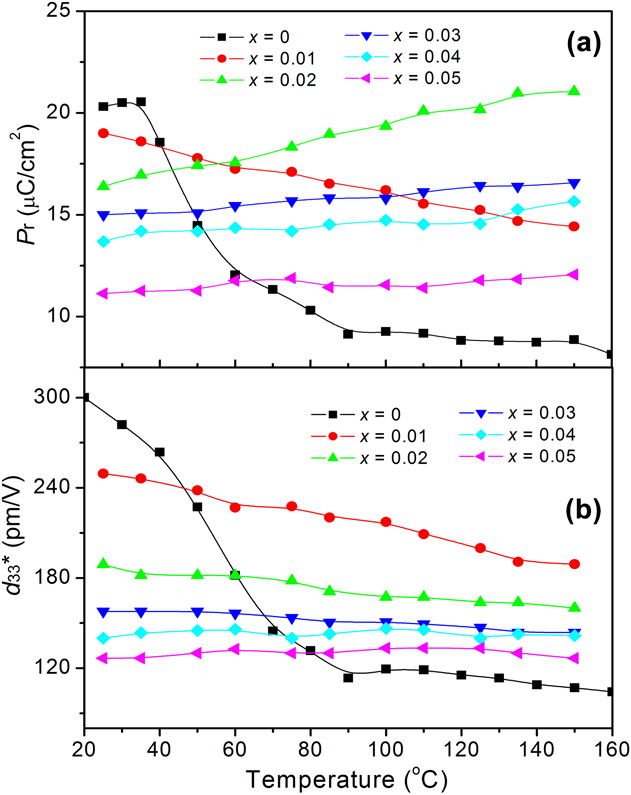
Since the addition of BKT in the ceramics shifts the PPT below RT. It is expected that the temperature stability of KNLN6 ceramics could be improved by BKT doping. Figure 9 shows the P–E (insets: I–E loops) hysteresis loops and unipolar S–E curves of KNLN6–xBKT ceramics with x = 0, 0.02, and 0.04 at different temperatures (25–150 °C). For pure KNLN6 samples, P–E loops change notably with elevating measuring temperature, and both the remnant polarization P r and unipolar strain S exhibit a linear decrease in this temperature range. By contrast, for 0.02BKT samples, the P–E loops keep a typical ferroelectric shape with elevating measuring temperature. Meanwhile, samples have a small P r and S deviations in the temperature range. For the 0.04BKT composition, no significant deformation of the P–E loops and unipolar strain curves is observed in the whole range of the measuring temperatures. These results indicate that the modified KNLN6 ceramics exhibit relatively good temperature stability in the measured temperature range.Reference Hao, Xu, Chu, Zhang, Chen, Li, Fu, Zang, Li and Yin17,Reference Wu, Xiao, Wu, Sun, Lin, Zhu, Yu, Zhuang and Wei36 The results can be seen more clearly in Fig. 10, which gives the remnant polarization P r and large signal d 33* (S max/E max) as a function of temperature for pure and modified KNLN6 materials. KNLN6 ceramics showed a higher P r and d 33* at RT. In the case of BKT-modified samples, despite the lower initial P r and d 33* at RT, they demonstrate relatively stable behavior with temperature. The P r and d 33* at 150 °C relative to those at RT for samples of x = 0.03–0.05 are all above 90%, while the two values for unmodified ceramic are both only about 35%.
The P–E hysteresis loops (insets: I–E loops) and unipolar S–E curves of KNLN6–xBKT ceramics with x = 0, 0.02, and 0.04 at different temperatures (25–150 °C).

(a) The remnant polarization P r and (b) large signal d 33* (S max/E max) as a function of temperature for KNLN6–xBKT ceramics.
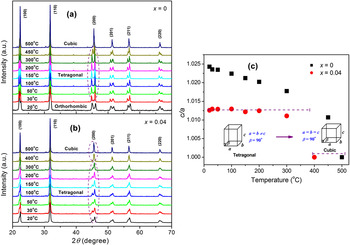
The above results show that the temperature stability of KNLN6 ceramics has been greatly improved by the addition of BKT due to phase transition from O–T mixed phase to a single tetragonal phase and the shift of PPT down to below RT. It further reveals that samples with a single tetragonal phase favor good resistance to thermal cycles. To further study the temperature stability of the system and give a detailed understanding of temperature resistance mechanism, we chosen two compositions, KNLN6 with O–T mixed phase and 0.04BKT-modified samples with single T phase, and carefully studied the phase transition behavior induced by the temperature. Figures 11(a) and 11(b) give the XRD patterns measured at different temperatures (20–500 °C) of the two samples. As shown in this figure, the XRD patterns of KNLN6 ceramics show the coexistence of orthorhombic and tetragonal phases at 20 °C, tetragonal phase at 80–450 °C, and cubic phase at 500 °C. For 0.04BKT-modified samples, a stable tetragonal phase exists until 300 °C, following a tetragonal–cubic phase transition at 400 °C. These phase transition points reflected by the high-temperature XRD measurements are consisted with that determined by the dielectric permittivity peaks, as disclosed in Fig. 3. Figure 11(c) gives the variation of the tetragonality c/a with temperature, for KNLN6 and 0.04BKT-modified samples. It is evident that the c/a ratio of 0.04BKT-modified samples keeps a stable value of 1.013 in the temperature range from RT to 300 °C, and then it drops rapidly to 1 near the Curie temperature. By contrast, KNLN6 material shows an obvious decease of c/a ratio in the whole temperature range from RT to 500 °C. Based on the above, it can be concluded that the excellent temperature stability of BKT-modified properties should be attributed to the stable tetragonal phase over a wide temperature range.
XRD patterns of KNLN6–xBKT ceramics with (a) x = 0 and (b) x = 0.04 in the 2θ range of 20–70° at different temperatures. (c) Variation of the tetragonality c/a with temperature, for KNLN6 and 0.04BKT-modified samples.

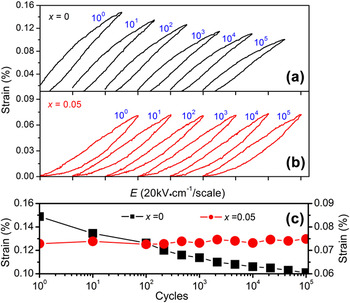
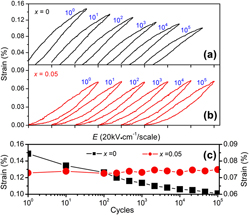
Suitable materials for piezoelectric applications not only show excellent piezoelectric properties and good temperature stability but also have to be reliable under long-term electric cycling.Reference Yao, Glaum, Wang, Jo, Rödel and Li37 For electromechanical applications, such as sensors or ultrasonic devices, a high-piezoelectric coefficient d 33 is often the desired quality. For actuator applications, however, the normalized strain d 33* is a more important feature.Reference Yao, Glaum, Wang, Jo, Rödel and Li37–Reference Jo, Dittmer, Acosta, Zang, Groh, Sapper, Wang and Röodel39 However, for KNN-based materials, this property and its fatigue behavior did not get much attention so far,Reference Zhang, Xia, Hao, Liu and Shrout13,Reference Yao, Wang and Li14,Reference Yao, Glaum, Wang, Jo, Rödel and Li37 even though it is a crucial aspect for industrial implementation. Figure 12 shows the unipolar fatigue behavior of (a) KNLN6 and (b) 0.05BKT-modified ceramics for 105 cycles, and the unipolar strain levels at different unipolar fatigue cycles are summarized in Fig. 12(c). It can be observed that the KNLN6 material exhibits obvious fatigue behavior, whereupon the unipolar strain is found to decrease by 50% after 105 switching cycles. For the BKT-modified materials, however, no fatigue behavior up to 105 switching cycles is observed.
The unipolar fatigue behavior of (a) KNLN6 and (b) 0.05BKT-modified ceramics for 105 cycles, (c) the unipolar strain levels of the two compositions at different unipolar fatigue cycles.

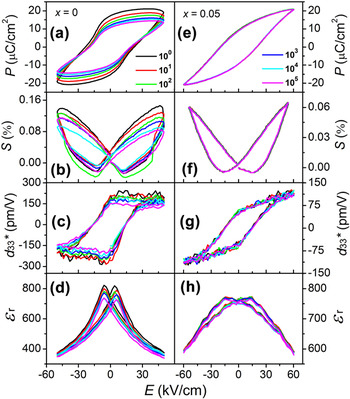
To understand the behavior of the unipolar strain during electrical cycling more in detail, bipolar hysteresis loops of polarization P, strain S, permittivity εr, and piezoelectric coefficient d 33* at different fatigue cycles were recorded. The evolution of polarization P–E, bipolar strain S–E, d 33*−E and εr−E hysteresis loops of KNLN6 and 0.05BKT-modified ceramics is displayed in Fig. 13. Similar to the fatigue behavior reflected in the unipolar strain loops, pure KNLN6 ceramics exhibit significant fatigue behavior, the remnant polarization P r is found to decrease by ∼45% after 105 bipolar fatigue cycles, with a corresponding decrease in bipolar strain S levels, as depicted in Figs. 13(a) and 13(b). Furthermore, d 33*−E and εr−E hysteresis loops provided in Figs. 13(c) and 13(d) also show an obvious degradation with bipolar electric cycling. By contrast, KNLN6 ceramics with 0.05BKT addition exhibit fatigue-free behavior: no decrease of the P r and the corresponding S, d 33*, and εr values are observed as represented in Figs. 13(e)–13(h), even as the switching cycles reaching up to 105. In the present work, 90° domain switching occurs much easier in the KNLN6 ceramics when compared to the BKT-modified samples, owing to the coexistence of tetragonal and orthorhombic phases.Reference Zhang, Xia, Hao, Liu and Shrout13,Reference Li, Rogan, Ustundag and Bhattacharya40 It is widely accepted that bipolar fatigue generates microscopic defects and/or defect clusters in bulk ceramics, effectively pinning 90° domain wall motion, resulting in the loss of switchable polarization during continuous electric field switching.Reference Zhang, Xia, Hao, Liu and Shrout13 However, for 0.05BKT-modified ceramics, 90° domain switching occurs much harder. As a result, the polarization is found to maintain the same value with increasing switching cycles, and no fatigue is observed in the modified KNLN6 materials.
The evolution of (a), (e) polarization P–E, (b), (f) bipolar strain S–E, (c), (g) d 33*−E, (d), (h) εr−E hysteresis loops with different fatigue cycles for KNLN6 and 0.05BKT-modified ceramics.

IV. CONCLUSIONS
In summary, the effects of the BKT on the phase structure and electrical properties of the KNLN6 ceramics were systematically studied. It is found that the KNLN6 material exhibited strong temperature-dependent properties and electrical fatigue due to the coexistence of orthorhombic and tetragonal phases at RT. However, as certain amounts of BKT were introduced into KNLN6, the phase structure changes from coexisted phases to a single tetragonal phase with the shift of PPT down to below RT. As a result, a temperature stable behavior over the range of 25–200 °C and fatigue-free characteristics are obtained. Temperature-dependent structural analysis reveals that the good properties insensitive to temperature of the modified samples can be ascribed to the stable tetragonal phase over a wide temperature range. The exceptionally good fatigue resistance and temperature stable behavior make this material promising for actuator and transducers applications.
ACKNOWLEDGMENTS
This work was supported by the National Natural Science Foundation of China (Nos. 51402144, 51372110, 51302124), the Project of Shandong Province Higher Educational Science and Technology Program (Grant Nos. J14LA11 and J14LA10), the National High Technology Research and Development Program of China (No. 2013AA030801), Science and Technology Planning Project of Guangdong Province, China (No. 2013B091000001), Independent innovation and achievement transformation in Shandong Province special, China (No. 2014CGZH0904), the Natural Science Foundation of Shandong Province of China (Grant Nos. ZR2012EMM004 and ZR2014JL030), and the Research Foundation of Liaocheng University (Nos. 318051407, 318011301, 318011306).