1. INTRODUCTION
In this paper I describe how certain Finnish sound words are tied to specific mimetic schemas, and how these sound words, due to this connection, can also be used metaphorically when describing emotional or cognitive experiences. Mimetic schemas are body-based image schemas that concern basic processes and activities, such as the ones described with the English verbs eat, hit, put in, fall and fly (Zlatev Reference Zlatev2005:317, Reference Zlatev2007, Reference Zlatev2014). I argue that the cultural sharedness of experience and intersubjective knowledge becomes visible through the more or less conventional uses of these sound words. Here we have two examples of the use of the sound words I examine, as listed in the Dictionary of Contemporary Finnish (NS):
-
(1)
-
a. Naps, ja valo sammui.
‘Naps [“snap”], and the light went out.’
(NS, naps)
-
b. Ja humpsis! Se [naskali] oli päätänsä myöten uponnut nahkaan.
‘And humpsis [sound of soft falling or sinking]! It [an awl] had sunk up to the hilt into the leather.’
(NS, humpsis)
-
The sound words this paper deals with will be termed imitatives. Imitatives (also known as onomatopoetic interjections), such as naps (meaning roughly, ‘snap, pop’) and humps ( is ) (the sound of relatively soft falling – no precise English equivalent) in the examples above, are sound-symbolic words that imitate sounds and/or the movements of animals, nature, the environment and people (for the use of this term, see Penttilä Reference Penttilä1957:503–504; Oswalt Reference Oswalt1994). Imitatives are a sub-group of ideophones, a category of expressions that has attracted considerable attention, especially in more recent linguistic research, but which nevertheless remain under-researched (see Dingemanse Reference Dingemanse2012). This study contributes to the examination of the semantics and morphosyntactic variation of ideophones demanded by such scholars as Dingemanse (Reference Dingemanse2012, in press). Imitatives could very well be called ideophones in this article as well. However, imitatives are not the only Finnish ideophones, as other types of ideophones are also present in Finnish and other Baltic-Finnic languages (see Mikone Reference Mikone2001). Besides the imitative forms humps(is)(ta) and naps(is)(ta), the sound-symbolic stems hump(s)- and nap(s)- also occur in other parts of speech (e.g. the verbs humpsahtaa, napsahtaa and napista, and the nouns humpsahdus and nap(s)a(hd)us). In fact, in Finnish it is common for sound-symbolic vocabulary to form families of correlates with same stems, each correlate expressing a near-synonymic meaning (Mikone Reference Mikone2001). Consequently, in this article indeclinable Finnish ideophones are termed imitatives, a label specifically designated to indeclinable ideophones.
Stripped of any derivational affixes that would reveal word-class status, the Finnish imitatives have been considered reminiscent of word stems (Rytkönen Reference Rytkönen1935:91, Reference Rytkönen1940; Sivula Reference Sivula1989:165). In addition, they do not convert into other parts of speech without additional suffixes, unlike, for example, their English counterparts (see Oswalt Reference Oswalt1994:302). They present an imagistic, iconic depiction of a sensation: an imagistic impression of a sound heard, of a movement seen or, sometimes, of an event felt or otherwise perceived (Jääskeläinen Reference Jääskeläinen2013:332–338). As depictive, sound-symbolic words, imitatives mimic perception with their phonetic form – hence the name imitative – or at least present the illusion of imitation within the range of the phonetic system of a specific language (Rhodes Reference Rhodes1994, Jääskeläinen Reference Jääskeläinen2015). Stylistically, Finnish imitatives are not as neutral as ideophonic verbs, nouns and adverbs in Finnish, and, due to their more expressive nature, they are seldom used in the most normative or matter-of-fact text genres, in which near-synonymic, same-stem verbs and nouns might be used. As linguistic elements, they are not random, however; in written texts they often occur in conventional, recurring constructions that can also be analysed and described.
In this paper I examine two imitatives, humps and naps, along with their longer variants humpsis, humpsista and napsis, napsista, respectively. The words humps (the sound or sensation of relatively soft falling) and naps ‘snap, pop’ were chosen for the reason that they portray different sounds that are also produced in different ways. Furthermore, naps and humps have developed their own phrases or constructions (see Section 4). The meaning of naps is relatively easily definable. The meanings of the imitative humps are more difficult to define. In addition, humps seems to have uses beyond the basic imitation of sound: it is often semantically synesthetic and sometimes used in an interjection-like way. Humps not only depicts a sound; it can also depict movement, other sensory impressions and sometimes emotions. This versatility makes humps an interesting subject for close semantic study.
If diversity of meaning across semantic fields is seen as a defining quality of ideophones, the semantic versatility of humps also brings it close to being a typical ideophone (see Voeltz & Kilian-Hatz Reference Voeltz and Kilian-Hatz2001a, Dingemanse Reference Dingemanse2012). Indeed, ideophones can convey many kinds of meaning: they can depict, for example, sounds, movements, visual impressions, tactile impressions, feelings and cognitive impressions. When the different meanings found in the ideophone systems of different languages are compared, it is not assumed that a single lexeme necessarily holds meanings across these different semantic fields; rather within a language system there might be a set of ideophones, each depicting a single meaning. For example, in a specific language, there might be ideophones depicting sound, others depicting movements, and others still depicting emotions, and so on (see Dingemanse Reference Dingemanse2012:660–664). However, it is possible that a single lexeme can cover different combinations of meanings, as humps seems to do.
In the sections below I usually refer to Finnish imitatives as sound words or as depictions of sounds. This is a shorthand: many Finnish imitatives carry meanings of movement as well. However, the depiction of sound is often their most salient meaning. For example, Rytkönen (Reference Rytkönen1940) persuasively reasons how other meanings of imitative words can be motivated by the depiction of sound.Footnote 1
In this paper I argue that the various meanings and uses of humps and naps reflect different mimetic schemas with a different emotional feel, and this basic difference gives rise to differences in their more abstract or metaphorical uses. In terms of theory, this investigation follows the principles of cognitive linguistics (Langacker Reference Langacker1987, Reference Langacker2008) and the study of metaphors (e.g. Lakoff & Johnson Reference Lakoff and Johnson1980, Reference Lakoff and Johnson1999; Grady Reference Grady1997) and utilizes the ideas of embodied motivations for meaning. Zlatev's (Reference Zlatev2005, Reference Zlatev2007, Reference Zlatev2014) ideas of mimetic schemas are especially examined and utilized. When examining the semantics and functions of the imitatives naps and humps I pay particular attention to the following questions: What causes the sound described by either naps or humps? What kind of movement is described and to what mimetic schema (if any) is the sound linked? Is the sound a real sound or a fictional/metaphoric sound? If the sound is a fictional/metaphoric sound, what kind of process is it used to describe? And finally: What concrete, spatial processes might motivate the words’ more abstract uses? The paper proceeds as follows: Section 2 provides an exploration of the semantics of imitatives in general as well as the concept of mimetic schemas; in Section 3, I introduce my data; the results are then presented in Sections 4 and 5; and finally, Section 6 presents conclusions and further discussion.
2. MIMETIC SCHEMAS AND THE SEMANTICS OF IMITATIVES
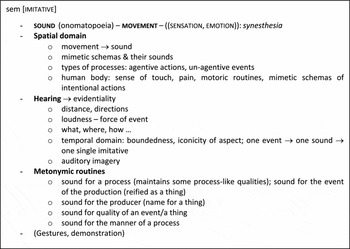
In this section, I will describe the features common to the semantics of all imitatives. I will begin by describing the idea of mimetic schemas in connection to imitatives as conventional sound words, after which I will outline the semantics of Finnish imitatives in general. At the end of this section, Figure 1 provides a summary of my main arguments.
The semantic frame of a Finnish imitative as a construction.

My claim is that mimetic schemas are a part of, or at least closely linked to, the meaning of certain imitatives through the sounds (and other sensations) conventionally associated with these mimetic schemas. Mimetic schemas, a type of intermediately specific image schema, are ‘dynamic, concrete and preverbal representations, involving the body image, which are accessible to consciousness, and pre-reflectively shared in a community’ (Zlatev Reference Zlatev2005:313). According to Zlatev (Reference Zlatev2005, Reference Zlatev2007, Reference Zlatev2014), mimetic schemas are tied to well-known concepts that represent basic events and actions, such as bodily concepts of the basic processes eat, sit, hit, kiss, put in, take out, fall, fly and so on (Zlatev Reference Zlatev2005:317). Mimetic schemas as ‘categories of acts of overt or covert bodily mimesis’ (Zlatev ibid.) are learned early on by the movements and functioning of one's own body and by seeing the movements of other people and things in social interaction. Mimetic schemas are not linguistic, but they can be described in language. Because of their very basic nature, Zlatev (Reference Zlatev2005:327–329) proposes that the first verbs and other motion expressions that a child learns actually reflect some of the most basic mimetic schemas; such verbs include the English cry, pee-pee, jump, move, stay, bring, take, sweep, cut, drive and kick (Tomasello Reference Tomasello1992:187–221, according to Zlatev Reference Zlatev2005:328, also Zlatev Reference Zlatev2014).
What I would like to add is that most of these basic bodily actions are also accompanied with sounds – they are not silent. I argue that also the conventional, familiar sounds of these processes are a part of the cognitive, mimesis-based knowledge structures associated with these processes, mediated by auditory imagery (discussed below). Certain processes come with certain sounds. These sounds can then be imitated with iconic sound words, just as with the naps and humps that I deal with; onomatopoetic sound words are, in fact, another quite concrete manifestation of (bodily) mimesis (see Zlatev Reference Zlatev2005, Reference Zlatev2014), often combined with mimetic narrative strategies in speech and texts (Jääskeläinen Reference Jääskeläinen2013:267–274). I argue that knowledge of basic action-concepts and their sounds are in fact part of the meaning of conventional sound words – we know what things or processes give rise to the sounds ‘plop’ and ‘tick tock’ and so on.
A language typically has many different onomatopoetic interjections that each portrays a certain kind of sound. Their phonological material often reflects certain language-specific sound-symbolic conventions (Oswalt Reference Rhodes1994, Rhodes Reference Rhodes1994, Jääskeläinen Reference Jääskeläinen2015). Rhodes (Reference Rhodes1994) lists the words smack, clack, clank and clunk as examples of such words in English. They all depict differing sounds. However, what is common to all these sound presentations? I will now turn to a more detailed discussion of the semantic pole of an imitative as a construction.
A (certain type of) word can be described as a lexical (or an atomic) construction (Croft Reference Croft2001:16; Fried & Östman Reference Fried and Östman2004). As the class of ‘imitatives’ is described as an abstract (in opposition to a specific) lexical construction, its form should be described as well as its semantic structure, as a construction is a conventional, symbolic association of a form and a meaning/function (Fried & Östman Reference Fried and Östman2004; Goldberg Reference Goldberg2006:3). The description of the form would include, for example, the distinctive phonological characteristics of imitatives, such as their phonological ‘mold’ (e.g. general shape and syllable structure; see Jääskeläinen Reference Jääskeläinen2015). For this paper, however, the description of the semantic pole will suffice due to space restrictions.Footnote 2
First, a typical imitative presents an imagistic, iconic depiction of a sound. The presentation reflects phonological iconicity, onomatopoeia. In addition, some imitatives in the Finnish lexicon describe movements (and simultaneously sounds); sound is always produced by movement, and therefore movement is embedded in the meaning of many imitatives. Some imitatives can also convey other sensations, such as touch, or emotional feelings produced by movement. Many Finnish imitatives are in fact synesthetic, simultaneously conveying different impressions. The depiction of sound is always present, however, and often the most salient sense of an imitative lexeme.
Second, the spatial domain (Langacker Reference Langacker2008:44–45) is active in the semantic frame of an imitative (other active domains are e.g. the domain of sound/pitch and the domain of time). This is because physical movements in the spatial domain produce the sounds that are portrayed by imitatives. Moreover, embedded in the knowledge of the spatial domain are mimetic schemas, the knowledge of types of possible events, whether intentional and agentive actions or un-agentive events, and the intuitive knowledge of the human body and its sensations.
Third, knowledge of the sense of hearing is active in the semantic frame of an imitative. The sense of hearing leads to evidential meanings; providing evidence is in fact the most basic motivation for using imitatives (Jääskeläinen Reference Jääskeläinen2013). More precisely, in practically all use of imitatives the sound that is imitated functions as evidence (for the process producing the sound, for quality, etc.). When an imitative depicting sound is used, the basic qualities of the auditory information processing are activated: human beings with normal hearing can without any conscious processing determine where a natural sound originates, whether the location is near or far away, often what produces the sound, and whether the source of the sound is moving, etc. (‘what’, ‘where’, ‘where from’, ‘how’; Darwin Reference Darwin2010, McAlpine Reference McAlpine2010, Yost Reference Yost2010). Furthermore, the loudness of the sound correlates with the force of the producing event.
Together with the sense of hearing, the domain of time (Langacker Reference Langacker2008:44–45) is also activated; as a rhythmic phenomenon, sound has an integral relation to time and the passage of time (Leisiö Reference Leisiö2010). Different natural sounds convey aspectual information on the processes that produced them: on duration and the boundedness of events, on repetition (frequentative processes), transience, and so on. These qualities are also imitated by the phonetic and syllable structure of imitatives (Jääskeläinen Reference Jääskeläinen2015). For instance, a single imitative (such as naps) imitates a single, short sound that has a clear ending, and if the word is lengthened, this imitates a longer-lasting sound, thus mimicking an event with a longer duration (e.g. fiuuuuuuu used for a longer sound of something flying past).
The sense of hearing is accompanied by the mental capacity for auditory imagery, and part of the use of conventional imitatives can be understood through this capacity. The findings of psychological research show that the human brain produces auditory imagery in addition to, for example, visual imagery, though the latter has nevertheless attracted far more interest in cognitive semantics. Auditory imagery includes the possibility of imagining and manipulating differing sounds in one's mind: the voices of familiar people, the timbre and sounds of instruments, the sounds of nature, melodies of songs, and so on. What is special about auditory imagery is that it seldom occurs without other imagery (visual, tactile, kinesthetic), and auditory imagery is difficult to completely separate from the attendant visual images (Reisberg Reference Reisberg2010). Auditory imagery is relevant to the meanings of conventional imitatives at least in the sense that it helps in the selection of the appropriate conventional imitative. Representations of familiar sounds are stored in memory, and these sounds can be brought to mind with auditory imagery. Then, a corresponding sound word can be used when describing this sound.
Fourth, certain metonymic routines have been found in the use of imitatives. As the Finnish imitatives do not specify the entity that they designate as a thing or a relation but as something more holistic, they are semantically open to interpretation, and sometimes used instead of other parts of speech in certain constructions. For example, imitatives are sometimes used in an adverbial-like manner when describing manner and in an adjective-like manner when describing quality (Jääskeläinen Reference Jääskeläinen2013), these kinds of metonymic changes sometimes leading to permanent semantic changes in lexemes. Imitatives may also be used instead of other kinds of descriptions of a process, e.g. instead of construing an event explicitly as a process with the use of a finite verb (see examples (5) and (8d) below). This kind of use, in fact, reflects a mimetic and demonstration-like construal that is available for speakers and writers when using ideophones (see Kunene Reference Kunene2001).
Finally, gestures and demonstration (see Clark & Gerrig Reference Clark and Gerrig1990) often also accompany the use of imitatives in speech (see Kita Reference Kita1997, McGregor Reference McGregor2001, Nuckolls Reference Nuckolls2001, Dingemanse Reference Dingemanse2013), remnants of which can also be detected in written texts (Jääskeläinen Reference Jääskeläinen2013:320–324). For example, if a person has used a combination of an imitative and a gesture, both of these means can be described in the written account of the speech event, as in this newspaper interview, in which a woman recalls her childhood experiences during the Finnish Civil War:
-
(2) “Ollessani torilla, tästä korvan vierestä meni joku, fiuu”, Lea Laaksonen kuvailee ja näyttää mistä luoti suhahti ohi.
(Language Bank)
‘“While I was at the market, here, beside my ear went something, swoosh [an imitative],” Lea Laaksonen describes and shows where the bullet swished past.’
Gestures are certainly closely linked to imitative use, but the connection between imitatives and gestures might not be a part of the semantic frame of an imitative as a lexical construction, and therefore this connection is shown in brackets in Figure 1.Footnote 3
The semantic dimensions of the Finnish imitative are compiled in Figure 1. The figure describes the semantic pole of an imitative, seen as an abstract lexical construction: this representation aims to summarize the common features of different imitatives in Finnish (but not their individual meanings).
One more terminological issue must be dealt with before proceeding to the semantic study of naps and humps: the question of real or ‘factual’ sounds versus imaginary of ‘fictive’ sounds. Imitatives are not only used when describing actual, audible sounds; rather, they are also employed when describing the imaginary ‘sounds’ of more abstract processes where no sound is really heard at all, as when describing emotional or cognitive processes (Jääskeläinen Reference Jääskeläinen2013:327–332). Thus, in a spatial scenario, an imitative depicts an actual movement, but in its ‘fictive’ use, it depicts a non-spatial, fictive movement. I shall term this kind of use the metaphorical use of imitatives. The metaphorical use of imitatives covers, in fact, many different uses of non-spatial or non-factual imitatives, with different levels of abstraction, transparency and explicitness. In many non-literal cases of imitative use, a conventional figure of speech can be clearly seen. Nevertheless, as the figure of speech creates its own mental space, in that mental space (see Fauconnier & Sweetser Reference Fauconnier and Sweetser1996, Fauconnier & Turner Reference Fauconnier and Turner1998), the sound might actually be factual:
-
(3) Huiman naiset eivät ole tänä keväänä mukana koripallon mitalipeleissä. Viimeinenkin oljenkorsi katkesi ja sanoi naks lauantaina Forssassa, jossa hallitseva mestari Alku kukisti vieraansa pistein 85-76 (40-40).
(Language Bank)
‘The women of Huima [a basketball club] will not be in the basketball finals this spring. The very last straw broke and went [lit.: “said”] naks [“snap”] on Saturday in Forssa, where the reigning champion Alku defeated its guest by 85 points to 76 (40–40).’
In (3), the ‘breaking of the last straw’ is a figure-of-speech; obviously there were no straws present in the game and no actual sound. If a straw were to break, however, naks would be an appropriate sound.Footnote 4 The figure-of-speech in (3) might be seen as an extended metaphor (see Lakoff & Turner Reference Lakoff and Turner1989:69–72), as a new element (a sound) is added to an otherwise conventional figurative phrase. In the most ‘abstract metaphorical’ cases, no sound could be heard in any case, as the processes are less figurative and more abstract, such as cognitive processes; thus there is no explicit indication at all of what causes the sound. The uses of metaphorical imitatives and their motivation are explained in Sections 4.1, 4.2 and 5 below.
3. THE DATA OF THE STUDY
In this examination my intention is to discover what the words humps(is)(ta) and naps(is)(ta) actually mean and how their meanings and uses are motivated. Both words and their correlates are listed in dictionaries. For example, the Dictionary of Contemporary Finnish (Nykysuomen sanakirja, NS)Footnote 5 entries for the words humpsis, naps and napsis are as follows:
-
humpsis interj. äkillisestä uppoamisesta, putoamisesta: hupsis. | H.! Sinne meni syvälle hankeen. | Ja h.! Se [naskali] oli päätänsä myöten uponnut nahkaan. järvent.
-
‘humpsis interjection of sudden sinking, falling: hupsis. | Humpsis! There [it] went deep under the snow. | And humpsis! It [an awl] had sunk up to the hilt into the leather.’
-
naps onom.interj. napsahtavasta äänestä; vrt. nips. | N., ja valo sammui.
-
‘naps onomatopoetic interjection of a snapping sound; cf. nips. | Naps, and the light went out.’
-
napsis onom.interj. = naps. | N. vain, niin kaunis Apollo oli varpusen suussa *tark.
-
‘napsis onomatopoetic interjection = naps. | Napsis only, and [lit.: “so”] the beautiful Apollo was in the mouth of the sparrow.’
Furthermore, these imitatives are related to more specific words with the same stem. The imitative humps, for example, is a closely related to the verb humpsahtaa, and thus the meaning of this verb aids the interpretation of humps. The online dictionary Kielitoimiston sanakirja gives the following entry for humpsahtaa:
-
humpsahtaa pudota, hupsahtaa, humahtaa. (Pudota) humpsahti hankeen. Kuv. Hankkeeseen humpsahti rahaa pari miljoonaa
-
(http://www.kielitoimistonsanakirja.fi/netmot.exe?motportal=80)
-
‘to fall, [other sound-symbolic verbs]. (Fell and) humpsahti into snow. Figuratively A couple of million in money sank [humpsahti] into the project.’
This dictionary-given meaning associates the verb humpsahtaa with downward movement; as we will see in a later section, downward movement is often present also in the uses of the imitative humps (see Section 4.2 below).
The dictionary meanings given above are obviously only partial and do not translate perfectly into other languages (on translating sound-symbolic words, see Veldi Reference Veldi2001, Reference Veldi, Williams and Vessier2004). For this examination, I have collected 257 examples of the imitative humps(is)(ta) and 275 examples of the imitative naps(is)(ta). These examples come from several sources and genres: (i) colloquial texts found on the Internet, (ii) more normative newspaper and prose texts from the Finnish CSC Language Bank collection (cited as Language Bank in the example source annotations), (iii) newspaper texts from the online archives of Helsingin Sanomat (1990–2011), and (iv) older, 19th-century and early 20th-century newspaper texts gathered from the National Library's digital collections.Footnote 6 The method of the present study was close semantic analysis and comparison of the examples. This part of the data was originally collected for my doctoral thesis (Jääskeläinen Reference Jääskeläinen2013), which dealt with the syntactic constructions of expressions containing imitatives. As a corpus, the data are not uniform, as the examples were collected over a long period of time and for specific purposes.
As with other Finnish imitatives of the same CVC(s) structure, the variants CVC(s), CVCsis and CVCsista/ä are equal candidates for the use of humps and naps. Because my first collection focused on the shorter variants, I subsequently collected more examples of the longest forms humpsista (118 examples) and napsista (88) to ensure that they were synonymous with the shorter variants with the aid of the Google search engine. These additional examples were given a slightly less in-depth analysis and were used as an extra resource. The three variants of each word are indeed essentially synonymous, and I will usually only refer to the shortest variant; this practice should be understood to cover the two longer variants as well.
Dingemanse (Reference Dingemanse2012:666) calls for the study of ideophones in actual discourse:
Working with naturally occurring speech is crucial and most urgent [for ideophone research], as it will make it possible to catalogue the different uses of ideophones in everyday social interaction, a necessary baseline to understand all the other uses.
I agree that studying the mere form of ideophones is insufficient and that the meaning and syntactic behaviour of these words, as situated in actual language use, should also be studied. However, many written texts serve as ‘everyday interaction’ in the modern world of print media and, particularly, the social media; consequently, these uses are just as relevant to ideophone study as spoken interaction, at least in a language with a history of writing. Finnish imitatives are used in non-normative Internet texts that simulate speech, such as chat-room discussions (Jääskeläinen Reference Jääskeläinen2013:288–294), but they are also used in prose and edited newspaper texts of many genres, with the exception of the most matter-of-fact, standardized genres. Thus, examining written discourse is also a relevant approach in ideophone studies.
4. MEANINGS AND USES OF NAPS AND HUMPS
4.1 Meanings and uses of naps
The imitative naps(is)(ta) has several basic uses as an imitation of a real sound. As an onomatopoetic word, it can of course be used when it is considered appropriate to the sound heard. Conventionally, however, it is particularly used as a sound word for describing the following processes: the snapping of the fingers, as in (4a) below; the snapping (breaking) of something, especially into two, as in (4b); pressing or turning the electrical switches of appliances (also lights turning on or off, as in (4c); and cutting with scissors, as in (4d).Footnote 7
-
(4)
-
a. “Kaiken on mentävä näin, naps, naps, naps”, Linnander-Manfred napsuttelee sormiaan.
(Internet, from the archive of the magazine Suomen Kuvalehti)
‘“Everything must go like this, naps naps naps,” Linnander-Manfred snaps her fingers.’
-
b. Sini-hopeasävyiseen lusikkaan nappasi alta kilon hauki ja minä tietysti innokkaana veivaamaan sitä kohti rantaa, mutta naps, siima katkesi ja vapa suoristui.
(Internet, chat)
‘A pike of less than a kilo bit the blue-grey spoon [lure] and I enthusiastically started reeling it towards the shore, but naps, the line broke and the rod straightened.’
-
c. Maanviljelijä Markku Heikkilä, 48, istahtaa pirtin pöydän ääreen kotonaan Pälkäneen Laitikkalassa, ja sitten se alkaa. Naps, nauhuri pyörii.
(Language Bank)
‘Farmer Markku Heikkilä, 48, sits down at the living-room table in his home in Pälkäne, Laitikkala, and then it begins. Naps, the tape recorder is on [lit.: “is spinning”].’
-
d. Ensin siirretään vasemmalla kädellä viininlehtiä syrjään, jotta ulottuu saksikädellä Chardonnay-rypäleterttuihin. Sitten leikataan terttu oksasta, naps.
(Helsingin Sanomat)
‘First the vine leaves are moved aside with the left hand, so that the bunch of Chardonnay grapes can be reached with the scissor hand. Then the bunch is cut from the branch, naps.’
-
In examples (4a–d), naps is used for portraying processes that actually produce sound. These kinds of examples with naps are the most common. However, other spatial processes with less audible sounds are also described with naps – this is reflective both of the fact that movement produces sound and also of synaesthesia, listed in Figure 1 as a typical feature of the Finnish imitatives. In some cases, naps seems to portray movement that might (but does not necessarily) include sound, such as the visual, tactile and auditory impression of a fish grabbing a lure (as in (5); naps is used for other kinds of relatively silent grabbing and catching as well) and the sudden adopting of a position:
-
(5) Aamukahvin aikaan mies rullautti siimaansa juuri sopivasti, sillä mustanvihreä perho liitsi upposi syömään tulleen kilon taimenen eteen: naps. Markun hymy levisi, kun hetkeä myöhemmin iso kirjolohi iski samaan perhoon ja vei siimaa pitkin kivikoita. Se oli voittokala.
(Language Bank)
‘Around the time of morning coffee the man cast his line just right, because the black-green fly sank in front of a one-kilo trout that had come up to feed: naps. Markku's smile widened, when a moment later a big rainbow trout hit the same fly and carried the line along the rocky shore. It was a winning fish.’
In (5), a visual ‘snap’ into another state or position is present, but the sound itself might be fictive – if naps is taken to depict sound at all in these examples, and not merely movement. This example, as well as some of the more fictive examples, can often be understood through metonymy; many examples show that the move from literal to metonymic and on to metaphoric is not always a ‘leap’ but a fuzzy continuum between literal, metonymic and metaphorical uses (Radden Reference Radden2002; Moore Reference Moore2014:97–100). In many metonymic examples, a sound is present, but another aspect of the sound-producing process is more relevant. This is the case in (4a), in which the interviewee actually snaps her fingers and this snapping very likely produces a real sound, described with naps. However, the snapping of the fingers in fact stands for swiftness, the tempo of the process being discussed – the sound as such is not the main point.
A display of metaphor, on the other hand, involves extracting one aspect of a factual process that produces a sound like naps – often swiftness or on–off nature – and extending that aspect to another process that does not contain a spatial, factual movement or produce a sound at all, but which is similar in some other significant way. In all metaphorical uses of naps, the process is presented as immediate, complete and very swift; the common denominator is the momentary nature of the process.
Example (5) above is still possibly related to a sound, and it also describes spatial movement. Further along the continuum from the literal through the metonymic to the metaphoric are examples in which the sound is clearly of a non-literal nature, such as the following:
-
(6)
-
a. Mua oikeesti ketuttaa nuo “lopeta stressaaminen, niin NAPS, olet raskaana”-jutut, koska se ei oikesti pidä edes paikkansa.
(Internet, chat)
‘I am really annoyed by that “stop stressing, then NAPS, you are pregnant” talk, because really it's not even true.’
-
b. Kuka oikeasti jaksaa uskoa, että kerran vuodessa, tuossa joulukuun puolivälin tietämissä kristikansa muuttuu – napsista vaan – pelkän hyvän tahdon täyttämäksi herranenkelikuoroksi?
(Internet, a column in a newspaper)
‘Who can really believe that once a year, around mid-December, Christian folk change – just napsista – into a choir of the Lord's angels filled with good will?’
-
c. Erästäkin tapailin puoli vuotta, ja kaikki näytti hyvältä, kunnes naps, tyttö/nainen pisti välit poikki, ja vielä Juhannuksen alla.
(Internet, comment on a blog)
‘One [woman] I dated for half a year, and everything seemed fine, until naps, the girl/woman broke up [with me], and just before Midsummer, too.’
-
d. mä sain eilen raivarin, naps, se oli päällä. siis mitättömästä asiasta koin olevani aivan hylätty ja huono. [– –] mulla on ihan selvä automaatio itsetuhoisuuteen. kun “naps” tapahtuu levy pyörittää: kuolema, kuolema, kuolema . . ei tästä elämästä tule mitään, en kykene . . etc.
(Internet, chat)
‘I had a fit of rage yesterday, naps, it began [lit.: “it was on”]. Because of a trivial thing I felt I was completely abandoned and bad. . . . I have a clear automatic tendency to become suicidal. when “naps” happens the record spins: death, death, death. . . this life is not going to work, I can't. . . etc.’
-
In (6a), a change of bodily state is (falsely) presented as inevitable and swift, (6b) ironically describes a sudden change in people's attitudes and behaviour, and in (6c), one of the writer's romantic partners breaks up with him unexpectedly. In (6d), a mood suddenly swings (naps). This sudden swing is later in the text referred to as naps (‘when “naps” happens’), reflecting a common metonymic routine found in the use of imitatives, the manner of using a sound word as a name for a phenomenon and thus referring to it as a reified thing (see Figure 1 and Jääskeläinen Reference Jääskeläinen2013:264–267).
The fictive sounds in (6a–d) are a metaphorical means of describing meaningful experiences in a comprehensive, concrete way (see e.g. Lakoff & Johnson Reference Lakoff and Johnson1980, Reference Lakoff and Johnson1999). They are attached to descriptions, which often reflect very common, basic conceptual metaphors that occur time and again, as in (6d), which is an example of the metaphor the mind is a machine (Lakoff & Johnson Reference Lakoff and Johnson1980:27–28): a fit of rage gets ‘switched on’ with the sound reminiscent of the sound produced by an electric switch (recall examples (1a) and (4c) above).Footnote 8 The fictive sounds added to these conceptualizations are a rhetorical device. The rhetorical practice of adding sounds to abstract movement processes, thus making those processes more literal or concrete, is not unlike the extension and elaboration of metaphor which Lakoff & Turner (Reference Lakoff and Turner1989:67–72) discuss in connection with poetry and poetic language. Sound as such is not the most vital part of the metaphor, but it can be added to it, as the sound is, after all, part of the source domain or the source frame (Moore Reference Moore2014) of the metaphorical mapping. Making the source domain or frame more salient deconstructs the metaphor and therefore makes it appear fresher. As the examples show, the same devices for revitalizing metaphors are in use in everyday language use as in poetry (Lakoff & Turner Reference Lakoff and Turner1989:67–72; Enwald Reference Enwald1997:62–81).
In addition to the cases presented above, naps is included in certain phrase-like constructions, which occur time and again. One of them is the phrase t(u)osta vain/vaan naps(is)(ta) (glossed: that.ela only naps ‘from there only naps’), meaning ‘just like that; suddenly, quickly, easily, automatically’ and (niin) että/jotta naps (vaan/vain), ‘(so) that naps (only)’, with a similar meaning:
-
(7) Kukaan ei lopeta tuosta vain NAPS ja ala elää raitista elämää miettimättä, joisiko vai ei joisi.
(Internet, chat)
‘Nobody quits tuosta vain NAPS [“just like that”] and starts living a sober life without thinking whether to drink or not.’
It is worth noting that the more metaphorical examples with naps most often occur in negative sentences (such as (7)) or in connection with irony (such as (6a), (6b) and (7)); something does not happen easily – ‘snap’, ‘just like that’ – even if somebody might claim otherwise. Humps can also be used in the construction (niin) että/jotta + imitative + vaan/vain ‘only’, depicting manner, along with many other imitatives. The difference between naps or humps in instantiations of this construction is that variants with naps tend to occur in negative or ironic sentences. Variants with humps are used more ‘honestly’, as actual descriptions of events.
4.2 Meanings and uses of humps
Analysis of the data suggests that even though humps is clearly an audible sound in some examples (8a) it seems more often to portray a synesthetic impression of movement, sound and perhaps also the proprioceptive feel of movement (see Figure 1). An audible sound might not always be present or relevant. The element of pulse-like movement is almost always present in the examples with humps, even in its most metaphorical uses. The most common uses of humps can be grouped as described in the next few paragraphs.
Its most basic meanings involve spatial movement (sinking, soft falling, and downward movement in general; see examples (8a–b) below). Descriptions of falling or sinking into snow or through ice, as in (8c) are particularly common. Other basic spatial uses are descriptions of other pulse-like movement (effortless leaping, weightless rising, see (8d)).
-
(8)
-
a. Usko pois, se 12 kuutiota uppoaa Maaonnen pihaan niin että humps vaan kuuluu! Multa on niin hupaa.
(Internet, chat)
‘You'd better believe it, that 12 cubic metres [of soil] will sink into Maaonni's [a pseudonym] yard with no more than humps [lit.: “so that humps only is heard”]! Soil just vanishes.’
-
b. Eli siis neuvolassa nähtiin video, jossa synnytys oli kyllä musta tosi epärealistinen, vauva vaan humps pullahti maailmaan!
(Internet, chat)
‘So in prenatal clinic we saw a video in which the delivery was in my opinion really unrealistic, the baby just humps plopped into the world!’
-
c. Yleensä kotipiirissä pysyttelevä koira suuntasi kulkunsa merelle. Se ehti tuskin kymmentä metriä rannasta, kun jää koipien alla petti. Humps, ja Osku oli yksin hyisessä meressä!
(Helsingin Sanomat)
‘The dog, which usually stayed near home, directed its step toward the sea. It hardly walked ten metres from the shore, when the ice under its legs gave way. Humps, and Osku was alone in the freezing sea!’
-
d. Kulmala sanoo, että alkaa olla laskeutumisen aika. Kuusen latvat törröttävät korin alla ja humps, taas ylöspäin laakeammille aukeille.
(Internet, story on a hot-air balloon site)
‘Kulmala says it will soon be time to land. The tops of spruces are sticking up under the basket [of the hot-air balloon] and humps, again upward to more open clearings.’
-
The examples show that soft, pulse-like movement is possible in different directions; however, downward movement is the most common.
Examples (8a–d) are descriptions of processes of spatial movement. In addition, humps is often used when describing different types of abstract motion situated in domains other than the spatial domain. The movement described is often a metaphorical vertical motion, in which humps might be used if the movement were spatial. These include the falling and rising of value, in (9a), the loss or gain of weight, in (9b), disappearance and appearance, in (9c), and other abstract movement, in (9d):
-
(9)
-
a. Kultaa ja timantteja, ne on arvokkaita. Mutta jos löytyy suunnaton kulta- tai timanttiesiintymä niin humps, menetti ne möhkäleet arvonsa.
(Internet, chat)
‘Gold and diamonds, they are valuable. But if an enormous gold or diamond deposit is found then humps, those lumps [of gold or diamonds] will lose their value [lit.: “lost their value”].’
-
b. Laihtuminen: laihduin alkuvuodesta raskauden alkuosassa 8 kg ihan niin kuin humpsis vain!
(Internet, blog)
‘Losing weight: At the beginning of the year I slimmed by 8 kg in early pregnancy just like humpsis only!’
-
c. Romaani oli ollut markkinoilla jo monta viikkoa, eikä yhtään arvostelua ollut julkaistu. Sitten, humps, tulivat sekä Finlandia-palkintoehdokkuus että Olvi-säätiön uuden kirjallisuuspalkinnon ehdokkuus.
(Helsingin Sanomat)
‘The novel had already been on the market for weeks, and not a single review had been published. Then, humps, came both the nomination for the Finlandia Prize and the new Olvi foundation literature prize.’
-
d. Jos on joku vahva ihastus olemassa valmiiksi, niin voi olla vaikeaa siirtää niitä tunteita vain humps johonkin toiseen vaikka kuinka haluaisi.
(Internet, chat)
‘If there is already a strong crush, then it can be difficult to transfer those feelings only humps to somebody else even if you want to.’
-
The abstract movement described in (9a–d) cannot really be seen or heard. Thus, these examples reflect metaphorical use if humps is taken at face value, as a description of an actual sound or an impression of actual movement. A common case of more abstract movement described with humps is temporal movement, the passing of time; emphasizing the manner of time just speeding by:
-
(10) Kellohan on jo kolme, koko päivä on mennyt hukkaan. Ja tämäkin päivä menee vain humps ohitse.
(Internet, blog)
‘It is already three o'clock, the whole day has been wasted. And this day too will just go humps past.’
Example (10) reflects a common way of describing the passing of time, termed time is a mover (Lakoff & Johnson Reference Lakoff and Johnson1999, Moore Reference Moore2014).
Finally, there are also more figurative uses of humps that portray metaphoric falling – becoming disappointed or even sinking into depression, feeling metaphorically ‘down’:
-
(11) Sitten lopulta en kestänytkään sitä pahaa, kun annoin sen tarttua itseenikin, ja vaivuin syvään masennukseen. [– –] Sinne minä taas vajosin että humpsis vaan [– –].
(Internet, chat)
‘Then in the end I could not take all that bad after all, when I let it to stick to me too, and I fell into a deep depression. . . . There I sank again like [lit.: “that”] humpsis only.’
The image of falling in (11) reflects the basic metaphors happy is up, or more generally good is up (Lakoff & Johnson Reference Lakoff and Johnson1980) and, in general, the type of metaphor in which mental and cognitive processes are described as bodily experiences, termed mind-as-body metaphors (Sweetser Reference Sweetser1990).
Above, I have presented some representative uses of humps. However, in some examples it is difficult to define its actual meanings. Sometimes humps seems to function as an interjection, expressing surprise or another emotional stance:
-
(12) Samalla ajattelin tutkia tuon lämpömittarin, ja kas humpsista kun saikin kiristellä muttereita.
(Internet, chat)
‘At the same time I thought of examining that thermometer, and well humpsista there were some nuts to tighten [more literally: “huh humpsista when one had to tighten some nuts”].’
In (12) the construction used [interjection + kun ‘when’ + a statement of states of affairs/an adjective] is typical for (some) interjections but not as typical for imitatives. Consequently, although such examples with humps might be easy enough to understand as a whole, the role of humps itself might be difficult to explain. Often the event includes simultaneous literal or metaphorical movement, usually downward, and the description of surprise or another emotion that arises. In these cases, it might be possible to interpret humps as an actual interjection, depicting surprise. Whereas naps is clearly a depiction of a sound in its basic sense, humps is more open to interpretation. In fact, humps is clearly tied by sound-symbolic conventions to some interjections expressly conveying surprise, such as hups (said, for example, when dropping something or bumping into somebody) and hui (said, for example, when startled or seeing something mildly scary), and it has interjection-like uses in which its exact meaning is difficult to define. All these words contain the phonaestheme hu-, which is sound-symbolically tied to the movement of air in onomatopoetic words (Jääskeläinen Reference Jääskeläinen2015). As already seen, the element of moving through air is present in the meaning of humps.
5. DISCUSSION: MIMETIC SCHEMAS AND THE SEMANTICS OF NAPS AND HUMPS
In Sections 4.1 and 4.2 we saw some typical uses of the imitatives naps(is)(ta) and humps(is)(ta). Both words are used literally, but they are also employed to describe more abstract movements with fictive sounds; abstract movements or mental processes cannot actually produce a sound, nor can they be seen. However, there is clearly a continuum between literal and metaphorical uses, constructed via metonymy (Radden Reference Radden2002). A process might actually produce an audible sound, but the sound per se is not as relevant as certain other aspects of the sound-producing process, such as rapidity and momentariness, and the sound, in a sense, embodies these qualities. In addition, it is not always possible to say how literal a sound is: a sound might be real but exaggerated.
Some metaphorical uses of sound words have actually become rather conventional and lexicalized. However, the types of sounds that become lexicalized to certain meanings or become chosen for the less-lexicalized representation of abstract processes (Jääskeläinen Reference Jääskeläinen, Herlin and Kotilainen2012) are highly significant. In other words, sounds are not chosen for metaphorical use by accident, as these sounds reflect shared knowledge of different types of action and their qualities. In Section 2, I argued that part of the meaning of imitatives is their connection to mimetic schemas, which are the categorizations of basic types of action: certain actions produce certain kinds of sounds, and this knowledge is shared. Thus, by using certain sound words people can draw imagery from the relevant shared knowledge structures of these basic processes with their differing ‘feel’ (see Figure 1). Writing on mimetic schemas Zlatev (Reference Zlatev2005:322) states:
[M]imetic schemas exist at the level of specific real or imagined bodily actions. Since they are by their nature experiential structures, each mimetic schema has a different emotional-proprioceptive “feel”, or affective tone (Thompson Reference Thompson2001) to it. Consider, for example, the affective contrast between the mimetic schemas x-kick-y and x-kiss-y. In this way they capture what Johnson [Reference Johnson2005] refers to as “the flesh and blood of meaning”. [Emphasis in the original]
Thus, for example, when the sound word naps is chosen in preference to any other sound word, for a metaphorical scenario, it carries with it a distinctive ‘emotional-proprioceptive feel or affective tone’ that the sound itself is able to evoke.
The literal, concrete uses of imitatives are a reflection of the basic types of action to which they are tied. The present study suggests that naps is particularly bound to the basic action of snapping one's fingers, breaking things into two, cutting with scissors, turning the switch of an electrical appliance, and catching or grabbing something. Humps, on the other hand, is tied to processes involving pulse-like downward movement, such as relatively soft sinking and falling, and other effortless air-mediated movements. These sounds, or also other impressions in the case of humps, are then used for processes that are similar in some sense but situated in a domain other than the spatial.
In the case of naps, the metaphorical target domains or frames are sudden on–off changes, such as breaking off a relationship, as in (6c) above and stopping or beginning something suddenly (e.g. breaking a habit, recall (7) above). These uses may reflect the mimetic schemas of breaking something into two or cutting with scissors. It is worth noting that many examples that concern quitting or giving something up are negative sentences that contain irony; quitting is not as simple as claimed.
Some other on–off changes involve becoming pregnant ‘just like that’, in (6a), and suddenly changing one's behaviour and character, in (6b). These, in turn, perhaps reflect the turning of the switch of an electrical appliance (as literally in (1a), (4c)). Moreover, many of the most abstract uses of naps, in which the sound word is used in combination with mental processes, reflect the same scenario of turning a switch, as in (6d); such uses are relatively common. In some examples, the source scenario is less obvious, as many kinds of processes could produce the naps-like sound that motivated the more abstract use; in these examples, what is common is the suddenness of the movement and the momentary nature of the change that the sound naps represents. Furthermore, the mental images functioning as source frames might be blended: in some examples there seems to be more than one type of imagery motivating a usage.
In the case of humps, the more abstract movements that correspond to the literal movements in the spatial domain are, for example, the rising and falling of value, as in (9a), the loss or gain of weight, as in (9b), and appearing and disappearing, as in (9c). The emotional processes described with humps are those of metaphorical falling, such as becoming depressed, recall (11) above, and, more generally, the process of becoming startled or surprised, which indeed might be the consequence of suddenly tumbling over or falling through ice, see (8c). In other words, the emotional feeling of surprise co-occurs with the proprioceptive feel of falling or sinking. Thus, the more abstract meanings of humps are metaphorical uses that are partly motivated by metonymy.
Humps or naps also differ in the extent and nature of their use to express temporal movement. Humps is commonly used to express such movement, recall (10) above, whereas naps is rarely used. Temporal examples with humps usually portray surprise at the rapidity of the passing of time: an hour goes humps, just like that, or the whole summer flies past with the sound humps. These examples display many kinds of conceptualizations of the passing of time, many of which reflect the basic metaphor of the passing of time, ‘Ego-centered Moving Time’ (Moore 2012): a moment of time or an event approaches the viewer situated in a stationary location, reaches this location, and in the case of many examples with humps, also passes the location. In contrast, when naps is used, the scenario is often something arriving at a goal. Put simply, with humps, time passes by, whereas when sounds like naps are used, an event arrives at the location of the ego. These uses reflect the human experience of time elapsing too fast, and the manner of the movement of time is emphasized with an appropriate sound or visual impression of movement (Jääskeläinen Reference Jääskeläinen2007b, Reference Jääskeläinen, Herlin and Kotilainen2012).
Above, I have discussed the mimetic schemas to which the words naps and humps are tied and how these mimetic schemas are reflected in the metaphorical uses of these sound words. Mimetic schemas are intersubjectively shared, which makes the metaphorical use of sound words possible in the first place. Nevertheless, often the target processes of the metaphorical use of imitatives are also intersubjective: most people have some kind of knowledge of how it feels to, for example, break up, see (6c) above, or to feel sad or depressed, see (11). In other words, there are also shared mental or emotional schemas concerning scenarios of emotional experiences. In order to talk about these universal yet highly personal experiences, people need expressive language, and metaphorical imitatives are often used precisely on those occasions; naps and humps are attached to metaphors that are based on shared experiences and are, in fact, learned ways of retelling those experiences, the same structures and phrases occurring time and time again. Some of the occurrences and events explained with the help of sound words include experiences of emotional life, such as falling in love and breaking up, spiritual issues, such as finding faith, issues concerning breaking habits, such as struggling to lose weight or stop smoking, and issues involving mental health. Indeed, this sharedness presents a paradox: on the one hand, we have the deeply felt individuality of personal experience, and, on the other, we have the sharedness of mimetic and emotional schemas. Another paradox follows: conventional ways of retelling individual experiences also produce banality and clichés, as language is felt to be individual but is very general at the same time.
In the data for this study, the same narrative structures and metaphoric ways of describing experiences occur time and again. There might be multi-layered motivations for the structures and metaphors appearing in the study data, but at bottom they are underpinned by the embodied nature of meaning, and embodied experience is both individual and shared.
6. CONCLUSIONS
This study has examined the use and meanings of two Finnish imitatives, naps(is)(ta) and humps(is)(ta), in natural data comprised of various text genres. The aim was to discover the semantic nuances of these two words, the shared mimetic schemas that function as source frames in their metaphorical use, and the shared emotional schemas that function as the target frames in that metaphorical use. A more general aim of the paper was to contribute to the study of ideophones in actual language use. A further goal was to demonstrate that within a language with a history of writing, speech and spoken interaction are not the only seedbed of naturally occurring ideophonic language: written discourse can also be of relevance. However, written discourse cannot tell us everything there is to know about the use of imitatives. Certain resources that are characteristic for spoken interaction, such as prosody and gestures, are absent. It is indeed obvious that both written and spoken interaction should be examined; different types of material complement each other.
One motivation for this study was also to test Zlatev's ideas of mimetic schemas (Reference Zlatev2005, Reference Zlatev2007, Reference Zlatev, Zlatev, Racine, Sinha and Itkonen2008, Reference Zlatev2014) and to add a component seemingly missing from Zlatev's description: sounds that are produced by very basic action processes and are, in all probability, part of their stored representations – sounds which are made visual especially through the metaphorical use of imitatives. In Sections 4 and 5, I examined the different uses of humps and naps and demonstrated that these words are used not only as literal depictions of sounds and impressions of spatial movement processes but also more abstractly, in descriptions of abstract motion and also as ideophonic impressions attached to cognitive and emotional processes, which also reflect shared schemas. Emotional feeling of surprise is one of the senses of humps, and the mimetic schema of falling, with its distinctive proprioceptive feel, was given as one possible bodily motivator for this sense. The strength of imitatives is their unique construal: they present an imagistic, iconic depiction of a sensation and thus evoke imagery that is shared on direct bodily level. Their use is demonstration-like and expressive. Thus they aid at identifying with others and their experiences on a level that is directly accessible.
The more abstract uses of naps and humps can be seen as metonymic or metaphoric extensions of their more spatial uses, which take advantage of auditory and visual imagery. In the case of naps, the meaning of sound is quite salient in most uses; in the case of humps, however, it is in fact debatable whether the meanings of movement or sound are in all uses relevant. However, over the course of time, figurative use can become conventionalized to the point of semantic change and loss of transparency in motivation. The loss of some imitative meaning is in fact evident also in the use of naps and humps. As the same structures and metaphors occur time and again in similar contexts, it is indeed possible that some of their original onomatopoetic and expressive meaning will be lost, and sound words will develop into conventionalized means of describing such things as swiftness, ease, or surprise, as is already evident in the use of naps and humps in some contexts. In many cases, however, both naps and humps are still used literally, and these literal, spatial uses are still transparent motivators for their more abstract uses.
ACKNOWLEDGEMENTS
The writing of this article has in many ways been the result of the inspiring discussions of our research group The Social Mind and Grammar, at the University of Helsinki. I wish to thank the members of this group for their inspiration and help! Especially, I want to thank Marja Etelämäki and Ilona Herlin for reading and editing my text. I also thank the reviewers of NJL for their careful and valuable comments.