Introduction
Indigofera is an important genus of hot arid region of India but had received very little attention (Singh and Beniwal, Reference Singh and Beniwal2005) for sustainable utilization in rangelands. It is well represented by 10 species namely Indigofera oblongifolia Forssk., I. argentia Burm., I. astragalina DC. Prodr., I. caerulea Roxb., I. cordifolia Heyne., I. hochstetteri Baker., I. linifolia (L.) Retz., I. linnaei Ali., I. sessiliflora DC. Prodr. and I. tinctoria L. occurring in different habitats of western Rajasthan (Bhandari, Reference Bhandari1990). A new species, I. jaisalmerica has also been reported from Jaisalmer district of Indian desert by Purohit and Kulloli (Reference Purohit and Kulloli2021). Species of Indigofera could withstand adverse environmental conditions such as extremes of temperature and drought in the Thar Desert besides overgrazing. They can also grow on a wide range of soils and rainfall as well as of temperature. Most of the Indigofera species are in a wild state and grazed by animals particularly sheep and goats, and also used as cut and carry fodder. Due to heavy grazing pressure, many of the species and their ecotypes are on the verge of extinction particularly in the Thar Desert (western Rajasthan). The seeds of some of the species like I. cordifolia Heyne ex Roth are also the source of food during the times of scarcity and famine. The genus Indigofera received attention earlier in regard to chemotaxonomy (Bhalla and Dakwale, Reference Bhalla and Dakwale1978; Mishra et al., Reference Mishra, Danie and Sabnis1981) and also for anatomical studies (Kumar, Reference Kumar1983). Among the different species, I. oblongifolia is one of the important underutilized multi-use leguminous shrub traditionally used for forage, medicine and herbal tooth-brush. It is an erect arid shrub that occupied open dry areas with stable sandy soils in the region.
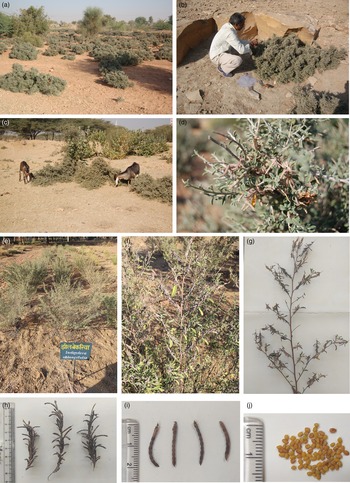
I. oblongifolia (syn. I. paucifolia Delile) belongs to family Fabaceae. It is a tall woody, erect much branched, ashy-grey shrub that become more or less woody, especially near the base. Leaves are simple or imparipinnate; leaflets (1-) 3–5, alternate, elliptic-oblong, more or less hairy above and silvery hairy beneath. Flowers are small, in many flowered, axillary racemes and red in colour. Pods are densely silvery when young, dirty reddish at length, slightly up-curved, tortulose and 6–8-seeded (Fig. 2i). Seeds are obliquely oblong-globose, yellow and smooth (Fig. 2j). Flowering and fruiting occur from September to March, however, it may be throughout the year if conditions are favourable (Bhandari, Reference Bhandari1990; BSI, 2022). It is known by different vernacular names in different areas. It is commonly known as Goilia or Jhil bakeriya in western Rajasthan, Raktpala in Sanskrit, Jhiladi in Gujarat, Kuttukara or chammathi in Tamil Nadu, Janglineeli in Karnataka and Kondavempali in Andhra Pradesh.
It is widely distributed in Jordan, Yemen, Baherien, Eritrea, Somalia, Egypt, Sudan, Senegal, Angola, Nigeria, Arabia, Baluchistan, Pakistan, Java, Sri Lanka, India (Bhandari, Reference Bhandari1990; BSI, 2022) and also in Australia and North and South America (Lubbad et al., Reference Lubbad, Al-Quraishy and Dkhil2015). In India, it is distributed from Upper Gangetic Plains to Peninsular India, Rajasthan and also in Gujarat. In Rajasthan, it is reported from different locations from Banswara, Barmer, Jaipur, Jhalawar and Sawai Madhopur districts (Shetty and Singh, Reference Shetty and Singh1987). In western Rajasthan, it mainly occurs in Barmer, Bikaner, Jaisalmer, Jodhpur and Pali districts (Bhandari, Reference Bhandari1990). In Rajasthan, it occurs in gravelly calcareous soil or on older alluvial plains. This species generally grow in open sun light, preferring a well-drained but moist soil. This is found on a variety of soils, ranging from black clays to sandy soils. Relatively little scientific work has been done for exploitation of its potential for multipurpose utilization and development in hot arid region of India. Thus, the present paper highlighted the distribution pattern, browsing value, morphological characterization, phytochemical of leaves and, traditional knowledge and utilization of I. oblongifolia for exploitation of its potential and, to stimulate research interest and promotes its sustainable utilization in hot arid regions.
Materials and methods
Survey and germplasm collection
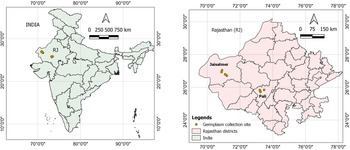
Field surveys were undertaken in four districts viz., Barmer, Jaisalmer, Jodhpur and Pali of western Rajasthan of India. The germplasm in the form of fruits (pods) were collected during fruiting stage in the month of October to December. Passport data were noted as per passport data sheet of Indian Council of Agricultural Research-National Bureau of Plant Genetic Resources (ICAR-NBPGR), New Delhi (online Supplementary Table S1). The geographical coordinates of the germplasm collected sites were recorded using GPS and depict in Fig. 1. Some of the accessions were deposited at National Gene Bank, ICAR-NBPGR, New Delhi for long-term conservation. The associated vegetation and conservation status of species were also noted during field survey. The information on ethno-botany and distribution pattern was collected from the personal interviews of local peoples and secondary data from available literature.
Geographical map of germplasm collection sites covering two districts of western Rajasthan (RJ) namely Jaisalmer and Pali.

Basic soil analysis
Soil samples were taken from collection sites and analysed for pH, electrical conductivity (EC), soil organic carbon (SOC), available phosphorus (P) and available potassium (K) at ICAR-Central Arid Zone Research Institute (CAZRI), Jodhpur. The collected soil samples were air-dried and sieved with a 2 mm screen and subjected to physical and chemical analyses using following standard analytical procedures. The pH and EC (dS m−1) were determined in supernatant solution of 1:2 soil: water suspensions (w/v) using pH meter and conductivity meter, respectively (Jackson, Reference Jackson1973). SOC (%) was determined by rapid titration method (Walkley and Black, Reference Walkley and Black1934). Available phosphorus (kg ha−1) and available potassium (kg ha−1) were estimated using colorimetric (Olsen et al., Reference Olsen, Cole, Watanabe and Dean1954) and flame photometer (Pratt, Reference Pratt, Page, Miller and Keeney1982) methods, respectively.
Field establishment and evaluation for agro-morphological traits
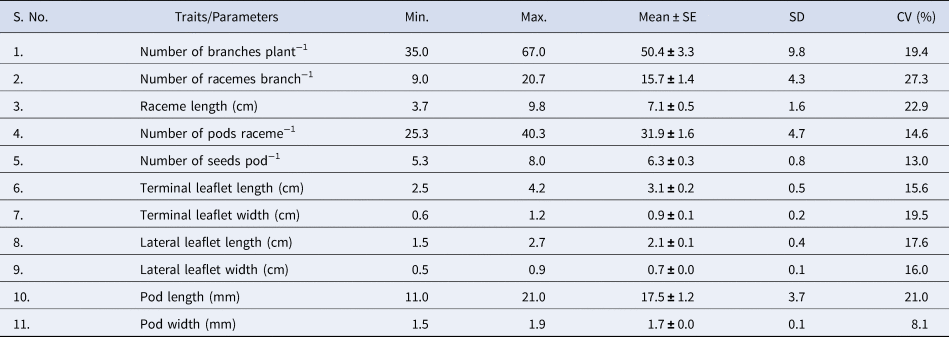
The seeds were extracted from collected pods and dried at room temperature. Five seeds were sown in polythene bags prepared with soil mixture of sand, silt and FYM (1:1:1) in nursery. Field repository of I. oblongifolia was established in Botanical Garden of ICAR-CAZRI, Jodhpur for ex-situ on-farm conservation (Fig. 2e). Plant growth data viz., plant height (cm), canopy diameter (cm) in north-south and east-west direction, and number of branches per plant was recorded for one year of establishment in the interval of 3rd, 6th and 12th month. Ten individual plants were subjected for morphological characterization using 11 important traits after one year of establishment as follows: Number of branches plant−1, number of raceme branch−1, raceme length (cm), number of pods raceme−1, number of seeds pod−1, terminal leaflet length (cm), terminal leaflet width (cm), lateral leaflet length (cm), lateral leaflet width (cm), pod length (mm) and pod width (mm). The data were statistically analysed and presented in form of minimum and maximum values, mean ± SE, standard deviation and coefficient of variance (CV).
(a) Natural view of Indigofera oblongifolia at Devikot site in Jaisalmer district of western Rajasthan, (b) seed collection at Amarsagar site (Jaisalmer), (c) browsing by goats, (d) dense and bushy nature of stem by browsing pressure, (e) field repository of I. oblongifolia showing one year of growth at Desert Botanical Garden, ICAR-CAZRI, Jodhpur, (f) individual branch with raceme at field, (g) individual branch, (h) raceme, (i) pods and (j) seeds.

Phytochemical estimation
The fresh leaves of I. oblongifolia were collected from field repository established at Desert Botanical Garden, ICAR-CAZRI, Jodhpur for phytochemical analysis. Total antioxidant activity and total flavonoid content were determined by the methods described by Benzie and Strain (Reference Benzie and Strain1996) and Marghitas et al. (Reference Marghitas, Dezmirean, Laslo, Moise, Popescu and Maghear2007), respectively. Total phenolic content was estimated using Folin Ciocalteu assay (Singleton et al., Reference Singleton, Orthofer and Lamuela-Raventós1999). Total saponin content was estimated by vanillin–sulphuric acid method described by Hiai et al. (Reference Hiai, Oura and Nakajima1976) and total chlorophyll content was determined by DMSO (dimethyl sulphoxide) reagent (Blanke, Reference Blanke1992). All biochemical analysis was carried out in biological triplicates with three replications. The detailed information on phytochemical estimation is described in supplementary Table S2.
Results and discussion
Survey and distribution pattern
During the field survey in four districts of western Rajasthan, i.e. Jaisalmer, Barmer, Pali and Jodhpur, its distribution was found in different natural habitats of only Jaisalmer and Pali districts (Fig. 1). Literature and herbarium specimens indicated its presence in the districts of Bikaner, Ganganagar, Jalore, Jhunjhunu, Sikar and Sirohi as well (Shetty and Singh, Reference Shetty and Singh1987; Bhandari, Reference Bhandari1990). The passport data of collected I. oblongifolia fruit samples is presented in online Supplementary Table S1. Its occurrence was observed in the range of 25.72–27.04 °N latitude, 70.87–73.47 °E longitude and 153.3–276.1 m altitude. During the germplasm collection from Jaisalmer and Pali districts in Rajasthan, it showed an irregular patchy distribution in the depressions of rocky areas and sometimes in the bunds of farmer fields, and also along the depressions on the road sides. However, it's very good coverage along the road sides was noticed in the Devikot site of Jaisalmer district (Fig. 2a).
Associated vegetation and browsing pressure
The associated species observed in Jaisalmer district during field survey and germplasm collections were woody perennial in nature like Acacia senegal (L.) Willd., Salvadora oleoides Decne., Euphorbia caducifolia Haines, Grewia tenax (Forsk.) Fiori, Capparis decidua (Forsk.) Edgew., Calotropis procera (Ait.) R.Br., Ziziphus nummularia (Burm.f.) Wt. etc., however, in Pali district mainly two woody species were noticed such as Capparis decidua and Acacia nilotica (L.) Del. The analysis of association vegetation described the information on what kind of plant diversity and protection available in natural habitats for its better survival in open areas of the Thar Desert of India.
I. oblongifolia is one of the adapted hot arid legume browse species, very much preferred by sheep and goats. During the germplasm collection, high browsing pressure was noticed in its natural stands particularly in Jaisalmer district, which limited the availability of mature seeds for their propagation and spread across the region. The extent of browsing pressure can be seen by the condition of shrub and their plant height as shown in Fig. 2(c) and (d). The plant becomes woodier, especially near the base, and stem becomes dense and bushy under high browsing pressure. However, its profuse plant growth, flowering and fruiting was observed, under protected condition (Fig. 2(e) and (f)).
Edaphic characteristics
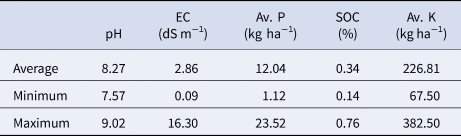
The soil samples collected from I. oblongifolia sites in the district of Jaisalmer and Pali revealed significant variation in pH, EC, soil organic carbon (SOC), available P and available K (Table 1). I. oblongifolia showed good growth in dry and poor soil conditions in an arid region. The soils were dominantly alkaline in reaction, with pH ranging from 7.57 to 9.02 with a mean value of 8.27. The electrical conductivity (EC) varied from 0.09 to 16.30 dS m−1. Wide variations in EC values could be due to the use of poor quality water as well as inherent properties of the Thar Desert soils (Dhir, Reference Dhir1977; Kumar et al., Reference Kumar, Raina and Singh2020). Results of the soil analysis revealed that SOC was low throughout the study area region, while available P and K were low to medium and medium to high, respectively. The values of SOC ranged from 0.14 to 0.76% with a mean of 0.34%. The SOC obtained in this study is extremely low (<0.50%), according to an earlier report on the organic carbon status of western Rajasthan districts such as Jaisalmer, Barmer, Bikaner, Churu and Nagaur (Kumar et al., Reference Kumar, Raina and Singh2020). The available phosphorus in the soils showed wide variability (1.12–23.52 kg ha−1) with mean value of 12.04 kg ha−1. As the mean values across the region suggests, in general the quantity is low to medium. The available potassium (K) ranged from 67.50 to 382.50 kg ha−1 with mean values of 226.81 kg ha−1 with an overall medium fertility rating. Comparatively, samples collected from Pali district showed high level of SOC and available K as compared to Jaisalmer district. It also showed high pH (9.02) and EC (16.30 dS m−1) which indicates its suitability to saline areas. A study by Khan and Ahmad (Reference Khan and Ahmad1998) from Pakistan on effects of saline water irrigation on germination, growth and mineral distribution of I. oblongifolia revealed that sodium accumulating capability of it as foliar succulence in leaves and fruit wall compare to selective transport of Mg2+ to leaves and accumulation of Ca2+ in roots.
Range of variation on soil parameters collected from collection sites of Indigofera oblongifolia

Plant growth and agro-morphological characterization
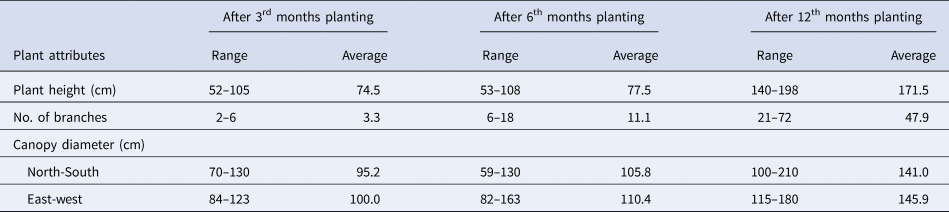
Under Jodhpur conditions, it showed good plant growth with respect to plant height, number of branches and canopy diameter after 3rd, 6th and 12th months of planting in the field (Table 2). The plant height increased up to 171.5 cm after 12 months of planting and varied from 52 to 105 cm, 53 to 108 cm and 140 to 198 cm at 3rd, 6th and 12th months after planting, respectively. The number of branches plant−1 increased considerably up to 12th months and reaching value 47.9 branches plant−1 and it ranged from 2 to 6, 6 to 18 and 21 to 72 at 3rd, 6th and 12th months after planting, respectively. In contrast to plant height and the number of branches plant−1, the canopy diameter increased directly with rise in the age of plants in both north–south and east–west directions. The canopy diameter in north–south and east–west direction were ranged as 70–130 cm and 84–123 cm, 59–130 cm and 82–163 cm, 100–210 cm and 115–180 cm at 3rd, 6th and 12th months after planting, respectively. The profuse plant growth of this species in adverse climatic condition of hot arid region makes it suitable for rangelands improvement.
Growth data of Indigofera oblongifolia at Jodhpur, India

Ten individual plants were subjected to morphological characterization using 11 important traits and their range of variations is presented in Table 3. The range values of number of branches plant−1, number of racemes branch−1, raceme length and pod length are as 35–67.0, 9.0–20.7, 3.7–9.8 cm and 11.0–21.0 mm, respectively, with mean of 50.4, 15.7, 7.1 cm and 17.5 mm. This study revealed the presence of a considerable amount of genetic variation within the plant as high CV (%) was obtained in the number of racemes branch−1 (27.3) followed by raceme length (22.9), pod length (21.0) and least in pod width (8.1). The length variability in raceme and pods is also depicted in Fig. 2(h) and (i). The morphological characterization of three Indigofera species was also carried out by Fugarasti et al. (Reference Fugarasti, Muzzazinah and Ramli2020) in Java, Indonesia for identification, characterization and classification. Atta et al. (Reference Atta, Al-faifi and El-Shabasy2022) characterized six Indigofera species including I. oblongifolia using traditional morphological characters and modern phytochemical for study of their relationship and distribution of active compounds of these species.
Range of variation for 11 morphological traits in Indigofera oblongifolia

Phytochemicals
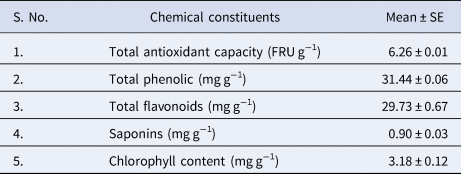
Analysis of phytochemicals in different solvent extract of leaves of I. oblongifolia was performed (Table 4). The ethanolic extract showed an antioxidant capacity of 6.26 FRU g−1 (Ferric reducing equivalent). The samples showed high total phenolic (mg catechol equivalent g−1 leaves) and total flavonoids (mg quercetin equivalent g−1 leaves) content as 31.44 and 29.73, respectively as compared to cereals and grasses (Niroula et al., Reference Niroula, Khatri, Khadka and Timilsina2019). The saponin and chlorophyll content (mg g−1 leaves) were found in the samples to be 0.90 and 3.18, respectively. The presence of considerable amount of phytochemicals like total phenolic, total flavonoids and total antioxidant capacity in the leaves of I. oblongifolia promotes it as a good browse species in the rangelands of Indian hot arid region especially in western Rajasthan. Previous studies on different plant parts of I. oblongifolia have reported a range of compounds from different phytochemical classes. The major compounds identified belonged to the flavones, flavanols, phenolic acids and phytosterols followed by other groups such as aliphatic alcohols, alkaloids, polyamines and glucosinolates (online Supplementary Table S3). Some of the identified phytochemicals like indigin, indigotin, indirubin and indigoferic acid are characteristic of the genus Indigofera. Anuradha et al. (Reference Anuradha, Vijay Kumar, Radhakrishnaiah and Narayana1987) reported that there is a uniform occurrence of p-coumaric, p-OH benzoic and vanillic acids and an unknown phenolic compound ‘e’ of hRf value 42/57 in all the taxa. I. dalzellii, I. hirsuta, I. oblongifolia and I. prostrata stand out in the unique possession of certain compounds. The compounds Indigoferin-A, Indigoferin-B and Indigoferin-C were also reported in the species I. gerardiana by Tariq et al. (Reference Tariq, Ahmad, Obaidullah, Khan, Choudhary, Ahmad and Ahmad2011).
Phytochemical constituents in the leaves of Indigofera oblongifolia

Traditional knowledge and utilization
It is leguminous, non-thorny arid shrub reported to good browse species in western Rajasthan. Its leaves are grazed by goats, sheep and camels and have ability to survive under high browsing pressure in extreme arid condition (Fig. 2c). Species of Indigofera have been well known for preparation of dye in India since ancient times. Some Indigofera species such as I. tinctoria L., I. caerulea Roxb, and I. dosua Don are used as blue dye, but, I. tinctoria was once the main source of blue dye production in India. I. oblongifolia is not used as a dye plant in India, but utilized as a dye plant in Mali and Zimbabwe (Mansfeld, Reference Mansfeld2001). Indigofera species are traditionally used for green manure in India, especially in southern part of India. It is reported to be extensively employed as green manure (Singh et al., Reference Singh, Wadhwani and Johri1996).
I. oblongifolia is one of the important traditional medicinal plant species in arid and semi-arid regions. It is very much used by the rural and tribal people and commonly used as an herbal tooth brush. Owing to its rich phytochemical profile, it exhibits various health-promoting effects. It is known as Raktpala in Ayurveda. In Ayurvedic formulation, its roots are used as cooling agent, improve appetite and rheumatism. All parts of plant are useful in enlargement of spleen and liver (Kirtikar and Basu, Reference Kirtikar and Basu1975). It is considered as an antidote to all kinds of poison and used as an anti-inflammatory for insect stings, snakebites and swellings. Roots are used as purgatives and stem decoction as a gargle in mercurial salivation (Caius, Reference Caius1989). It is also used as a cure for stomach-ache (Bhandari, Reference Bhandari1990). Saharias and Damors take orally the fresh juice of plant with sugar or ‘Gur’ to cure liver diseases, diarrhea and rheumatism (Singh and Pandey, Reference Singh and Pandey1998). Aggarwal et al. (Reference Aggarwal, Prasad, Reuter, Kannappan, Yadev, Park, Kim, Gupta, Phromnoi, Sundaram, Chaturvedi and Sung2011) also reported that I. oblongifolia is used traditionally in folk medicines to treat infection of the urinary tract and skin, dissolved urinary stones and to relieve coughs. Leaf decoction is used to remove dandruff, leaf juice given in spruce, crushed leaves are applied to wounds and leaves are used in veterinary medicine to treat abdominal gas (Quattrocchi, Reference Quattrocchi2012). In Barda hills, Gujarat, Joshi and Nishteswar (Reference Joshi and Nishteswar2014) reported that whole plant ash of I. oblongofolia with oil is used in animal healthcare for treating traumatic wounds and non-healing ulcers, and also is used in the urticaria of camels. The whole plant is also given with Avartani (Helicteris isora) leaves and salt in acute indigestion conditions of animals. Its tender branches are commonly used as tooth brush in rural areas and also by the Kathodi tribals in Rajasthan (Gupta et al., Reference Gupta, Gaur, Malhotra and Dutta1966; Bhandari, Reference Bhandari1990; Singh and Pandey, Reference Singh and Pandey1998). Recently, Abdel Moneim (Reference Abdel Moneim2016) reported protective, anti-fibrotic, antioxidant, and anti-apoptotic activities of I. oblongifolia extracts on PbAc-induced hepatotoxicity. Al-Quraishy et al. (Reference Al-Quraishy, Dkhil, Ibrahim and Abdel Moneim2016) investigated the possible neuroprotective role of I. oblongifolia leaf methanolic extract against lead-induced neurotoxicity. It indicated its beneficial effects on mitigating lead acetate-induced neurotoxicity via its antioxidant and anti-apoptotic activities. Dkhil et al. (Reference Dkhil, Hafiz, Thagfan, Al-Shaebi, Mubaraki, Khalil, Abdel-Gaber and Al-Quraishy2019a) proved the antioxidant activities of I. oblongifolia in the spleen against the oxidative damage induced by Trypanosoma evansi. Dkhil et al. (Reference Dkhil, Abdel-Gaber, Khalil, Hafiz, Mubaraki, Al-Shaebi and Al-Quraishy2019b) investigated the impact of I. oblongifolia leaf extract on Trypanosoma evansi-induced hepatic injury. Further, Dkhil et al. (Reference Dkhil, Al-Shaebi and Al-Quraishy2019c) investigated the potential role of I. oblongifolia leaf extract on hepatic inflammation in mice with Plasmodium chabaudi-infected erythrocytes. They found that it exerts significant effects against malaria and protects the liver from injury caused by P. chabaudi via antioxidant and anti-inflammatory ways. Dkhil et al. (Reference Dkhil, Al-Shaebi, Abdel-Gaber and Al-Quraishy2020) reported that I. oblongifolia has anti-trypanosomal activity and might enhance the brain response to Trypanosoma evansi. Lubbad et al. (Reference Lubbad, Al-Quraishy and Dkhil2015) also reported that I. oblongifolia leaf extract exhibits significant antimalarial and antioxidant effects, and protects host spleen tissue from injuries induced by Plasmodium chabaudi. Sethi et al. (Reference Sethi, Ahn, Sandur, Lin, Chaturvedi and Aggarwal2006) explained the reasons for the anti-inflammatory and anti-cancer activities of I. oblongifolia. They indicated that anti-cancer and anti-inflammatory activities previously assigned to indirubin may be mediated in part through the suppression of the NF-kappaB activation pathway. Upwar et al. (Reference Upwar, Patel, Waseem and Mahobia2011) investigated and evaluated the anti-inflammatory effect of I. oblongifolia extracts on carrageenan-induced inflammation in rats and provide scientific evidence for development of I. oblongifolia as a potential natural oral anti-inflammatory agent. Shahjahan et al. (Reference Shahjahan, Vani and Shyamala Devi2005) also assessed the protective effect of I. oblongifolia in CCl4-induced hepato toxicity and proposed that the extract has antioxidant property. Dahot (Reference Dahot1999) also reported anti-microbial and antifungal activity of small proteins in the leaves of I. oblongifolia.
Conclusion
I. oblongifolia is a multi-use leguminous, woody, non-spiny perennial underutilized shrub species in western Rajasthan and as a good source of browse for small ruminants in its range of natural distribution. Besides its value as a forage/fodder, it can also be very well exploited for its medicinal value, as the species is viewed as an antidote for all kinds of poisons and is known for its analgesic and anti-inflammatory effects. The present study clearly showed the distribution pattern, browsing pressure, plant growth and agro-morphological traits, phytochemicals of leaves and traditional utilization of I. oblongifolia under extreme hot arid conditions of western Rajasthan. The good plant growth under hot arid condition makes it suitable for introduction in alternate land-use systems or in rangeland improvement programmes. The presence of good amount of total phenolic, total flavonoids and total antioxidant capacity in leaves revealed its suitability to be promoted as a browse species in rangelands of hot arid regions, especially in western Rajasthan. Being underutilized multipurpose leguminous shrub species revealed to promote it as a new crop in arid and semi-arid of India especially in western Rajasthan to exploit the potential of the species. The following research gap would be needed:
• Systematic exploration from diversity-rich region and development of superior genotypes for higher fodder value.
• Experiment on feeding trials on small ruminants and a detailed study on nutritive and also anti-nutritive factors if any, for its wider use.
• Introduction of superior genotypes in alternate land-use system or in rangelands improvement programme.
• Study of threat assessment and in-situ conservation of its natural stands in the region and also to create awareness amongst the inhabitants for its multi-use value.
Supplementary material
The supplementary material for this article can be found at https://doi.org/10.1017/S1479262123000837
Acknowledgements
The authors express their sincere thanks to The Director, ICAR-CAZRI, Jodhpur for guidance and providing all available facilities, and financial support. The study was conducted under Institute project (Project No. CAZRI/T-02/50) at Regional Research Station, ICAR-CAZRI, Jaisalmer.