Infants born at extremely low birth weight (ELBW; <1000 g) are the tiniest and most vulnerable babies and are exposed to negative environmental stressors in prenatal and early postnatal life. ELBW infants provide an experiment in nature that can illustrate how exposure to extreme early adversity may play a role in gene–environment interactions. Preterm infants, and particularly those born at ELBW, are exposed to suboptimal intrauterine conditions, which create an adverse early environment. These infants spend their first weeks or months of life in the neonatal intensive care unit (NICU), an extremely stressful environment, where these infants require numerous invasive medical procedures to diagnose and treat life-threatening conditions. This environment contrasts greatly from the calm and protective maternal intrauterine environment that they were to experience during this period of development (Chau et al., Reference Chau, Ranger, Sulistyoningrum, Devlin, Oberlander and Grunau2014). However, premature birth has brought these fragile neonates to repeated exposure of highly stressful and potentially painful experiences that are developmentally unexpected.
Later in development, survivors of ELBW are at increased risk for a wide range of neurosensory impairments, behavioral and emotional problems, decrements in intellectual performance, and poorer general health than those born at normal BW (NBW; BW ≥ 2500 g; Levy-Shiff et al., Reference Levy-Shiff, Einat, Har-Even, Mogilner, Mogilner and Lerman1994; Rickards, Kelly, Doyle, & Callanan, Reference Rickards, Kelly, Doyle and Callanan2001; Saigal & Doyle, Reference Saigal and Doyle2008; Saigal et al., Reference Saigal, Feeny, Rosenbaum, Furlong, Burrows and Stoskopf1996; Saigal, Hoult, Streiner, Stoskopf, & Rosenbaum, Reference Saigal, Hoult, Streiner, Stoskopf and Rosenbaum2000; Saigal, Rosenbaum, Szatmari, & Campbell, Reference Saigal, Rosenbaum, Szatmari and Campbell1991; Saigal, Szatmari, Rosenbaum, Campbell, & King, Reference Saigal, Szatmari, Rosenbaum, Campbell and King1990, Reference Saigal, Szatmari, Rosenbaum, Campbell and King1991).
Because of advances in fetal and neonatal medicine, the first generation of ELBW survivors born in the early era of neonatal intensive care has reached adulthood. This cohort of survivors was born in the late 1970s–early 1980s, prior to many medical advancements, including the use of surfactant for proper lung functioning. Thus, rates of ELBW survival were substantially lower than today. In the present prospective, longitudinal study, we examined whether gene–environment interactions predicted internalizing problems among survivors of ELBW in their mid-20s and mid-30s. To the best of our knowledge, this is the first study to report on the impact of gene–environment interactions on psychopathology among ELBW adult survivors.
Studies that have followed infants born at ELBW or very low BW (VLBW; <1500 g), and extreme prematurity (<26 weeks), have reported increased risks of psychopathology during childhood and adolescence, particularly inattention and anxiety (Botting, Powls, Cooke, & Marlow, Reference Botting, Powls, Cooke and Marlow1997; Farooqi, Hägglöf, Sedin, Gothefors, & Serenius, Reference Farooqi, Hägglöf, Sedin, Gothefors and Serenius2007; Indredavik, Vik, Heyerdahl, Kulseng, & Brubakk, Reference Indredavik, Vik, Heyerdahl, Kulseng and Brubakk2005; Indredavik et al., Reference Indredavik, Vik, Heyerdahl, Kulseng, Fayers and Brubakk2004; Johnson et al., Reference Johnson, Hollis, Kochhar, Hennessy, Wolke and Marlow2010; Saigal, Pinelli, Hoult, Kim, & Boyle, Reference Saigal, Pinelli, Hoult, Kim and Boyle2003; Stevenson, Blackburn, & Pharoah, Reference Stevenson, Blackburn and Pharoah1999; Szatmari, Saigal, Rosenbaum, & Campbell, Reference Szatmari, Saigal, Rosenbaum and Campbell1993; Szatmari, Saigal, Rosenbaum, Campbell, & King, Reference Szatmari, Saigal, Rosenbaum, Campbell and King1990). However, very few studies have followed ELBW survivors into adulthood. Nonetheless, the studies that have followed them reported increased levels of anxiety and depression in their mid-20s and mid-30s (Boyle et al., Reference Boyle, Miskovic, Van Lieshout, Duncan, Schmidt and Hoult2011), as well as shyness, timidity, behavioral inhibition, and risk aversion (Schmidt, Miskovic, Boyle, & Saigal, Reference Schmidt, Miskovic, Boyle and Saigal2008; Waxman, Van Lieshout, Saigal, Boyle, & Schmidt, Reference Waxman, Van Lieshout, Saigal, Boyle and Schmidt2013). These internalizing problems may be particularly prominent among ELBW survivors who were born small for gestational age (SGA; BW < 10th percentile for GA) compared to those born at an appropriate weight for GA (AGA; BW > 10th percentile for GA; Boyle et al., Reference Boyle, Miskovic, Van Lieshout, Duncan, Schmidt and Hoult2011; Van Lieshout, Boyle, Saigal, Morrison, & Schmidt, Reference Van Lieshout, Boyle, Saigal, Morrison and Schmidt2015). In a study with adults aged 18–27, who were born at VLBW, only those born SGA were at elevated risk for emotional instability and depression compared to those born at VLBW and AGA (Raikkonen et al., Reference Raikkonen, Pesonen, Heinonen, Kajantie, Hovi and Jarvenpaa2008; Strang-Karlsson et al., Reference Strang-Karlsson, Räikkönen, Pesonen, Kajantie, Paavonen and Lahti2008). Thus, intrauterine growth restriction and size for GA are factors that may modify the risk of developing psychopathology. According to a cumulative risk model, individuals born at both ELBW and SGA are placed at the greatest risk for negative developmental outcomes, including psychopathology.
Internalizing problems are also related to allelic variations in the promoter region of the serotonin transporter linked polymorphic region gene (5-HTTLPR; Lesch et al., Reference Lesch, Bengel, Heils, Sabol, Greenberg and Petri1996). The short allele of 5-HTTLPR is associated with lower transcriptional efficiency compared to the long allele, with functional effects on neural circuits regulated by serotonin (Hariri et al., Reference Hariri, Mattay, Tessitore, Kolachana, Fera and Goldman2002). This reduction is linked to a predisposition for depression, anxiety, and negative emotionality (Munafo et al., Reference Munafo, Clark, Moore, Payne, Walton and Flint2003). In addition, carriers of the short allele are more likely than carriers of the long allele to develop depression or depressive symptoms in response to adverse or stressful life events (Benjet, Thompson, & Gotlib, Reference Benjet, Thompson and Gotlib2010; Caspi, Hariri, Holmes, Uher, & Moffitt, Reference Caspi, Hariri, Holmes, Uher and Moffitt2010; Caspi et al., Reference Caspi, Sugden, Moffitt, Taylor, Craig and Harrington2003; Taylor et al., Reference Taylor, Way, Welch, Hilmert, Lehman and Eisenberger2006; Uher & McGuffin, Reference Uher and McGuffin2008). Taken together, these studies suggest that the risk for internalizing problems following exposure to significant psychological and/or physiological stress is elevated among carriers of 5-HTTLPR short allele and diminished among those carrying the long allele. Thus, given the early pre- and postnatal (e.g., experiences in the NICU) adversity to which ELBW survivors, particularly SGAs, are exposed, it is likely that similar genetic variations leading to internalizing problems will be observed among these survivors.
Here, we examined the combined effect of BW status (a proxy of intrauterine and early postnatal environmental exposure to stress) and 5-HTTLPR on internalizing problems among survivors of ELBW during their mid-20s and mid-30s. We prospectively followed the oldest known longitudinal cohort of ELBW survivors and a matched group of NBW controls. ELBW participants were further stratified into SGA and AGA groups. To the best of our knowledge, this is the first study to examine the interaction effect of BW status and 5-HTTLPR on adult psychopathology among survivors of ELBW. Given that ELBW survivors, particularly those born SGA, are at increased risk for internalizing problems in adulthood and because carrying the short allele of 5-HTTLPR has been linked with these problems as well, our study focused on internalizing problems in the mid-20s and 30s. Participants were classified into either 5-HTTLPR short (SS/SLG/SLA) or long (LALG/LALA) alleles. Based on previous research (Boyle et al., Reference Boyle, Miskovic, Van Lieshout, Duncan, Schmidt and Hoult2011; Van Lieshout et al., Reference Van Lieshout, Boyle, Saigal, Morrison and Schmidt2015), we expected that survivors of ELBW who carry the short allele would report increased internalizing problems. Furthermore, we expected cumulative risk for ELBW/SGA short allele carriers and predicted that this group will report the most internalizing problems.
Method
Participants and cohort overview
The study followed 397 predominantly Caucasian infants who were born at ELBW (501–1000 g) between 1977 and 1982 to residents of a geographically defined region in central-west Ontario, Canada. Infants were weighed at birth, and GA was estimated from maternal report of the first day of the last menstrual period. Using Canadian norms (Kramer et al., Reference Kramer, Platt, Wen, Joseph, Allen and Abrahamowicz2001), infants with BWs < 10th percentile for GA were classified as SGA and the remainder as AGA. Follow-up assessments were conducted when participants were 22–26 and 29–36 years old. Of the original 397 infants, 179 survived to hospital discharge. There were 13 later deaths, and 166 survived to adulthood. At age 22–26, Young Adult Self-Report (YASR; Achenbach, Reference Achenbach1997) data were collected on 142 of the 166 adult survivors. At age 29–36, 100 ELBW participants completed the YASR. At age 29–36, 92 ELBW participants provided buccal cell samples, with 89 providing an adequate amount for processing. There was 1 participant who did not complete the age 22–26 assessment, but completed the age 29–36 assessment.
The NBW control group was recruited when both groups were 8 years old. This group comprised 145 children born at term according to maternal report, between 1977 and 1981. The control sample was matched with the ELBW cohort on child age, sex, and socioeconomic status (Saigal, Szatmari, et al., Reference Saigal, Szatmari, Rosenbaum, Campbell and King1991). At age 22–26, YASR data were collected on 133 of the 145 NBW control participants. During the 29–36 year assessment, 89 NBW participants completed the YASR. At age 29–36, 89 participants provided buccal cell samples, with 81 participants providing an adequate amount for processing. The study was approved by the Hamilton Integrated Research Ethics Board, and informed consent was obtained from all participants.
Measures
YASR
The YASR (Achenbach, Reference Achenbach1997) was completed during both the mid-20s and mid-30s assessments. The YASR contains problem items rated from 0 (not true) to 2 (very true or often true). Our study focused only on scales related to internalizing problems. Based on experts' ratings of the items' consistency with classifications in the Diagnostic and Statistical Manual of Mental Disorders (DSM-IV; American Psychiatric Association, 1994), the items were grouped into DSM-oriented scales (Achenbach, Bernstein, & Dumenci, Reference Achenbach, Bernstein and Dumenci2005). We analyzed continuous scores for the depressive (mid-20s α = 0.88; mid-30s α = 0.87), anxiety (mid-20s α = 0.77; mid-30s α = 0.82), somatic (mid-20s α = 0.74; mid-30s α = 0.77), and avoidant personality (mid-20s α = 0.76; mid-30s α = 0.80) problems scales. In addition, we analyzed a higher order internalizing problems scale (mid-20s α = 0.93; mid-30s α = 0.93), which was composed of all other scales.
DNA extraction and genotyping
Participants provided buccal cell samples during the mid-30s visit. DNA was isolated from buccal swabs using the QIAamp DNA Investigator kit from Qiagen. Genotyping for 5-HTTLPR was done in a two-step process. First, the gene was amplified using polymerase chain reaction (PCR). Second, a portion of the PCR product underwent restriction fragment length polymorphism analysis where a restriction enzyme is used to digest the DNA into fragments that can translate into genotype. Genotyping was performed without knowledge of the participant's BW group. Either a 484- or a 528-base pair fragment was generated using forward primers 5′-GGCGTTGCCGCTCTGAATGC and reverse primer 5′- GAGGGACTGAGCTGGACAACCAC (Lesch et al., Reference Lesch, Bengel, Heils, Sabol, Greenberg and Petri1996). AccuPrime GC-Rich DNA polymerase (invitrogen 12337-016) was used to amplify the gene. The 25 μl amplification mixture contained 100 ng of genomic DNA, 0.2 μM of each primer, 1X AccuPrime GC-Rich Buffer A, and 1 U of AccuPrime GC-Rich DNA polymerase. The cycling conditions were as follows: initial denaturation at 95 °C for 3 min; followed by seven cycles of 95 °C for 30 s, 68 °C for 30 s, and 72 °C for 1 min; then seven cycles of 95 °C for 30 s, 67 °C for 30 s, and 72 °C for 1 min; and another seven cycles of 95 °C for 30 s, 66 °C for 30 s, and 72 °C for 1 min. Final extension took place at 72 °C for 10 min. The uncut product was run on a 1.5% agarose gel at 50 V for 90 min. Twelve microliters of the PCR product was then cut using the restriction enzyme MSPI (New England Biolabs) for 3 hr at 37 °C (Praschak-Rieder et al., Reference Praschak-Rieder, Kennedy, Wilson, Hussey, Boovariwala and Willeit2007). The cut product was run on a 4%–20% tris/borate/EDTA gel at 14 mA for 100 min to separate the bands (invitrogen EC6225BOX). 5-HTTLPR is found on chromosome 17. 5-HTTLPR is a 44 base pair deletion in the promoter region at base pairs 1212 to 1255, resulting in a short or long allele (Heils et al., Reference Heils, Teufel, Petri, Stöber, Riederer and Bengel1996). Within the extra 44 base pairs of the long variant there is also a single nucleotide polymorphism, which is a substitution of adenosine to guanine present at nucleotide 6 (Hu et al., Reference Hu, Lipsky, Zhu, Akhtar, Taubman and Greenberg2006). The resulting band pattern for the cut PCR product was 340 base pairs for long-A, 297 base pairs for short, and 166 + 174 base pairs for long-G (Praschak-Rieder et al., Reference Praschak-Rieder, Kennedy, Wilson, Hussey, Boovariwala and Willeit2007). The participants were classified according to allele into either short (SS/SLG/SLA) or long (LALG/LALA). No significant differences were found between the BW groups in the distribution of short or long 5-HTTLPR alleles (all ps > .38). The genotypes were within Hardy–Weinberg equilibrium.
Results
Preliminary analyses
At both the mid-20s and mid-30s assessments, participants who were included and not included in the analyses did not significantly differ on age (all ps > .45), BW (all ps > .24), GA (all ps > .08), or level of education (all ps > .48). Significant gender differences were found between participants included and not included in the analysis at both the mid-20s assessment, χ2 (1) = 9.53, p < .01, and mid-30s assessment, χ2 (1) = 14.48, p < .0001, with more females (mid-20s, N = 103; mid-30s, N = 103) than males (mid-20s, N = 63; mid-30s, N = 57) included in both visits.
Statistical analyses included participants who had both YASR and 5-HTTLPR data available. Data were examined for outliers and participants with more than 3 SD from the mean were removed from all analyses. These outliers were removed because they can affect the mean dramatically and not represent the majority of the group. This resulted in one ELBW/SGA and two ELBW/AGA participants being excluded from the analysis on the internalizing scale at the mid-20s assessment. As well, one ELBW/SGA participant was excluded from the analysis on the internalizing scale at the mid-30s assessment. Table 1 indicates the number of participants who were included in each analysis.
Comparison of demographic variables by birth weight group at the mid-20s (age 22–26) and mid-30s (age 29–36) assessments

Note: ELBW, Extremely low birth weight; SGA, small for gestational age; AGA, average for gestational age; NBW, normal birth weight; SES, socioeconomic status (Hollingshead, Reference Hollingshead1969). Highest level of education ranges from 1 to 7, with 7 being the highest score; SES ranges from 1 to 5, with 5 being the lowest score.
a Compared with NBW participants, p < .05.
b Compared with NBW participants, p < .0001.
c Compared with ELBW/AGA participants, p < .0001.
To ascertain that the three BW groups were comparable on sociodemographic measures (Hollingshead, Reference Hollingshead1969), a series of analyses comparing ELBW/SGA, ELBW/AGA, and NBW participants were carried out (Table 1). A univariate analysis of variance revealed significant age differences during the mid-20s assessment, F (2, 163) = 3.89, p < .05, ηp 2 = 0.05, such that ELBW/SGAs were significantly younger than NBWs (Table 1). Therefore, participant age was entered as a covariate in all further analyses. No other significant sociodemographic differences emerged between the three groups. Next, we analyzed each scale using separate analyses of variance for the 22–26 and 29–36 time points. Birth weight group (ELBW/SGA, ELBW/AGA, NBW) and 5-HTTLPR efficiency (short, long) were between-subject factors, and age was included as a covariate.
Mid-20s assessment
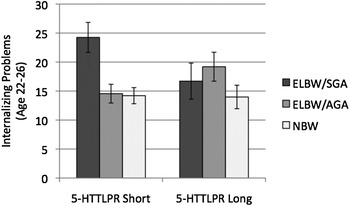
The results for the internalizing scale revealed a main effect for BW group, F (2, 159) = 3.70, p < .05, ηp 2 = 0.04, with ELBW/SGA participants (M = 20.48, SE = 2.03) reporting more internalizing problems than NBW participants (M = 14.09, SE = 1.24), p < .05. ELBW/AGA participants reported intermediate levels of internalizing problems (M = 16.87, SE = 1.49). This main effect was qualified by a significant Birth Weight Group × 5-HTTLPR interaction, F (2, 159) = 2.98, p < .05, ηp 2 = 0.04. Pairwise comparisons indicated that among short allele carriers, ELBW/SGA participants reported more internalizing problems than both ELBW/AGA and NBW participants (all ps < .005), which did not significantly differ from each other. No significant differences were found between the three BW groups among carriers of the long allele. No significant differences were found between short and long allele carriers within each BW group (Figure 1).
Internalizing problems at age 22–26 as a function of birth weight group and 5-HTTLPR allele. Bars indicate standard errors.

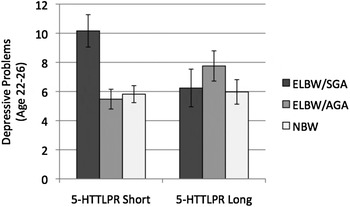
The results for the depressive problems scale revealed a significant Birth Weight Group × 5-HTTLPR interaction, F (2, 157) = 4.37, p < .01, ηp 2 = 0.05. Pairwise comparisons indicated that among short allele carriers, ELBW/SGA participants reported more depressive problems than both ELBW/AGA and NBW participants (all ps < .005), which did not significantly differ from each other. No significant differences were found between the three BW groups among carriers of the long allele. Furthermore, among ELBW/SGA participants, those carrying the short allele reported significantly more depressive problems than those carrying the long allele, p < .05. No significant differences were found between short and long allele carriers within the ELBW/AGA or NBW groups (Figure 2).
Depressive problems at age 22–26 as a function of birth weight group and 5-HTTLPR allele. Bars indicate standard errors.

The results for the anxiety problems scale revealed a main effect for BW group, F (2, 159) = 3.78, p < .05, ηp 2 = 0.05, with ELBW/SGA participants (M = 4.66, SE = 0.50) reporting significantly more anxiety problems than NBW participants (M = 3.21, SE = 0.30), p < .05. ELBW/AGA participants reported intermediate levels of anxiety problems (M = 4.15, SE = 0.36). No other significant effects were found for anxiety problems during the mid-20s assessment.
No significant main effects or interactions were found for somatic or avoidant personality problems during the mid-20s assessment.
Mid-30s assessment
The results for the internalizing scale revealed a main effect for BW group, F (2, 151) = 4.25, p < .05, ηp 2 = 0.05, with ELBW/SGA participants (M = 18.61, SE = 2.16) reporting more internalizing problems than NBW participants (M = 11.97, SE = 1.38), p < .05. ELBW/AGA participants reported intermediate levels of internalizing problems (M = 16.69, SE = 1.65). No other significant effects or interactions were found for internalizing problems during the mid-30s assessment. The interaction between BW group and 5-HTTLPR was not significant.
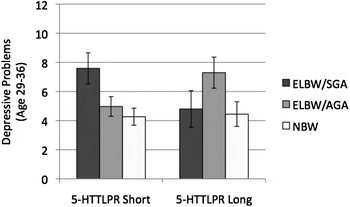
The results for the depressive problems scale revealed a main effect for BW group, F (2, 146) = 3.09, p < .05, ηp 2 = 0.05. Pairwise comparisons probing this main effect were not significant. The main effect of BW group was qualified by a significant Birth Weight Group × 5-HTTLPR interaction, F (2, 146) = 3.05, p < .05, ηp 2 = 0.04. Pairwise comparisons indicated that among short allele carriers, ELBW/SGA participants reported more depressive problems than NBW participants, p < .05, but did not significantly differ from ELBW/AGA participants. No significant differences were found between the three BW groups among carriers of the long allele. No significant differences were found between short and long allele carriers within each BW group (Figure 3).
Depressive problems at age 29–36 as a function of birth weight group and 5-HTTLPR allele. Bars indicate standard errors.

The results for the avoidant personality problems scale revealed a main effect for BW group, F (2, 149) = 3.07, p < .05, ηp 2 = 0.04. Pairwise comparisons probing this main effect were not significant. No other significant effects or interactions were found for avoidant personality problems during the mid-30s assessment.
No significant main effects or interactions were found for anxiety or somatic problems during the mid-30s assessment.
Stability of internalizing problems
In order to examine whether internalizing problems were stable between the two assessments points, Pearson correlations were conducted on outcome variables. The findings revealed that scores on the YASR scale during the mid-20s assessment were significantly positively correlated with these scores during the mid-30s assessment: internalizing problems, r (153) = .68, p < .0001; depressive problems, r (150) = .61, p < .0001; anxiety problems, r (154) = .59, p < .0001; somatic problems, r (151) = .39, p < .0001; avoidant personality problems, r (152) = .67, p < .0001.
Discussion
The present study is the first known to examine gene–environment interactions predicting psychopathology among ELBW survivors. As expected, the findings suggest that increased levels of internalizing problems are found among ELBW survivors through their early to mid-30s. These internalizing problems were particularly increased among ELBW survivors who were also born SGA. For the first time, we also report an interaction between BW group and 5-HTTLPR. Across their 20s and 30s, ELBW/SGAs carrying the short allele of 5-HTTLPR reported more internalizing problems, particularly depression, as compared to ELBW/AGAs and NBW controls. Taken together, these data suggest that ELBW/SGA survivors are at increased risk for internalizing problems, particularly those carrying the short allele of 5-HTTLPR. These findings were obtained when these survivors were in their third decade of life and remained stable into their fourth decade. Internalizing scores during the mid-20s assessment were significantly and substantially positively correlated with internalizing scores during the mid-30s assessment, suggesting that these problems were stable between ages 22–26 and 29–36.
The present study is consistent with previous studies suggesting increased internalizing problems among adults born at ELBW (Boyle et al., Reference Boyle, Miskovic, Van Lieshout, Duncan, Schmidt and Hoult2011; Schmidt et al., Reference Schmidt, Miskovic, Boyle and Saigal2008; Van Lieshout et al., Reference Van Lieshout, Boyle, Saigal, Morrison and Schmidt2015; Waxman et al., Reference Waxman, Van Lieshout, Saigal, Boyle and Schmidt2013). Our findings extend this body of research by suggesting that 5-HTTLPR is a factor in the development of internalizing problems among survivors of ELBW. In particular, our findings support a cumulative risk model, according to which ELBWs who were also born SGA were at the greatest risk for internalizing problems during their mid-20s and mid-30s. These findings underscore the importance of examining moderating neurobiological factors that contribute to developmental outcomes and risk for psychopathology among survivors of prematurity.
ELBW infants, particularly those who were also born SGA, have been exposed to a stressful intrauterine and early postnatal environment. Birth weight and GA are surrogate markers of the fetal environment (Boyle et al., Reference Boyle, Miskovic, Van Lieshout, Duncan, Schmidt and Hoult2011). This environment may become stressful due to a variety of factors, including maternal genes, health behavior during pregnancy, and adverse maternal exposure. This stressful intrauterine environment, in combination with the stressful NICU environment, exposes these infants to adverse early experiences. Thus, our findings are also consistent with previous research suggesting that in response to negative life events, individuals carrying the short allele of 5-HTTLPR are more likely than those carrying the long allele to experience internalizing symptoms, particularly depression (e.g., Caspi et al., Reference Caspi, Sugden, Moffitt, Taylor, Craig and Harrington2003, Reference Caspi, Hariri, Holmes, Uher and Moffitt2010; Uher & McGuffin, Reference Uher and McGuffin2008).
It is important to note that our findings were significant for the depressive problems scale at both the mid-20s and mid-30s assessments, as well as for the internalizing problems scale at the mid-20s assessment. We did not find significant interactions for the other scales that we analyzed. These findings suggest that the gene–environment interaction observed in this study was stable across the two adult assessment points for depression problems only. The gene–environment interaction for the internalizing problems scale was not stable over time. The reason is that this scale comprises all other internalizing scales, for which no interaction effects were observed, other than the depression problems scale. The finding that 5-HTTLPR interacts with adverse environmental influences in predicting depression is consistent with previous studies (Benjet et al., Reference Benjet, Thompson and Gotlib2010; Caspi et al., Reference Caspi, Sugden, Moffitt, Taylor, Craig and Harrington2003, Reference Caspi, Hariri, Holmes, Uher and Moffitt2010; Taylor et al., Reference Taylor, Way, Welch, Hilmert, Lehman and Eisenberger2006; Uher & McGuffin, Reference Uher and McGuffin2008), which suggest that early adversity, in combination with the short allele of 5-HTTLPR, plays a role in the development of depression.
Several limitations to the present study should be noted. First, our participants were born and raised in a developed country, where medical care and education are universally available.
Second, it is important to note that our sample size is relatively small for a gene–environment study. However, given the uniqueness of our sample, and the fact that our results are consistent with prior gene–environment studies (Benjet et al., Reference Benjet, Thompson and Gotlib2010; Caspi et al., Reference Caspi, Sugden, Moffitt, Taylor, Craig and Harrington2003, Reference Caspi, Hariri, Holmes, Uher and Moffitt2010; Taylor et al., Reference Taylor, Way, Welch, Hilmert, Lehman and Eisenberger2006; Uher & McGuffin, Reference Uher and McGuffin2008), we believe this limitation does not undermine the importance of our findings.
Third, although our ELBW and NBW groups were matched on age, gender, and socioeconomic status, and the participants in the mid-20s and mid-30s assessments did not differ on important variables, our sample has undergone attrition due to loss to follow-up over the past 30 years. However, no significant sociodemographic differences were found between those who continued in the study and those who dropped out.
Fourth, our participants were born before the use of surfactant, at a time when survival rate of ELBW infants was lower, and therefore in order to survive, SGAs, on average, had a higher GA than AGAs. Although our sample does not include ELBW/SGAs with an earlier GA (because they did not survive), our findings are in line with research suggesting that late preterm infants face increased risk for physical and mental health problems, as well as mortality, compared to full-term infants (e.g., Engle, Tomashek, & Wallman, Reference Engle, Tomashek and Wallman2007; van Baar, Vermaas, Knots, de Kleine, & Soons, Reference van Baar, Vermaas, Knots, de Kleine and Soons2009). Furthermore, although our sample was born before 1990, when surfactant became widely used in neonatal intensive care, the literature suggests that mental health problems, particularly internalizing problems, are also prevalent among ELBW samples born after 1990 (Anderson, Doyle, & Group, Reference Anderson, Doyle and Group2003; Conrad, Richman, Lindgren, & Nopoulos, Reference Conrad, Richman, Lindgren and Nopoulos2010; Farooqi et al., Reference Farooqi, Hägglöf, Sedin, Gothefors and Serenius2007; Hack et al., Reference Hack, Taylor, Schluchter, Andreias, Drotar and Klein2009; Methúsalemsdóttir, Egilson, Guðmundsdóttir, Valdimarsdóttir, & Georgsdóttir, Reference Methúsalemsdóttir, Egilson, Guðmundsdóttir, Valdimarsdóttir and Georgsdóttir2013; Taylor, Margevicius, Schluchter, Andreias, & Hack, Reference Taylor, Margevicius, Schluchter, Andreias and Hack2015).
Fifth, our sample is unique because it includes survivors of ELBW who are currently in their fourth decade of life. Hence, replication of this study is currently not possible given the uniqueness of this sample. However, our findings are in line with research on methylation of the serotonin transporter gene (solute carrier family C6, member 4 [SLC6A4]) in a cohort of children who were born very preterm (24- to 32-weeks GA; Chau et al., Reference Chau, Ranger, Sulistyoningrum, Devlin, Oberlander and Grunau2014). The findings from that work suggest that greater methylation of SLC6A4 among very preterm school-age children was significantly associated with total problems on the Child Behavior Checklist (Achenbach & Rescorla, Reference Achenbach and Rescorla2001). Although findings from the present study and Chau et al.'s (2014) study point to similar conclusions, future research should attempt to replicate the findings of the present study in other samples of ELBW adult survivors.
In sum, this is the first known study to examine gene–environment interactions in predicting internalizing problems among adult survivors of ELBW. Using the oldest known longitudinally followed cohort of ELBW survivors, we found increased internalizing problems among ELBW survivors who were also born SGA and carried the short allele of 5-HTTLPR. Our findings are novel and possibly elucidate the neurobiological pathways underlying risk for psychopathology. Understanding the factors playing a role in developmental trajectories leading to psychopathology in these survivors can provide valuable insights for prevention and intervention efforts particularly given the worldwide increase in rates of premature birth.