Introduction
New patterns of international migration have altered the demographic landscape of liberal-democratic countries. New forms of difference have generated new political pressures and sparked debates about traditional conceptions of identity and community, as well as the rights and mutual obligations embedded in citizenship. One sector where the new demography may have changed the rules is the welfare state. The nature of the relationship between migration and welfare state spending is as yet unclear: some researchers suggest that international migration will drive growth in the welfare state, while other research predicts the opposite (cf. Nannestad, Reference Nannestad2007; Portes and Vickstrom, Reference Portes and Vickstrom2011; Stichnoth and Straeten, Reference Stichnoth and Straeten2013). That said, almost none of this literature goes directly to the impact of international migration; almost without exception, the data are about ethnic diversity, where the latter is often the residue not of migration but of arbitrary boundary-making or historical patterns of racial or ethnic domination. Sometimes the evidence is subnational.
One early paper that uses cross-national immigration data is Soroka et al. (Reference Soroka, Johnston and Banting2006), which finds a negative relationship between international migration and destination-country social spending. The current paper builds upon that earlier investigation in two ways. First, we update the general claim and find that the relationship is even more robust than before. Second, we are now able to disaggregate social spending into subdomains, such as unemployment benefits, pensions, and the like. Where the earlier work barely allowed researchers to scratch the surface of causal inference, disaggregation enables us to compare domains for their political vulnerability.
Migration and social welfare spending
Where the relationship between migration and welfare state spending is concerned, two strikingly different possibilities appear. One is that a large inflow of migrants will drive up social spending, especially in generous welfare states. This possibility reflects two expectations with both academic support and public resonance. The first is that migrants coming to the developed world from developing countries will be comparatively low-skilled and poorly educated, relative to both source and host countries (Borjas, Reference Borjas1994). The second is that these low-skilled migrants, well aware of the notable variance in welfare state generosity, will cluster in more generous welfare states. This ‘welfare magnet theory’ (Borjas, Reference Borjas1999) suggests that migrants are more likely than native-born welfare recipients to engage in welfare shopping; this greater propensity towards welfare shopping results from the fact that for an immigrant, the cost of migration is offset by both lower wage dispersion in host countries and the more generous welfare state (whereas for the native-born, the latter factor alone would have to justify the cost of moving).
Both the accuracy and the generalizability of these results have been the subject of considerable debate. On the accuracy question, for instance, Zavodny (Reference Zavodny1999) argues that Borjas’ findings are simply the result of the clustering of migrants in certain states where immigrant populations are already large, as they attempt to take advantage of pre-existing immigrant networks. On generalizability, the applicability of Borjas’ US-focused conclusions to international decisions about migration destination is contested – when migrants choose among destination countries (as opposed to simply choosing among US states), numerous other factors come into play. In an international setting, migration policy regimes, family reunification options, and cultural/linguistic similarities can all have considerable roles in directing the flow of migrants, with the result that the effect of welfare generosity may (at least in some instances) disappear (cf. Pedersen et al., Reference Pedersen, Pytlikova and Smith2004; Peridy, Reference Peridy2006). It is also possible that the relationship highlighted by the welfare magnet theory is endogenous, with the composition of immigrant groups or policy changes in reaction to immigration altering unemployment benefit spending (Giulietti et al., Reference Giulietti, Guzi, Kahanec and Zimmermann2013).
Existing cross-national research on the matter is divided. Concerns that generous welfare benefits may negatively affect levels of labour market participation of migrants have found some support in research (e.g. Constant and Schultz-Nielsen, Reference Constant and Schultz-Nielsen2004). Other researchers find that migrants are – albeit only marginally – more likely than non-migrants to be welfare recipients (Borjas and Hilton, Reference Borjas and Hilton1996; Brücker et al., Reference Brücker, Epstein, McCormick, Saint-Paul, Venturini and Zimmermann2002). Moreover, the effect of migration on factor prices may in some instances counteract these negative effects (see Razin and Sadka, Reference Razin and Sadka2000). In general, the conclusion here suggests that migration in its current form is associated with somewhat smaller increases in welfare state expenditures (Nannestad, Reference Nannestad2007).
If the critiques just mentioned do not impugn the basic observational pattern, they do question the causal ordering or suggest conditions. A more rounded critique argues that the primary effect of international immigration is negative – it leads to decreases in social spending. In this scenario, the impact is political rather than economic: increased migration shifts public attitudes towards a preference for welfare cutbacks (see, e.g., Freeman, Reference Freeman1986; Nannestad, Reference Nannestad2007; Eger, Reference Eger2010; Burgoon et al., Reference Burgoon, Koster and van Egmond2012). Regardless of whether migrants are actually choosing their destinations on the basis of welfare state generosity or are more welfare state-reliant than native-born populations, concern about migration amongst native-born populations decreases aggregate support for redistributive policies.
It is certainly true that public concern about migration and immigrant reliance on welfare benefits is on the rise throughout the developed world. ‘Welfare chauvinist’ attitudes and political parties have seen a particular increase in Europe. This European phenomenon is in line with work focused on the United States as well. The account offered in well-known work by Alesina and colleagues (Alesina et al., Reference Alesina, Baqir and Easterly1999; Alesina and Glaeser, Reference Alesina and Glaeser2004), for instance, is that anti-welfare state politicians in the United States play upon racial stereotypes in their push to limit welfare benefits.
The political motivations underlying welfare chauvinism may not be purely fiscal in nature. The literature on anti-immigrant attitudes suggests that economic concerns are often secondary to broader anxieties about the changing ethnic makeup of the national community (Sniderman et al., Reference Sniderman, Peri, Figuerido and Piazza2000, Reference Sniderman, Hagendoorn and Prior2004, Reference Sniderman and Hagendoorn2007). In particular, research along these lines builds on decades of work from social psychologists pointing to the importance of social groupings and consequent in-group/out-group biases (see Tajfel, Reference Tajfel1981); under this perspective, certain categorical distinctions are deemed salient under specific circumstances, often due to factors such as low self-esteem and an uncertainty about a group’s dominant status in society (cf. Tajfel and Turner, Reference Tajfel and Turner1979; Hogg and Abrams, Reference Hogg and Abrams1993). According to this argument, then, one would expect to see a link between increases in migration and decreases in social spending and redistributive policy more generally.
Alongside work that finds a negative relationship between migration and welfare spending; however, there is a growing body of work suggesting that the main effects of migration on social spending are limited, or require mediation by other factors. Lipsmeyer and Zhu’s (Reference Lipsmeyer and Zhu2011) examination of EU states, for instance, suggests that increased migration may increase welfare benefits if left-party strength or union density is high. Taylor-Gooby (Reference Taylor-Gooby2005) finds that the effects of the left’s strength can counteract those of diversity. In a study of 21 countries over 20 years, Banting et al. (Reference Banting, Johnston, Kymlicka and Soroka2006) found that the impact on social spending may be weakly conditional on the strength of multicultural policies.
Survey data also suggest that the immigration-redistribution link is nuanced. Mau and Burkhardt find that migration and ethnic diversity do not have a simple direct effect on public attitudes, but rather are mediated by institutional factors such as ‘whether inclusion is institutionally organized and whether social benefits schemes have been constructed in such a way that they reinforce or lessen conflicts over redistribution’ (Reference Mau and Burkhardt2009: 226). An examination of survey data in 17 European countries by Burgoon et al. (Reference Burgoon, Koster and van Egmond2012) suggests that working in an occupational sector that has a high percentage of foreign-born employees actually increases support for redistribution, due to increased economic insecurity. Emmenegger and Klemmensen (Reference Emmenegger and Klemmensen2013) stress the importance of individual motivations other than simple self-interest (such as egalitarianism and humanitarianism) in moderating the perceived relationship between attitudes towards immigration and redistribution; Brady and Finnigan Reference Brady and Finnigan(2013) also emphasize heterogeneity in the impact of immigration.
In short, the relationship between migration and welfare state spending is complex, mediated by a number of factors, and may be changing over time. We address this last possibility first by seeing if the relationship changes with the addition of 10 years of data to the Soroka et al. (Reference Soroka, Johnston and Banting2006) framework. We address the first by considering in some detail not just the direct impact of migration on social spending, but the degree to which prima facie evidence for a connection between migration and social spending may be produced through other, mediating variables. We also explore one facet of conditionality, by examining effects in nine social welfare subdomains. We do so with the expectation that if migration affects social expenditures, it will affect different types of welfare programmes in different ways.
Broadly speaking we see two possibilities. First, increased migration may reduce spending across all social programmes, regardless of how heavily they may be used by immigrants or how exposed they may be to moral hazard (Hypothesis 1). Perhaps political backlash against increasing migration pushes voters and governments to the right, and this ideological shift reduces support for social welfare programmes of all kinds. As a result, the negative effects of increasing migration on social welfare spending would be equally evident across all social welfare policies. A second possibility is that increased migration reduces commitment to specific programmes that are – or are perceived to be – more likely to be used by migrants (Hypothesis 2). In this instance, the effects of increasing migration on social welfare spending are policy specific, and evidenced in certain types of programmes. On the arithmetic, it is possible for Hypothesis 2 to hold even if Hypothesis 1 does not, and vice versa.
What types of programmes might be most prone to welfare-chauvinist pressures? The existing literature points to several possibilities. One critical distinction seems to be between universal and targeted programmes. As universal programmes benefit everyone and do not draw invidious boundaries, they tend to receive higher levels of support (see, e.g., Rothstein, Reference Rothstein1998; van Oorschot, Reference van Oorschot2000; Ove Moene and Wallerstein, Reference Ove Moene and Wallerstein2001; Korpi and Palme, Reference Korpi and Palme2003). Health care would be an obvious example. Targeted programmes lead non-beneficiaries to schemes of private provision, which in turn diminishes their political investment in public provision. At the same time, the very drawing of boundaries encourages categorical thinking and promotes a discourse of moral hazard. A second distinction is between contributory and non-contributory programmes. Contributory programmes internalize costs and benefits, even as they restrict the scope for moral-hazard discourse. Although several welfare programmes are ostensibly contributory, the zone where the distinction matters most is for pensions. Contributory schemes mask the extent to which pensions are transfers between generations, and thus from one group to another. The literature on programme-specific resilience has not addressed vulnerability to immigration pressure, in particular. However, the general logic of the universality/targeted and contributory/non-contributory distinctions extends directly to pressure from increased immigrant numbers.
Data
For social spending we draw on Organisation for Economic Co-operation and Development (OECD) Social Expenditure Database (SOCX) data. The most recent version includes total social spending alongside spending in nine subdomains: old age, survivors, incapacity related, health, family, active labour market policies (ALMP), unemployment, housing, and ‘other’. Spending variables are represented as percentage (for levels) or percentage points (for changes) of gross domestic product (GDP). Expressing spending this way has both advantages and disadvantages. A negative relationship between migration and social spending could reflect decreases in the numerator, as anti-immigrant politics reduce outlays, precisely the mechanism of interest. However, it could also reflect increases in the denominator, reflecting a boost to GDP that comes with immigration, either as cause or effect. In the end, normalizing to GDP makes spending comparable across countries and over long periods. This decision, and our modelling more generally, follow directly on past work – in particular, Soroka et al. (Reference Soroka, Johnston and Banting2006), which drew in turn on a vast and valuable literature on time-series cross-sectional (TSCS) modelling of social spending (e.g. Hicks, Reference Hicks1999; Huber and Stephens, Reference Huber and Stephens2001; Swank, Reference Swank2002).
To extend the analysis back to 1970, we link the current SOCX data set to an older OECD data set dating back in most countries to the 1960s. We combine the two using backward interpolation, where percentage changes in the new series are estimated backwards, year-by-year, based on the percentage changes in the old series. The method is not perfect, as the series have slightly different definitions. That said, differences between the new and old series are relatively small, and this is the only means by which to get a spending series that runs for 37 years across multiple countries. This spending data set has annual values.
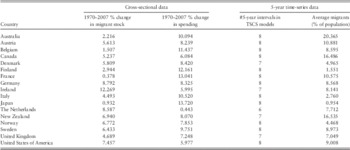
Migration data have a different source and a different time frame. Here the source is the United Nations, Trends in International Migrant Stock: The 2008 Revision. These data are noisier than the various OECD series. In particular, they are not annual data but rather are reported in 5-year intervals, roughly tracking national censuses. However, the timing of the census differs from country to country, so the series has temporal noise. Migration statistics, levels, or changes, are expressed as percentages of the total population.
We focus on the 17 OECD countries that are advanced capitalist economies with long-standing democratic systems. The exclusions are (a) Greece, Spain, and Portugal, each of which had dictatorships for the early period and a late-developing welfare state, and (b) Switzerland, which presents an impenetrable challenge because of a society-wide change in social welfare spending, some of which seems to be a shift in accounting methods, in the mid 1990s (see Soroka et al., Reference Soroka, Johnston and Banting2006).
Analysis
We begin with a highly aggregated, simple cross-sectional analysis that reproduces the logic of Soroka et al. (Reference Soroka, Johnston and Banting2006). We then extend the analysis to a time-series cross-section setup with a 5-year frequency. This enables controls for competing hypotheses, and captures most of the elements in the standard models of welfare-state growth. Then we move down the ladder of policy aggregation, to look at the nine spending domains separately. Again, we start with the simple cross-section and then move to the 5-year frequency.
Total social spending
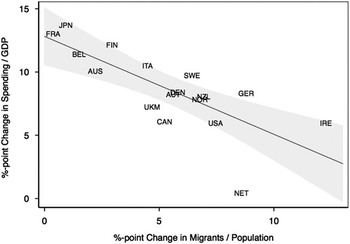
First we consider the basic bivariate cross-sectional relationship. Figure 1 shows the 1970−2007 link between change in the foreign-born share of the population and change in social spending as a per cent of GDP. The emphasis on change is important. Level of migration (as measured by the proportion of the population that is foreign born) is a standard variable in the literature; but our past work suggests that it is not overall levels of migration that matter so much as changes in migration flows. Countries with high but stable foreign-born populations, seem to have less difficulty in sustaining their historic welfare commitments than countries with smaller but rapidly growing migrant populations (Soroka et al., Reference Soroka, Johnston and Banting2006). Similarly, the size of the welfare state is set by historic patterns, reflecting coalitions in place before the great post-1970 expansion in international migration. In addition, the logic of the argument seems to us to pertain to the rate of growth in the welfare state, not to static levels. Nowhere does social spending actually decrease over this period, as Figure 1 shows. The scatterplot in the figure is accompanied by the bivariate OLS regression line and the 95% confidence interval for point estimation. The figure reveals a long-term relationship between immigration and social spending that is strong, linear, and negative.
Changes in foreign-born population and changes in social spending, 17-country Organisation for Economic Co-operation and Development sample, 1970–2007.

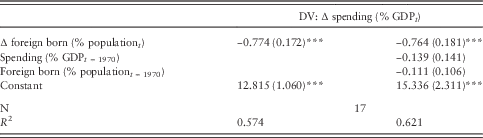
Parameters for the relationship in Figure 1 appear in the first column of Table 1. They suggest that each percentage-point increase in foreign born is associated with, on average, a 0.77 percentage-point reduction in social spending growth. The second model in Table 1 tests for the possibility that the bivariate relationship is an artefact of the starting points in either spending or immigration. Higher levels of spending in the early years of our analysis may constrain potential upward changes in spending over the time period, and the same may be true for the initial size of the foreign-born population. As it turns out, including the 1970 levels for spending or immigration makes little difference; neither control is statistically significant, and the estimated effect of migration change barely changes.
Cross-sectional models, changes in total social spending, 1970 to 2007, 17-country Organisation for Economic Co-operation and Development sample

Cells contain coefficients from an ordinary least square regression with standard errors in parentheses.
GDP=gross domestic product.
***p<0.01.
The evidence in Figure 1 and Table 1 is spartan, to say the least. It will be more persuasive if the basic relationships hold as we move to a more elaborate suite of controls and higher temporal frequencies. Controls also enable us to gauge if any of the effect of immigration is indirect, through shifts in the party system for instance. In constructing the estimations, we respect the frequency of the migration data, so 5 years is the maximum frequency and the only one we report in tables. To get to annual estimations would require interpolation for the immigration data, which would build in serially correlated errors as an artefact. Equally to the point, migration requires time for its effects to be felt in policy. This will be visible in the tables that follow. Instead of interpolation for missing years on the dependent variable, we aggregate variables across years to reflect the unfolding of policy change. For instance, the dependent variable is the difference between current 5-year averaged spending and lagged 5-year averaged spending (1995−99 minus 1990−94, and so on). The same is true for other variables that appear as changes. Only the change in the percentage foreign born is based solely on data spaced 5 years apart.
Our choice of controls mirrors the welfare state literature; the justification for each is given in some detail in Soroka et al. (Reference Soroka, Johnston and Banting2006). The variables are: (1) population under 15 years, (2) population over 64 years, (3) trade union density, (4) female labour force participation, (5) unemployment, (6) inflation, (7) per cent right-wing cabinet posts, and (8) per cent left-wing cabinet posts. These variables capture the main demographic, economic, and political drivers of total social spending. Political factors are lagged 1 year before collapsing to the 5-year average, given that expenditures in the current year are the consequence of budgetary policy in the previous year. This means that the partisanship of government is included at t−1, and so is immigration. All other variables appear as changes to the current year.
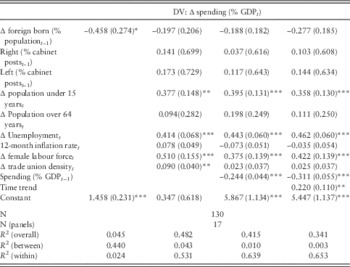
Table 2 starts with current changes in spending regressed only on lagged changes in the per cent foreign born; the second adds the remaining political effects, that is, the measures of partisanship of government in lagged levels, as well as all the economic variables in concurrent changes. The third and fourth columns provide two robustness checks: we first add lagged levels of spending, on the possibility that the system has autoregressive tendencies; we then add a time trend, to ensure that preceding results are not the consequence of a general upward trend in dependent and independent variables. We present fixed-effects estimations, to account for time-constant unobserved country-level heterogeneity.
Total social spending, 5-year time-series cross-sectional (TSCS) analysis, 1970–2007

Cells contain coefficients (with standard errors in parentheses) from a fixed-effects TSCS model, using a generalized least squares estimation.
GDP=gross domestic product.
*p<0.10; **p<0.05; ***p<0.01.
The critical coefficients, for changes in the percentage foreign born, are in the top row. Immigration is statistically significant in the first, bivariate model. Consider what this means: none of the effect of immigration here reflects differences across countries, given the fixed-effects setup. The coefficient thus reflects the over-time impact of immigration on spending, within countries – and the relationship between changes in immigration and changes in spending is quite clearly negative. Once other variables enter; however, the immigration effect shrinks. Indeed, entering the full suite of controls reduces the direct effect of migration markedly. This suggests that some of the total impact of immigration is mediated by other factors.
Exploring this mediation speaks to the possibility that migration matters for social spending not just directly, but indirectly. (through demographics, for instance.) It is accordingly worth mulling over some diagnostics. Which demographic/economic variables might be conveying the impact of migration on social spending? Intuition and past work (e.g. Huber and Stephens, Reference Huber and Stephens2001; Swank, Reference Swank2002; Soroka et al., Reference Soroka, Johnston and Banting2006) suggest the potential importance of three variables in particular, each of which has a significant impact on social spending in Table 2: (1) unemployment, which may be positively related to migration, (2) under-15s, also positively related to migration, and (3) female labour force participation, negatively related to migration.
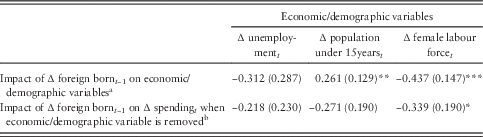
Table 3 presents diagnostic analyses for each of these mediating variables. The table captures the two steps in the mediation process. The first step is to estimate the impact of immigration on each demographic mediator. This is shown in the top row, which presents coefficients capturing the effect of a one-unit change in migrant stock (at t−1) on each potential mediating variable (in changes at t), from a simple bivariate TSCS fixed-effects estimation. The second step is to show what happens to the effect of immigration on the spending variable when the mediator is dropped from the estimation. This is akin to reduced-form estimation, when the putative mediator is removed. Coefficients on this row should be compared with the coefficient (−0.277) in the rightmost column of Table 2. If any coefficient on the second row of Table 3 is substantially greater in absolute value than −0.277, we have prima facie evidence that the putative mediator is an actual one. Put another way, we can infer that the omitted variable is a key carrier of the effect from immigration. The interpretation is all the more persuasive as gains indicated by the second row correspond to values on the first row.
Relationships between changes in migrant stock and three mediating variables

Cells contain coefficients (with standard errors in parentheses) from a time-series cross-sectional (TSCS) model, using a fixed-effects generalized least squares estimation.
a Coefficients are drawn from TSCS fixed-effects models in which each Y is regressed on ∆ foreign born t−1 (with no additional controls).
b Based on the fully saturated models of social spending, as in Table 2, but where each Y is dropped from the estimation (holding the sample constant).
*p<0.10; **p<0.05; ***p<0.01.
Of course, the potential for one of the variables in Table 3 to be a mediator of immigration effects is linked to the direction of the relationship between both immigration and the mediator, and the mediator and immigration. Consider the following possibility: immigration leads to more unemployment; but immigration pulls spending downwards and unemployment pulls spending upwards. In this instance, the impact of immigration is not mediated by unemployment – unemployment should increase rather than decrease the estimated impact of immigration. We are able to explore these possibilities here. The existing literature suggests the likely direction of effects, of course, but the models themselves will expose effects regardless of their direction.
Results in Table 3 are telling. To start, none of the impact from migration runs through unemployment. The regression of changes in unemployment on lagged changes in migration, in the first column of Table 3, reveals no significant relationship between the two variables. The sign of the coefficient is the opposite of the widely held expectation – indeed, in only seven of the 17 countries is the immigration-unemployment relationship positive. This fits with a growing body of work suggesting that migration is, at most, only very weakly connected to unemployment rates (see, e.g., Brücker, Reference Brücker2012). It leaves open the possibility that immigration may be linked to reduced spending by decreasing unemployment, though this also does not appear to be the case: dropping unemployment from the fully-specified model makes no real difference to the immigration coefficient; indeed the value in Table 3 is lower than in Table 2.
Change in the age structure is not the culprit either. The relationship with immigration is quite strong: a percentage-point increase in immigration yields a 0.26 increase in the under-15 share of the overall population. This positive relationship appears in 13 of the 17 countries. That said, as shown in the bottom-middle cell, dropping the under-15 variable from the model yields no real change in the coefficient for migration. Migration matters for the size of the young population, to be sure; and based on results in Table 2, the presence of under-15s clearly increases social spending. However, the impact is not a by-product of migration.
Female labour force participation appears to be the key. A percentage-point increase in migration cuts nearly half a percentage point from growth in female participation. This is consistent with existing work (in the Canadian case, see Kustec, Reference Kustec2012). The effect is not universal – just 10 countries show a clearly negative relationship between the two variables – but the average effect is very robust. Moreover, female participation is clearly a mediator of the immigration effect. Dropping change in female participation from the saturated model produces a coefficient for immigration (−0.339) that is markedly higher than in the rightmost column of Table 2.
How exactly does female labour force participation affect social spending? There are several possibilities. (See Huber and Stephens, 2001 for a useful discussion.) One account focuses on political mobilization: labour force participation will change (and increase) women’s demands for a more comprehensive welfare state. This likely occurs over the medium to long term; however, perhaps beyond the 5-year window examined in our analyses. It is more likely that that the relatively short-term impact we observe here is related to increases in spending that result from a larger labour force, requiring increased expenses related to employment insurance, training, leave, and so on.
Even over a 5-year span, immigration is negatively related to social spending. This is the message of the simple relationship in the leftmost column of Table 2. The summary effect is complicated by the short-term dynamics in spending itself, which has an autoregressive tendency (indicated by the significant negative effect of lagged spending in the third column of Table 2). However, this complication should not distract us from the total effect. That said, the effect does not appear to just be a function of immigration per se – it is in part a result of other changes in the demographic and economic landscape related to immigration. The primary mediator of impact appears to be female labour force participation: immigration reduces the female participation rate, sufficiently to account for much of the attenuation in the direct effect of immigration (the contrast along the top row between the middle and the rightmost columns in Table 2).
By-domain social spending
Does the impact of immigration extend all the way across the welfare policy landscape? Broadly speaking, targeted programmes may be more vulnerable than universal ones, as noted above. Table 4 provides a first test of the possibility that (a) increased migration reduces spending across all social programmes, regardless of moral hazard, or (b) increased migration reduces commitment to specific programmes that are – or are perceived to be – more open to use by migrants.
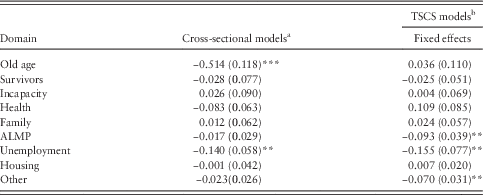
Subdomain social spending, various models, 1980–2007

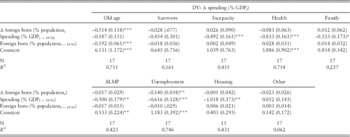
a Cells contain coefficients from an ordinary least square regression with standard errors in parentheses. Complete results are shown in Table A3.
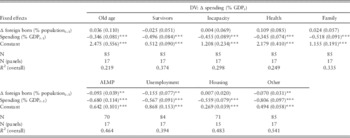
b Cells contain coefficients (with standard errors in parentheses) from TSCS models, using fixed-effects generalized least squares estimations. Complete results are shown in Table A4.
TSCS=time-series cross-sectional; ALMP=active labour market policies.
**p<0.05; ***p<0.01.
By-domain spending is not available for the 1970s, so estimations rely on 1980–2007 changes. This is true for most cases, at least – for several countries spending in certain domains is not available until the mid-1980s, so estimations in Table 4 are based on slightly varying time periods, beginning in a domain the 1st year in which spending is available for all countries. For economy of presentation, Table 4 includes just the coefficient for changes in migration. The first set of coefficients is based on the same cross-sectional model as in Table 1. The second set is based on simplified versions of the setup in Table 2, including just changes in migrant stock and lagged levels of spending (corresponding to the second model in that table).
There are advantages and disadvantages to the pared-down approach to modelling used in Table 4. The appropriate control variables will differ across subdomains – age will matter for old-age spending, unemployment will matter for unemployment spending, and so on. Although models in Table 4 do not account exhaustively for variance in spending change nor do they afford detailed exploration of mediators, the alternative may be worse. Building ideal by-domain models reduces across-domain comparability. Consider the following possibility: in one domain the impact of immigration on spending change is entirely unmediated, so the addition of controls makes no difference to our findings; in another, the impact of immigration is mediated by a control variable, and so the addition of controls masks the broader relationship. Here, for the time being at least, we care just about that broader, (nearly) bivariate relationship between immigration and spending change. We accordingly rely on basic, comparable models in Table 4 – though we do take up the issue of additional controls below.
Of the 18 coefficients in Table 4, only five are clearly different from zero and negative in sign. (The one borderline coefficient, for health spending in the TSCS column, has a positive sign.) With one exception, the domains that stand out correspond to targeted spending. The one domain to feature in both cross-sectional and TSCS estimations is spending on the unemployed. In addition, leaping from the TSCS column is spending on ALMP. These are policy domains whose beneficiaries are numerically limited and vulnerable to being represented as abusers of the system. This is all the more striking in that, according to Table 3, immigration is at best weakly related to the actual rate of unemployment. The implication is that the mechanism is not economic, but political. From a strictly economic perspective, the negative impact of immigration on ALMP spending makes even less sense than for unemployment, insofar as such programmes are designed to increase labour market participation, presumably for immigrants as well as others. Here, too, what matters may be politics, symbolic politics in fact.
Further to the theme of vulnerability for targeted programmes, is the TSCS evidence for the ‘other’ category. The contents of this residual category vary somewhat from one country to the other, but the SOCX definition is illuminating: ‘other’ includes programmes that do not fit into the other categories, including social expenditure related to immigrants and indigenous people, and more importantly (in terms of spending levels), income support and social assistance payments (OECD, 2007). ‘Other’ spending comprises precisely the kind of policies that we hypothesize as vulnerable to immigration politics.
Pension spending merits discussion. As a universal domain, why is it vulnerable in the first place? Pensions may be vulnerable because of their peculiar juxtaposition of universality and delayed access to benefits. Most persons ultimately entitled to a pension are not currently receiving one. Schemes where benefits, although delayed, are tied to contributions may be less politically vulnerable. In eight of our 17 countries, pension schemes are almost entirely contributory: Austria, Belgium, France, Germany, Ireland, Italy, the Netherlands, and the United States. In the other nine, the pension systems combine contributory and non-contributory elements: Australia, Canada, Denmark, Finland, Japan, New Zealand, Norway, Sweden, and the United Kingdom. For the countries with entirely contributory pension schemes, the immigration coefficient is −0.215 (p=0.09). Where there is a significant non-contributory element, the coefficient is −0.409 (p=0.04). In short, changes in immigration appear to be negatively associated with spending on old-age programmes only in those countries where a significant portion of pensions spending is non-contributory.
That said, why are results for pensions evident only in the cross-sectional estimation? Our own suspicion is that to capture pension politics the 5-year frequency is simply too high. The pension clientele is broad and the successful mobilization of political will for structural change is rare and highly conditional (Jacobs, Reference Jacobs2011). What is more, the impact of current structural change is delayed, as part of the bargain usually requires that current pensioners be insulated against change in their entitlement. It strikes us as eminently reasonable that pensions respond to multi-decade changes in the foreign-born share of the population, not to 5-year ones. That said, we cannot fully rule out the possibility that our results for pensions are spurious – evidence of an effect at one frequency, and no such evidence at another, is troubling. Take our interpretation here as partly conjectural, then. Non-contributory pensions may be negatively affected by immigration, in line with our expectations. Even if they are not, the domains which are most likely to be associated (incorrectly) with immigration – unemployment, ALMP, and ‘other’ immigration and welfare programmes – are the ones most clearly affected by immigration.
Just as importantly as the effects that do occur are the ones that do not. Clearly, some areas of social spending are affected by migration, but others – including many of the largest – are not. Migration matters to social welfare expenditure. The effect appears to be more political than economic. Moreover, the impact is felt only in certain domains.
What about mediators of the effects shown in Table 4? Does immigration continue to matter (directly) even when other variables are added to the model, or is there evidence that the impact of immigration is mediated by other factors, as we have seen in estimates of total social spending? We do not present detailed estimates here of the extent to which the impact of immigration on by-domain spending is mediated by other factors. The necessary, fully specified by-domain results are partly constrained by a lack of data. (Recall that those estimates rely on data from 1980, and sometimes even more recently, forwards.) However, we are not entirely reluctant to investigate further the potential mediators of immigration effects in by-domain results. Our own diagnostic results suggest the following.
First, in no domain does adding a full (or partial) set of control variables reveal statistically significant effects of immigration change where they do not already exist in the 5-year results in Table 4; put differently, the identification of a significant impact of immigration does not appear to be contingent on the inclusion of controls for any of the seven domains with insignificant immigration coefficients in Table 4. Where ALMP and unemployment spending is concerned, the inclusion of macroeconomics as well as female labour force participation leads to a statistically insignificant immigration variable. None of these variables seems to be a culprit on its own, however – it is the combined inclusion of the three that seems to matter. For ‘other’ spending, the inclusion of all controls makes no difference – a fully-specified model has an immigration coefficient of −0.067, only very marginally (and insignificantly) smaller than the −0.070 in Table 4. This is the domain in which the negative impact of immigration is the most robust. It is also a strong indication that the impact of immigration on social spending is political.
Discussion and conclusions
Two critical points from earlier work remain relevant. First is the importance of focusing on changes in migration rather than levels of migration. Existing work often focuses on the latter. In doing so, it tends to emphasize cross-national variance rather than within-country variance over time. Analyses draw their power from variance across countries and thus incorporate other features of the countries’ history, even as hypotheses are based on political effects within countries. The current political effect of migration cannot be adequately observed without moving to an estimation that focuses on changes in immigrant flows. Second, the effect of migration takes place over the medium term. Annual estimations are thus not the most appropriate way to capture the impact of migration; indeed, while the impact is clear in our 5-year models, it is totally absent from annual models. This makes good sense. Public reactions to increasing migration are bound to take some time – there needs to be migration, the public needs to notice that migration and change their preferences accordingly, and then those preferences have to find their way into political and budgetary processes. Besides, annual immigration data are dubious constructs, interpolations from quinquennial (at best) census exercises.
This paper also points to the advantages of disaggregating spending. There is strong evidence here for our Hypothesis 2, that the impact of immigration varies across policy domains. In most domains there is essentially no evidence of a relationship. In other domains, the impact is clear, and variation across domains is telling. The impact of immigration is most pronounced for labour market policy, unemployment spending in particular, but also for active labour market policy outlays. ‘Other’ spending is also vulnerable, not surprisingly for it is in this domain that outlays specifically targeted at immigrants are housed.
Although the magnitude of effects should not be overstated, effects do cumulate, over time and across domains. As our estimations of total spending suggest: a 1-percentage point increase in the foreign-born share over 37 years is associated with a nearly 0.8-percentage point damping of increases in spending. Moreover, given measurement error in our data effects are probably underestimated. More generally, the existing literature may both under- and over-state relationships. Overall effects are mediated and modest, but when we drill down to specific domains, typically those serving the most marginal economic actors, impacts are not small.
There clearly is more to do. Our exploration of mediating variables points to the importance, perhaps now at the subdomain level, of examining the ways in which immigration may indirectly matter for social welfare spending. We also see some potential for work that more carefully distinguishes between (upward) pressures on spending due to increasing numbers of people in need and (downward) pressures on spending for political reasons. Our analyses also assume that the immigration-welfare state link is the same everywhere, such that different outcomes are solely the result of different values for component variables. However, Figure 1 also strongly suggests that there is considerable scope for variation in response to immigration pressures. The pattern in the figure is clearly heteroscedastic: residuals get bigger as immigration changes get bigger. Note, for instance, that the vertical gap between the Netherlands and Germany, with essentially identical (high) growth in the percentage foreign born, is as large as that between Canada and France, with markedly different (low to moderate) migration histories. One possibility, probed in Banting et al. (Reference Banting, Johnston, Kymlicka and Soroka2006), is the conditioning role of multicultural policy. Such policies may reshape the discourse of immigrant reception and buy insulation; or they may do the opposite. Another possible conditioning factor may be the shape of the ex ante welfare state. Universal domains are more resilient than targeted ones in the face of immigration pressure. Perhaps the same is true at the level of the overall system: do universal systems resist or accommodate immigration pressure better than conservative or liberal regimes? Multiculturalism policy and pre-existing welfare regimes may interact. Our reading of the literature and our own work converge in suggesting that the negative impact of immigration on welfare spending can be moderated by political and policy institutions. It follows that future work should take heterogeneity – in both spending domains and institutions – into account.
Acknowledgement
This paper has benefitted from comments by Edward Koning, Peter Loewen, Georg Menz, Tim Reeskens, Gijs Schumacher, and Matthew Wright.
Appendix
Variable sources
Social Welfare Spending: all measures are drawn from the OECD SOCX databases.
Migrants (% population): data drawn from the United Nations, Trends in International Migrant Stock: The 2008 Revision; as data are reported in 5-year intervals, we use linear interpolation to fill in missing years.
Population under 15 years: annual data from OECDStat.
Population over 64 years: same as above.
Unemployment: same as above.
Female Labour Force: same as above.
Trade Union Density: same as above.
Right (% Cabinet Posts): data from Soroka et al. (Reference Soroka, Johnston and Banting2006) updated using Armingeon et al., Comparative Political Data Set III, 1990–2008.
Left (% Cabinet Posts): same as above.
Basic descriptive data for countries included in time-series cross-sectional analyses


Subdomain social spending, full cross-sectional models, 1970–2007

Subdomain social spending, full 5-year time-series cross-sectional (TSCS) model