

Introduction
Millions of people are displaced every year as a result of war or persecution in their homelands. By nature, being a refugee is a stressful experience, and having to settle into a new country can compound that stress, contributing to low socio-economic status (SES) and mental illness. According to the United Nations 1951 Convention, refugees are persons who have crossed an international boundary because they are unable or unwilling to avail themselves in the confines of their former country due to a well-founded fear of persecution based on race, religion, nationality, membership of a particular social group or political opinion (UNHCR, 1951). By the end of 2009, there were an estimated 10.4 million refugees worldwide (UNHCR, 2010), increasing to 10.5 million by the end of 2012 (UNHCR, 2012). There were 2.9 million new refugees in 2014 alone (UNHCR, 2015). During 2009–2010, Australia's refugee population passed the 750,000 mark (Refugee Council of Australia, 2011). Between 2010 and 2014, Australia admitted an additional 25,399 refugees (Commonwealth of Australia, 2011, UNHCR, 2015).
Refugees generally have lower SES outcomes compared to the general population and non-refugee immigrants. SES is defined as ‘a composite measure that typically incorporates economic status, measured by income; social status, measured by education; and work status, measured by occupation (Dutton & Levine, Reference Dutton, Levine, Bunker, Gomby and Kehrer1989, p. 30)’. These three measures of SES are interrelated variables. Researchers often consider SES effects broadly and measure SES using a variety of specific indicators (Adler et al., Reference Adler, Boyce, Chesney, Cohen, Folkman, Kahn and Syme1994), for instance, using English proficiency to measure education level for immigrants and refugees (Fennelly & Palasz, Reference Fennelly and Palasz2003; Nawyn, Gjokaj, Agbenyiga, & Grace, Reference Nawyn, Gjokaj, Agbenyiga and Grace2012). It has been long established that SES is associated with health outcomes. The socioeconomically disadvantaged are often more likely to expose to higher levels of risk factors to physical and mental health than their less-disadvantaged counterparts (Adler et al., Reference Adler, Boyce, Chesney, Cohen, Folkman, Kahn and Syme1994; Blakely, Hales & Woodward, Reference Blakely, Hales and Woodward2004; Murray, Davidson & Schweitzer, Reference Murray, Davidson and Schweitzer2008; Nawyn et al., Reference Nawyn, Gjokaj, Agbenyiga and Grace2012).
It has been reported in Australia that refugees are over-represented amongst those who are underemployed, low-paid, low-skilled and insecurely employed in the Australian labour force. Moreover, compared to other immigrant groups, refugees experience more prolonged periods of unemployment (Olliff, Reference Olliff2010). It is therefore expected that refugees have lower income than the general population. This notion is supported by research in the USA. Jeung et al. (Reference Jeung, Jeung, Nhung Le, Yoo, Lam, Loveman and Maung2011) reported that 63 per cent of Burmese refugees living in California were unemployed. Those that were employed had sporadic, low-wage jobs. They also found that 57 per cent of the participants lived below the national threshold for extreme poverty, earning less than US$1,000 per month for an average household size of five.
Research has identified that a major challenge experienced by refugee youth is a lack of formal education before arrival in the host country (Briggs, Reference Briggs2011). Therefore, overall, refugees have a lower educational level when compared to the general population. Research has also identified that, as fewer refugees complete high school than non-refugee immigrants, refugees have lower levels of English language proficiency than non-refugee immigrants (Fennelly & Palasz, Reference Fennelly and Palasz2003). Studies have also suggested that many refugee families are linguistically isolated, meaning that no one in the household older than 14 years old speaks English very well (Nawyn et al., Reference Nawyn, Gjokaj, Agbenyiga and Grace2012). Linguistic isolation by household is likely to be a factor that contributes to the low level of English language proficiency among refugees.
Many countries admitting refugees establish services to support refugee families in establishing new lives and healing in a new environment. For example, refugee support services in Australia provide short-term initial settlement support to clients after their arrival into Australia, and support for those who have arrived within the last twelve months. These services include: on arrival reception and initial orientation; information about and referral to other service providers and mainstream agencies; assistance with accommodation and basic household goods; short-term torture and trauma counselling (Steel, Momartin, Silove, Coello & Tay, Reference Steel, Momartin, Silove, Coello and Tay2011). Research has revealed that social support can decrease refugees’ loneliness and isolation and enhance mental health (Makwarimba et al., Reference Makwarimba, Stewart, Simich, Makumbe, Shizha and Anderson2013).
Research shows that traumatic experiences are at the very centre of the refugee journey, and highlight the link between trauma and mental health outcomes among refugees (Vromans, Schweitzer & Brough, Reference Vromans, Schweitzer and Brough2012). Many studies have suggested a higher prevalence rate of mental disorders among refugee groups than the general population (Lhewa, Banu, Rosenfeld & Keller, Reference Lhewa, Banu, Rosenfeld and Keller2007; Li & Francis, Reference Li, Francis and Francis2014). The most common mental health disorders among refugees reported in the literature include anxiety, depression and PTSD (Li & Francis, Reference Li, Francis and Francis2014).
Older refugees often experience such traumatic events as bombing, torture, severe harassment by authorities, disappearance of family members, rape and witnessing their significant others suffering atrocities (Wall et al., Reference Wall, Santalucia, Salem, Giacomin, McDonald and Bosnjak2011). Research suggests that older refugees have higher rates of adverse social outcomes and are particularly vulnerable to mental health illness (FECCA National Office, 2015). However, to the author's best knowledge, there is no research on comparing older refugees’ SES and mental health to those of younger refugees.
To address this research gap, this article explores socio-economic status, traumatic experience and mental health disorders among refugees in Australia. It specifically focuses on comparing older refugees’ socio-economic status, traumatic experience and mental health disorders to younger refugees. Most refugees in Australia entered at a young age and are now older. The lack of research data on these older refugees with respect to SES, trauma and mental health disorders prompted this study. Specifically, this study compared older refugees to younger refugees in SES, trauma and mental health disorders.
Method
Respondents
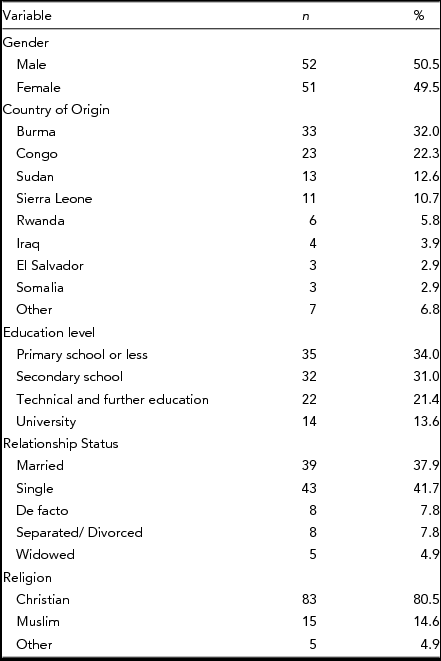
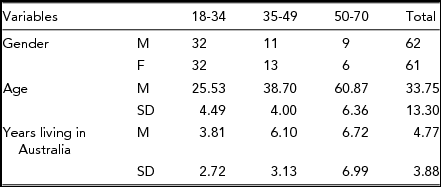
Participants, who were 18 years or older and arrived as a refugee into Australia under the Australian Government Humanitarian Resettlement programme, were recruited from an urban and a regional city in Queensland, Australia, through non-government refugee resettlement organisations, yielding an 89.6 per cent completion rate. A snowballing technique was used to recruit participants. The final sample size was 103. Among the 103 participants, the ages ranged from 18 to 70 (M = 33.75, SD= 13.34). The total sample was balanced regarding gender, with 50.5 per cent male respondents of (n=52) and 49.5 per cent female (n = 51). Tables 1 shows the demographic characteristics of the participants.
Summary of participant demographics (N = 103)

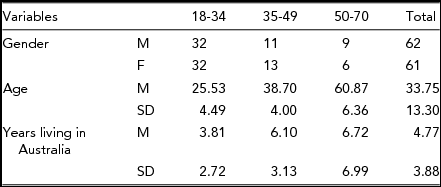
The participants were categorised into three age groups: 18–34 years, 35–49 years and 50–70 years of age. The gender compositions across three age groups were as follows: there were 32 males and 32 females (n=64), 11 males and 13 females (n=24), and 9 males and 6 females (n=15), in the 18–34 group, 35–49 group and 50–70 group respectively. Table 2 presents the characteristics of the three groups.
Summary of the characteristics of three age groups (N=103)
Materials
Socio-economic status (SES)
Demographic information was collected to investigate the SES of the participants. The SES factors included: education, employment, income, perceived English ability and perceived community support received by the participants. Perceived English ability was measured by three self-reported questions: How well can you speak or listen to English? How well can you read English? How well can you write English? The 5-point Likert scale for each question was score from 1=not very well, 2 = not well, 3 = average, 4 = well to 5 = very well.
The Hopkins Symptom Checklist-25
The Hopkins Symptom Checklist-25 (HSCL-25) was used to measure self-report symptoms of anxiety and depression. The HSCL-25 has 25 items, including 10 items for anxiety symptoms and 15 items for depressions symptoms for the previous week. The 4-point Likert scale for each question is scored between 1=not at all to 4=extremely. The mean score >1.75 is generally considered ‘checklist positive’ for anxiety/depression (Derogatis, Lipman, Rickels, Uhlenhuth & Covi, Reference Derogatis, Lipman, Rickels, Uhlenhuth and Covi1974). This measure has demonstrated consistent validity and reliability, with a Cronbach's alpha coefficient ranging from 0.85 to 0.90 in cross-cultural studies (Hollifield et al., Reference Hollifield, Warner, Lian, Krakow, Jenkins, Kesler and Westermeyer2002). The current study found a Cronbach's alpha coefficient of 0.93 for the depression scale and 0.93 for the anxiety subscale.
The Harvard Trauma Questionnaire (HTQ)
PTSD symptoms and trauma exposure were measured using HTQ (Harvard Program in Refugee Trauma, 2011), which lists 40 PTSD symptoms and 40 trauma events. Since then it has been widely used with refugee populations and is widely recognised for adaptability to context (Shoeb, Weinstein & Mollica, Reference Shoeb, Weinstein and Mollica2007). Participants were asked to rate whether they have experienced symptoms in the last week according to a 4-point Likert scale from 1=not at all, 2=a little, 3=quite a bit to 4=extremely. Higher scores indicate increased prevalence of PTSD. A mean cutoff score of >=2.5 is considered meeting the criteria for PTSD symptomology. The trauma exposure scale consists of 40 items. The participants were asked to answer either ‘yes’ (coding 1) or ‘no’ (coding 0) to having experienced the listed events. The higher the scores the higher trauma exposure. The HTQ has demonstrated excellent internal consistency with a Cronbach's alpha coefficient of 0.90 and test-retest reliability of 0.89 (Mollica et al., Reference Mollica, Caspi-Yavin, Bollini, Tor and Lavelle1992). In the current study, the Cronbach's alpha coefficients for PTSD and trauma exposure were 0.97 and 0.93 respectively.
The Multidimensional Loss Scale
The Multidimensional Loss scale (MLS) is a 24-item self-report scale that is divided into a ‘loss event’ scale, and a consequent ‘loss distress’ score for the event item. Respondents marked ‘yes’ (coding=1) or ‘no’ (coding =0) to each loss event, generating a range of 0 to 24. Participants were asked to record how much the loss event was ‘upsetting you or causing you difficulties in any way’ on a four-point scale, from 0 (not at all) to 3 (extremely). Total scores for loss distress range from 0 to 72. Validation studies found high internal consistency for both scales; loss events (Cronbach's α = 0.85) and loss distress (Cronbach's α = 0.92) (Vromans et al., Reference Vromans, Schweitzer and Brough2012). The current study found a Cronbach's alpha coefficient of 0.91 for loss events, and Cronbach's alpha of 0.91 for loss distress. The Loss Distress subscales have demonstrated high reliabilities with the Cronbach's alphas as follows: 11-item Loss of Symbolic Self (0.90), 3-item Loss of Interdependence (0.75), 4-item Loss of Home (0.86), 3-item Interpersonal Loss (0.71), and 3-item Loss of Intrapersonal Integrity (0.64) (Vromans et al., Reference Vromans, Schweitzer and Brough2012). The Cronbach's alphas of Loss Distress subscales in the current study were: Loss of Symbolic Self (0.85), Loss of Interdependence (0.74), Loss of Home (0.84), Interpersonal Loss (0.79), and Loss of Intrapersonal Integrity (0.77).
Procedure
Ethical approval was obtained from the Human Research Ethics Committee at James Cook University. A cross-sectional survey was employed to collect data from March 2013 to July 2014. Respondents were informed that the study would explore mental health issues among refugees in Australia. After the provision of informed consent, those participants who had high English language proficiency proceeded to fill out a pen-and-paper questionnaire. The completed questionnaires were collected by the researcher or alternatively, returned to the researcher in the supplied postage paid envelope.
For those who had low English literacy, interpreters were used. Two male and one female interpreter each with multilingual interpreting abilities were selected based on their level of training in psychological research, and each had a minimum bachelor's qualification in either psychology or human services. Kashdan, Morina and Priebe's (Reference Kashdan, Morina and Priebe2009) approach to training the interpreters was employed. A one-day interpretation training programme was offered to the interpreters. During the training, they were interviewed by the research team and familiarised themselves with the questionnaire by completing it. Translation of the items was developed during the training. Interpreter faithfulness/fidelity – completeness, accuracy and reliability in translation (Moody, Reference Moody2011) – was emphasised. The translation that best matched the source text's meaning was the one that best complied with the precision, accuracy, conformity to the original scales (Moody, Reference Moody2011). Difficulties, such as understanding some wording (e.g., feeling blue), were also discussed with the research team. Following the training, they each conducted two pilot interviews with refugee participants. The training process was continued until they felt that they were comfortable and confident to go to the interview with the researcher.
With the assistance of the interpreters, questionnaires were completed either at the settlement organisation or at their home. After completing the questionnaire, participants were debriefed. A voucher of AU$20 each was given to the participants for their time and travel.
Analysis
Data analysis was performed using IBM's SPSS Statistics 22. Preliminary examinations of the data revealed that missing data ranged from a low of 0.97 per cent for HSCL Anxiety to a high of 9.71 per cent for the Multidimensional Loss, with the overall level of missing data being 3.08 per cent. Missing values were imputed using maximum likelihood after finding no statistically reliable deviation from randomness using Little's MCAR test (χ2 = 5012.91, df = 9909, p = 1.00). Tests of normality using the Kolmogorov-Smirnov test showed the scales used in the current study violated the assumption of normality. Due to small sample sizes, re-sampling was performed and analysed by bootstrapping 1,000 samples along with the parametric methods described by the method of Efron and Tibshirani (Reference Efron and Tibshirani1986).
Descriptive statistics were used to characterise the sample. Cross-tabulation was performed to compare the group differences in SES, including education, employment, income, English ability and perceived community support. One-way between-groups ANOVA with post-hoc tests was conducted to explore the impact of age on the levels of anxiety, depression, PTSD, trauma events, loss events (including loss of symbolic self, loss of interdependence, loss of home, interpersonal loss and loss of intrapersonal integrity) and loss distress.
Results
Cross-tabulation of SES factors
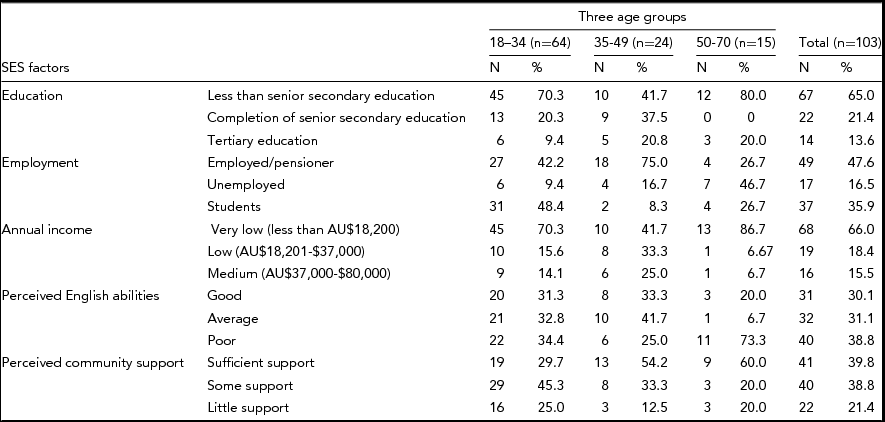
Table 3 shows the results of bootstrapped cross-tabulation of SES factors between three age groups. Overall, 65 per cent of participants had not completed secondary education. Compared to younger participants, older refugees aged from 50 to 70 years had the lowest level of education, with 80 per cent not completing secondary education. Regarding employment among the three age groups, older refugees had the highest unemployment rate of 46.7 per cent. Overall, 66 per cent of participants’ individual annual income was less than AU$18,200 and 86.7 per cent of older refugees were in this income group. Compared to younger refugees, a majority of who perceived that their English abilities were above average, 73.3 per cent of older refugees believed that their English abilities were poor. Regarding perceived community support, participants across three age groups recognised that they received good support from the boarder community. A greater percentage of older refugees (60 per cent) perceived that they received sufficient support from the community when compared to younger refugees (29.7 per cent and 54.2 per cent for 18–34 and 35–49 groups respectively).
Cross-Tabulation of SES factors between three age groups

Descriptive statistics of the traumatic experience and mental health disorders
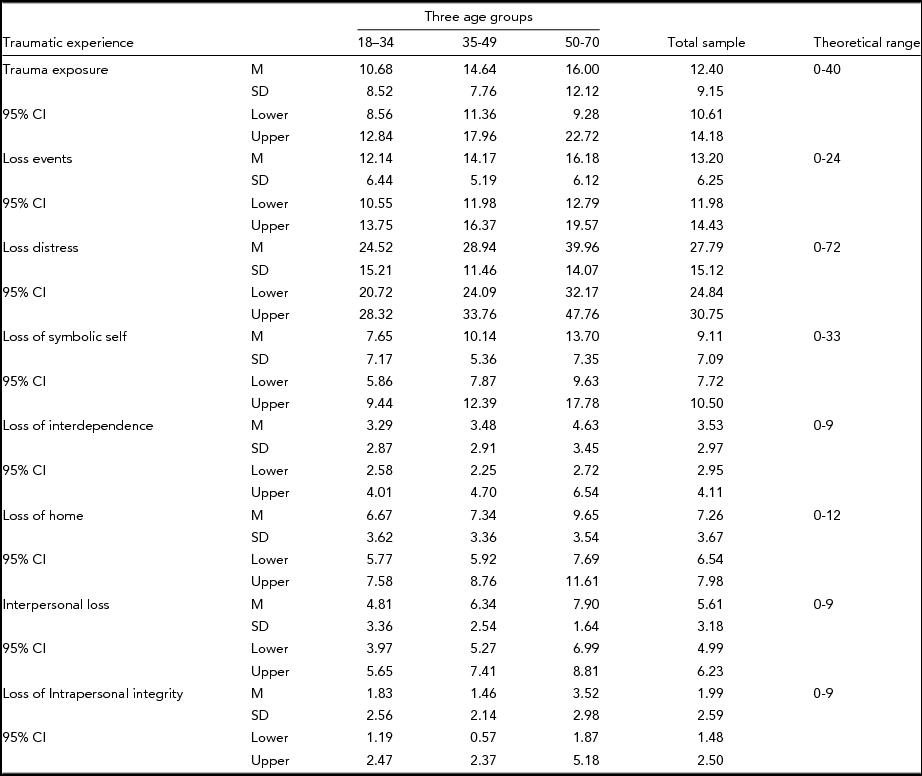
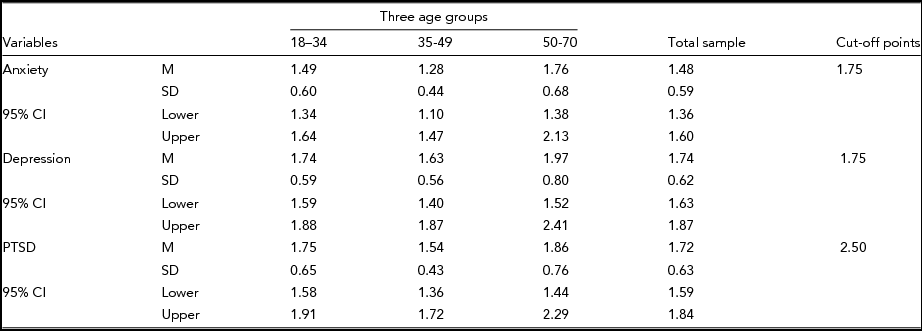
Table 4 indicates that older participants aged over 50 years had higher mean scores in all trauma events measured by the MLS than the younger participants aged 18–34 and 35–49. Table 5 suggests that participants aged over 50 years had higher mean scores in anxiety, depression and PSTD than the younger participants aged 18–34 and 35–49.
Descriptive statistics of the traumatic experience

Descriptive statistics of mental health disorders

The impact of age on the levels of the traumatic experience
Levene's tests indicated that the assumption of homogeneity of all variances had not been violated. The bootstrapped ANOVA results showed that age significantly affected the level of the trauma related variables: trauma exposure, F(2,102)=3.10, p=0.05; loss events, F(2,102)=3.03, p=0.05; loss distress, F(2,102)=7.22, p=0.001; loss of symbolic self, F(2,102)=5.14, p=0.008; loss of home, F(2,102)=4.23, p=0.02; interpersonal loss, F(2,102)=7.41, p=0.001; loss of intrapersonal integrity, F(2,102)=3.40, p=0.04. The effect size of the actual difference in mean scores between the groups was calculated using omega squared. The between-group effect sizes of trauma exposure (0.04), loss event (0.04) and loss of intrapersonal integrity (0.04) were small. The effect sizes of loss distress (0.11), loss of symbolic self (0.07), loss of home (0.10) and interpersonal loss (0.11) were medium.
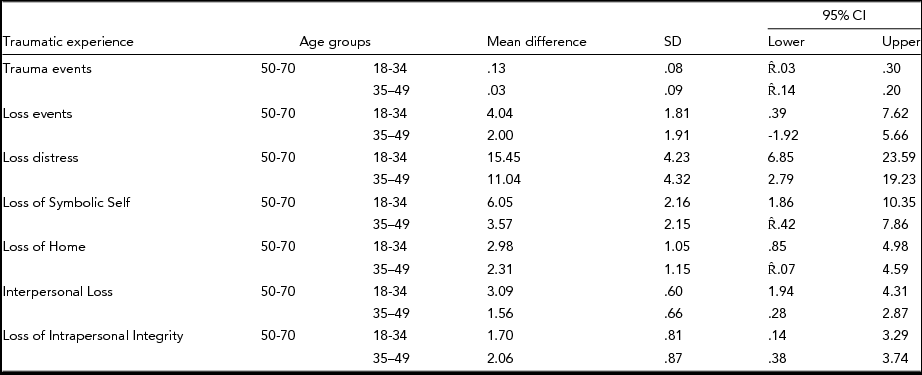
Bootstrap for post-hoc comparisons using the Tukey HSD test indicated that for trauma exposure, older refugees did not significantly differ from younger refugees. Table 6 shows the results of the bootstrap for multiple comparison in ANOVA. The mean scores of loss events, loss of symbolic self and loss of home for older participants were significantly higher than the 18–34 group, while there were no significant differences between the 50–70 and 34–49 groups. For mean scores of loss distress, interpersonal loss and loss of intrapersonal integrity, the 50–70 group was significantly higher than both the 18–34 and 35–49 groups.
Bootstrap for multiple comparisons (Tukey HSD)

The impact of age on the levels of mental health
Before the results of the impact of age on the levels of mental health disorders are presented, the comparison of mental health prevalence between the current study and national level is shown in Table 7. The prevalence of depression, anxiety and PTSD among the sample utilised the established international cut-offs. Depression and anxiety mean scores >1.75 indicated clinical levels of symptomatology (Vromans, Schweitzer & Brough, Reference Vromans, Schweitzer and Brough2012). Mean PTSD scores of 2.5 and over indicated likely PTSD diagnosis (Mollica, McDonald, Massagli & Silove, Reference Mollica, McDonald, Massagli and Silove2004). The bootstrapped prevalence showed that the prevalence of anxiety and depression of older participants aged between 50 to 70 years was much higher than that in younger age groups.
Mental disorder prevalence (%) among the sample (Bootstrapped)

Bootstraps for per cent at 95% CI are reported in brackets.
Levene's tests indicated that the assumption of homogeneity of anxiety, depression and PTSD had not been violated. The bootstrapped ANOVA results also showed that age significantly affected the level of anxiety, F(2,102)=3.14, p=0.05. Bootstraps for post-hoc comparisons using Tukey HSD test indicated that the mean scores of anxiety for the 50–70 group was significantly higher than the 35–49 group. There were no significant differences in mean scores of anxiety between the 50–70 and 18–34 groups. There was also no significant difference in the mean scores of depression and PSTD between the 50–70 group and the younger groups of 18–34 years old.
Discussion
This study explored the SES, trauma and mental health disorders among three Australian refugee age groups. The results show that older refugees (ages 50–70) had lower SES scores over younger age groups (ages 18–34 and 35–49). As much as 80 per cent of those aged 50–70 did not complete secondary education, with 47 per cent unemployed, and 87 per cent whose annual income was lower than the AU$18,200 tax-free threshold at the time the research was conducted (Australian Taxation Office, 2012). The high percentage of low level formal education, unemployment and low income is consistent with existing literature suggesting that compared to the general population, refugees have a lower SES (Jeung et al., Reference Jeung, Jeung, Nhung Le, Yoo, Lam, Loveman and Maung2011; Briggs, Reference Briggs2011; Olliff, Reference Olliff2010).
Compared to younger refugees, more than 70 per cent of older refugees perceived that their English abilities were poor. This finding reflects the previous finding that the low level of formal schooling among the majority of older refugees and little pre-migration exposure to English pose the greatest hurdles to English proficiency for older refugees. Moreover, older refugees are more likely to live in linguistically isolated households, which provide older refugees with little exposure to English, particularly for older refugees who are not involved in work. This finding is consistent with the suggestions that refugees have a lower level of English language proficiency than other migrant groups in Fennelly and Palasz's (Reference Fennelly and Palasz2003) study.
The findings of the current research revealed that 60 per cent of older refugees reported that they received sufficient support from the broader community and this was double that reported by younger refugees aged 18–34 years (30 per cent). This finding suggests that older refugees recognised that Australia provided good support to them after they settled in the community. This finding may also suggest that older refugees had longer periods to establish support systems and social networks, and were more likely to seek help than their younger counterparts.
The results of the present study suggested that traumatic experience was age related in the sample. Compared to younger refugees, older refugees experienced significantly higher levels of trauma exposure, loss event, loss distress, loss of symbolic self, loss of home, interpersonal loss and loss of intrapersonal integrity. This finding revealed that although all participants had experienced traumas, older refugees appeared to have experienced more severe human rights abuses compared to younger participants in the study. According to the New South Wales Refugee Health Service (2006), many older refugees in Australia have spent a significant amount of time in detention camps where they were likely to experience poor medical care, overcrowding, food shortages, lack of access to educational facilities and lack of safety. Older refugees are particularly vulnerable in the camps as they have limited ability to build shelter, find food and access water and medical treatment. These additional hardships may contribute to the higher prevalence of traumatic experiences among older refugees in the study.
The current study reported that among the three age groups of refugees in this study, older refugees had the highest prevalence of anxiety, depression and PTSD over Australia's national average. These findings reflect the notion that war and organised violence have long-term, negative impacts on people's mental health (Joffe, Joffe & Brodaty, Reference Joffe, Joffe and Brodaty1996; NSW Refugee Health Service, 2006), and that older refugees are especially vulnerable to these long-term, negative impacts.
The present study provides evidence-based implications for policy making, refugee funding guidelines and aged care service planning and delivery. Older refugees should be recognised as a group with special needs in the categories of both refugees and older adults. To help service providers to work more effectively and sensitively with older refugees, it is essential to understand older refugees’ individual life experience, the impact of loss and grief on older refugees, and the impact of the refugee experience on older refugees’ ageing process.
There are several limitations of the study. First, although bootstrapping was used for resampling, the sample number is small, limiting the generalisation of the findings in the current study. Future research comparing SES, traumatic experience and mental health disorders between older and younger refugees should include a larger sample size. Second, the non-probability sampling method and cross-sectional design limit the generalisability of the current findings. A longitudinal design may overcome the limitations of cross-sectional research. Third, older refugees in Australia fall into two groups, one being those who have grown old in Australia and the other being refugees who are elderly when they arrive in Australia. Future research into the variations between these two groups would be valuable. Fourth, the current study is specific to Australia. General conclusions therefore should be drawn with caution. Extending the study with refugees in other continents and/or ethnic groups and comparing similar parameters to ‘older’ versus ‘younger’ refugees would be highly desirable. Thus, a collaborative study with other countries/continents in the theme of this study is warranted.