





Introduction
Early theories of bilingual lexical representation centered on the independent representation theory, which proposed the complete segregation of a bilingual’s two languages within the mental lexicon, each possessing unique concepts and semantic systems (Doctor et al., Reference Doctor, Ahmed, Ainslee, Cronje, Klein and Knight1987; Klein & Doctor, Reference Klein and Doctor1992). However, advances in cognitive neuroscience challenged this view. The shared representation theory emerged, positing that both languages access a standard conceptual representation system (Fontes & Schwartz, Reference Fontes and Schwartz2010), a notion strongly supported by evidence on semantic memory and cross-linguistic semantic activation (Francis, Reference Francis2018; Ip et al., Reference Ip, Hsu, Arredondo, Tardif and Kovelman2017; Kubus et al., Reference Kubus, Villwock, Morford and Rathmann2014). Acknowledging the complexity, the mixed representation theory suggests that bilingual lexicons operate on a continuum between independence and integration, influenced by factors such as proficiency, age of acquisition, and usage frequency (Miozzo et al., Reference Miozzo, Costa, Hernández and Rapp2009). Yet, despite theoretical advancements, the specific mechanisms by which proficiency, word frequency, and semantic relationships shape the representation of abstract lexical categories, such as psych verbs, remain underexplored.
Language proficiency, a key indicator of linguistic command, critically shapes the structure and processing within the bilingual mental lexicon. Highly proficient bilinguals demonstrate efficient semantic access in both languages and more symmetrical interlanguage priming effects (Cumming, Reference Cumming1989). Luk and Bialystok (Reference Luk and Bialystok2013) found that proficiency significantly influences both intra- and interlanguage processing, with higher proficiency associated with enhanced intralanguage efficiency and greater flexibility in controlling interlanguage switching. As proficiency increases, lexical access, syntactic parsing, and semantic integration in the L2 improve, alongside better inhibition of irrelevant lexical competitors (Zeng et al., Reference Zeng, Chen and Guo2022). For instance, highly proficient bilinguals exhibit sustained automatic activation of L1 translations during L2 processing, whereas low-proficiency individuals show brief activations that require greater cognitive effort to suppress. Research using masked priming and translation tasks confirms variations in performance across proficiency levels in lexical access, semantic integration, and the suppression of cross-linguistic competition (Kahraman & Beyersmann, Reference Kahraman and Beyersmann2024). High-proficiency bilinguals access word meanings more quickly (Dijkstra et al., Reference Dijkstra, Wahl, Buytenhuijs, Halem, AL-Jibouri, Korte and Rekké2018) and integrate semantics more efficiently than their low-proficiency counterparts, who face greater L1 influence during rapid processing (Lachelin et al., Reference Lachelin, Marinova, Reynvoet and Schiltz2024; Tabori & Pyers, Reference Tabori and Pyers2025; Wolna et al., Reference Wolna, Szewczyk, Diaz, Domagalik, Szwed and Wodniecka2024). Proficiency impacts not only reaction times (RTs) but also response accuracy, reflecting deeper cognitive engagement (Fang & Zhang, Reference Fang and Zhang2021). Furthermore, higher proficiency correlates with more efficient resolution of language competition and reduced switch costs (Zhu et al., Reference Zhu, Sturt and Damian2025), suggesting that proficiency dynamically modulates the semantic network. Consequently, bilingualism is increasingly viewed not as a categorical but as a continuum in which proficiency substantially influences processing outcomes (Hell, Reference Hell2023; Wang et al., Reference Wang, Wu, Ji, Yan and Wu2022, Reference Wang, Huang and Chang2023), a perspective crucial for examining nuanced aspects of lexical representation, such as psych-verb processing.
Word frequency interacts with L2 proficiency to shape bilingual lexical processing. Although high-frequency words are processed faster and more accurately than low-frequency words in monolinguals (Maye et al., Reference Maye, Weiss and Aslin2008), bilinguals possess a system that integrates information from both languages (Altarriba & Heredia, Reference Altarriba and Heredia2017). Frequency effects arise through two pathways; stronger neural representations resulting from repeated exposure facilitate easier activation, and frequency information acts as a statistical constraint that interacts with semantic, morphological, and phonological cues (Hamrick & Pandža, Reference Hamrick and Pandža2020). However, bilingual semantic overlap and cross-linguistic co-activation complicate this effect. Representations involve higher-order semantic integration (Belinkov et al., Reference Belinkov, Durrani, Dalvi, Sajjad and Glass2020), and retrieving a word in one language often activates representations in the other, potentially weakening the high-frequency advantage (Marian et al., Reference Marian, Faroqi-Shah, Kaushanskaya, Blumenfeld and Sheng2009). For example, cognate processing speed varies with usage frequency in each language context (Paradis, Reference Paradis2010), indicating that bilingual vocabulary access involves both simultaneous activation and suppression, which, in turn, influences frequency effects. Current models explain dual-language activation (Whitford & Joanisse, Reference Whitford and Joanisse2021) but do not adequately specify how interlanguage interactions cause different frequency words to exhibit varying processing advantages (Whitford & Titone, Reference Whitford and Titone2017). The combined effects of frequency and proficiency on abstract verb processing remain particularly poorly understood (Duñabeitia et al., Reference Duñabeitia, Ivaz and Casaponsa2015).
Beyond proficiency and frequency, the nature of semantic relationships itself critically shapes bilingual lexical representation. Research in this area examines intra- and interlinguistic dimensions. Intralinguistically, studies focus on semantic relationships (such as synonyms and antonyms) and the structure of semantic networks within a single language (Wolter, Reference Wolter2001). Synonyms and antonyms elicit distinct brain activation patterns and occupy specific positions in semantic space (Klepousniotou, Reference Klepousniotou2002). Semantic priming paradigms demonstrate that lexically related words readily establish activation links, whereas unrelated words exhibit inhibition (Wolter & Gyllstad, Reference Wolter and Gyllstad2011), underscoring the crucial role of intralanguage semantic microstructure. However, a systematic account of how activation patterns for synonyms and antonyms are modulated by proficiency and frequency is lacking (Plaut & Gonnerman, Reference Plaut and Gonnerman2000). Interlinguistically, research explores semantic transfer and the processing of translation equivalents (TEs). Bilinguals often communicate via a shared semantic network during language switching, with neuroimaging studies showing overlapping brain regions involved in semantic processing across languages (Thierry & Rebuschat, Reference Thierry and Rebuschat2020). Positive activation of TEs, even in nontarget-language tasks, supports a shared representation (Ye & Zhao, Reference Ye and Zhao2024). However, a bias toward the L1’s conceptual system persists, potentially explaining variations in TE processing speed and priming effects (Goetry et al., Reference Goetry, Kolinsky, Mousty, Goetry, Kolinsky and Mousty2009; Lachelin et al., Reference Lachelin, Marinova, Reynvoet and Schiltz2024). Key questions remain unresolved: the consistency and asymmetry of rapid TE activation, and how these relate to bilingual experience, vocabulary frequency, and proficiency differences during language switching.
Psych verbs, which denote internal mental states and affective/emotional experiences, present unique challenges due to their abstract nature and syntactic and semantic peculiarities across languages (Rudolph & Försterling, Reference Rudolph and Försterling1997). Functional magnetic resonance imaging (fMRI) studies reveal distinct neural mechanisms, such as activation of the dorsomedial prefrontal cortex, for processing these verbs (Tomasino et al., Reference Tomasino, Nobile, Re, Bellina, Garzitto, Arrigoni, Molteni, Fabbro and Brambilla2018). Cross-linguistic comparisons show significant structural and functional differences (e.g., Latin/Italian fragility: Giusti & Iovino, Reference Giusti and Iovino2019; Arabic diversity: Amzali et al., Reference Amzali, Kourtin, Mourchid, Mouloudi and Mbarki2020). For L2 learners, proficiency has a critical influence on psych-verb processing; higher proficiency is associated with faster semantic integration and greater accuracy, whereas lower proficiency is associated with reliance on explicit markers and cross-linguistic transfer (Kim & Chung, Reference Kim and Chung2024). Because psych verbs map onto abstract semantic features (e.g., cognitive vs. affective, stative vs. dynamic) whose degree of cross-linguistic overlap varies considerably, they provide an ideal test case for examining how proficiency and frequency shape distributed semantic representations.
Despite the unique properties of psych verbs and their potential to inform bilingual lexical models, the combined influence of L2 proficiency, word frequency, and semantic relations (synonymy/antonymy) on their intra- and interlanguage representations remains unexplored. The present study addresses this gap by systematically manipulating these three factors within a single masked priming design. We draw on prior masked priming research demonstrating this paradigm’s sensitivity to the architecture of the bilingual lexicon. Jiang and Forster (Reference Jiang and Forster2001) demonstrated asymmetric interlanguage priming effects in lexical decision, with stronger priming from L1 to L2 than from L2 to L1, a pattern we examine across proficiency levels. Wolter and Gyllstad (Reference Wolter and Gyllstad2011) used masked priming to investigate collocational links in the L2 mental lexicon, showing that semantic relatedness (SR) (including synonyms) produces facilitation only under specific proficiency conditions. More recently, Kahraman and Beyersmann (Reference Kahraman and Beyersmann2024) employed masked compound priming to compare L1 and L2 speakers, revealing proficiency-dependent effects on morphological decomposition. Together, these studies provide the methodological foundation for our use of masked priming with synonym/antonym and translation-equivalent manipulations.
We adopt the distributed feature model of semantic representation (Plaut & Gonnerman, Reference Plaut and Gonnerman2000; Van Hell & De Groot, Reference Van Hell and De Groot1998), which posits that word meanings are represented as distributed patterns of activation across shared semantic features rather than as discrete, localist entries. Within this framework, psych verbs are assumed to be represented as configurations of abstract semantic features (e.g., cognitive vs. affective, stative vs. dynamic) that may overlap to varying degrees across languages. The shared asymmetric model (Kroll & Stewart, Reference Kroll and Stewart1994) further suggests that bilinguals have stronger lexical–semantic links from their L1 to their L2, especially at lower-proficiency levels, due to continued reliance on L1-mediated conceptual access during L2 processing. These two models jointly motivate the following research questions:
-
(1) How do synonym/antonym semantic relations and word frequency modulate intralanguage masked priming effects for English psych verbs in Chinese-English bilinguals (CEBs)?
-
(2) How do translation direction (Chinese-English vs. English-Chinese [C-E vs. E-C]) and word frequency modulate interlanguage masked priming effects for English psych verbs in CEBs?
-
(3) How does L2 proficiency modulate the relative magnitude of intra- versus interlanguage priming effects, and does this pattern differ for high- vs. low-frequency words?
Drawing on the distributed feature model and the shared asymmetric model, we propose the following hypotheses. First, for intralanguage processing (Experiment 1), high-proficiency learners should show faster RTs and larger priming effects for synonyms than for antonyms, reflecting increased featural overlap with proficiency; low-proficiency learners should not show this synonym advantage. Additionally, high-frequency words should produce larger priming effects than low-frequency words across all groups, with this frequency effect being most pronounced in low-proficiency learners. Second, for interlanguage processing (Experiment 2), translation priming effects should be stronger in the C-E direction than in the E-C direction, consistent with the shared asymmetric model’s claim of stronger L1-to-L2 connections. This asymmetry should be largest for low-proficiency learners. High-frequency words should yield larger translation priming effects than low-frequency words, and this advantage should diminish as L2 proficiency increases. Third, intralanguage processing should yield faster RTs, whereas interlanguage processing should produce significantly larger priming effects across all groups. The efficiency gap between the two should narrow as L2 proficiency increases, especially for low-frequency words. Together, these hypotheses test whether the distributed feature model and the shared asymmetric model—originally developed for concrete nouns—extend to abstract verbs under the modulating influence of L2 proficiency.
Method
Participants
The study recruited 180 CEBs divided into three proficiency groups based on educational attainment and standardized certification: 60 high school seniors (G1: low proficiency), 60 second-year English majors with Test for English Majors-4 (TEM-4) certification (G2: intermediate proficiency), and 60 English postgraduates with TEM-8 certification (G3: high proficiency). The TEM is a nationwide standardized English proficiency test widely used as a valid indicator of L2 proficiency in bilingualism research (Fang & Zhang, Reference Fang and Zhang2021; Zeng et al., Reference Zeng, Chen and Guo2022). TEM-4 and TEM-8 correspond to intermediate and advanced levels, respectively. The sample size determination using MorePower 6.0 (Campbell & Thompson, Reference Campbell and Thompson2012) indicated a minimum requirement of 132 participants (effect size η 2 = .25, power = .95, α = .05). One hundred eighty participants were enrolled to account for potential attrition. Proficiency differences were objectively validated using the Lexical Test for Advanced Learners of English (LexTALE) (Lemhöfer & Broersma, Reference Lemhöfer and Broersma2012), in which participants completed a 5-minute online lexical decision task (comprising 60 items: 40 pseudowords and 20 real words) with automated accuracy-based scoring. We performed an Analysis of Variance (ANOVA) to compare group differences. A one-way ANOVA confirmed significant between-group differences in LexTALE scores, F (2, 177) = 451.06, p < .001, with post hoc comparisons revealing the expected hierarchy: G1 (50.55 ± 6.30) < G2 (64.97 ± 3.08) < G3 (80.93 ± 6.56; all ps < .001), thereby establishing three discrete levels of L2 lexical proficiency. All participants signed an informed consent form in accordance with the Declaration of Helsinki (1991) and received 30 RMB for their participation. All experimental procedures were reviewed and approved by the local ethics committee.
Design
Experiment 1, which focused on intralanguage semantic priming, utilized a mixed two-factor design crossing priming type (SR, semantic unrelatedness [SUR], and a nonword filler [NF] condition) with L2 proficiency group (low, intermediate, and high). Similarly, Experiment 2, which investigated interlanguage semantic priming, employed a mixed two-factor design crossing priming type (TEs, non-translation equivalents [NTEs], and NF) with L2 proficiency group (low, intermediate, and high). The dependent variables in both experiments were RTs and priming effects. The NF condition was included solely to ensure task engagement and maintain the lexical-decision nature of the task; it was not of theoretical interest and was excluded from all priming-effect calculations. All priming effects were computed as the difference between RTs in the unrelated condition and RTs in the related condition (i.e., unrelated RT–related RT). In Experiment 1, the critical comparison between SR and SUR isolates the facilitatory effect of semantic associations (synonyms/antonyms) on lexical access. Comparing these effects across proficiency groups allows us to infer how L2 proficiency modulates the organization of intralanguage semantic links. In Experiment 2, the critical comparison between TE and NTE reveals whether L1–L2 semantic links are automatically activated across languages, with the C-E versus E-C contrast testing the asymmetry hypothesis (stronger priming from L1 to L2). Comparing these effects across proficiency groups reveals how L2 proficiency shapes interlanguage semantic integration and the degree of reliance on TEs.
Materials
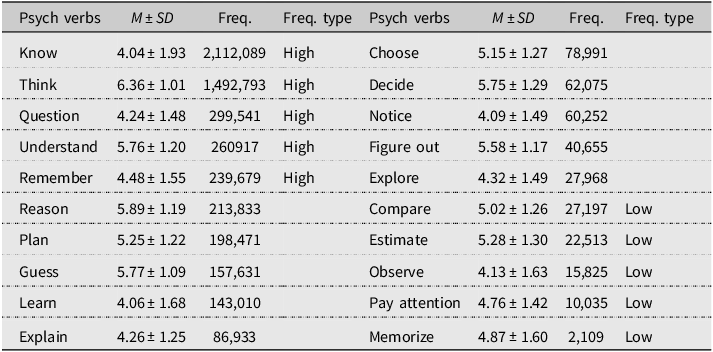
The experimental materials were based on a set of 30 psych verbs identified by Schwanenflugel et al. (Reference Schwanenflugel, Fabricius, Noyes, Bigler and Alexander1994) as the most prototypical for native English speakers. These verbs were adapted for CEBs through a rating task administered to 142 second-year English majors who did not participate in the formal experiment. They rated the verbs on a scale of 1–7 for typicality. Twenty verbs scoring above the mean value were selected as the core experimental materials (see Table 1). To explore the frequency effect, the study used the 2024 Contemporary American English Corpus (COCA), which contains approximately 600 million words. The 20 verbs were ranked by frequency and divided into high- and low-frequency groups using a median split. To validate the suitability of this categorization for CEBs, the same raters were asked to assess their familiarity with each psych verb using a 7-point scale. Paired sample t-tests confirmed higher familiarity ratings for high-frequency words (6.48 ± .31) than for low-frequency words (5.52 ± .30), t = 26.70, df = 141, Cohen’s d = 3.15, p < .001, confirming the validity of the frequency classification.
The typicality ratings of English psych verbs by CEBs (N = 142)

Table 1. Long description
The table compares psych verbs based on their mean and standard deviation, frequency, and frequency type. It has two main sections, each with 20 rows and 6 columns. The first section lists verbs like Know, Think, Question, Understand, Remember, Reason, Plan, Guess, Learn, and Explain. The second section lists verbs like Choose, Decide, Notice, Figure out, Explore, Compare, Estimate, Observe, Pay attention, and Memorize. Each row provides the mean and standard deviation, frequency, and frequency type for each verb. The frequency type is categorized as High or Low. The table does not include any visible trends or patterns beyond the categorization of verbs into high and low frequency types.
Note: freq.= frequency.
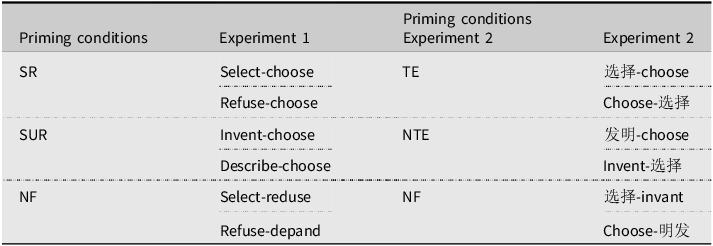
Experiment 1 used 20 English psych verbs from Table 1 to create 120 prime–target pairs. These pairs were categorized into three conditions: (1) related priming, where primes were synonyms or antonyms of the target (half each); (2) unrelated priming, where targets were the same as those in Condition 1, but primes were semantically unrelated; and (3) NF condition, where primes were the same as those in Condition 1, but targets were nonwords. The materials were randomized using a Latin square to ensure that each prime–target pair was presented to each participant only once. An example is shown in Table 2.
Material examples for Experiments 1 and 2

Table 2. Long description
A table with three columns and four rows, detailing priming conditions for two experiments. The columns are labeled ‘Priming conditions’, ‘Experiment 1’, and ‘Priming conditions Experiment 2 Experiment 2’. The rows are labeled ‘SR’, ‘SUR’, and ‘NF’. Under ‘SR’, Experiment 1 has ‘Select-choose’ and ‘Refuse-choose’, while Experiment 2 has ‘TE’, ‘选择-choose’, and ‘Choose-选择’. Under ‘SUR’, Experiment 1 has ‘Invent-choose’ and ‘Describe-choose’, while Experiment 2 has ‘NTE’, ‘发明-choose’, and ‘invent-选择’. Under ‘NF’, Experiment 1 has ‘Select-reduce’ and ‘Refuse-depend’, while Experiment 2 has ‘NF’ and ‘Choose-发明’.
Note: SR = semantically related; SUR = semantically unrelated; NF = nonword filler; TE = translation equivalent; NTE = nontranslation equivalent.
The selection of synonyms and antonyms followed a two-step procedure. In the first step, candidate synonyms and antonyms for each target verb were drawn from the first sense item of the Random House Roget’s Thesaurus (2012). Ten professors specializing in psycholinguistics then reviewed these candidates, providing up to five synonyms and five antonyms that best captured the affective and cognitive attributes of each target verb. The selection criteria adhered to the principles of exclusivity and mutual exclusion, ensuring no repetition of the original 20 psych verbs and no overlap between synonyms and antonyms. In the second step, based on the top three consistently identified candidate words, 30 second-year English majors who did not participate in the formal experiment rated the semantic appropriateness of each set of synonyms and antonyms on a scale of 0–10 (0 = completely inappropriate, 10 = completely appropriate). The words with the highest ratings were selected as the formal experimental materials.
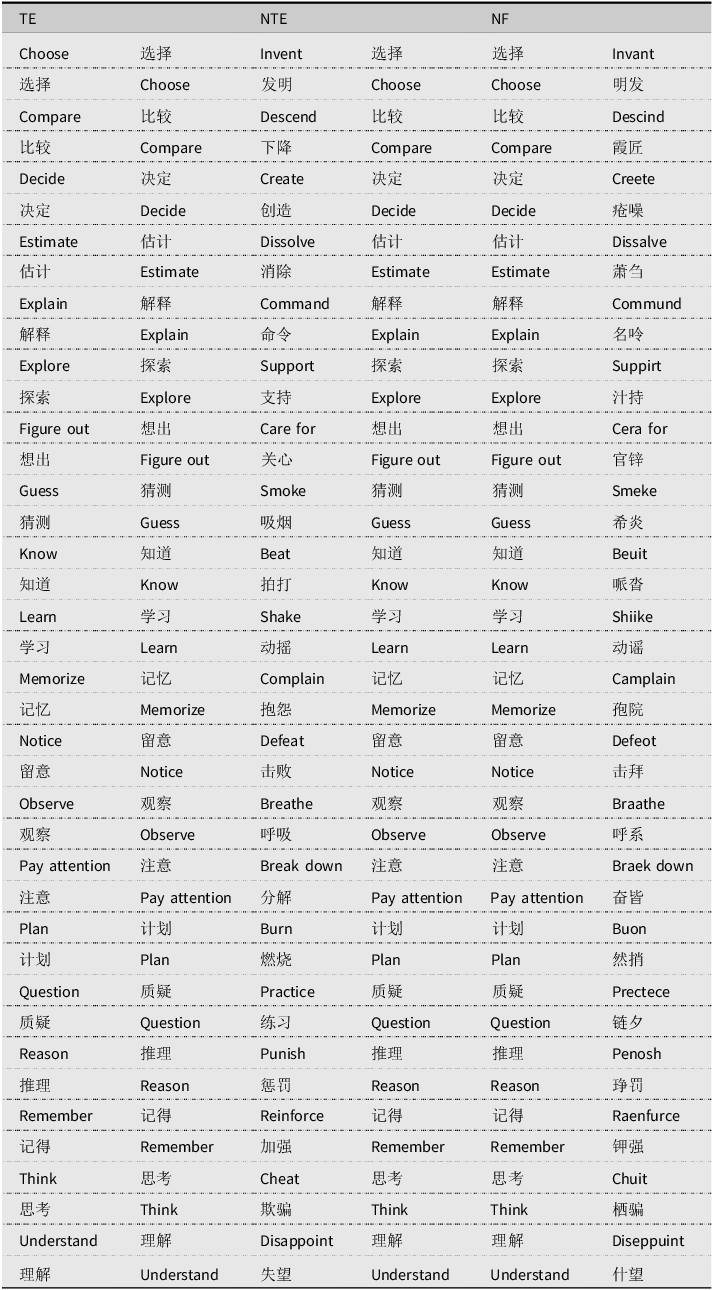
Experiment 2 used an expanded set of materials comprising 20 English psych verbs (Table 1), yielding 120 prime–target pairs. These pairs were classified into three prime conditions: (1) translation priming, where English psych verbs and their Chinese equivalents were used interchangeably as primes and targets (half in the E-C direction and half in the C-E direction); (2) nontranslation priming, where the targets remained consistent with those in Condition 1, but the primes were semantically unrelated; and (3) the NF condition, where the primes were the same as those in Condition 1 but the targets were nonwords. The experimental design was adapted from Li and Peng (Reference Li and Peng1999) and modified for the present study, as shown in Table 2. Unlike Li and Peng’s (Reference Li and Peng1999) sentence-completion approach, this study employed a masked priming paradigm in conjunction with a lexical decision task, providing a more direct evaluation of lexical-level semantic activation.
The process for selecting Chinese translation words for English psych verbs followed a procedure similar to that in Experiment 1: expert-provided candidate translation words were evaluated for appropriateness by a student group to identify vocabulary that accurately conveys the original affective and semantic attributes while adhering to Chinese expression conventions.
Procedure
Experiment 1: Stimuli were presented using E-Prime 2.0 on a computer screen, with black text on a white background. The procedure included displaying instructions (infinite), a 500-ms fixation cross, a 500-ms prime, a 500-ms mask (######), and a target word shown for a maximum of 2,000 ms. Participants were instructed to judge the lexicality of the target word by pressing the “D” key with their left middle finger for real words and the “K” key with their right middle finger for nonwords. The key assignment was counterbalanced among participants. Before the formal experiment, participants completed 20 practice trials, achieving an accuracy rate of over 90%. Experimental materials were presented at random, and the entire experiment lasted approximately 10 minutes. Data were collected individually in a quiet laboratory setting. The 500-ms prime duration was chosen based on evidence that L2 intra-language semantic priming, particularly for abstract verbs, may require a longer prime exposure to yield reliable facilitation effects due to weaker L2 lexical representations (Elgort, Reference Elgort2011). A 500-ms pattern mask immediately followed the prime to minimize prime visibility, and post-experiment debriefing confirmed that no participant reported awareness of the primes. Thus, although the prime duration is longer than in canonical masked priming studies with L1 participants, the procedure qualifies as masked priming in the functional sense, i.e., primes were rendered invisible via pattern masking, and the paradigm served to probe automatic lexical activation rather than strategic or conscious processing.
Experiment 2: Based on pilot testing, the prime duration was set at 100 ms, as pilot data indicated that interlanguage translation priming between Chinese and English was robust at this shorter duration, consistent with standard masked priming parameters for TEs (Jiang & Forster, Reference Jiang and Forster2001). All other aspects of the procedure remained consistent with Experiment 1. The experiment lasted approximately 8 minutes, and the data collection method was identical to that used in Experiment 1.
All participants completed both experiments. To counteract order effects, participants were divided into two groups: one completed Experiment 1 first, followed by Experiment 2, and the other completed the experiments in the opposite order.
Data processing
Accuracy rates consistently exceeded 95% across all experimental conditions, indicating a ceiling effect due to the high familiarity of the selected psych verbs. Consequently, RTs were used as the primary dependent variable. For RT data, trials with incorrect responses and RTs deviating by ±2.5 standard deviations from each participant’s mean were excluded. In total, 9.83% of the data in Experiment 1 and 8.16% in Experiment 2 were removed. Subsequently, p-values for all post hoc comparisons and correlation analyses involving RTs were adjusted using the Bonferroni method to control for multiple comparisons.
Results
Experiment 1: the intralanguage representation characteristics
Processing efficiency and priming effect
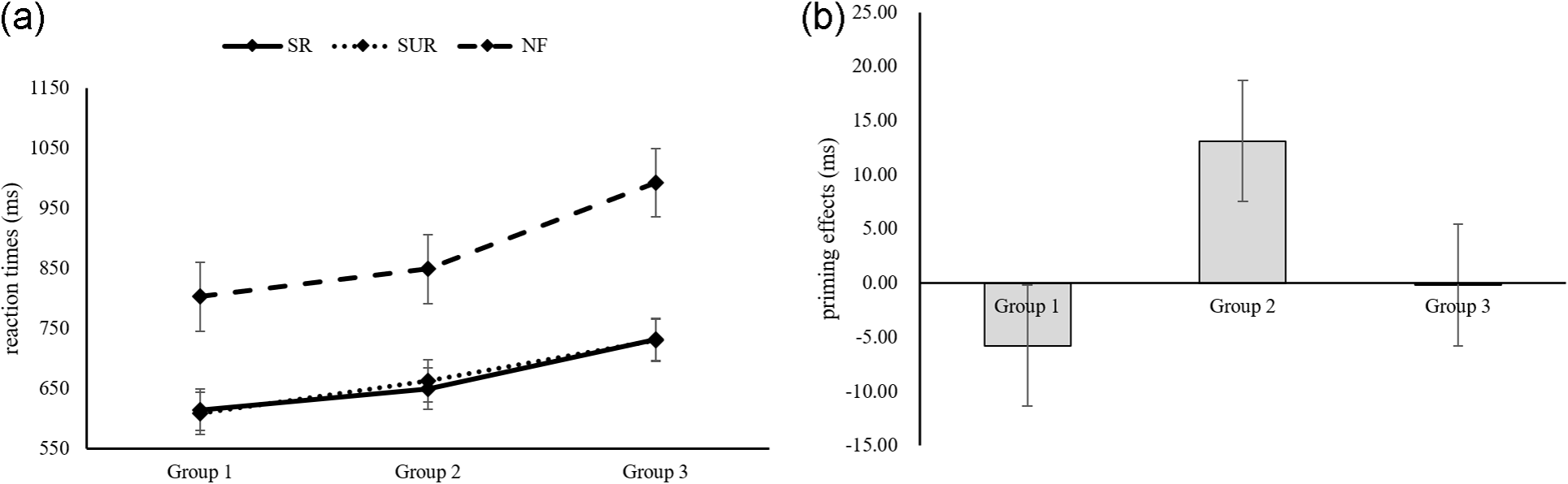
The descriptive statistics for RTs and priming effects under different conditions are presented in Table 3 for each group. The distributions of RTs and priming effects for each group are illustrated in Figure 1.
Descriptive statistics for RTs and priming effects under different conditions in Experiment 1 (M ± SD)

Table 3. Long description
The table presents descriptive statistics for reaction times (RTs) and priming effects under different conditions for three groups. It has four columns and three rows. The columns are labeled Group, SR, SUR, NF, and Priming effects. The row labels are Group 1, Group 2, and Group 3. Each cell contains values with standard deviations. Row 1: Group 1, SR 614.46 ± 140.13, SUR 608.68 ± 139.45, NF 803.05 ± 220.15, Priming effects -5.78 ± 54.77. Row 2: Group 2, SR 649.57 ± 132.12, SUR 662.69 ± 140.40, NF 849.05 ± 190.17, Priming effects 13.12 ± 51.07. Row 3: Group 3, SR 731.35 ± 110.87, SUR 731.15 ± 118.09, NF 993.10 ± 182.25, Priming effects -0.20 ± 82.56.
Note: Priming effects = SUR RTs—SR RTs.
The average RTs (a) and priming effects (b) under different priming conditions in Experiment 1. Error bars indicate standard errors.

A two-way ANOVA on RTs with priming type (SR, SUR, NF) and proficiency group (low, intermediate, high) revealed significant main effects of priming type (F (2,354) = 406.24, p < .001,
 $\eta _p^2$
= .70) and proficiency group (F (2,177) = 11.24, p < .001,
 $\eta _p^2$
= .11). However, the interaction was not significant (F (4,354) = .36, p = .835,
 $\eta _p^2$
= .01). Post hoc comparisons showed that RTs in the NF condition were significantly longer than those in the SR and SUR conditions within each group (ps < .001), confirming that participants successfully discriminated words from nonwords.
Critically, the SR and SUR conditions did not differ significantly in any proficiency group (ps > .05), and the priming effect (SUR–SR) did not vary significantly across groups (F (2,177) = 1.37, p = .258). Thus, intralanguage SR did not produce reliable facilitation in overall RTs. However, a significant proficiency effect emerged within the SR condition: RTs for the low- and intermediate-proficiency groups were significantly shorter than those for the high-proficiency group (ps < .01), with no significant difference between the low- and intermediate-proficiency groups (p = .136).
As shown in Figure 1b, the priming effect exhibited an inverted V-shaped pattern across proficiency levels, increasing from low-to-intermediate proficiency and then decreasing at high proficiency. However, this variation did not reach statistical significance (p = .258).
The influence of lexical–semantic relations on intralanguage representation
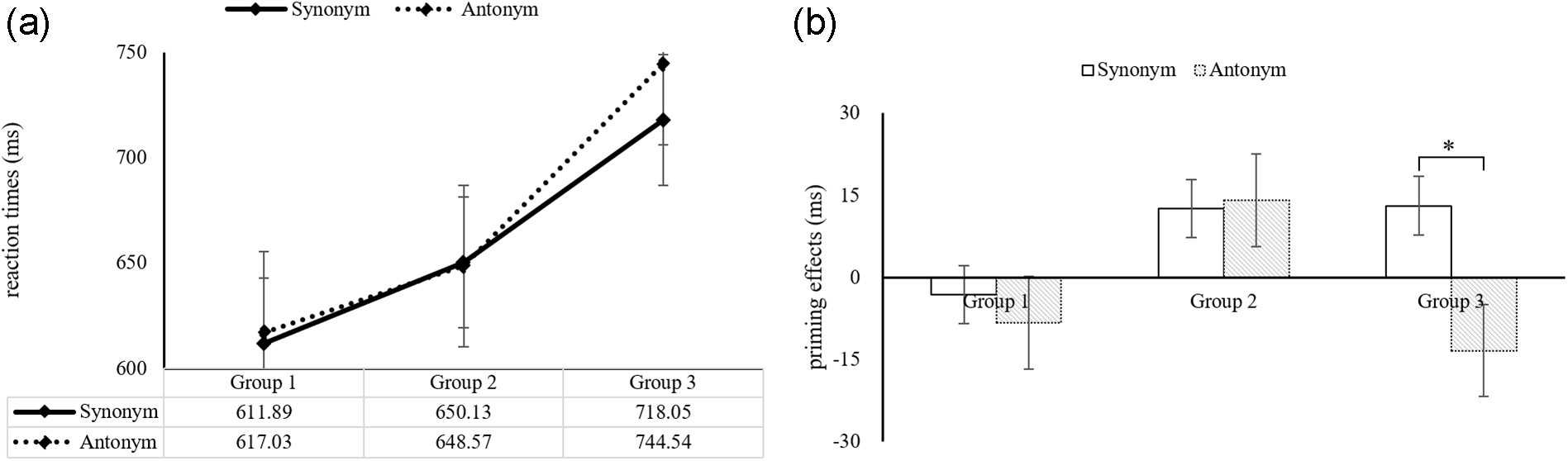
Figure 2a illustrates participants’ RTs to synonyms and antonyms in the context of intralanguage priming, along with the distribution of their corresponding priming effects shown in Figure 2b.
The average RTs (a) and priming effects (b) under different semantic relations in Experiment 1. ***<.001, **<.01, *<.05.

A two-way ANOVA on RTs with semantic relation (synonym, antonym) and proficiency group (low, intermediate, high) revealed a significant main effect of proficiency (F (2,177) = 13.11, p < .001,
 $\eta _p^2$
= .13). The main effect of semantic relation was not significant (F (1,177) = 1.96, p = .163,
 $\eta _p^2$
= .01), nor was the interaction (F (2,177) = 1.39, p = .251,
 $\eta _p^2$
= .02). Within the high-proficiency group, RTs for synonyms were significantly faster than for antonyms (p < .05). Conversely, no significant differences between synonyms and antonyms were found in the low- and intermediate-proficiency groups (ps > .05). Thus, a significant synonym advantage emerged only at high proficiency.
As shown in Figure 2b, the priming effects mirrored the RT pattern: the synonym advantage over antonyms reached significance only in the high-proficiency group (p < .05). All other pairwise comparisons, both within each proficiency group and between groups for each semantic relation, were not significant.
The influence of word frequency on intralanguage representation
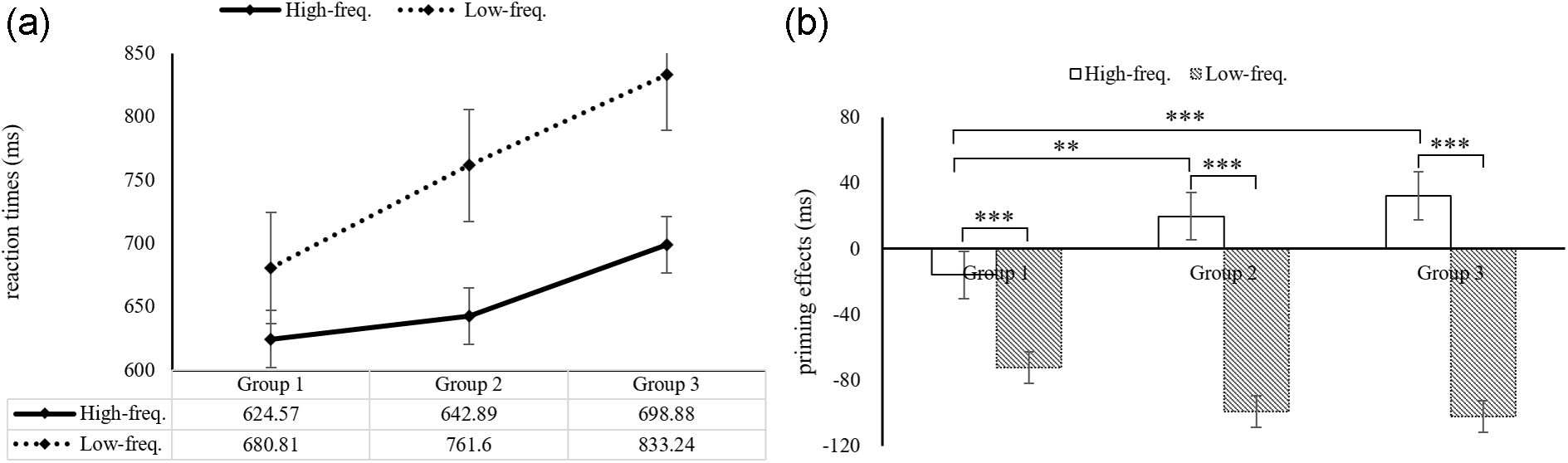
The RTs for high- and low-frequency words in each group are illustrated in Figure 3a, and the distributions of their respective priming effects are displayed in Figure 3b.
The average RTs (a) and priming effects (b) under different frequencies in Experiment 1.

Figure 3. Long description
The image contains two line graphs labeled (a) and (b). Panel A shows a line graph depicting reaction times in milliseconds (ms) on the y-axis and three groups on the x-axis. Two lines represent high-frequency and low-frequency conditions, with high-frequency shown as a solid line and low-frequency as a dotted line. The reaction times increase from Group 1 to Group 3 for both conditions, with low-frequency consistently higher than high-frequency. Panel B shows a line graph depicting priming effects in milliseconds (ms) on the y-axis and three groups on the x-axis. Two sets of bars represent high-frequency and low-frequency conditions. The priming effects are negative for all groups, with low-frequency showing more negative effects than high-frequency. Significant differences are indicated by asterisks, with more asterisks denoting higher significance levels.
A two-way ANOVA on RTs with word frequency (high, low) and proficiency group (low, intermediate, high) revealed a significant main effect of frequency (F (1,177) = 155.60, p < .001,
 $\eta _p^2$
= .47), a significant main effect of proficiency (F (2,177) = 7.75, p < .01,
 $\eta _p^2$
= .08), and a significant interaction (F (2,177) = 8.34, p < .001,
 $\eta _p^2$
= .09). High-frequency words elicited significantly shorter RTs than low-frequency words within each group (ps < .001). The interaction reflected that, for high-frequency words, the low- and intermediate-proficiency groups responded significantly faster than the high-proficiency group (ps < .05); for low-frequency words, the low-proficiency group responded the fastest, and the high-proficiency group responded the slowest, with all pairwise differences being significant (ps < .05).
Figure 3b shows the corresponding priming effects. For each proficiency group, high-frequency words elicited significantly larger priming effects than low-frequency words (ps < .001). Between-group comparisons revealed significant differences only for high-frequency words: the low-proficiency group showed significantly smaller priming effects than both the intermediate- and high-proficiency groups (ps < .01), whereas no significant difference was found between the intermediate- and high-proficiency groups. For low-frequency words, no significant group differences were observed (ps > .05).
The joint influence of word frequency and semantic relation on intralanguage representation
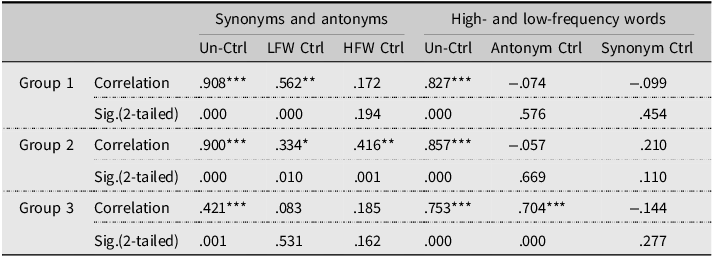
Table 4 shows the results of the partial correlation analysis of synonyms and antonyms, adjusting for word frequency and controlling for semantic relationships, for high- and low-frequency terms and across various cohorts.
The results of the partial correlation analysis under different conditions in Experiment 1

Table 4. Long description
A table comparing partial correlation analysis results for synonyms and antonyms, adjusting for word frequency and controlling for semantic relationships, across various cohorts. The table has 3 rows and 8 columns. Row labels are Group 1, Group 2, and Group 3. Column headers are Un-Ctrl Correlation, LFW Ctrl Correlation, HFW Ctrl Correlation, Un-Ctrl Correlation, Antonym Ctrl Correlation, and Synonym Ctrl Correlation, Sig.(2-tailed). Row 1: Group 1 Correlation: .908***, .562**, .172, .827***, -.074, -.099 Sig.(2-tailed): .000, .000, .194, .000, .576, .454. Row 2: Group 2 Correlation: .900***, .334*, .416**, .857***, -.057, .210 Sig.(2-tailed): .000, .010, .001, .000, .669, .110. Row 3: Group 3 Correlation: .421***, .083, .185, .753***, .704***, -.144 Sig.(2-tailed): .001, .531, .162, .000, .000, .277.
Note: (1) LFW = low-frequency words; HFW = high-frequency words; Antonym = antonyms; Synonym = synonyms; Ctrl = controlled; Un-Ctrl = uncontrolled. Combinations indicate the variable controlled for (e.g., LFW Ctrl = controlled for low-frequency words). (2) ***< .001, **< .01, *< .05.
Table 4 shows significant correlations between synonyms and antonyms across all proficiency levels (ps < .001) without controlling for word frequency. However, for low-frequency words, significant correlations are observed only in the low- and intermediate-proficiency groups. Similarly, after accounting for high-frequency words, significant correlations are found solely in the intermediate-proficiency group. In contrast, significant correlations between high- and low-frequency words are observed across all groups, even without controlling for semantic relations. Notably, when controlling for antonyms, a significant correlation between high- and low-frequency words is apparent exclusively within the high-proficiency group.
In summary, the partial correlation analyses showed that the relationship between synonyms and antonyms was modulated by word frequency. With increasing proficiency, semantic integration between synonyms and antonyms became less frequency-dependent. In contrast, the link between high- and low-frequency words became more dependent on semantic relation, particularly antonymy.
Experiment 2: the interlanguage representation characteristics
Processing efficiency and priming effect
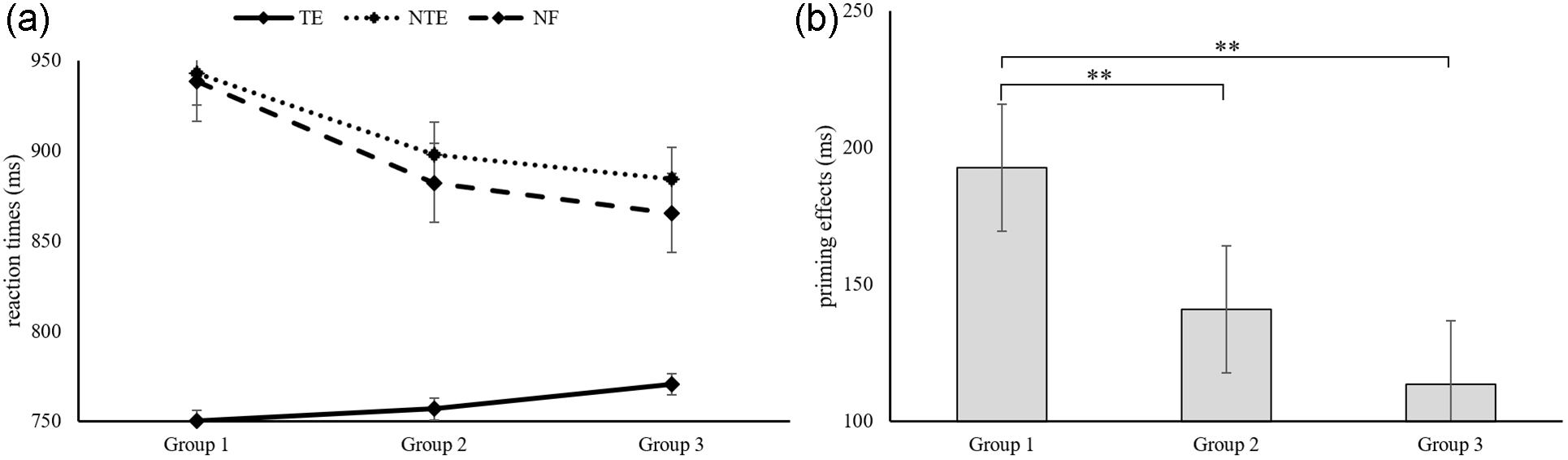
Table 5 shows the statistical results for RTs and priming effects, while Figure 4 illustrates the distribution of RTs and priming effects within each group.
Descriptive statistics for RTs and priming effects under different conditions in Experiment 2 (M ± SD)

Table 5. Long description
The table presents descriptive statistics for reaction times (RTs) and priming effects under different conditions in Experiment 2. It includes three groups, each with values for TE, NTE, NF, and Priming effects. The table has four columns: Group, TE, NTE, NF, and Priming effects, and three rows for Group 1, Group 2, and Group 3. Each cell contains mean values with standard deviations. Row 1: Group 1, TE 750.15 ± 117.35, NTE 942.97 ± 166.56, NF 938.13 ± 169.87, Priming effects 192.82 ± 92.12. Row 2: Group 2, TE 756.92 ± 85.23, NTE 897.93 ± 127.87, NF 882.18 ± 131.67, Priming effects 141.01 ± 86.41. Row 3: Group 3, TE 770.62 ± 76.25, NTE 884.25 ± 123.69, NF 865.46 ± 117.34, Priming effects 113.63 ± 91.65.
Note: Priming effects = NTE RTs—TE RTs.
The average RTs (a) and priming effects (b) under different priming conditions in Experiment 2.

A two-way ANOVA on RTs with priming type (TE, NTE, NF) and proficiency group (low, intermediate, high) revealed a significant main effect of priming type (F (2,354) = 407.50, p < .001,
 $\eta _p^2$
= .70) and a significant interaction (F (4,354) = 13.04, p < .001,
 $\eta _p^2$
= .13). The main effect of proficiency was not significant (F (2,177) = 1.68, p = .190,
 $\eta _p^2$
= .02). Post hoc comparisons confirmed that RTs in the NF condition were significantly longer than those in the TE and NTE conditions within each group (ps < .001), validating task compliance. RTs in the TE condition were significantly shorter than those in the NTE condition (p < .001), indicating robust facilitation from TEs. No significant RT differences were observed among proficiency groups within the TE condition (ps > .05).
As shown in Figure 4b, the priming effect decreased consistently as L2 proficiency increased. A one-way ANOVA on the priming effect with proficiency as the independent variable yielded a significant main effect (F (2,177) = 11.96, p < .001). Post hoc comparisons confirmed that the priming effect was significantly larger for the low-proficiency group than for the intermediate- and high-proficiency groups (ps < .01); the intermediate- and high-proficiency groups did not differ significantly (p = .089). The translation priming effect was strongest at the lowest proficiency level and weakened as proficiency increased.
The influence of language direction on interlanguage representation
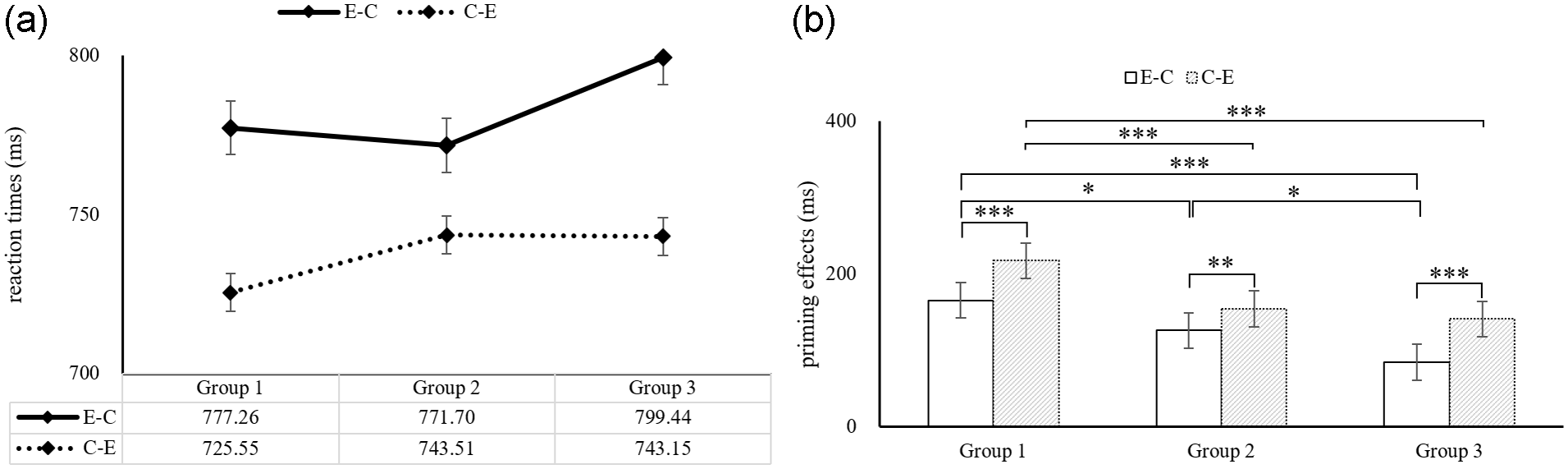
Figure 5a depicts the TE RTs for three groups in both E-C and C-E directions, and Figure 5b shows the distribution of priming effects for each direction.
The average RTs (a) and priming effects (b) under different directions in Experiment 2.

Figure 5. Long description
Panel A: A line graph shows reaction times in milliseconds (ms) for two conditions, E-C and C-E, across three groups. The x-axis represents the groups, and the y-axis represents reaction times in ms. The E-C condition is represented by a solid line, while the C-E condition is represented by a dotted line. The table below the graph lists the average reaction times for each group and condition. Group 1 has E-C at 777.26 ms and C-E at 725.55 ms. Group 2 has E-C at 771.70 ms and C-E at 743.51 ms. Group 3 has E-C at 799.44 ms and C-E at 743.15 ms. Panel B: A bar graph shows priming effects in milliseconds (ms) for the same conditions and groups. The x-axis represents the groups, and the y-axis represents priming effects in ms. The E-C condition is represented by white bars, while the C-E condition is represented by shaded bars. Significant differences between groups and conditions are indicated by asterisks, with more asterisks indicating higher significance levels. Group 1 shows significant differences between E-C and C-E conditions. Group 2 also shows significant differences, with some comparisons marked by fewer asterisks. Group 3 exhibits highly significant differences between conditions.
A two-way ANOVA on RTs with language direction (E-C, C-E) and proficiency group (low, intermediate, high) revealed a significant main effect of direction (F (1,177) = 58.31, p < .001,
 $\eta _p^2$
= .25). Neither the main effect of proficiency (F (2,177) = .69, p = .501,
 $\eta _p^2$
= .01), nor the interaction (F (2,177) = 2.14, p = .120,
 $\eta _p^2$
= .02) was significant. RTs were significantly shorter in the C-E direction than in the E-C direction within each proficiency group (ps < .01). This C-E advantage was consistent across proficiency levels.
As shown in Figure 5b, the priming effects decreased with increasing proficiency in both directions. Within each proficiency group, the C-E priming effect was significantly larger than the E-C priming effect (ps < .01). In the E-C direction, the priming effect of the low–proficiency group was significantly larger than those of the intermediate- and high–proficiency groups (ps < .01), and the intermediate group also showed a significantly larger effect than the high group (p < .05). In the C-E direction, the low-proficiency group had significantly larger priming effects than both the intermediate and high groups (ps < .001), but there was no significant difference between the intermediate and high groups (p > .05).
The influence of word frequency on interlanguage representation
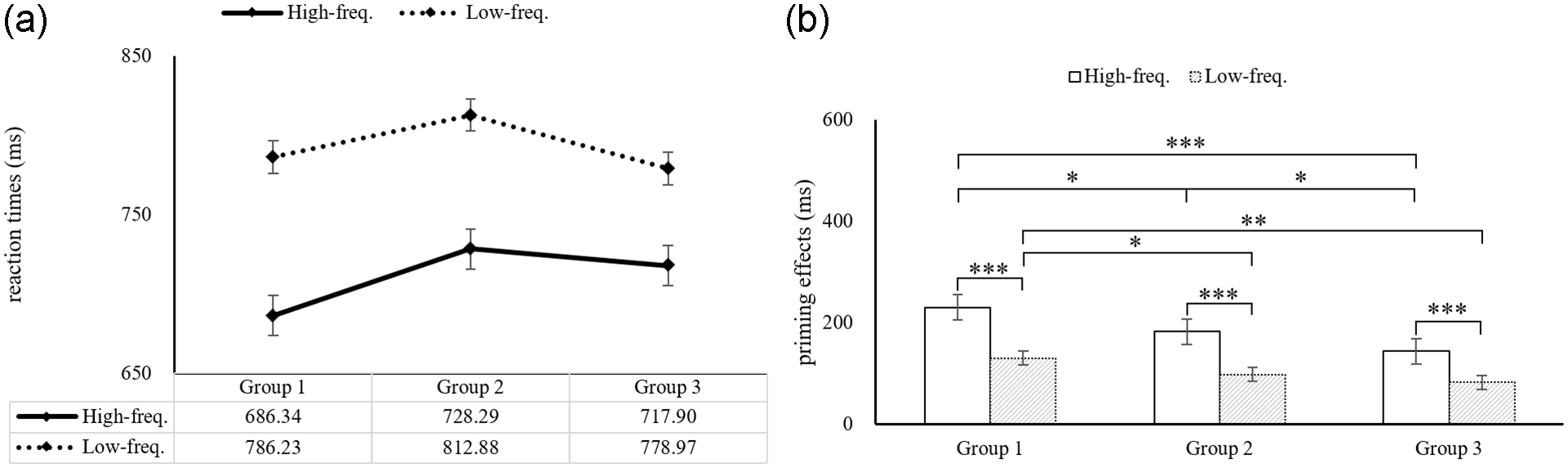
Figure 6a depicts the RTs for high- and low-frequency words in three groups, and Figure 6b shows the distribution of their respective priming effects.
The average RTs (a) and priming effects (b) under different frequencies in Experiment 2.

A two-way ANOVA on RTs with word frequency (high, low) and proficiency group (low, intermediate, high) showed a significant main effect of word frequency (F (1,177) = 174.25, p < .001,
 $\eta _p^2$
= .50). The main effect of proficiency was not significant (F (2,177) = .26, p = .770,
 $\eta _p^2$
= .003), but the interaction was significant (F (2,177) = 3.12, p = .047,
 $\eta _p^2$
= .03). Simple effect analyses revealed that RTs for high-frequency words were significantly shorter than those for low-frequency words in each proficiency group (ps < .001). No significant differences in RTs among proficiency groups were observed for either high- or low-frequency words (ps > .05).
The priming effects depicted in Figure 6b show a gradual decline for high- and low-frequency words as L2 proficiency increases. High-frequency words produced significantly larger priming effects than low-frequency words within each proficiency group (ps < .001). For high-frequency words, the priming effect was largest in the low-proficiency group and smallest in the high-proficiency group, with all pairwise differences being significant (ps < .05). For low-frequency words, the priming effect was significantly larger in the low-proficiency group than in the intermediate- or high-proficiency group (ps < .05).
The joint influence of word frequency and language direction on interlanguage representation
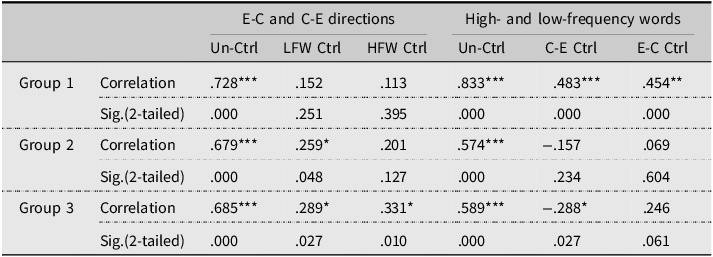
Table 6 shows the partial correlation results for the E-C and C-E directions. It considers word frequency as a controlled variable for both high- and low-frequency words and incorporates language direction as a covariate across three groups.
The results of the partial correlation analysis under different conditions in Experiment 2

Table 6. Long description
The table presents partial correlation results for the E-C and C-E directions, considering word frequency as a controlled variable for both high- and low-frequency words and incorporating language direction as a covariate across three groups. The table has 3 rows and 8 columns. The columns are labeled as Un-Ctrl, LFW Ctrl, HFW Ctrl, Un-Ctrl, C-E Ctrl, and E-C Ctrl under the headers E-C and C-E directions and High- and low-frequency words. The rows are labeled as Group 1, Group 2, and Group 3. Each row contains values for Correlation and Sig. (2-tailed). Row 1: Group 1, Correlation: .728***, .152, .113, .833***, .483***, .454**, Sig. (2-tailed): .000, .251, .395, .000, .000, .000. Row 2: Group 2, Correlation: .679***, .259*, .201, .574***, -.157, .069, Sig. (2-tailed): .000, .048, .127, .000, .234, .604. Row 3: Group 3, Correlation: .685***, .289*, .331*, .589***, -.288*, .246, Sig. (2-tailed): .000, .027, .010, .000, .027, .061.
Note: (1) Abbreviations for Ctrl, Un-Ctrl, LFW, and HFW are as defined in Table 4. Additional abbreviations: C-E = Chinese to English; E-C = English to Chinese. Combinations indicate the direction controlled for (e.g., C-E Ctrl = controlled for the C-E direction). (2) Significance levels are the same as in Table 4.
Table 6 shows a significant correlation in TE representation between the E-C and C-E directions across all groups, with no control for word frequency. However, the correlation patterns change when low- and high-frequency words are controlled separately. Specifically, after controlling for low-frequency words, a significant correlation is observed only within the intermediate- and high-proficiency groups. In contrast, controlling for high-frequency words reveals a significant correlation only within the high-proficiency group. Moreover, irrespective of language direction, high- and low-frequency TEs exhibit significant correlations within each group. However, when controlling for the C-E direction, a positive correlation is present in the low-proficiency group, whereas a negative correlation emerges in the high-proficiency group. Conversely, a significant correlation is evident only within the low-proficiency group, even after controlling for the E-C direction.
The key findings were twofold. First, word frequency significantly modulates the TE correlation between the E-C and C-E directions, especially for advanced-proficiency learners. Second, the association between high- and low-frequency words varied by language direction. In the E-C direction, low-proficiency learners showed a significant positive correlation between high- and low-frequency TEs, whereas high-proficiency learners showed a negative correlation. In the C-E direction, a significant positive correlation emerged only in the low-proficiency group.
The comparison between the intra- and interlanguage representations of English psych verbs
At varying proficiency levels (low: 614.46 ± 140.13 vs. 750.15 ± 117.35; intermediate: 649.57 ± 132.12 vs. 756.92 ± 85.23; high: 731.35 ± 110.87 vs. 770.62 ± 76.25), learners demonstrated significantly shorter RTs for intralanguage processing compared with interlanguage processing (ps < .001), indicating superior efficiency in intralanguage processing. High-frequency words consistently showed significantly shorter RTs in intralanguage processing than in interlanguage processing across all proficiency levels (low: 624.57 ± 148.59 vs. 706.23 ± 123.05; intermediate: 642.89 ± 145.79 vs. 707.37 ± 88.78; high: 698.88 ± 128.33 vs. 735.56 ± 79.75; ps < .05). However, for low-frequency words, significant differences between intra- and interlanguage processing were only evident in the low (680.81 ± 196.06 vs. 803.71 ± 146.02) and intermediate (761.60 ± 194.86 vs. 803.68 ± 110.64) proficiency groups (ps < .05), with no significant distinction in the high-proficiency group (833.24 ± 179.43 vs. 798.18 ± 102.62; p = .092). This suggests that the advantage of intralanguage processing for low-frequency words diminishes with increasing L2 proficiency. Notably, as L2 proficiency advances, the efficiency gap between intra- and interlanguage processing gradually narrows.
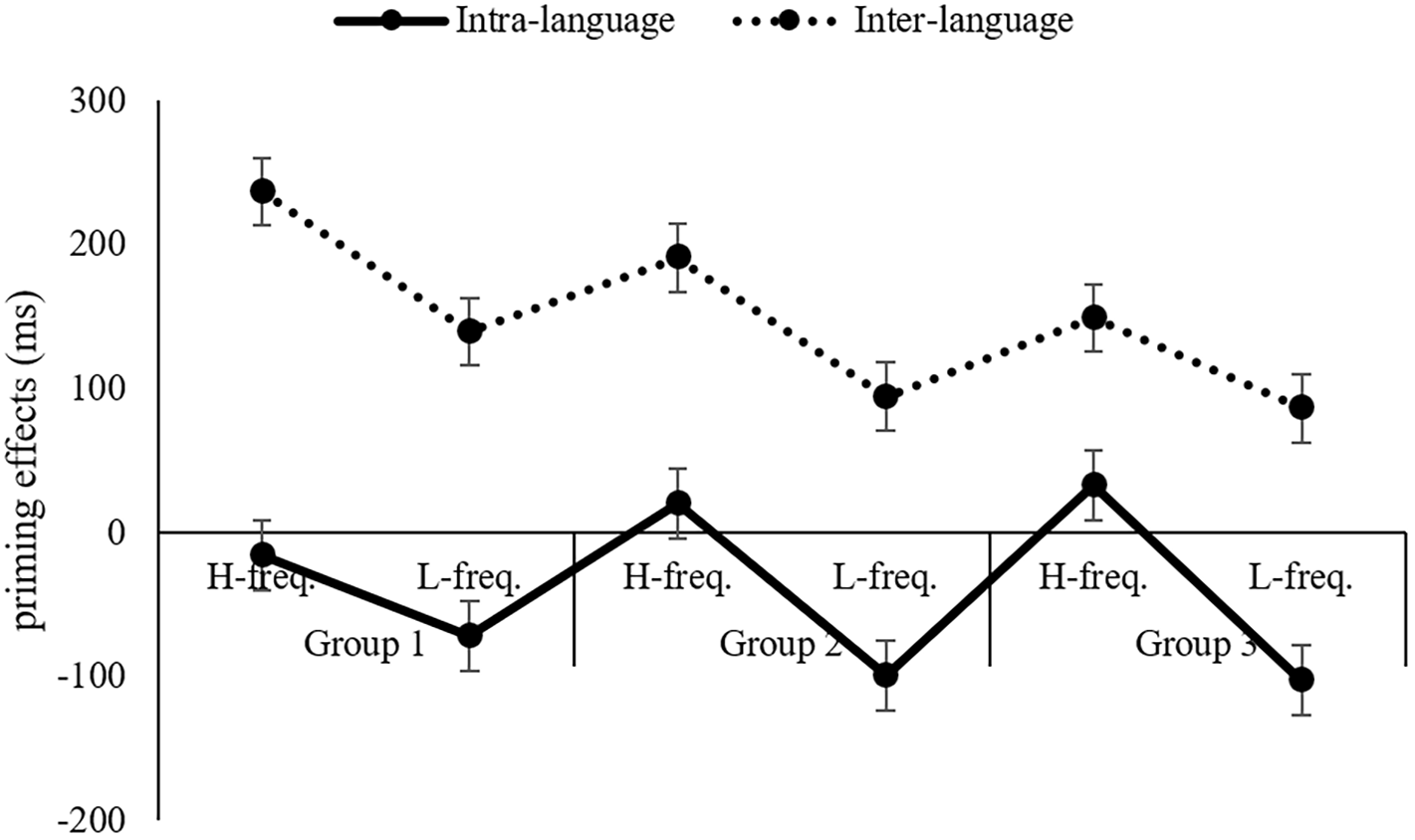
Across different proficiency levels (low, intermediate, high), interlanguage priming effects significantly exceeded intralanguage priming effects (priming effects: −6.19 ± 55.14 vs. 195.83 ± 89.90; 13.12 ± 51.07 vs. 141.01 ± 86.41; −.20 ± 82.56 vs. 113.63 ± 91.65), all with p-values less than .001. High-frequency words consistently showed higher interlanguage priming compared with intralanguage priming across all proficiency levels (priming effects: -15.89 ± 58.83 vs. 236.74 ± 115.52; 19.80 ± 79.18 vs. 190.56 ± 104.69; 32.27 ± 77.08 vs. 148.69 ± 108.03), all with p-values less than .001. Similarly, low-frequency words also exhibited significantly stronger interlanguage priming than intralanguage priming across all proficiency levels (priming effects: −72.13 ± 124.17 vs. 139.25 ± 116.39; −98.91 ± 89.97 vs. 94.25 ± 101.99; −102.08 ± 99.24 vs. 86.06 ± 107.09), all with p-values less than .001. These results indicate a consistent prevalence of interlanguage priming over intralanguage priming in CEBs, as shown in Figure 7, suggesting shared distributed lexical representations between English and Chinese. This challenges the traditional notion of distinct or highly segregated intra- and interlanguage representations.
The priming effects between intra- and interlanguage under various frequencies for different groups.

Discussion
Intralanguage representation characteristics of English psych verbs
The finding that intralanguage semantic relatedness (SR vs. SUR) did not produce significant facilitation in overall RTs appears to reflect that lexical–semantic associations alone do not automatically drive psych-verb processing for CEBs; instead, processing appears to be modulated jointly by semantic relation, proficiency, and word frequency. The emergence of a significant synonym advantage—but only among high-proficiency learners—indicates that the integration of synonyms into a coherent semantic network is a proficiency-dependent achievement. This pattern is consistent with the distributed feature model (Plaut & Gonnerman, Reference Plaut and Gonnerman2000), which predicts that increased proficiency leads to more differentiated and finely calibrated featural representations. The synonym advantage at high proficiency suggests that synonymous psych verbs achieve sufficient featural overlap to generate robust priming. In contrast, antonyms, which share fewer semantic features, remain less integrated even at advanced proficiency levels.
Consistent with prior research, high-frequency words produced significantly larger intralanguage priming effects than low-frequency words across all groups (Monaco et al., Reference Monaco, Abbott and Kahana2007). Notably, this frequency advantage was smallest for low-proficiency learners, who showed significantly weaker high-frequency priming than the intermediate- and high-proficiency groups. Contrary to the hypothesis that frequency effects would be most pronounced in low-proficiency learners, the high-frequency advantage was smallest in this group. This unexpected pattern may reflect the fact that low-proficiency learners, whose lexical representations are less entrenched, benefit less from the cumulative exposure that drives high-frequency facilitation (Elgort, Reference Elgort2011; Kim, Reference Kim2008).
The partial correlation analyses further revealed that proficiency moderates the interplay between semantic relations and word frequency. For low- and intermediate-proficiency learners, semantic associations—particularly antonymy—remained tied to word frequency; for high-proficiency learners, synonym integration became independent of frequency, whereas antonym processing remained frequency-sensitive. This asymmetry between the organization of synonyms and antonyms is consistent with the view that psych verbs carry inherent affective complexity, making antonymic contrasts harder to integrate, even at high proficiency (Ferré et al., Reference Ferré, Guasch, García-Chico and Sánchez-Casas2015).
Interlanguage representation characteristics of English psych verbs
The robust translation priming effect (TE < NTE) across all proficiency levels confirms that TEs are automatically activated during bilingual psych-verb processing, consistent with the shared asymmetric model’s claim that L1 and L2 lexical representations are interconnected via shared conceptual features (Kim & Chung, Reference Kim and Chung2024; Kroll & Stewart, Reference Kroll and Stewart1994). The magnitude of this priming effect decreased as proficiency increased, with low-proficiency CEBs showing significantly larger facilitation than intermediate- and high-proficiency CEBs. This pattern suggests a developmental shift; at lower proficiency, L2 processing relies heavily on L1-mediated access, whereas at higher proficiency, it enables more direct L2-to-concept mapping, reducing the relative contribution of translation-mediated activation (Kroll & Stewart, Reference Kroll and Stewart1994).
Consistent with the hypothesis, the C-E advantage was largest for low-proficiency learners, confirming that the translation priming asymmetry—with significantly stronger priming in the C-E than in the E-C direction—directly supports the shared asymmetric model’s core prediction that lexical–semantic links are stronger from L1 to L2 than vice versa (Kroll & Stewart, Reference Kroll and Stewart1994; Yang et al., Reference Yang, Gao and Zhang2023). This asymmetry was largest among low-proficiency learners and diminished with increasing proficiency, suggesting that the C-E advantage reflects L1-mediated access that weakens as direct L2 representations strengthen.
Word frequency further modulated cross-linguistic priming. High-frequency TEs produced larger priming effects than low-frequency ones across all proficiency levels, consistent with the idea that stronger L2 representations—built through repeated exposure—activate their L1 counterparts more efficiently (Marian et al., Reference Marian, Faroqi-Shah, Kaushanskaya, Blumenfeld and Sheng2009). The frequency effect on translation priming was largest for low-proficiency learners. It weakened as proficiency increased, suggesting that frequency-driven facilitation is most critical when direct L2 representations are still developing.
The partial correlation analyses confirmed that language direction and word frequency jointly shape interlanguage representation. In the E-C direction, intermediate learners showed a positive correlation between high- and low-frequency TEs, suggesting that high-frequency words facilitate access to low-frequency counterparts when processing from L1 to L2. High-proficiency learners, by contrast, exhibited a negative correlation in the same direction, indicating that they process high- and low-frequency words via more differentiated pathways. In the C-E direction, only low-proficiency learners showed a significant positive correlation between high- and low-frequency words, reinforcing the view that frequency-driven co-activation is most pronounced when L2 proficiency is low (Marian et al., Reference Marian, Faroqi-Shah, Kaushanskaya, Blumenfeld and Sheng2009).
Relationship between intra- and interlanguage representations and proficiency modulation
Across all proficiency levels, intralanguage RTs were significantly shorter than interlanguage RTs, consistent with prior evidence that intralanguage lexical processing imposes lower cognitive demands than interlanguage processing (Sabourin & Stowe, Reference Sabourin and Stowe2008). This intralanguage efficiency advantage likely reflects the fact that staying within a single language avoids the cost of cross-linguistic switching and integration (Frumuselu, Reference Frumuselu2018).
The intralanguage RT advantage was robust for high-frequency words across all proficiency levels. For low-frequency words, however, this advantage was significant only for low- and intermediate-proficiency groups and disappeared at high proficiency. This convergence suggests that as L2 proficiency increases, low-frequency words are more efficiently integrated into the interlanguage network, reducing the gap between intra- and interlanguage access. Despite faster intralanguage RTs, interlanguage priming effects were consistently larger across all conditions. This dissociation—faster processing within a language but stronger interlanguage facilitation—is a signature of the shared asymmetric model, in which shared conceptual representations enable robust interlanguage activation even when language-specific lexical access remains more efficient (Jiang & Forster, Reference Jiang and Forster2001).
These results extend the shared asymmetric model (Kroll & Stewart, Reference Kroll and Stewart1994) in two important ways. First, they demonstrate that the developmental shift from L1-mediated to direct L2 conceptual access applies to abstract psych verbs, not only to the concrete nouns on which the model was originally tested. Second, they show that this shift is modulated by word frequency; low-frequency words continue to rely on L1-mediated access even at intermediate proficiency, whereas high-frequency words develop direct L2-to-concept links earlier.
A central finding of this study is that interlanguage priming tended to exceed intralanguage priming across all proficiency levels, despite faster intralanguage RTs. This pattern supports the view that the bilingual lexicon is a fundamentally integrated system in which interlanguage connections remain active regardless of proficiency (Li et al., Reference Li, Cao, Chen, Liu, Zhang and Mei2023; Siyambalapitiya et al., Reference Siyambalapitiya, Chenery and Copland2013). The persistent interlanguage facilitation observed here suggests that shared distributed representations between L1 and L2 are automatically co-activated during lexical processing, even when intralanguage access is more efficient.
Taken together, the results largely support the three core hypotheses, while also revealing an unexpected pattern. The synonym advantage emerged only at high proficiency (supporting the first prediction of Hypothesis 1). However, contrary to the second prediction of Hypothesis 1, the frequency effect was smallest, not largest, in low-proficiency learners, suggesting that cumulative exposure benefits are constrained when lexical representations are not yet entrenched. The C-E asymmetry was largest for low-proficiency learners (supporting Hypothesis 2), and the intra–inter gap narrowed with increasing proficiency, particularly for low-frequency words (supporting Hypothesis 3). Despite this partial deviation, the convergent findings robustly demonstrate that the distributed feature model and the shared asymmetric model—originally developed for concrete nouns—extend to abstract psych verbs under the modulating influence of L2 proficiency.
Limitations and future directions
Several limitations warrant consideration. First, the sample predominantly consisted of students within a narrow age range, which may have limited the generalizability of the findings to older bilinguals or to those with nonacademic language acquisition backgrounds. Second, methodologically, while the masked priming paradigm effectively probed implicit semantic processing, its focus on lexical decision-making tasks may not fully capture explicit memory retrieval or syntactic/discourse-level processing. The cross-sectional design also precludes the examination of longitudinal changes in semantic networks, and relying solely on RTs as the behavioral measure overlooks complementary neurocognitive data from techniques such as fMRI or electroencephalogram (EEG). Third, the study examined a specific set of English psych verbs within a single language pair (C-E); future research should test whether the observed patterns generalize to other word classes and language combinations. Fourth, we employed aggregated ANOVA analyses to examine the effects of proficiency, priming type, and word frequency on RTs. Although this approach is well established in psycholinguistic research and remains appropriate for detecting population-level effects, it does not simultaneously model random variability associated with both participants and items. Recent studies have suggested that item-level variability may influence the magnitude of semantic priming effects and that mixed-effects models offer advantages in handling crossed random factors and estimating random slopes (Barr et al., Reference Barr, Levy, Scheepers and Tily2013; Heyman et al., Reference Heyman, Bruninx, Hutchison and Storms2018). Future research with a sufficiently large stimulus set could employ linear mixed-effects models to complement the present findings and further examine item-level contributions to the observed priming patterns. Finally, the two experiments employed different prime durations (500 ms in Experiment 1 vs. 100 ms in Experiment 2). Although this choice was motivated by the distinct processing demands of intralanguage L2 priming and interlanguage translation priming, and post-experiment debriefing confirmed no conscious awareness of the prime in either experiment, the duration asymmetry should be taken into account when interpreting interexperiment comparisons. Future studies could adopt a unified parametric design to systematically examine how prime duration modulates both intra- and interlanguage priming effects in L2 abstract verb processing.
To address these gaps, future research could diversify participant demographics to include a broader range of ages and educational backgrounds. Integrating multimodal approaches, such as combining implicit and explicit tasks with neuroimaging, would deepen our understanding of the neural mechanisms underlying bilingual processing. Longitudinal designs tracking proficiency development over time, alongside comparative studies across multiple language pairs and word classes, would further refine theoretical models. Moreover, examining the relationships among proficiency, age of acquisition, and language use patterns may reveal additional dimensions of bilingual semantic representation, with practical implications for L2 pedagogy.
Conclusion
This study demonstrates that L2 proficiency significantly modulates the organization of English psych verbs in the mental lexicons of CEBs. Regarding intralanguage representation, the emergence of a synonym advantage only at high proficiency is consistent with the distributed feature model’s prediction that featural representations become more differentiated with increasing L2 proficiency (Plaut & Gonnerman, Reference Plaut and Gonnerman2000). In terms of interlanguage processing, the robust C-E translation priming asymmetry—largest for low-proficiency learners—provides direct support for the shared asymmetric model’s core claim of stronger L1-to-L2 connections (Kroll & Stewart, Reference Kroll and Stewart1994) and advances recent work on proficiency-dependent asymmetries in translation priming (Yang et al., Reference Yang, Gao and Zhang2023). Importantly, interlanguage priming tended to exceed intralanguage priming across all proficiency levels, suggesting that the integrated nature of the bilingual lexicon may extend to abstract verb categories. The central theoretical contribution lies in demonstrating that the distributed feature model and the shared asymmetric model—originally developed for concrete nouns—generalize to abstract psych verbs, and that this generalization is modulated by L2 proficiency and word frequency. Advanced learners transcend frequency constraints for synonymy but not for antonymy, underscoring the unique featural complexity of psych verbs. These findings suggest that future models of the bilingual lexicon should incorporate both L2 proficiency and word frequency as interacting parameters that jointly govern the rate at which distributed L2 representations become autonomous from their L1 counterparts.
Replication package
All analysis, data, and code are available at: https://osf.io/kuc6w/.
Author contributions
Concept and design, data collection, and analysis: Yun Wang; drafting of the article and critical revision of the article for important intellectual content: Xinfang Liu. Both authors approved the final article.
Financial support
This work was supported by the National Social Science Foundation (21BYY100) from China.
Competing interests
The authors report there are no competing interests to declare.
Appendix 1
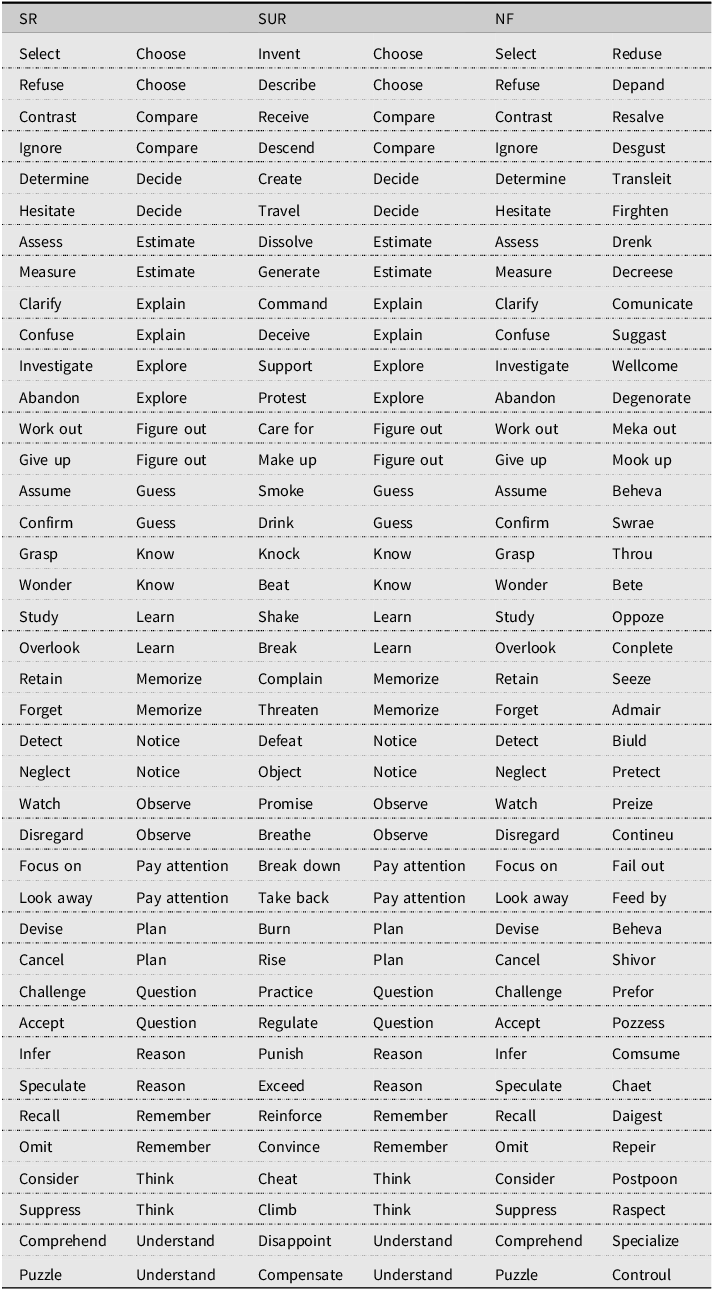
Materials in Experiment 1

Table A1. Long description
The table has three columns labeled SR, SUR, and NF, and multiple rows with various terms. Row 1: SR: Select, SUR: Choose, NF: Invent. Row 2: SR: Refuse, SUR: Choose, NF: Describe. Row 3: SR: Contrast, SUR: Receive, NF: Compare. Row 4: SR: Ignore, SUR: Compare, NF: Descend. Row 5: SR: Determine, SUR: Decide, NF: Create. Row 6: SR: Hesitate, SUR: Decide, NF: Travel. Row 7: SR: Assess, SUR: Estimate, NF: Dissolve. Row 8: SR: Measure, SUR: Estimate, NF: Generate. Row 9: SR: Clarify, SUR: Explain, NF: Command. Row 10: SR: Confuse, SUR: Explain, NF: Deceive. Row 11: SR: Investigate, SUR: Explore, NF: Support. Row 12: SR: Abandon, SUR: Explore, NF: Protest. Row 13: SR: Work out, SUR: Figure out, NF: Care for. Row 14: SR: Give up, SUR: Figure out, NF: Make up. Row 15: SR: Assume, SUR: Guess, NF: Smoke. Row 16: SR: Confirm, SUR: Guess, NF: Drink. Row 17: SR: Grasp, SUR: Know, NF: Knock. Row 18: SR: Wonder, SUR: Know, NF: Beat. Row 19: SR: Study, SUR: Learn, NF: Shake. Row 20: SR: Overlook, SUR: Learn, NF: Break. Row 21: SR: Retain, SUR: Memorize, NF: Complain. Row 22: SR: Forget, SUR: Memorize, NF: Threaten. Row 23: SR: Detect, SUR: Notice, NF: Defeat. Row 24: SR: Neglect, SUR: Notice, NF: Object. Row 25: SR: Watch, SUR: Observe, NF: Promise. Row 26: SR: Disregard, SUR: Observe, NF: Breathe. Row 27: SR: Focus on, SUR: Pay attention, NF: Break down. Row 28: SR: Look away, SUR: Pay attention, NF: Take back. Row 29: SR: Devise, SUR: Plan, NF: Burn. Row 30: SR: Cancel, SUR: Plan, NF: Rise. Row 31: SR: Challenge, SUR: Question, NF: Practice. Row 32: SR: Accept, SUR: Question, NF: Regulate. Row 33: SR: Infer, SUR: Reason, NF: Punish. Row 34: SR: Speculate, SUR: Reason, NF: Exceed. Row 35: SR: Recall, SUR: Remember, NF: Reinforce. Row 36: SR: Omit, SUR: Remember, NF: Convince. Row 37: SR: Consider, SUR: Think, NF: Cheat. Row 38: SR: Suppress, SUR: Think, NF: Climb. Row 39: SR: Comprehend, SUR: Understand, NF: Disappoint. Row 40: SR: Puzzle, SUR: Understand, NF: Compensate.
Appendix 2
Materials in Experiment 2

Table B1. Long description
A table with three columns labeled TE, NTE, and NF, and multiple rows listing English words and their Chinese translations. The table includes words such as Choose, Compare, Decide, Estimate, Explain, Explore, Figure out, Guess, Know, Learn, Memorize, Notice, Observe, Pay attention, Plan, Question, Reason, Remember, Think, and Understand. Each English word is followed by its Chinese translation and variations in the subsequent columns. The table provides a side-by-side comparison of the words and their translations.



 Open access

