Carbapenem-resistant Enterobacteriaceae (CRE) represent an urgent antibiotic resistance threat. 1 The Centers for Disease Control and Prevention (CDC) recommends contact isolation precautions for CRE colonized or infected patients to limit healthcare-associated transmission. 2 Most US inpatient facilities, however, do not perform routine screening to detect CRE. Our objective was to measure the prevalence of CRE perirectal colonization upon hospital unit admission (results unknown to clinical staff) and to evaluate whether CRE carriers were already on contact precautions for other indications at the time of unit entry.
Methods
Study setting and population
This study included adults admitted to the Johns Hopkins Hospital (JHH) medical intensive care unit (MICU) or solid organ transplant unit (transplant unit) between May 1, 2016, and July 1, 2017. Both units have a longstanding vancomycin-resistant Enterococcus (VRE) surveillance program and collect admission perirectal Eswabs (Copan Diagnostics, Murrieta, CA) from patients.
Microbiology methods
Residual Amies media was stored at 4°C and, within 4 days of swab collection, directly plated onto MacConkey agar with ertapenem and meropenem disks.Reference Simner, Martin, Opene, Tamma, Carroll and Milstone 3 Colonies growing within 27 mm of ertapenem and 32 mm of meropenem were identified using matrix-assisted laser-desorption ionization time-of-flight mass spectrometry (MALDI-TOF MS, Bruker Daltonics). Carbapenem antimicrobial susceptibility testing (ie, ertapenem, meropenem, and imipenem) was performed by disk diffusion applying Clinical and Laboratory Standards Institute guidelines. 4 Enterobacteriaceae resistant to ertapenem, meropenem, and/or imipenem were categorized as CRE. CRE-positive isolates were tested for carbapenemase production (CP-CRE) using the modified carbapenem inactivation method (mCIM).Reference Pierce, Simner and Lonsway 5 CRE status was deidentified until study completion and blinded to clinical and infection control staff.
Infection control data collection
Infection control databases were queried to identify patients placed on contact precautions at unit admission because of a flagged history of (1) methicillin-resistant Staphylococcus aureus (MRSA); (2) vancomycin-resistant Enterococcus (VRE); (3) Clostridioides difficile; (4) multidrug-resistant gram-negative (MDRGN) bacteria; (5) CRE (which are classified separately from other MDRGNs at JHH); (6) respiratory viruses; and (7) other indications, including “CRE rule-out” for patients recently hospitalized internationally (≤6 months), 2 enteric pathogens, and contact precautions without associated infection control flag(s).
Statistical methods
Descriptive statistics for contact precaution status and indications were calculated. The relationship between these variables and CRE or CP-CRE colonization was evaluated using univariable logistic regression with general estimating equations and robust standard errors to account for patient-clustering due to repeat unit admissions. Results were summarized as odds ratios (ORs) and corresponding 95% confidence intervals (CIs). Analyses were performed in STATA version 13.0 software (StataCorp, College Station, TX). The Johns Hopkins University School of Medicine Institutional Review Board approved this study with a waiver of consent.
Results
In total, 3,784 unit admissions occurred during the study period: 2,034 (54%) in the MICU and 1,750 (46%) in the transplant unit. Of these encounters, 3,249 (86%), representing 2,424 unique patients, had stored perirectal admission screening swabs.
Overall, 126 of 3249 admission swabs (3.9%) (from 117 unique patients), tested positive for 1 or more CRE (95% CI, 3.2%–4.6%). The CRE prevalence was higher among MICU admissions compared to transplant unit admissions (4.7% vs 2.8%; P = .01). Of the 126 CRE-positive swabs, 26 (21%) were positive for carbapenemase production (from 24 unique patients), yielding a CP-CRE admission prevalence of 0.8% (95% CI, 0.5%–1.2%). The prevalence of CP-CRE was similar in both units (0.8% in the MICU vs 0.9% in the transplant unit; P = .74). Most CP-CRE isolates were Klebsiella pneumoniae (46%), followed by Enterobacter cloacae (35%), Citrobacter amalonaticus (11%), and Escherichia coli (8%).
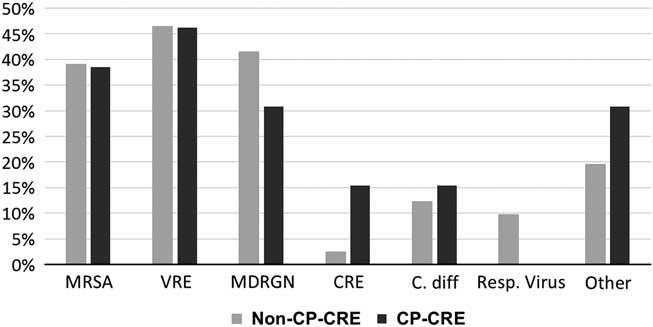
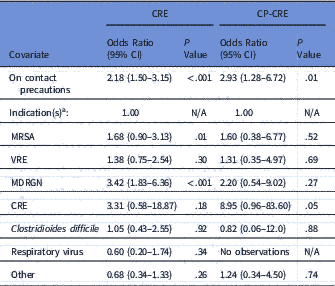
During the study period, 817 patients (25%) were on contact precautions at unit admission. Most patients with perirectal CRE and CP-CRE colonization (72 [57%] and 13 [50%], respectively) were not on contact precautions at unit entry. Relative to noncarriers, however, CRE and CP-CRE carriers were more likely to be on contact precautions: ORs, respectively: 2.18 (95% CI, 1.50–3.15) and 2.93 (95% CI, 1.28–6.72). The most common infection control flag indication(s) among CRE carriers were a history of VRE (46%), MRSA (39%), or MDRGN organisms (39%) (Fig. 1). Patients with an MDRGN history were nearly 3.5 times more likely to test positive for CRE (OR, 3.42; 95% CI, 1.83–6.36) (Table 1). Also, 3 CRE carriers (all CP-CRE-negative MICU patients) had documented recent international hospitalization: 1 patient was not on contact precautions at unit admission, and 2 patients were already isolated for history of MDRGNs.
Indications for contact precautions among non–CP-CRE (n=59) and CP-CRE (n=13) colonized patients who were on contact precautions at unit admission. There were 126 CRE carriers (overall) during the study period (100 non–CP-CRE and 26 CP-CRE), 57% of whom (72, 59 non–CP-CRE and 13 CP-CRE) were on contact precautions at unit admission. Note. MRSA, methicillin-resistant Staphylococcus aureus; VRE, vancomycin-resistant Enteroccocus; MDRGN, multidrug-resistant gram-negative bacteria (defined as gram-negative rods other than nonfermenters resistant to 3 of 5 antibiotic classes, nonfermenters resistant to 4 of 5 antibiotic classes, trimethoprim and sulfamethoxazole-resistant Stenotrophomonas spp, extended-spectrum β-lactamase (ESBL)–producing bacteria, and/or specified Enterobacteriaceae resistant to ceftriaxone); CRE, carbapenem-resistant Enterobacteriaceae (defined as resistance to any carbapenem); C. diff, Clostridioides difficile; Resp. Virus, respiratory viruses; and Other, other indications, including enteric pathogens, “CRE Rule-Out” for recent internationally hospitalized patients, and unspecified reasons. Percentages exceed 100%, due to >1 possible indication per patient.

Association Between Colonization and Indication for Contact Precautions at Unit Admission, Comparing CRE or CP-CRE Carriers to Noncarriers

Note. CRE, carbapenem-resistant Enterobacteriaceae; CP-CRE, carbapenem-resistant Enterobacteriaceae; CI, confidence interval; MRSA, methicillin-resistant Staphylococcus aureus; VRE, Vancomycin-resistant Enterococcus; MDRGN, multidrug-resistant gram-negative; N/A, not applicable.
a Indications analyses were restricted to patients who were on contact precautions at admission.
Of 26 patients who had CP-CRE isolated on admission perirectal surveillance, 2 patients were already on contact precautions with a CRE ‘flag’ because of a prior CRE-positive culture (unrelated to study screening). In 16 additional encounters, patients were isolated based upon an institutional CRE flag, but they tested CP-CRE negative. The sensitivity and specificity of a CRE flag for predicting CP-CRE colonization at unit admission were 7.7% and 99.5%, respectively.
Discussion
Identifying CRE-colonized patients at hospital unit admission can facilitate timely infection control interventions, such as placing colonized patients on contact precautions, to limit healthcare-associated transmission. The CDC recommends CRE colonization screening in limited instances (eg, patients with recent international hospitalization), 2 but most US hospitals do not perform routine CRE colonization screening. Evaluating patients admitted to a MICU and a solid organ transplant unit, we found that CRE colonization a unit admission was infrequent (3.9%), and only 21% of CREs were carbapenemase producers. These findings are similar to the proportions of CRE (3.1%) and CP-CRE (32% of CRE) among clinical isolates reported to the National Healthcare Safety Network in 2015 and 2017, respectively.Reference Woodworth, Walters and Weiner 6
Most CRE- and CP-CRE–colonized patients were not on contact precautions at unit admission. Of particular concern, only 1 CP-CRE carrier (2 encounters) had a known history of CRE, which may reflect a true lack of prior positive cultures or incomplete data from institutions outside the Johns Hopkins Health System. Moreover, no CP-CRE–colonized patients were recently hospitalized internationally. Our findings suggest that many CP-CRE carriers, and the potential they pose for onward transmission, are missed for infection control interventions under existing institutional protocols.
Although most CRE-colonized patients were not on contact precautions at unit admission, CRE- and CP-CRE–colonized patients were still 2–3 times more likely than noncarriers to be on contact precautions. The most common indications were histories of VRE, MRSA, and/or MDRGNs. These findings are consistent with the overlap in risk factors (eg, antibiotic use and exposure to high-risk healthcare facilities) between CRE and other drug-resistant organisms.Reference Logan and Weinstein 7 – Reference Simner, Goodman, Carroll, Harris, Han and Tamma 9 Moreover, an MDRGN history was associated with colonization with CRE, but not CP-CRE, which may reflect differing acquisition pathways between CRE types.Reference Goodman, Simner, Tamma and Milstone 10 Identifying additional risk factors for CRE colonization, particularly among patients who lack MDRGN histories, could enhance targeted screening efforts.
This study has several limitations. This was a single-center study with some missing swabs, and our results should be validated in other cohorts. In addition, contact precautions policies vary among hospitals, which could impact generalizability of these findings. We only ascertained contact precaution status at unit admission, and patient status may have changed during unit stay. Screening method may also affect organism recovery, although CDC guidance endorses perirectal swabs for CRE surveillance. 2
In summary, most CRE-colonized patients who participated in this study were not on contact precautions at unit admission. Given low colonization prevalence, further research on CRE colonization risk factors among US inpatients is necessary to develop algorithms for identifying and screening patients at greatest risk of harboring CRE.
Acknowledgments
We would like to thank Verna Scheeler, Michael Anderson, Dina Khamash, and Sean Thompson for their assistance with study coordination, and data collection, and validation, as well as Belita Opene, Shawna Lewis, and Krizia Chambers for their work processing surveillance cultures. We would also like to thank members of the JHU Clinical Microbiology Laboratory staff for helping with the collection of surveillance swabs for the study.
Financial support
This work was supported by the Centers for Disease Control (CDC) Prevention Epicenters Program (CDC grant no. 1U54CK000447), by the CDC MIND-Healthcare Program (grant no. 1U01CK000536), by the Agency for Healthcare Research and Quality (AHRQ grant no. R36HS025089), and by The Sherrilyn and Ken Fisher Center for Environmental Infectious Diseases.
Conflicts of interest
Dr Milstone reports personal fees from Becton Dickinson Diagnostics, Dr Rock reports grant support from The Clorox Company, and Dr Tamma reports grants from Merck, all outside the scope of the submitted work. Dr Simner reports grants and personal fees from Accelerate Diagnostics, grants from BD Diagnostics, grants from bioMerieux, grants from Check-Points Diagnostics, grants from Hardy Diagnostics, personal fees from Roche Diagnostics, personal fees from Opgen, and personal fees from Oxford Nanopore, all outside the scope of the submitted work. All other authors report no potential conflicts of interest.