Implications
Ruminal microorganisms synthesize a large proportion of B vitamins available for the dairy cow. An improved understanding of dietary factors affecting this synthesis could allow to better evaluate the potential imbalance between supply and requirement for B vitamins in high-producing cows. This information will increase the likelihood of an increase in metabolic efficiency, and a reduction of the cost of production and environmental impacts when dairy diets are supplemented with B vitamins or formulated to promote adequate supply from bacterial synthesis in the rumen.
Introduction
In 1954, in a review on B-vitamin synthesis in ruminants, Kon and Porter stated that ‘It is generally accepted … that the composition of the flora and fauna of the rumen varies with the diet …, and it is reasonable to expect corresponding changes in the synthesis of the vitamins’ (Reference Kon and Porter1954). Since then, studies have been conducted looking at the effects of different forage-to-concentrate ratios (Conrad and Hibbs, 1954; Sutton and Elliot, Reference Sutton and Elliot1972; Santschi et al., Reference Santschi, Chiquette, Berthiaume, Martineau, Matte, Mustafa and Girard2005b; Schwab et al., Reference Scheifinger and Wolin2006), grain processing (Hunt et al., Reference Hunt, Kick, Burroughs, Bethke, Schalk and Gerlaugh1941; Hayes et al., Reference Hayes, Mitchell, Little and Bradley1966), sources of nitrogen (Hollis et al., Reference Hollis, Chappel, Mac Vicar and Whitehair1954) or concentrations of non-fiber carbohydrates (Schwab et al., Reference Scheifinger and Wolin2006) on ruminal concentrations or duodenal flow (DF) of B vitamins. Nevertheless, knowledge on factors affecting B-vitamin supplies from diet or ruminal synthesis in dairy cows is still very limited.
Forage maturity at harvest is an important factor affecting the nutritive value of dairy cow diets. Delaying harvest increased total yield of dry matter (DM), but resulted in greater fiber concentration, while reducing CP content and fiber digestibility of both grass and legume forage plants (Cleale and Bull, Reference Cleale and Bull1986; Kammes and Allen, Reference Kammes, Ying and Allen2012; Kammes et al., Reference Kammes and Allen2012). According to the same authors, the amount of concentrate needed to meet the nutrient requirements increases with plant maturity. Such changes in forage and diet composition could affect supply, digestibility and utilization of macronutrients, inducing changes in microbial populations, and therefore the ruminal fermentation patterns.
Data regarding the effect of plant maturity on B-vitamin synthesis in the rumen and their flows to duodenum are scarce in the literature. We hypothesized that the effects of differences of plant maturity at harvest and the associated adjustments to diet composition on rumen parameters (such as microbial fermentation), already evaluated in our studies (Kammes and Allen, Reference Kammes, Ying and Allen2012; Kammes et al., Reference Kammes and Allen2012), will affect B-vitamin apparent ruminal synthesis (ARS) and supply to the duodenum of dairy cows. Such responses are due to (i) the intrinsic B-vitamin content of these diets, and (ii) related changes in ruminal fermentation and microbial metabolism. The present study was undertaken to determine the effect of diets based on alfalfa (AL) and orchardgrass (OG) silages harvested at different maturity (early cut (EC) or late cut (LC)) on B-vitamin supply and ARS in lactating dairy cows.
Material and methods
Experimental procedures of the two reported studies were conducted on cows from the Dairy Cattle Teaching and Research Center, and approved by the Institutional Animal Care and Use Committee at Michigan State University (East Lansing, MI, USA). Before calving, cows were equipped with a ruminal cannula (Bar Diamond Inc., Parma, ID, USA) and a duodenal gutter-type T cannula, ~10 cm distal to the pylorus (Joy et al., Reference Joy, DePeters, Fadel and Zinn1997). Surgeries were performed at the Department of Large Animal Clinical Sciences, College of Veterinary Medicine, Michigan State University. Experimental procedures, measurements and analyses were described in detail by Kammes et al. (Reference Kammes and Allen2012, Trial 1) and Kammes and Allen (Reference Kammes, Ying and Allen2012, Trial 2).
Treatments and cows
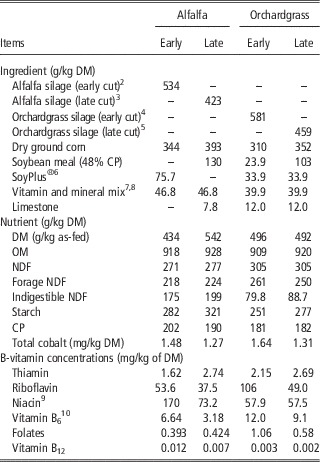
Experimental treatments were diets containing AL (Medicago sativa L.; Trial 1) or OG (Dactylis glomerata L.; Trial 2) harvested either (a) EC or (b) LC as the sole forage (Table 1). Cows were fed ad libitum a total mixed ration (TMR) offered once daily (1130 h) at 110% of expected intake.
Ingredients, chemical composition and B-vitamin concentrations of treatment diets containing alfalfa or orchardgrass harvested and ensiled as early or late cutFootnote 1

DM=dry matter; OM=organic matter.
1 Adapted from Kammes et al. (Reference Kammes and Allen2012) and Kammes and Allen (Reference Kammes, Ying and Allen2012).
2 DM, 302 g/kg (as-fed); OM, 895 g; NDF, 408 g; indigestible NDF, 277 g; CP, 237 g; starch, 116 g (per kg of DM).
3 DM, 356 g/kg (as-fed); OM, 921 g; NDF, 531 g; indigestible NDF, 393 g; CP, 181 g; starch, 148 g (per kg of DM).
4 DM, 373 g/kg (as-fed); OM, 907 g; NDF, 449 g; indigestible NDF, 108 g; CP, 201 g; starch, 292 g (per kg of DM).
5 DM, 319 g/kg (as-fed); OM, 922 g; NDF, 544 g; indigestible NDF, 145 g; CP, 153 g; starch, 21 g (per kg of DM).
6 West Central Soy, Ralston, IA, USA.
7 Alfalfa: vitamin–mineral mix contained (per kg of DM) 171 g sodium bicarbonate, 39 g dicalcium phosphate, 26 g magnesium oxide, 19 g salt, 19 g trace mineral premix, 4 g vitamin A, 4 g vitamin D, 2 g vitamin E and 716 g dry ground corn as a carrier.
8 Orchardgrass: vitamin–mineral mix contained (per kg of DM) 165 g sodium bicarbonate, 142 g magnesium sulfate, 71 g salt, 58 g dicalcium phosphate, 24 g trace mineral premix, 4 g vitamin A, 4 g vitamin D, 2 g vitamin E and 531 g dry ground corn as a carrier.
9 Sum of nicotinic acid and nicotinamide.
10 Sum of pyridoxamine, pyridoxal and pyridoxine.
Trial 1
In total, 16 multiparous Holstein cows were assigned randomly to treatment sequence in a crossover design with a 14-day preliminary period followed by two 17-day treatment periods. Cows were 137±45 (mean±SD) days in milk, averaging 569±43 kg of empty BW (ruminal content removed) and 43.7±8.6 kg/day of 3.5% fat-corrected milk yield (mean±SD) at the beginning of the experiment. Both experimental diets provided ~22% forage NDF and 27% total NDF. The forage-to-concentrate ratios were 53 : 47 and 42 : 58 for EC and LC, respectively.
Trial 2
In total, 13 multiparous Holstein cows were assigned randomly to treatment sequence in a crossover design with a 14-day preliminary period followed by two 18-day treatment periods. Cows were 164±85 (mean±SD) days in milk, averaging 588±55 kg of empty BW and 43.7±7.7 kg/day of 3.5% fat-corrected milk yield (mean±SD) at the beginning of the experiment. Both experimental diets provided 25% to 26% forage NDF and 30.5% total NDF. The forage-to-concentrate ratios were 58 : 42 and 46 : 54 for EC and LC, respectively.
Sample and data collection
Individual feed intake was recorded daily. At each period, samples of all dietary ingredients were collected from days 11 to 15 and mixed into one sample. During this collection period, duodenal digesta samples were collected every 15 h (Allen and Linton, Reference Allen and Voelker Linton2007) so that eight samples were taken for each cow in each period, representing every 3 h of a 24-h period to account for nycthemeral variation. All samples were stored at −20°C before processing.
Laboratory analyses
Frozen duodenal digesta samples were chopped finely using a commercial food processor (84142 Food cutter; Hobart Manufacturing Co., Troy, OH, USA) and a representative subsample was lyophilized. All dried samples were ground with a Wiley mill (1-mm screen; Arthur H. Thomas, Philadelphia, PA, USA). Methods for analyses of DM, organic matter (OM), ash, NDF, indigestible NDF and starch in feed and duodenal digesta samples as well as those used to determine digestive parameters (ruminal digestion of true OM, NDF and starch, ruminal pH and volatile fatty acids (VFA) profile, and DF of DM, microbial N and indigestible NDF) were described by Kammes et al. (Reference Kammes and Allen2012, Trial 1) and Kammes and Allen (Reference Kammes, Ying and Allen2012, Trial 2).
Concentrations of B vitamins in feed and duodenal digesta were analyzed at the Sherbrooke Research and Development Centre (Agriculture and Agri-Food Canada, Sherbrooke, QC, Canada). Thiamin, riboflavin, niacin and vitamin B6 were quantified by HPLC (Varian ProStar, Lake Forest, CA, USA) equipped with a solvent delivery system (model 210), an autosampler (model 410) and a fluorescence detection system (model 363) as described by Castagnino et al. (Reference Castagnino, Seck, Beaudet, Kammes, Voelker Linton, Allen, Gervais, Chouinard and Girard2016). Folates were determined with a microbiological microtiter plate test (VitaFast® Folic Acid; R-Biopharm Inc., Marshall, MI, USA) and vitamin B12 was analyzed by radioassay (SimulTRAC-S Vitamin B12 (Co57)/Folate (I125); MP Biomedicals, Solon, OH, USA) as described by Castagnino et al. (Reference Castagnino, Seck, Beaudet, Kammes, Voelker Linton, Allen, Gervais, Chouinard and Girard2016). Cobalt concentration in experimental diets was determined by atomic absorption spectrometry with flame stoichiometric air-acetylene at 240.7 nm based on an adaptation of the method of Bellanger (Reference Bellanger1988). Aliquots of 1.0 g of feed were dry-ashed for 18 h at 500°C with a hold at 350°C for 1 h. Then, dry-ashed samples were dissolved in 2.0 M HCl and homogenized in an ultrasonic bath (Ultrasonic Cleaners, 40 kHz; Cole-Parmer®, Montréal, QC, Canada) for 30 min. If needed, further dilutions were made with 1.0 M HCl. All samples were analyzed in duplicate (except for folates which were analyzed in triplicate), and a CV of <10% was accepted between replicates.
Calculations and statistical analyses
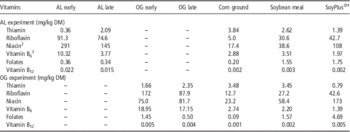
B-vitamin concentrations in the TMR were the summation of B-vitamin concentration of each ingredient (Table 2) multiplied by the proportion of this ingredient in the TMR, on a DM basis. Daily intakes of each vitamin were calculated as the concentration of the vitamin in the TMR multiplied by the amount of TMR ingested, on a DM basis. DM DF was estimated using indigestible NDF as a flow marker as described by Kammes et al. (Reference Kammes and Allen2012, Trial 1) and Kammes and Allen (Reference Kammes, Ying and Allen2012, Trial 2). DF of vitamins was calculated as B-vitamin concentrations in duodenal digesta multiplied by the daily DM flowing through the duodenum. Daily ARS was calculated as DF minus the intake.
B-vitamin concentrations of ingredients used in the experimental diets containing alfalfa (AL) or orchardgrass (OG) harvested and ensiled as early or late cut

DM=dry matter.
1 West Central Soy, Ralston, IA, USA.
2 Sum of nicotinic acid and nicotinamide.
3 Sum of pyridoxamine, pyridoxal and pyridoxine.
The data were analyzed separately for the two feeding trials. Daily intake, DF and ARS for each vitamin, expressed in milligram per day or milligram per kilogram of dry matter intake (DMI), were analyzed using the mixed procedure of SAS (version 9.2; SAS Institute, 2008). The hypothesis was tested using the following model:
 $$Y_{{ijk}} \,{\equals}\,\mu {\plus}C_{i} {\plus}P_{j} {\plus}T_{{(k)}} {\plus}{\epsilon}_{{ijk}} $$
where Y ijk is the dependent variable, µ the overall mean, C i the cow (i=1 to 16, Trial 1; 1 to 13, Trial 2), P j the period effect (j=1 to 2), T k the treatment effect (k=1 to 2) and ε ijk the residual error. Pearson’s correlation coefficients were determined using combined data from both experiments. Differences were declared significant at P<0.05 and as a tendency at 0.05⩽P⩽0.10.
Results
Animal performance was presented and discussed previously by Kammes et al. (Reference Kammes and Allen2012, Trial 1 – AL treatments) and by Kammes and Allen (Reference Kammes, Ying and Allen2012, Trial 2 – OG treatments). Diets based on EC AL silage increased DMI (28.6 v. 26.8 kg/day, P=0.003) compared with the LC diet, whereas OG maturity did not affect DMI (22.5 v. 22.4 kg/day for EC and LC, respectively, P=0.71). Plant maturity did not affect DF of DM in either experiment (Trial 1: 18.1 v. 18.4 kg/day (SEM 0.75; P=0.57); Trial 2: 14.0 v. 13.5 kg/day (SEM 0.47; P=0.49) for EC and LC, respectively).
Intake, apparent ruminal synthesis and duodenal flow
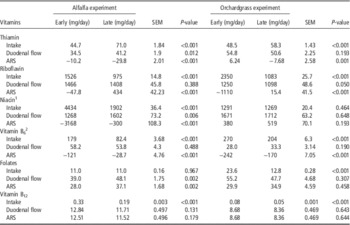
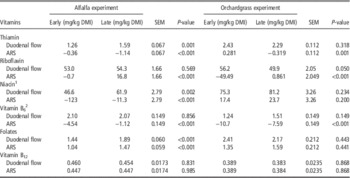
Despite the difference in DMI in Trial 1, treatment effects on ARS and DF were similar, whether they were expressed as daily amounts (Table 3), or as milligrams per kilogram of DMI (Table 4). In both experiments, intake of thiamin was greater for LC than EC but intakes of riboflavin and vitamin B6 was less for LC than EC. In Trial 1, DF of thiamin, niacin and folates was greater for LC compared with EC, whereas in Trial 2, the only effect was a reduction of riboflavin DF for LC compared with EC. With diets based on AL silages, increasing maturity decreased ruminal degradation or promoted synthesis of riboflavin, niacin, vitamin B6 and folates but increased ruminal degradation of thiamin. With diets based on OG silages, ruminal degradation of riboflavin and vitamin B6 was reduced with LC, whereas it was increased for thiamin compared with EC.
Daily intake, duodenal flow and apparent ruminal synthesis (ARS) of B vitamins in response to diets containing alfalfa or orchardgrass harvested and ensiled as early or late cut

1 Sum of nicotinic acid and nicotinamide.
2 Sum of pyridoxamine, pyridoxal and pyridoxine.
Duodenal flow and apparent ruminal synthesis (ARS) of B vitamins in response to diets containing alfalfa or orchardgrass harvested and ensiled as early or late cut

DMI=dry matter intake.
1 Sum of nicotinic acid and nicotinamide.
2 Sum of pyridoxamine, pyridoxal and pyridoxine.
Discussion
Maturity at harvest altered physical characteristics and chemical composition of forages, affecting concentration and availability of nutrients consumed. In the present trial, NDF and indigestible NDF increased, whereas CP content decreased with advancing maturity in both forages (Kammes and Allen, Reference Kammes, Ying and Allen2012; Kammes et al., Reference Kammes and Allen2012). Overall, in both experiments, the maturation process decreased in vitro NDF digestibility by 16% (calculated from Kammes and Allen, Reference Kammes, Ying and Allen2012; Kammes et al., Reference Kammes and Allen2012). Fiber is intimately related with forage quality. It is also a major source of energy for rumen microbes and an important promoter of rumen function (Van Soest, Reference Van Soest1994). The decrease in nutritive quality of forage with maturity was probably due to lignification process, and differences in the proportions of leaves and stems (Albrecht et al., Reference Albrecht, Wedin and Buxton1987, Martiniello et al., Reference Martiniello, Paolette and Berardo1997). Leaf production declines during the reproductive stage, the nutrients being redirected to produce inflorescences and seeds (Thomas, Reference Thomas2013). Except for thiamin in both forage species, and niacin in OG silage, B-vitamin concentrations in both silages were greater in EC than LC, possibly due to the higher leaves-to-stems ratio in early vegetative stages (Ball et al., Reference Ball, Collins, Lacefield, Martin, Mertens, Olson, Putnam, Undersander and Wolf2001).
In order, for the experimental diets, to provide a similar nutrient supply, composition of experimental diets differed to take into account changes in chemical composition of forages with increasing maturity at harvest. Nevertheless, forage was the main source of vitamins in all experimental diets. Exceptions were thiamin, for which dry corn was the main source in all diets and folates in the LC AL silage diet, in which soybean meal provided 48% of the dietary folate content. As plants do not synthesize vitamin B12, the presence of this vitamin in diets was likely due to the bacterial synthesis occurring during silage fermentation or to contamination by soil microorganisms (McDowell, Reference McDowell2000).
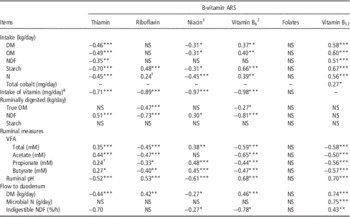
With AL diets, thiamin ARS was in the same range (around −0.75 mg/kg DMI) as reported by Miller et al. (Reference Miller, Meiske and Goodrich1986; −1.19 mg/kg DMI) and Castagnino et al. (Reference Castagnino, Seck, Beaudet, Kammes, Voelker Linton, Allen, Gervais, Chouinard and Girard2016; −1.20 mg/kg DMI). Thiamin destruction could be partially explained by the presence of thiaminases in the rumen as suggested by Edwin and Jackman (Reference Edwin and Jackman1982). However, in our study (Table 5), as previously observed by Schwab et al. (Reference Scheifinger and Wolin2006), there was a negative correlation between thiamin ARS and ruminal pH.
Pearson’s correlations coefficients between apparent ruminal synthesis (ARS, mg/day) and dietary and digestive parameters combining data from both experiments

DM=dry matter; OM=organic matter; VFA=volatile fatty acids.
1 Sum of nicotinic acid and nicotinamide.
2 Sum of pyridoxamine, pyridoxal and pyridoxine.
3 Not calculated.
4 Intake of the corresponding B vitamin.
† P<0.10, *P<0.05, **P<0.01, ***P<0.001.
For both forages, riboflavin intake decreased with maturity, whereas the ARS followed an opposite pattern (Table 3). Late cut treatments increased riboflavin ARS possibly due to less riboflavin microbial degradation, as a result of reducing digestible OM (Kammes and Allen, Reference Kammes, Ying and Allen2012; Kammes et al., Reference Kammes and Allen2012). The negative correlation observed between riboflavin ARS and ruminally digested true OM supports this suggestion (Table 5). In our study, riboflavin ARS varied from −49.6 to 16.8 mg/kg DMI, and were similar to values reported by Castagnino et al. (Reference Castagnino, Seck, Beaudet, Kammes, Voelker Linton, Allen, Gervais, Chouinard and Girard2016; −21.1 to 18.4 mg/kg DMI); it was negatively correlated with riboflavin intake. Data calculated from Miller et al. (Reference Miller, Meiske and Goodrich1986), Santschi et al. (Reference Santschi, Berthiaume, Matte, Mustafa and Girard2005a) and Schwab et al. (Reference Scheifinger and Wolin2006) have all shown positive ARS (6.25, 13.48 and 11.67 mg for riboflavin/kg DMI, respectively). However, on average, in Castagnino et al. (Reference Castagnino, Seck, Beaudet, Kammes, Voelker Linton, Allen, Gervais, Chouinard and Girard2016) and the present studies, riboflavin intake (mg/day) and DF (mg/kg DMI) were 18- and threefold greater, respectively, than reported in literature cited above.
Maturity of OG at harvest had no effect on niacin intake, DF and ARS. Niacin daily intake was more than twice as high for EC compared with LC AL but degradation in the rumen was greater resulting in a lower DF of that vitamin (Table 3). The important degradation (72%) of dietary niacin with this treatment is probably due to its high intake (>4 g/day) as emphasized by the strong negative correlation between niacin ARS and its intake (Table 5). Santschi et al. (Reference Santschi, Berthiaume, Matte, Mustafa and Girard2005a) reported an almost complete ruminal degradation of niacin from a dietary supplement (98.5%). Nevertheless, studies on ruminal synthesis of niacin with daily intakes of the vitamin ranging from 163 to 2019 mg/day have reported only positive ruminal balance (Miller et al., Reference Miller, Meiske and Goodrich1986, 27.6 to 79.2; Santschi et al., Reference Santschi, Berthiaume, Matte, Mustafa and Girard2005a, 111.7; Schwab et al., Reference Scheifinger and Wolin2006, 21.0 to 70.0; Niehoff et al., 2013, 82.4 to 127.3; Castagnino et al., Reference Castagnino, Seck, Beaudet, Kammes, Voelker Linton, Allen, Gervais, Chouinard and Girard2016, 29.3 to 36.0 mg of niacin/kg DMI).
Postponing the harvesting of AL and OG decreased vitamin B6 intake and its ruminal degradation. Consequently, the amounts of vitamin reaching the small intestine were not affected by changes due to forage maturity. Vitamin B6 ARS was strongly and negatively correlated with its intake as previously observed by Castagnino et al. (Reference Castagnino, Seck, Beaudet, Kammes, Voelker Linton, Allen, Gervais, Chouinard and Girard2016). Similar to our study, Santschi et al. (Reference Santschi, Berthiaume, Matte, Mustafa and Girard2005a) with an intake of 8.5 mg/kg of DM observed ruminal degradation of vitamin B6 (−0.71 mg/kg of DMI), whereas Schwab et al. (Reference Scheifinger and Wolin2006) reported positive values (ranging from 0.76 to 1.34 mg/kg of DMI) with diets providing 3.2 mg/kg of DM.
With OG diets, folate intake was greater for EC than LC but there was no effect of maturity on DF and ARS. Despite similar folate intakes (Table 3), the LC AL diet increased folate ARS by 31%, and thus increased DF by 22% compared with EC. Similar to our study, Santschi et al. (Reference Santschi, Berthiaume, Matte, Mustafa and Girard2005a; 1.06 mg/kg of DMI), Schwab et al. (Reference Scheifinger and Wolin2006; ranging from 0.77 to 0.91 mg/kg of DMI) and Castagnino et al. (Reference Castagnino, Seck, Beaudet, Kammes, Voelker Linton, Allen, Gervais, Chouinard and Girard2016; ranging from 0.79 to 1.44 mg/kg of DMI) observed positive folate ARS.
Stage of maturity did not affect vitamin B12 ARS, which represented >99.9% of DF of that vitamin. When averaged across diets, ARS of vitamin B12 was 0.46 and 0.38 mg/kg DMI for AL and OG, respectively. These values are similar to ARS reported by Castagnino et al. (Reference Castagnino, Seck, Beaudet, Kammes, Voelker Linton, Allen, Gervais, Chouinard and Girard2016) and Brito et al. (Reference Brito, Chiquette, Stabler, Allen and Girard2014). However, ARS reported in current trials were approximately eightfold less than values reported by Santschi et al. (Reference Santschi, Berthiaume, Matte, Mustafa and Girard2005a) and Schwab et al. (Reference Scheifinger and Wolin2006), even though the total cobalt concentrations in our diets (ranging from 1.27 to 1.64 mg/kg DM) were similar to those studies. In this regard, dietary cobalt supply was not predicted to be a limiting factor for vitamin B12 synthesis by ruminal microflora because it was higher than the daily recommendations for dairy cows proposed by National Research Council (Reference Niehoff, Hüther, Lebzien and Flachowsky2001, 0.11 mg/kg DM), Commonwealth Scientific and Industrial Research Organisation (Reference Conrad and Hibbs2007, 0.07 to 0.15 mg/kg DM) and Meschy (Reference Meschy2007, 0.1 to 0.3 mg/kg DM). Nevertheless, there was a significantly positive, although weak (r 2=0.07) correlation between ARS of vitamin B12 and total cobalt intake in the current trials (Table 5).
On the one hand, ARS of riboflavin and vitamin B6 were correlated positively with starch intake and DM flow. On the other hand, ARS of these vitamins were correlated negatively with NDF digested in rumen and VFA concentrations in ruminal content (total and individual VFA) and positively with ruminal pH. Moreover, microbial N flow to duodenum was positively correlated with ARS of vitamin B12. These correlations suggest that increasing nutrient intake, including cobalt, increased the amounts of these vitamins synthesized by ruminal bacteria. Moreover, the reduction of the retention time of digesta in the rumen reduced microbial utilization and degradation of these vitamins. Daily ARS of thiamin and niacin followed an opposite pattern to that described above; they were negatively correlated with DM, OM, starch and N intakes, ruminal pH and DF of DM but positively with ruminal digestibility NDF and ruminal concentrations of total VFA. This combination of results suggests that thiamin and niacin ARS could be affected by bacterial species interaction (fibrolytics v. non-fibrolytics), especially those promoting propionate synthesis from cellulose and soluble sugars (Scheifinger and Wolin, Reference Schwab, Schwab, Shaver, Girard, Putnam and Whitehouse1973). The ARS of folate was not correlated with any of dietary and digestive parameters evaluated in the current study. Moreover, as stated previously, daily ARS of thiamin, riboflavin, niacin and vitamin B6 were correlated negatively with the intake of these vitamins, suggesting a possible regulation by the microbial population.
Conclusions
Changes in diet composition due to increasing AL maturity at harvest increased intakes of thiamin and decreased intakes of riboflavin, niacin, vitamin B6 and vitamin B12, whereas differences in diet composition when increasing OG maturity increased intakes of thiamin and decreased intakes of riboflavin, vitamin B6, folates and vitamin B12. Nevertheless, diets based on LC AL silages increased the amounts of thiamin, niacin and folates reaching the sites of absorption, whereas those based on mature OG silages only decreased riboflavin DF. Daily ARS of thiamin, riboflavin, niacin and vitamin B6 were correlated negatively with the intake of these vitamins, suggesting a microbial regulation in the rumen possibly linked with the vitamin needs of these microbial populations. Microbial N synthesis was directly correlated with ARS of vitamin B12. The ARS of folate was not correlated with any of dietary and digestive parameters evaluated in the current study.
Acknowledgments
The authors wish to thank Chrystiane Plante (Agriculture and Agri-Food Canada, Sherbrooke, QC, Canada) for her technical support. The Programme de recherche en partenariat pour l’innovation en production et transformation laitière Novalait – Agriculture et Agroalimentaire Canada – Fonds de recherche du Québec Nature et Technologies – Ministère de l’Agriculture, des Pêcheries et de l’Alimentation du Québec, QC, Canada financially supported a grant for the PhD student and vitamin analyses.