Introduction
The order Lagomorpha includes the modern hares and rabbits (Leporidae) and pikas (Ochotona Link, Reference Link1795, the only Recent genus of Ochotonidae). Lagomorphs have a long history dating back to the Eocene. The Paleogene stem lagomorphs have been referred previously to Leporidae (Matthew and Granger, Reference Matthew and Granger1923; Burke, Reference Burke1934, Reference Burke1941; Wood, Reference Wood1940; Dawson, Reference Dawson1958, Reference Dawson, Teichert and Yochelson1967, Reference Dawson1970, Reference Dawson, Janis, Gunnell and Uhen2007; Meng and Hu, Reference Meng and Hu2004; Meng et al., Reference Meng, Hu and Li2005; Fostowicz-Frelik and Tabrum, Reference Fostowicz-Frelik and Tabrum2009; Korth and Dharmapuri, Reference Korth and Dharmapuri2017), to Palaeolagidae within Lagomorpha (Gureev, Reference Gureev1964; Fostowicz-Frelik et al., Reference Fostowicz-Frelik, Li, Meng and Wang2012; Fostowicz-Frelik, Reference Fostowicz-Frelik2013), or to Lagomorpha incertae sedis (Li et al., Reference Li, Meng and Wang2007; Lopatin and Averianov, Reference Lopatin and Averianov2008; Fostowicz-Frelik and Li, Reference Fostowicz-Frelik and Li2014). Averianov and Lopatin (Reference Averianov and Lopatin2005) placed some Asiatic Eocene taxa into the family Strenulagidae within Lagomorpha.
With the advent of phylogenetic systematics, the term Lagomorpha was restricted to the crown group stemming from the most common ancestor of Ochotona and Leporidae. Duplicidentata is the total group defined as all members of Glires sharing a more recent common ancestor with Lagomorpha than with Rodentia (Wyss and Meng, Reference Wyss and Meng1996; Meng and Wyss, Reference Meng, Wyss, Rose and Archibald2005). Two clades were proposed within the stem Lagomorpha: Lagomorphamorpha, the clade stemming from the most common ancestor of Mimotona Li, Reference Li1977 and Lagomorpha; and Leporomorpha, the clade including all lagomorphs sharing a more recent common ancestor with Leporidae than with Ochotona (Meng and Wyss, Reference Meng and Wyss2001). However, there is a considerable morphological gap between the Paleocene stem lagomorphs (Mimotonidae) and the Eocene stem lagomorphs, which shares numerous dental similarities with modern lagomorphs and often regarded as ‘lagomorphs of modern aspect’ (Li et al., Reference Li, Meng and Wang2007; Fostowicz-Frelik and Li, Reference Fostowicz-Frelik and Li2014; Fostowicz-Frelik et al., Reference Fostowicz-Frelik, Li, Mao, Meng and Wang2015a; Fostowicz-Frelik, Reference Fostowicz-Frelik and Pontarotti2017; Ruedas et al., Reference Ruedas, Mora, Lainer, Smith, Johnston, Alves and Hackländer2018). This morphological similarity was the main reason for the referral of these Eocene taxa to Lagomorpha and even Leporidae in the previous literature. The tarsal bones of the early Eocene stem lagomorphs are so similar with the bones in modern lagomorphs that Rose et al. (Reference Rose, DeLeon, Missiaen, Rana, Sahni, Singh and Smith2008) supposed the presence of the crown Lagomorpha and even Leporidae in the early Eocene. In this report, we propose a new clade, Eulagomorpha new clade, uniting these Eocene stem lagomorphs and the crown group Lagomorpha. This clade is based on the phylogenetic analysis presented herein and is defined in the Systematic paleontology section.
Materials and methods
Dental measurements
The measurements are the tooth crown length (L) and width (W). All measurements are in mm.
Phylogenetic analysis
We used characters mostly employed in the diagnostics of Eocene stem lagomorphs (Burke, Reference Burke1934, Reference Burke1941; Dawson, Reference Dawson1970; Zhang et al., Reference Zhang, Dawson and Huang2001; Meng and Hu, Reference Meng and Hu2004; Averianov and Lopatin, Reference Averianov and Lopatin2005; Meng et al., Reference Meng, Hu and Li2005; Lopatin and Averianov, Reference Lopatin and Averianov2006; Li et al., Reference Li, Meng and Wang2007; Fostowicz-Frelik and Tabrum, Reference Fostowicz-Frelik and Tabrum2009; Fostowicz-Frelik et al., Reference Fostowicz-Frelik, Li, Meng and Wang2012; Fostowicz-Frelik and Li, Reference Fostowicz-Frelik and Li2014), as well as some new characters recognized in this study. Because most of the Eocene stem lagomorphs are represented by jaw fragments and dentitions, we utilized mostly dental characters and those of cranial characters that can be checked at least in some Eocene taxa.
A total of 32 taxa and 54 characters (Appendices 1, 2), formed the data matrix (Appendix 3), assembled using Mesquite 3.61 (Maddison and Maddison, Reference Maddison and Maddison2019). Three multistate characters (3, 19, and 20) were ordered. The eurymylid Rhombomylus turpanensis Zhai, Reference Zhai1978 from the early Eocene of China and Mongolia (Dashzeveg and Russell, Reference Dashzeveg and Russell1988; Meng et al., Reference Meng, Hu and Li2003) was used as an outgroup. The scoring of this taxon was based on the detailed description provided by Meng et al. (Reference Meng, Hu and Li2003). The ingroup taxa were scored based on the specimens and casts from the AMNH, PIN, and ZIN collections and from the literature (Appendix 1). For obtaining the tree statistics, consensus tree, and distribution of characters, we used WinClada 1.00.08 (Nixon, Reference Nixon1999). The character-taxon matrix was analyzed using PRAP, parsimony ratchet analysis using PAUP (Müller, Reference Müller2007), and PAUP* 4.0b10 (Swofford, Reference Swofford2002).
To increase tree resolution and recover better phylogenetic signal, we performed a second analysis, including a successive weighting for various characters (Farris, Reference Farris1969). Using PAUP, the characters were reweighted by the maximum value of rescaled consistency indices (RC), and a heuristic search with 10,000 random sequence addition replicates, and TBR (tree bisection and reconnection) branch swapping was performed. Thirty-one characters got a weight of < 1 during the reweighting.
Repositories and institutional abbreviations
AMNH, American Museum of Natural History, New York, USA; PIN, Borissiak Paleontological Institute, Russian Academy of Sciences, Moscow, Russia; ZIN, Zoological Institute, Russian Academy of Sciences, Saint Petersburg, Russia.
Systematic paleontology
Mammalia Linnaeus, Reference Linnaeus1758
Glires Linnaeus, Reference Linnaeus1758
Duplicidentata Illiger, Reference Illiger1811
Lagomorphamorpha Meng and Wyss, Reference Meng and Wyss2001
Eulagomorpha new clade
Remarks
Eulagomorpha n. clade is here defined as a node-based clade that contains the most-recent common ancestor of Lepus Linnaeus, Reference Linnaeus1758 and Dawsonolagus Li, Meng, and Wang, Reference Li, Meng and Wang2007 and all of its descendants.
Arnebolagus Lopatin and Averianov, Reference Lopatin and Averianov2008
Type species
Arnebolagus leporinus Lopatin and Averianov, Reference Lopatin and Averianov2008.
Other species
Type species only.
Revised diagnosis
Referred to Eulagomorpha n. clade because of one labial root of P3 and trigonid and talonid of lower cheek teeth connected by lingual bridge on worn teeth. Similar to Dawsonolagus and differs from other Eulagomorpha n. clade by less pronounced unilateral hypsodonty of upper cheek teeth, separate roots of lower cheek teeth, and m1-2 hypoconulid separated from the rest of talonid by labial fold only. Similar to Dawsonolagus and Lushilagus danjiangensis Tong and Lei, Reference Tong and Lei1987 and differing from other Eulagomorpha n. clade by brachyodont lower cheek teeth. Differs from Dawsonolagus by two labial roots of P4.
Arnebolagus leporinus Lopatin and Averianov, Reference Lopatin and Averianov2008
Figures 1−3
- Reference Lopatin and Averianov2008
Arnebolagus leporinus Lopatin and Averianov, p. 131, fig. 1.
Holotype
PIN 3104/914, a right P3.
Occurrence
Tsagan-Khushu locality, Nemegt Depression, Ömnögovi Aimag, Mongolia; base of Bumban member, Naran Bulak Formation, earliest Eocene.
Description
The upper cheek teeth are unilaterally hypsodont, with the lingual crown side approximately two times as high as the labial crown side on little worn teeth. The P3-4 are nonmolariform.
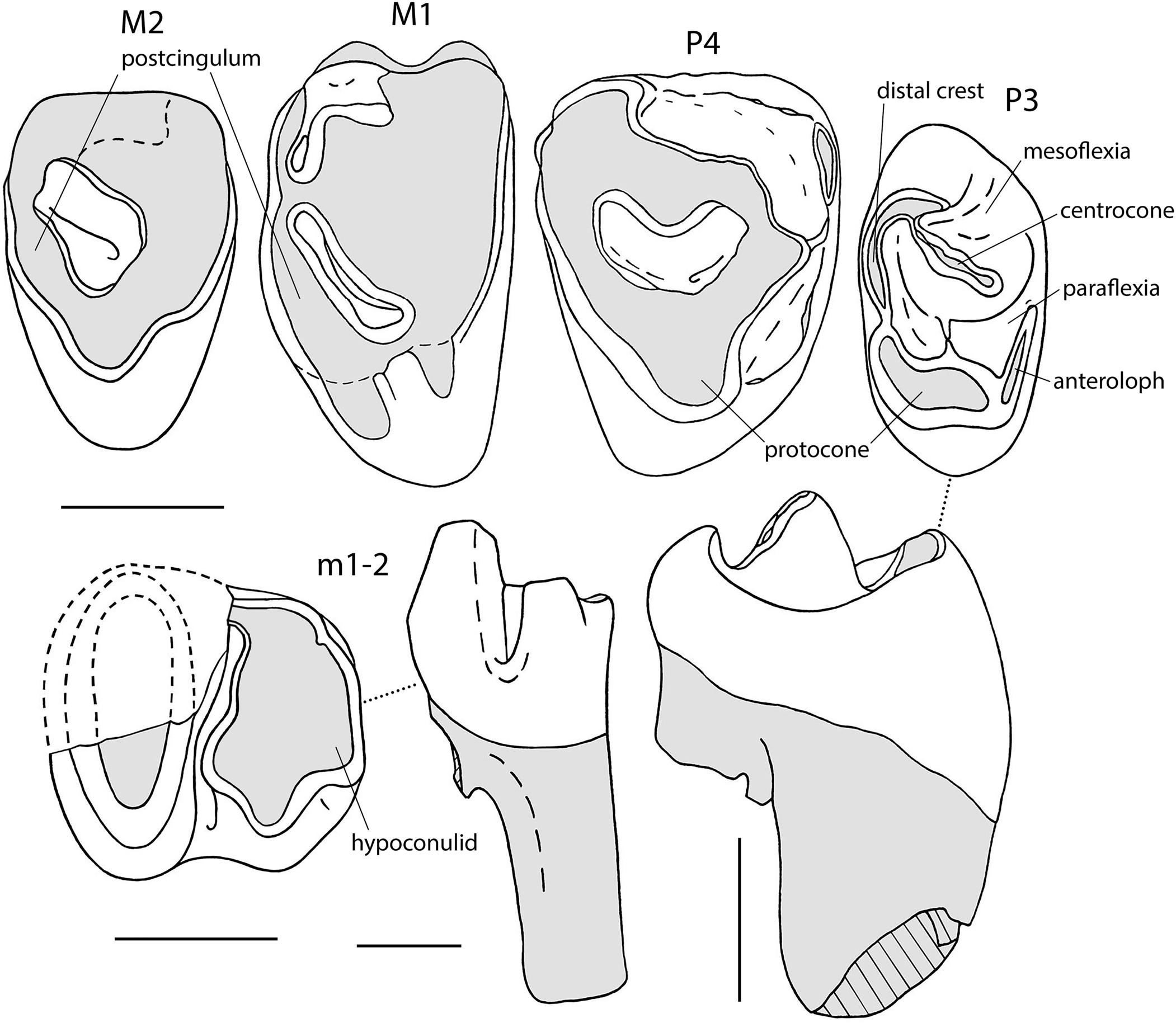
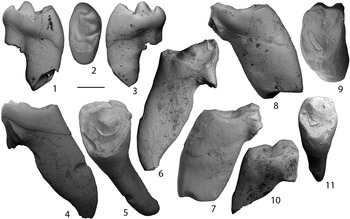
The P3 is oval in crown outline, approximately twice in transverse width than in mesiodistal length (Figs. 1, 2.1−2.3). The centrocone is high and massive, positioned closer to the labial margin of the crown. The anteroloph is short, straight, and terminates slightly labial to the line of the lingual wall of the centrocone. At the early wear stage, the anteroloph and posterior crest are separated from the wear facet on the protocone. The mesoflexia is half as long as the paraflexia. The paraflexia is divided in the middle by a narrow crest formed by projections of the lingual wall of the centrocone and the labial wall of the protocone. One labial root is present.
Known dentition of Arnebolagus leporinus Lopatin and Averianov, Reference Lopatin and Averianov2008, Tsagan-Khushu locality, Nemegt Depression, Mongolia, basal Eocene, Bumban Member of Naran Bulak Formation: right M2 (PIN 3104/918), occlusal view; right M1 (PIN 3104/917), occlusal view; left P4 (PIN 3104/915), occlusal view (reversed); right P3 (PIN 3104/914, holotype), occlusal and distal views; m1-2, left (PIN 3104/920), occlusal and labial views. Scale bars = 1 mm.

Upper dentition of Arnebolagus leporinus Lopatin and Averianov, Reference Lopatin and Averianov2008, Tsagan-Khushu locality, Nemegt Depression, Mongolia, basal Eocene, Bumban Member of Naran Bulak Formation: (1−3) PIN 3104/914, holotype, right P3 in distal (1), occlusal (2), and mesial (3) views; (4−6) PIN 3104/915, left P4 in mesial (4), occlusal (5), and distal (6) views; (7−9) PIN 3104/917, right M1 in mesial (7), distal (8), and occlusal (9) views; (10, 11) PIN 3104/918, right M2 in mesial (10) and occlusal (11) views. Scale bar = 1 mm.

The P4 is subtriangular, with a flattened labial side and a pointed lingual side (Figs. 1, 2.4−2.6). The crown is dominated by a large centrocone, which is compressed labiolingually. The protocone is small and flattened mesiodistally. PIN 3104/915 is moderately worn, with wear facets on the centrocone, protocone, and posterior crest. Also, there is a transverse wear facet mesial to the centrocone and protocone that connects these cusps. This wear facet closes the paraflexia mesially. The mesoflexia is slightly shorter than the paraflexia. The anteroloph is in shape of a weak cingulum extending along the whole mesial margin of the crown and connecting with the labial cingulum. The labial cingulum is interrupted mesial to the worn distal crest. There are two labial roots. The large lingual root is swollen in the middle part and tapers toward the distal end.
The labial roots of M1 and M2 are well separated. M1 is transversely wide, 1.4 times labiolingually wider than mesiodistally long (Figs. 1; 2.7−2.9). The lingual part is similar in width with the labial part. PIN 3104/917 is heavily worn, with most of the crown structures obliterated by wear. The fold separating the trigon and the postcingulum is still present but closed distally. Unworn enamel is present in the distolabial corner of the crown. Two wear facets extend on the lingual side at the postcingulum and protocone.
M2 is smaller than M1, with crown width:length ratio of 1.3, similar to that of M1. The labial crown margin is straight, and the lingual part is compressed mesiodistally (Figs. 1; 2.10, 2.11). In PIN 3104/919, most of the crown is heavily worn. Enamel remains only on the distal side of the trigon and partially within the fold separating the trigon and postcingulum.
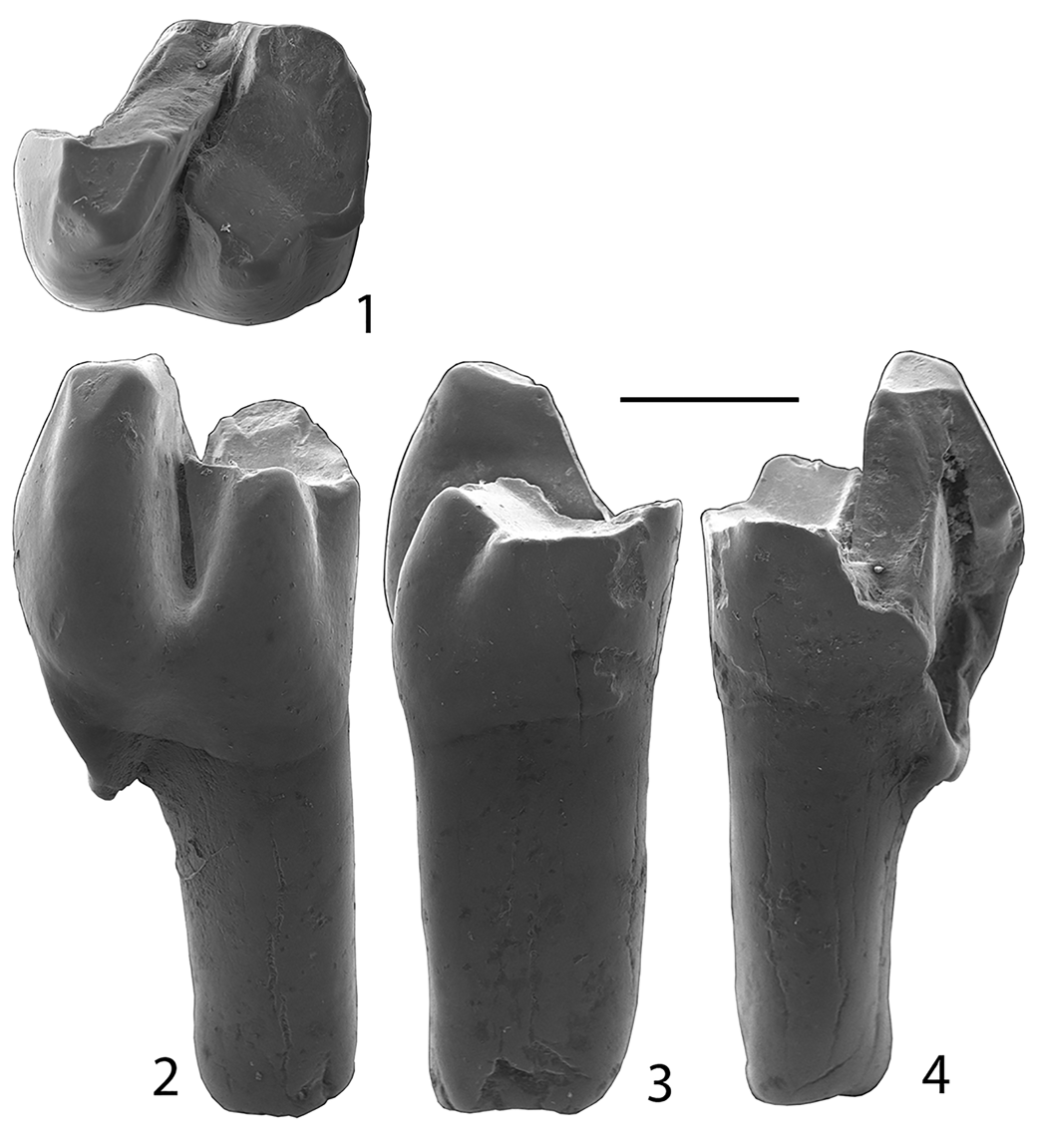
The single known lower molar (PIN 3104/920, m1 or m2; Figs. 1, 3) is broken at the mesiolingual corner of the trigonid. The crown is brachyodont, with the labial crown side only a little deeper than the labial one. The trigonid is higher and wider than the talonid. The crown is moderately worn and the trigonid and talonid are connected lingually by a relatively wide bone bridge. The labial fold, separating the trigonid and talonid, extends deeply for more than half of the preserved crown height. There is a remnant of the hypoconulid separated from the rest of the talonid by a shallow labial fold. On the distal side of the hypoconulid, there is a polished surface likely representing the contact facet with the trigonid of the succeeding molar. There are two well-separated roots. The mesial root is mostly missing. The distal root is higher than the preserved talonid and somewhat compressed mesiodistally.
Left lower molar (m1 or m2, PIN 3104/920) of Arnebolagus leporinus Lopatin and Averianov, Reference Lopatin and Averianov2008, Tsagan-Khushu locality, Nemegt Depression, Mongolia, basal Eocene, Bumban Member of Naran Bulak Formation: in occlusal (1), labial (2), distal (3), and lingual (4) views. Scale bar = 1 mm.

Materials
PIN 3104/915, left P4; 3104/917, right M1; 3104/918, right M2; 3104/920, left lower molar (m1 or m2).
Measurements
PIN 3104/914 (holotype, P3): L = 1.2, W = 2.3; PIN 3104/915 (P4): L = 1.4, W = 2.2; PIN 3104/917 (M1): L = 1.5, W = 2.1; PIN 3104/918 (M2): L = 1.5, W = 1.9.
Remarks
PIN 3104/915 differs from the P4 typical for the stem lagomorphs by the crown shape, which is not oval, and by a very large lingual root. The latter character is more appropriate for a molar. An M1 with centrocone is present in Dawsonolagus (Li et al., Reference Li, Meng and Wang2007: fig. 4A). However, PIN 3104/915 lacks the postcingulum and thus could not be interpreted as a molar.
Phylogenetic analysis
The phylogenetic analysis presented here focuses on the interrelationships among the Asiatic Eocene stem lagomorphs. Fostowicz-Frelik (Reference Fostowicz-Frelik2013) provided a thorough phylogenetic analysis of Paleogene North American stem lagomorphs based on distribution of 44 morphological characters. Most of the cranial characters used in that analysis cannot be checked for more fragmentary materials on Asiatic Eocene stem lagomorphs and some dental characters require considerable ontogenetic series of the dentition that are not available for most of the Asiatic taxa.
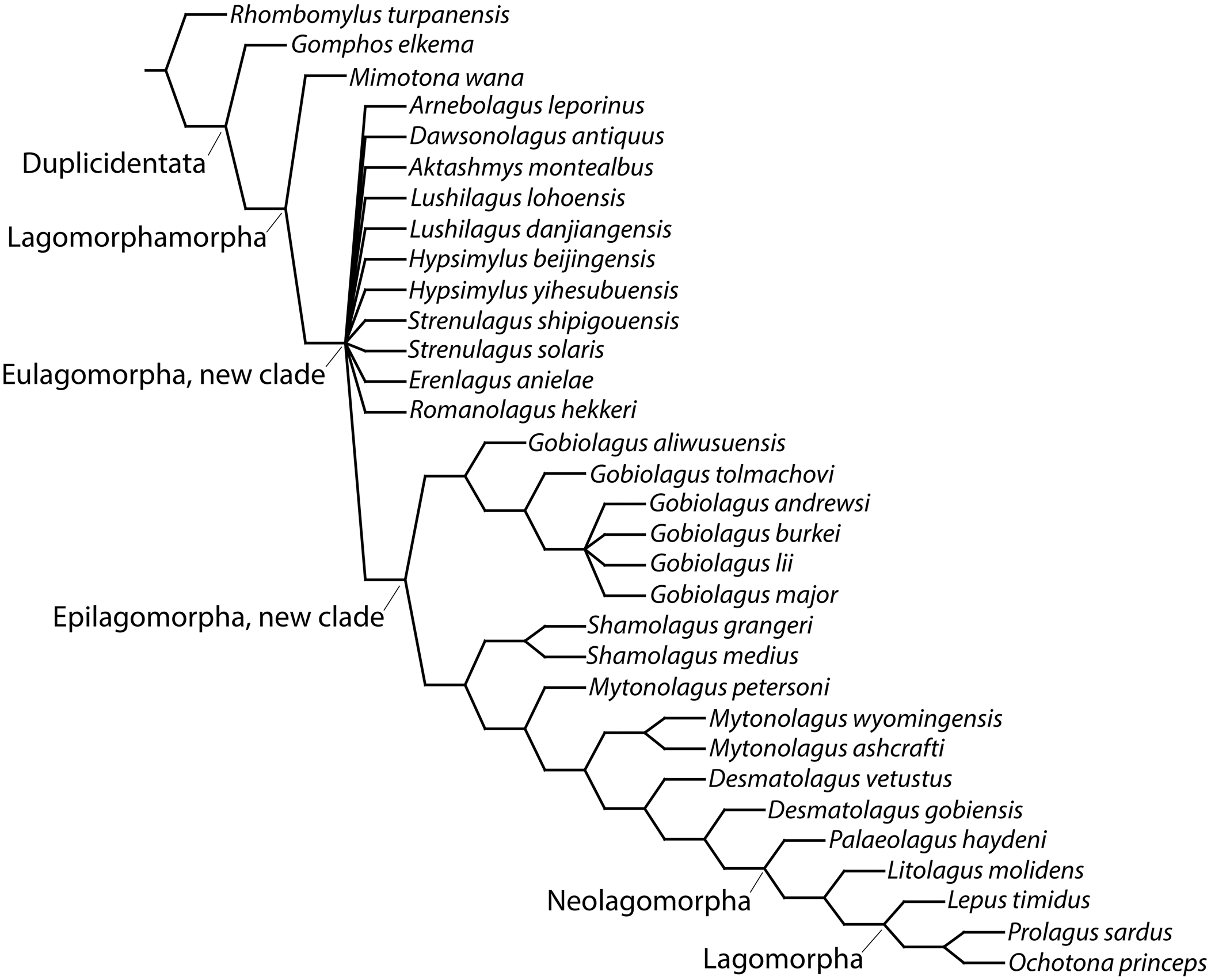
This analysis produced 968 most-parsimonious trees (see Table 1 for tree statistics). The strict consensus tree has poor resolution. The relationships within the crown Lagomorpha are fully resolved and Palaeolagus haydeni Leidy, Reference Leidy1856 is the sister taxon to that group. Most other Paleogene stem lagomorph taxa are collapsed to a polytomy. This result is largely affected by incomplete nature of the majority of Eocene stem lagomorphs. In the successive weighting analysis, tree statistics stabilized after three successive runs (Table 1). The strict consensus of 202 trees obtained in the last and preferred analysis is illustrated in Figure 4.
The strict consensus tree of 202 trees produced by PAUP reweighted analysis. See Appendices 1, 2 and 3 for taxon list, character list, and data matrix, respectively.

Statistics for equal weight (PRAP and PAUP) and reweight (PAUP) analyses.

Lagomorphamorpha, the node-based clade stemming from the most-recent common ancestor of Mimotona and Lagomorpha (Meng and Wyss, Reference Meng and Wyss2001), is supported in our analysis by two new unambiguously optimized synapomorphies: dI2 groove present [13(1)] and p3 single-rooted [41(1)]. In the analysis by Meng and Wyss (Reference Meng and Wyss2001), it was supported by nine characters. The node is a polytomy consisting of the Eocene Asiatic and North American stem lagomorphs that have been traditionally referred to the Lagomorpha or even Leporidae (see Introduction) and more derived Oligocene to Recent lagomorphs. This cluster of lagomorphs ‘of the modern aspect’ (Li et al., Reference Li, Meng and Wang2007) is supported in our analysis by ten unambiguously optimized synapomorphies: P3 with one labial root [23(1)]; P4 with one labial root [25(1)]; M3 double-rooted [32(1)]; p4, m1-3 roots fused or connected by a bony bridge [36(1)]; p3 trigonid narrower than talonid [38(1)]; p4 paracristid absent [44(1)]; p4 and m1-3 trigonid and talonid connected lingually on worn teeth [45(1) and 47(1)]; m1-2 hypoconulid separated by labial and lingual folds [49(1)]; and m1-2 similar in size [50(1)].
However, there are no sufficient characters to resolve the relationship of these taxa. Under the current topology, some of these characters are reversed in a number of Asiatic Eocene taxa. Two labial roots of P3 and P4 [23(0) and 25(0)] are present in Hypsimylus yihesubuensis Meng and Hu, Reference Meng and Hu2004, Strenulagus shipigouensis Tong and Lei, Reference Tong and Lei1987, and Gobiolagus major Burke, Reference Burke1941; the latter character is also found in Gobiolagus lii Zhang, Dawson, and Huang, Reference Zhang, Dawson and Huang2001. M3 is three-rooted [32(0)] in Dawsonolagus antiquus Li, Meng, and Wang, Reference Li, Meng and Wang2007, according to the original description (Li et al. Reference Li, Meng and Wang2007: p. 102) but only two roots are evident on the published photograph (Li et al., Reference Li, Meng and Wang2007: fig. 4A). The roots of lower molars are separate [36(0)] in D. antiquus and Arnebolagus leporinus. The p3 trigonid is subequal to the talonid [38(0)] in Lushilagus danjiangensis. The p4 paracristid present [44(0)] in Aktashmys montealbus Averianov, Reference Averianov1994. The labial and lingual folds separating trigonid and talonid are of similar depth [45(0)] in Aktashmys montealbus, H. beijingenis Zhai, Reference Zhai1977, and Strenulagus shipigouensis. A similar character regarding the trigonid and talonid separation on lower molars [47(0)] is present in Lushilagus danjiangensis and H. beijingensis. The hypoconulid of m1-2 is separated by the labial fold only [49(0)] in Arnebolagus leporinus and D. antiquus. The m2 is larger than m1 [50(1)] in D. antiquus, Shamolagus Burke, Reference Burke1941, and three species of Gobiolagus Burke, Reference Burke1941. The largest number of reversals (four) is found in D. antiquus. This could indicate a more basal position of this taxon related to other Eocene stem lagomorphs under the alternative tree topology. Here we propose a new name, Eulagomorpha n. clade, for the clade containing these lagomorphs ‘of the modern aspect.’ This is a node-based clade defined as the most-recent common ancestor of Lepus and Dawsonolagus and all of its descendants.
Our analysis did not reveal monophyly for the two genera of Asiatic Eocene eulagomorphs: Hypsimylus Zhai, Reference Zhai1977 and Strenulagus Tong and Lei, Reference Tong and Lei1987. Hypsimylus beijingensis, based on a dentary fragment with two cheek teeth from the middle Eocene of China, was initially referred to Eurymylidae (Zhai, Reference Zhai1977; Dashzeveg and Russell, Reference Dashzeveg and Russell1988) or Mimotonidae (Li and Ting, Reference Li, Ting, Luckett and Hartenberger1985), but later was considered a lagomorph (Averianov, Reference Averianov1998; Meng and Hu, Reference Meng and Hu2004). The cheek teeth, originally interpreted as dp4, m1, are likely p4, m1 (Dashzeveg and Russell, Reference Dashzeveg and Russell1988). The second species, H. yihesubuensis, is known from jaw fragments from the late Eocene of China (Meng and Hu, Reference Meng and Hu2004). Both species of Hypsimylus are similar in their large size, high tooth crowns, and very large hypoconulid on p4, m1-2, which is well separated from the rest of the talonid by deep labial and lingual folds. By a combination of these characters, Hypsimylus is clearly different from other Asiatic Eocene Eulagomorpha n. clade. However, at least high tooth crowns and large hypoconulid might be related to the juvenile nature of the known specimens of Hypsimylus. More worn teeth of this taxon could be more similar to the other Asiatic Eocene eulagomorphs.
The type species of the genus Strenulagus, Strenulagus shipigouensis, is represented by jaw fragments and isolated teeth from the middle Eocene of China (Tong and Lei, Reference Tong and Lei1987; Tong, Reference Tong1997). The second species, Strenulagus solaris Lopatin and Averianov, Reference Lopatin and Averianov2006 is known from similar specimens from the middle Eocene of Mongolia and China (Lopatin and Averianov, Reference Lopatin and Averianov2006; Fostowicz-Frelik et al., Reference Fostowicz-Frelik, Li, Li, Meng and Wang2015b). The original diagnosis of Strenulagus is somewhat misleading because M2 was confused with P3 (Lopatin and Averianov, Reference Lopatin and Averianov2006). Most of the characters listed in the revised diagnosis of Strenulagus by Lopatin and Averianov (Reference Lopatin and Averianov2006) were not included in our phylogenetic analysis and we could not test their utility. More complete specimens of Strenulagus shipigouensis are needed to confirm the monophyly of Strenulagus.
Among the Asiatic Eocene stem lagomorphs, two previously recognized genera received support in our analysis: Gobiolagus and Shamolagus. Gobiolagus includes all species previously referred to that genus except for Gobiolagus hekkeri (Shevyreva, Reference Shevyreva1995) from the early Eocene of Kyrgyzstan. The latter species was originally referred to a distinct monotypic genus Romanolagus Shevyreva, Reference Shevyreva1995 (Shevyreva, Reference Shevyreva1995) but later transferred to Gobiolagus by Lopatin and Averianov (Reference Lopatin and Averianov2006). As it is evident now, Romanolagus hekkeri is a more primitive eulagomorph with the crescentic valley open mesially on both P3-4 [20(0)], double-rooted M3 [32(1)], and hypoconulid on p4, m1-2 [46(0) and 48(0)].
The genus Gobiolagus is supported in our analysis by two unambiguously optimized synapomorphies: pear-shaped trigonid of p4 [43(1)]; and m3 hypoconulid absent [54(1)]. The pear-shaped trigonid of p4 was previously considered diagnostic for Gobiolagus tolmachovi Burke, Reference Burke1941 (Burke, Reference Burke1941; Meng et al., Reference Meng, Hu and Li2005), but is also found in Gobiolagus aliwusuensis Fostowicz-Frelik et al., Reference Fostowicz-Frelik, Li, Meng and Wang2012 (Fostowicz-Frelik et al., Reference Fostowicz-Frelik, Li, Meng and Wang2012) and variously expressed in other species. Two species of Shamolagus are united in our analysis by a single unambiguously optimized synapomorphy, m1-2 similar in size [50(0)]. This is reversal from the basal eulagomorph condition, also found in some species of Gobiolagus.
The close relationships between the Asiatic Shamolagus and Gobiolagus on the one hand and the North American Mytonolagus Burke, Reference Burke1934 on the other was first noted by Burke (Reference Burke1941), who united these three genera into the subfamily Mytonolaginae within Leporidae. This conclusion is also supported by our analysis (Fig. 4). Gobiolagus is the sister taxon for the more derived Eulagomorpha n. clade, including Shamolagus. Shamolagus is the sister taxon for the clade including Mytonolagus and more derived taxa. Mytonolagus is paraphyletic in our analysis: Mytonolagus petersoni Burke, Reference Burke1934 is the sister taxon for the clade of more derived eulagomorphs including the clade Mytonolagus wyomingensis Wood, Reference Wood1949 and Mytonolagus ashcrafti Fostowicz-Frelik and Tabrum, Reference Fostowicz-Frelik and Tabrum2009. This result is in line with the previous conclusion that Mytonolagus petersoni is less advanced compared with Mytonolagus wyomingensis (Dawson, Reference Dawson1970; Fostowicz-Frelik and Tabrum, Reference Fostowicz-Frelik and Tabrum2009). The clade including Gobiolagus, Shamolagus, and more derived eulagomorph taxa is named here Epilagomorpha new clade. This is a node-based clade defined as the most-recent common ancestor of Lepus and Gobiolagus and all of its descendants.
The interrelationships of the Oligocene to Recent eulagomorphs are fully resolved in our analysis (Fig. 4) but our taxonomic sample was limited to few taxa and cannot demonstrate the split between the Leporidae and Ochotonidae. In particular, the Oligocene North American Litolagus molidens Dawson, Reference Dawson1958 is outside the crown group Lagomorpha on our cladogram (Fig. 4), but it is distinctly more related to the modern leporids than to Ochotona (Dawson, Reference Dawson1958; Fostowicz-Frelik, Reference Fostowicz-Frelik2013) and should belong to the crown group Lagomorpha (to the Leporomorpha sensu Meng and Wyss [Reference Meng and Wyss2001]). Palaeolagus haydeni in our analysis is the sister taxon to the crown group Lagomorpha. The clade containing the most-recent common ancestor of Lepus, Ochotona, and Palaeolagus Leidy, Reference Leidy1856, and all of its descendants, was previously named Neolagomorpha (Averianov, Reference Averianov1999).
Discussion
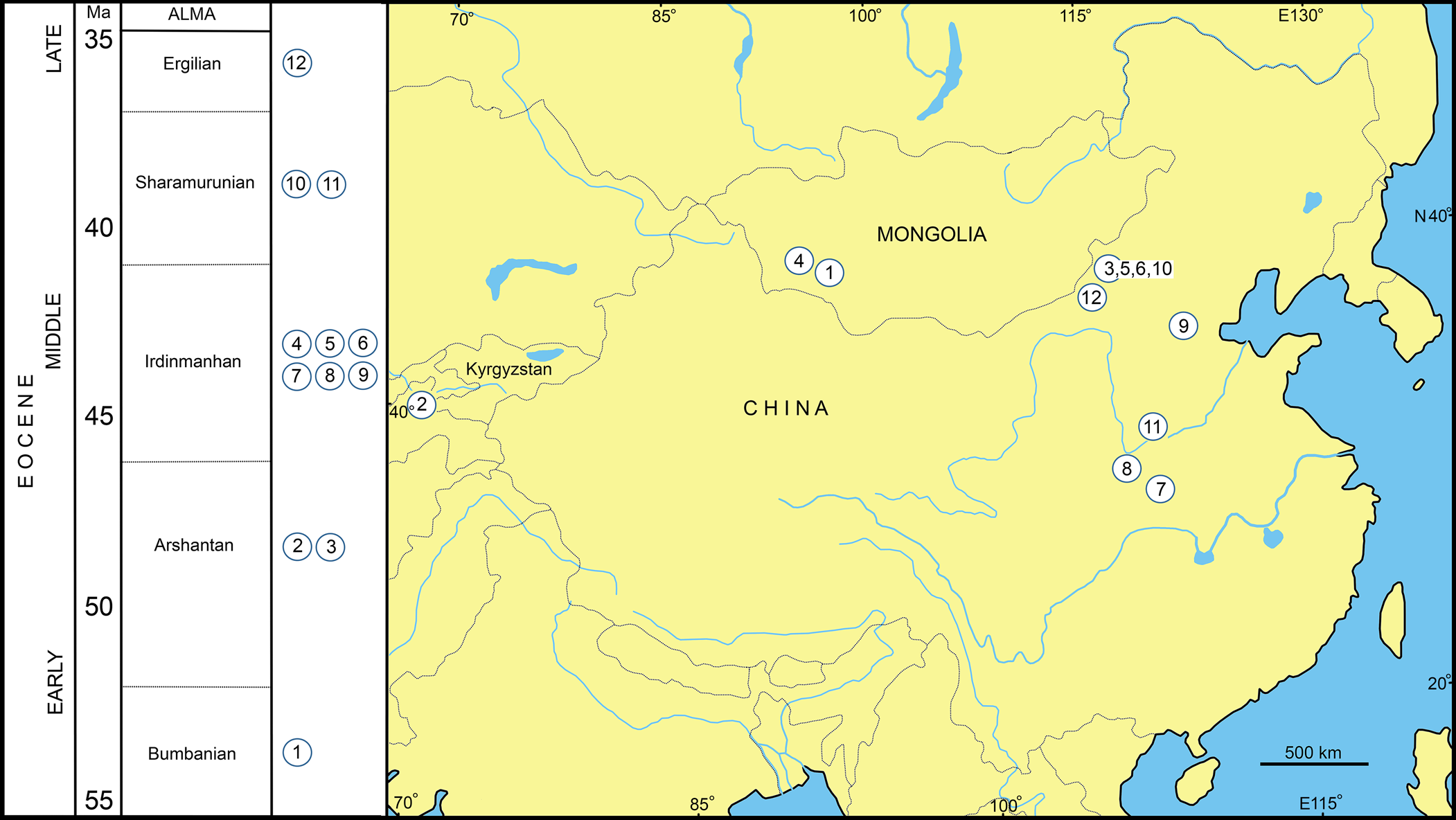
Arnebolagus leporinus comes from the base of the Bumban Member of Naran Bulak Formation (Fig. 5). The fauna from this stratigraphic unit forms the biological basis for the early Eocene Bumbanian Asiatic Land Mammal Age (ALMA) (Russell and Zhai, Reference Russell and Zhai1987; Dashzeveg, Reference Dashzeveg1988; Ting, Reference Ting1998). The Bumban Member represents the Orientolophus Interval Zone, the first biozone of the Bumbanian ALMA (Ting, Reference Ting1998). Arnebolagus was the first lagomorph ‘of the modern aspect’ reported from the Bumbanian ALMA (Lopatin and Averianov, Reference Lopatin and Averianov2008) and it remains the oldest known eulagomorph. The next oldest eulagomorph is Dawsonolagus from the lower part of the Arshanto Formation in Inner Mongolia, China (Li et al., Reference Li, Meng and Wang2007; Fig. 5). Now, most of the Arshanto Formation is regarded as late early Eocene in age (Meng et al., Reference Meng, Wang, Ni, Beard, Sun, Li, Jin and Bai2007; Sun et al., Reference Sun, Yue, Wang, Meng, Wang and Xu2009). The Bumbanian and Arshantan ALMAs correlate with the Ypresian stage in Europe and with the Wasatchian North American Land Mammal Age (NALMA) (Wang et al., Reference Wang, Meng, Beard, Li, Ni, Gebo, Bai, Jin and Li2010). According to Beard (Reference Beard1998), the Bumbanian ALMA could correlate with the late Clarkforkian–early Wasatchian NALMAs. Aktashmys Averianov, Reference Averianov1994 and Romanolagus from the Alay beds in Kyrgyzstan are late Ypresian in age (Averianov and Udovichenko, Reference Averianov and Udovichenko1993; Averianov and Godinot, Reference Averianov, Godinot, Beard and Dawson1998) and slightly younger than Arnebolagus and Dawsonolagus. Rose et al. (Reference Rose, DeLeon, Missiaen, Rana, Sahni, Singh and Smith2008) reported some tarsal bones similar to those of modern lagomorphs from the early Eocene (middle Ypresian) Cambay Shale at the Vastan lignite mine in Gujarat, India. These bones could belong to a eulagomorph similar in age with Dawsonolagus. All other Eocene eulagomorphs from Asia are middle−late Eocene in age (Appendix 1). ‘Procaprolagus’ vusillus Storer, Reference Storer1984 and three species of Mytonolagus, the oldest stem lagomorphs of North America, come from the middle Eocene deposits (Uintan-Duchesnian) (Burke, Reference Burke1934; Wood, Reference Wood1949; Gazin, Reference Gazin1956; Dawson, Reference Dawson1970, Reference Dawson, Janis, Gunnell and Uhen2007; Storer, Reference Storer1984; Fostowicz-Frelik and Tabrum, Reference Fostowicz-Frelik and Tabrum2009). This spatial distribution of taxa and our phylogenetic analysis support origin of the lagomorphs ‘of the modern aspect’ (Eulagomorpha n. clade) in Asia and their subsequent migration to North America at the beginning of the middle Eocene. Eulagomorpha n. clade likely appeared in Asia shortly before the Paleocene/Eocene boundary together with some other important mammalian groups (Bowen et al., Reference Bowen, Clyde, Koch, Ting, Alroy, Tsubamoto, Wang and Wang2002).
Stratigraphic (left) and geographic (right) positions of the main occurrences of the Eocene Eulagomorpha n. clade in Asia: Occurrences: 1 = Bumban Member, Naran Bulak Formation, Mongolia; 2 = Alay beds, Kyrgyzstan; 3 = Arshanto Formation, Inner Mongolia, China; 4 = Khaychin Formation, Mongolia; 5 = Irdin Manha Formation, Inner Mongolia, China; 6 = Ulan Shireh Formation, Inner Mongolia, China; 7 = Hetaoyan Formation, Henan, China; 8 = Lushi Formation, Henan, China; 9 = Changxiandian Formation, Beijing, China; 10 = Shara Murun Formation, Inner Mongolia, China; 11 = Heti Formation, Shanxi, China; 12 = Ulan Gochu Formation, Inner Mongolia, China.

The assemblage of small mammals from the Bumban Member of Naran Bulak Formation is dominated by eurymylids, mimotonids, and diverse ctenodactyloid rodents and ‘insectivores’ (Dashzeveg et al., Reference Dashzeveg, Russell and Flynn1987; Dashzeveg and Russell, Reference Dashzeveg and Russell1988; Shevyreva, Reference Shevyreva1989; Dashzeveg, Reference Dashzeveg1990a, Reference Dashzevegb; Lopatin, Reference Lopatin2006). The abundance of ctenoactyloid rodents and rodent-like eurymylids on the one hand and the rarity of primates compared with the contemporaneous Bumbanian faunas of China (Beard, Reference Beard1998) on the other hand, suggest a predominance of open landscapes in Tsagan-Khushu area during Bumbanian times. These open landscapes were likely favorable for radiation of the earliest eulagomorphs.
Acknowledgments
We thank two anonymous reviewers for their careful review of the paper and useful suggestions. We thank J. Meng and F. Mao for help in the study of the AMNH collection of Paleogene mammals. The research was completed using equipment of the Core Facilities Centre ‘Taxon’ at the Zoological Institute, Russian Academy of Science (St. Petersburg, Russia). The second author received support from the Zoological Institute, Russian Academy of Sciences (project АААА-А19-119032590102-7) and Russian Foundation for Basic Research (project 19-04-00057).
Appendix 1. Taxa used in the phylogenetic analysis
Aktashmys montealbus Averianov, Reference Averianov1994—Represented by isolated teeth and jaw fragments from the early Eocene Alai beds at Andarak 2 locality in Kyrgyzstan (Averianov, Reference Averianov1994; Averianov and Lopatin, Reference Averianov and Lopatin2005). Valerilagus reshetovi Shevyreva, Reference Shevyreva1995, based on the maxillary fragment from this locality (Shevyreva, Reference Shevyreva1995), is a junior subjective synonym of Aktashmys montealbus (see Averianov and Lopatin, Reference Averianov and Lopatin2005).
Arnebolagus leporinus Lopatin and Averianov, Reference Lopatin and Averianov2008—The species is known from the holotype (PIN 3104/914), an isolated P3 (Lopatin and Averianov, Reference Lopatin and Averianov2008), and additional upper cheek teeth described in this report from the earliest Eocene Bumban Member of Naran Bulak Formation at Tsagan-Khushu locality in Mongolia.
Dawsonolagus antiquus Li, Meng, and Wang, Reference Li, Meng and Wang2007—Based on a fragmentary skull with mandibles and isolated teeth and tarsal bones from the early Eocene Arshanto Formation of Inner Mongolia, China (Li et al., Reference Li, Meng and Wang2007).
Desmatolagus gobiensis Matthew and Granger, Reference Matthew and Granger1923—The species is represented by abundant jaw fragments and isolated teeth from the middle Oligocene Shand-Gol Formation at several localities within Valley of Lakes Depression, Mongolia (Matthew and Granger, Reference Matthew and Granger1923; Sych, Reference Sych1975).
Desmatolagus vetustus Burke, Reference Burke1941—The species is known from the late Eocene Ulan Gochu Formation, Inner Mongolia, China (Burke, Reference Burke1941; Meng and Hu, Reference Meng and Hu2004; Meng et al., Reference Meng, Hu and Li2005).
Erenlagus anielae Fostowicz-Frelik and Li, Reference Fostowicz-Frelik and Li2014—Based on isolated teeth from the middle Eocene Irdin Manha Formation at Huheboerhe locality, Erlian Basin, Inner Mongolia, China (Fostowicz-Frelik and Li, Reference Fostowicz-Frelik and Li2014).
Gobiolagus aliwusuensis Fostowicz-Frelik et al., Reference Fostowicz-Frelik, Li, Meng and Wang2012—The species is represented by abundant fragments from the middle Eocene deposits at Aliwusu, Inner Mongolia, China (Fostowicz-Frelik et al., Reference Fostowicz-Frelik, Li, Meng and Wang2012).
Gobiolagus andrewsi Burke, Reference Burke1941—The species is known from two mandibles from the late Eocene Ulan Gochu Beds, Inner Mongolia, China (Burke, Reference Burke1941; Meng et al., Reference Meng, Hu and Li2005).
Gobiolagus burkei Meng, Hu, and Li, Reference Meng, Hu and Li2005—The species is known by jaw fragments from the middle Eocene Shara Murun Formation, Inner Mongolia, China (Meng et al., Reference Meng, Hu and Li2005).
Gobiolagus lii Zhang, Dawson, and Huang, Reference Zhang, Dawson and Huang2001—Represented by a single maxilla from the middle Eocene Heti Formation; Shanxi Province, China (Zhang et al., Reference Zhang, Dawson and Huang2001).
Gobiolagus major Burke, Reference Burke1941—The species is known from maxillary and dentary fragments from the late Eocene of Ulan Gochu Beds, Inner Mongolia, China (Burke, Reference Burke1941; Meng et al., Reference Meng, Hu and Li2005).
Gobiolagus tolmachovi Burke, Reference Burke1941—The species is known from maxillary and dentary fragments from the middle Eocene Shara Murun Formation at Ula Usu (= Baron Sog Mesa), Shara Murun Region, Inner Mongolia, China (Burke, Reference Burke1941; Qi, Reference Qi1988; Meng et al., Reference Meng, Hu and Li2005).
Gomphos elkema Shevyreva in Shevyreva et al., Reference Shevyreva, Chkhikvadze and Zhegallo1975—The species is represented by a skeleton and jaw fragments from several early Eocene localities in Mongolia and China (Shevyreva et al., Reference Shevyreva, Chkhikvadze and Zhegallo1975; Dashzeveg and Russell, Reference Dashzeveg and Russell1988; Meng et al., Reference Meng, Bowen, Jie, Koch, Ting, Qian and Jin2004; Asher et al., Reference Asher, Meng, Wible, McKenna, Rougier, Dashzeveg and Novacek2005).
Hypsimylus beijingensis Zhai, Reference Zhai1977—The species is based on a dentary fragment from the middle Eocene Changxiandian Formation in Beijing, China (Zhai, Reference Zhai1977; Dashzeveg and Russell, Reference Dashzeveg and Russell1988).
Hypsimylus yihesubuensis Meng and Hu, Reference Meng and Hu2004—The species is known from maxillary and dentary fragments from unnamed upper Eocene beds at Yihesubu locality, Inner Mongolia, China (Meng and Hu, Reference Meng and Hu2004).
Lepus timidus Linnaeus, Reference Linnaeus1758—The Recent mountain hare is widely distributed across Europe and Asia; scoring is based on specimens in the ZIN collection.
Litolagus molidens Dawson, Reference Dawson1958—A rare species known from rather complete materials, including skulls and a postcranial skeleton from the early Oligocene (Orellan) deposits of Wyoming, USA (Dawson, Reference Dawson1958; Fostowicz-Frelik, Reference Fostowicz-Frelik2013).
Lushilagus danjiangensis Tong and Lei, Reference Tong and Lei1987—The species is based on isolated teeth from the middle Eocene lower part of the Hetaoyuan Formation in Henan Province, China (Tong and Lei, Reference Tong and Lei1987; Tong, Reference Tong1997).
Lushilagus lohoensis Li, Reference Li1965—The species is represented by upper dentition from the middle Eocene Lushi Formation, Henan Province, China, and karstic fillings in the Triassic Shanghuang Limestone, Jiangsu Province, China (Li, Reference Li1965; Qi et al., Reference Qi, Zong and Wang1991; Tong, Reference Tong1997).
Mimotona wana Li, Reference Li1977—The species is known from cranial and postcranial material from the middle Paleocene Wanghudun Formation, Qianshan Basin, Anhui Province, China (Li, Reference Li1977; Li and Ting, Reference Li, Ting, Luckett and Hartenberger1985, Reference Li, Ting, Szalay, Novacek and McKenna1993; Dashzeveg and Russell, Reference Dashzeveg and Russell1988).
Mytonolagus ashcrafti Fostowicz-Frelik and Tabrum, Reference Fostowicz-Frelik and Tabrum2009—The species is represented by jaw fragments and isolated teeth from the middle Eocene (Duchesnean) Renova Formation at Diamond O Ranch No. 1 locality, Montana, USA (Fostowicz-Frelik and Tabrum, Reference Fostowicz-Frelik and Tabrum2009).
Mytonolagus petersoni Burke, Reference Burke1934—The species is known from a fragmentary skeleton, jaw fragments, and isolated teeth from the middle Eocene (Uintan) Uinta Formation, Utah, USA (Burke, Reference Burke1934; Dawson, Reference Dawson1970).
Mytonolagus wyomingensis Wood, Reference Wood1949—The species is represented by a maxillar fragment and isolated teeth from the middle Eocene (Uintan) of Wyoming and Montana, USA (Wood, Reference Wood1949; Gazin, Reference Gazin1956).
Ochotona princeps Richardson, Reference Richardson1828—The Recent American pika is distributed in western North America; scoring is based on specimens in the ZIN collection and on Wible (Reference Wible2007).
Palaeolagus haydeni Leidy, Reference Leidy1856—The species is represented by abundant cranial and postcranial material from the late Eocene (Chadronian) of Nebraska, USA (Leidy, Reference Leidy1856; Troxell, Reference Troxell1921; Wood, Reference Wood1940; Dawson, Reference Dawson1958; Korth and Dharmapuri, Reference Korth and Dharmapuri2017).
Prolagus sardus Wagner, Reference Wagner1832—The recently extinct Sardinia pika lived on Sardinia, Corsica and neighboring Mediterranean islands (Dawson, Reference Dawson1969).
Rhombomylus turpanensis Zhai, Reference Zhai1978—This species was used as the outgroup taxon in the phylogenetic analysis. It is known from numerous cranial and postcranial specimens from several early Eocene formations in China and Mongolia (Zhai, Reference Zhai1978; Dashzeveg and Russell, Reference Dashzeveg and Russell1988; Meng et al., Reference Meng, Hu and Li2003).
Romanolagus hekkeri Shevyreva, Reference Shevyreva1995—The species is known from maxillary fragments and isolated teeth from the early Eocene Alai beds at Andarak 2 locality, Kyrgyzstan (Shevyreva, Reference Shevyreva1995; Lopatin and Averianov, Reference Lopatin and Averianov2006).
Shamolagus grangeri Burke, Reference Burke1941—The species is based on a dentary fragment with p4, m1−3 (AMNH 26289) from the middle Eocene Ulan Shireh Formation at Wulanhuxiu (= Chimney Butte), Shara Murun region, Inner Mongolia, China (Burke, Reference Burke1941; Meng et al., Reference Meng, Hu and Li2005).
Shamolagus medius Burke, Reference Burke1941—The species is known from a dentary fragment and fragmentary skeleton from the middle Eocene Shara Murun Formation at Ula Usu (= Baron Sog Mesa), Shara Murun region, Inner Mongolia, China (Burke, Reference Burke1941; Li, Reference Li1965; Meng et al., Reference Meng, Hu and Li2005).
Strenulagus shipigouensis Tong and Lei, Reference Tong and Lei1987—The species is represented by jaw fragments and isolated teeth from the middle Eocene lower part of the Hetaoyuan Formation, Henan Province, China (Tong and Lei, Reference Tong and Lei1987; Tong, Reference Tong1997).
Strenulagus solaris Lopatin and Averianov, Reference Lopatin and Averianov2006—The species is known from jaw fragments and isolated teeth from the middle Eocene Khaychin Formation at Khaychin-Ula 3 locality, Mongolia (Lopatin and Averianov, Reference Lopatin and Averianov2006) and isolated teeth from the middle Eocene Irdin Manha Formation at the Irdin Manha and Huheboerhe localities, Erlian Basin, Inner Mongolia, China (Fostowicz-Frelik et al., Reference Fostowicz-Frelik, Li, Li, Meng and Wang2015b).
Appendix 2. Character list.
1. Postorbital process of frontal: present (0); absent (1).
2. Posterior end of zygomatic root: at M1 (0); more posterior, at P4 (1).
3. Incisive foramen posterior margin (ordered): anterior to the cheek teeth (0); at P2 (1); at P3 or more posterior (2).
4. Premolar foramen on maxilla: absent (0); present (1).
5. Posterior margin of palate: at M2 or more posterior (0); at M1 or more anterior (1).
6. Masseteric fossa anterior end: at m3 or more posterior (0); at m2 (1).
7. Tubercle on masseteric crest: absent (0); present (1).
8. Coronoid process of dentary: large (0); small (1).
9. Coronoid canal on mandible posterior to m3: absent (0); present (1).
10. Anterior mental foramen: at p3 (0); at diastema (1).
11. Posterior mental foramen: at p4−m1 (0); at m2 (1). Taxa without posterior mental foramen were coded as inapplicable.
12. Cement on teeth: absent (0); present (1).
13. dI2 groove: absent (0); present (1).
14. dI2 cross section: heart-shaped, distal side narrow (0); subrectangular (1). Taxa without groove were coded as inapplicable.
15. dI2 medial and lateral lobes relative width: similar (0); medial lobe wider (1); medial lobe narrower (2). Taxa without groove were coded as inapplicable.
16. dI2 medial lobe position: projecting anteriorly (0); level with the lateral lobe (1). Taxa without groove were coded as inapplicable.
17. Upper cheek teeth: unilaterally hypsodont (0); hypsodont (roots absent) (1).
18. P2 crown shape: round (0); mesiodistally compressed (1).
19. P2 mesial folds (ordered): one (0); two (1); three (2).
20. P3−4 crescentic valley (paraflexia) (ordered): open mesially on both P3 and P4 (0); open on P3, closed on P4 (1); open on P3, absent on P4 (2); absent on both P3 and P4 (3).
21. P3 anteroloph: short (0); long, extending labially at least to the middle of centrocone (1). Taxa without anteroloph were coded as inapplicable.
22. P3 hypostria: absent (0); shallow, forming lake (1); deep, not forming lake (2).
23. P3 labial roots: two (0); one (1). Taxa without roots were coded as inapplicable.
24. P4 hypostria: absent (0); present (1).
25. P4 labial roots: two (0); one (1). Taxa without roots were coded as inapplicable.
26. M1−2 crescent: absent (0); present (1).
27. M1−2 postcingulum: present (0); absent (0).
28. M1−2 hypostria: absent or shallow (0); short, enamel lake on late wear (1); present for most of crown width (2).
29. M3: present (0); absent (1).
30. M3 size: wider than M2 (0); 50−100% of M2 width (1); < 50% of M2 width (2). Taxa without M3 were coded as inapplicable.
31. M3 postcingulum: present (0); absent (0). Taxa without M3 were coded as inapplicable.
32. M3 roots: three (0); two (1); one (2). Taxa without M3 or roots were coded as inapplicable.
33. i3: present (0); absent (1).
34. Origin of di2: posterior to m3 (0); at m1−2 (1); more anterior (2).
35. Lower cheek teeth: brachyodont (0); unilaterally hypsodont (1); hypsodont (roots absent) (2).
36. p4, m1−3 roots: separate (0); fused or connected by a bony bridge (1). Taxa without roots were coded as inapplicable.
37. p4, m1−2 trigonid height to talonid: larger (0); subequal (1).
38. p3 trigonid to lalonid width: larger or subequal (0); smaller (1).
39. p3 trigonid and talonid separation: labial and lingual folds (0); labial fold only (1); lingual fold closed in enamel lake on late wear (2).
40. p3 mesiolingual fold on trigonid: absent (0); present (1).
41. p3 roots: two (0); one (1). Taxa without roots were coded as inapplicable.
42. p4 trigonid width to talonid: larger (0); subequal (1).
43. p4 pear-shaped trigonid: absent (0); present (1).
44. p4 paracristid: present (0); absent (1).
45. p4 labial and lingual folds separating trigonid and talonid: of similar depth (0); lingual fold shallower, trigonid and talonid connected lingually on worn teeth (1).
46. p4 hypoconulid (little worn teeth): present (0); absent (1).
47. m1−3 labial and lingual folds separating trigonid and talonid: of similar depth (0); lingual fold shallower, trigonid and talonid connected lingually on worn teeth (1).
48. m1−2 hypoconulid (little worn teeth): present (0); absent (1).
49. m1−2 hypoconulid separated from talonid: by labial fold (0); by both labial and lingual folds (1). Taxa without hypoconulid were coded as inapplicable.
50. m1−2 relative size: m2 larger (0); similar (1).
51. m1 trigonid length to talonid: larger (0); similar (1).
52. m2 trigonid length to talonid: larger (0); similar (1).
53. m3 trigonid height to talonid: larger (0); subequal (1).
54. m3 hypoconulid (little worn teeth): present (0); absent (1).
Appendix 3. Data matrix. A = [01].