Chemical, Biological, Radiological, and Nuclear (CBRN) threats represent significant dangers to human health and safety, with potential for extensive social, physical, and psychological impacts. Historical incidents involving CBRN agents have demonstrated the profound destructive capabilities of these materials. For instance, the use of chemical weapons during World War I caused widespread casualties and long-term environmental damage.Reference Dökmeci1, Reference Erkekoğlu and Koçer-Gümüşel2 Similarly, nuclear accidents like the Chernobyl disaster have had lasting health impacts on affected populations.Reference Downes and Hobbs3
Children, due to their anatomical and physiological differences from adults, are particularly vulnerable to CBRN threats. Their developing bodies and lower resilience to toxic exposures make them more susceptible to severe consequences.Reference Chiu, Goodman and Palacios4 Children have thinner skin, higher respiratory rates, and developing immune systems, which increase their risk of injury from CBRN agents.Reference Siegel, Strauss-Riggs and Needle5 Despite this heightened vulnerability, the literature on CBRN education specifically targeted at children is sparse. Most existing research focuses on the general effects of disasters on children, with limited studies addressing the specific challenges posed by CBRN threats.Reference Pita and Domingo6
This gap is critical, given the increasing prevalence of such incidents due to technological advancements, geopolitical tensions, and industrial accidents. Raising awareness and preparedness among children is essential for mitigating the potential harms of CBRN events. Education plays a pivotal role in this process, equipping young individuals with the knowledge and skills necessary to respond effectively in emergencies.Reference İbrahimoğlu, Akarsu and Polat7 However, traditional educational methods may not fully engage children or adequately convey the complexities of CBRN threats. Animation, as an educational tool, offers unique advantages in engaging young audiences and simplifying complex topics. By incorporating visually appealing and interactive elements, animations can make learning more enjoyable and memorable, thereby increasing retention and understanding.Reference Ekici8 Studies have shown that animation can significantly enhance learning outcomes in various educational contexts, making it an ideal medium for CBRN education.Reference Rakhshani, Rahmaniyan and Kashfi9
The lack of training on CBRN threats to children illustrates a significant gap in this field. Existing literature often focuses on adults or the general population and does not adequately address the special needs and vulnerabilities of children.Reference Gürler, Gürsoy and Çiftçi10–Reference Dökmeci, Kimyasal and Biyolojik12
This study aims to evaluate the effectiveness of animation-supported education in enhancing the awareness and preparedness of seventh-grade students regarding CBRN threats. The primary objectives are to assess the baseline knowledge of students about CBRN threats, implement an animation-supported educational program, and measure the changes in knowledge and awareness following the intervention. Additionally, the study seeks to gather feedback on the students’ satisfaction with the educational method and their perceptions of the animations used.
In summary, this study addresses the critical need for targeted CBRN education for children. By leveraging animation-supported education, it aims to improve the preparedness and awareness of young students, ultimately contributing to their safety and resilience in the face of CBRN threats.
Methods
Study Design
This study was conducted with a quasi-experimental method to raise awareness of secondary school seventh grade students against CBRN threats and hazards. The research was conducted between February 2024 and March 2024 in a total of 15 secondary schools in Edirne, Kırklareli, and Tekirdağ provinces in Türkiye. One branch from 5 randomly selected middle schools in each province was included in the study. The study was structured with a pretest-posttest design including pre- and post-training measurements.
Participants
The population of the study consisted of a total of 323 seventh-grade students studying in these schools.
However, participation in the study was voluntary and 233 students who agreed to participate in the training program were included in the study. This corresponds to approximately 72% of the population. This age group was determined as a suitable target group for CBRN awareness training recommended by the Ministry of National Education. Participants completed the pre- and post-training questionnaires completely and participated in all stages of the study.
Training content and animations
CBRN basic training was supported by animations specially developed by the researchers.
Access to the content of the animations:
https://www.youtube.com/watch?v=0OnL3KmQ1nI
https://www.youtube.com/watch?v=bc5bqriEuPk
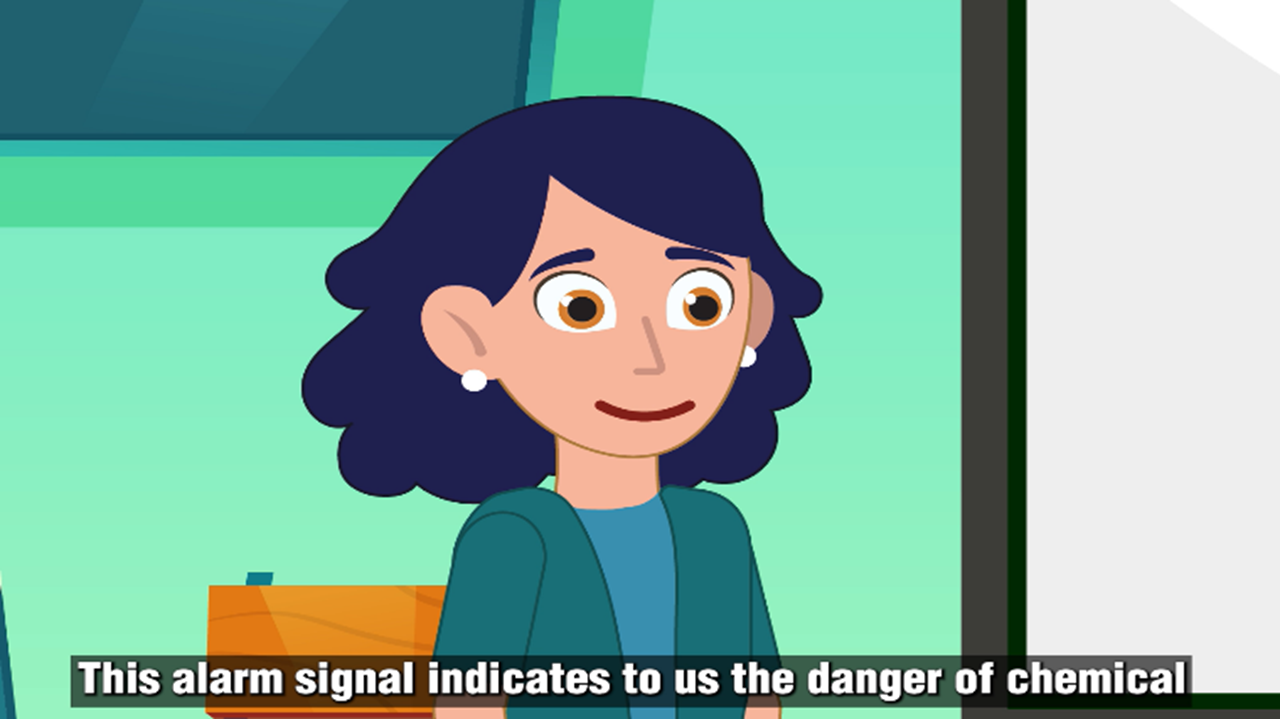
The content of the animations was structured to cover the definition of chemical, biological, radiological, and nuclear threats, the measures that can be taken against these threats, what to do in emergencies, and basic first aid practices. Educational and attention-grabbing animations suitable for the age group, using a combination of visual and auditory elements, were prepared. These animations include humorous elements and examples from daily life to attract students’ attention. In addition, short knowledge questions and scenario-based applications were included during the animations, allowing students to test their knowledge. For example, there are interactive sections such as choosing the right behavior in a CBRN incident. A total of 4 animation scenarios were developed, each addressing a different CBRN threat, and designed to help students understand real-life situations (Pictures 1, 2, 3).
Sections from animations.

Sections from animations.

Sections from animations.

Data Collection
The research was conducted in 3 stages:
-
1. Pre-Training Assessment (Pre-Test): CBRN Knowledge Test was applied to the participants to determine their initial level of knowledge. In addition, demographic information was collected.
-
2. Training Process: Participants were given CBRN training with animation support.
The training consisted of 3 sessions including basic information on chemical, biological, radiological, and nuclear threats.
-
3. Post-Training Evaluation (Post-Test): After the training was completed, the CBRN Knowledge Test was administered to the participants again. In addition, the Training Satisfaction Questionnaire and Animation Opinion Scale were used to assess the participants’ satisfaction levels with the training and their opinions on the animations.
Data collection tools used in the study:
-
1. Demographic Information Form: It includes the participants’ gender, age, class, and school information.
-
2. Pre-test-post-test: This test was prepared to measure the level of basic knowledge on CBRN. The test consists of 10 questions with 4 options (a, b, c, d). The questions cover basic knowledge on chemical, biological, radiological, and nuclear threats.
-
3. Education Satisfaction Questionnaire: This scale, developed by Altınarık (2020) and consisting of 10 5-point Likert-type items (1: Strongly disagree, 5: Strongly agree), was used to measure the participants’ level of satisfaction with the training.
The Cronbach Alpha coefficient of the scale was determined as 0.76.
-
4. Animation Opinion Scale: This scale, developed by Daşdemir and Doymuş (2016), was used to evaluate the participants’ opinions about the content of the animations used in the training. The Cronbach Alpha coefficient of the scale consisting of 13 items in 5-point Likert type (1: Strongly disagree, 5: Strongly agree) was determined as 0.70.
Data Analysis
The collected data were analyzed using SPSS 21.0 and Microsoft Excel software. Various statistical methods were applied during the analysis process. First, descriptive statistics were used to calculate the number of correct and incorrect answers, correct answer averages, and success percentages. Within the scope of item analysis of the CBRN Knowledge Test, item difficulty, item discrimination, internal consistency coefficient (KR-21), Spearman-Brown, and Guttman 2-half test correlations were examined. In the comparison of CBRN knowledge test scores before and after the training, Wilcoxon Signed Rank Test was used because it was determined that the scores did not show normal distribution. In addition, Cohen’s d effect size was calculated to evaluate the effect of animation-supported training on CBRN knowledge level. In this analysis, the effect size was classified as “low” between 0.20-0.50, “moderate” between 0.50-0.80, and “large” above 0.80. Mann Whitney U and Kruskal Wallis H tests were applied to compare training satisfaction, animation opinions, and CBRN knowledge test scores according to demographic variables such as gender, age group, branch, and province of the school. These methods were used to determine the significant differences between different groups and the findings obtained enabled a more comprehensive evaluation of the results of the study.
Ethical Considerations
The study was conducted with the approval of Tekirdağ Namik Kemal University Non-Interventional Clinical Research Ethics Committee with the research protocol number 2023.192.11.06. Written informed consent was obtained from the parents of the participants and the participation of the students in the study was voluntary. Participants were informed about the confidentiality of their data and their right to withdraw from the study at any time.
Results
This section presents the findings from the study assessing the effectiveness of animation-supported education in increasing the awareness and knowledge of seventh-grade students regarding CBRN threats. The data were analyzed to understand the impact of the educational intervention on students’ knowledge levels, satisfaction with the education, and perceptions of the animations used.
Demographic Characteristics of the Sample
The sample consisted of 233 seventh-grade students, with an equal distribution of 45.1% male and 54.9% female participants. The age distribution indicated that 28.8% were 12 years old and 71.2% were 13 years old.
Item analysis of the CBRN Knowledge Test
The items with the highest correct responses were i3 (51%), i2 and i5 (49%), i7 (44%), and i8 (41%). The items with the lowest correct responses were i4 (18%) and i6 (17%). The average test score was 3.50 ± 2.98, and the overall success rate was 35% (Table 1). All items had a discrimination index above 0.30, indicating their suitability for the test. The item difficulty analysis showed that 4 items (i4, i6, i9, i10) were “difficult”, and 6 items were of “medium difficulty” (Table 1). The item analysis showed that the test had good reliability with KR-21 (α = 0.843), Spearman-Brown (r = 0.855), and Guttman (r = 0.819) coefficients (Table 1). The CBRN Knowledge Test, with its 10 items, was found to be a valid and reliable measure for assessing CBRN knowledge.
Item description, discrimination, and difficulty results of the CBRN knowledge test

Note: IC=Incorrect Count; C=Correct Count; %=Correct Percentage; d: Discrimination index; P: Item difficulty index; r = Item-Total Score Correlation,1 = t-test for the lowest and highest 27% groups, **P<0.01.
Descriptive statistics of educational satisfaction and knowledge levels
Descriptive statistics for the education satisfaction scale, animation perception scale, and CBRN knowledge test scores are presented in Table 2. The results indicate high levels of satisfaction with the education and positive perceptions of the animations used. The mean score for the education satisfaction scale was 44.76 (SD = 4.84), and for the animation feedback scale, it was 46.94 (SD = 6.42). The mean CBRN knowledge test scores were 3.06 (SD = 2.40) before the training and 7.58 (SD = 1.95) after the training. As shown in Table 2, significant positive correlations were found between education satisfaction and animation feedback (r = 0.39, P < 0.01), animation feedback and post-test scores (r = 0.16, P < 0.05), and pre-test and post-test scores (r = 0.47, P < 0.01). In Table 2, columns labeled 1, 2, and 3 represent the correlation coefficients with the education satisfaction, animation feedback, and CBRN pre-test scores, respectively (Table 2).
Descriptive statistics for education satisfaction, animation feedback scales, and CBRN Knowledge Test scores

Note: Columns labeled 1, 2, and 3 represent the correlation coefficients between the respective scales and tests. For example, column 1 shows the correlation with “Education satisfaction,” column 2 with “Animation feedback,” and column 3 with “CBRN Pre-Test.” r: correlation coefficient; **P<0.01; *P<0.05.
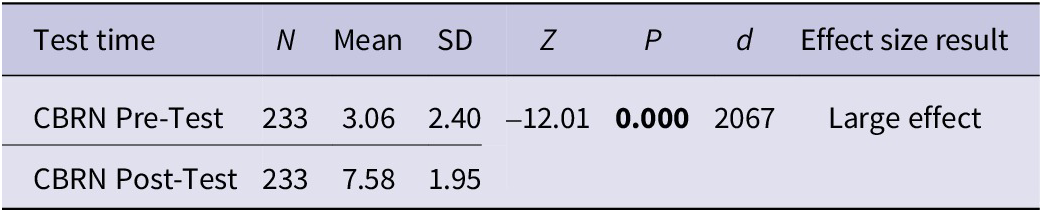
A significant increase in CBRN knowledge was observed following the animation-supported education. The pre-test mean score was 3.06 (SD = 2.40), while the post-test mean score increased to 7.58 (SD = 1.95). The Wilcoxon signed-rank test indicated that this increase was statistically significant (P < 0.001), with a large effect size (Cohen’s d = 1.95), demonstrating the effectiveness of the educational intervention. A significant increase in CBRN knowledge test scores was observed post-training (t = -28.73, P < 0.01) with a large effect size (d = 1.88) (Table 3).
Paired samples t test results for CBRN Knowledge Test scores

d: Cohen’s d effect size coefficient.
Comparison by demographic variables
Gender differences. Education Satisfaction: Both male (M = 44.73, SD = 5.05) and female students (M = 44.80, SD = 4.60) reported similar levels of educational satisfaction. The slight difference was not statistically significant (Z = -0.17, P = 0.865).
Animation Feedback: Male students had a slightly higher mean score (M = 47.45, SD = 5.94) compared to female students (M = 46.30, SD = 6.94), but this difference was not statistically significant (Z = -1.12, P = 0.262).
CBRN Knowledge (Pre-Test and Post-Test): Female students scored slightly higher on the pre-test (M = 3.19, SD = 2.27) and post-test (M = 7.70, SD = 1.91) compared to male students (Pre-Test: M = 2.95, SD = 2.51; Post-Test: M = 7.48, SD = 1.99). However, these differences were not statistically significant (Pre-Test: Z = -0.83, P = 0.406; Post-Test: Z = -1.03, P = 0.301).
Age differences. Education Satisfaction: Students aged 12 (M = 44.42, SD = 4.87) and 13 (M = 44.90, SD = 4.83) reported similar levels of satisfaction, with no significant difference (Z = -0.86, P = 0.387).
Animation Feedback: Both age groups provided similar feedback on animations (12 years: M = 46.69, SD = 6.63; 13 years: M = 47.04, SD = 6.35), with no significant difference (Z = -0.05, P = 0.961).
CBRN Knowledge (pre-test and post-test). Students aged 13 scored slightly higher on the pre-test (M = 3.17, SD = 2.33) and post-test (M = 7.61, SD = 1.93) compared to those aged 12 (Pre-Test: M = 2.76, SD = 2.56; Post-Test: M = 7.51, SD = 2.02). The pre-test difference approached significance (Z = -1.78, P = 0.076), while the post-test difference was not significant (Z = -0.16, P = 0.875).
No significant differences were found in education satisfaction, animation feedback, and CBRN knowledge test scores between female and male students. No significant differences were found in education satisfaction, animation feedback, and CBRN knowledge test scores by age groups (Table 4).
Comparison of scale and test scores according to demographic variables

Discussion
This study examined the effectiveness of an animation-supported educational program in increasing the awareness of seventh-grade students about CBRN threats. The results show that animation-supported education is effective in enhancing children’s awareness and knowledge levels regarding CBRN threats.Reference Karakus13 This discussion section will provide a more detailed analysis of the findings and comparisons with existing literature.
Student Satisfaction and Opinions
In this study, animation-supported training was found to be an effective method to increase awareness and knowledge of CBRN threats. The findings obtained from the training satisfaction and animation opinion scales show that the satisfaction levels of the students regarding the animation-supported training are high and they have positive opinions about the animations. The average of the scores obtained from the training satisfaction scale was 44.76±4.84 and the average of the scores obtained from the animation opinion scale was 46.94±6.42. These results reveal that students find animation-supported education both interesting and effective. Students appreciated the visual and interactive features of the animations and stated that these features facilitated the learning process. Making technical and often frightening subjects such as CBRN more understandable through animations increased students’ interest in these subjects. The findings are in line with other studies in the literature. For example, Demirkan (2020) and Daşdemir and Doymuş (2016) reported that animations facilitate learning and increase students’ academic achievement by making abstract and complex subjects concrete.Reference Demirkan14–Reference Daşdemir and Doymuş15 In addition, in a study conducted by Lone et al. (2017), it was emphasized that animations are effective in attracting students’ attention and increasing learning motivation. These findings support the contribution of animation-supported education to learning processes.Reference Lone, McKenna and Cryan16 Students stated that the visual and auditory elements of the animations were remarkable and facilitated the learning process. This finding is in line with the results of studies conducted by Rieber (1991) and Ünal (2020), which emphasize the contributions of animations to the learning process. Rieber (1991) stated that animations increase motivation in the learning process and are effective in attracting students’ attention. Ünal (2020) emphasized that animations help students learn information more permanently, especially in visual learning processes.Reference Rieber17–Reference Ünal18 Recent studies have examined the impact of animations in education in more depth and supported the contributions of this method to learning processes. For example, Farhat et al. (2022) showed that the interactive elements of animations play an important role in increasing students’ knowledge retention. In this study, students’ positive views on animation-supported education reveal that animations not only transfer knowledge but also make the learning process more interesting and effective.Reference Farhat, Laughton and Joseph19
The Effect of Animation Supported Basic CBRN Training on Children
Children are more vulnerable to CBRN threats due to their anatomical and physiological characteristics.Reference Siegel, Strauss-Riggs and Needle5 Children’s thin skin, high metabolic rates, narrow airways, and underdeveloped immune systems make them more vulnerable to the effects of CBRN incidents.Reference Bartenfeld, Peacock and Griese20 Therefore, the development of special education programs for children is of great importance. Educational programs play an important role in protecting children from CBRN threats and ensuring their preparedness against these threats. The findings of this study show that animation-supported education is an effective method to increase children’s awareness of CBRN threats.
The results of the CBRN knowledge test conducted before and after the training revealed that animation-supported training significantly increased the level of knowledge. While the average CBRN knowledge test score of the students was 3.06±2.40 before the training, this average was 7.58±1.95 after the training. These results show that animation-supported training increased the knowledge level by approximately 45.2%. In addition, according to the Wilcoxon signed-rank test results, a statistically significant difference was found between the CBRN knowledge level scores before and after the training (Z = -12.01; P < 0.05). These findings clearly demonstrate the contribution of animation-supported training to learning processes. The findings are consistent with other studies in the literature. For example, in a study conducted by Ekici (2021), it was emphasized that animations facilitate children’s understanding of abstract concepts and make the learning process fun.Reference Ekici8 In this study, it was observed that animations made technical and often frightening subjects such as CBRN more understandable and interesting. The effect of animation-supported education was not only limited to increasing the level of knowledge but also increased students’ interest and motivation in the learning process. In a study conducted by Lone et al. (2017), it was emphasized that animations were effective in attracting students’ attention and increasing their motivation to learn.Reference Lone, McKenna and Cryan16 This study makes an important contribution to the literature by showing that animation-supported education is an effective method to raise awareness about CBRN threats. In the literature, it is seen that trainings on CBRN threats are generally focused on adults and studies for children are limited.Reference Siegel, Strauss-Riggs and Needle5, Reference Adanalı, Yıyın and Özenel21 Raising children’s awareness of CBRN threats and learning the right behaviors can contribute to creating a more prepared society against possible CBRN incidents in the future.
Regional and Demographic Differences
The study revealed that CBRN knowledge level did not show a significant difference according to gender and age groups (P>0.05) but revealed significant differences (P < 0.05) according to variables such as branch and the province where the school is located. This finding emphasizes the impact of the educational environment and regional differences on the learning process. For example, students in Kırklareli and Tekirdağ provinces have higher knowledge levels than students in Edirne, indicating that regional factors can affect the effectiveness of education. This situation reveals the importance of adapting educational materials according to regional needs. In the literature, the impact of regional differences on education is frequently emphasized. Ilgar (2023) stated that the regional differences in education in Turkey stem from socio-economic and socio-cultural factors and that these factors play a determining role on access to education and learning levels.Reference Ilgar22 In this context, the higher knowledge levels of students in more developed regions such as Kırklareli and Tekirdağ may be due to the better educational infrastructure and resources in these regions.
Differences by Gender and Age Groups
In the study, it was found that the level of CBRN knowledge did not show a significant difference according to gender and age groups. The lack of differences according to gender and age groups shows that CBRN training is equally effective for all student groups. Gürler et al. (2021) stated that CBRN knowledge level was not related to gender and the effect of training was similar for both genders.Reference Gürler, Gürsoy and Çiftçi10 This shows that the effect of CBRN training depends on the training method and content rather than individual differences. In the study conducted by Eren (2023), it was stated that the level of CBRN knowledge did not show a significant difference according to gender and age groups.Reference Eren23 This situation reveals that CBRN training is an effective learning tool regardless of the demographic characteristics of individuals. In addition, in a study conducted by Huyar (2021), it was shown that full learning model-based training increased the practical skills of student nurses in CBRN hazards and that such training is also effective in the field of health.Reference Huyar and Esin24 These findings reveal that animation-based training is an effective method not only for children, but also for different age groups and professional groups.
Limitations of the Study
There are some limitations to the study. First, the study of only seventh grade students limits generalizability. Future studies covering different age groups and education levels are recommended. Second, the lack of qualitative data collection made it difficult to understand the detailed views of students about animations. Methods such as focus group discussions or individual interviews can be used to address this deficiency. Third, the study was conducted only in a specific geographic region, making it difficult to generalize the findings to other regions or socioeconomic groups. Studies to be conducted in different regions are recommended. Finally, the long-term effects of animation-supported education were not evaluated. In the future it will be important to study retention of knowledge.
Conclusion
Animation-supported education is an effective method for raising awareness about CBRN threats, especially among vulnerable groups such as children. By making complex topics more understandable and engaging, animations can enhance learning motivation and facilitate knowledge retention. This approach not only supports existing evidence on the educational benefits of animations but also highlights its potential for broader application in diverse educational settings. Expanding such training programs to different age groups and sectors may further strengthen society’s preparedness and resilience against CBRN incidents.
Author contribution
AHD: Conceptualization and design of the study, data analysis and interpretation, manuscript writing. EK: Development of educational materials, organization and implementation of educational sessions, data analysis.
Funding statement
No funding or sponsorship was received for any aspect of this article, including the design and conduct of the study; collection, management, analysis, and interpretation of the data; preparation, review, or approval of the manuscript; or decision to submit the manuscript for publication.
Competing interests
All authors report no conflicts of interest.