Introduction
To the outside observer, the Northern Ireland ‘problem’ has, for all intents and purposes been ‘solved’. Local political parties, in particular long-standing arch antagonists, the Democratic Unionist Party (DUP) and Sinn Féin, are now key players in a devolved power-sharing Executive and Assembly, which has been functioning since May 2007. The existing arrangements are rooted in the Belfast (Good Friday) Agreement of 1998 that provided for, inter alia, a devolved Assembly with full executive and legislative authority for all matters that are the responsibility of Northern Ireland Government departments (so-called ‘transferred matters’). Despite substantial public endorsements of the Agreement via referenda in both Northern Ireland and the Republic of Ireland (although the figures concealed a split in unionist support) devolution faltered largely over decommissioning of paramilitary weapons. From the inception of devolution in December 1999 until October 2002, the Assembly was suspended four times with intermittent flurries of public administration and legislative business conducted. The British Secretary of State dissolved the Assembly in April 2003 leading (eventually) to elections in November of the same year, after which it was restored to a state of suspension when local political parties engaged in a review of the Belfast (Good Friday) Agreement with the aim of restoring devolution.
A political break-through came in the form of the St Andrews Agreement in October 2006, which set out a timetable to restore devolution and fixed the date for the third election to the Northern Ireland Assembly. Following the elections, devolved power was restored to the Assembly on 8 May 2007 with a power-sharing Executive comprising ten ministers and two junior ministers: five Democratic Unionist, four Sinn Féin, two Ulster Unionist, and one Social Democratic and Labour Party. The Executive was headed by Ian Paisley as First Minister (now replaced by Peter Robinson) and Martin McGuinness as Deputy First Minister. Although Northern Ireland has witnessed many ‘historic break-throughs’, a public meeting between Ian Paisley (then DUP leader) and Sinn Féin leader Gerry Adams carried huge symbolic significance as a turning point which copper-fastened the peace process.
Public expectations for devolved government were high but delivery on key policy issues has become bogged down in political disagreements between the two main parties (DUP and Sinn Féin). These have included a public squabble between the parties over the how to address victims of the ‘troubles’, central to which were contested notions of ‘deserving’ and ‘undeserving’ victims of violence; the latter being seen by some as ‘combatants’ in the conflict, and the former innocent parties somehow caught up in the violence. Political controversy has also raged over the DUP's refusal to enact legislation to promote the use of the Irish language (pledged by the British Government in the St Andrew's Agreement), stalemate over Sinn Féin's Education Minister (Caitríona Ruane) commitment to end academic selection as a entry route to secondary level education and a political fall-out over future policy on a replacement for A Shared Future. In addition, the Executive failed to meet the May 2008 deadline agreed at St Andrews for the devolution of policing and justice powers, prompting a reaction from Sinn Féin which resulted in the cancellation of Executive meetings for a five month period in 2008. Since then an uneasy relationship exists between the two main parties in the Executive as they work through the backlog of Executive business and face the problems of the global economic slow-down and its implications for employment and public spending in Northern Ireland.
Although devolved government is facing some political difficulties (hardly unexpected), statistics on the security situation illustrate just how much Northern Ireland has moved towards a post-conflict society. In 2008/09 there were five security related deaths compared to 44 in 1998/99, the year of the Belfast (Good Friday) Agreement. Security related incidents have also dropped significantly. There were 54 shooting and 46 bombing incidents in 2008/09, which compares with 358 and 318 respectively in 2001/02 (Police Service of Northern Ireland, 2009). In short, the security situation shows major signs of improvement as the new political dispensation becomes embedded – the Northern Ireland ‘problem’ has been ‘solved’.
The difficulty with this progress report on both the political and security situation at the macro level in Northern Ireland is that it ignores the realities of extensive community divisions, religious segregation and the problems of reconstruction after a peace agreement has been signed (Darby, Reference Darby2006; Borer et al., Reference Borer, Darby and McEvoy-Levy2006). In a Government consultation document (2003), aimed at improving community relations in Northern Ireland, the following baseline evidence captures the extent of segregation:
• Violence at interfaces between communities continues to affect lives, property, business and public services.
• Housing has become more segregated over the last 20 years – more than 70 per cent of (public) Housing Executive estates are more than 90 per cent Protestant or more than 90 per cent Catholic.
• Around 95 per cent of children still attend schools segregated by religion.
• There is little change in the extent of inter-community friendship patterns.
• People's lives continue to be shaped by community division.
In summary, the consultation document concluded ‘Northern Ireland remains a deeply segregated society with little indication of progress towards becoming more tolerant or inclusive’ (Office of the First Minister and Deputy First Minister (OFM/DFM), 2003: 4).
The British Government's response to this high degree of segregation came (during suspended devolved arrangements) in the form of a policy document entitled A Shared Future aimed at establishing over time ‘a society where there is equity, respect for diversity and recognition of interdependence’ (OFM/DFM, 2005: 10). The Shared Future implementation strategy was unequivocal in terms of improving relations between the communities: ‘Separate but equal is not an option. Parallel living and the provision of parallel services are unsustainable both morally and economically’ (OFM/DFM, 2005: 15, 2006, 2007). The British (direct rule) Government prioritised areas which were deemed necessary to build a shared society, such as: tackling the visible manifestations of sectarianism and racism, reclaiming shared space, reducing tensions at interface areas, supporting good relations through cultural diversity and developing shared workspaces.
With the restoration of devolved government in 2007, the expectation was that local politicians would embrace the Shared Future policy agenda. Instead the Executive's Programme for Government 2008–2011 abandoned A Shared Future with the promise that it would ‘bring forward a programme of cohesion and integration for this shared and better future to address the divisions within our society and achieve measurable reductions in sectarianism, racism and hate crime’ (Northern Ireland Executive, 2008: 12). Current disagreements between the DUP and Sinn Féin have delayed progress on a number of policies – this issue is part of the backlog of business.
The above stalemate and obvious disagreements on the way forward provide the backdrop to this paper, the aim of which is to examine a case study of community organisations which have sought to operationalise the principles of A Shared Future and investigate empirical evidence of the effectiveness of their work. Specifically, the paper will consider an interface area in West Belfast (Suffolk and Lenadoon) as an extreme example of two highly segregated communities living cheek by jowl, blighted by violence, sectarianism and social deprivation since the early 1970s. In a public policy vacuum it will provide an analysis of their efforts to secure a shared future – the role played by civil society in peace building.
Theoretical context
The wider literature on conflict and peace building offers some insights into the segregated society of Northern Ireland. Oberschall (Reference Oberschall2007), for example, in a comparative study of the peace-building processes in Bosnia, Israel–Palestine and Northern Ireland argues that peace settlements leave many loose ends on key issues in the conflict to be dealt with during the implementation process. He supports the need for social transformation or reconstruction policies that: encourage identities other than ethnicity, provide inducements for inter-ethnic cooperation where there are non-partisan public symbols and shared institutions rather than segregation and avoidance – the converse of the principle ‘good fences make good ethnics and good citizens’. He concludes:
The reason that sharing is preferable to separation and avoidance is that recent history has repeatedly shown how ‘live and let live’ separatism rapidly descends into ethnic warfare in a crisis as in the Balkans. (Oberschall, Reference Oberschall2007: 237)
When ethnic groups have different preferences, he argues, public policy should not support or subsidise these practices and institutions that make for separation, although at the same time it should not ban them as long as they are voluntary and benign. Taylor (Reference Taylor and McGarry2001, Reference Taylor2006, Reference Taylor2008) also advocates social transformation. In a critique of the consociational arrangements synonymous with the Belfast (Good Friday) Agreement (McGarry and O'Leary, Reference McGarry and O'Leary2006) he suggests that political accommodation will regulate rather than transform the conflict. He argues for micro level support to promote non-sectarian initiatives within civil society that advance democracy and justice, such as integrated education and housing, and criticises consociational arrangements that ‘work with and solidify intracommunal networks, rather than being concerned to promote intercommunal association’ (Taylor Reference Taylor and McGarry2001: 47). Cochrane (Reference Cochrane and McGarry2001, Reference Cochrane, Cox, Guelke and Stephen2006) characterises social transformation in Northern Ireland as a behavioural model within which the creation of better community relations and cross-community reconciliation, through various means of contact, is the key to conflict resolution in Northern Ireland. He describes the model as follows:
The behavioural analysis argues that the conflict is, at its most fundamental, a product of dysfunctional human relationships, a consequence of a negative stereotyping of the ‘other’ community and a lack of contact and communication with the ‘other’ community to break down the myths and distrust that provide the fuel for the conflict. (Cochrane, Reference Cochrane and McGarry2001: 147–8)
Those who support the behavioural approach are more likely to emphasise the contact hypothesis, communication and cross-community dialogue and the need to tackle sectarianism at both the individual and group levels (Knox and Quirk, Reference Knox and Quirk2000; Lederach, Reference Lederach1997, Reference Lederach2005). At its most simple, the contact hypothesis argues that contact (under the right conditions) between members of different racial or ethnic groups leads to a reduction in prejudice between the groups and an increase in tolerance and mutual understanding (Allport, Reference Allport1954; Pettigrew, Reference Pettigrew1971; Hewstone and Brown, Reference Hewstone and Brown1986; Hughes et al., Reference Hughes, Campbell, Hewstone and Cairns2007). The alternative model is a structural perspective which holds that Northern Ireland comprises two rival ideologies that are separate and represent ‘antithetical identities which cannot be integrated but must be recognised and accommodated through political mechanisms such as consociationalism’ (Cochrane, Reference Cochrane and McGarry2001: 151).
Connolly (Reference Connolly2000) provides a useful summary of the competing theories. The contact hypothesis attributes the nature and causes of ethnic division to individual ignorance and misunderstanding. Sustained contact challenges pre-existing prejudices and stereotypes and, over time, will translate into positive attitudes towards the ‘other’ ethnic group. This ignores however the broader social processes, institutions and structures that help to create and sustain ethnic tensions. Contact work is endorsed by government because it reduces its role to one of encouraging cross-community contact rather than rebuilding structural relations. Connolly (Reference Connolly2000: 171) argues for a twin track approach: there is ‘certainly a need to maintain a clear focus on the central role played by the broader social structures and institutions, but it is also important that the more micro and interpersonal processes and practice which help to sustain and reproduce racial and ethnic divisions are not overlooked’.
McGarry (Reference McGarry and McGarry2001) rejects these social transformation approaches on the grounds that their advocates see divisions in Northern Ireland as superficial and are unduly optimistic about the prospects for social integration (integrated schools and housing estates) in the short-term. He argues that social integration cannot take place any time soon and outside the context of a political settlement, finding no evidence that the two communities want to mix socially. McGarry cites the low percentage of children attending integrated schools (around 6 per cent in 2007/08) as evidence of the slow pace of social transformation despite being promoted since the mid 1970s and a statutory duty, from 1989, on the Department of Education to ‘encourage and facilitate’ its development. In a more recent quantitative study (sample size 11,500 people) of integrated education however, Hayes et al. (Reference Hayes, McAllister and Dowds2007: 476) found that despite the small number of children involved ‘attendance at an integrated school has long-term benefits in weakening sectarian political outlooks and promoting a centre and common ground in Northern Ireland politics, and this is particularly the case within the Protestant community’. Ten years on from the Belfast (Good Friday) Agreement however, ‘common ground’ appears elusive and segregation is entrenched.
A particular manifestation of segregation and sectarianism occurs at interface areas delineated in some cases by physical barriers (so-called ‘peace’ walls) in Northern Ireland (Murtagh, Reference Murtagh2002; Morrow, Reference Morrow2008). In a study of segregation in Belfast, Shirlow and Murtagh (Reference Shirlow and Murtagh2006: 58), note that interfaces ‘both divorce and regulate intercommunity relationships, and in so doing they compress space into sites that become notable places of violence and resistance’. They argue that interface areas vary in form and style – some are denoted by physical barriers, by flags, emblems and wall murals but all will most certainly be known and understood by those who live within segregated communities. Such is the pervasiveness of these barriers that it is difficult to estimate the numbers which exist. Jarman (Reference Jarman2006, Reference Jarman2008) claims that the term interface barrier or ‘peaceline’ is generally used to refer to those barriers that have been authorised by the Northern Ireland Office in response to concerns for safety and security but many other structures have been built in the course of regeneration projects to separate communities. In Belfast alone he estimates that there are over 80 barriers, half of which are Northern Ireland Office ‘sanctioned’ barriers. Jarman's work is particularly important in the context of the case study in this paper which adopted the strap line ‘A Shared Future Project in Action’, accepting the principle that ‘separate but equal’ communities or ‘parallel living’ was no longer an option.
This article adopts a conceptual position which challenges structural and behavioural approaches as polar opposites when seeking to tackle systemic segregation in Northern Ireland. Although McGarry and O'Leary are broadly dismissive of the ‘mix and fix’ mentality of social integration, they support it ‘where it is feasible and wanted’ but also recognise durable divisions and the need to ensure that both groups are treated in an equal manner (Bruce, Reference Bruce1994; McGarry and O'Leary, Reference McGarry and O'Leary1995: 856). This is consistent up to a point with Taylor's social transformation approach which involves promoting reconciliation and desegregation through cross-community networks running alongside a social justice agenda to tackle inequalities and injustices between the communities (Taylor, Reference Taylor and Taylor2009). In short, this article attempts to demonstrate that even in extreme circumstances, interface communities, social transformation can work effectively because of the willingness of groups to see a shared rather than separate future.
The case study
The Lenadoon Estate is a public sector housing scheme with over 9,000 residents situated on the outskirts of West Belfast, on the boundary between Belfast and Lisburn City Councils. The estate was built during the mid 1960s just before the outbreak of ‘the troubles’ in Northern Ireland. Housing tenure was originally mixed religion, but, as civil unrest spread, the nature and development of the estate suffered significantly from population shift. A largely Protestant population living in the lower part of the estate (Lenadoon Avenue and Horn Drive) moved out during the early 1970s and their homes were filled with Catholics fleeing sectarian strife from other parts of Belfast. These population shifts created a fragmented community with a common adversary – sectarian violence. A Lenadoon community worker described the evolving situation thus:
As a result of the conflict many local people were killed and scores more injured in incidents in the area. Hundreds of local people were imprisoned and this placed a heavy burden on the community . . . Despite this adversity, people showed a strong attachment to the area and a determination to work collectively to improve the estate and challenge the neglect of successive governments and statutory bodies. (Lenadoon Community Forum, 2003: 5)
As Lenadoon became the refuge of Catholics from other parts of Belfast, Protestant families living on the estate were forced to either move out because of sectarianism and intimidation or shift to the Suffolk estate (at the lower end of Lenadoon and the south side of the Stewartstown Road), which became an enclave for Protestants living in West Belfast. As Catholic families grew on the Lenadoon estate, Suffolk became the repository for Protestants who had chosen to remain – in effect a small commune of public houses with around 1,000 people surrounded on all sides by their Catholics neighbours. This managed ‘security solution’ in the early 1970s created an interface area between Lenadoon and Suffolk estates (the boundary of which is Stewartstown Road) which endures to the present day – euphemistically known as ‘the peace line’.
One Lenadoon resident at the time described it thus:
By 1976–7, most Protestant residents in Lenadoon had moved across the Stewartstown Road into Suffolk, while their houses had been resettled by Catholic families burnt or intimidated out of other parts of Belfast. And that's when the Road became the permanent interface, the peace line. And for most Catholics this road had become somewhere you didn't cross, if you could avoid. (Hall, Reference Hall2007: 12)
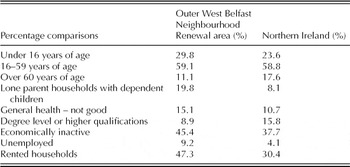
Both Suffolk and Lenadoon estates suffer from significant economic disadvantage. They are part of the Outer West Belfast Neighbourhood Renewal area, defined as the top 10 per cent of deprived neighbourhoods in Northern Ireland.Footnote 1 The key statistics for Outer West Belfast compared with Northern Ireland in general are shown in Table 1.
Outer West Belfast – key statisticsFootnote 2

Community development groups evolved in both areas to tackle social disadvantage and became affiliated to their respective umbrella groups. Lenadoon Community Forum was established in 1992 to co-ordinate the community development needs of some 20 member groups on the estate. Suffolk Community Forum was set up in 1994 ‘to work towards creating a stable, secure and confident community in Suffolk’ (Insight Consulting, 2006: 3). Both forums subsequently moved to co-operate. The spirit of the early joint meetings in 1995/96 was to discuss ‘things we think we have in common, the difficulties between us and how we can be better neighbours’ (O'Halloran and McIntyre, Reference O'Halloran and McIntyre1999: 5). From these early informal meetings, as trust developed, a formally constituted Suffolk and Lenadoon Interface Group (SLIG) was established in 1999. An important aspect of building trust was recognition by SLIG that both communities faced common problems. The British Government reduced and eventually closed community employment schemes (ACE projects) on both sides of the interface; poverty presented itself as a real issue for the two estates; and protocols were established to deal with issues (parades, interface violence) during periods of heightened tensions.
The journey towards greater co-operation between Suffolk and Lenadoon encountered a number of setbacks. Wider political problems (the Drumcree parades, the deaths of the Quinn children in Ballymoney) played out in the form of community interface violence within Suffolk and Lenadoon. There were ongoing problems over disputed land and territory. Catholics in Lenadoon point to an increasing need for social housing and vacant publicly owned land available in Suffolk. Residents in Suffolk however perceive this as ‘their land’ which should only be used to enhance housing or community facilities for Protestants. Community activists involved in SLIG also risked a backlash from within their own communities for moving at a pace on shared working inconsistent with the wishes of the majority of people living in both areas. In an attempt to summarise the evolution of SLIG, researchers involved in interface work in Belfast noted two key points. First, although violence subsided in areas such as West Belfast (and Northern Ireland more generally), this was not tantamount to ‘peace’, rather it emphasised the significant amount of work to be done within communities coming out of years of conflict. Second, joint development that results in real and meaningful inter-community work can be a ‘very slow and frustrating process’ (O'Halloran and McIntyre, Reference O'Halloran and McIntyre1999: 27).
The International Fund for Ireland funded an initial project in 2001 under the auspices of SLIG for youth and community work in both areas for a three-year period. The project, specifically aimed at conflict management, was conceived as a diversionary programme on a single identity/community basis which sought to draw young people away from the interface and direct their energies into activities. The work was crucially important in terms of reducing interface tension and violence. The International Fund for Ireland reinvested for an additional three-year period which enabled SLIG to employ staff and implement cross-community activities. At the same time, a regeneration project on the peace line (Stewartstown Road) was initiated by the Suffolk Community Group which identified a semi-derelict building owned by the Northern Ireland Housing Executive as the basis for a joint project. SLIG jointly applied for funding to create a shared space on the site and developed a mixed use building of 1,000m2 with retail, office and community space. Such was the success of this venue that a second phase has just been completed, including a modern childcare facility attracting parents and toddlers from Suffolk and Lenadoon estates. The residents attribute little of this to support from government in Northern Ireland. As one Lenadoon resident put it:
The civil service gave us no amount of hassle, putting us through endless hoops and obstacles. They openly called our initiative a ‘white elephant’, questioned what was in it for Lenadoon, or Suffolk, and passed the opinion that it wouldn't be used, it would just stand idle. . . I remember after we had applied for further funding to develop the project into its second phase, a representative from the Belfast Regeneration Office said at a meeting: ‘you've cured the interface, so why would you need more funding?’ As if it was some sort of disease to be ‘cured’! (cited in Hall, Reference Hall2007: 28)
In January 2007, as a direct result of ongoing collaborative work, SLIG attracted a major investment of £2m over three years from Atlantic PhilanthropiesFootnote 3 for the implementation of a (joint) SLIG peace-building plan to support community-based reconciliation through the promotion of shared services, facilities and public spaces. Specifically the joint plan comprises four key strands:
(a) Peace-building activities: these include shared pre-school provision, transformation of the controlled (Protestant) Suffolk Primary School into an integrated school, a health and women's development project, cultural initiative, youth activities and sports development schemes.
(b) Joint advocacy: lobbying government agencies on a joint community basis to address the social and economic needs of Suffolk and Lenadoon and the legacy of the conflict.
(c) Building capacity for peace building: through community leadership and widening and deepening the basis of community self-help beyond the established activists which constitute the respective community forums.
(d) Developing shared space: by targeting derelict land and premises which could be reclaimed or refurbished as joint community facilities owned and managed by local people from the two communities.
An important element of the project was to undertake a probability survey of residents in the Suffolk and Lenadoon areas after a two-year period to assess the effectiveness of this grassroots initiative. SLIG commissioned a reputable market survey company (Millward Brown) to conduct the fieldwork and the data set was made available to the author for further analysis beyond reported descriptive statistics. A random location sampling technique was used to ensure that every resident in the specified areas of Suffolk and Lenadoon (those streets closest to the interface) was given an equal chance to participate. In addition, the sample was quota controlled by age to reflect the population of the area. In total 400 questionnaires were completed in November 2008 using a face-to-face methodology (Millward Brown, Reference Millward2008). Weightings were applied to the sample to ensure that it would reflect the proportion of households in the Suffolk and Lenadoon areas. This produced a sample size of 116 from the Suffolk area and 284 from the Lenadoon area.
The findings
Has this community-based bottom–up initiative proved successful and does it offer the potential for a wider civil society model in Northern Ireland peace building? We consider two key questions arising from the empirical work as a means of understanding support for, and early reactions to, peace-building work in two polarised and highly segmented communities suffering from a protracted period of political conflict. Residents were asked:
1. Have you supported peace-building work between the Suffolk and Lenadoon communities?
2. Do you think that the peace-building work between Suffolk and Lenadoon has been effective?
The obviously corollary to these questions is why residents in the two communities thought peace-building work had been effective or ineffective. This question was not asked in the survey on the basis that it demanded more detailed qualitative responses (perhaps using focus groups) or at the very least an open-ended question which, from experience, tends to result in a superficial or non response. Indirectly, by examining those factors which influence or predict respondents’ support for, and perceptions of, effective peace building, we attempt to interrogate their opinions further.
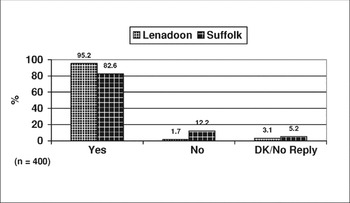
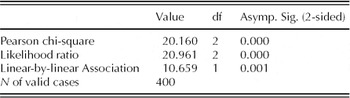
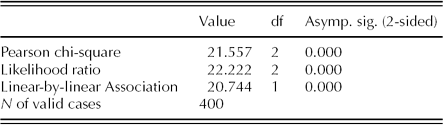
Considering the first question, the results indicate that there is a greater level of support for peace building from Catholic/Lenadoon residents than their Protestant counterparts in Suffolk, although overall support for cross-community work comes from almost 90 per cent of respondents in the survey (see Figure 1). The chi-square tests suggest that there is a significant difference (p < 0.05) between Suffolk and Lenadoon in their support for peace-building work (see Table 2). That said, it is important to acknowledge the overwhelming support in both communities for peace building at 95.2 per cent and 82.6 per cent in Lenadoon and Suffolk, respectively. This clearly demonstrates the appetite for cross-community work in an area previously synonymous with violent conflict.
Have you supported peace-building work?

Chi-square tests

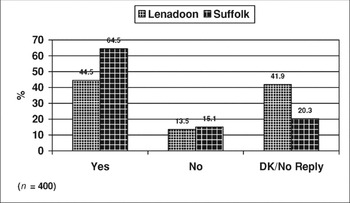
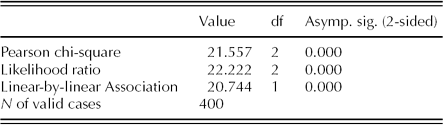
In response to the second question, the results show that despite Lenadoon (Catholic) residents overwhelmingly supporting peace-building work, less than half of them (44.5 per cent) considered it to be effective (see Figure 2). Although a lower percentage of Suffolk residents supported peace building, almost two-thirds (64.5 per cent) felt that it was effective. Overall, just over half the respondents (53.1 per cent) considered cross-community peace-building work to be effective with almost one-third (32.7 per cent) undecided. The chi-square tests suggest a significant difference (p < 0.05) between the views of Lenadoon and Suffolk residents on whether they feel peace building has been effective (see Table 3).
Has peace-building work been effective?

Chi-square tests
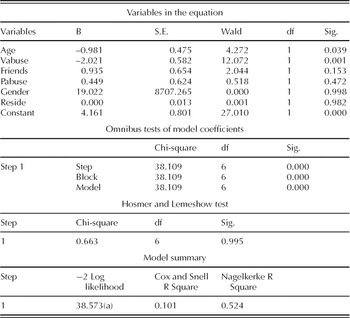
To further understand which factors influence/predict the different views of Lenadoon and Suffolk residents towards peace building we conducted logistic regressions. We were interested in finding out which variables predict the likelihood of (a) residents supporting peace building and (b) whether they see peace-building efforts as effective, respectively? In terms of the former the categorical dependent variable and predictor variables are as follows:
Have you supported peace-building work between Suffolk and Lenadoon communities?
Categorical dependent variable:
Support: Have you supported peace-building work between Suffolk and Lenadoon? (yes/no)
Predictor variables:
Gender: Gender of respondent (male/female)
Age: Age of respondent (in years)
Reside: Are you a Suffolk or Lenadoon resident? (Suffolk/Lenadoon)
Friends: Do you have any friends from the ‘other community’? (yes/no)
Vabuse: Have you ever been verbally abused by a member from the ‘other community’ close to the interface area? (yes/no)
Pabuse: Have you ever been physically abused by a member from the ‘other community’ close to the interface area? (yes/no)
The results are set out in Table 4.
Have you supported peace-building work between Suffolk and Lenadoon?

The omnibus tests of model coefficients show a highly significant value (p<0.0005) and the Hosmer and Lemeshow test supports the conclusion that the model is a good fit (chi square value of 0.663 and p>0.05). The model summary statistics indicate that between 10.1 per cent and 52.4 per cent of the variability in the dependent variable is explained by this set of predictor variables. The Wald test shows that the two variables that contribute significantly to the predictive ability of the model (significance < 0.05) are the age of the respondent (p = 0.039) and whether they have suffered verbal abuse by a member of the other community at the interface area (p = 0.001). The results suggest that younger people (16–25 age group) and those who have suffered verbal abuse at the interface are less likely to support cross-community peace-building work.
Turning to the second question:
Do you think that this peace-building work between Suffolk and Lenadoon has been effective?
Categorical dependent variable:
Effective: Do you think that the peace-building work between Suffolk and Lenadoon has been effective? (yes/no)
Predictor variables:
Gender: Gender of respondent (male/female)
Age: Age of respondent (in years)
Reside: Are you a Suffolk or Lenadoon resident? (Suffolk/Lenadoon)
Friends: Do you have any friends from the ‘other community’? (yes/no)
Vabuse: Have you ever been verbally abused by a member from the ‘other community’ close to the interface area? (yes/no)
Pabuse: Have you ever been physically abused by a member from the ‘other community’ close to the interface area? (yes/no)
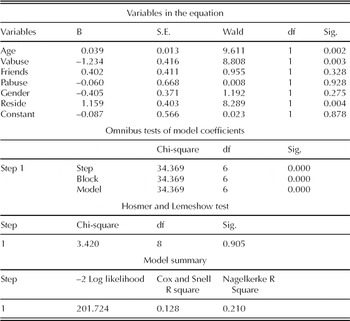
The results are set out in Table 5.
Do you think that the peace-building work between Suffolk and Lenadoon has been effective?

The omnibus tests of model coefficients show a highly significant value (p<0.0005) and the Hosmer and Lemeshow test supports the conclusion that the model is a good fit (chi square value of 3.420 and p>0.05). The model summary statistics indicate that between 12.8 per cent and 21 per cent of the variability in the dependent variable is explained by this set of predictor variables. The Wald test shows that the three variables which contribute significantly to the predictive ability of the model (significance < 0.05) are: the age of the respondent (p = 0.002); whether they have suffered verbal abuse by a member of the other community at the interface area (p = 0.003); and whether they come from Suffolk or Lenadoon (p = 0.004). The results suggest that younger people (16–25 age group) and those who have suffered verbal abuse at the interface are less likely to think that peace-building work has been effective, and residents from Suffolk are more likely to see its effectiveness.
These survey results are clearly located in the behavioural cross-community contact literature, testing interaction across the community divide, and devoid of a structural overlay in the form of public policies to address segregation. Having adopted the mantra of ‘A Shared Future Project in Action’, Suffolk and Lenadoon communities felt abandoned by local politicians who eschewed this policy framework. There is a real sense that macro political ‘solutions’ have yet to deliver social, economic and reconciliation gains at grassroots level and Suffolk and Lenadoon see their destiny in their own hands. In this policy vacuum, communities appear to be ahead of their politicians and some are taking control of, and shaping, their own shared future.
Conclusions
This empirical case study has attempted to understand the dynamics of cross-community interaction and contact at the most acute level of segregation in Northern Ireland – an interface area in West Belfast. In so doing, it has responded to the challenge posed by Shirlow and Murtagh (Reference Shirlow and Murtagh2006: 172) that ‘there is a general failing within academic analysis with regard to misunderstanding the role and designation of peace builders. It is usually assumed that the educated and “rational” will play a significant role in conflict alteration.’ Our findings offer an insight into the response of community groups and interface residents (as opposed to outside agencies) to a joint peace-building plan funded by a philanthropic benefactor. The case study provides a micro analysis of the social transformation process between two polar communities, embittered by the legacy of sectarianism, and interrogates the effectiveness of activities aimed at peace building. What is significant in the findings is that although the majority community in the case study (Catholic Lenadoon) is more supportive of the peace-building work, it is the minority community (Protestant Suffolk) which sees the activities as more effective. Key variables which predict these responses are young people who suffer verbal abuse at interface areas. Those in the age group 16–25 who have suffered verbal abuse at the interface are less likely to support peace-building work and see its effectiveness. This poses specific challenges for future work within highly segregated communities.
In conclusion, the empirical results of this case study of Suffolk and Lenadoon, an extreme example of segregation, would support the need for social transformation initiatives involving civil society, set alongside progress at the macro political level. This micro analysis provides evidence of the success of social transformation in a public policy vacuum, but also highlights the need for local politicians to embrace a broader social justice agenda to reinforce the expressed wishes of communities to share rather than consolidate separation. Consociationalism and social transformation are not mutually exclusive but rather jointly supportive. There are some encouraging signs of connection. DUP Minister of Finance and party stalwart, Sammy Wilson, recently visited a cross-community interface project in North Belfast (Alexandra Park) and commented that ‘people are challenging some of the root causes of sectarianism and in doing so improving the quality of life for themselves and future generations’ (Wilson, Reference Wilson2009: 2). This comment is from a minister in the devolved power-sharing Executive who recognises the work of cross-community groups at local level.
A key variable in the success of inter-community work is the involvement of young people and the quality of contact between them. This study also challenges the assumption that Protestant interface residents are ‘lukewarm’ on the effectiveness of peace-building work. The Northern Ireland Executive is currently considering a replacement policy for A Shared Future in which it aims to increase investment over the next three years to promote cohesion, sharing and integration from £21.7m currently to £28.7m (Office of the First Minister and Deputy First Minister, 2008). Thus far, there has been a reluctance by the two main power-sharing parties (DUP and Sinn Féin) to prioritise social transformation, presumably because it could weaken the sectarian bases from which they draw their own political support – indeed the two largest parties have issued separate draft versions of the proposed policy on Cohesion, Sharing and Integration. More recently there was a partisan response to reviving the Civic Forum (representing business, trade union and voluntary sectors) which was originally set up under the Belfast (Good Friday) Agreement as a consultative mechanism on social, economic and cultural issues but was mothballed during the suspension of devolution. With adequate resources and jointly agreed peace-building goals, the Suffolk and Lenadoon communities have shown that they are capable of managing their own preferred destiny towards a more cohesive, integrated and shared society. Civil society in Northern Ireland can play a key role in bottom–up peace building by tackling the worst excesses of a deeply segregated society in a post-conflict era.
Acknowledgements
The author wishes to acknowledge the valuable inputs provided by members of the Suffolk and Lenadoon Interface Group to this paper. All views expressed, errors and omissions remain the responsibility of the author.