


INTRODUCTION
Paris – May 1968. I had been in the city for 2 months, studying French at Alliance Française until it was closed and chained up. A friend and I had witnessed fires in the street, the tearing up of cobblestones to make barricades, burned-out cars, the seizure of L’Odéon, and the sealing off of the Sorbonne by a line of police. Then, one day walking down the St Michel, we noticed another demonstration. At a busy crossroad, people were milling around, holding posters and placards, shouting and blowing whistles, but then the police appeared, carrying their batons, their Romanesque shields, and helmets. They charged southwards along the St Michel, and we found ourselves in the middle of a street battle beneath the blossoming Parisian trees. I pulled out my Yashica-Mat and photographed a policeman as he pulled his truncheon back behind his head, about to smash it down on a young man holding his arms limply in self-defence. People were running, some with head in hands. After taking my shot, I was confronted by a red-faced gendarme, screaming at me to hand over the camera, and gesticulating towards a black police van which, in my memory, was located to my right [or is that a confabulation?]. I knew perfectly well what he was saying but I just kept repeating in English: “I’m English. I don’t understand.” Eventually, he let me go. As I resumed my walk briskly towards Montparnasse, I experienced tingles of relief, as I left the shouting and screaming behind me.
Such is an autobiographical memory in all its vividness, conviction, and yet uncertainty. This particular memory comes from my autobiographical memory or reminiscence ‘bump’ (Rubin & Schulkind, Reference Rubin and Schulkind1997), to which we will return. In this paper, I will discuss certain ‘anomalies’ or disorders, arising in autobiographical memory, which have interested me over the years. These are (i) retrograde amnesia (RA); (ii) spontaneous confabulation; and (iii) psychogenic amnesia.
RETROGRADE AMNESIA
The Temporal Gradient
Across the years, there has been considerable controversy concerning the existence of a temporal gradient in amnesia, that is, relative sparing of early memories. In Diseases of Memory, Ribot (Reference Ribot1882) postulated: “The progressive destruction of memory follows a logical order – a law … it begins with the most recent recollections which, being … rarely repeated and … having no permanent associations, represent organisation in its feeblest form.”
In the first modern empirical study, Sanders and Warrington (Reference Sanders and Warrington1971) did not obtain a temporal gradient on Famous Faces or Famous Events tests. While others replicated this (e.g., Cipolotti et al., Reference Cipolotti, Shallice, Chan, Fox, Scahill, Harrison, Stevens and Rudge2001; Rosenbaum, Gilboa, Levine, Winocur, & Moscovitch, Reference Rosenbaum, Gilboa, Levine, Winocur and Moscovitch2009; Viskontas, McAndrews, & Moscovitch, Reference Viskontas, McAndrews and Moscovitch2000), there have also been many reports of temporal gradients (e.g., Bayley, Gold, Hopkins, & Squire, Reference Bayley, Gold, Hopkins and Squire2005; Butters & Cermak, Reference Butters and Cermak1980, Reference Butters, Cermak and Rubin1986; Kirwan, Bayley, Galván, & Squire, Reference Kirwan, Bayley, Galván and Squire2008; Manns, Hopkins, Reed, Kitchener, & Squire, Reference Manns, Hopkins, Reed, Kitchener and Squire2003; Marslen-Wilson & Teuber, Reference Marslen-Wilson and Teuber1975). In my own studies, there was a steep gradient in Korsakoff patients (Kopelman, Reference Kopelman1989; Rensen et al., Reference Rensen, Kessels, Migo, Wester, Eling and Kopelman2017) and a gentler gradient in patients with Alzheimer dementia or temporal lobe damage (Kopelman, Reference Kopelman1989; Kopelman, Stanhope, & Kingsley, Reference Kopelman, Stanhope and Kingsley1999).
Case A (Kopelman, Reference Kopelman1995) was a Korsakoff patient, aged 55, who consumed two and a half bottles of wine per day for 20 years and, more recently, three-fourths of a bottle of gin plus half a bottle of wine per day for 7 years until her admission. Her General Practitioner had observed Wernicke’s syndrome (ophthalmoplegia, nystagmus, ataxia, and confusion), peripheral neuropathy, and pronounced confabulation. Following thiamine administration, the ophthalmoplegia and confabulation resolved, but she was left with a dense Korsakoff syndrome. Full Scale Intelligence Quotient was 115 with normal performance on verbal fluency and card-sorting tests, but scores on anterograde memory tests were 2–3 standard deviations below population means. On retrograde tests, she showed relative sparing of early memories. For example, she was able to describe how she had won a tennis cup at 15, beating ‘Gorgeous Gussie’, and how, after the prize-giving, her father made a derogatory comment about her maths. On the other hand, she gave only a very fragmentary account of her recent life, and was unable to recognise the author from visit to visit.
Bright et al. (Reference Bright, Buckman, Fradera, Yoshimasu, Colchester and Kopelman2006) found that patients with focal medial temporal lobe pathology (including three cases with focal hippocampal atrophy) showed a fairly steep temporal gradient, but patients with more extensive temporal lobe damage exhibited a ‘flatter’ gradient (compare Lah & Miller, Reference Lah and Miller2008). In general, the steepness of the gradient may reflect the severity of amnesia, and the extent of pathology beyond the medial temporal lobes, as in this example:
Case B (Kopelman & Morton, Reference Kopelman and Morton2015), a professional actor of international reputation, suffered a cardiac arrest at 66 years of age at a public meeting. Resuscitated by police and ambulance men, he was recorded as having 5-min ‘down time’. Initially, he was severely amnesic, disorientated, and confabulating. After approximately 6 weeks, he started recognising his family consistently. His confusion and confabulation gradually subsided, but his amnesia persisted. He forgot conversations within minutes. He was completely unaware of his heart attack and cardiac arrest, despite having been told about this frequently. He recalled virtually no autobiographical memories, even after prompting, and showed a ‘flat’ gradient for famous faces.
Theories of RA and the Temporal Gradient
RA occurs across autobiographical, personal semantic, and remote semantic memory; and recent studies have investigated the components of personal semantic memory (Grilli, Reference Grilli2017; Grilli & Verfaellie, Reference Grilli and Verfaellie2014). There have been three main theories of RA: (i) Consolidation theory states that there is consolidation of memories, and associated structural reallocation, such that memories eventually become independent of the hippocampi or medial temporal lobes, and thereby spared from the effects of medial temporal damage (Alvarez & Squire, Reference Alvarez and Squire1994; Milner, Reference Milner, Whitty and Zangwill1966). (ii) Episodic-to-semantic shift theory or ‘semanticisation’ (Cermak, Reference Cermak, Squire and Butters1984) states that episodic memories acquire a more semantic form as they become older, thereby protecting them against the effects of brain damage. Similarly, memory transformation theory (Winocur & Moscovitch, Reference Winocur and Moscovitch2011) argues that memories are transformed from an episodic to a gist-like (semantic) form; this theory is embedded within Multiple Trace Theory. (iii) Multiple trace theory (Nadel & Moscovitch, Reference Nadel and Moscovitch1997) states that the hippocampi (or medial temporal lobes) are always involved in the storage, retrieval, and reactivation of episodic memories. Sparing of early episodic memories is related to the number of traces which have been laid down. Semanticised memories are stored more widely within the neocortex, and show a steeper temporal gradient. This theory has the great virtue of postulating very specific predictions: (a) The degree of hippocampal damage should predict the severity of RA in episodic memory, and (b) extensive hippocampal damage should result in a ‘flat’ gradient in episodic memories and a steeper gradient in semantic (and personal semantic) memories.
There are unresolved issues with each of these theories. First, the notion of consolidation is problematical (Dewar, Cowan, & Della Sala, Reference Dewar, Cowan and Della Sala2007), and breaking it down into component processes (Dudai, Reference Dudai2004) does not resolve this. In RA, the critical question is how long does consolidation last (years or decades?), and what independent markers indicate its occurrence, beyond the temporal gradient itself? Dudai (Reference Dudai2012) argued that consolidation is a continuing and evolving process, whereas Bonnici and Maguire (Reference Bonnici and Maguire2018) have indicated that it may be completed within 2 years. Interestingly, this latter view is consistent with findings from some traumatic head injury and electroconvulsive therapy studies, suggesting that the severity of a ‘short’ RA (less than 2 years) should correlate with that of anterograde amnesia, whereas a more extensive RA will not (Kapur, Reference Kapur1999; Kopelman, Reference Kopelman, Goldenberg and Miller2008; Russell & Nathan, Reference Russell and Nathan1946; Squire, Cohen, & Nadel, Reference Squire, Cohen, Nadel, Weingartner and Parker1984).
Secondly, semanticisation/memory transformation theory does not make its predictions entirely clear. The conventional wisdom is that there is a ‘flat’ gradient across all time periods in amnesic patients’ episodic memory, and a steeper gradient in patients’ (personal) semantic memory (see Figure 1a and caption). However, if people’s episodic memories become progressively semanticised through time, it follows that controls’ episodic memory curves might show a recency effect and their personal semantic memories a gradient in the opposite direction, reflecting this episodic-to-semantic shift (Figure 1b), and one possibility is that the curves would actually cross over. (Indeed, if all memories became semanticised, controls might not show any episodic recall at all for early, childhood time periods). In amnesic patients, Figure 1b postulates a downward shift of both curves, but they remain in parallel with those of healthy controls. However, Winocur and Moscovitch (Reference Winocur and Moscovitch2011) stated that (i) “The transformation hypothesis is explicit in proposing that the progression of memories from hippocampal to extra-hippocampal structures necessarily entails a loss of detailed, contextual features,” and also (ii) “Importantly, the transformed memory need not replace the initial more detailed memory, but can co-exist and interact with it as the situation demands [my italics].” But, this seems to me to leave open and under-specified the question of when, which, and to what degree, memories are ‘transformed’.
This shows a ‘flat’ gradient in episodic autobiographical memory and a steeper temporal gradient in semantic memory in amnesic patients, relative to healthy control participants, as commonly predicated. However, the relative position of the patients’ two curves along the Y-axis is not specified by theory: the patients’ episodic curve might be lower or higher along the Y-axis, according to the severity of their episodic memory disorder – as indicated by the small arrow to the left of the Y-axis. (b) What might be expected if episodic memories become ‘semanticised’ through time: if healthy people’s episodic memories became progressively semanticised, controls’ episodic memory curves would show a recency effect, and their personal semantic memories would have a gradient in the opposite direction, reflecting this episodic-to-semantic shift (see upper curves). (One possibility, depending on the relative height of the two curves along the Y-axis [see small arrow to its left], is that the curves would actually cross over). In amnesic patients, a downward shift of both curves is postulated and shown with the curves remaining in parallel with those of healthy controls, such that there remains a recency effect in episodic memory and a temporal gradient in (personal) semantic memory (see lower curves). (If all episodic memories were to become semanticised in normal participants, the faint dotted line might be predicted.)

With respect to Multiple Trace Theory itself, the critical question is whether the specific predictions work. Does the severity of episodic RA correlate with the degree of hippocampal atrophy? Fujii, Moscovitch and Nadel (Reference Fujii, Moscovitch, Nadel and Cermak2000) argued that it was the damage in the ‘hippocampal complex’ (effectively, the medial temporal lobes) which was critical for RA in humans, whereas Winocur and Moscovitch (Reference Winocur and Moscovitch2011) emphasised the ‘hippocampus proper’ (compare Race, Keane, & Verfaellie, Reference Race, Keane and Verfaellie2011). The study most commonly cited in this connection is that by Rosenbaum et al. (Reference Rosenbaum, Moscovitch, Foster, Schnyer, Gao, Kovacevic, Verfaellie, Black and Levine2008), which included only five patients and their findings varied according to which analysis was examined. Kopelman et al. (Reference Kopelman, Lasserson, Kingsley, Bello, Rush, Stanhope, Stevens, Goodman, Buckman, Heilpern, Kendall and Colchester2003) investigated this issue in 40 patients with focal brain lesions, examining correlations with regional volumes across the cerebral cortex. In patients with diencephalic or frontal pathology, the correlation between autobiographical recall and total frontal brain volume was r = .60. Multiple regression based on frontal, thalamic, and medial temporal magnetic resonance imaging (MRI) volumes accounted for 60% of the variance in autobiographical memory recall. Across all 40 patients, the correlation with medial temporal volume was r = .42, p < .05; and in 14 patients whose primary pathology was in the medial temporal lobes (or ‘hippocampal complex’, see p. 880 of that paper), it was only r = .28 and not significant. Other investigators have also found that the degree of autobiographical episodic impairment is not closely correlated with the severity of hippocampal atrophy (Serra et al., Reference Serra, Bozzali, Fadda, De Simone, Bruschini, Perri, Caltagirone and Carlesimo2018; Tomadesso et al., Reference Tomadesso, Perrotin, Mutlu, Mézenge, Landeau, Egret, de la Sayette, Jonin, Eustache, Desgranges and Chételat2015). In a recent review, Sekeres, Winocur, and Moscovitch (Reference Sekeres, Winocur and Moscovitch2018) concluded the same, but postulated specialisation in subfields along the long axis of the hippocampi. Many recent studies indicate widespread cortical activations during autobiographical memory retrieval (Svoboda, McKinnon, & Levine, Reference Svoboda, McKinnon and Levine2006) or postulate important interactions between cortical and medial temporal regions in autobiographical retrieval (Bonnici & Maguire, Reference Bonnici and Maguire2018; Ghosh, Moscovitch, Colella, & Gilboa, Reference Ghosh, Moscovitch, Colella and Gilboa2014; Irish et al. Reference Irish, Landin-Romero, Mothakunnel, Ramanan, Hsieh, Hodges and Piguet2018; McCormick, St-Laurent, Ty, Valiante, & McAndrews, Reference McCormick, St-Laurent, Ty, Valiante and McAndrews2015; McCormick, Ciaramelli, De Luca, & Maguire, Reference McCormick, Ciaramelli, De Luca and Maguire2018; Moscovitch, Cabeza, Winocur, & Nadel, Reference Moscovitch, Cabeza, Winocur and Nadel2016; Simons & Spiers, Reference Simons and Spiers2003; Verfaellie & Keane, Reference Verfaellie and Keane2017).
Multiple Trace Theory also predicted that there should be a steeper gradient in semantic than episodic remote memory. In my own Neuropsychiatry and Memory Disorders clinic, some patients do indeed manifest such a pattern. However, many patients show a consistent pattern across episodic, personal semantic, and remote semantic memory tasks (Figure 2, upper row). Moreover, some patients actually show the opposite pattern with a steeper gradient on remote episodic than remote semantic memory tasks, a pattern reported in studies by Greene, Hodges, and Baddeley (Reference Greene, Hodges and Baddeley1995) and Kopelman et al. (Reference Kopelman, Bright, Fulker, Hinton, Morrison and Verfaellie2009).
Upper row shows a steep temporal gradient in Korsakoff patients and a gentler temporal gradient in Alzheimer patients, consistent across the recall of autobiographical episodes or incidents, personal semantic facts, and famous news events. Upper and lower rows, circles show evidence of a preserved reminiscence ‘bump’ in autobiographical recall in patients with neurological memory disorders across various studies. Reproduced and modified with permissions from Kopelman (Reference Kopelman1989), Neuropsychologia, 27, 437–460; Piolino et al. (Reference Piolino, Desgranges, Belliard, Matuszewski, Lalevee, De la Sayette and Eustache2003), Brain, 126, 2203–2219; Moss et al. (Reference Moss, Kopelman, Cappelletti, De Mornay Davies and Jaldow2003), Cognitive Neuropsychology, 20, 703–732; Irish et al. (Reference Irish, Lawlor, O’Mara and Coen2011), Cortex, 47, 236–249.

A Retrieval Deficit in Retrograde Amnesia?
On the basis of ‘flat’ temporal gradients, Sanders and Warrington (Reference Sanders and Warrington1971) argued for a retrieval deficit in RA, although Weiskrantz (Reference Weiskrantz, Weinberger, McGaugh and Lynch1985) later pointed out that a temporal gradient does not exclude a retrieval deficit. A number of findings lend support to, or are consistent with, an important retrieval component in RA: (i) on some tasks, recognition/recall or cued/uncued differences can be found in patient groups, consistent with a retrieval deficit (Kopelman, Reference Kopelman1989; Kopelman et al., Reference Kopelman, Stanhope and Kingsley1999; Parkin, Montaldi, Leng, & Hunkin, Reference Parkin, Montaldi, Leng and Hunkin1990). (ii) Low correlations between the severity of RA, when ‘extensive’ backwards in time (more than 2 years), and scores on tests of anterograde amnesia (Kopelman, Reference Kopelman1989; Shimamura & Squire, Reference Shimamura and Squire1986). (iii) Much higher correlations between the severity of RA and performance on executive function tests, or between RA and frontal lobe pathology (Della Sala, Laiacona, Spinnler, & Trivelli, Reference Della Sala, Laiacona, Spinnler and Trivelli1993; D’Esposito, Alexander, Fischer, McGlinchey-Berroth, & O’Connor, Reference D’Esposito, Alexander, Fischer, McGlinchey-Berroth and O’Connor1996; Kopelman, Reference Kopelman1991; Kopelman et al., Reference Kopelman, Lasserson, Kingsley, Bello, Rush, Stanhope, Stevens, Goodman, Buckman, Heilpern, Kendall and Colchester2003). (iv) In addition, frontal activations have virtually always been found on functional magnetic resonance imaging (fMRI) investigations of remote memory (e.g., Maguire, Reference Maguire2001). (v) There is increasing emphasis on the importance of ventromedial frontal/hippocampal interactions (Bonnici & Maguire, Reference Bonnici and Maguire2018; Ghosh et al., Reference Ghosh, Moscovitch, Colella and Gilboa2014; Simons & Spiers, Reference Simons and Spiers2003; Tse et al., Reference Tse, Langston, Kakeyama, Bethus, Spooner, Wood, Witter and Morris2007). In particular, Maguire and colleagues (Barry and Maguire, Reference Barry and Maguire2019; McCormick et al., Reference McCormick, Ciaramelli, De Luca and Maguire2018) have recently argued that the hippocampus plays a time-limited role in consolidation, and then interacts with the ventromedial prefrontal cortex in the (re-)construction of scenarios. (vi) Other factors, such as mental imagery, emotion, and the laterality of the lesion, may influence such retrieval processes (Ahmed et al., Reference Ahmed, Irish, Loane, Baker, Husain, Thompson, Blanco-Duque, Mackay, Zamboni, Foxe, Hodges, Piguet and Butler2018; Buccione, Fadda, Serra, Caltagirone, & Carlesimo, Reference Buccione, Fadda, Serra, Caltagirone and Carlesimo2008; Greenberg & Knowlton, Reference Greenberg and Knowlton2014; Holland & Kensinger, Reference Holland and Kensinger2010).
The Temporal Gradient: A Hypothesis
There may also be age-of-onset effects in amnesia (Grilli, Wank, & Verfaellie, Reference Grilli, Wank and Verfaellie2018). Kopelman, Wilson, and Baddeley (Reference Kopelman, Wilson and Baddeley1989) found that older, but not younger, patients showed a steep gradient, arguing that: “Older subjects (but not the younger) encode or consolidate new [recent] memories in a way that somehow makes them more vulnerable to the effects of brain damage than our earlier memories.” Subsequently, Kopelman (Reference Kopelman, Goldenberg and Miller2008) put this the other way around: “The specific manner in which memories are encoded in earlier life protects those early memories – particularly autobiographical memories – from the effects of subsequent brain damage, giving rise to a temporal gradient in retrograde memory loss.” It was also suggested that one factor underlying this might be the reminiscence bump (Rubin & Schulkind, Reference Rubin and Schulkind1997). Subsequently, somewhat similar propositions have been made by Irish, Lawlor, O’Mara, and Coen (Reference Irish, Lawlor, O’Mara and Coen2011), Morris and Mograbi (Reference Morris and Mograbi2013), and Kirk and Berntsen (Reference Kirk and Berntsen2018).
There is neuropsychological evidence consistent with this view. Fromholt and Larsen (Reference Fromholt and Larsen1991) and Fromholt et al. (Reference Fromholt, Mortensen, Torpdahl, Bender, Larsen and Rubin2003) asked participants to give a narrative of their life histories, a procedure reflecting people’s bias to recall from particular decades. In terms of both the number, and (more particularly) the proportion, of memories recalled across decades, they found preserved reminiscence ‘bumps’ in participants with dementia or depression and people older than 100. Figure 2 (upper and lower rows) shows that a preserved ‘bump’ in autobiographical memory was visible in some other studies of memory-disordered patients (Irish et al., Reference Irish, Lawlor, O’Mara and Coen2011; Kopelman, Reference Kopelman1989; Moss, Kopelman, Cappelletti, De Mornay Davies, & Jaldow, Reference Moss, Kopelman, Cappelletti, De Mornay Davies and Jaldow2003; Piolino et al., Reference Piolino, Desgranges, Belliard, Matuszewski, Lalevee, De la Sayette and Eustache2003). In each case, the findings suggested relative preservation in recollecting autobiographical memories from ‘early adult’ life (between 18 and 35 years across the various studies). Why a bump emerges at these ages remains unclear: various hypotheses were postulated and then rejected by Rubin and Schulkind (Reference Rubin and Schulkind1997). A possibility is that it relates to identity formation and the emergence of self-concepts (Rathbone, Moulin, & Conway, Reference Rathbone, Moulin and Conway2008). The pertinent point here is that the bump results from factors at encoding, and is partially protective against later (‘frontal’) retrieval deficits.
Summary
There are still unresolved issues in RA, which is what makes the topic so challenging and interesting. In particular, it is unclear how long a process of ‘consolidation’ lasts. There is a relatively low correlation between the severity of RA and the degree of hippocampal atrophy. The slopes of the curves can vary across the episodic, personal semantic, and semantic components of RA: it is not the case that the temporal gradient is always steeper in semantic than episodic memory. Multiple cortical regions (including frontal, ventromedial frontal, and lateral temporal) can contribute to autobiographical retrieval and RA; and the interactions between these regions and medial temporal activations/pathology are currently being explored. My own proposition is that RA may result from a retrieval deficit and that the temporal gradient (when it occurs) is secondary to an age effect at encoding, reflecting (in turn) the autobiographical or reminiscence ‘bump’. Footnote 1
CONFABULATION
Types of Confabulation
Confabulation can be defined as false or erroneous memories arising unintentionally in the context of a neurological amnesia. The memories may be false in themselves or ‘real’ memories jumbled up and confused in temporal context, and thereby retrieved inappropriately.
Case C (Kopelman, Reference Kopelman2010), aged 61 years, was found collapsed on a pavement, confused, and disorientated with pronounced nystagmus. He was very ataxic, and could stand only with support. He admitted to consuming a bottle of whisky a day. He was ‘stuck’ in the 1970s or early 1980s, thinking that Margaret Thatcher was the Prime Minister and Richard Nixon, the President of the United States. He confabulated in episodic memory, thinking that he had recently taken a girlfriend to his parents and describing experiences in the Air Force (which occurred in the 1970s) as if very recent. He also confabulated in personal semantic memory, stating that his brother was living in Canada, when in fact he was visiting every week.
Case D (Kopelman, Ng, & Van Den Brouke, Reference Kopelman, Ng and Van Den Brouke1997) was a senior nurse admitted with Wernicke’s encephalopathy and a half-empty bottle of vodka in her handbag. Even after high-dose multivitamins, she continued to confabulate floridly, and later cancer was diagnosed. In episodic memory, she confabulated that her parents were visiting regularly, when they had been dead for 20 and 4 years, respectively. She talked as if she were employed in our hospital, but she worked elsewhere. She stated that her brother was a doctor living on the 22nd floor, when her ward was on the top floor (the 12th floor). In semantic memory, she confabulated that Stanley Baldwin was the Prime Minister and that Robert Maxwell (the newspaper proprietor) had been shot [he drowned].
Following earlier work by Berlyne (Reference Berlyne1972) and others, Kopelman (Reference Kopelman1987) distinguished between two types of confabulation: (i) spontaneous confabulation, consisting of persistent and unprovoked outpourings of erroneous memories, and (ii) momentary or provoked confabulation, entailing fleeting intrusion errors or distortions in response to a challenge to memory. Spontaneous confabulation was postulated as pathological, resulting from disease, whereas momentary confabulation was regarded as a ‘normal’ process, to which we are all liable when memory is ‘weak’. Coltheart (Reference Coltheart2017) has postulated two types of provoked confabulation; and Schnider (Reference Schnider2017) distinguished between four types of confabulation, a central notion being that spontaneous confabulation is defined by a patient acting upon his/her erroneous memories.
There is considerable evidence that spontaneous confabulation results from damage to the frontal lobes (Baddeley & Wilson, Reference Baddeley, Wilson and Rubin1986; Kapur & Coughlan, Reference Kapur and Coughlan1980; Luria, Reference Luria1976; Stuss, Alexander, Lieberman, & Levine, Reference Stuss, Alexander, Lieberman and Levine1978). More recent investigations have pinpointed the critical pathology to specific regions in the ventromedial frontal and/or orbitofrontal regions (Gilboa et al., Reference Gilboa, Alain, Stuss, Melo, Miller and Moscovitch2006; Nahum, Bouzerda-Wahlen, Guggisberg, Ptak, & Schnider, Reference Nahum, Bouzerda-Wahlen, Guggisberg, Ptak and Schnider2012; Toosy et al., Reference Toosy, Burbridge, Pitkanen, Loyal, Akanuma, Laing, Kopelman and Andrews2008; Turner, Cipolotti, Yousry, & Shallice, Reference Turner, Cipolotti, Yousry and Shallice2008), perhaps acting as a ‘filter’ mechanism, although lesions outside these regions have also been implicated (Bajo, Fleminger, Metcalfe, & Kopelman, Reference Bajo, Fleminger, Metcalfe and Kopelman2017; Dalla Barba, Brazzarola, Marangoni, Barbera, & Zannoni, Reference Dalla Barba, Brazzarola, Marangoni, Barbera and Zannoni2017; Turner et al., Reference Turner, Cipolotti, Yousry and Shallice2008).
Theories of Confabulation
Five theories of confabulation will be briefly reviewed here: (i) temporal context confusions (TCCs); (ii) temporal consciousness (TC) as intact but malfunctioning; (iii) trace specification/verification theories; (iv) motivational accounts; and (v) multifactorial theories.
(i) Korsakoff (Reference Korsakoff1889) gave a TCC account of confabulation, writing of a confusion of “old recollections with present impressions.” For example, “in telling of something about the past, the patient would suddenly confuse events and would introduce the events related to one period into the story about another period ….” He gave the example of a patient who, in describing her voyage to Finland before her illness in fair detail, mixed into her account her recollections of another trip to the Crimea: “So it turned out that, in Finland, people always eat lamb and the inhabitants are Tartars.” The temporal context memory confusion account of confabulation was favoured by a number of clinically orientated writers (Moll, Reference Moll1915; Talland, Reference Talland1965; Victor, Adams, & Collins, Reference Victor, Adams and Collins1971).
To test this idea, Schnider, von Däniken, and Gutbrod (Reference Schnider, von Däniken and Gutbrod1996) conducted an experiment which included two ‘runs’ of a continuous recognition task. In the first run, some items (targets) recurred and participants were required to identify when this occurred, and some (distractors) were presented only once. In the second run (40 min later), some of the previous distractors became targets, and the previous targets became distractors, and participants were required to identify items previously seen in this run only. This design provoked an abnormal rate of false positive responses (TCC) by confabulators in the second ‘run’, differentiating them from non-confabulating amnesic patients and healthy controls.
(ii) Dalla Barba, Cappelletti, Signorini, and Denes (Reference Dalla Barba, Cappelletti, Signorini and Denes1997), Dalla Barba et al. (Reference Dalla Barba, Brazzarola, Marangoni, Barbera and Zannoni2017) have adopted a different view: confabulating patients tend to retrieve those episodic memories which are strongest and most stable, whether appropriate or inappropriate. In this account, TC is distinguished from knowledge consciousness. TC allows individuals to have the phenomenological experience of remembering their personal past, of being oriented in the present, and of predicting their personal future (Dalla Barba & La Corte, Reference Dalla Barba and La Corte2015). In confabulation, TC interacts only with the more stable event-related modifications within the brain, such that repeated events, habits, and over-learned information are treated as unique events and form the content of confabulation, which is usually plausible and indistinguishable from ‘real’ memories. In consequence, when asked what they have done the day before, confabulators commonly report activities from their life before the illness. A taxonomy suggested that many confabulations arise from ‘habit’ (32–41%), but that misplacements in time and place, fabrications, confusions, self-referential contaminations, and semantically anomalous (‘bizarre’) confabulations also occur (La Corte, Serra, Attall, Boisse, & Dalla Barba, Reference La Corte, Serra, Boissé and Dalla Barba2010). In support of their theory, Dalla Barba and colleagues have shown a high rate of intrusion errors in prose recall of anomalous/modified fables, compared with recall of unmodified fables or prose in elderly and Alzheimer participants, a finding accentuated by dividing attention at encoding (Dalla Barba, Attali, & La Corte, Reference Dalla Barba, Attali and La Corte2010; De Anna et al., Reference De Anna, Attali, Freynet, Foubert, Laurent, Dubois and Dalla Barba2008; Attali, De Anna, Dubois, & Dalla Barba, Reference Attali, De Anna, Dubois and Dalla Barba2009). Importantly, this theory assumes that the hippocampus is at least partially functioning, and Dalla Barba et al. (Reference Dalla Barba, Brazzarola, Marangoni, Barbera and Zannoni2017) have also shown that, in the chronic stages, confabulations commonly persist through time.
(iii) The trace specification/verification approach was exemplified in Burgess and Shallice’s (Reference Burgess and Shallice1996) theory. They argued that memory retrieval requires (i) strategic control which, if defective, gives rise to implausible or fantastic responses; (ii) specification of the memory trace which, if impaired, gives rise to inappropriate retrieval; and (iii) the editing out of errors. Somewhat similarly, Moscovitch and Melo (Reference Moscovitch and Melo1997) suggested that impaired strategic search, faulty cue-retrieval, and defective monitoring are the bases of confabulation; and Schacter et al. (Reference Schacter, Norman and Koutstaal1998) postulated impairments in focused description, retrieval, and/or post-retrieval monitoring. Gilboa et al. (Reference Gilboa, Alain, Stuss, Melo, Miller and Moscovitch2006) placed emphasis upon strategic retrieval and the pre-conscious, post-retrieval monitoring of responses, giving rise to ‘a feeling of rightness’: deficits in these processes resulted in confabulation.
(iv) Motivational accounts have emphasised that autobiographical confabulations involved the inappropriate retrieval of pleasant experiences and positive self-representations (Conway & Tacchi, Reference Conway and Tacchi1996; Fotopoulou, Conway, Solms, Tyrer, & Kopelman, Reference Fotopoulou, Conway, Solms, Tyrer and Kopelman2008; Fotopoulou, Solms, & Turnbull, Reference Fotopoulou, Solms and Turnbull2004; Turnbull & Salas, Reference Turnbull and Salas2017). This was very well illustrated in Conway and Tacchi’s (Reference Conway and Tacchi1996) case description: “The explanations derived from the confabulations make more bearable the largely indifferent attitude of her relatives. This coupled with her glowing views of lengthy time-periods from her remote past, transforms the present into a time of harmony and comfort rather than discord and distress. She is aware that people do not now engage her in conversation. … [Her] confabulations rewrite her personal history so that both the remote and recent past provide support for her in a difficult period … Her often repeated statement, when referring to some past period, that she had ‘wonderful friends’ attests to this. … Negative events … can be recast in a better light by the beliefs emanating from her confabulated memories.” However, other studies only partially supported this view, some confabulated memories being strongly affective, but distinctly unpleasant in character (Bajo, Fleminger, & Kopelman, Reference Bajo, Fleminger and Kopelman2010; Metcalf, Langdon, & Coltheart, Reference Metcalf, Langdon and Coltheart2010).
(v) Multifactorial accounts have emphasised the interaction of several factors. For example, Metcalf, Langdon, and Coltheart (Reference Metcalf, Langdon and Coltheart2007) postulated an executive retrieval deficit, a personal bias to the content of confabulation, and an evaluation deficit. Kopelman et al. (Reference Kopelman, Ng and Van Den Brouke1997) argued that spontaneous confabulation can occur across episodic, personal semantic, and semantic memory, and that differing mechanisms might underlie confabulations within these various domains. For example, within episodic memory, TCCs were particularly common, whereas in semantic memory, confabulation frequently involved inappropriate perseverations. Johnson, O’Connor, and Cantor (Reference Johnson, O’Connor and Cantor1997) described a patient, whose confabulation was attributed to a vivid imagination, an inability to retrieve autobiographical memories systematically, and an ‘executive’ deficit in source monitoring.
Empirical Investigation
In a recent study, Bajo et al. (Reference Bajo, Fleminger, Metcalfe and Kopelman2017) investigated which factors were particularly associated with the occurrence and subsequent resolution of spontaneous confabulations. They examined TCCs, affective factors, lack of insight, and memory and executive performance. There were 24 confabulating brain-injured patients, seen at a mean of 6.1 months (±3.7) after their brain injury, and then again 3 and 9 months later.
On Schnider’s TCC test, 17 out of 24 confabulators performed above cut-off, as predicted, but 7 scored below cut-off (Bajo et al., Reference Bajo, Fleminger, Metcalfe and Kopelman2017). Nonconfabulating brain-injured patients scored either side of the cut-off (compare Gilboa et al., Reference Gilboa, Alain, Stuss, Melo, Miller and Moscovitch2006). Moreover, on Dalla Barba’s (Reference Dalla Barba1993) Confabulation Battery, although there was a near-significant correlation between TCC and total confabulations, the correlation between TCC and episodic memory confabulations was close to zero. Poor autobiographical memory and story recall, and high error counts on cognitive estimates and the Hayling test, correlated significantly with the frequency of total and episodic memory confabulations (see Table 1a). A stepwise regression, based on such measures, predicted 49% of the variance in total confabulations.
Correlates of initial severity and subsequent decline in confabulation (over 9 months).

n.s. = non-significant.
When these patients were followed up over 9 months, there was a decline in total and episodic confabulations, although a few confabulations still persisted at 9 months (compare Dalla Barba et al., Reference Dalla Barba, Brazzarola, Marangoni, Barbera and Zannoni2017). Bajo et al. (Reference Bajo, Fleminger, Metcalfe and Kopelman2017) found that this change in confabulations did not correlate with the change in TCC, mood state, or insight scores. The changes in autobiographical memory scores, story recall and, in particular, changes in error counts on cognitive estimates correlated with the decline in confabulations (Table 1b). A stepwise regression, based on autobiographical memory and cognitive estimates scores, predicted 44% of the variance as total confabulations subsided.
Summary
In summary, autobiographical memory and executive function, the latter measured by cognitive estimate errors, were the strongest correlates of both the initial severity of confabulation and change in confabulations over the course of 9 months (Bajo et al., Reference Bajo, Fleminger, Metcalfe and Kopelman2017). However, another study of 13 confabulating patients in the ‘chronic stage’ has shown persistence of confabulation over a mean of 12.3 months (Dalla Barba et al., Reference Dalla Barba, Brazzarola, Marangoni, Barbera and Zannoni2017). Moreover, Bajo et al.’s findings were essentially descriptive: although they did not support Schnider’s theory, they were consistent with, but did not allow us to choose between, Gilboa et al.’s (Reference Gilboa, Alain, Stuss, Melo, Miller and Moscovitch2006; Gilboa and Moscovitch, Reference Gilboa and Moscovitch2017) theory of impaired ‘feeling of rightness’ and post-retrieval monitoring and Dalla Barba et al.’s (Reference Dalla Barba, Cappelletti, Signorini and Denes1997; Reference Dalla Barba and La Corte2015; Reference Dalla Barba, Brazzarola, Marangoni, Barbera and Zannoni2017) theory of malfunctioning TC (in which confabulating patients retrieve inappropriately the most stable elements in memory).
PSYCHOGENIC AMNESIA
Types of Psychogenic Amnesia
Psychogenic amnesia is also known as dissociative or functional amnesia. The term ‘dissociative amnesia’ implies a specific mechanism, whereas ‘functional amnesia’ evades the salient point that these amnesias are essentially dysfunctional. ‘Psychogenic’ amnesia places the emphasis on the psychosocial precipitants of the amnesia, whilst acknowledging that there may be neurophysiological correlates of the disorder.
Psychogenic amnesia can be either ‘global’ or ‘situation-specific’ (Kopelman, Reference Kopelman2002). In global psychogenic amnesia, the entirety of a person’s life is affected, and personal identity (sense of self) can be implicated. This occurs in a ‘fugue’ state, which is transient, and in psychogenic focal RA (FRA), which is persisting. Situation-specific amnesia consists of ‘gaps’ in memory for specific events, such as those that occur in post-traumatic stress disorder or the victims of crime.
Psychogenic fugue is a syndrome, consisting of (i) a sudden loss of memory, (ii) involving loss of autobiographical memories and the sense of personal identity, (iii) usually associated with a period of wandering, and (iv) normally lasting for a few hours or days (up to about 4 weeks). (v) On recovery, there is an amnesic gap for the period of fugue. (vi) If amnesia persists, then the term ‘psychogenic focal retrograde amnesia’ should be used, and the possibility of simulation should also be considered.
Reviews of the literature (Kopelman, Reference Kopelman1987, Reference Kopelman2002) suggest that, preceding a fugue episode, there is always a severe precipitating stress, such as a marital or financial crisis, being charged with an offence, wartime events, or bereavement. Very commonly, the person has experienced depressed mood and has been contemplating suicide. Surprisingly often, there is a past history of a transient neurological amnesia, caused by head injury, alcoholic blackout, or epileptic seizure.
Patient E came round in a central London park. He did not recall who he was or any past memories. Found by a policeman, he was taken to an Emergency Department and admitted to hospital. Physical investigations (bloods, EEG, MRI) were normal. Memories slowly started to return: he recollected first his forename, and later his surname (primed when his forename was called out by a doctor). Having identified him, his relatives were contacted. He had disappeared from his home 8 days earlier, following a combination of marital and employment crises. Treatment for depression was commenced and, within a positive therapeutic environment, he recovered memories for his past, although not for the 8 days of his disappearance.
FRA is a term coined by Kapur (Reference Kapur1993), referring to RA in the absence of any anterograde memory loss. Sometimes, it is initially accompanied by a transient loss of awareness of personal identity. Unlike fugue episodes, the memory disorder persists. It often (but not always) follows a mild concussion or other cerebral event. Early reports were assumed to reflect underlying brain pathology, but brain imaging is usually normal. A review (Kopelman, Reference Kopelman2000) noted that some cases, described as ‘FRA’ in the literature, were not in fact ‘focal’: there was also anterograde memory loss. Moreover, many reports also contained hints that they might be psychogenic in origin, although such clues had not been followed up. There is continuing debate about underlying causality in such cases (Kopelman, Reference Kopelman2000; Kapur, Reference Kapur2000).
Patient F collapsed at work and was admitted to hospital with physical signs suggestive of a minor stroke. Only small vessel disease was found on MRI. Physical signs resolved within 24 hours, but F was left with an apparently profound autobiographical memory loss (including initially the sense of personal identity). He had collapsed when being dismissed from one of two employments he had pursued simultaneously. With support from his family, and treatment for underlying depression, F was helped to re-retrieve most of his memories over the next 3 months
In some cases, a fugue-like episode, involving the loss of personal identity and a period of wandering, may precede a persisting FRA. Harrison et al. (Reference Harrison, Johnston, Corno, Casey, Friedner, Humphreys, Jaldow, Pitkanen and Kopelman2017) termed such cases ‘Fugue-to-FRA’:
Case G (Kopelman, Christensen, Puffett, & Stanhope, Reference Kopelman, Christensen, Puffett and Stanhope1994) left the United States by aeroplane following a marital crisis. She ‘came round’ on the London Underground, complaining of amnesia, and was directed to a police station and then to hospital. Her severe amnesia persisted for more than a year. Following identification through the Missing Persons Bureau, we spoke to her family, and she was helped to recover her memories. She remained amnesic for the first 8 days of her disappearance.
An Alternative Approach
In a series of reviews, Markowitsch and colleagues (Markowitsch & Staniloiu, Reference Markowitsch and Staniloiu2012, Reference Markowitsch and Staniloiu2013; Staniloiu & Marckowitsch, Reference Staniloiu and Markowitsch2014) have postulated a (stress-hormone mediated) ‘mnemonic block’ theory. In this, a cascade of factors results in amnesia: early psychological or biological trauma, biological priming, latency, reactivation via psychological or biological events, further latency, cognitive dissociation, psychobiological stress characterised by excess glucocorticoid secretion, and minor depression. Many of these factors remain ill-defined and unproven. However, Markowitsch and colleagues have also postulated highly plausible precipitants to these types of amnesia (overlapping partially with those cited in the previous section): loss of status or career, physical or minor brain injury, being the victim of an assault or road traffic accident, and being incarcerated in prison. Staniloiu, Markowitsch, and Kordon (Reference Staniloiu, Markowitsch and Kordon2018) showed that such critical incidents preceded the amnesia in 25 out of 28 cases, often initially denied and sometimes having delayed effect (‘incubation’).
Staniloiu and Markowitsch (Reference Staniloiu and Markowitsch2014) reviewed functional imaging findings in such patients. Very variable patterns of abnormality have been obtained, including both prefrontal activation and inhibition (Markowitsch, Fink, Thone, Kessler, & Heiss, Reference Markowitsch, Fink, Thone, Kessler and Heiss1997; Glisky et al., Reference Glisky, Ryan, Reminger, Hardt, Hayes and Hupbach2004; Piolino et al., Reference Piolino, Hannequin, Desgranges, Girard, Beaunieux, Giffard, Lebreton and Eustache2005; Hennig-Fast et al., Reference Hennig-Fast, Meister, Frodl, Beraldi, Padberg, Engel, Reiser, Möller and Meindl2008; Brand et al., Reference Brand, Eggers, Reinhold, Fujiwara, Kessler, Heiss and Markowitsch2009; Kikuchi et al., Reference Kikuchi, Fujii, Abe, Suzuki, Takagi, Mugikura, Takahashi and Mori2010); temporal lobe changes (Yasuno et al., Reference Yasuno, Nishikawa, Nakagawa, Ikejiri, Tokunaga, Mizuta, Shinozaki, Hashikawa, Sugita, Nishimura and Takeda2000; Thomas-Antérion, Guedj, Decousus, & Laurent, Reference Thomas-Antérion, Guedj, Decousus and Laurent2010); posterior cortical changes (Botzung, Denkova, & Manning, Reference Botzung, Denkova and Manning2007; Arzy et al., Reference Arzy, Collette, Wissmeyer, Lazeyras, Kaplan and Blanke2011); or a combination of such findings (Magnin et al., Reference Magnin, Thomas-Antérion, Sylvestre, Haffen, Magnin-Feysot and Rumbach2014). Brand et al. (Reference Brand, Eggers, Reinhold, Fujiwara, Kessler, Heiss and Markowitsch2009) acknowledged that their finding was not a specific neural correlate of ‘dissociative amnesia’ but can be seen in other patient groups. The variability of findings may reflect differences in the syndromes described (not usually differentiated), the time delays until imaging was conducted (often prolonged), and the imaging methods employed (fMRI, single photon emission computed tomography, and positron emission tomography).
Empirical Investigation
Harrison et al. (Reference Harrison, Johnston, Corno, Casey, Friedner, Humphreys, Jaldow, Pitkanen and Kopelman2017) described 53 cases of psychogenic amnesia, who had often ‘come round’ in London parks or railway termini. They were brought to a central London Emergency Department and assessed in a psychiatric admissions ward. There were 16 cases of psychogenic fugue; 16 FRA patients whose amnesia followed a very minor head injury or cerebral event; 16 fugue-to-FRA cases; and 5 patients with specific ‘gaps’ in their memories. These patients were compared with 21 neurological memory-disordered patients and 14 healthy controls. Case records and neuropsychological test scores were reviewed.
Loss of personal identity occurred only in psychogenic cases and not in neurological memory disorder (compare Hodges & Warlow, Reference Hodges and Warlow1990; Quinette et al., Reference Quinette, Guillery-Girard, Dayan, de la Sayette, Marquis, Viader, Desgranges and Eustache2006). Failure to recognise the family was much more common in the psychogenic groups, particularly the two FRA groups. Compared with neurological patients, there was a significantly raised prevalence of marital or family problems, financial or employment problems, and past or precipitating clinical depression in the psychogenic groups. There was also a significantly higher rate of past or precipitating head injury in the psychogenic patients (41.5%) than the neurological cases (10%). Rates of post-traumatic stress disorder (PTSD), somatisation, childhood problems, and substance/alcohol misuse were also higher in the psychogenic cases, but these differences failed to reach statistical significance.
On standard anterograde memory tests, the psychogenic group during the amnesic episode scored approximately 10–15 index points below their scores 3–6 months later; this difference was statistically significant for verbal recall memory. During the amnesia, fugue patients were very severely impaired in the retrieval of personal semantic facts and autobiographical episodes with a ‘flat’ gradient across all time periods (Figure 3). The two FRA groups performed almost identically to each other, but showed a ‘reversed’ temporal gradient, retrieving recent facts and events much better than those from earlier life (the opposite pattern to that in neurological amnesia).
(a) Recall of personal semantic facts across the patient groups during amnesia and (b) at follow-up 3–6 months later, and (c) recall of autobiographical incidents/episodes across the patient groups during amnesia and (d) at follow-up 3–6 months later. Reproduced with permission from Harrison et al. (Reference Harrison, Johnston, Corno, Casey, Friedner, Humphreys, Jaldow, Pitkanen and Kopelman2017), Brain, 140, 2498–2510.

At 3–6 months’ follow-up, the fugue group had improved to ‘normal’ (performing as well as controls) for personal semantic facts and near-normal in retrieving autobiographical episodes. The two FRA groups had also improved, but not as much as the fugue group, and still showed a ‘reversed’ temporal gradient (Figure 3).
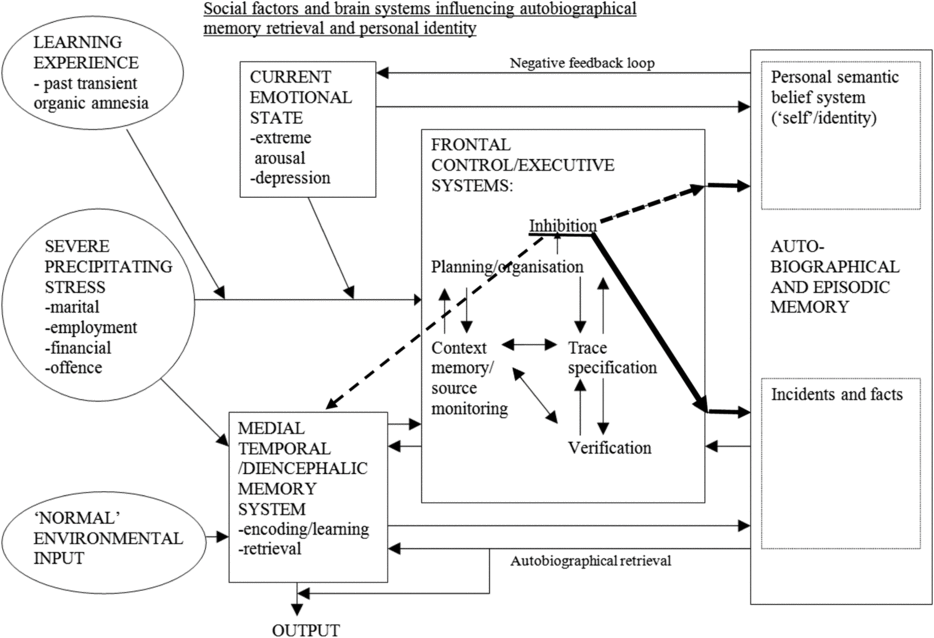
These findings were interpreted as reflecting an inhibitory process in memory retrieval, which partially resolved – more fully in fugue than FRA cases. Kopelman (Reference Kopelman2000) proposed that, in psychogenic amnesia, frontal inhibitory processes prevent the retrieval of autobiographical memories and, in extreme cases, the sense of self (personal identity). This arises in the presence of precipitating stress, depressed mood, and often a past history of a transient neurological amnesia (Figure 4). Such patients can appear to operate normally in the environment because the (‘extended’) medial temporal lobe/diencephalic system is relatively unaffected. However, on recovery from fugue, patients forget what they have done during the acute episode, perhaps indicating that medial temporal/diencephalic function may not have been completely normal during encoding (Figure 4), or perhaps reflecting the very different context at retrieval (post-fugue) from that during encoding (fugue). This theory is broadly consistent with Anderson et al.’s (Reference Anderson, Ochsner, Kuhl, Cooper, Robertson, Gabrieli, Glover and Gabrieli2004) more recent imaging findings which show that memory suppression involves bilateral frontal activation (of ‘inhibitory’ systems) and medial temporal deactivation. Moreover, Kikuchi et al. (Reference Kikuchi, Fujii, Abe, Suzuki, Takagi, Mugikura, Takahashi and Mori2010) obtained similar imaging findings in two cases of psychogenic amnesia – one of whom fitted the definition of ‘fugue’ and the other ‘focal retrograde amnesia’. However, it has to be acknowledged that other imaging studies have reported variable findings following episodes of psychogenic amnesia, including reduced frontal activation/metabolism (as described above).
Model of psychogenic amnesia, incorporating both psychosocial factors and brain systems. Frontal control mechanisms inhibit the retrieval of autobiographical memories and, in extreme circumstances, personal semantic beliefs about ‘self’ or identity (which, by a negative feedback loop produces a flattening in the mood state). Medial temporal/diencephalic system (also known as the ‘extended hippocampus’) appears to be functioning normally, such that the person appears to function normally in the environment, but it cannot be completely normal because, on recovery from a fugue, he/she has forgotten what occurred during the episode (dashed line). Reproduced and modified from Kopelman (Reference Kopelman2000), Cognitive Neuropsychology, 17, 585–621.
Conscious Avoidance or Unconscious Mechanism?
The question always arises as to whether such amnesias reflect conscious (or deliberate) or unconscious processes. The early Freud argued that: “(There) are those cases in which … it was a question of things which the patient wished to forget, and therefore intentionally repressed from his conscious thought and inhibited and suppressed” (Freud & Breuer, Reference Freud and Breuer1895). It was only later that he argued for a wholly unconscious process: “If (memories) have already pushed their way forward to the threshold and have been turned back … then they are inadmissible to consciousness; we speak of them as repressed” (Freud, 1915-17).
In the Lancet paper, on which the writer Pat Barker based her Regeneration novels, W.H.R. Rivers (Reference Rivers1918) wrote “Many kinds of mental experience may be repressed. Thus, after one of my patients had for long baffled all attempts to discover the source of his trouble, it finally appeared that he was attempting to banish from his mind feelings of shame due to his having broken down. … In another case, an officer had carried the repression of grief through the war to the point of suppression, … In nearly every case, …they were either deliberately thrusting certain unpleasant thoughts from their minds, or were occupying every moment of the day in some activity (so) that these thoughts might not come into the focus of attention.” This suggests that conscious avoidance was being used to induce forgetting, similar to the younger Freud’s theory (Freud & Breuer, Reference Freud and Breuer1895) and, indeed, to Anderson’s current theories concerning memory inhibition and suppression (Anderson & Green, Reference Anderson and Green2001; Anderson et al., Reference Anderson, Ochsner, Kuhl, Cooper, Robertson, Gabrieli, Glover and Gabrieli2004; Anderson & Hanslmayr, Reference Anderson and Hanslmayr2014).
In fact, it is very difficult, if not impossible, to know the extent to which people have deliberately avoided painful or difficult memories, or the extent to which this is truly an unconscious process. Comments from two (different) patients exemplify this: “It is like a box locked away and I don’t really want to open it”; “I put things in boxes. I choose to put them in the back of my mind. I’ve always done that. I know the memories are there … but (I) cannot get access to them” (Harrison et al., Reference Harrison, Johnston, Corno, Casey, Friedner, Humphreys, Jaldow, Pitkanen and Kopelman2017).
Summary
Psychogenic amnesias can be interpreted at different levels – cognitive, neurophysiological (imaging), or psychodynamic. They involve the avoidance of unpleasant memories, and varying degrees of awareness may be implicated (Kopelman et al., Reference Kopelman, Christensen, Puffett and Stanhope1994). Frontal inhibitory control mechanisms may well be implicated, and there is some functional imaging support for this notion.
CONCLUSIONS
In conclusion, the mysteries of RA remain unresolved; none of our existing theories accounts fully for all its phenomena. Moreover, frontal and lateral temporal damages contribute to RA as well as hippocampal pathology. There may be an important retrieval component to the deficit, and the temporal gradient may result from age effects at encoding – perhaps, in turn, related to the autobiographical/reminiscence ‘bump’. Spontaneous confabulation appears often to result from a damaged ‘filter’ in ventromedial and/or orbitofrontal cortex. Bajo et al. (Reference Bajo, Fleminger, Metcalfe and Kopelman2017) found that confabulation is associated with ‘executive’ impairments, particularly on cognitive estimates, in the presence of autobiographical memory impairment. Psychogenic amnesia occurs in the context of certain critical psychosocial factors with frontal inhibition of autobiographical memory retrieval and compromised new memory formation. There is now neuroimaging support for this hypothesis. Taken together, these various observations point to the importance of frontal ‘control’ systems in the retrieval and, more particularly, the disrupted retrieval of ‘old’ memories (compare McCormick et al., Reference McCormick, Ciaramelli, De Luca and Maguire2018).
On the basis of memory testing across the decades, Deary, Wessely, and Farrell (Reference Deary, Wessely and Farrell1985) reported that, in dementia, Mrs Thatcher reached “those parts of the brain other Prime Ministers could not.” Putting it another way, the last thing to go before impending death was Margaret Thatcher. At least I know that, when I develop RA, then according to my own theory, the last thing to go will be my memories of the events in Paris during May 1968.
ACKNOWLEDGEMENTS
This paper is based on my Presidential Address to the International Neuropsychological Society in Washington D.C. in February 2018 and was also given as the Freda Newcombe Prize Lecture at the British Neuropsychological Society in April 2018. A previous paper, based on an earlier version of this talk, was published as Kopelman, M.D., Marsh, L. (2017) Autobiographical memory in amnesia. Revue de Neuropsychologie, 9, 219–227. doi: 10.1684/nrp.2017.0437. I would like to acknowledge the very helpful comments of 3 reviewers of this paper. The author’s research has mainly been funded by various grants from the Wellcome Trust.
CONFLICT OF INTEREST
The author has nothing to disclose.



