Children's oral language skills, including their listening comprehension, are intricately linked with aspects of reading and writing ability, including reading comprehension (Keenan, Betjemann, Wadsworth, DeFries, & Olson, 2006; Nation & Angell, Reference Nation and Angell2006; Nation & Snowling, Reference Nation and Snowling2004; Whitehurst & Lonigan, Reference Whitehurst and Lonigan1998). Indeed, Nation and Angell (Reference Nation and Angell2006) claim that many of the skills children require for comprehending text are parasitic upon their early spoken language skills. The implication of such claims is that the development of reading comprehension difficulties might be prevented in some cases by interventions that specifically target young children's developing listening and spoken language skills (Keenan et al., Reference Keenan, Betjemann, Wadsworth, DeFries and Olson2006; Snow, Burns, & Griffin, 1998).
Exposure to spoken vocabulary is a known predictor of spoken language development, literacy, and academic achievement (Cunningham & Stanovich, Reference Cunningham and Stanovich1997; Hoff, Reference Hoff2003; Kispal, Reference Kispal2008; Nation & Snowling, 2004). Research has, therefore, explored how children might benefit from situations in which new vocabulary is provided. Results suggest that, in addition to learning new vocabulary through explicit instruction by adults, young children show a remarkable ability to acquire the meanings of words they encounter incidentally in conversations, on television, and in storybooks (Akhtar, Reference Akhtar, Hall and Waxman2004; Nagy & Herman, Reference Nagy, Herman, McKeown and Curtis1987). According to Elley (Reference Elley1989, p. 176), listening to stories has been “almost universally praised as an activity” for promoting vocabulary growth. Numerous studies have shown gains in word knowledge to result from storytelling to both preschoolers (Justice, Meier, & Walpole, 2005; Senechal & Cornell, Reference Senechal and Cornell1993; Waisk & Bond, Reference Waisk and Bond2001; Walsh & Blewitt, Reference Walsh and Blewitt2006) and older children (Dickinson, Reference Dickinson1984; Elley, Reference Elley1989; Nagy, Anderson, & Herman, Reference Nagy, Anderson and Herman1987; Penno, Wilkinson, & Moore, 2002; Robbins & Ehri, 1994). Importantly, such learning is not transient but lasts for several months (Dickinson, Reference Dickinson1984; Elley, Reference Elley1989; Senechal & Cornell, Reference Senechal and Cornell1993).
Considerable attention has therefore been paid to identifying the factors that impact on children's ability to learn words through listening to stories, including the individual differences that determine the listener's ability to profit from this type of learning opportunity. Children are not passive recipients of information about new words, but respond differently to word-learning opportunities depending on their age and spoken language ability (Ewers & Brownson, Reference Ewers and Brownson1999; Penno et al., Reference Penno, Wilkinson and Moore2002; Senechal, Thomas, & Monker, 1995). The role played by a child's prior vocabulary knowledge has received particular attention from researchers. Most authors corroborate the existence of a “Matthew Effect” (Stanovich, Reference Stanovich1986), whereby children with greater prior vocabulary knowledge make larger word-learning gains from storybook interventions than children with poor vocabulary skills (e.g., Dockrell, Braisby, & Best, 2007; Ewers & Brownson, Reference Ewers and Brownson1999; Joshi, Reference Joshi2005; Penno et al., Reference Penno, Wilkinson and Moore2002; Reese & Cox, Reference Reese and Cox1999; Robbins & Ehri, 1994; Senechal et al., Reference Senechal, Thomas and Monker1995). However, others have found no effect of prior vocabulary knowledge on learning (Walsh & Blewitt, Reference Walsh and Blewitt2006), while still further studies have found children with the lowest baseline vocabulary to make the greatest gains from listening to stories (Elley, Reference Elley1989). Although ceiling effects may account for some of these findings, because there is more scope for word learning in children with smaller vocabularies, differences in the number of exposures and/or manner in which new words are presented in each study may also contribute to these discrepancies between studies.
Both the number and the nature of the exposures provided to new vocabulary within a story have been found to impact on children's learning. For example, research has shown that, if a child is to gain more than a temporary or surface-level understanding of new vocabulary, multiple encounters are beneficial, whether these are provided in repeated occurrences of the word within a story or in repeated readings of the same story (Beck, McKeown, & Kucan, 2002; Best, Dockrell, & Braisby, 2006; Elley, Reference Elley1989; Justice et al., Reference Justice, Meier and Walpole2005; Penno et al., Reference Penno, Wilkinson and Moore2002; Senechal, Reference Senechal1997). Thus, Robbins and Ehri (Reference Robbins and Ehri1994) found that preschoolers were significantly more likely to learn a new word if the word occurred twice within a story than if it occurred only once. Further research has demonstrated that, although children may be able to decipher the meaning of unfamiliar words from incidental exposure to the words in a story context (e.g., Akhtar, Reference Akhtar, Hall and Waxman2004; Nagy & Herman, Reference Nagy, Herman, McKeown and Curtis1987), learning may be enhanced if the reader elaborates on the meanings of the words as they are encountered (Elley, Reference Elley1989; Justice et al., Reference Justice, Meier and Walpole2005; Penno et al., Reference Penno, Wilkinson and Moore2002). Although the term elaboration has been variously defined by researchers, the provision of an explicit definition of a new word's meaning has sometimes been found to play a facilitatory role. For example, Elley (Reference Elley1989) reported that vocabulary gains were doubled when explanations of unfamiliar words were provided to 7- and 8-year-old children as the words were encountered in a text.
However, questions remain about the universality of these effects. For example, Karweit and Wasik (Reference Karweit and Waisk1996) concluded that the beneficial effect of repeated readings of a story may vary according to the vocabulary level of the child, such that children with poorer vocabulary skills demonstrate increased involvement with and comprehension of the story with each repetition, whereas children with greater vocabulary ability show the opposite pattern. The literature similarly suggests that the benefit provided by dictionary definitions depends on the age and language ability of the child learner. For example, Coyne, Simmons, Kame'enui, and Stoolmiller (2004) have argued that elaborated exposure to new words in stories may narrow the gap between children with high and low vocabulary knowledge, implying that children with poor vocabulary skills may benefit more from the provision of explicit definitions. Support for their claim comes from Justice et al.'s (2005) finding that low-vocabulary preschoolers made significant word-learning gains only when new words were introduced alongside dictionary definitions. However, others have found that definitions are more helpful to older children with superior vocabulary knowledge. For example, Dickinson (Reference Dickinson1984) found that 11- and 12-year-old children made greater vocabulary gains when they were given definitions of words compared to when they heard new words in a story context, whereas 6- to 7-year-old children showed the opposite pattern. The causes of these discrepancies in the literature remain unclear. However, one possible explanation is that younger children have been found unable to draw useful information from explicit definitions of words in some cases because the definitions provided were not age-appropriate.
In sum, research to date has revealed a variety of factors that impact on the ability to acquire new words when listening to stories, including the child's age and vocabulary size, the number of exposures they are given to each word, and whether words are elaborated on (or defined) as they are encountered. However, the notable failure to systematically explore the roles played by each of these variables within a single study has led to confusion about how teachers should present new vocabulary in the classroom. Furthermore, most research to date has examined children's learning of new vocabulary from classroom stories read by experimenters. Mol, Bus, and de Jong (2009) conducted a meta-analysis of research in this field and found that effect sizes tended to be smaller when interventions were teacher led, rather than experimenter led; they note the importance of addressing this difference in order to “bridge the gap between research and practice” (p. 1000). The study described in this article therefore set out to systematically investigate the impact of different types of exposure to new words through teacher-administered storybook readings, while at the same time examining the contribution of individual differences to children's learning.
A second limitation of the literature in this field is that it has made little attempt to explore more theoretical questions about how story contexts allow new words to be established in the lexicon, such as the source of the facilitation afforded by multiple or elaborated exposure. The ease with which children pick up new words when they are presented in stories fits comfortably within spreading activation models of vocabulary storage (e.g., Collins & Loftus, Reference Collins and Loftus1975), which see the lexicon as a network of related concepts, in which access to a word is assisted by spreading activation between interconnected items. According to such accounts, presenting a new word in context allows it to be correctly situated within the lexicon from the outset; each further exposure to the word strengthens its connections with related concepts, facilitating comprehension at future encounters (see Mol et al., 2009). Carey (Reference Carey, Halle, Bresnan and Miller1978) similarly hypothesized that, after an initial mapping has been formed for a new word, the representation of its meaning gradually becomes more defined as the word is encountered in further contexts. One prediction of such models is that hearing new vocabulary in a variety of different contexts should assist learning by increasing the number of appropriate connections that might be formed between new and established concepts, thereby strengthening the positioning of the words within the child's existing semantic framework (see also Carlo et al., 2004). Yet, research to date has failed to explore whether repetition of new vocabulary within a variety of different story contexts is actually advantageous for children's vocabulary acquisition.
Similarly, little attention has been paid to the theoretical basis of the benefits associated with defining new vocabulary. Biemiller and Boote (Reference Biemiller and Boote2006) note that definitions might facilitate learning simply by drawing the child's attention to the word. If it is, rather, the information in the definition that provides the facilitation, there remain several alterative accounts of how this information might be beneficial. For example, definitions might work simply by providing additional contextual support for words’ meanings. That is, a definition might highlight related concepts with which the new vocabulary should be linked in the lexicon. An alternative perspective is that the assistance provided by this kind of elaboration is of a qualitatively different kind to that provided by contextual support, in that it requires metalinguistic or metacognitive understanding of the role played by definitions. Thus, some have argued that even “learner-friendly” definitions are unsuitable for young children or those with limited resources (McKeown, Reference McKeown1993; Nagy & Scott, Reference Nagy, Scott, Kamil, Mosenthal, Pearson and Barr2000). As discussed earlier, questions remain about whether it is only older children and/or those with superior vocabulary skills who benefit from the provision of definitions.
This article therefore aims to address the methodological limitations of previous research in the field while seeking to clarify the nature of the facilitation provided by multiple repetitions and elaborated exposure to new words. We report an experiment that addresses two main research questions. First, is learning facilitated by hearing words in a variety of story contexts, rather than repeatedly in the same context? Second, do children of all ages and abilities benefit equally when dictionary definitions are provided at the point that new words are encountered? In our study, learning was assessed by means of a standardized forced-choice vocabulary test; this task allowed us to establish whether children had acquired the gist of each word's meaning, rather than the depth of the child's understanding of each word (Ouellette, Reference Ouellette2006). Before describing the main experiment, we report an initial pilot study that was conducted to ensure that the materials to be used in our main study were suitable for our youngest participants.
PILOT STUDY
A preliminary study involving 78 6- to 7-year-old children (47 boys) from three schools in the south of England was conducted to assess the suitability of the stories and definitions for the younger participants in our main study. Training and testing were carried out on a one to one basis, with the experimenter and child sitting in a quiet area at the child's school. Children were taught eight “difficult” words through either: (a) a purpose-written short story (“The Adventures of Jess & Patch”), (b) a child-friendly definition (see Appendix A), or (c) an elaborated story that included the same set of definitions. In all conditions words were orally presented, with each new word repeated three times before the next word was introduced.
The eight target words were randomly selected from Sets 11 and 12 of the British Picture Vocabulary Scale (BPVS-II; Dunn, Dunn, Whetton, & Burley, Reference Dunn, Dunn, Whetton and Burley1997), a vocabulary test that was standardized in a sample of 2571 children (aged 3–17 years) and that has a median split-half reliability of 0.86. According to BPVS-II guidelines, word set 9 is suitable for assessing the vocabulary of individuals aged 16 to 21 years; the words in Sets 11 and 12 are therefore highly unlikely to be familiar to 6- and 7-year-olds (see Appendix B for words that were selected).
To establish whether children could draw on the story context and/or definition to identify the meanings of the target words, comprehension of each word was tested immediately after it had been heard in the story and/or definition, using standard BPVS-II test cards; children were asked to point to the correct pictorial representation of the spoken word from four possible choices.
Children in all three conditions selected the correct response more often than expected by chance: definition, mean = 5.31, SD = 1.74, t (25) = 9.70, p < .001; story context, mean = 5.52, SD = 1.42, t (26) = 12.84, p < .001; story context plus definition, mean = 5.36, SD = 2.00, t (24) = 8.41, p < .001, and there was no main effect of condition, F (2, 75) = 0.11, p = .90, partial η2 = 0.003. These analyses confirm that children could use the information provided by the story and definitions to gain an understanding of the new vocabulary and that the immediate support offered by each source of information was equivalent, confirming the suitability of the stimuli for the main study.
MAIN EXPERIMENT
Our main experiment investigated the factors that influence children's ability to learn vocabulary while listening to stories, including the impact of providing definitions of words as they are heard and of presenting words in multiple versus single story contexts. Participants were recruited from two age groups, 6- to 7-year-olds and 8- to 9-year-olds, to allow us to establish whether children of different ages (and/or levels of vocabulary knowledge) benefit from different modes of exposure to new vocabulary. Specifically, we investigated whether elaborating on words’ meanings by providing definitions of the target vocabulary within the story context would facilitate learning for all children equally, or whether definitions would be of particular benefit to older children or those with greater prior vocabulary knowledge. To examine whether the extraction of a word's meaning is facilitated by hearing the word in a variety of contexts, rather than in the same context repeatedly, children heard stories incorporating the new vocabulary on three occasions, with some groups hearing the same story on each occasion and others hearing three different stories. We hypothesized that children of all ages and abilities would benefit from hearing new words in multiple contexts. To test these hypotheses, we examined children's understanding of the exposed words and a matched set of control words prior to the storybook intervention, soon after the final exposure, and again 2 weeks later, to elucidate the factors that determine the ease with which words become embedded in the lexicon in the longer term.
Participants
We recruited 165 children from two schools in the South of England and one school in South Wales. All three schools were urban primary schools. Data on Free School Meal eligibility suggest that schools were similar in terms of socioeconomic status (proportion of pupils meeting Free School Meal criteria was 9% at School A, 8% at School B, and 5% at School C). BPVS-II standardized scores suggest that the schools were also similar in terms of pupils’ ability (School A: mean = 101.8, SD = 13.8; School B: mean = 103.8, SD = 11.1; School C: mean = 105.6, SD = 8.2).
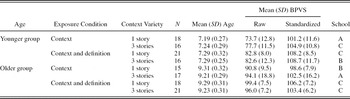
Twenty-one children were excluded from analyses due to absence at one or more of the training or test sessions, and two children were excluded as extreme outliers in the data (see Results Section). The final sample comprised four classes of 6- to 7-year-olds (N = 71, 37 boys, 34 girls; mean age = 7 years, 3 months; range = 6 years, 9 months to 7 years, 9 months), henceforth the “younger group,” and four classes of 8- to 9-year-olds (N = 71, 37 boys, 34 girls; mean age = 9, 3 months; range = 8 years, 9 months to 9 years, 9 months), henceforth the “older group.” The children's class teachers also participated in the study. For full details of the ages and BPVS-II scores of children in each class, see Table 1.
Characteristics of children in each experimental condition

Note: Mean (standard deviation) age and British Picture Vocabulary Scale (BPVS) raw and standardized scores at baseline by condition and the school from which each class was drawn.
Materials
The same eight target words were used as in the pilot study. A further eight words from Sets 11 and 12 of the BPVS-II were randomly selected to be control words (see Appendix B). The use of control words matched for difficulty with target words ensured within-subjects control for spontaneous learning during the test period. Note that the inclusion of control words in the design obviates the need for a control group of participants, who would provide only between-subjects control for spontaneous vocabulary growth. Eight “easy” words were selected from Sets 4 to 6 of the BPVS-II to ensure that children understood the nature of the test and remained on task (see Appendix B).
Three 5- to 10-min stories were purpose written to introduce the target vocabulary: “The Adventures of Jess & Patch” (also used in the pilot study), “Jess & Patch go to the Beach,” and “Jess & Patch go to the Circus.” Each story was written in a similar style and included the same eight target words in a different random order. In each story, target words were presented three times in a passage of 50–100 words before the next word was introduced (see Appendix C for story samples). Passages were sequenced to form a coherent narrative. In “story context only” conditions, each instance of each target word formed part of the story narrative. For “story context plus definition” conditions, stories were adapted by replacing the second mention of each target word with a child-friendly definition (see Appendix A), so that children in both conditions heard target words three times each.
Standard BPVS-II test cards were used to assess comprehension of the target, control, and easy words. Each card displayed four pictures, one of which represented the target word. The card for penguin was used as a practice card.
Procedure
One class in each age group was randomly assigned to each cell of the 2 × 2 design, so that each class heard either the same story or a different story each week, which either did or did not include dictionary definitions of the target vocabulary. Exposure to the new vocabulary was provided by teachers who read their class a story containing the target words once a week for 3 consecutive weeks. This was considered the most naturalistic form of delivery within the classroom, and therefore the most likely to encourage participation and learning by the children. Asking teachers to read stories to the whole class also minimized disruption to the school day. See Table 1 for numbers of children in each condition.
Word understanding was assessed at three time points: Baseline (before training), Time 1 (soon after training was completed) and Time 2 (after a 2-week delay). Testing was carried out individually, with the experimenter and child sitting together in a quiet area at the child's school.
Baseline. In the 48 hr before the first story reading, the experimenter assessed each child's global vocabulary level, using the BPVS-II. Children's understanding of the eight target words and eight control words was also tested using the relevant BPVS-II test cards, in a fixed random order.
Training. Teachers were asked to read the children in their class a story at the same time each week, for 3 consecutive weeks. In all classes, children sat on a mat on the floor and were shown a picture of Jess and Patch while they listened to the story. They were told to listen carefully as they might hear words that they had not heard before. Teachers were told which story to read each week, and were instructed to provide no information about the events or words in the story, other than those given in the story. Confirmation was obtained from all teachers that these instructions had been followed.
Classes assigned to the “one-story” condition heard the same Jess & Patch story at each of the three readings (the specific story choice was randomized), while classes in the “three-story” condition heard a different story each week, in a random order. Children in the “story context only” condition heard the new words only as they appeared in stories, while children in the “story context plus definition” condition heard definitions of the words as they were encountered during the story.
Time 1. The experimenter returned to each school within 24 hs of the third and final reading to assess children's comprehension of the exposed vocabulary. Each child was individually asked to identify the pictures matching the target words, control words, and a set of easy words on the relevant BPVS-II test cards in a fixed random order. Each test session lasted 10 to 15 min.
Time 2. After a further 2 weeks, during which there were no further readings of the stories or conversations about the target vocabulary, the experimenter returned to each school to assess children's memory for the target words’ meanings. As at Time 1, children were tested on their understanding of the target words, control words and easy words.
RESULTS
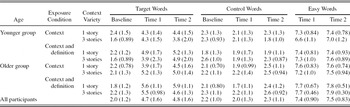
Each child provided eight sets of comprehension test scores: for target and control words at Baseline, Time 1 and Time 2, and for easy words at Times 1 and 2 (see Table 2). Each score was out of a maximum of 8; as each test card provided a choice of four pictures, a score of 2 would be expected by chance. As expected, performance on easy words was at ceiling at both Time 1 and Time 2; these data are not included in analyses.
Mean (standard deviation) number of words comprehended (out of a maximum of 8)

Note: Comprehension of target words and control words was assessed at baseline, Time 1, and Time 2; comprehension of easy words was assessed at Times 1 and 2.
Comparison of target and control word understanding
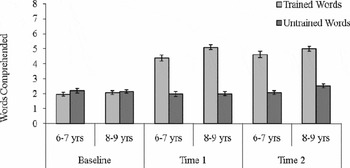
Mean comprehension test scores for target and control words are shown in Figure 1. It can be seen that children had no baseline (pretraining) understanding of either target or control words; all scores are at the level expected by chance. At Time 1, immediately after training, children showed better comprehension of target words than control words and this difference remained at Time 2, 2 weeks later. A 2 (Age) × 2 (Word Type) × 3 (Time) mixed analysis of variance (ANOVA) found a main effect of age, F (1, 140) = 5.81, p = .017, partial η2 = 0.04; older children showed higher levels of comprehension than younger children. There was a large main effect of word type, F (1, 140) = 192.31, p < .001, partial η2 = 0.58; scores for target words were higher than scores for control words. There was also a large main effect of time, F (2, 280) = 167.19, p < .001, partial η2 = 0.54; children's scores increased both from baseline to Time 1, F (1, 140) = 268.63, p < .001, partial η2 = 0.66, and from Time 1 to Time 2, F (1, 140) = 5.29, p = .023, partial η2 = 0.04. Importantly, there was a highly significant Word Type × Time interaction, F (2, 280) = 162.99, p < .001, partial η2 = 0.54. Children performed equivalently on target and control words at baseline, t (141) = 1.10, p = .28, but better on target words than control words at Time 1, t (141) = 15.09, p < .001, and Time 2, t (141) = 15.53, p < .001, showing that specific learning about the target words had occurred as a result of training. No further effects were found.
The mean number of target words and control words comprehended (out of a maximum of eight) at the three testing times, with standard error bars.

The overall ANOVA confirms that children acquired some knowledge about the target words, which they retained over a 2-week period. The analyses that follow explore whether our manipulations of word exposure affected the extent of children's learning of the new vocabulary, first when they were tested soon after exposure, and second, after the 2-week test delay.
Impact of exposure manipulations on target word comprehension at Time 1
Table 2 displays children's performance in each experimental condition at Time 1. Paired-sample t tests comparing children's understanding of target words and control words confirmed that learning of the trained vocabulary had occurred in all eight between-subject conditions (all ps < .01).
Prior to exploring the impact of our experimental manipulations on children's comprehension of target words at Time 1, we screened the participant background data for any potentially confounding differences between the children assigned to each condition. Note that, in our design, randomization to conditions occurred at the class level, rather than the individual level. That is, each class of children was allocated to one of the cells in the 2 (Age) × 2 (Exposure Type) × 2 (Context Variety) design. Although this type of methodology enables one to look at teacher-driven effects among whole classes of children, it raises the possibility that, by chance, the children in each class might differ on some dimension other than those manipulated intentionally by the experiment. We therefore carried out preliminary checks to ensure that participants in each class were well matched on age and baseline BPVS-II standardized scores. These analyses confirmed that there were no differences between the ages of the children in the four younger classes, F (3, 67) = 0.55, p = .65, partial η2 = 0.02, or the four older classes, F (3, 67) = 0.37, p = .77, partial η2 = 0.02. To ensure that classes were closely matched on BPVS-II standardized scores, it was necessary to exclude two extreme outliers with low BPVS scores (both boys, both from the older group). Once these children were excluded, there were no differences between the standardized BPVS scores of children in either the four younger classes, F (3, 67) = 1.95, p = .13, partial η2 = 0.08, or the four older classes, F (3, 67) = 1.61, p = .20, partial η2 = 0.07.
A further difficulty associated with randomizing whole classes of children to conditions in our design is the potential for teachers to differ in the manner in which they delivered the experimental manipulation assigned to them. Although we provided clear instructions to teachers about their role during the storybook readings, some teachers might nevertheless have presented stories (and therefore the vocabulary contained in them) more effectively than others. Our approach to data analysis was, therefore, to conduct a preliminary investigation of the main effects of each factor, collapsing across all other factors. This procedure minimizes the potential for any class differences (between children or between teachers) to impact on the results, by ensuring that more than one class contributes to each level of the factor under investigation. Only where significant main effects were revealed did we proceed to explore potential interactions between the variables involved. Note that, under this strategy, four separate classes of children contribute to each data point in analyses of main effects, while two classes contribute to each data point in analyses of interactions.
At Time 1, this procedure revealed a main effect of age, F (1, 140) = 7.31, p = .008, partial η2 = 0.05; older children learned significantly more words than younger children. There was also a significant effect of exposure type, F (1, 140) = 5.29, p = 0.02, partial η2 = 0.04; children in the context plus definition condition showed greater comprehension of the target words than children in the context only condition. However, there was no main effect of context variety, F (1, 140) = 9.11, p = 0.74, partial η2 = 0.001. We therefore proceeded to investigate potential interactions involving age and exposure type. Results revealed a significant interaction between age and context variety, F (1, 138) = 4.34, p = .039, partial η2 = 0.03; although the two age groups showed similar levels of comprehension of the target vocabulary when words had been heard in only a single context, t (70) = 0.45, p = .65, the older group showed significantly more learning than the younger group when words were presented in three different contexts, t (48.4) = 3.33, p = .002.
Analyses of children's initial learning therefore reveal that children in all conditions showed high levels of understanding of the target vocabulary following three storytelling sessions by their teacher. However, older children learned more words overall, and all children benefited from the provision of definitions during the story. Results also suggest that the younger group may have struggled with the complexity associated with hearing new vocabulary in multiple contexts; although the two age groups performed comparably when words were provided in the same story each week, the older group outperformed the younger group when three different stories were heard.
Impact of exposure manipulations on target word comprehension at Time 2
The next set of analyses explores whether children's longer term learning was affected by our experimental manipulations in a similar manner to their immediate learning. Table 2 displays the comprehension scores of children in each condition at Time 2. Paired-sample t tests confirmed that children in all eight experimental groups showed greater understanding of target words than control words at Time 2 (all ps < .004), confirming that learning was retained in all conditions.
Following the analysis procedure described above, we first explored the independent main effects of each of our experimental manipulations on children's understanding of the target vocabulary. Again, there was no effect of context variety, F (1, 140) = 3.28, p = .07, partial η2 = 0.02. At Time 2, there was, in addition, no effect of age, F (1, 140) = 1.86, p = .18, partial η2 = 0.01. However, the main effect of exposure type remained, F (1, 140) = 7.12, p = .009, partial η2 = 0.05. As at Time 1, children in the context plus definition condition scored more highly than children in the context only condition. There were no two-way interactions involving exposure type, confirming that the provision of a definition enhanced the longer term learning of children in both age groups and both context variety groups.
Effects of prior vocabulary knowledge
The previous set of analyses suggests that age is not a critical factor in children's ability to profit from elaborated exposure to new words, at least in the longer term. To explore whether individual differences in children's prior vocabulary knowledge might play a more important role, we entered children's ages and raw BPVS-II vocabulary scores into a linear regression to identify the best predictor of learning at Times 1 and 2. Raw scores are appropriate for this type of analysis because we are interested in the impact of the size of children's vocabulary knowledge on their level of learning; age-standardized scores would not reflect the large variability in vocabulary knowledge of the 6- to 9-year-old children in our sample (for similar usage of BPVS raw scores, see Archibald & Gathercole, Reference Archibald and Gathercole2006; Briscoe, Bishop, & Norbury, Reference Briscoe, Bishop and Norbury2001; Briscoe, Gathercole, & Marlow, Reference Briscoe, Gathercole and Marlow2001). The regression analysis showed that age accounted for 3.6% of the variance in children's understanding of target words at Time 1 (β = 0.21, t = 2.49, p = .014) and a nonsignificant 1.1% at Time 2 (β = 0.11, t = 1.26, p = .21). When baseline raw BPVS-II scores were added to the regression, the two variables together accounted for a considerable proportion of the variance: 24% at Time 1 (age: β = −0.10, t = 1.09, p = .28; BPVS: β = 0.54, t = 6.00, p < .001) and 21% at Time 2 (age: β = −0.20, t = 2.17, p = .03; BPVS: β = 0.54, t = 5.89, p < .001).
As prior vocabulary knowledge clearly plays a significant role in determining children's ability to learn new words from stories, we used a median split on raw BPVS-II scores to construct two new groupings of children with large and small vocabularies. Employing the same approach to ANOVA described above, but replacing “age” with the new factor “vocabulary size,” we found a large effect of vocabulary size on comprehension of target words at Time 1, F (1, 140) = 37.74, p < .001, partial η2 = 0.21; children with larger vocabularies showed higher levels of initial learning (mean = 5.5 words, SD = 1.2) than children with smaller vocabularies (mean = 4.0, SD = 1.6). However, vocabulary size did not interact with exposure type, F (1, 138) = 0.06, p = .81, partial η2 = 0.00, or context variety, F (1, 138) = 0.01, p = .94, partial η2 = 0.00, indicating that the effect of these manipulations on children's word learning did not depend on their existing vocabulary knowledge.
At Time 2, we found the same pattern. There was a main effect of vocabulary size, F (1, 140) = 15.82, p < .001, partial η2 = 0.10; children with larger vocabularies showed greater retention of the target words’ meanings (mean = 5.3 words, SD = 1.4) than children with smaller vocabularies (mean = 4.3, SD = 1.6). Again, there was no interaction between vocabulary size and exposure type, F (1, 138) = 0.53, p = .47, partial η2 = 0.04, or between vocabulary size and context variety, F (1, 138) = 0.06, p = .81, partial η2 = 0.00, confirming that vocabulary size does not moderate the influence of our manipulations of exposure on children's longer term word learning.
In sum, these results show that both older and younger children learned the meanings of new words while listening to storybook readings, and that the knowledge they acquired was retained without significant loss over at least a 2-week period. Although prior vocabulary knowledge was a significant predictor of children's ability to acquire new vocabulary in this way, this factor did not determine whether children profited from the provision of dictionary definitions or variable story contexts. Indeed, presenting new vocabulary in a variety of contexts produced no detectable facilitatory effects. In contrast, children of a range of ages and abilities showed long-term word-learning gains when explicit definitions of new words were provided as they were encountered.
DISCUSSION
These results support previous research demonstrating that children are able to learn the meanings of unfamiliar words that are experienced incidentally while listening to stories (e.g., Dickinson, Reference Dickinson1984; Elley, Reference Elley1989; Penno et al., Reference Penno, Wilkinson and Moore2002; Robbins & Ehri, 1994; Senechal & Cornell, Reference Senechal and Cornell1993). In this study, 6- to 9-year-old children demonstrated levels of understanding of the target vocabulary that were at chance prior to training and significantly above chance immediately posttraining and after a 2-week test delay. These findings contrast with children's persistent lack of comprehension of a set of control words selected from the same set of “difficult” vocabulary items as target words. We can therefore be confident that the observed learning of the target vocabulary can be attributed to the storybook exposure procedure.
Our findings also corroborate claims that the learning that occurs while listening to stories is not transient (Dickinson, Reference Dickinson1984; Elley, Reference Elley1989; Senechal & Cornell, Reference Senechal and Cornell1993). Studies that have involved repeated exposures to new vocabulary have particularly supported the longevity of vocabulary learning from storybook readings (e.g., McGregor, Sheng & Ball, Reference McGregor, Sheng and Ball2007; Penno et al., Reference Penno, Wilkinson and Moore2002; Senechel, 1997). In the current study, we found no loss of learning from the immediate posttraining test to the 2-week follow-up test; an average of four or five of the eight trained words were correctly identified at both time points. Although it is possible that children's performance at Time 2 depended partly on their memory for the responses they made when tested 2 weeks earlier, the significant improvement we observed in children's performance between the two testing times does not support this conclusion. More likely is that learning was consolidated during the 2-week period following training; consolidation of word learning over a 24-hr period has previously been demonstrated in adults (Dumay & Gaskell, Reference Dumay and Gaskell2007), and in other species the benefits associated with the reorganization of newly acquired knowledge are thought to accrue for several weeks (see Takashima et al., Reference Takashima, Petersson, Rutters, Tendolkar, Jensen and Zwarts2006).
This study also explored the roles played by age and prior vocabulary knowledge in children's ability to learn words while listening to stories. Results confirmed that, although children of all ages and vocabulary levels made gains in understanding, age and prior vocabulary knowledge both determined the extent of children's learning. Older participants made greater gains than younger participants, but prior vocabulary knowledge was an even stronger predictor of learning; children with higher baseline vocabulary scores outperformed those with lower scores both immediately after exposure and 2 weeks later. The data therefore add to the wealth of evidence supporting the existence of a “Matthew Effect” in vocabulary acquisition (Cain, Oakhill & Elbro, Reference Cain, Oakhill and Elbro2003; Ewers & Brownson, Reference Ewers and Brownson1999; Penno et al., Reference Penno, Wilkinson and Moore2002; Senechal et al., Reference Senechal, Thomas and Monker1995; Stanovich, Reference Stanovich1986).
Robbins and Ehri (Reference Robbins and Ehri1994) suggest several possible reasons for the Matthew Effect. First, better understanding of the nontarget vocabulary in a story might allow children with larger vocabularies to more readily infer the meaning of the target vocabulary from the context. Second, children with larger vocabularies might have more experience of listening to stories; the incidence of home literacy experiences is known to be related to familial socioeconomic status (Hoff, Reference Hoff2003; Rush, Reference Rush1999). Finally, possession of a richer knowledge base, interest or motivation to learn new words and/or other aspects of intelligence might contribute to individual differences in vocabulary gains (Stanovich, Cunningham, & Feeman, Reference Stanovich, Cunningham and Feeman1984). Indeed, the most motivated children might have sought information about the target vocabulary outside the classroom. However, the existence of a Matthew Effect in our data should not overshadow the fact that substantial levels of learning were achieved by children of all ages and abilities. The universality of the word learning gains we saw in this study underlines the importance of early exposure to new vocabulary in educational contexts for all children, especially those from less educated or disadvantaged backgrounds (Dockrell & Messer, 2004). Targeting such children during the early school years may help to narrow the attainment gap that typically widens during primary school years (Department for Children, Schools and Families, 2009).
In terms of the manner in which new vocabulary should be provided, these studies serve to clarify a discrepancy in the literature regarding the effectiveness of elaborated exposure. Previous research has produced conflicting evidence regarding children's ability to profit from explicit definitions of new words. Our results reveal that children of a range of ages and abilities benefit from explicit definitions of words as they are encountered in stories. When children were tested 24 hr and 2 weeks after the final story reading, children showed greater understanding of the words if they had been defined as they were encountered in stories, regardless of age or prior vocabulary knowledge. Thus, when age-appropriate definitions of new words are repeatedly presented within suitable story contexts, learning is enhanced for children of all ages and abilities.
Although our results add weight to previous findings of advantageous outcomes associated with elaborated word exposure (Carlo et al., Reference Carlo, August, McLaughlin, Snow, Dressler and Lippman2004; Justice et al., Reference Justice, Meier and Walpole2005), they do not support the claim that learning cannot occur without elaborated exposure (see Justice et al., 2005). One explanation for Justice et al.'s (2005) discrepant claim in this regard may be the particularly low vocabulary levels of the participants in their study. There was no effect of vocabulary size on children's ability to benefit from elaborated exposure in our typical sample; however, children with severe vocabulary difficulties may require a method of word introduction that incorporates multiple cues to the word's meaning. In support of this view, Coyne et al. (Reference Coyne, Simmons, Kame'enui and Stoolmiller2004) suggest that explicit teaching of words’ meanings during storybook readings may reduce the disparity between children with especially high and low vocabulary knowledge.
A further question of interest in this study was whether learning was facilitated by presenting words in a variety of contexts, rather than repeatedly in the same context. We hypothesized that hearing a word in multiple contexts would allow the child to create a larger network of semantic associations between the new word and related concepts and hence to embed the word more successfully within the lexicon (Collins & Loftus, Reference Collins and Loftus1975). Presenting words in varying story contexts did not provide any benefit over and above hearing words repeatedly within the same context, for children of any age or vocabulary size. Indeed, we found some evidence that younger children's learning may have been hindered by hearing words in several different contexts, although no effects of context variety were apparent after the 2-week test delay. These findings suggest that it is the repetition of words in context, rather than the variety of contexts in which words are presented, that is necessary for learning to occur, and that it is inconsequential whether teachers choose to read children the same story repeatedly or new material containing the same lexical items. However, it is likely that more diverse reading material containing overlapping vocabulary would prove beneficial in the longer term, as exposure to a variety of texts would both reinforce children's existing knowledge while simultaneously introducing new vocabulary items. Equally of importance, a selection of different stories would better maintain children's (and teachers’) interest, and the motivation of both partners in the storytelling experience is likely to be related to the degree of learning that results from it.
Previous reports that experimenter-driven training procedures do not translate well into real-life school environments (Mol et al., Reference Mol, Bus and de Jong2009) suggest that the involvement of teachers in research of this type is crucial. The current study confirms that storybook readings can lead to vocabulary gains when exposure is delivered by teachers rather than experimenters and supports the implementation of this type of intervention in the classroom. However, it is important to acknowledge the difficulties associated with including class teachers in research. Most notably, the involvement of teachers in the delivery of our story material carried with it the possibility that individual differences in teaching style might mask differences in the effectiveness of our exposure manipulations. In an attempt to maintain control over teachers’ storybook reading styles, we instructed them not to provide any clarification of the events or words contained in the stories. However, this may contrast with their usual reading style; if teachers had been free to discuss the vocabulary with the children in their class, even greater levels of learning might have resulted. It is similarly worth noting that the stories used in this study were developed for purpose and may not resemble the reading material typically used by teachers, which may be longer in length, involve more complex storylines and provide a less stilted introduction to new vocabulary. For example, repeating each word three times before the next new word was introduced is a structure unlikely to be found in a typical storybook. Further research is therefore required to explore whether more natural reading styles and more natural reading materials provide greater facilitation to children's attempts to infer the meanings of new words, and to substantiate our findings among larger numbers of schools, classes, teachers, and pupils.
The study leaves a number of further questions unanswered. For example, the optimal number of exposures to a new word within a story, the optimal number of story readings, and the optimal time interval between readings remain unknown. Nor do our data speak to the issue of whether all classes of vocabulary can be learned through listening to stories. Dockrell et al.'s (2007) investigations into children's acquisition of scientific vocabulary have shown that some word classes are more difficult to learn than others (e.g., verbs are harder than adjectives), and that domain-general words (e.g., satellite in the domains of space and television) are learned more easily than words whose uses are restricted to one specific domain (e.g., migrate in the animal kingdom). Although our target vocabulary comprised a mixture of verbs, adjectives, and nouns, the numbers of each word type were too small to reveal any effects of word class on learning.
A further limitation of this research is in our knowledge of the extent of children's knowledge of the target vocabulary at the end of the study. Although there are no formal criteria by which one can judge whether a word is “known” (Beck & McKeown, Reference Beck, McKeown, Barr, Karmil, Mosenthal and Pearson1991), the forced-choice picture selection approach has limitations as a measure of children's vocabulary knowledge. The benefit of the BPVS-II vocabulary test we chose to employ is that it allowed us to directly compare children's understanding of target and control words of the same difficulty level. That children chose the correct pictorial representation of almost five of the target words, compared to only two of the control words (chance levels), confirms that children had acquired some knowledge of around half of the words they encountered in the stories. But although forced-choice comprehension tasks might measure the breadth of children's word knowledge (whether each word's meaning is broadly familiar), this method of testing cannot reveal the depth of children's word understanding (see Dockrell & Messer, 2004; Ouellette, Reference Ouellette2006).
Further work is therefore required to explore whether the benefits associated with the provision of dictionary definitions are reflected in the greater depth of children's understanding of these words, as well as the greater breadth (in terms of the number of referents correctly identified). Best et al. (Reference Best, Dockrell and Braisby2006) propose that direct instruction about words’ meanings in the form of definitions supports a deeper level of understanding than that gained from incidental exposure to words in context; this proposal might be investigated in future studies by employing additional tasks that tap into children's word comprehension more deeply. For example, Funnell, Hughes, and Woodcock (Reference Funnell, Hughes and Woodcock2006) describe a technique for assessing vocabulary knowledge that requires children to name a picture of an object and then to answer a series of questions about the object.
It would also be valuable to ascertain whether children who have encountered new words in stories and/or definitions are able to use the newly learned vocabulary appropriately in their expressive language, as well as their receptive language. Pearson, Hiebert, and Kamil (Reference Pearson, Hiebert and Kamil2007) suggest that the universal use of the word “vocabulary” to describe the ability to use words in writing, reading, speaking, and listening causes confusion when deciding how to assess children's knowledge. They propose that vocabulary testing should focus on the outcome variable of interest, such that a test of receptive vocabulary is the appropriate measure of reading comprehension while an expressive vocabulary test is more appropriate as a measure of speaking ability. Similarly, Dockrell et al. (Reference Dockrell, Braisby and Best2007) suggest that different processes may underpin the learning of words for receptive and expressive purposes; these authors recommend the use of a range of assessments of word knowledge, including tests of both receptive and expressive competence, such as sentence completion, word definition, and drawing tasks. Although most tests have their limitations (Best et al., Reference Best, Dockrell and Braisby2006), a more diverse set of assessments of vocabulary knowledge might be fruitfully employed in future research to establish the extent of children's new knowledge and their ability to put this to use in the weeks and months following an exposure intervention.
If children maintain their new vocabulary knowledge beyond the 2-week period over which it was assessed in the current study, storybook exposure has the potential to contribute to both the child's vocabulary knowledge and their later academic achievement. The size of a child's vocabulary repertoire plays a pivotal role in literacy development (Dockrell & Messer, 2004; Keenan et al., Reference Keenan, Betjemann, Wadsworth, DeFries and Olson2006; Nation & Angell, 2006; Nation & Snowling, 2004; Snow et al., Reference Snow, Burns and Griffin1998). Recent work has demonstrated that the facilitation afforded by knowing a word's meaning may be specific and direct. For example, unfamiliar words with inconsistent pronunciation are read more quickly and more accurately if participants are first taught the meanings of the words (McKay, Davis, Savage, & Castles, Reference McKay, Davis, Savage and Castles2008). Such evidence suggests a direct relationship between possession of a semantic representation of a word and recognition of its form. This is not to imply that efforts to increase children's comprehension vocabulary are only constructive when children are learning to read the words; evidence suggests that it may be important to target vocabulary development at a much earlier stage. For example, a recent review by the National Early Literacy Panel (2008) reports strong correlations between preschool children's receptive language comprehension and their decoding and reading comprehension skills at school. Researchers have also made the case for targeting vocabulary that is well beyond the current level of the child. For example, Biemiller (Reference Biemiller, Neuman and Dickinson2005) claims that children require an above average spoken word vocabulary if they are to attain adequate reading comprehension beyond the age of 8 years. Given that children encounter basic (“Tier 1”) words outside of school, Beck et al. (Reference Beck, McKeown and Kucan2002) advise that primary school vocabulary-teaching practices should emphasize the learning of “Tier 2” words, the high frequency vocabulary employed by mature language users. Reading stories to children that include some vocabulary beyond the expected level of the child may therefore prove the most effective means of encouraging both vocabulary acquisition and, at a later stage, reading comprehension.
Dockrell and Messer (Reference Dockrell, Messer and Berman2004, p. 43) comment that, at present “children are not necessarily given enough opportunities to build a rich vocabulary in the early school years.” Our study suggests that whole class storybook readings may provide a useful tool for introducing vocabulary to children of a range of ages and ability levels. Given an appropriate context from which to learn, children are able to discern the meanings of words well beyond their current vocabulary range. Moreover, incorporating unfamiliar terminology into children's stories in the classroom context is a low-cost, effective, and enjoyable means of introducing new words, with the potential to result in sizeable gains in vocabulary understanding for children of a range of ages and ability levels. Importantly, the learning that is achieved in this manner does not appear to be transitory. Repeated exposure to words through readings of the same or related materials establishes new word knowledge in long-term memory, while elaborating on words’ meanings as they are encountered further facilitates vocabulary growth.
APPENDIX A
Definitions of target words as suggested by the 1994 Oxford Schools Dictionary

APPENDIX B
Target, control, and easy words

APPENDIX C: EXAMPLE EXTRACTS FROM THE THREE STORIES
Context only condition
Target word: Incline
“Jess and Patch's Day of Adventures”
Mum, Jess, and Patch set off to the shops. Jess's house is at the bottom of a hill and they had to walk up a sharp incline to get to the shops. As the incline got bigger, Patch started to pant and slow down. “Poor Patch” said Jess's Mum. “He's too old to walk up this incline, we'll have to get the bus next time.”
“Jess and Patch Go to the Beach”
Since it was such a nice day, after Mum's arm was feeling better Mum, Jess, and Patch all went to the beach. They parked the car at the bottom of a steep incline. To get to the beach they had to walk up the incline carrying all of their bags full of buckets and spades to make sandcastles. Patch got very tired!
When they reached the top of the incline they could see that the beach was very busy!
“Jess and Patch Go to the Circus:
The next act that came on stage was two clowns walking up a ramp at a steep incline, and then jumping off the edge! The ramp wasn't very long but the incline was so sharp that it went quite high up into the air.
“That incline is so steep I'm surprised they can walk up it!” whispered Dad.
Context plus definition condition
Target word: physician
“Jess and Patch's Day of Adventures”
“Oh no!” said Jess, “I've hit Mr. Jones on the head with my ball.” Jess put her head over the fence to say sorry to Mr/ Jones when she noticed a big lump on his head.
“Sorry Mr. Jones, are you OK?”
“No, Jess” said Mr. Jones. “I have a very sore head. I think I will have to go and see my physician.” A physician is a doctor who is not a surgeon.
Jess felt really bad about Mr. Jones's head. “Shall I call the physician for you?” she asked.
“That's ok thank you Jess, I will call myself and make an appointment at the surgery” he replied, rubbing his head.
“Jess and Patch Go to the Beach”
Just then, Jess heard a loud “CRASH!” Mum had fallen off the ladder!
“Ouch!” cried Mum, “That hurt!” Mum was squeezing her arm tightly.
“Oh no!” said Jess, “We will have to take you to see the physician”. A physician is a doctor who is not a surgeon.
Jess liked the physician in the local surgery because every time she went to see him he would give her a sticker to add to her collection.
“Jess and Patch Go to the Circus”
Then the clown started juggling while he was swinging!
“Wow!” said Jess. “Can I try that Mum?”
“No you cannot!” replied Mum quickly. “We would definitely be making a trip to the surgery to see the physician then!” A physician is a doctor who is not a surgeon.
“Why's that Mum?” asked Jess.
“Because you would probably hurt yourself and we would have to take you to the doctor to make you better. I wouldn't be surprised if these clowns have made a few trips to see their physicians before now!”
“OK” said Jess, “I'll just watch for now.”