INTRODUCTION
Leymus chinensis grassland, producing herbage of excellent quality and quantity, is widely distributed at the eastern end of the Eurasian steppe zone and is one of the most suitable grassland types for forage production in China (Li et al. Reference Li, Zheng, Zhao, Ye, Smith and Hays1983). However, the increasing demand for more pasture to support livestock has resulted in a substantial reduction in canopy cover throughout large areas of grassland (Wang & Ripley Reference Wang and Ripley1997) and a decline in the quality and quantity of high-grade grasses such as L. chinensis (Wang & Li Reference Wang and Li1995) is seriously restricting the economic viability of the grassland.
The factors influencing grazing behaviour are highly relevant to better understanding of the impacts of grazing on grassland vegetation and, therefore, the design of appropriate management schemes. The diet composition of sheep changes markedly over the grazing season (Salt et al. Reference Salt, Mayes, Colgrove and Lamb1994; Fraser et al. Reference Fraser, Theobald and Moorby2006; Narvaez & Pittroff Reference Narvaez and Pittroff2007; Sun et al. Reference Sun, Zhou, Ferreira, Zhong and Lou2008) and is influenced by grazing pressure (Milne et al. Reference Milne, Bagley and Grant1979). The variable diet selection is important for the species composition of the grassland sward communities (Parsons et al. Reference Parsons, Harvey and Johnson1991). The vertical (e.g. sward surface height of a species) and horizontal availability (e.g. proportion cover of a species) of the component plant species are thought to be important factors influencing the diet selection response of sheep (Edwards et al. Reference Edwards, Newman, Parsons and Krebs1996). Vertical availability of a plant species can influence the mass and dimensions of bites taken by the sheep (Burlison et al. Reference Burlison, Hodgson and Illius1991; Gross et al. Reference Gross, Shipley, Hobbs, Spalinger and Wunder1993; Edwards et al. Reference Edwards, Parsons, Penning and Newman1995). Horizontal availability influences the rate at which the sheep encounters food items on the grassland and, thus, the time required, on average, to find food alternatives (Stephens & Krebs Reference Stephens and Krebs1986; Thornley et al. Reference Thornley, Parsons, Newman and Penning1994). Furthermore, changes in vertical and horizontal availability can lead to changes in the total availability of the vegetation, which influences the animal's intake (Penning et al. Reference Penning, Parsons, Orr and Treacher1991; Dumont et al. Reference Dumont, Meuret and Prud'hon1995). Previous studies have primarily concentrated on how sward canopy structure influences animal ingestive behaviour, such as bite rate, weight, size, intake rate or grazing time (Burlison et al. Reference Burlison, Hodgson and Illius1991; Gong et al. Reference Gong, Lambert and Hodgson1996a ). However, all these parameters are only indirect measurements of the real food items ingested. Few studies have tested directly whether or not seasonal variation in diet composition is induced by changes in the horizontal and vertical availability of plant species in complex natural vegetation. This may be because it is difficult to estimate accurately the diet composition of animals grazing on complex natural vegetation communities. In addition, most studies (Gong et al. Reference Gong, Lambert and Hodgson1996a ; Harvey et al. Reference Harvey, Parsons, Rook, Penning and Orr2000; Wang et al. Reference Wang, Wang, Bai, Jiang, Liu, Huang and Li2010) have been conducted using experimentally controlled, simplified food environments, or sown swards, and their findings still require validation under complex natural vegetation conditions.
n-Alkanes have been used successfully as biomarkers to estimate diet composition (Mayes et al. Reference Mayes, Dove, Chen, Guada, Journet, Farce and Demarquilly1995; Hameleers & Mayes Reference Hameleers and Mayes1998; Duncan et al. Reference Duncan, Mayes, Lamb, Young and Castillo1999; Osoro et al. Reference Osoro, Olivan, Celaya and Martinez2000). The use of other plant-wax compounds (i.e. long-chain fatty alcohols and fatty acids) further extended the range of available faecal markers (Lin et al. Reference Lin, Luo, Wang, Zhang and Shu2009a ; Ferreira et al. Reference Ferreira, Celaya, Santos, Falco, Guedes, Rodrigues and Osoro2011), making it possible to estimate the diet composition of sheep grazing on complex natural vegetation communities accurately. In the current study, two plots with different vegetation availabilities, created by adjusting sheep numbers, were studied on L. chinensis grassland. One was a low stocking rate plot (LP) with relatively low sheep numbers aiming to achieve high vegetation availability; the other was a high stocking rate plot (HP) with relatively high sheep numbers aiming to achieve low vegetation availability. The seasonal diet selection of sheep on the two plots was estimated using alkanes in combination with alcohols and/or acids during the grazing months. The vertical and horizontal availability of component plant species was simultaneously measured in each season.
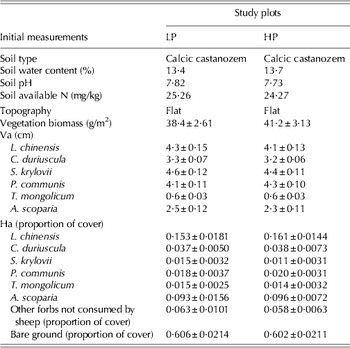
The objective of the present study was to identify the relative importance of the two major variables (vertical and horizontal availability) in influencing the seasonal variation of sheep diet on both the LP and HP. In addition, the selectivity index for each plant species consumed by the sheep was developed to examine the impact of grazing on the grassland (Table 1).
The initial vegetation and soil parameters of the LP and HP

Va, vertical availability; Ha, horizontal availability; LP, low stocking rate plot; HP, high stocking rate plot.
MATERIALS AND METHODS
All the sheep used in the experiment received the approval of the China Agricultural University Laboratory Animal Care Advisory Committee.
Experimental site
Experiments were carried out at the Guyuan State Key Monitoring and Research Station of Grassland Ecosystem (in the southern Inner Mongolian steppe), Hebei province, China (41°45′N, 115°39′E, 1430 m asl). The area had a semi-arid continental monsoon climate with an average annual precipitation of 430 mm, occurring mostly between July and September. The mean temperatures throughout the experimental periods were 18·1, 21·1 and 16·4 °C in June, July and August, respectively. Leymus chinensis, Artemisia scoparia and Carex duriuscula were the dominant species in the experimental area, germinating in early May and remaining green until mid-September. In addition, high proportions of Phragmites communis and Cleistogenes squarrosa were present during the experimental period; Stipa krylovii was also present but with a scattered distribution. Other species, such as Astragalus tataricus Franch., Saussurea japonica, Potentilla supina, Taraxacum mongolicum and Sibbaldia adpressa Bge. constituted only a minor component of the grassland.
Two plots (=1·5 ha) with fairly uniform vegetation and similar topography and soil conditions, moderately grazed by sheep for several years before the experiment, were fenced between June and August of 2011, when the season's main green plant species were available, and used to assess the relationship between sheep grazing and vegetation availability. Six sheep from each plot were selected randomly and marked with a coloured ribbon for diet composition determination (providing six replicates for each plot). Although it was possible that the proportions of the minor vegetation components differed, the size of the areas should have ensured that the proportions of the main plants consumed did not vary too much. The botanical availability of the two plots reflected the evolution of vegetation during the grazing months (June to August).
Animals and management
Mongolian sheep (the common sheep species in the region where the experiments were conducted) were selected from the main flock at the beginning of the grazing month on the basis of uniformity of live weight (average weight 40·1±3·7 kg), and allocated randomly to the experimental plots. Ten sheep were put on the LP and 14 on the HP: the average numbers of sheep were 6·67/ha on the LP and 9·33/ha on the HP during the experimental period. All of the sheep in the free-grazing trial were allowed to graze whole day during the grazing period, and a sheepfold was established in each plot for them to rest. Water and salt were available at all times and no supplement was added. Animals received an anthelminthic drench before the start of the experiment. The changes in animal live weight over the course of the experiment were 44·6±2·12, 48·2±2·24 and 47·3±2·65 kg for LP, and 44·7±1·80, 47·1±2·61 and 43·3±3·53 kg for HP in June, July and August, respectively.
Sample collection
In the last 4 days of each experimental period (26–29 June, 28–31 July and 28–31 August), canvas bags with polyethylene inserts were attached to the marked animals by harness straps, adjusted for each animal's comfort. The collection bags were emptied by removing the excreta-filled polyethylene inserts and replacing them with clean ones each morning. The faecal samples were immediately oven-dried at 65 °C for 48 h and milled through a 1-mm sieve; the samples from each sheep on each sampling day were then combined, resulting in one bulk sample per sheep in each experimental period for subsequent analysis.
To determine the plant species and parts consumed by the sheep, a direct observation of feeding behaviour was conducted during the plant collection period. Throughout the observation sessions, sheep were selected randomly and observed for a period of 20 min during which bite-like plant samples (individual species) were clipped. Care was taken to ensure that the observation and manual simulation of grazing had no detectable impact on sheep foraging behaviour. Considering that plant-wax compounds may vary with month, plant samples were collected in the same experimental period. Bite-like plant samples were collected and immediately dried for 48 h at 65 °C and then ground through a 1-mm sieve for subsequent analysis of n-alkanes, long-chain fatty alcohols and fatty acids.
Extraction and analysis of n-alkanes, alcohols and fatty acids
Alkane concentrations of individual plant species and faecal samples were analysed in duplicate according to the procedures of Mayes et al. (Reference Mayes, Lamb and Colgrove1986) as modified by Olivan & Osoro (Reference Olivan and Osoro1999). Long-chain alcohols and fatty acids were extracted and analysed using the method described by Lin et al. (Reference Lin, Luo, Zhang, Wang, Shu and Hong2009b ).
Standard solutions containing a mixture of synthetic odd-chain alkanes (C23 to C33), even-chain alcohols (C20-OH to C32-OH) or even-chain acid-methyl esters (C20-acid to C32-acid) were prepared at five different concentrations. The varying concentrations of standard solutions were used for the calibration by linear regression. The response factors for individual alkane, alcohol and acid were calculated from peak areas and the known concentrations.
Estimation of faecal recovery
Based on the above observations, another six sheep with similar body conditions were selected from the main flock and fed on the freshly cut plant species harvested from areas similar to those of the study twice daily (08:00 and 16:00 h) in equal proportions. The plants were chopped into lengths of c. 20 mm and it was assumed that no selection occurred. The amount of the material fed to each sheep was adjusted during a 6-day adaption period, to ensure fewer refusals (<0·05). The total faecal output and food intake were recorded individually for each sheep. Samples of faeces and plants were collected daily for 6 days to calculate the faecal recovery rates of n-alkanes (C25, C27 and C29), alcohols (C20, C22, C24, C26, C28 and C30) and fatty acids (C20, C22, C24, C26, C28 and C30).
Sward availability and diet composition
The sward availability of each plot in terms of sward surface height (vertical availability) and proportion of plant cover (horizontal availability) was determined at the same time as the faecal and plant samples were collected. This allowed a direct comparison between the pasture availability on offer and the estimated diet composition. The dry-weight proportions of the plants were determined within a 1 m×1 m quadrat; the material within it was cut to ground level using a trimmer at nine random locations across each plot. After harvesting, the material within each quadrat was oven-dried at 65 °C for 72 h to determine dry matter and dry-weight proportions. The sward surface height was measured throughout the grazing months, recording 80 random measurements per plot in each month using the HFRO sward-stick (Barthram Reference Barthram1986). Within each of the two plots, 1 m×1 m quadrats with 100 equally distributed grids, spaced 10 cm apart, were used for plant cover measurement on ten random plots. The proportion of cover for each species was visually point estimated in all grids and summed across grids to obtain species cover in each quadrat. The proportions of the forage components consumed by the sheep were estimated based on n-alkanes in combination with alcohol and/or acid patterns, using a non-negative least-squares procedure in the software Eatwhat (Elwert et al. Reference Elwert, Dove and Rodehutscord2008). Faecal n-alkane, alcohol and fatty acid concentrations were all corrected for their incomplete recovery. Corrections of each marker in the current study were based on the mean recovery rate of the six housed sheep mentioned above.
The selectivity index was also calculated, defined as the proportion of a bite type in the diet relative to its proportion in the pasture, which was quantified by calculating selectivity indices (D) for each food item using Jacobs' (Reference Jacobs1974) modification of Ivlev's electivity index
 $$D = \displaystyle{{r_i - p_i} \over {r_i + p_i - 2r_i p_i}} $$
where r is the percentage of component i in the diet and p is the percentage of the same component in the sward. The selectivity index varied from 0 to 1 for positive selection and from 0 to −1 for negative selection. Jacobs’ index was chosen because it is independent of the relative food abundance and reflects directly sheep selection or impact on a given food item in the environment.
Statistical analysis
Statistical analysis was carried out using SAS 8.2. t-Tests were carried out for the vegetation availability variance analysis between the LP and HP in each grazing month. In order to examine the difference among species in terms of their patterns of alkane, alcohol, acid, alkane+alcohol, alkane+acid and alkane+alcohol+acid concentrations, principal component analysis (PCA) was applied to the log-transformed [log(1+x)] concentrations of individual alkanes, alcohols, acids, alkane+alcohol, alkane+acid and alkane+alcohol+acid of all collected samples in each sampling period. The PCA scores were estimated from the correlation matrix. The first two components (PC1 and PC2) represented most of the between-species variance in the pattern of plant-wax markers. Graphically, PC1 was plotted against PC2 where points on the graph represent different plant species. Points close to each other on the graph represented species that were similar in their pattern of plant-wax markers.
Simple linear regression was used to explore the relationship between the percentages of botanical components in the diet and the total dry weight proportion (DWP) of corresponding plants in the sward. Correlation analyses were also performed between the proportions of botanical components in the diet and corresponding sward variables (vertical and horizontal availability) to determine the relative importance of vertical and horizontal availability in influencing the seasonal variation in sheep diet.
RESULTS
Sward availability
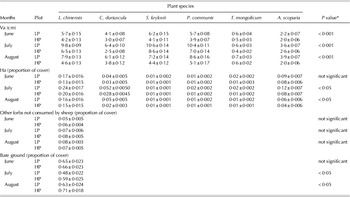
Table 2 shows the vertical and horizontal availability of the plant species consumed by sheep. Statistical analysis revealed that the vertical availability of each plant species on LP was higher than that on HP (P<0·05) in each month; the horizontal availability of vegetation on LP was also generally higher (but not significantly so) than that on HP, with an exception in June.
Vertical (mean±s.e., n=80 for each individual species measurement) and horizontal availability (mean±s.e., n=10 for each individual species measurement) of vegetation on the LP and HP during three grazing months

Va, vertical availability; Ha, horizontal availability; LP, low stocking rate plot; HP, high stocking rate plot.
* Probability of t-test between the LP and HP.
The herbage biomass on the LP was 53·2, 150·6 and 58·4 g DM/m2 in June, July and August, respectively. The biomass on the HP was 33·5, 87·2 and 23·1 g DM/m2 in June, July and August, respectively (Table 2).
Diet composition
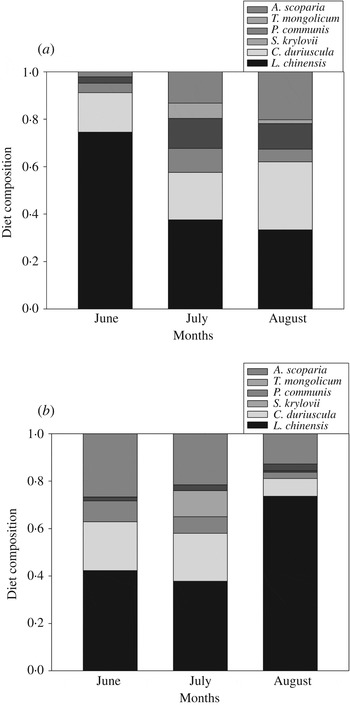
The concentrations of plant-wax markers showed obvious seasonal variation (Supp. Table 1; go to http://journals.cambridge.org/AGS) and the recovery rates of each marker ranged from 0·47 to 1·28 (Supp. Table 2; go to http://journals.cambridge.org/AGS). The appropriate marker combination used for diet composition determination was alkane+LCOH, alkane+LCOH and alkane+LCOH in June, July and August, respectively (Supp. Fig. 1; go to http://journals.cambridge.org/AGS). The proportions of various dietary components were different in each month on the LP (Fig. 1(a)). In June, the bulk of the sheep diet was made up of L. chinensis and C. duriuscula, with other plant species presenting only minor components. In July, sheep tended to consume a more diverse diet although L. chinensis was still the major dietary component. In August, L. chinensis, C. duriuscula and A. scoparia became the major dietary components. On the HP, the different diet composition was also identified in each month (Fig. 1(b)). The major dietary composition was L. chinensis, C. duriuscula and A. scoparia in June and July. However, L. chinensis accounted for the largest proportion in August.
Diet composition of sheep grazing on the (a) LP and (b) HP in June, July, and August.

Relationship between diet composition and sward variables
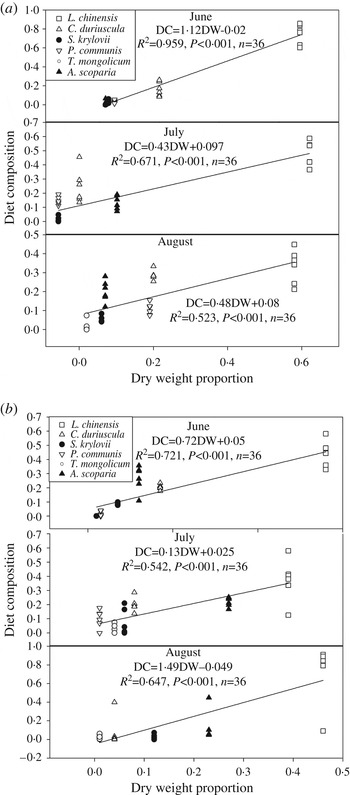
Diet composition (proportion of botanical composition in the diet) for each component plant species showed a positive and linear relationship with dry weight proportion of corresponding plant species on offer in the sward in June (R 2=0·959, P<0·001), July (R 2=0·671, P<0·001) and August (R 2=0·523, P<0·001) on LP, and also for HP in June (R 2=0·721, P<0·001), July (R 2=0·542, P<0·001) and August (R 2=0·647, P<0·001) (Figs 2(a) and (b)).
The relationship between the percentages of botanical components in the diet and DWP of corresponding plants on the (a) LP and (b) HP.

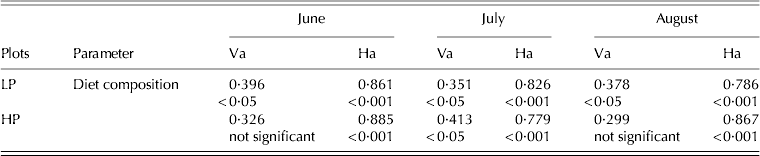
On the LP, diet composition was positively and significantly associated with vertical availability in June (r=0·396, P<0·05), July (r=0·351, P<0·05) and August (r=0·378, P<0·05). Horizontal availability also significantly correlated with diet composition in June (r=0·861, P<0·001), July (r=0·826, P<0·001) and August (r=0·786, P<0·001). In the case of HP, correlations between diet composition and horizontal availability were also significantly positive and strong in June (r=0·885, P<0·001), July (r=0·779, P<0·001) and August (r=0·867, P<0·001). However, a significant (r=0·413, P<0·05) correlation between vertical availability and diet composition only occurred in July (Table 3).
Correlation between diet composition, Va (vertical availability) and Ha (horizontal availability) for the low (LP) and high (HP) stocking rate plots

All values are Pearson correlation coefficient (range 0–1).
Selectivity index
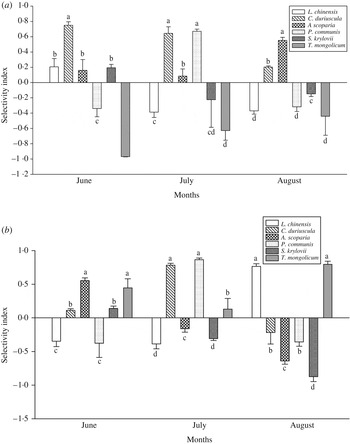
The selectivity index for each plant species changed on both plots over the grazing months (Fig. 3). On LP, both C. duriuscula and A. scoparia were positively selected during all the grazing periods. In contrast, T. mongolicum was consistently avoided in each month. Leymus chinensis, the dominant species in this region, was only positively selected in June. When the selectivity index was calculated for the estimated diets on the HP, the variation of selectivity index of plant species in each month was also observed. Leymus chinensis was negatively selected in June and July, but was positively selected in August. Taraxacum mongolicum showed consistent positive selection during the whole grazing seasons. However, positive selection for A. scoparia and S. krylovii only occurred in June.
Selectivity index for sheep grazing on L. chinensis grassland in the (a) LP and (b) HP in June, July and August (n=6).

DISCUSSION
n-Alkanes, alcohols and fatty acids are the plant-wax markers generally used in estimating diet composition of sheep and much work in evaluating the accuracy of n-alkanes, long-chain alcohols and long-chain fatty acids as diet composition markers has been done using these markers in the past few years (Lin et al. Reference Lin, Luo, Zhang and Shu2007, Reference Lin, Luo, Wang, Zhang and Shu2009a , Reference Lin, Luo, Zhang, Wang, Shu and Hong b ). A particular study conducted by Lin et al. (Reference Lin, Zhu, Jiang, Luo, Wang, Zhang and Hong2012) on this type of grassland found alkanes, alcohols and acids as markers to be of great value for determining the complex diet composition of sheep with up to eight diet components. Although the reliability of the plant-wax technique appeared to decline as the number of dietary components increased, the results of the estimations were still satisfactory. Appropriate marker combination should be selected before the estimation of sheep diet composition. The use of more markers increases the possibility of differentiating plant species (Mayes & Dove Reference Mayes and Dove2000), but using more markers does not always imply better estimation of composition of mixtures (Bugalho et al. Reference Bugalho, Dove, Kelman, Wood and Mayes2004; Ali et al. Reference Ali, Mayes, Hector and Ørskov2005). The study carried out by Lin et al. (Reference Lin, Luo, Wang, Zhang and Shu2009a ) in the same region as the current study based on PCA also pointed out that appropriate marker combination should be chosen based on PCA in assessing composition of mixtures. In the present study, the results of PCA indicated that the clearest separation between the six species analysed was from the combination of alkane+LCOH, alkane+LCOH and alkane+LCOH in June, July and August, respectively.
The diet composition results attained in the current study demonstrate clearly that the botanical components selected by grazing sheep differed between months and between plots. An individual component's vertical and horizontal availability varied with season and plot, and the diet selection response of the sheep was influenced by these changes.
In complex natural sward communities, herbivores are presented with differences in the vertical and horizontal availability of different species, created by the feedback effects of previous consumption and climate conditions in different seasons. It is well established that herbivore intake is affected by changes in vertical and horizontal food availability (Thornley et al. Reference Thornley, Parsons, Newman and Penning1994; Dumont et al. Reference Dumont, Meuret and Prud'hon1995; Edwards et al. Reference Edwards, Newman, Parsons and Krebs1996). In the current study, it was found that the botanical proportion of component plant species in the diet was correlated with that on offer on the sward both on the LP and HP in each month. Earlier studies investigating sheep grazing behaviour have indicated that the diet composition of grazing animals within a range of grazing intensities has often been positively related to the relative abundance of vegetation items in the sward (Hernandez et al. Reference Hernandez, Argel, Ibrahim and Mannetje1995; Wright et al. Reference Wright, Jones and Parsons2001; Animut et al. Reference Animut, Goetsch, Aiken, Puchala, Detweiler, Krehbiel, Merkel, Sahlu, Dawson, Johnson and Gipson2005). The abundance (dry weight proportion or the absolute mass on offer in the sward) is the total reflection of the vertical and horizontal availability of each plant species. However, there was uncertainty over the relative importance of the two variables in influencing the seasonal diet variation when sheep grazed freely on natural sward communities.
In most studies, vertical availability was generally thought to be the most important sward variable affecting the ingestion of food items (Gong et al. Reference Gong, Hodgson, Lambert and Gordon1996b , Reference Gong, Hodgson, Lambert and Gordon c ). In the current study, a significant correlation was detected on the LP between diet composition and vertical availability in June, July and August. Bite depth, area and volume increased with vertical availability (Burlison et al. Reference Burlison, Hodgson and Illius1991; Laca et al. Reference Laca, Ungar, Seligman and Demment1992); the relatively high vertical availability of certain plant species on the LP may promote their consumption and, thus, they will occupy a high proportion of the diet. Horizontal availability was consistently and significantly correlated with sheep diet composition, and was a more important determinant than vertical availability in influencing seasonal diet variation in all grazing months. The horizontal availability used in the current paper was the proportion of ground cover for each plant species, which tended to reflect the encounter frequency for a species when sheep grazed freely on the grassland. The results on the LP clearly demonstrate that the plant species with a relatively high horizontal availability increased their consumption; this is in agreement with the findings of Parsons et al. (Reference Parsons, Thornley, Newman and Penning1994). High horizontal availability increases the rate at which the sheep encounters the food items and, thus, the time spent on grazing the particular food type.
The sheep's response to vertical sward availability on the HP was different from that of the LP. Stocking rates impact animal performance and sward conditions (Huston et al. Reference Huston, Thompson and Taylor1993; Davies & Southey Reference Davies and Southey2001). High stocking rates restrict forage mass and limit potential forage selectivity (Davies & Southey Reference Davies and Southey2001). In the current study, the sheep numbers used on the LP and HP were determined according to the most common grazing practices (moderate and high grazing treatments) in the region where the experiments were conducted. In addition, the vegetation availability attained from the two plots in each month was similar to that of the moderate and high grazing treatments. The standing mass per unit area presented in each month on the HP was obviously lower than that of the LP, which could also reflect a lower vertical and horizontal sward availability. In contrast to the LP, vertical availability and diet composition were not related in either June or August. This was because the very low vertical availability of all the components species might impose severe constraints to bite depth, area or volume, and sheep tended to eat whatever they encountered. In July, the vertical availability of each plant species increased to varying degrees, relieving the severe bite constraints to some extent. Consumption of plant species with high vertical availability was increased. The results attained from the LP and HP indicated that the relationship between diet composition and vertical availability becomes less relevant when the food item's vertical availability falls above or below a certain level. Under low vegetation availability conditions, sheep diet composition was affected by the horizontal availability in a similar way to that on the LP, and showed a consistently dominant effect in plant consumption. Overall, when grazing on natural vegetation communities with plant species differing in both vertical and horizontal availability, sheep tended to take the ‘easier-reach’ strategy, as suggested by Parsons et al. (Reference Parsons, Thornley, Newman and Penning1994). Selective grazing strategies and optimal diets, i.e. those that provide maximum net energy balance or value, are identified by animals when grazing from plant species with different availabilities.
A number of theoretical studies have demonstrated that animal grazing is influenced by horizontal availability, because horizontal availability is directly related to searching time and energy costs in locating food items (Parsons et al. Reference Parsons, Thornley, Newman and Penning1994; Thornley et al. Reference Thornley, Parsons, Newman and Penning1994). Grazing behaviour is also significantly related to vertical availability irrespective of forage species (Gong et al. Reference Gong, Lambert and Hodgson1996a ). These results indicate that animal grazing is modified by the vertical and horizontal availability of plant species. In the current study, it was found that the seasonal variation in diet composition at both plots was obviously influenced by the vertical and horizontal availability of plant species, but the relative importance of these two variables differed. Vertical availability was a less important factor than horizontal availability in each month. Most studies have shown that vertical availability was most strongly and positively correlated with intake and was the dominant influence (Burlison et al. Reference Burlison, Hodgson and Illius1991; Gong et al. Reference Gong, Hodgson, Lambert and Gordon1996c ). The difference may come from the fact that previous studies were short term, generally lasting less than 15 min on specially created artificial swards or simplified food environments and horizontal availability was rarely taken into consideration. Although these previous experiments have provided valuable information on the effects of sward characteristics on food item intake, it is clear that those short-term observations and simplified environments do not adequately reflect the long-term grazing situation in the field. In addition, the animal species and size, and the specific vegetation availability created in the current experiment varied from previous studies, which may also contribute to this difference. In addition to vegetation availability, the nutrient contents (protein or fibre contents) might also play a role in sheep diet selection, especially for the main diet items such as L. chinensis, C. duriuscula and A. scoparia. Leymus chinensis is the dominant plant species in the experimental region. It contained higher crude protein and fibre contents than C. duriuscula and A. scoparia during the whole grazing months and was the most important diet component on both plots. However, the consumption pattern for these plant species differed between the two plots. On the LP, with enough food resources, sheep tended to decrease their consumption of L. chinensis and turned to C. duriuscula and A. scoparia as the month progressed, because of the consistently increased fibre content in L. chinensis. However, sheep still focused their grazing on L. chinensis on HP, particularly in August when the fibre content reached its peak. The reason might be that sheep would trade off quality for quantity when faced with limited vegetation availability.
Selective grazing is an important determinant of the botanical composition of complex species grassland communities. Changing selectivity from month to month will have significant implications for the long-term restoration and sustainability of the L. chinensis grassland. The selectivity index used in the current study represents the relative consumption of plant species, accounting for differences in its relative abundance and, hence, its availability to the sheep. In this way, the selectivity indices of diet components reflect the sheep's impact on plant community composition and structure (Augustine & McNaughton Reference Augustine and McNaughton1998; Ritchie & Olff Reference Ritchie, Olff, Olff, Brown and Drent1999). Positive values for plant species indicate an excess consumption in relation to their abundance. Similarly, the negative score indicates a lower consumption in relation to abundance. On the LP, the grazing impacts on different component items were different. Although L. chinensis occupied a higher proportion of the diet than the others in each month, it was only excessively consumed in June. Across the entire grazing period on the LP, the average selectivity indices of L. chinensis, P. communis and the minor components T. mongolicum and S. krylovii were all negative values, indicating a lower consumption relative to abundance. In addition, C. duriuscula and A. scoparia were the only excessively consumed plant species. On the HP, as L. chinensis consumption in August was high (accounting for >0·6 of the total diet), the sheep showed very strong selection in this month. The negative selection of C. duriuscula in August and A. scoparia in July and August most likely resulted from the decreased availability of both species. Although P. communis and S. krylovii had a relatively high vertical availability, the low horizontal availability would hinder their consumption and resulted in low average selectivity indices across all of the grazing months.
The results of the current study also showed a general trend for the grazing impacts of different plant species to increase with the increased proportion of corresponding plant items in the diet on both plots. This, combined with the results discussed previously (the positive relationship between diet composition and abundance of vegetation items in the sward) indicated that the plant species with higher availability in the sward may be more likely to face excessive consumption in this region. The continuously changing selectivity indices induced by the changing vegetation availability suggest that temporal changes in different stocking regimes in the selectivity of plant species must be taken into account when considering sheep grazing. Pasture management strategies should maintain or enhance the abundance and growth of those species mainly consumed by sheep in light of the diet selectivity index in each period.
CONCLUSION
Overall, when grazing on natural L. chinensis grassland sheep exhibited significant seasonal changes in diet selection on both the LP and HP. It was confirmed that the seasonal variation of sheep diet composition is related to the vertical and horizontal availability of plant species on both plots. However, the relative importance of these two variables differed. Horizontal availability was continuously dominant in influencing sheep consumption in each grazing month, but the effect of vertical availability varied among months and between plots. The selectivity index reflected the changing selectivity for each plant species on both plots, indicating that grazing impacts on grassland communities differ with vegetation availability.
The supplementary material for this article can be found at http://www.journals.cambridge.org/AGS
We thank the funds of project (2014CB138805), the National Natural Science Foundation of China (31270375) and Projects for Agro-Industry Technology Research (200903060 and CARS-35) for their generous support of our research.