Introduction
Host partitioning allows for multiple species to live in close proximity to one another. An extreme case of this is found on the surface of an individual bird, which may host multiple taxa of permanent ectosymbionts. One rock pigeon, Columba livia Gmelin (Columbiformes: Columbidae), for example, can be infested with chewing lice (Phthiraptera: Menoponidae, Philopteridae), vane-dwelling feather mites (Sarcoptiformes), skin mites (Trombidiformes), and nasal mites (Mesostigmata) (Grossi and Proctor Reference Grossi and Proctor2021). Although the nasal passages and skin of a bird offer fairly homogeneous environments, the feathers of a bird vary greatly in size and structure; this allows chewing lice and vane-dwelling feather mites to further partition their host.
The scale in which the host’s feathers are examined depends on the taxa of interest. When investigating the distribution of vane-dwelling feather mites, each feather must be examined because several species may spatially partition individual feathers (Mestre et al. Reference Mestre, Mesquita-Joanes, Proctor and Monrós2011; Fernández-González et al. Reference Fernández-González, Pérez-Rodríguez, de la Hera, Proctor and Pérez-Tris2015). Chewing lice, on the other hand, tend to inhabit different regions of the host as characterised by the feathers present. Dubinin (Reference Dubinin1947) presented the classic example, where he mapped the distribution of four genera of chewing lice infesting the glossy ibis (Plegadis falcinellus Linnaeus) (Pelecaniformes: Theskiornithidae) according to different areas of its body. Nelson and Murray (Reference Nelson and Murray1971) also looked at the distribution of lice on rock pigeons and found that Campanulotes compar (Burmeister) infests the neck, back, sides, breast, and vent of the rock pigeon, and Columbicola columbae (Linnaeus) is found overwhelmingly on the wings. Several additional authors have examined the spatial distribution of chewing lice on a variety of avian hosts (e.g., Stock and Hunt Reference Stock and Hunt1989; Cicchino and Mey Reference Cicchino and Mey2007; Rouag-Ziane et al. Reference Rouag-Ziane, Boulahbal, Gauthier-Clerc, Thomas and Chabi2007; Touati and Samraoui Reference Touati and Samraoui2013; Touati et al. Reference Touati, Figuerolac, Alfarhand and Samraoui2015).
Chewing lice are permanent ectoparasites of birds and mammals; therefore, they have no free-living stage and complete their whole life cycle upon their host (Marshall Reference Marshall1981). Lice disperse between hosts mainly by direct contact. There are two suborders of chewing lice infesting birds, each typically having different strategies for spatial distribution. Ischnocera are thought to be more site specific than Amblycera, which are generally more mobile and less restricted to a specific area of the host’s body (Ash Reference Ash1960; Marshall Reference Marshall1981).
One benefit to becoming specialised to an area of a host body is being able to counteract host defences. The primary mechanism that birds use to defend themselves against chewing lice is preening (Clayton et al. Reference Clayton, Koop, Harbison, Moyer and Bush2010). Preening is the manipulation of the feathers with the beak and, to a lesser extent, the feet. There are four main ways that chewing lice combat host defences, which are linked to where they are found on the host body. Chewing lice found on the head avoid preening by being located on a region of the body where the beak cannot reach; however, they are still susceptible to foot scratching. Foot scratching has been experimentally shown to disturb the lice residing on the head and neck and to flush them into areas of the body where they are more susceptible to preening (Goodman et al. Reference Goodman, Klingensmith, Bush and Clayton2020). Lice found on the head usually have stout, round bodies that are not as dorsoventrally flattened as are seen in chewing lice found elsewhere because they do not have to deal with the same degree of host preening (Clay Reference Clay1949). Feathers found on the head and neck are often narrower than are found elsewhere on the body; as an adaptation, lice infesting the head have large mandibles that are used to grip the feather barbs (Clay Reference Clay1951). Lice inhabiting the wings, such as C. columbae, usually have slim, elongated bodies that allow them to fit between the barbs of the flight feathers (Marshall Reference Marshall1981; Clayton Reference Clayton, Loye and Zuk1991). This is advantageous because lice that are situated between the barbs of the flight feathers are less likely to be removed during preening. Lice infesting the body region, such as C. compar, usually have rounded bodies and rounded head margins (Johnson et al. Reference Johnson, Shreve and Smith2012). They avoid preening by dropping from one feather to another or by burrowing into the downy matrix of the feathers (Clayton Reference Clayton, Loye and Zuk1991). Lice found more generally over the body surface have an intermediate body shape and are not associated with any particular region of the host’s body. To avoid preening, they actively move about through the feathers. It should be noted that many groups of lice do not fall into these morphological types, and little is known about their microhabitat preferences and preening escape mechanisms.
The spatial distribution of chewing lice on Canada geese, Branta canadensis (Linnaeus) (Anseriformes: Anatidae), and mallards, Anas platyrhynchos Linnaeus (Anseriformes: Anatidae), was studied as part of ongoing ectoparasite research at the University of Manitoba, Winnipeg, Manitoba, Canada. The objective of the present study was to describe the spatial distribution of chewing lice infesting Canada geese and mallards. We expected the distribution of ischnoceran lice to be restricted to more limited areas of the host’s body and amblyceran lice to be generalists and therefore found more widely distributed on the host’s body. For the ischnocerans, we predicted Anaticola to be restricted to the wings and Anatoecus to be restricted to the head because they both have morphology typical of lice associated with those respective regions. We also predicted that Ornithobius would be found on the body. Although Ornithobius does not display the typical morphology of a body louse, if ischnoceran lice do have restricted distributions, the host’s body seems like the default location because Ornithobius does not have morphology typical of lice associated with the head or wings. Three genera of lice (Anaticola, Anatoecus, and Trinoton) are found on both Canada geese and mallards, and we predicted they would be found in the same regions of their hosts’ bodies, despite the hosts being different species. Although Strilchuk (Reference Strilchuk1976) studied spatial distribution of chewing lice on mallards previously (n = 2), the present study is the first to examine the spatial distribution of chewing lice on Canada geese.
Materials and methods
Hosts were salvaged from wildlife rehabilitation centres in Manitoba, Canada, under a wildlife scientific permit (CWS99-M023) issued by Environment Canada, Canadian Wildlife Service or were provided by licensed hunters. Once euthanised or shot, birds were placed immediately into individual plastic bags and frozen for at least 48 hours at –20 °C to kill all chewing lice.
To remove the lice, birds were thawed at room temperature. Once a bird’s appendages were easily movable, the bird was dissected into six body regions: head and neck, left wing, right wing, back, underside, and tail. The head and neck were removed where the neck meets the clavicle. Each wing was then separated from the body where the head of the humerus meets the scapula. The back and then the underside were skinned, taking special care not to dislodge any lice. The underside includes the breast, sides, flanks, belly, tibial feathers, and vent. The tail was then removed; this included the upper- and undertail coverlets.
Each body region was then washed separately according to the procedure outlined in Grossi et al. (Reference Grossi, Sharanowski and Galloway2014). Lice were mounted on slides (Richards Reference Richards1964) and were identified using relevant taxonomic literature (Kéler Reference Kéler1960; Price and Beer Reference Price and Beer1965; Price Reference Price1971; Eichler and Vasjukova Reference Eichler and Vasjukova1980; Price et al. Reference Price, Hellenthal, Palma, Price, Hellenthal, Palma, Johnson and Clayton2003; Arnold Reference Arnold2005). Regarding the genus Anatoecus, we followed the synonymy proposed by Grossi et al. (Reference Grossi, Sharanowski and Galloway2014), in which Anatoecus dentatus (Scopoli) and Anatoecus icterodes (Nitzsch) are reclassified as A. dentatus. All lice collected were deposited in the J.B. Wallis/R.E. Roughley Museum of Entomology, University of Manitoba, Winnipeg, Manitoba, Canada.
To visualise and compare the spatial distribution of the different species of lice, nonmetric multidimensional scaling (NMDS) plots were generated in R using the vegan package (Oksanen et al. Reference Oksanen, Blanchet, Guillaume Friendly, Kindt, Legendre and McGlinn2018). Additionally, Fisher’s Exact tests were done in R (R Core Team 2018) to compare the distributions of adults and nymphs of the same species.
Results
From March to December 2012, 20 adult Canada geese and eight adult mallards were broken down into six body regions, as described above. Because the left and right wings represent the same feather structure, lice from both wings were combined and are hereafter referred to collectively as ‘wings’.
Canada geese, Branta canadensis (n = 20)
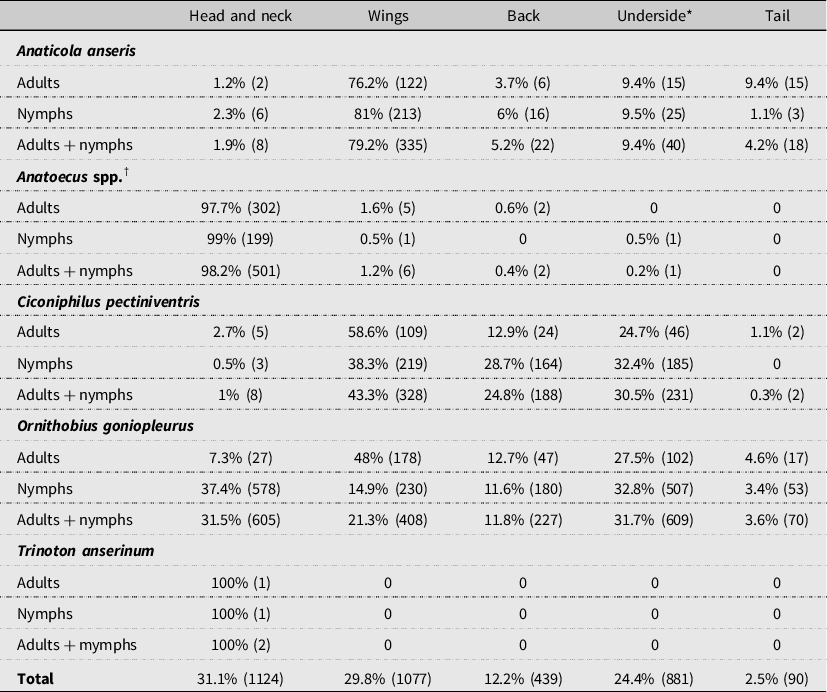
Six species of lice were collected from Canada geese: Amblycera – Ciconiphilus pectiniventris (Harrison), Trinoton anserinum (Fabricius) and Ischnocera – Anaticola anseris (Linnaeus), Anatoecus dentatus, Anatoecus penicillatus (Kéler), and Ornithobius goniopleurus Denny. In total, 3611 lice were collected, and infestations ranged from 0 to 1374 lice per bird (Supplementary material, Table S1). Most of the lice were found on the head and neck (31.1%), wings (29.8%), and underside (24.4%) regions of their hosts (Table 1).
Prevalence of chewing lice infesting different body regions of Canada geese, Branta canadensis (n = 20), in 2012, Manitoba, Canada. Total numbers of lice collected from each body region are in parentheses.

* Underside includes breast, sides, flanks, belly, tibial feathers, and vent.
† Includes Anatoecus dentatus and Anatoecus penicillatus.
Anaticola anseris (n = 423) was found primarily on the wings (79.2%; Table 1). Although adults and nymphs were both mainly found on the wings, their distribution on the rest of the host’s body differed (Fisher’s Exact, P = 0.001). Adults were distributed over the underside and tail, whereas nymphs were distributed over the back and underside. Anatoecus spp. (n = 510) were found almost exclusively on the head and neck (98.2%; Table 1). Anatoecus penicillatus (n = 2 adults) was observed on only one Canada goose. This goose was also infested with A. dentatus (n = 19 adults). Both of these species were only found on the head and neck of this bird. The distribution of adults and nymphs of Anatoecus spp. did not differ (Fisher’s Exact, P = 0.27). Ornithobius goniopleurus (n = 1919) was found mainly on the underside (31.7%), head and neck (31.5%), and wings (21.3%). A large difference in the distribution of adults and nymphs was identified (Fisher’s Exact, P = 2.2 × 10⁻¹⁶); adults were found predominantly on the wings (48.0%), whereas nymphs were found mainly on the head and neck (37.4%) and underside (32.8%). Ciconiphilus pectiniventris (n = 757) was found mainly on the wings (43.3%) but not to the same extent as A. anseris. Adults of C. pectiniventris were mostly restricted to the wings (58.6%) and underside (24.7%); nymphs were distributed more evenly over the wings (38.3%), underside (32.4%), and back (38.7%; Fisher’s Exact, P = 6.1 × 10⁻⁹). Only two T. anserinum were collected from one host, both from the head and neck; due to the small sample size, no conclusions about the spatial distribution of this species can be reached.
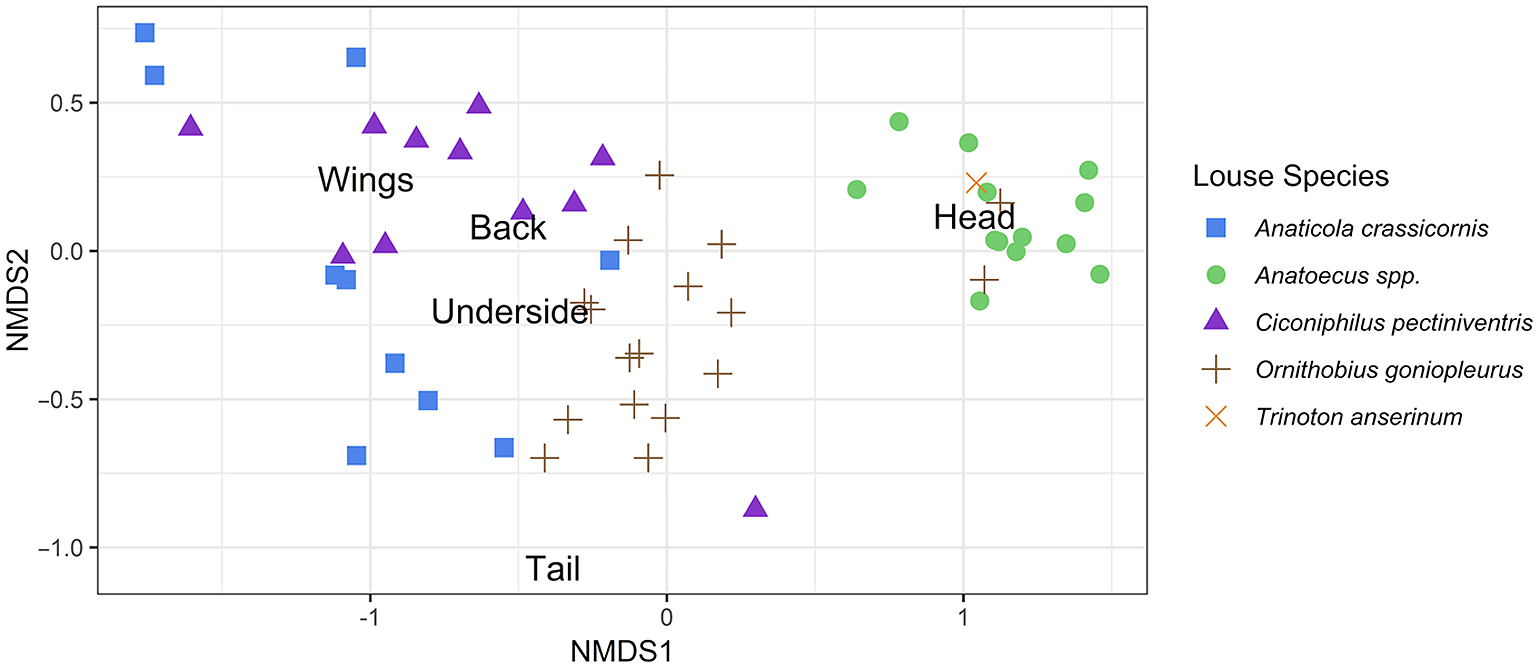
The plot (Fig. 1), based on the distribution of each louse species on its host, shows Anatoecus spp. grounded around the head and A. anseris, C. pectiniventris, and O. goniopleurus more widely distributed over the wings, back, and underside.
Nonmetric multidimensional scaling plot of chewing louse species infesting Canada geese, Branta canadensis, based on body region they inhabit (n = 20). Stress = 0.076; points have been jittered (width = 0.25, height = 0.25), to minimise visual overlap.

Mallard, Anas platyrhynchos (n = 8)
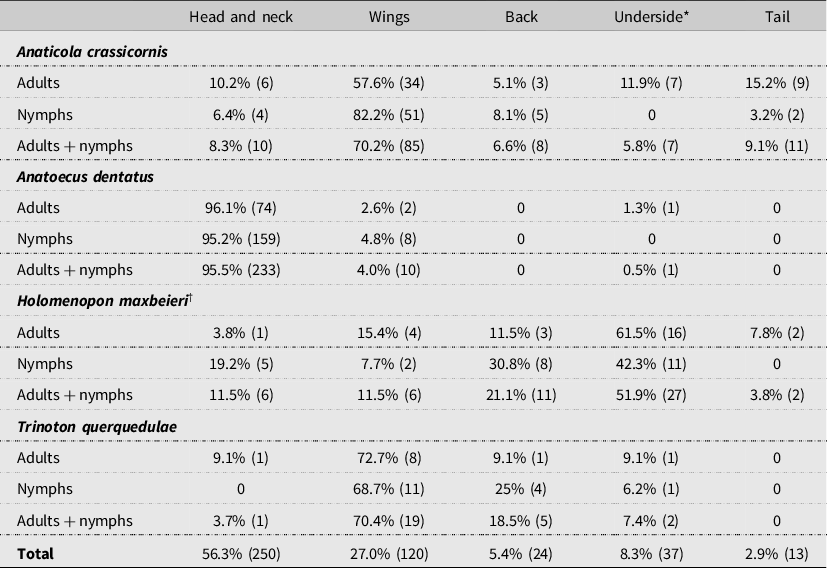
Four species of chewing lice were collected from mallards: Amblycera – Holomenopon maxbeieri Eichler and Trinoton querquedulae (Linnaeus); Ischnocera – Anaticola crassicornis (Scopoli) and A. dentatus. In total, 444 lice were collected, and infestations ranged from four to 213 lice per bird (Supplementary material, Table S2). Most of the lice were collected from the head and neck (56.3%) and wings (27.0%); Table 2 provides the spatial distribution of each species.
Prevalence of chewing lice infesting different body regions of mallards, Anas platyrhynchos (n = 8), in 2012, Manitoba, Canada. Total numbers of lice collected from each body region are in parentheses.

* Underside includes breast, sides, flanks, belly, tibial feathers, and vent.
† May include nymphs of Holomenopon leucoxanthum.
Anaticola crassicornis (n = 121) was found primarily on the wings (70.2%; Table 2). Although nymphs were restricted mainly to the wings (82.2%), adults were more widely distributed across not just the wings (57.6%) but also the tail (15.2%), underside (11.9%), and head and neck (10.2%; Fisher’s Exact, P = 0.0018). Anatoecus dentatus (n = 244) was found almost exclusively on the head (95.5%), and there was no difference in the distributions of adults and nymphs (Fisher’s Exact, P = 0.35). Both H. maxbeieri and Holomenopon leucoxanthum (Burmeister) have been recorded from mallards (Price et al. Reference Price, Hellenthal, Palma, Price, Hellenthal, Palma, Johnson and Clayton2003). In the present study, only three mallards were infested with Holomenopon; two mallards were infested with only adult H. maxbeieri; and one mallard was infested with only nymphs. Because nymphs cannot be confidently identified to species, no attempt was made to identify Holomenopon nymphs, and therefore, we refer to all Holomenopon as H. maxbeieri, despite the possibility that nymphs of H. leucoxanthum may also have been present. Holomenopon maxbeieri (n = 52) was most prevalent on the underside (51.9%) and back (21.1%). No significant difference in the distributions of adults and nymphs of H. maxbeieri was found (Fisher’s Exact, P = 0.074). Trinoton querquedulae (n = 27) was collected predominantly from the wings (70.4%); the distribution of adults and nymphs did not differ (Fisher’s Exact, P = 0.59).
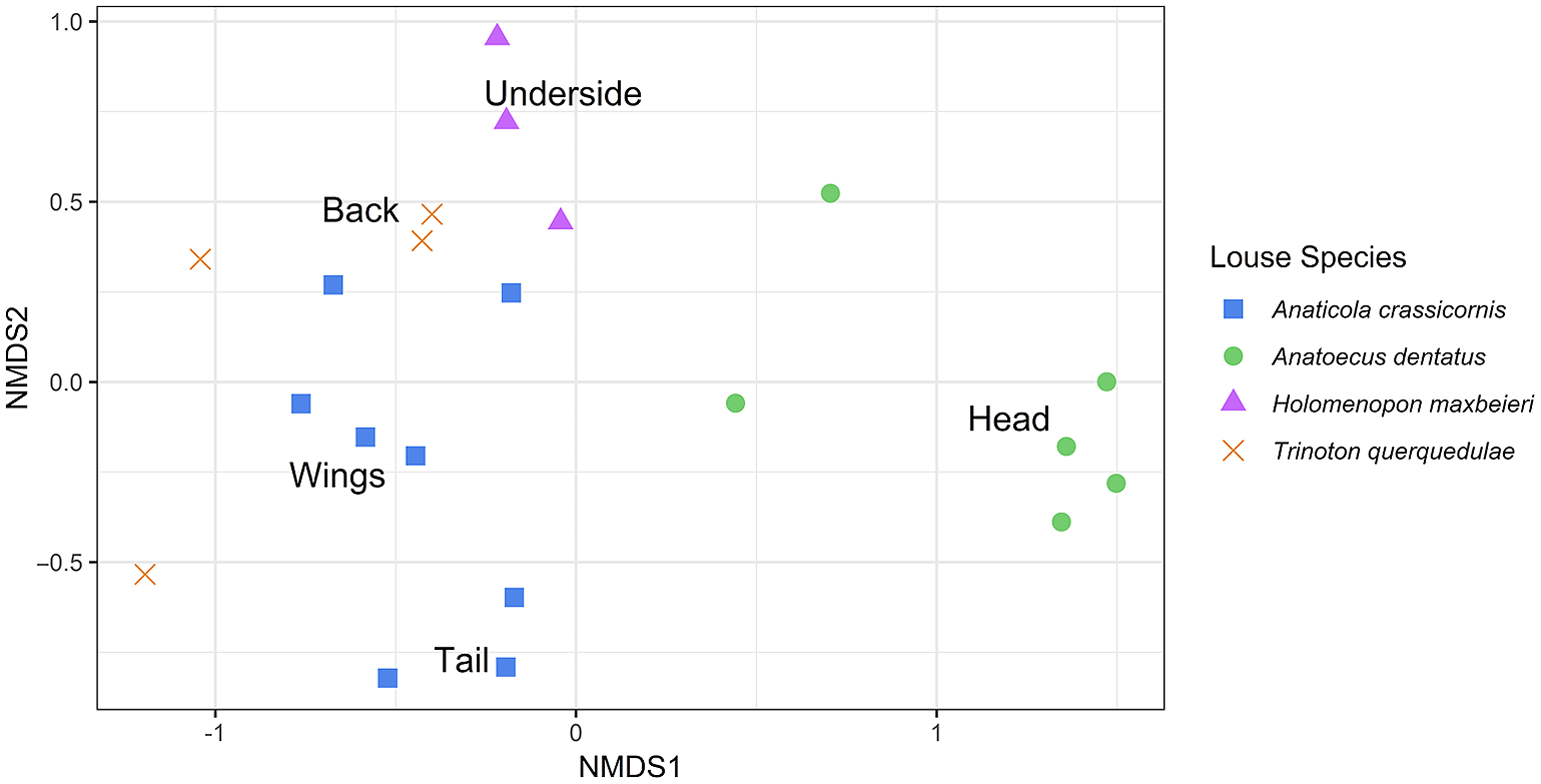
The plot (Fig. 2), based on the distribution of each louse species on its host, shows Anatoecus dentatus grouped around the head and Anaticola crassicornis grouped around the wings and tail.
Nonmetric multidimensional scaling plot of chewing louse species infesting mallards, Anas platyrhynchos, based on body region they inhabit (n = 8). Stress = 0.11; points have been jittered (width = 0.25, height = 0.25), to minimise visual overlap.

Discussion
Ischnoceran lice are known to be specialised to particular body regions (Ash Reference Ash1960; Marshall Reference Marshall1981), and the present study found this to be true for Anaticola spp. and Anatoecus spp. These species also fit the stereotypical distributions for their body shape. Anaticola is a long slender louse that is found predominantly on the wings, and Anatoecus is a short, globular louse that is found almost exclusively on the head. However, on Canada geese, the ischnoceran O. goniopleurus is a long, nonslender louse with rounded head margins, and it was not confined to a specific area but was distributed over multiple body regions (31.5% head and neck, 21.3% wings, and 31.7% underside). Amblyceran lice are considered to be generalists, and H. maxbeieri and C. pectiniventris were found over multiple body regions, with H. maxbeieri found mainly on the underside and back and C. pectiniventris found distributed over the wings, underside, and back. Trinoton querquedulae, an amblyceran found on mallards and as reported by Strilchuk (Reference Strilchuk1976), was recorded mainly on the wings (70.4%) of its host, contrary to the generalist nature of amblycerans. Trinoton querquedulae is a large robust louse and in no way would be referred to as slender, as the ischnoceran wing specialists are. In the present study and in Strilchuk (Reference Strilchuk1976), sample sizes for T. querquedulae were relatively small, with only 29 specimens in the present study and 10 in Strilchuk (Reference Strilchuk1976). Strilchuk (Reference Strilchuk1976) reported that eggs of T. querquedulae were present on the head and neck and on the wings, suggesting that at least the females of this species must move about on regions other than the wings. Additional data would be useful to verify our findings.
The ability of Ornithobius goniopleurus to inhabit multiple body regions may be linked to its diet. Ischnoceran and amblyceran lice both feed on feathers and skin debris; in addition, many species of amblyceran are known to feed on blood (Marshall Reference Marshall1981). It is thought that the ability to feed on blood, combined with their greater mobility, allows amblyceran lice to avoid competition by moving around the host’s body because they are less restricted to a specific feather structure (Marshall Reference Marshall1981; Choe and Kim Reference Choe and Kim1988). While conducting this study, a red substance assumed to be blood was frequently observed in the guts of adults and nymphs of O. goniopleurus. The ability of O. goniopleurus to feed on blood may have allowed it to adopt a generalist strategy in terms of where it is found on the body of its host.
In addition to O. goniopleurus being more of a generalist, its adults and nymphs exhibited different spatial distributions. Other examples of different life stages of chewing lice infesting different body regions of their host exist. Quadraceps obliquus (Mjöberg) on the common murre, Uria aalge (Pontoppidan) (Charadriiformes: Alcidae), also has this segregated distribution, with the breast and belly supporting most adults and the crissum and tail supporting most nymphs (Choe and Kim Reference Choe and Kim1988). Ziani et al. (Reference Ziani, Ziani, Dik, Marniche and Lazli2020) found that adults of Pseudomenopon pilosum (Scopoli) (Amblycera) were distributed mainly on the breast and belly regions of their host, common coot, Fulica atra Linnaeus (Gruiformes: Rallidae), whereas nymphs were found almost exclusively on the breast. Ziani et al. (Reference Ziani, Ziani, Dik, Marniche and Lazli2020) also reported that nymphs of Rallicola fulicae (Denny) (Ischnocera) were found on the wings of the same host in addition to other regions of the body where adults occurred. In the present study, on Canada geese, adult O. goniopleurus were mainly located on the wings (48%) and the underside (27.5%), whereas nymphs were more evenly distributed across the head and neck (37.4%) and underside (32.8%); adults were seldom found on the head and neck (7.3%). Even though a large percentage of nymphs was found on the head and neck, this could be an artefact of how the geese were dissected. The neck was removed at the point where it meets the body at the clavicle and not where the feather structure changes from narrow, black head feathers to downier white feathers. Therefore, the basal portion of the neck was covered in contour and downy feathers. Approximately one-third of O. goniopleurus nymphs were found on the underside of the goose, which is also covered in contour and downy feathers. It is possible that the nymphs of O. goniopleurus found on the head and neck, as defined here, were located on the basal portion that was covered in contour and downy feathers and not on the dorsal portions made up of the narrow contour feathers on the head. In any case, this is a region where adults of this species were seldom encountered. Even though it is not believed to be the case here, there have been records of lice moving towards the head of their host once the host is deceased — a movement pattern labelled the Drost Effect (Stenram Reference Stenram1956). We found no evidence of the Drost Effect on any of the hosts examined; this could be due to each host being placed into the freezer soon after being euthanised.
Examining smaller sections of each bird may be helpful to determine how louse species interact. One interaction that warrants closer examination is between A. dentatus and A. penicillatus on Canada geese. Previously, the mute swan, Cygnus olor (Gmelin) (Anseriformes: Anatidae), was the only recorded host for A. penicillatus (Price et al. Reference Price, Hellenthal, Palma, Price, Hellenthal, Palma, Johnson and Clayton2003); however, A. penicillatus was found on Canada geese and snow geese, Anser caerulescens (Linnaeus) (Anseriformes: Anatidae) in North America (Grossi et al. Reference Grossi, Sharanowski and Galloway2014). Anatoecus dentatus and A. penicillatus were observed together on the head and neck of these species. If the head and neck were subdivided and examined in smaller sections, it may be possible to determine whether finer spatial discrimination occurs. It would also be interesting to determine where on the head and neck A. penicillatus is found on its original host, the mute swan, and to compare that to its location on Canada geese and snow geese. This comparison could determine if A. penicillatus has modified its behaviour with these new hosts and the presence of a new competitor, A. dentatus.
Canada geese and mallards share three of the same genera of lice, Anaticola, Anatoecus, and Trinoton; these genera are also found on flamingos (Price et al. Reference Price, Hellenthal, Palma, Price, Hellenthal, Palma, Johnson and Clayton2003). Strilchuk (Reference Strilchuk1976) examined the spatial distribution of chewing lice on two mallards, and Palma et al. (Reference Palma, Johnson, Cezilly, Thomas and Renaud2002) described the spatial distribution of chewing lice on 250 live greater flamingo chicks, Phoenicopterus roseus Pallas (Phoenicopteriformes: Phoenicopteridae). Based on the distribution of Anaticola spp. from these two publications and from the present study, it is apparent that Anaticola is a wing specialist. In Manitoba, 79.2% and 70.2% of all Anaticola were found on the wings on Canada geese and mallards, respectively. Anaticola from the two mallards that Strilchuk (Reference Strilchuk1976) examined did not indicate such a clear preference for the wings; on these birds, 34.5% were found on the wings and 65.5% were found on the back; however, 97.7% of the Anaticola eggs were found on the wings. On the greater flamingo, 70.2% of Anaticola were observed on the wings. Another well-known wing specialist, C. columbae, that infests rock pigeons cements its eggs to the wing feathers, and it lies between the barbs of the wing feathers to avoid preening (Nelson and Murray Reference Nelson and Murray1971; Clayton Reference Clayton, Loye and Zuk1991). However, these lice feed on the fluffy portion of the body feathers (Nelson and Murray Reference Nelson and Murray1971). Perhaps something similar happens with Anaticola, which would explain why Strilchuk (Reference Strilchuk1976) found such a high percentage of adults on the body but found almost all of the eggs on the wings. Anatoecus is almost exclusively found on the head and neck, regardless of host. In the present study, 98.2% and 95.5% of all Anatoecus were found on the head of Canada geese and mallards, respectively. Strilchuk (Reference Strilchuk1976) observed 92.3% of Anatoecus on the head and neck on mallards, and Palma et al. (Reference Palma, Johnson, Cezilly, Thomas and Renaud2002) observed 94.3% of Anatoecus on the head of the greater flamingo. Trinoton does not have such a clear pattern observed across different host species. Peters (Reference Peters1928) described Trinoton as “very agile and strong of foot, infests the back and breast of most ducks”; however, 75% and 70.4% of Trinoton were reported on the wings of mallards in Strilchuk (Reference Strilchuk1976) and in the present study, respectively. On flamingos, Trinoton was predominantly observed on the flanks (61.5%; Palma et al. Reference Palma, Johnson, Cezilly, Thomas and Renaud2002).
In some other studies in which spatial distribution of lice was examined, a paper towel was placed between the body and wings to prevent movement between these body regions (Nelson and Murray Reference Nelson and Murray1971; Strilchuk Reference Strilchuk1976). This was not done in the present study, so movement between the wings and body cannot be ruled out. However, after the hosts are placed in the freezer, if movement did occur, it would probably be from the wings to the body as the lice tried to escape the cold.
In summary, ischnocerans Anaticola and Anatoecus have clearly defined distributions on the wings and head of Canada geese and mallards, respectively. In addition, their body shapes are consistent with what is expected for the lice that occupy these regions. Ornithobius goniopleurus is a generalist ischnoceran, and C. pectiniventris and H. maxbeieri are generalist amblycerans. Trinoton querquedulae was predicted to be a generalist because it is an amblyceran; despite this presupposition, its distribution was found to be confined mostly to the wings. Thus, what is currently known about the distribution of Ischnocera and Amblycera on their hosts should be considered generalisations of what is most commonly observed and should not be assumed to occur for all species. More detailed studies are needed to examine smaller regions of each host and egg distribution to improve our understanding of how these species of lice interact.
Supplementary material
To view supplementary material for this article, please visit https://doi.org/10.4039/tce.2022.27.
Acknowledgements
This work would not have been possible without the assistance of staff at Wildlife Haven, Prairie Wildlife Rehabilitation Centre, and Manitoba Conservation and the care they took in processing hosts for this study. The authors thank D. Holder, P. Snarr, S. Repa, and D. Dunlop for their technical support in washing birds. Ricardo Palma, Museum of New Zealand Te Papa Tongarewa, Wellington, New Zealand, kindly identified specimens of Anatoecus penicillatus. Funding was provided, in part, by a Discovery Grant held by Terry D. Galloway from the Natural Sciences and Engineering Council of Canada. The authors also thank Richard Labossière and John Dunlop for issuing Canadian Wildlife Service Scientific Permits. The continued support of the Department of Entomology and the Faculty of Agricultural and Food Sciences at the University of Manitoba is greatly appreciated.