Introduction
Many countries have an aging population; for example, in the U.K. 16% (9.7 million) of the population are over the age of 65 years, an increase of 31% between 1974 and 2006. By 2012, nearly 1 million people in the U.K. will have dementia (Knapp and Privette, Reference Knapp and Privette2007). Globally, more than 24.3 million people have dementia and this is set to double over the next 20 years (Ferri et al., Reference Ferri2005).
Older people use 40% of healthcare resources in the U.K. and occupy two-thirds of National Health Service hospital beds (Department of Health, 2001). In the U.S.A. 63% of Medicare costs for people with Alzheimer's disease (AD) are for inpatient hospital care. The age and physical frailty of patients in the acute hospital population suggests that dementia is common in this setting; however, even after hospital admission, detection rates are low (37–46%) (Harwood et al., Reference Harwood, Hope and Jacoby1997; Joray et al., Reference Joray, Wietlisbach and Bula2004) and dementia is often missed.
There appears to be limited data on the characteristics of patients with dementia in the acute hospital, on medical and psychiatric co-morbidity and on the effects of dementia on clinical and system-related outcomes. Evidence from the U.S.A. suggests that holistic management of frail older people in the acute hospital can significantly improve outcomes and decreases the risks of adverse events (Bogardus et al., Reference Bogardus, Desai, Williams, Leo-Summers, Acampora and Inouye2003). Improving the quality of care for people with dementia in general hospitals is a key objective of the English National Dementia Strategy (Banerjee and Owen, Reference Banerjee and Owen2009). Interventions to improve the quality of care will need to be informed by data on prevalence, associations and a range of clinically relevant outcomes.
Our primary aim was to review systematically the prevalence, associations and outcomes of dementia in older people admitted to the general hospital. Secondary aims were to examine the range of diagnostic tools used in this setting, highlight important gaps in the literature and assess the methodologies used in published work.
Methods
Search strategy and selection criteria
“Cognitive impairment” and “dementia” are terms that are sometimes used interchangeably but denote distinct clinical syndromes. To maximize the evidence base for our review we searched for both “dementia” and “cognitive impairment”. The search strategy was developed and refined on PubMed and translated for use in other databases (for the PubMed search strategy, see Appendix 1, published as supplementary material online attached to the electronic version of this paper at http://www.journals.cambridge.org/ipg). Databases included were PubMed (from 1950), Embase (from 1974), PsychInfo (from 1806) and Medline (from 1950). All databases were searched up to 4 March 2008. Ethical committee approval was not required.
Papers were selected if they fulfilled the following criteria:
• use of validated criteria for the diagnosis of dementia (i.e. DSM or ICD);
• subjects over 55 years of age (this appeared to be the most commonly used age cut-off point in the literature); studies on mixed cohorts that included younger patients, as well as those over 55 years, were included if dementia prevalence data regarding patients over 55 years was given separately;
• studies conducted in the general hospital;
• if the prevalence of dementia was not the primary outcome of the study, results from prospective cohort trials or cross-sectional studies were included if selection of study participants was not biased and subjects were representative of the general hospital population; and
• written in English.
Patients with hip fracture have a high prevalence of dementia. A systematic review of this and associated outcomes has already been published and we did not wish to repeat this work (Holmes and House, Reference Holmes and House2000). Therefore, studies of these patients were excluded. However, studies including other surgical specialties and wards within a general hospital were included.
Abstracts of studies were appraised for inclusion by the first author (NM). In cases of uncertainty, papers were independently assessed by a second reviewer (ELS). References of selected studies were also hand-searched.
Data extraction
Information was extracted from studies using a standardized tool. We examined the sampling methods for the population, the tools or diagnostic criteria used, the prevalence of dementia and, where given, associated demographic and clinical factors. The main outcomes of interest were mortality, length of hospital stay, change in functional status, place of residence after discharge, in-hospital morbidity and economic costs.
Data analysis
We calculated 95% confidence intervals (CI) for the prevalence of dementia to provide an estimate of the precision of results, using the following formula:
Proportion ± 1.96 × √[(proportion × (1 − proportion))/sample population]
Forest plots of prevalence estimates were generated using a validated meta-analysis software package (Bax et al., Reference Bax, Yu, Ikeda, Tsuruta and Moons2006).
Assessment of study quality
Studies were assessed for quality using a tool adapted from existing guidelines (Boyle, Reference Boyle1998). We noted whether studies used validated diagnostic or screening tools for delirium or depression, both of which, if present, may give a false-positive diagnosis of dementia. The tool comprised ten items giving a maximum (highest) quality score of 10.
Results
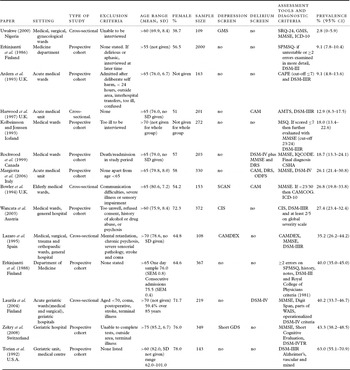
The PubMed search identified 1093 papers, but the majority of these were excluded as they were community based or assessed only delirium. Psychinfo retrieved a further 14 papers of interest, Embase and Medline retrieved one further paper each. After combining the results of all the searches, a total of 85 papers were considered, but only 12 of these met the final inclusion criteria. Hand-searching the references of retrieved papers identified a further eight papers of potential interest and of these, two fulfilled the inclusion criteria giving a total of 14 papers from which data are presented in this review. Table 1 summarizes the included studies, presented in order of increasing prevalence of dementia.
Prevalence of dementia in general hospital patients aged over 55 years

ADL = Activities of Daily Living; AMTS = Abbreviated Mental Test Score; BMI = Body Mass Index; CAM = Confusion Assessment Method; CAMCOG = Cognitive section of CAMDEX; CAMDEX = Cambridge Mental Disorders of the Elderly Examination; CAPE = Clifton Assessment Procedure for the Elderly; CIS = Clinical Interview Schedule; CSHA = Canadian Study of Health and Aging protocol; DRS = Delirium Rating Scale; DSM = Diagnostic and Statistical Manual of Mental Disorders; FIM = Functional Independence Measure; GDS = Geriatric Depression Scale; GMS = Geriatric Mental State; IADL = Instrumental Activities of Daily Living; IQCODE = Informant Questionnaire on Cognitive Decline in the Elderly; MNA = Mini Nutritional Assessment; MMSE = Mini-mental State Examination; ODFS = One Day Fluctuation Scale; SCAN = Schedules for Clinical Assessment in Neuropsychiatry; SD = standard deviation; SEM = standard error of the mean; SPMSQ = Short Portable Mental Status Questionnaire; SRQ-24 = Self-Reporting Questionnaire (24 item); WAIS = Wechsler Adult Intelligence Scale.
Study quality
Study quality varied widely (see Appendix 2, published as supplementary material online attached to the electronic version of this paper at http://www.journals.cambridge.org/ipg). Many studies were not explicit about their inclusion criteria, exclusion criteria or response rates. Factors causing the most variation in quality scoring were standardization of assessment methods between study staff and screening for delirium.
Methodology, sampling and setting of included studies
Sample sizes varied greatly (median number of subjects 203, range 108–2000). There were nine prospective cohort studies and five cross-sectional studies. Most studies investigated patients admitted to acute medical wards or elderly medical/geriatric units. Studies were based in a number of countries (three each from U.K. and Finland, one each from Nigeria, Iceland, Canada, Austria, Spain, Switzerland, U.S.A. and Italy).
Screening for delirium and depression
Five of the studies screened for delirium. The most commonly used tools were the Confusion Assessment Method (CAM) (Inouye et al., Reference Inouye, Dyck, Alessi, Balkin, Siegal and Horwitz1990) or DSM IV criteria. Laurila et al. (Reference Laurila, Pitkala, Strandberg and Tilvis2004) and Bowler et al. (Reference Bowler, Boyle, Branford, Cooper, Harper and Lindesay1994) excluded people with delirium and therefore may have underestimated the prevalence of dementia. Five studies screened for depression (Bowler et al., Reference Bowler, Boyle, Branford, Cooper, Harper and Lindesay1994; Lazaro et al., Reference Lazaro, Marcos and Valdes1995; Uwakwe, Reference Uwakwe2000; Wancata et al., Reference Wancata, Windhaber, Krautgartner and Alexandrowicz2003; Zekry et al., Reference Zekry2008) using a variety of tools, including the Geriatric Depression Scale (GDS) and the Geriatric Mental State (GMS). These studies used hierarchical methods to diagnose dementia and thus patients with depression were not excluded from calculations of dementia prevalence.
Demographic characteristics of study participants
The mean age of study subjects ranged from 69.9 years in a general hospital in Nigeria (Uwakwe, Reference Uwakwe2000) to 85.2 years in a geriatric hospital in Switzerland (Zekry et al., Reference Zekry2008). The proportion of women varied from 38.7% (Uwakwe, Reference Uwakwe2000) to 78.0% (Torian et al., Reference Torian, Davidson, Fulop, Sell and Fillit1992).
Prevalence of dementia
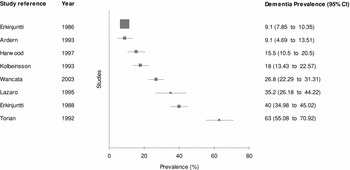
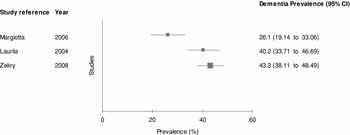
The prevalence of dementia ranged from 2.8% (Uwakwe, Reference Uwakwe2000) to 63.0% (Torian et al., Reference Torian, Davidson, Fulop, Sell and Fillit1992). It was not possible to calculate pooled estimates for dementia prevalence because of considerable heterogeneity (I2 statistic) in study populations (for studies using DSM-III/DSM-IIIR criteria, I2 = 98%, 95% CI 97–99%) (Figure 1). Prevalence estimates for studies using DSM-IV criteria are plotted in Figure 2, again there was significant heterogeneity (I2 = 87%, 95% CI 64–96) and data were not pooled.
Forest plot for prevalence of dementia using DSM-III and DSM-IIIR criteria.

Forest plot for prevalence of dementia using DSM-IV criteria.

Four studies examined the prevalence of subtypes of dementia. Erkinjuntti et al. (Reference Erkinjuntti, Wikstrom, Palo and Autio1986) found vascular dementia to be most common (72.3%) followed by “primary degenerative dementia (22.9%). As in their later study (Erkinjuntti et al., Reference Erkinjuntti, Autio and Wikstrom1988), the prevalence of vascular dementia was 69.4% followed by 16.1% for primary degenerative dementia and 14.5% for “other” causes. Zekry et al. (Reference Zekry2008) found the commonest subtype to be mixed dementia (41.1%), followed by AD (40.4%), vascular dementia (11.2%) and “other” (7.3%).
Clinical associations and outcomes of dementia
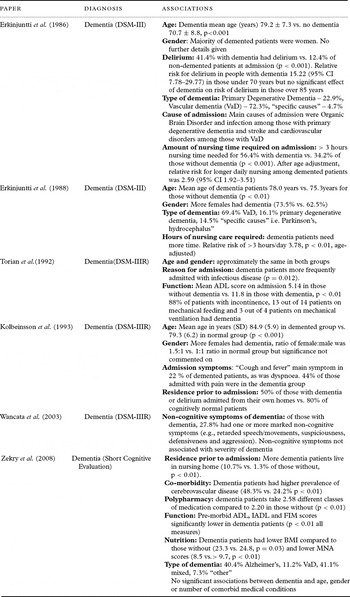
Patients in the acute hospital with dementia were significantly older by 4–9 years (Erkinjuntti et al., Reference Erkinjuntti, Wikstrom, Palo and Autio1986, Reference Erkinjuntti, Autio and Wikstrom1988; Kolbeinsson and Jonsson, Reference Kolbeinsson and Jonsson1993) (Table 2) and more likely to be admitted from institutional care (Kolbeinsson and Jonsson, Reference Kolbeinsson and Jonsson1993; Zekry et al., Reference Zekry2008).
Demographic and clinical associations with cognitive impairment and dementia in general hospital patients aged over 55 years

ADL = Activities of Daily Living; BMI = Body Mass Index; DSM = Diagnostic and Statistical Manual of Mental Disorders; FIM = Functional Independence Measure; IADL = Instrumental Activities of Daily Living; MNA = Mini Nutritional Assessment; SD = standard deviation; SEM = Standard error of the mean; VaD = vascular dementia.
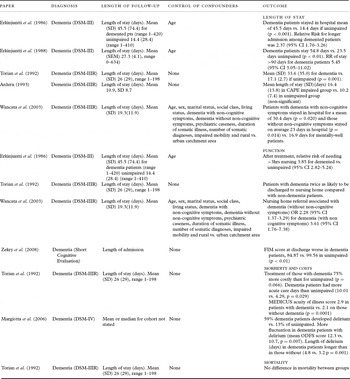
The most common cause of admission amongst people with dementia was “infectious diseases” (Torian et al., Reference Torian, Davidson, Fulop, Sell and Fillit1992). Dementia was also significantly associated with low body mass index (BMI) and poorer nutritional status prior to admission (Zekry et al., Reference Zekry2008). Dementia significantly increased the length of admission by 6–30 days (Erkinjuntti et al., Reference Erkinjuntti, Wikstrom, Palo and Autio1986; Reference Erkinjuntti, Autio and Wikstrom1988; Wancata et al., Reference Wancata, Windhaber, Krautgartner and Alexandrowicz2003) and is associated with a range of adverse outcomes (Table 3).
Outcomes of dementia in general hospital in patients aged over 55 years

CAPE = Clifton Assessment Procedure for the Elderly; CI = confidence interval; DSM = Diagnostic and Statistical Manual of Mental Disorders; FIM = Functional Independence Measure; ODFS = One Day Fluctuation Scale; OR = odds ratio; RR = relative risk; SD = standard deviation; SEM = Standard error of the mean.
Discussion
Prevalence of dementia
A high proportion of older acute hospital inpatients had dementia; however, the estimates vary widely. The lowest prevalence estimate (2.8%) occurred in a relatively young and predominantly male cohort which used ICD-10 criteria (Uwakwe, Reference Uwakwe2000). The study with the highest prevalence of dementia (63%) was recruited from a geriatric unit, with an older, mainly female population, using the less specific DSM-IV criteria (Torian et al., Reference Torian, Davidson, Fulop, Sell and Fillit1992). Limited data suggest that mixed and vascular dementia may be more common in the acute hospital compared to community samples (Erkinjuntti et al., Reference Erkinjuntti, Wikstrom, Palo and Autio1986; Zekry et al., Reference Zekry2008), possibly because these patients have higher cardiovascular comorbidity that increases the risk of acute hospital admission (Zekry et al., Reference Zekry2008).
Associations and outcomes
Given the limited number of papers that we identified, most associations were only reported by one or two studies and it is therefore difficult to draw broad conclusions. As would be expected, patients in the acute hospital with dementia were older, had poorer nutrition and functional ability and an increased risk of delirium. This leads to worse outcomes, increasing the length of hospital stay, functional decline and discharge to nursing home or institutional care. As many studies examining outcomes did not control for potential confounders, it is unclear whether dementia has an independent effect. Are poor outcomes secondary to the dementia itself or due to more complex interactions between the acute hospital environment, for example an increased risk of iatrogenic harm or adverse events such as falls?
Tools used by included studies
The acute hospital is a difficult environment in which to perform cognitive testing. Patients may not be able to complete written tests, may not have glasses or hearing aids available, and thus the MMSE may overestimate the prevalence of cognitive impairment. Observational and informant based interviews, such as the IQCODE (Jorm, Reference Jorm1994) or verbal tests such as the telephone version of the MMSE (Roccaforte et al., Reference Roccaforte, Burke, Bayer and Wengel1992) or the AMTS, which has been shown to be strongly associated with MMSE scores, may be more feasible (Swain et al., Reference Swain, O'Brien and Nightingale2000). Patients with atypical dementias such as fronto-temporal lobar degeneration may be missed as these tools may not adequately assess frontal domains. Applying ICD-10 criteria in this setting is challenging, as these require a six-month history of cognitive problems and an informant may not be available to clarify this.
Methodological limitations of included studies
The evidence base varies widely in terms of study quality. The prevalence of dementia may have been overestimated in studies that did not screen for delirium; however, we found no evidence that lower dementia prevalence was associated with screening for delirium. Depression is common in older people who are acute hospital inpatients (Lazaro et al., Reference Lazaro, Marcos and Valdes1995) and can mimic dementia. Future studies should consider screening for this. Research on dementia in this setting is challenging. Patients are physically ill, may not be able to give informed consent to participate in research, and may not have a relative or proxy available to give assent for them. Thus studies may exclude those most at risk of having pre-existing dementia, leading to selection bias and an under-estimate of the true prevalence (Adamis et al., Reference Adamis, Martin, Treloar and Macdonald2005). Cognitive assessment should be a routine part of the admission process for all older people (British Geriatrics Society, 2006) and this may facilitate less biased data collection.
Limitations of this review
We identified few papers that examined outcomes and associations and therefore could only draw limited conclusions from these. This may have occurred because we required that papers used validated criteria for the diagnosis of dementia. However, if we had included papers that did not use such criteria we may have risked the inclusion of studies with subjects that had cognitive impairment or delirium; this may have biased our conclusions. We also note that a systematic review on delirium has already been published (Siddiqi et al., Reference Siddiqi, House and Holmes2006). Although all the studies were set in the acute general hospital, admissions policies and models of care are likely to vary widely, even within the same country. Some studies were carried out throughout the whole hospital whilst others focused on geriatric units, where patients will be older and thus the prevalence of dementia is likely to be higher. When using data on the prevalence of dementia to plan services, it is important that the study setting and characteristics of the population are taken into account.
Future research recommendations
We identified a number of gaps in the existing evidence base, particularly on the prevalence of dementia in surgical wards or specialist units and on the prevalence of subtypes of dementia. We need to understand more about how dementia influences outcomes (controlling for important confounding factors), for example, complications, hospital acquired infections or iatrogenic harm. Further work is required on the most useful tools for screening this population and diagnosing dementia. Given the international variation in health care systems and demographic differences between hospital wards, brief regular audits or surveys may be the most useful and practical way to detect temporal trends in prevalence as demography changes.
Conclusions
Dementia is common in older people admitted to the acute hospital and is associated with poor outcomes. Improving the evidence base will provide those who fund services with more robust data that highlight the benefits of identifying these patients and the potential gains to be made from improving their care.
Conflict of interest
None.
Description of authors' roles
Both authors formulated the research question, designed the study, reviewed papers for inclusion, analyzed the data and wrote the paper.