Healthcare resource allocation inevitably involves adjudication between several relevant values (including clinical- and cost-effectiveness, solidarity, compassion, and autonomy) (Reference Littlejohns, Weale, Chalkidou, Faden and Teerawattananon1). However, in a liberal democratic society, it is almost impossible to gain agreement on which principles should be privileged (Reference Daniels and Sabin2). Individuals in these societies hold diverse moral views, all of which may be equally valid (this is termed value or moral pluralism) (Reference Engelhardt3); conflicts between these inevitably lead to disagreements about the best way to distribute scarce healthcare resources.
Despite this, resource allocation decisions must be made. Thus, many ethicists and political scientists have concluded that the goal should not be for all stakeholders to agree about the best course of action, but rather, for procedures to be put in place that stakeholders can understand and accept as “legitimate.” There are many definitions of legitimacy and a vast literature on the legitimacy of political decisions. For the purposes of this study, we have chosen to adopt the definition espoused by Daniels and Sabin (Reference Daniels and Sabin2): “legitimacy” refers to a situation where the decision to grant authority to individuals or institutions to set limits to health care is seen to be in accordance with established rules, principles, or standards.
Perceived legitimacy is important, both because it is an essential feature of liberal democracy (Reference Rothstein4) and because, without it, attempts will inevitably be made to circumvent decision-making processes (i.e., its justification is both moral and pragmatic). While there is not necessarily anything wrong with efforts to circumvent processes that are perceived to be ineffective or immoral, such efforts can create problems if they are established without due consideration for costs and opportunity costs (regardless of whether they increase access).
An example of this is the U.K. Cancer Drugs Fund, which was established in 2010 to provide subsidized access to cancer medicines that did not meet National Institute for Health and Care Excellence's (NICE) standards of cost-effectiveness (Reference Prasad and Mailankody5). The fund was established partly in response to concerns that NICE decisions were not in accordance with the principle that “society values health benefits to patients with cancer more highly. . . than benefits to patients suffering other conditions” (Reference Linley and Hughes6). However, after greater-than-expected demand (leading the fund to exceed its budget by 50 percent in 2014), it was deemed to be unsustainable and was recently converted to a managed access scheme that will provide funding for therapies for up to 2 years while further efficacy and cost-effectiveness data are gathered (Reference Mayor7). While it is important that funding systems are flexible and responsive to societal priorities, the establishment of unsustainable “alternative” systems and ad hoc funding in response to public pressure does little to promote either efficiency or equity and demonstrates the importance of maximizing the legitimacy of existing systems.
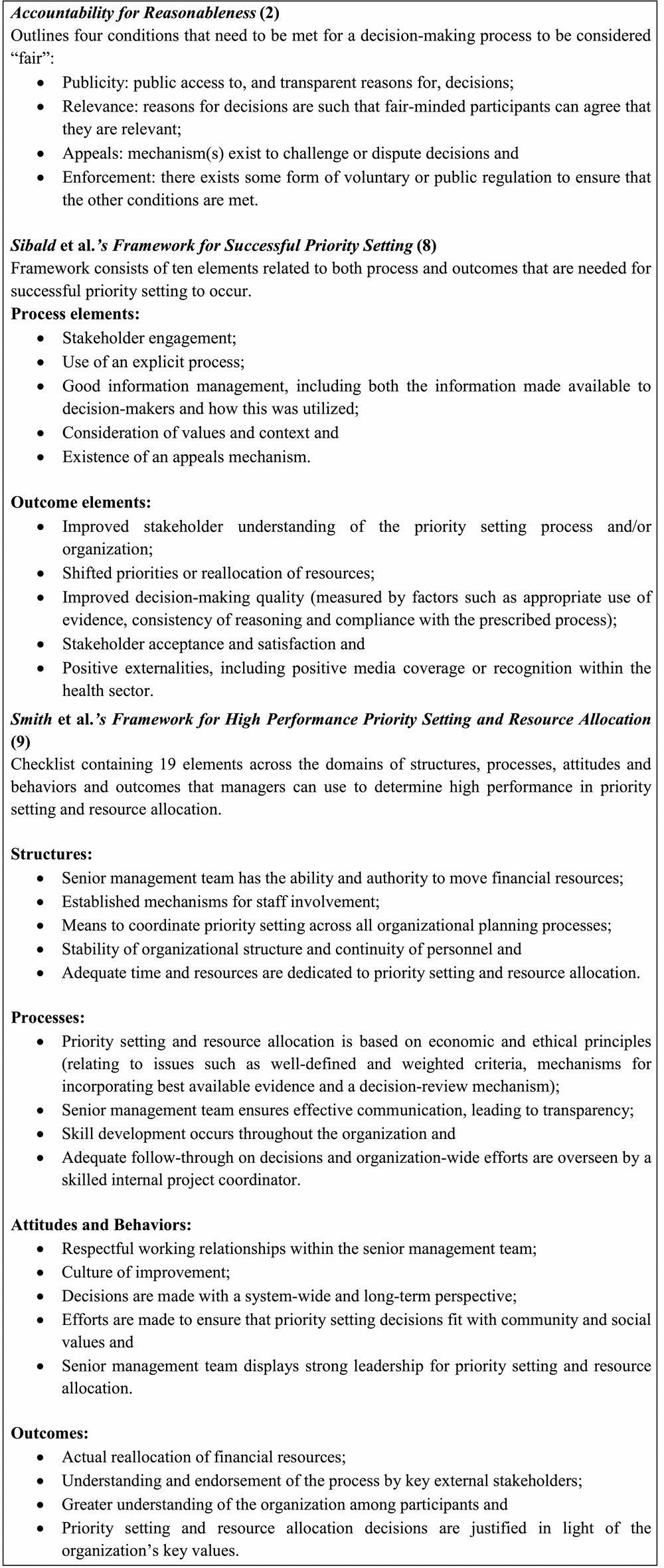
A range of frameworks, procedures and guiding principles (Reference Daniels and Sabin2;Reference Sibbald, Singer, Upshur and Martin8;Reference Smith, Mitton and Hall9) (henceforth “legitimacy frameworks”) have been devised to guide those making resource allocation decisions (Figure 1). Additionally, much recent academic and political work has focused on methods for eliciting the values of patients and the general public and incorporating these into decision making. These efforts have generally fallen into two groups: those that aim to determine the best way to involve patients and the general public in health policy decisions (and the health technology assessment that informs them) (including Degeling et al. and Wortley et al.) (Reference Degeling, Carter and Rychetnik10;Reference Wortley, Tong and Howard11) and those that aim to determine their values and preferences regarding legitimate resource allocation decisions, primarily through quantitative methods such as surveys and discrete choice experiments (including Linley and Hughes and Green and Gerald) (Reference Linley and Hughes6;Reference Green and Gerard12). Two well-recognized examples of organizations that have developed methods to incorporate the values of patients and the general public are the U.K.’s NICE “Patient and Public Involvement Programme” (13) and a system for patient group involvement in the Canadian Agency for Drugs and Technologies in Health's (CADTH) Common Drug Review (CDR) (14).
Existing frameworks to evaluate medicines funding decisions.

Efforts to ensure the legitimacy of medicines funding decisions have had some success. While some degree of controversy is to be expected (and desired), most decisions are accepted by stakeholders. However, there is some evidence that medicines funding processes may not be as legitimate as they need to be. It is not unusual to see media articles decrying the difficulties that patients have in accessing what they view as potentially life-saving therapies that are not currently subsidized and describing the measures that they will go to in order to obtain access. There are also ongoing examples of politicians promising to fund medicines after they have been deemed not to be cost-effective by health technology assessment bodies. Finally, several recent government reviews (including the 2015 Australian Senate Inquiry into the Availability of New, Innovative and Specialist Cancer Drugs and the U.K. government's Accelerated Access Review) (15;16) have been established in response to concerns about the adequacy of current reimbursement systems.
There is also a significant body of work examining the legitimacy of healthcare resource allocation processes, which has found that existing processes have several serious limitations. For example, transparency of decision making, consideration of relevant perspectives (particularly those of patients and the general public) and use of explicit and consistent decision-making processes have all been found to be important to legitimacy but are not always evident in existing processes (Reference Gallego, Taylor and Brien17;Reference Martin, Giacomini and Singer18). In recognition of these shortcomings, there is now an ongoing international research program (Reference Littlejohns, Weale, Chalkidou, Faden and Teerawattananon1) that draws on ethics, philosophy, health economics, political science, and health technology assessment to identify social value challenges faced in specific priority-setting contexts and to facilitate their cross-national comparative study.
In most cases, resource allocation processes are compared with existing legitimacy frameworks and found to be lacking in certain, predefined ways. However, it is possible that current frameworks are themselves limited by preconceptions as to what “rules, principles, or standards” should be applied. To explore this, we conducted a qualitative analysis of published stakeholder perspectives regarding the legitimacy of decision-making processes for the funding of high-cost breast cancer medicines. Our research question was: What if any factors, other than those espoused in existing legitimacy frameworks, do stakeholders think should be considered when making decisions about the funding of high-cost breast cancer therapies?
METHODS
Choice of High-Cost Breast Cancer Medicines as a Case Study
The medicines chosen for this case study were the high-cost breast cancer medicines referred to as HER2 inhibitors. Although the phrase “high-cost medicine” is used frequently, there is no agreed-upon cutoff; here, we consider any medicine whose price was considered to have a major influence on the ability of funders to subsidize it to be a “high-cost medicine.” Trastuzumab (marketed as Herceptin and approved for use in metastatic breast cancer by the U.S. Food and Drug Administration (FDA) in 1998 and early stage breast cancer in 2006) (19) was the first agent in this class; trastuzumab emtasine (Kadcyla) and pertuzumab (Perjeta) were both approved by the FDA in 2013 (20;Reference Levin21). We chose these medicines for our case study for several reasons. First, breast cancer is an active area of pharmaceutical research, with several breast cancer therapies either in development or recently entering the market. Decisions about the funding of HER2 inhibitors have also caused considerable controversy around the world. Following decisions in several countries not to fund these therapies, media articles highlighted “desperate” women pleading for access and derided governments as callous, out of touch with community values, or incompetent for withholding this; many jurisdictions established ad hoc funding processes to provide access to these therapies (Reference MacKenzie, Chapman, Salkeld and Holding22;Reference Gabe, Chamberlain and Norris23). Overall, there appears to be a perception that decisions about the funding of these therapies have not been in accordance with accepted standards of fairness and compassion, suggesting significant problems with their perceived legitimacy. While there has been some academic exploration of funding decisions for these therapies and the discourses surrounding these (including MacKenzie et al., Gabe et al., and Fenton) (Reference MacKenzie, Chapman, Salkeld and Holding22–Reference Fenton24), most of this has aimed to describe how these decisions were made and has not explicitly addressed their perceived legitimacy (or otherwise) from multiple stakeholder perspectives.
Identification of Published Material
The databases Google, Google Scholar, and Factiva were searched in August 2014 and July 2016 using the following terms: (breast cancer drugs OR cancer drugs OR breast cancer medicines OR cancer medicines OR breast cancer medications OR cancer medications OR Herceptin OR trastuzumab OR pertuzumab OR Perjeta OR Kadcyla) AND (access OR fund* OR subsid*). Our aim was to recall as many articles as possible and to then select articles that represented a variety of stakeholder groups, locations, and types of decision-making processes. We, therefore, used general databases and kept our search terms broad.
We subsequently included material in which stakeholders discussed their views on or experiences with gaining access to high-cost breast cancer therapies that were published in English between 2005 and 2016. The process for selecting material was as follows: the most recent material was analyzed first; characteristics such as stakeholder group, geographical location, and type of decision-making process were identified; and if we already had similar material from that group, location, or process, then we moved onto the next piece. As a result, our final set of articles included both very recent articles and some older articles where it was necessary to continue searching for articles representing particular groups, locations, and/or decision-making processes. We emphasize that our goal was to gain an overview of stakeholder perspectives across jurisdictions and not to draw out fine distinctions between sub-groups unless patterns were obvious.
Data Analysis
An inductive approach was taken to data analysis. This involved initial coding of paragraphs where opinions were expressed using “gerunding” (encoding action or process), synthesis of codes into categories, focused coding using these categories, and abstraction into concepts (Reference Patton25). A process of constant comparison was used, with continual refinement and enrichment of codes. Data analysis continued until categories were saturated (i.e., all codes appeared to fit under one or more existing categories and all concepts were fully described and well-understood). Categories and concepts were then organized to answer the research question. J.P. coded all articles and W.L. coded approximately 10 percent of these; detailed discussion was used to ensure consistency in emergent codes, categories, and concepts.
RESULTS
Material Analyzed
The search strategy revealed more than 15 million hits and fifty documents were analyzed before thematic saturation was reached. Supplementary Table 1 shows the hits in each database and how many articles were included in the final sample. Material analyzed included media releases (14), opinion pieces in popular media (10) and medical literature (10), letters in medical journals (7) and popular media (6), submissions to decision-making bodies (3), and reports and position statements (one of each). Stakeholders represented include doctors (14), members of the general public (10), patients (7), politicians (7), pharmaceutical companies (6), and multiple stakeholder groups (3). Material analyzed related to decisions in New Zealand (18), the United Kingdom (15), Australia (11), Canada (3), Europe, and the United States (1 each); one piece did not have an obvious geographical focus.
The “standard” elements of legitimacy emerged frequently. For example, stakeholders emphasized the need for decisions to be evidence-based, for consistency and transparency in decision making, for all parties involved to follow predefined processes, for decisions to be made by people with relevant expertise and without vested interests, and for due consideration of community values. We also identified three additional factors that many stakeholders think should be considered when making decisions about the funding of high-cost breast cancer therapies: (i) providing timely access to cancer medicines, (ii) greater flexibility with evidentiary requirements and evaluation criteria, and (iii) accelerating or bypassing existing processes when making decisions about cancer therapies. Supplementary Table 2 shows the codes, categories, and concepts that we identified. Citations for quotes in the following sections are shown in Supplementary Figure 1.
Providing Timely Access to Cancer Medicines
Many stakeholders emphasized the importance of timely access to new medicines. They asserted that decisions about the funding of cancer medicines were “unique” due to the low life-expectancy of many cancer patients and the serious consequences of delayed access to therapies.
Unlike many chronic conditions, cancer patients do not have the luxury of several years to wait for new advances to be made available. . . . Patients have been dying early because of delayed access to treatment.
Australian Multiple Stakeholder Group Cancer Drugs Alliance Discussing the Impact of Delays in Access to Cancer Medicines, 2013 (a).
Patients and the general public also cited the importance of funding new therapies so that all patients, irrespective of where they come from, can access these at the same time. They noted significant differences both in the time taken for a positive funding recommendation across jurisdictions and the ability of patients within the same healthcare system to access therapies. Inequities were perceived to be due to factors such as where the patient lives, the type and stage of their disease, the level of funding that their disease receives (e.g., differences in resources allocated to men's and women's health) and their own personal resources.
Mrs. Rogers might be saved from a particularly virulent form of breast cancer by a drug called Herceptin [trastuzumab]. . . But it is only licensed for breast cancer treatment in its later stages, and Ann Marie is in the early stages. [If] she lived in Isle of Wight, or Yorkshire, or Leicestershire, or down the M4 in Somerset, she would be given the chance to live. If Ann Marie was rich, the gift of life would be hers too. But she can't afford the £26,000 a year the drug costs.
Member of the General Public Discussing the Funding of Herceptin (Trastuzumab) for Patients with Early Breast Cancer in the United Kingdom, 2006 (b).
However, others (particularly payers) emphasized that any funding decision must be made with due regard to local policies and procedures and healthcare environments.
Greater Flexibility with Evidentiary Requirements and Evaluation Criteria
Many stakeholders (particularly patients and manufacturers) expressed a belief that current evidence requirements were too strict and impeded patient access to therapies. Manufacturers noted difficulties generating data of an acceptable quality for regulatory and reimbursement decisions due to the challenges of recruiting patients for oncology clinical trials and conducting randomized controlled trials in this setting. They thus advocated for decision makers to be realistic and prepared to base decisions on different types of evidence (including nonrandomized, open label, and single arm trials).
However, others (particularly payers and doctors) thought that only treatments of proven efficacy should receive funding, and that decision makers should be cautious about replacing or supplementing proven treatments with newer ones of unknown efficacy.
We could fund Herceptin [trastuzumab] if we did not treat 355 patients receiving adjuvant treatment (16 of whom would be cured) or 208 patients receiving palliative chemotherapy, and if we found £0.5m from another source. We will be the ones to tell [these untreated patients that] they are not getting a treatment that has been proved to be effective, which costs relatively little, because it is not the “treatment of the moment”.
Doctor Discussing the Opportunity Costs Involved in Funding Herceptin (Trastuzumab) for Early Breast Cancer in the United Kingdom, 2006 (c).
Additionally, many stakeholders argued that decision makers should use a wider range of criteria to evaluate new therapies. They emphasized that “hard endpoints” such as overall survival were not the only meaningful measure of efficacy and wanted decision makers to be more willing to make use of surrogate endpoints (such as progression-free survival or tumor shrinkage) when making reimbursement decisions. Patients and manufacturers also stressed the importance of considering factors such as quality of life and patient experiences of disease and therapy. Some noted that the major advantage of newer therapies was a reduction in side effects compared with traditional cytotoxic agents. However, others emphasized the need to give proper consideration to both the risks and benefits of treatment and to adequately determine the safety of new therapies, including the apparently less toxic “targeted” therapies.
Accelerating or Bypassing Existing Processes When Making Decisions About Cancer Therapies
Existing processes were seen by some to be inadequate for the evaluation of cancer therapies, due to the time taken to achieve reimbursement and difficulty demonstrating cost-effectiveness. There was concern about the ability of existing processes to accommodate newer targeted therapies and the evolving oncological indications of existing therapies.
The case has been made that, due to the nature of the current and future generation of cancer drugs, which are more targeted, require different technology, and smaller patient groups, our present requirements for evidence and processes need to be looked at in a new light.
Australian Multiple Stakeholder Group Cancer Voices Australia Outlining the Need for Changes to the Processes Used for the Evaluation of Cancer Therapies, 2014 (d).
Manufacturers and patients in particular advocated for the increased use of accelerated or alternative processes to expedite the provision of funding for cancer therapies. However, others (particularly doctors and payers) emphasized the importance of letting existing processes, established to ensure that medicines are safe, effective, and affordable for healthcare systems, run their course.
This raises several important issues. . .it is pre-empting the evaluations of both the European Agency for the Evaluation of Medicinal Products (EMEA, the licensing agency) and the National Institute for Health and Clinical Excellence (NICE), the body set up to advise the government on value for money in the NHS.
U.K. Doctor Discussing the Government's Decision to Test All Women with Early Breast Cancer for HER2 Overexpression to Determine Their Eligibility for Treatment with Herceptin (Trastuzumab) before It Was Approved for This Indication or Had Undergone Health Technology Assessment, 2005 (e).
DISCUSSION
To our knowledge, this is the first study to inductively examine the perceived legitimacy of medicines funding decisions from multiple stakeholder perspectives and across several jurisdictions and decision-making systems. We have demonstrated that stakeholders, particularly patients and manufacturers, want access to cancer medicines in a way that is procedurally efficient and epistemologically flexible, even if this means bypassing or substantially altering existing health technology assessment and resource allocation processes.
One possible interpretation of these findings is that processes themselves are perceived to be legitimate, but there is ongoing (and predictable) discomfort with specific decisions emerging from these. We believe, however, that our findings point to problems with perceived legitimacy because decision makers are seen to be insufficiently attuned to the need for rapid access to cancer medicines, and decision-making processes are perceived to be inadequate to this task. We would, therefore, argue that perceived legitimacy encompasses factors that are not included in existing “legitimacy frameworks,” including the need for decision makers and the processes in which they operate to be sufficiently flexible and responsive to the unique and urgent needs of certain patient groups.
In many ways, these findings are not surprising because the principles and values that stakeholders espoused are consistent with a range of contemporary policy initiatives aimed at accelerating both regulatory and reimbursement processes. Several jurisdictions, including Europe, the United States, and Japan (Reference Boon, Moors, Meijer and Schellekens26–Reference Fujiwara28), have introduced expedited regulatory schemes that enable medicines to be approved earlier and on the basis of less complete data (including the use of surrogate markers), with a shift to the acquisition of evidence in the postmarketing phase. Several payers, including U.S. Centers for Medicare and Medicaid, the U.K. Department of Health (30), and the Australian Government Department of Health (Reference Fujiwara28–31), have also introduced frameworks that allow for the use of “managed entry” or “coverage with evidence development” schemes. These provide subsidy for therapies at a price justified by the evidence available at the time a decision is made, with ongoing coverage and the final price paid determined through the collection of further data (either from the maturation and accumulation of clinical trials or “real world” evidence) once they enter the market.
It would no doubt be reassuring for those advocating for various kinds of “accelerated access” to know that stakeholder conceptualizations of legitimacy are aligned with such initiatives. We believe, however, that it is important not to take demands for accelerated access at face value. While there is little to argue with when it comes to demands for more efficient processes (except perhaps the question of who should pay to support this), many stakeholders also advocated for a relaxation of current evidence requirements (e.g., wanting decision makers to base their decisions on different types of evidence including the use of nonrandomized clinical trials and surrogate endpoints). It is understandable that patients in desperate situations might be resentful of evidence standards that appear to stand in the way of access to potentially life-saving therapies. However, we must remember that current requirements aim to ensure that only sufficiently safe and effective therapies are available to patients and that any therapies that are funded have proven to be cost-effective and/or affordable for healthcare systems. Relaxation of these requirements increases the risk that patients will be exposed to harm, and that payers will fund therapies that later prove to be unsafe and/or ineffective, with resulting opportunity costs for healthcare systems.
One well-known example of such an outcome is the angiogenesis inhibitor bevacizumab (marketed as Avastin). This was granted accelerated approval by the FDA for HER2-negative breast cancer in 2008; however, this was revoked in 2011 when further follow-up showed no survival benefits and several side effects (32). A recent study (Reference Kim and Prasad33) also examined the effectiveness of several cancer therapies approved by the FDA on the basis of surrogate endpoints and found that the majority of these had unknown or no effects on overall survival. The difficulties of withdrawal from the market or disinvestment from technologies that later prove to be unsafe, ineffective, or less cost-effective than initially thought are also well-recognized (Reference Lewis, Kerridge and Lipworth34). The recent changes to the U.K.’s Cancer Drugs Fund (described above) and the current review of Australia's special fund for the reimbursement of treatments for rare diseases (the Life Saving Drugs Program) on the basis of sustainability (35) are other salient examples of the risks and opportunity costs associated with accelerated access. Further research examining the ethical, political, and clinical implications of these claims and how they became incorporated into the discourse surrounding the legitimacy of medicines funding decisions is, therefore, needed before accelerated access can be deemed to be the “right” approach to funding medicines, no matter how legitimate such processes might be in the eyes of stakeholders.
Strengths, Limitations, and Future Research
Our chosen methods have some limitations. The use of published material to elicit stakeholder views is efficient and generates valuable insights into views that people hold strongly enough to express publicly. However, there is inevitably a loss of both the nuance that is possible in verbal communication and opportunities for the researcher to probe the subject for more detail and to clarify issues if necessary. The reliance on publicly available material also raises the possibility of publication bias. Additionally, our decision to examine the most recent material first may have led to identification of several articles focused on a recent debate, resulting in a false impression that thematic saturation had been achieved. As a result, we may have stopped our analysis too early and missed other important perspectives or debates. Supplementing our research with other methods such as interviews would allow for a more complete understanding of stakeholder perspectives on legitimacy in general, and accelerated access more specifically.
Our choice of qualitative methodology also has some limitations. First, as with all qualitative research, our work provides only one perspective on a complex phenomenon and the generalizability of our results to other settings or stakeholders may be limited (Reference Patton25). In this regard, it should be noted that most material analyzed concerned centralized decision-making processes in publicly funded healthcare systems and the applicability of our results to systems that are less centralized and use a mix of both public and private providers, or to decisions in settings such as public hospital drug and therapeutics committees, is unknown. It could also be argued that our chosen case-study is unique, meaning that our findings have limited utility in determining the legitimacy of medicines funding decisions for other types of cancers and other diseases. Future research could concentrate on other settings and diseases and aim to determine whether our results are also applicable here. Second, our decision to sample for maximum variation so that no major themes were missed meant that we were unable to draw out fine distinctions between the various stakeholder groups unless patterns were obvious. However, our results do appear to indicate a divide between the views of patients and manufacturers (who want decision makers and their processes to be more flexible and responsive to urgent needs) on one hand and payers and doctors (who emphasize the need to adhere to well-defined epistemological standards and have due regard for existing decision-making processes) on the other. Future research using both qualitative and quantitative methods would enable us to further tease out relevant differences between subgroups. Finally, theoretical ethical analysis would also be useful here, as the question that we are ultimately trying to address—what is the best way for us, as a society, to distribute limited healthcare resources—is an ethical one. We have already identified some potential ethical issues (e.g., the tension between individual autonomy and the need to protect both individuals and health systems), and exploration of these in combination with theoretical ethical analysis (such as consideration of theories of social justice) will need to occur before any firm recommendations for change can be made.
CONCLUSION
This research has generated a detailed account of stakeholder conceptualizations of legitimate decision making for the funding of high-cost breast cancer medicines. We have identified several factors that are not accounted for by existing frameworks or current decision-making practice, particularly the perception that processes are only legitimate if they are sufficiently flexible and responsive to the unique and urgent needs of certain patient groups. However, we do not think that these stakeholder claims should be taken at face value, even if doing so would increase the perceived legitimacy of decision-making processes.
SUPPLEMENTARY MATERIAL
Supplementary Table 1: https://doi.org/10.1017/S0266462317000794
Supplementary Table 2: https://doi.org/10.1017/S0266462317000794
Supplementary Figure 1: https://doi.org/10.1017/S0266462317000794
CONFLICTS OF INTEREST
Jessica Pace has nothing to disclose. Dr. Lipworth reports grants from the National Health & Medical Research Council during the conduct of the study. Professor Pearson reports grants from the National Health & Medical Research Council during the conduct of the study.