Introduction
Frontotemporal lobar degeneration (FTLD) is characterized by focal atrophy restricted to the frontal and/or temporal lobes. It comprises three clinical variants: a behavioral variant (bv-FTD), a semantic dementia (SD) variant, and a progressive non-fluent aphasia (PNFA) variant (Neary et al., Reference Neary1998; Hodges, Reference Hodges2001). In bv-FTD, the cardinal clinical features include early disinhibition, early emotional blunting, and early stereotypic behavior, ultimately leading to severe disability in daily living (Neary et al., Reference Neary1998; Mioshi et al., Reference Mioshi, Kipps, Dawson, Mitchell, Graham and Hodges2007). Some studies have shown that bv-FTD patients have much more emotional blunting than Alzheimer's disease (AD) patients (Joshi et al., Reference Joshi, Barsuglia, Mather, Jimenez, Shapira and Mendez2014). In SD and PNFA, language is impaired early thus limiting family communication and social participation, especially when language difficulties progress to aphasia. In addition, some SD patients also have behavioral changes (Bozeat et al., Reference Bozeat, Gregory, Ralph and Hodges2000). In conclusion, caregivers and family members in direct contact with patients with behavioral disturbances and language impairment have significantly more burden and stress (Merrilees, Reference Merrilees2007).
Dementia with Lewy bodies (DLB) is characterized by fluctuating cognition, visual hallucinations, and parkinsonism with Lewy bodies as the characteristic pathology. Additional suggestive clinical features include rapid eye movement sleep behavior disorder and severe neuroleptic sensitivity with increased parkinsonism and a higher prevalence of neuroleptic malignant syndrome (McKeith et al., Reference McKeith2005). Each clinical feature, particularly hallucinations, parkinsonism, and sleep disorder, may have some impact on caregiver burden.
Recent studies have shown that DLB caregivers experience higher caregiver distress than AD caregivers, and high distress is associated with delusions, hallucinations, anxiety, and apathy (Ricci et al., Reference Ricci2009; Bjoerke-Bertheussen et al., Reference Bjoerke-Bertheussen, Ehrt, Rongve, Ballard and Aarsland2012; Zweig and Galvin, Reference Zweig and Galvin2014). Some studies have shown that caregivers of DLB patients experience moderate or high caregiver burden with a greater risk of psychiatric disorders (Svendsboe et al., Reference Svendsboe2016). Burden among FTLD caregivers is higher than among AD caregivers, and spouses and female caregivers experience greater caregiver burden, distress, increased rates of depression, and sleep disorders (Wong et al., Reference Wong, Merrilees, Ketelle, Barton, Wallhagen and Miller2012; Caceres et al., Reference Caceres, Frank, Jun, Martelly, Sadarangani and de Sales2016; Uflacker et al., Reference Uflacker, Edmondson, Onyike and Appleby2016). The burden of caregivers of bv-FTD patients is also associated with the patients’ functional limitations (Lima-Silva et al., Reference Lima-Silva2015). However, to date, very few recent studies are available on caregiver burden, sleep quality, and stress in caregivers of FTLD and DLB patients, as compared to caregivers of AD patients. The reason might be that FTLD and DLB are largely unknown to the public so the behavioral symptoms cannot be understood and tolerated by the family and community. Moreover, medical professionals are not well acquainted with FTLD and DLB, which is therefore often misdiagnosed (Riedijk et al., Reference Riedijk2006).
In contrast, Alzheimer's disease is characterized by memory decline in the early stages with behavioral and personality changes occurring later in the disease progression. Recent studies have shown that caregiver burden in FTLD is significantly greater compared to AD (de Vugt et al., Reference de Vugt, Riedijk, Aalten, Tibben, van Swieten and Verhey2006; Riedijk et al., Reference Riedijk2006; Boutoleau-Bretonniere et al., Reference Boutoleau-Bretonniere, Vercelletto, Volteau, Renou and Lamy2008).
Caregiver burden has been extensively studied in caregivers of AD patients and therefore can serve as an ideal comparison for caregiver burden in caregivers of FTLD and DLB patients. We compared patients’ cognitive level, activities of daily living, and behavioral and psychological symptoms of FTLD, DLB, and AD. Furthermore, we compared caregiver burden, sleep quality and stress in caregivers of the three-dementia types. Our aim was to elucidate the proposed associations between behavioral and psychological symptoms in patients and burden in caregivers, particularly caregivers of FTLD and DLB patients. We also expected to observe some influence of individual caregiver characteristics on caregiver burden.
Currently, few recent studies are available on nursing intervention in patients with FTLD or DLB and in caregivers of FTLD and DLB patients, as compared to patients with AD and their caregivers. This research will provide some evidential basis for improving care consciousness, strengthening the degree of nursing intervention, and establishing some suitable nursing interventions for FTLD and DLB patients and caregivers.
Methods
Participants
This study was carried out from March 2011 to January 2014. In total, 325 pairs of caregiver and patient with AD (DSM-V)(Sorrell, Reference Sorrell2013), 131 pairs of caregiver and patient with FTLD (diagnosis according the criteria of The Lund and Manchester Groups (1994)), and 36 pairs of caregiver and patient with DLB (McKeith et al., Reference McKeith1996) participated in this study. The DLB group was smaller than the FTLD group for two reasons: DLB shares a number of clinical features with Parkinson's disease dementia (PDD), as well as with AD; in addition, patients with DLB often experience hallucinations and delusions, and are, as a result, treated at psychiatric hospitals (Mrak and Griffin, Reference Mrak and Griffin2007). Both of these factors contribute to a smaller DLB population at Tianjin Huanhu Hospital as compared with the FTLD patient population. All patients were Chinese citizens. 546 DLB, FTLD, and AD patients were asked to participate in our study, and 54 did not agree to take part in the study, which resulted in a total sample size of 492 participants. Patients who were diagnosed with either DLB, FTLD, or AD were considered for inclusion in this study, while those who were diagnosed with other forms of dementia (such as Vascular disease dementia) were not eligible to participate. All participants in the study were outpatients from the Tianjin Huanhu Hospital from March 2011 to January 2014, whose assessments were conducted by independent, experienced psychologists. All subjects signed informed consent. The study was approved by the Tianjin Huanhu Hospital Ethics Committee.
Measures
Patient Measures
Socio-demographic characteristics included gender, age, and duration of dementia in months.
Cognitive function was measured using the Mini-Mental State Examination (MMSE)(Folstein et al., Reference Folstein, Folstein and McHugh1975). Functional impairment was examined using the activities of daily living (ADL)(Katz et al., Reference Katz, Ford, Moskowitz, Jackson and Jaffe1963). The ADL consists of 20 questions and generates scores of basic activities of daily living (i.e. dressing, eating, and going to toilet) and instrumental activities of daily living (i.e. telephoning, taking medication, going on an outing, ability to stay safely at home). The summed score (range 20–80) was based on caregiver observations of the subject's actual performance during the previous four weeks, with higher scores indicating more serious functional disability.
Neuropsychiatric disturbance was assessed using the Chinese version of the Neuropsychiatric Inventory (NPI)(Cummings et al., Reference Cummings, Mega, Gray, Rosenberg-Thompson, Carusi and Gornbein1994), including delusions, hallucinations, agitation/aggression, dysphoria/depression, anxiety, euphoria, apathy, disinhibition, irritability, aberrant motor behavior, alterations in appetite, and changes in nighttime behavior. The score for each item is the product of the severity (1–3) multiplied by the frequency (1–4) (range 0–12). The total score (range 0–144) was assessed by caregiver observations of the subject's behavioral disturbances during the previous four weeks, with higher scores indicating stronger behavioral symptoms.
Caregiver Measures
Socio-demographic characteristics included gender, age, and type of relationship to the patient.
The caregiver's burden was evaluated using the Zarit Burden Inventory (ZBI)(Bocquet et al., Reference Bocquet, Pous, Charlet and Grand1996; Boutoleau-Bretonniere et al., Reference Boutoleau-Bretonniere, Vercelletto, Volteau, Renou and Lamy2008). The scale is made up of 22 items evaluating both the material and emotional burden, such as caregiver's quality of life, psychological suffering, financial difficulties, shame, guilt, and difficulties in social and family relationships (range 0–88). The higher the score, the greater the burden.
Depression and anxiety were assessed with the Patient Health Questionnaire-9 (PHQ-9)(Kroenke et al., Reference Kroenke, Spitzer and Williams2001) and Generalized Anxiety Disorder scale (GAD-7), respectively (Spitzer et al., Reference Spitzer, Kroenke, Williams and Lowe2006). Both are self-report scales. The former is a 9-item scale, which measures caregiver perceived depression (range 0–27), and the latter is a 7-item scale that evaluates caregiver perceived anxiety (range 0–21), with higher scores indicating the presence of increased psychological stress.
We measured caregiver sleep quality with the Pittsburgh Sleep Quality Index (PSQI) (Buysse et al., Reference Buysse, Reynolds, Monk, Berman and Kupfer1989), which consists of 19 items that are divided into seven components: subjective sleep quality, sleep latency, sleep duration, habitual sleep efficiency, sleep disturbances, use of sleeping medication, and daytime dysfunction. Each component score (range 0–21) was calculated to identify the degree of somnipathy, with a higher score indicating poorer sleep quality.
Data analyses
The statistical analysis was performed with the SPSS 17.0 program. Demographic variables of the FTLD, DLB, and AD group were compared using t-test and χ2-test. T-test or Mann–Whitney U-test was used to compare mean MMSE, ADL NPI, ZBI, PHQ-9, GAD-7, and PSQI between the three groups. ANCOVA was conducted to detect interaction effects of caregiver age, type of relationship to the patient, or dementia duration on caregiver burden. We used logistic regression to identify the factors that predicted caregiver burden. The analyses are presented separately for the comparison of caregivers of FTLD patients with caregivers of AD patients, and separately for caregivers of DLB patients with caregivers of AD patients. All statistical analyses were two-sided (p < 0.05) unless the Bonferroni correction was applied.
Results
FTLD patients and their caregivers compared with AD patients and their caregivers
Socio-demographic Characteristics
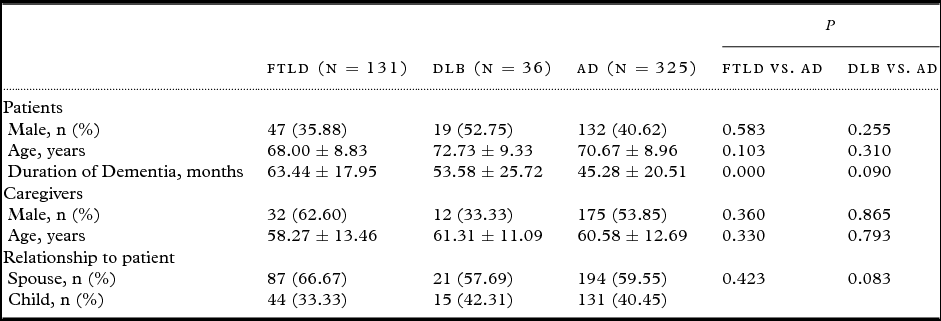
Table 1 shows the socio-demographic characteristics of the patients and their caregivers. There were no significant differences between the FTLD and AD groups in caregiver or patient sex and age. Furthermore, the two groups were not significantly different in terms of the type of relationship to the patient. However, duration of dementia of FTLD patients was significantly longer (63.44 ± 17.95 months) compared to AD patients (45.28 ± 20.51 months) (p = 0.000).
FTLD, DLB, and AD patient and caregiver demographic characteristics

Note: AD, Alzheimer's disease; FTLD, Frontotemporal Lobar Degeneration; DLB, Dementia with Lewy bodies.
Patient Characteristics
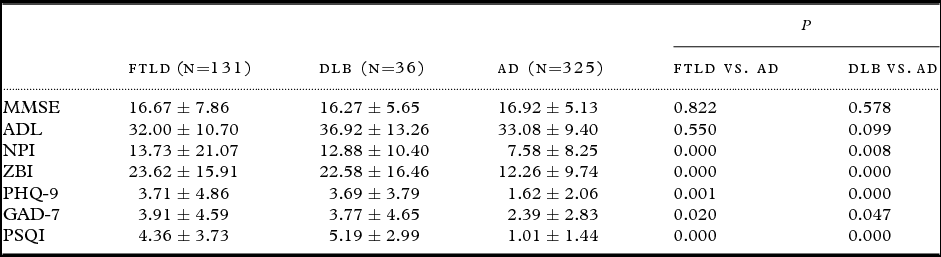
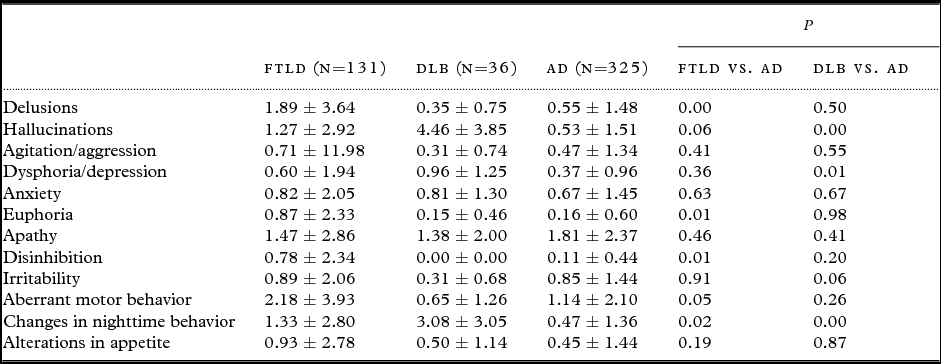
Table 2 shows the neuropsychiatric assessments of patients and caregivers in the FTLD and AD groups. In FTLD patients, significantly more neuropsychiatric symptoms were found compared to AD patients (13.73 ± 21.07 vs. 7.58 ± 8.25, p = 0.000). As shown in Table 3, these neuropsychiatric symptoms contain delusions, euphoria, disinhibition, aberrant motor behavior, and changes in nighttime behavior. In addition, the mean MMSE scores ± S.D. in the FTLD and AD groups were 16.67 ± 7.86 vs. 16.92 ± 5.13 (p = 0.822), respectively, while the mean ADL scores ± S.D. were 32.00 ± 10.70 vs. 33.08 ± 9.40 (p = 0.550), respectively. These results indicate that the two groups of subjects had the same degree of cognitive decline and actual performance in activities.
Analysis of MMSE, ADL, NPI, ZBI, PHQ-9, GAD-7, and PSQI scores by caregiver and patient factors

Note: AD, Alzheimer's disease; FTLD, Frontotemporal Lobar Degeneration; DLB, Dementia with Lewy bodies; MMSE, Mini-Mental State Examination; ADL, Activities of Daily Living scale; NPI, The Neuropsychiatric Inventory; ZBI, Zarit Burden Interview; PHQ-9, The Patient Health Questionnaire; GAD-7, The Generalized Anxiety Disorder scale; PSQI, The Pittsburgh Sleep Quality Index.
Analysis of the sub-item scores on the NPI according to caregiver and patient factors

Note: AD, Alzheimer's disease; FTLD, Frontotemporal Lobar Degeneration; DLB, Dementia with Lewy bodies; NPI, The Neuropsychiatric Inventory.
Caregiver Characteristics
As shown in Table 2, FTLD caregivers possessed significantly more burden compared to AD caregivers. The ZBI score was higher for FTLD caregivers compared to AD caregivers (FTLD caregivers: 23.62 ± 15.91; AD caregivers: 12.26 ± 9.74; p = 0.000).
Caregivers of FTLD patients presented greater stress compared with caregivers of AD patients. The scores on the PHQ-9, GAD-7, and PSQI in caregivers of FTLD patients were significantly higher compared with caregivers of AD patients (PHQ-9: 3.71 ± 4.86 vs. 1.62 ± 2.06, respectively, p = 0.001; GAD-7: 3.91 ± 4.59 vs. 2.39 ± 2.83, respectively, p = 0.020; PSQI: 4.36 ± 3.73 vs. 1.01 ± 1.44, respectively, p = 0.000).
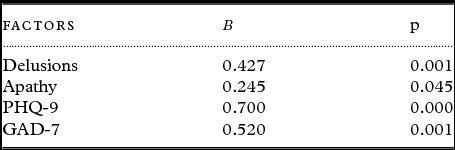
Stepwise linear regression analyses were also performed using ZBI scores as the dependent variable and patient- and caregiver-related MMSE, ADL, NPI, PHQ-9, GAD-7, and PSQI scores and the duration of dementia as independent variables. A significant model emerged, including delusions, apathy, GAD-7 scores, and PHQ-9 scores, accounting for 72.0% of the variance of ZBI scores (delusions: β = 0.427, p = 0.001; apathy: β = 0.245, p = 0.045; GAD-7: β = 0.520, p = 0.001; PHQ-9: β= 0.700, p = 0.000; Table 4).
Regression analysis of ZBI scores and MMSE, ADL, NPI, PHQ-9, GAD-7, and PSQI scores and the duration of dementia in the FTLD group

Note: FTLD, Frontotemporal Lobar Degeneration; MMSE, Mini-Mental State Examination; ADL, Activities of Daily Living scale; NPI, The Neuropsychiatric Inventory; ZBI, Zarit Burden Interview; PHQ-9, The Patient Health Questionnaire; GAD-7, The Generalized Anxiety Disorder scale; PSQI, The Pittsburgh Sleep Quality Index.
DLB patients and their caregivers compared with AD patients and their caregivers
Socio-demographic characteristics
As shown in Table 1, there were no significant differences between the DLB and AD groups in caregiver or patient sex, average age, duration of dementia, or type of relationship to the patient.
Patient Characteristics
In regard to the neuropsychiatric symptoms, the NPI total score was significantly higher in DLB patients compared to AD patients (12.88 ± 10.40 vs. 7.58 ± 8.25, respectively, p= 0.008). As shown in Table 3, these neuropsychiatric symptoms consisted of hallucinations, dysphoria/depression, and changes in nighttime behavior. In addition, the mean MMSE scores ± S.D. for DLB patients compared to AD patients were 16.27 ± 5.65 vs. 16.92 ± 5.13 (p = 0.578), respectively, while the mean ADL scores ± S.D. were 36.92 ± 13.26 vs. 33.08 ± 9.40 (p = 0.099), respectively. These results indicate that the two groups of subjects had the parallel level of cognitive decline and actual performance in activities.
Caregiver Characteristics
As shown in Table 2, DLB caregivers bore significantly more burden compared to AD caregivers. The ZBI score was higher for DLB caregivers compared to AD caregivers (22.58 ± 16.46 vs. 12.26 ± 9.74, p = 0.000).
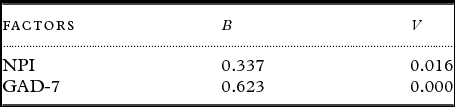
The level of DLB caregivers presenting with stress was higher compared to AD caregivers. The PHQ-9, GAD-7, and PSQI scores for DLB caregivers were significantly higher compared to AD caregivers (PHQ-9: 3.69 ± 3.79 vs. 1.62 ± 2.06, respectively, p = 0.000; GAD-7: 3.77 ± 4.65 vs. 2.39 ± 2.83, respectively, p = 0.047; PSQI: 5.19 ± 2.99 vs. 1.01 ± 1.44, respectively, p = 0.000). Stepwise linear regression analyses were also performed using ZBI scores as the dependent variable and patient- and caregiver-related MMSE, ADL, NPI, PHQ-9, GAD-7, and PSQI scores and the duration of dementia as the independent variables. The regression analysis showed that caregiver burden was predicted significantly by NPI scores (β = 0.337, p = 0.016) and GAD-7 scores (β = 0.623, p = 0.000), together explaining 66.9% of the total variance (Table 5).
Regression analysis of ZBI scores and MMSE, ADL, NPI, PHQ-9, GAD-7, and PSQI scores and the duration of dementia in the DLB group

Note: DLB, Dementia with Lewy bodies; MMSE, Mini-Mental State Examination; ADL, Activities of Daily Living scale; NPI, The Neuropsychiatric Inventory; ZBI, Zarit Burden Interview; PHQ-9, The Patient Health Questionnaire; GAD-7, The Generalized Anxiety Disorder scale; PSQI, The Pittsburgh Sleep Quality Index.
Discussion
The current study shows that the neuropsychiatric symptom profile differs between patients with FTLD, DLB, and AD, and that differences exist in the level of caregiver burden, sleep quality, depression, and anxiety related to these symptoms in the patients. Moreover, this study examined these four psychological conditions simultaneously.
In agreement with the literature, FTLD patients presented significantly more often with delusions, euphoria, disinhibition, and aberrant motor behavior symptoms, whereas AD patients suffered significantly more from depressive symptoms (Levy et al., Reference Levy, Miller, Cummings, Fairbanks and Craig1996; Rozzini et al., Reference Rozzini, Lussignoli, Padovani, Bianchetti and Trabucchi1997; Srikanth et al., Reference Srikanth, Nagaraja and Ratnavalli2005). FTLD caregivers have to treat patients with more diverse and intense neuropsychiatric symptoms, especially delusions and apathy, than caregivers of AD patients. As a result, FTLD caregivers feel more burdened by the process of caring compared to the AD caregivers.
In agreement with the results of previous studies, we observed that DLB patients have more neuropsychiatric symptoms than AD patients, which lead to DLB caregivers feel more burdened by the process of caring compared to the AD caregivers, particularly hallucinations and changes in nighttime behavior that are core characteristic symptoms of DLB (Metzler-Baddeley, Reference Metzler-Baddeley2007; Ricci et al., Reference Ricci2009). Furthermore, DLB patients generally have prominent deficits on tests of attentive and executive function (e.g. judgment, organization, planning) (Simard et al., Reference Simard, van Reekum and Cohen2000; Collerton et al., Reference Collerton, Burn, McKeith and O'Brien2003) and results in a higher degree of caregiver distress compared to AD patients in the same phase of cognitive decline.
Although caregiver burden is correlated with the patient's level of behavioral disturbance, it also depends on the individual caregiver's characteristics. This finding demonstrates that caregiver burden is not only associated with severity of symptomatology or functional disability of patients (Boutoleau-Bretonniere et al., Reference Boutoleau-Bretonniere, Vercelletto, Volteau, Renou and Lamy2008), but also caregiver-related variables, such as depression and anxiety(Cohen et al., Reference Cohen, Kamarck and Mermelstein1983).
Similarly, the reason for the higher levels of FTLD and DLB caregiver burden may be caused by the fact that FTLD and DLB caregivers have difficulty finding support in the healthcare system since both FTLD and DLB are much less prevalent compared to AD.
Our study has a number of limitations. One limitation is that the caregiver population was not completely characterized. It would be interesting to study this population in more detail, including factors such as medical care, family financial burden, or recognition of the illness by the family circle. Another limitation is that the data were cross-sectional. Longitudinal follow-up data will be needed to further investigate the role of dementia duration and burden.
Implications for nursing
This study suggests that patients with symptoms of behavioral disturbances require greater levels of nursing intervention. Furthermore, caregivers of FTLD and DLB patients may need more extensive psychological treatment than caregivers of AD patients in order to reduce their psychological and physical burden.
Conclusions
This study demonstrated that caregiver burden in patients with FTLD and DLB is a complex construct involving factors other than the patient symptoms. A better understanding of caregiver burden factors can also guide health professionals in providing better referrals to support services. From clinical experience, it is known that FTLD and DLB caregivers often have difficulty finding the professional support they need. Recognition of additional support needs by healthcare professionals would aid these caregivers in finding support more quickly.
Conflict of interest
None.
Description of authors’ roles
Shuai Liu, Jing Liu, and Xiao-Dan Wang designed the study, collected, verified, and analyzed data, and wrote manuscript. Zhihong Shi reviewed the manuscript. Yuying Zhou and Jing Li played an active role in data collection and analysis. Tao Yu assisted in study design, interpreted the data, and provided intellectual inputs on the manuscript. Yong Ji supervised the overall study design, the writing of the manuscript, and approved the manuscript version to be published.
Acknowledgments
This work was supported by National Natural Science Foundation of China (funding numbers: 81571057 and81300947); Tianjin Science and Technology Support Program (funding number: 12ZCZDSY02900); Science and Technology Foundation of Tianjin Municipal Health Bureau (funding numbers: 2013KY15 and 2014KR10); Tianjin Research Program of Application Foundation and Advance Technology (funding number: 13JCYBJC21300). Key Project of Tianjin Health Occupations (funding number: 14KG117).