




No CrossRef data available.
The case of case: Children's knowledge and use of upper- and lowercase letters
Published online by Cambridge University Press: 23 June 2004
Abstract
Research on children's spelling has focused on its phonological bases. In the present study, we examined a type of nonphonological knowledge that even young children may possess—knowledge about the distinction between upper- and lowercase letters. In Study 1, we analyzed the capitalization patterns used by children in kindergarten through second grade on words that did not contain a capital letter in their conventional spellings. The younger children, especially, often wrote with capital letters. They did so in a nonrandom way, being more likely to capitalize word-initial letters than later letters. When children inserted an uppercase letter in a noninitial position of a spelling, it tended to be a letter whose uppercase form was especially familiar to the child, the initial letter of the child's first name. In Study 2, which examined kindergartners' knowledge of the names of upper- and lowercase letters, we found further evidence that children's names influence their knowledge about letters and that some of this knowledge is case specific. Together, the results show that early spelling involves more than phonology.
Information
- Type
- Articles
- Information
- Copyright
- © 2004 Cambridge University Press
Over 30 years ago, Read published the first in what was to become an influential series of reports on spelling in English-speaking children (e.g., Read, 1971, 1975, 1986). The work was important because it showed that young children could invent spellings for words that reflect the words' phonological forms; thus, spelling is not purely a matter of rote memorization. In Read's publications, and much of the work that followed (e.g., Bissex, 1980; Treiman, 1993), children's spellings were printed in all uppercase letters. This convention was motivated both by substantive considerations (the beginners in these studies often wrote using uppercase letters) and stylistic considerations (readers could more easily distinguish children's spellings from conventional spellings if the former were set in uppercase and the latter in lowercase). As seen in the titles of the early publications on children's spelling, such as “Pre-school children's knowledge of English phonology” (Read, 1971) and “Children's categorization of speech sounds in English” (Read, 1975), researchers focused on how children represented phonology. Researchers found little of interest in children's choice of letter case, and they often did not code it when preparing their data for analysis.
Read's (1971, 1975) studies led several researchers to propose stage theories of spelling development according to which young children construct spellings for words purely on the basis of the words' phonological forms. After an initial period during which they are not able to map sounds to letters, children are thought to enter into a phonetic (Gentry, 1982) or alphabetic (Frith, 1985) stage of spelling development. During this period, children assign spellings to sounds without regard for acceptable and unacceptable letter sequences or other conventions of English. Only later, once children have reached a more advanced stage, does nonphonological information begin to influence their performance. This is thought to occur around the age of 7, or toward the end of first grade. Children who have not reached this stage of spelling development would not be expected to follow such conventions as capitalizing the first word of a sentence.
More recently, researchers have begun to question the assumption that young children spell only on the basis of phonology. For example, Treiman (1993) reported that even children in the first half of first grade produce relatively few spellings that begin with ff or ck, which are illegal in this position in English. Results such as these (see also Cassar & Treiman, 1997) have been taken as evidence against theories according to which young children spell purely on the basis of phonology and against stage theories of spelling development in general. Further evidence that young children can go beyond phonology comes from the finding that they use morphological relations among words, to some extent, to aid their spelling (e.g., Treiman, Cassar, & Zukowski, 1994).
Nonphonological aspects of spelling, whether they involve legal and illegal letter patterns or morphology, are often grouped together under the heading of “orthographic.” Existing measures of this construct encompass many things, some of which are only loosely related and some of which, in fact, may be based on phonology. Consider Treiman's (1993) orthographic constraints test, in which children choose the more wordlike of two nonwords. Some of the items, including the one that offers a choice between iit and ist, do appear to assess nonphonological knowledge. Nothing in English phonology explains why ee and oo occur in many words whereas ii, uu, and aa are very rare. In other items, however, phonology arguably influences the choice between the alternatives. For example, children can choose nuck as more wordlike than ckun if they know that /k/ may be spelled as ck after vowels but not elsewhere. A further problem with the concept of orthographic knowledge, as typically used in the field of literacy research, is the nomenclature. Dictionaries define “orthography” as spelling in accord with conventional usage. Conventional spelling, in English and other languages, is based in part on phonology. According to its dictionary definition, therefore, “orthography” encompasses both phonological and nonphonological aspects of spelling. Using it to mean the latter but not the former could be misleading. For these reasons, we avoid the term “orthographic” here.
The present study focused on one particular type of nonphonological knowledge that learners of English may possess: knowledge about the distinction between uppercase and lowercase letters and about the factors that influence the choice between these two forms. This choice is hardly ever based on phonology; the upper- and lowercase forms of a letter both represent the same sound. If children use capitalization systematically in their spelling, this would indicate that they consider more than phonology when selecting letters to write. In Study 1, we examined the capitalization patterns that children in kindergarten through second grade use when spelling words that do not contain a capital letter in their conventional written form. Study 2 focused on children's knowledge of the names of individual upper- and lowercase letters. Of interest, in both studies, is the extent to which children generalize over case when learning about letters versus the extent to which their learning is specific to the case in which they have experienced a letter.
Little information is available on children's use of upper- and lowercase letters in spelling. In several case studies, young writers have been reported to show a preference for capital letters (Bissex, 1980; Torrey, 1993). However, large-scale studies of children's spelling have rarely reported quantitative data on children's use of case. One exception is the study of Treiman, Berch, and Weatherston (1993), which found that young children were most likely to capitalize the initial consonant of a consonant–vowel–consonant syllable, next most likely to capitalize the final consonant, and least likely to capitalize the medial vowel. Also, kindergartners used uppercase letters more often than first graders. If even kindergartners are more likely to capitalize the first letter than the subsequent letters of a word, this would suggest that children begin to learn about certain nonphonological aspects of spelling from an early age. The pattern of an initial capital letter followed by a series of lowercase letters is one that kindergartners have seen in the initial words of sentences and in proper names. Children may extend the pattern to situations in which it does not apply. However, the relatively low capitalization rate for medial letters in the Treiman, Berch, and Weatherston study could have reflected a preference for lowercase spellings of vowel letters rather than a preference for lowercase spellings in certain positions of words.
Study 1 was designed to provide firmer evidence about the capitalization patterns in children's spellings. Five sets of data were analyzed, the first collected in Gainesville, Florida, and the other four in the suburbs of Detroit, Michigan. Children in each of the studies had been asked to spell words or nonwords to dictation. One goal of Study 1 was to provide descriptive information about children's use of case in spelling, information that is not available in most previous research reports. A second goal was to shed light on such theoretically important questions as whether use of nonphonological information in spelling comes after a period of reliance on phonology or whether spellers use both phonological and nonphonological information from an early age.
STUDY 1: USE OF UPPER- AND LOWERCASE LETTERS IN CHILDREN'S SPELLINGS
Method
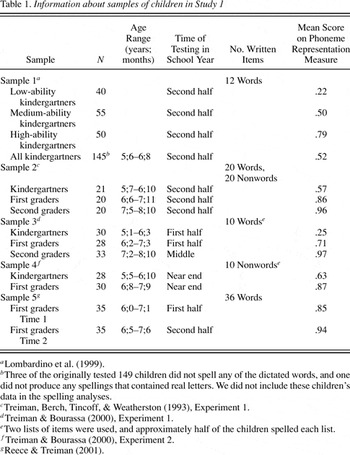
Table 1 provides information about the children in each sample and the items they spelled. None of the words in any of the studies contained an uppercase letter in its conventional spelling. The table also shows the scores for each group of children on an automated measure of phoneme representation that we developed for this study (available on-line at http://spell.psychology.wustl.edu/AMPR). One point is assigned for each phoneme that is spelled in a reasonable way, and the final values are scaled by the number of phonemes in the words. To count toward the tally, the child's spelling must map the phoneme sequence in left to right order. Extraneous inserted letters are ignored. If more than one subsequence would obey these rules, the one with the highest score is selected. For /kæt/, for example, kat would get 3 points for a score of 3/3 (1.0) and kqls would get 1/3 (.33). The spelling tka would get a score of 2/3 (.67) because ka maps the sequence /kæ/ in order. Although t could get one point as matching /t/, the rest of the spelling would not count because those letters are out of order. Spellings for /′/ or unstressed /I/ before final /τ/ are ignored because virtually any vowel letter is a plausible spelling of an unstressed vowel in English. These phonemes are not included in the phoneme count by which the score is scaled. The Appendix lists the spellings that were considered reasonable for each phoneme. Given the large number of kindergartners in Sample 1, we divided these children into three groups based on their score on the phoneme representation measure. Low-ability kindergartners had a score of .333 or less, medium-ability kindergartners scored more than .333 but less than or equal to .667, and high-ability kindergartners had a score of greater than .667.

Our computer-scored measure of phoneme representation correlated highly with other measures that use hand scoring. For Sample 1, we had available the score on the phoneme representation measure of Lombardino et al. (1999). For Samples 3 and 4, the score on the composite measure of Treiman and Bourassa (2000) was available. Our automated phoneme representation measure correlated .98 with the Lombardino et al. measure and .96 with the Treiman and Bourassa measure.
Each letter in each child's spelling of each item was coded for identity and case. The children used printed rather than cursive letters, cursive being taught only at later grade levels in US schools. For letters that have the same shape in upper- and lowercase, the size of the letter relative to the other letters in a child's spellings of that item and other items was used to identify the intended case. As a reliability check, a second coder scored the spellings of 38 kindergartners in Sample 1. The second coder agreed with the original coder on 98% of the judgments about letter identity and 95% of the judgments about letter case. Reliability would be higher for first and second graders, whose printing skills are better than kindergartners'. Each production was classified into one of four categories: all uppercase letters (AB), one uppercase letter followed by only lowercase letters (Ab), all lowercase letters (ab), or some other pattern (aB).
Results
Patterns of upper- and lowercase letters in children's spellings
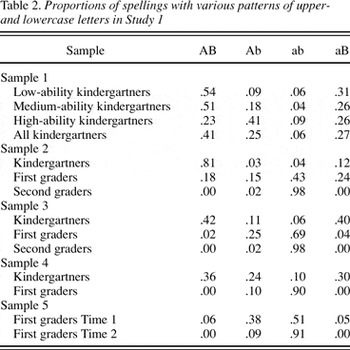
Table 2 shows the proportion of spellings that used each capitalization pattern. Only spellings that contained at least two letters were included in these analyses to ensure that each response could potentially fit into any of the four categories.

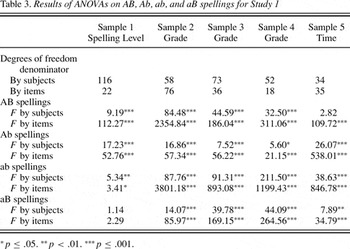
As a group, the kindergartners of Sample 1 favored AB spellings. Analyses of variance (ANOVAs) on the proportion of such spellings found a significant effect of spelling level (low, medium, high), such that AB spellings were less common among the high-ability kindergartners than among the low and medium spellers. The results of this and the following ANOVAs are summarized in Table 3. (For this and all other analyses that involve proportions, cases in which the denominator for the proportion was less than 10 were excluded from the analyses because a proportion cannot be computed reliably when the denominator is small. For ANOVAs that were carried out by subjects and by items, we focus on results that reached the .05 level in both types of analyses.) Spellings in the Ab and ab categories also varied reliably with spelling level, being more common among the high-ability kindergartners than among the less advanced spellers.

For Sample 2, the ANOVAs used the factors of grade (kindergarten, first, second) and lexicality (word, nonword). AB spellings became less common across the three grade levels, whereas ab spellings became more common. Ab spellings were more frequent among first graders than among kindergartners or second graders; aB spellings likewise peaked in first grade. For AB spellings, there was a small but significant effect of lexicality that did not interact with other factors, F1(1, 58)=4.26, p=.043, F2(1, 38)=5.82, p=.021. Words were about 3% more likely than nonwords to be printed in all uppercase letters. The analyses for Sample 3 used the factors of grade (kindergarten, first, second) and list (1, 2). As with Sample 2, AB spellings became less common from kindergarten to second grade and ab spellings became more common. Ab spellings peaked in first grade and aB spellings declined in frequency across the three grade levels. For Sample 4, analyses using the factors of grade (kindergarten, first) and list (1, 2) showed that AB and Ab spellings became less common from kindergarten to first grade, with ab spellings increasing in frequency. This increase was larger for one list of items than the other, as shown by an interaction between grade and list, F1(1, 52)=5.72, p=.020, F2(1, 18)=26.56, p<.001. For Sample 5, both Ab and aB spellings became less common from Time 1 to Time 2. Spellings with the ab pattern were more frequent in the second test than the first.
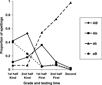
Figure 1 shows the combined results across the five samples. It depicts the proportions of spellings in various categories for children tested in the first half of kindergarten (N=30, mean proportion phonemes represented=.30), second half of kindergarten (N=194, mean proportion phonemes represented=.54), first half of first grade (N=63, mean proportion phonemes represented=.79), second half of first grade (N=85, mean proportion phonemes represented=.90), and second grade (N=53, mean proportion phonemes represented=.97). Kindergartners produced many AB spellings. The idiosyncratic aB pattern was also common among kindergartners, especially during the first half of the school year. AB spellings became less frequent once children entered first grade. However, spellings with the conventional ab pattern did not immediately take up the slack as AB spellings declined. Ab spellings also became more common, peaking in the first half of first grade. With further increases in skill, ab spellings became predominant.

Proportion of spellings with various capitalization patterns as a function of grade and time of school year when testing took place. AB spellings consist of all uppercase letters, Ab spellings consist of one uppercase letter followed by only lowercase letters, ab spellings are all lowercase letters, and aB spellings follow some other pattern.
Use of uppercase letters in initial, medial, and final positions of children's spellings
Based on the results reported so far, we cannot be sure whether uppercase letters were more common in the initial positions of children's spellings than in the later positions. Some of the children's aB spellings had an uppercase letter in the second or third position, for example, and further tests are needed to determine whether spellings with an uppercase letter in the first position outnumbered spellings with an uppercase letter in other positions. We therefore calculated the proportion of uppercase letters in the initial, medial, and final positions of all spellings that contained at least three letters. Table 4 shows the results for each sample.

By subjects ANOVAs were carried out for each sample. Position (initial, final, medial) was one factor in the analyses for all five samples. Spelling level (low, medium, high) was an additional factor for Sample 1, grade for Samples 2 through 4, and time in school year (first half, second half) for Sample 5. The results are shown in Table 5. The kindergartners of Sample 1 produced significantly more uppercase letters in the first position of their spellings than in the medial or final positions. For this sample, uppercase letters were reliably more frequent in the final position than the medial position. The difference between initial and noninitial positions was larger for the high-ability kindergartners than for the low and medium spellers. The children in Sample 2 were significantly more likely to produce an uppercase letter in the first position of their spelling than in the medial or final position; medial and final positions did not differ reliably. The position effect was larger for the first graders of Sample 2 than for the kindergartners or second graders. Lexicality, which was an additional factor in the ANOVA for Sample 2, had a small but significant effect, F(1, 51)=3.95, p=.05. The proportion of uppercase letters was about 2% higher for words than for nonwords. For Sample 3, kindergartners and first graders were significantly more likely to capitalize the first letters of their spellings than either the middle or final letters, which did not differ reliably. There was no significant effect of position for second graders. The kindergartners and first graders of Sample 4, likewise, were more likely to capitalize the first letters of their spellings than the subsequent letters. This difference was smaller for the first graders than the kindergartners. List, which was an additional factor in the ANOVA for Sample 4, interacted with grade, F(1, 44)=4.96, p=.03. One list yielded slightly more uppercase spellings than the other for kindergartners, with the opposite pattern for first graders. Finally, the first graders of Sample 5 were significantly more likely to capitalize the first letters of their spellings than the subsequent letters. As in Samples 2, 3, and 4, medial and final letters did not differ significantly from one another. The effect of position was smaller in the second half of first grade than in the first half.

The differences between initial and subsequent positions that we have seen so far could arise if children prefer to capitalize some letters more than others and if those letters happened to predominate in the initial positions of the children's spellings. To provide stronger evidence, we tabulated the proportion of uppercase instances of each letter when the letter occurred in the initial, medial, and final positions of spellings with at least three letters. The results were pooled across all samples at each grade level in order to maximize the number of letters that appeared reasonably often in all positions of the children's spellings. ANOVAs were performed using the factor of position (initial, medial, final), with letters as the unit of analysis. The effect of position was reliable for kindergartners, F(2, 44)=26.81, p<.001, and first graders, F(2, 26)=25.52, p<.001. At both these grade levels, the proportion of uppercase spellings was significantly higher when a letter occupied the initial position of a child's spelling than when it occupied the medial or final position. The difference between medial and final positions was not reliable. The effect of position was not statistically significant for second graders, who produced few uppercase letters.
Use of uppercase letters in noninitial positions of spellings
As we have seen, even inexperienced spellers use uppercase letters more often in the initial positions of their spellings than in the later positions. Nevertheless, a number of the noninitial letters in kindergartners' and first graders' spellings were printed in uppercase. Such spellings may stem, in part, from children's experiences with their own names. For example, Dayna may have capitalized the last letter when she spelled word as wrD because she frequently sees and writes the first letter of her name in uppercase. To test this idea, we calculated the proportion of noninitial letters of the children's spellings that were uppercase, broken down by whether the letter was or was not the child's initial. These analyses were performed on the combined data for kindergarten and first graders, the second graders' data being omitted because they rarely capitalized noninitial letters. We pooled the results across kindergartners and first graders in order to maximize the number of letters for which a reasonable number of children had the letter as their initial. The percentage of noninitial uppercase letters that matched the child's initial was 40%, as compared to 30% for noninitial uppercase letters that did not match the child's initial. The difference was significant by a one-tailed t test, t(11)=2.02, p=.034.
Discussion
The results of Study 1 indicate that even kindergartners show a nonrandom pattern in their use of upper- and lowercase letters. Although uppercase letters sometimes appear in all positions of their spellings, kindergartners are more likely to capitalize the initial letter of a spelling than the medial or final letter. Unlike Treiman, Berch, and Weatherston (1993), we did not find a consistent pattern of more uppercase use in final position than in medial position. The pattern of an initial uppercase letter followed by a series of lowercase letters is not formally taught in North American kindergartens, although teachers use this pattern when printing children's names and the first letters of sentences. Children appear to pick up the pattern from exposure and extend it to isolated words that are not proper names. By second grade, children learn that most words, when not at the beginning of a sentence, are spelled with all lowercase letters.
Previous studies have suggested that children's own names play an important role in the acquisition of literacy (Bloodgood, 1999; Ferreiro & Teberosky, 1982; Levin & Aram, in press; Treiman, Kessler, & Bourassa, 2001). Our results provide new evidence for this view by showing that the capitalization pattern of the name influences children's productions of other words. Kindergartners and first graders sometimes capitalize a letter when it occurs in a noninitial position of a spelling, and they are more likely to do this when the letter is the first letter of their own name than when it is not. That is, children preferentially learn about and use the letters in their own name, and some of this learning is specific to the case in which letters appear in the name.
In Study 2, we followed up on this evidence of case specificity in learning by examining kindergartners' knowledge of letter shape–letter name associations. Of particular interest was the influence of a child's first name on his or her knowledge of these associations. Treiman and Broderick (1998) found that children did better on the initial letter of their own first name or commonly used nickname than on other letters when they were queried about the names of uppercase letters. Similar trends were found when children were queried about the uppercase forms of later letters of their names, but the differences were not statistically significant for letters beyond the first letter of the name. These results suggest that children's experiences with their own name boost their knowledge about the labels of the letters that it contains, especially the first letter. A limitation of the Treiman and Broderick study is that it examined children's knowledge of shape–name associations for uppercase letters but not for lowercase letters. We examined both cases in Study 2 in order to determine whether children's knowledge about letters is specific to the case in which a letter appears in the conventional spelling of their name or whether it generalizes across case. For example, do children with names such as Brett and Becky name b better than children whose names do not begin with B? An affirmative answer would suggest that children generalize from the uppercase form of a letter to its lowercase form. A negative result would suggest that the boost in letter knowledge that comes from having a letter as one's initial is specific to the case in which the letter appears in the printed name.
STUDY 2: CHILDREN'S KNOWLEDGE OF THE NAMES OF UPPER- AND LOWERCASE LETTERS
Method
We analyzed data from two groups of kindergartners who were tested during the second half of the school year. Table 6 provides information about the two samples, each of which included 149 children. Each child was asked to identify each upper- and lowercase letter by name. Within each case, the letters were presented in a random order.

Results
Table 6 shows the mean proportion of correct responses to upper- and lowercase letters by the children in the two samples. The results are broken down by whether the letter has a highly similar shape in upper- and lowercase (c, k, o, p, s, v, w, x, z) or a noticeably different shape. Preliminary analyses were carried out using the factors of case in which the letter was presented (upper, lower), shape similarity (similar vs. different upper- and lowercase shapes) and sample (1, 2). The main effect of case, F1(1, 296)=295.59, p<.001, F2(1, 24)=10.54, p=.003, was modified by an interaction with shape similarity, F1(1, 296)=365.79, p<.001, F2(1, 24)=9.73, p=.005. With lowercase letters, children performed substantially better when the letter had the same shape as its uppercase counterpart than when it did not. Shape similarity had no significant effect with uppercase letters. Shape similarity interacted with sample, F1(1, 296)=8.09, p=.005, F2(1, 24)=5.13, p=.033, with the effect of shape similarity being larger in Sample 2 than in Sample 1.
Our main analyses considered children's performance on upper- and lowercase letters as a function of the letters in each child's first name or nickname. Of interest was whether performance was better when a letter appeared in the child's name than when it did not. If an own-name benefit was found, was it specific to the case in which the letter appeared in the child's name or did it extend to both the upper- and lowercase forms of the letter? To address this question, we focused on letters that had different forms in upper- and lowercase. Results, shown in Table 7, were pooled across the two samples. An ANOVA was carried out with the factors of case in which the letter was presented (upper, lower) and name membership (uppercase in child's name, only lowercase in child's name, not in child's name), using letters as the unit of analysis. There was a main effect of case, F(1, 7)=9.88, p=.016, a main effect of name membership, F(1, 7)=25.86, p<.001, and an interaction, F(2, 14)=4.74, p=.027. Generally, children did better when queried about uppercase letters than lowercase letters. They did better on letters that were in their name than on letters that were not and especially well on letters that appeared in the initial position of their name (i.e., letters that were in uppercase in the name). The benefit of name membership for letters that were not in the initial position of the name was a statistically significant and sizable 11% when the letter occurred in the same form as it did in the name, lowercase. The own-name advantage was smaller (3%) but still statistically significant when a later letter of the name was presented in uppercase, a form in which it does not occur in the conventional spelling of the name.

Discussion
The results of Study 2 confirm the finding of Treiman and Broderick (1998) that children are especially knowledgeable about letter shape–letter name associations for the first letter of their own name, when that letter is presented in uppercase. For example, performance on B was better for children with names such as Ben than children with names like Tim. A new finding is that a reliable advantage for the first letter of the first name also appeared when that letter was presented in lowercase. For example, Ben performed better than Tim on b as well as B. This result implies that kindergartners show some generalization from the uppercase form of a letter to its lowercase form, even when the two differ noticeably in shape. Another new finding is that significant own-name benefits appeared for the later letters in the name as well as for the initial letter. For example, children with names such as Sue did significantly better when queried about lowercase u than did children with names like Dan. The own-name advantage for later letters in the name was larger when the letters appeared in the same case in which they appeared in the name (i.e., lowercase) than in the other case, pointing to a degree of specificity in learning about letters. These results imply that children do not show full generalization from the uppercase to the lowercase form of a letter, although they show some generalization. The results of Study 2 further show that children's performance on lowercase letters is strongly influenced by whether a lowercase letter is similar in shape to its uppercase counterpart. All lowercase letters are not equally difficult (see also Treiman & Kessler, 2003).
GENERAL DISCUSSION
Young children, it is clear, attempt to represent the phonological forms of words when they spell. What is less clear is whether young children's spelling is completely based on sound. According to stage theories of spelling development, such as those of Gentry (1982) and Frith (1985), spelling is a purely phonological matter at some points in development. Other researchers suggest that, although phonology is important for young spellers, there is no point at which spelling is based only on phonology (e.g., Cassar & Treiman, 1997). We addressed this debate by examining young children's knowledge about an aspect of spelling that is not phonological: knowledge about the upper- and lowercase forms of letters and when to use each form. If young children's spelling were based purely on phonology, we would not expect them to learn about and follow the capitalization patterns of their language. If children consider more than just phonology, they may begin learning about these patterns from an early age. The results of Study 1 indicate that children begin to learn about the capitalization patterns of English as early as kindergarten, before these patterns are formally taught in North American schools. Children are more likely to use uppercase letters at the beginnings of their spellings, a position in which capital letters often occur in English, than in the later positions of their spellings. Together with other evidence of use of nonphonological information in early spelling (e.g., Treiman et al., 1994), the present results speak against the view (e.g., Frith, 1985; Gentry, 1982) that acquisition of nonphonological knowledge must await the completion of a stage of spelling development during which children's only focus is on the representation of sound. Although some types of nonphonological knowledge are acquired relatively late, other types of nonphonological knowledge, including the ones examined here, are not relegated to advanced levels of spelling development.
Our results also speak to the role of children's names in the learning of literacy. Previous results show that a child's name provides a stock of letters that the child tends to use, and overuse, when writing (Bloodgood, 1999; Gombert & Fayol, 1992; Levin & Aram, in press; Treiman et al., 2001). Also, young children tend to be more familiar with the name of the first letter of their own name than the names of other letters (Treiman & Broderick, 1998). In the present study, we discovered several additional ways in which children's names affect literacy learning, ways that show that an important part of learning about the name is learning about the forms in which letters appear in the name. One such finding was that children sometimes capitalize a noninitial letter in a spelling when it is the first letter of their own name. Another finding was that children's performance on tests of letter shape–letter name associations is affected by the case in which a letter appears in their own name, not only by whether the letter appears in their name.
The case of letter case provides a good vehicle for examining issues of breadth versus specificity in children's learning. Children see letters in particular forms and particular fonts. For some purposes, such as learning how to capitalize words or learning about print versus cursive writing, it is important that children store information about the specific shapes. For other purposes, such as learning about the relationships between letters and sounds, children should treat letters abstractly. Much of the previous work on letter knowledge and spelling development has focused on letters as vehicles for sound–spelling relationships. As such, children have been assumed to possess abstract representations of letters. Little consideration has been given to how children build these abstract representations and whether they retain information about the specific forms they have experienced. Our results suggest that information about the case in which letters appear in print is stored in memory from an early age and that this information influences children's performance. Learning about letters and about spelling involves more than just phonology.
APPENDIX
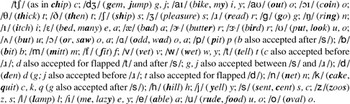
For each phoneme, one or two key words are listed, followed by the spelling(s) that were scored as reasonable in the automated measure of phoneme representation in spelling. These assignments are based on the phonemes' conventional English spellings and some common errors that are made by young children. Even when sounds are normally spelled with sequences of more than one letter, we only look for the most distinctive (normally the first) letter in the sequence. If the child is spelling a real word, we accept in addition any letter from the correct spelling of the phoneme.

ACKNOWLEDGMENTS
This research was supported by NSF Grants SBR-9807736 and BCS-0130763 and March of Dimes Grants 12-FY98-204 and 12-FY99-674. Thanks to Linda Lombardino and Mary Ann Evans for sharing their data; to Laura Kaakati, Margo Bowman, Suzanne Bick, and Tatiana Cury Pollo for help with the analyses; and to Iris Levin for comments on a draft of the manuscript.
References
Bissex G. L.
1980.
Gnys at wrk.
Cambridge, MA:
Harvard University Press.
Bloodgood J. W.
1999
What's in a name? Children's name writing and literacy acquisition.
Reading Research Quarterly,
34,
342–
367.Google Scholar
Cassar M. &
Treiman R.
1997
The beginnings of orthographic knowledge: Children's knowledge of double letters in words.
Journal of Educational Psychology,
89,
631–
644.Google Scholar
Evans M. A.,
Shaw D.,
Moretti S., &
Page J.
2003.
Letter names, letter sounds and phonological awareness: An examination of kindergarten children across letters and of letters across children.
Manuscript submitted for publication.
Ferreiro E. &
Teberosky A.
1982.
Literacy before schooling.
New York:
Heinemann.
Frith U.
1985.
Beneath the surface of developmental dyslexia.
In K. E. Patterson,
J. C. Marshall, &
M. Coltheart (Eds.),
Surface dyslexia: Neuropsychological and cognitive studies of phonological reading
(pp. 301–
330).
Hillsdale, NJ:
Erlbaum.
Gentry J. R.
1982
An analysis of developmental spelling in GNYS AT WRK.
Reading Teacher,
36,
192–
200.Google Scholar
Gombert J. E. &
Fayol M.
1992
Writing in preliterate children.
Learning and Instruction,
2,
23–
41.Google Scholar
Levin I., &
Aram D. (in press).
Children's names contribute to early literacy: A linguistic and a social perspective.
In D. Ravid &
H. Bat–Zeev Shyldkrot (Eds.),
Perspectives on language and language development.
Dordrecht:
Kluwer.
Lombardino L. J.,
Morris D.,
Mercado L.,
DeFillipo F.,
Sarisky C., &
Montgomery A.
1999
The Early Reading Screening Instrument: A method for identifying kindergarteners at risk for learning to read.
International Journal of Language & Communication Disorders,
34,
135–
150.Google Scholar
Read C.
1971
Pre-school children's knowledge of English phonology.
Harvard Educational Review,
41,
1–
34.Google Scholar
Read C.
1975.
Children's categorization of speech sounds in English
(NCTE Research Report No. 17).
Urbana, IL:
National Council of Teachers of English.
Read C.
1986.
Children's creative spelling.
London:
Routledge & Kegan Paul.
Reece C. &
Treiman R.
2001
Children's spelling of syllabic /r/ and of letter-name vowels: Broadening the study of spelling development.
Applied Psycholinguistics,
22,
139–
165.Google Scholar
Torrey J. W.
1993.
Learning to read without a teacher: A case study.
In F. Smith (Ed.),
Psycholinguistics and reading
(pp. 147–
157).
New York:
Holt, Rinehart & Winston.
Treiman R.
1993.
Beginning to spell: A study of first-grade children.
New York:
Oxford University Press.
Treiman R.,
Berch D.,
Tincoff R., &
Weatherston S.
1993
Phonology and spelling: The case of syllabic consonants.
Journal of Experimental Child Psychology,
56,
267–
290.Google Scholar
Treiman R.,
Berch D. &
Weatherston S.
1993
Children's use of phoneme–grapheme correspondences in spelling: Roles of position and stress.
Journal of Educational Psychology,
85,
1–
12.Google Scholar
Treiman R. &
Bourassa D.
2000
Children's written and oral spelling.
Applied Psycholinguistics,
21,
183–
204.Google Scholar
Treiman R. &
Broderick V.
1998
What's in a name: Children's knowledge about the letters in their own names.
Journal of Experimental Child Psychology,
70,
97–
116.Google Scholar
Treiman R.,
Cassar M., &
Zukowski A.
1994
What types of linguistic information do children use in spelling? The case of flaps.
Child Development,
65,
1310–
1329.Google Scholar
Treiman R. &
Kessler B.
2003.
The role of letter names in the acquisition of literacy.
In R. Kail (Ed.),
Advances in Child Development and Behavior
(Vol. 31,
pp. 105–
135).
San Diego, CA:
Academic Press.
Treiman R.,
Kessler B., &
Bourassa D.
2001
Children's own names influence their spelling.
Applied Psycholinguistics,
22,
555–
570.Google Scholar
Information about samples of children in Study 1
Proportions of spellings with various patterns of upper- and lowercase letters in Study 1
Results of ANOVAs on AB, Ab, ab, and aB spellings for Study 1
Proportion of spellings with various capitalization patterns as a function of grade and time of school year when testing took place. AB spellings consist of all uppercase letters, Ab spellings consist of one uppercase letter followed by only lowercase letters, ab spellings are all lowercase letters, and aB spellings follow some other pattern.
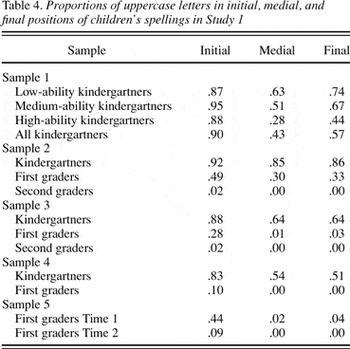
Proportions of uppercase letters in initial, medial, and final positions of children's spellings in Study 1
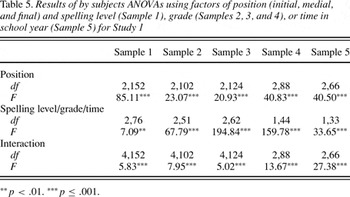
Results of by subjects ANOVAs using factors of position (initial, medial, and final) and spelling level (Sample 1), grade (Samples 2, 3, and 4), or time in school year (Sample 5) for Study 1
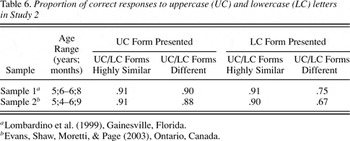
Proportion of correct responses to uppercase (UC) and lowercase (LC) letters in Study 2
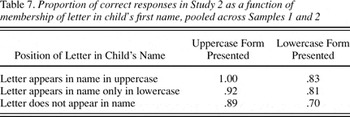
Proportion of correct responses in Study 2 as a function of membership of letter in child's first name, pooled across Samples 1 and 2
 You have
Access
- 55
- Cited by