INTRODUCTION
After the development of the radiocarbon (14C) technique by Willard Libby and his colleagues, several countries attempted to have specialized laboratories in this field. In Mexico, the international success of this methodology did not go unnoticed, especially because of the great interest that arose in the archaeological community. The Institute of Physics (IF) of the National Autonomous University of Mexico (UNAM, Universidad Nacional Autónoma de México), and the National Institute of Anthropology and History (INAH, Instituto Nacional de Antropología e Historia), were interested in applying the new technique to subjects of national benefit. Consequently, the first 14C laboratory was created by both institutions at the IF in 1954. Later, during the 1980s, three different institutions installed liquid scintillation counters (LSC) laboratories, but it was not until 2013 that an accelerator mass spectrometry (AMS) facility was established. This historical overview seeks to recognize the impetus of the pioneers who helped make AMS 14C analysis in Mexico a reality.
Augusto Moreno Proportional Counter Laboratory
The beginning of 14C research in Mexico is closely linked to the development of nuclear physics in our country. After the end of World War II, in response to the United States program Atoms for Peace, the Mexican government promoted the development of science around nuclear physics. As part of the nuclear program, a 2 MV Van der Graaff accelerator was purchased in 1950 and installed at the IF in the new UNAM campus (Cruz-Manjarrez Reference Cruz-Manjarrez1975; Mateos et al. Reference Mateos, Minor and Michel2012). After cooperation and exchange agreements with the United States, educational programs on the peaceful applications of nuclear energy were promoted. Mexican scientists traveled to North American universities to carry out postgraduate studies or training in tasks related to nuclear reactors and radioisotope techniques.
In 1953, one of the first researchers to participate in this program was chemist Augusto Moreno, who learned the 14C technique while working at Libby’s laboratory at the University of Chicago (Moreno Reference Moreno1955). Upon his return to Mexico, Moreno headed the tritium (3H) and 14C laboratories of the Radiochemistry Section at the IF (Cruz-Manjarrez Reference Cruz-Manjarrez1976). The 14C laboratory started applying the original Libby’s technique; later, in the 1960s, a proportional gas counter was acquired, but 14C analysis was complex and inaccurate due to the absorption of nuclear pollutants emitted by atmospheric nuclear tests (Moreno Reference Moreno1965). Few antecedents exist about scientific results obtained in this laboratory, which was eventually dismantled, when the IF moved into its new facilities, in 1976. On the other hand, there are some publications by Moreno about effects of nuclear explosions on radioactive rain, as part of a research program promoted by the United Nations Scientific Committee, which suggested the installation of a radioactive fallout monitoring network (Alba et al. Reference Alba, Beltrán, Brody, Lezama, Moreno, Tejera and Vázquez1956; Moreno Reference Moreno1960; Moreno and Ramírez Reference Moreno and Ramírez1961).
In the following decades, the development of LSC provided simple, affordable, and accurate equipment for 14C dating. In the 1980s, three 14C laboratories were set up in Mexico based on the LSC technique: the first one at INAH, the second one at UNAM, and the last one at the Mexican Institute of Water Technology (IMTA, Instituto Mexicano de Tecnología del Agua).
Douglas Donahue’s Visit to the IF in Mexico: the First Attempt to Establish an AMS Laboratory
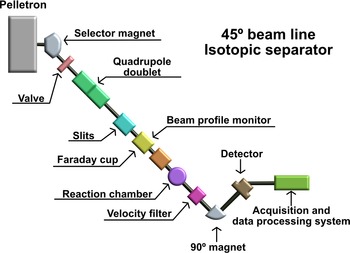
Although two of the three existing 14C laboratories were dedicated to the analysis of archaeological samples, the cultural richness of Mexico far exceeds the analytical capacity of both. The development of the 14C dating technique using AMS was close, when in 1994 a 3 MV Pelletron accelerator arrived at the IF of UNAM. With the acquisition of this new machine, a program was established to measure nuclear reaction cross sections relevant to astrophysics. As part of the instrumentation developed for this project, an isotopic separator was built and coupled to the accelerator at the 45° beam line (Figure 1). Ion transport programs were also developed in house (“traza” to draw the trajectories of different species within the separator, and “amoeba” to optimize the voltages and currents of the different optics elements). However, the evolution of this in-house effort had to stop in 2006 as the facility became dedicated to ion beam analysis (IBA) of surfaces and films, and the production of new materials through ion implantation.
Schematic diagram of the first isotopic separator at the Pelletron Facility (adapted from Macías et al. Reference Macías, Chávez, Ortíz, López and Huerta2001).

Naturally, already having an isotopic separator, a new proposal was to explore the feasibility of performing AMS analysis in the Pelletron, to which adaptations would have to be made. For this purpose, the 1st International Symposium on Radiation Physics was held at the IF in December 2003, with several invited specialists in AMS: Douglas Donahue from the University of Arizona, Greg Norton from NEC, N. L. Roberts from NOSAMS, Carl J. Gross and Salvador Galindo from Oak Ridge National Laboratory, and Thomas Calligaro from C2RMF, Louvre Museum.
Donahue, a pioneer in the use of AMS for 14C dating, stressed in his talk that Mexico, with such a cultural heritage, should look for the establishment of an AMS facility. During his visit, he volunteered to participate in a quick experiment to test the capability of the isotopic separator for masses 12, 13, and 14. The experiment conducted on the Pelletron allowed the verification of 14C transmission from the ion source to the surface barrier detector. It was performed with graphite samples that had very little 14C, but its concentration could be measured with an accuracy of 10%. After the experiment, Donahue agreed that with the simple adaptations proposed by the Mexican group, the Pelletron facility could perform AMS 14C determinations with uncertainties around 1% for modern samples. To improve the precision to the state-of-the-art laboratories, a bigger effort would be needed.
After the symposium and Donahue’s visit to Mexico, Corina Solís headed a program to establish a sample preparation laboratory for AMS 14C work. She made short stays at the University of Arizona’s AMS laboratory and at Livermore National Laboratory. She set up a sample preparation laboratory and graphitization line, and several years later, her former PhD student M. A. Martínez, worked for a year at the University of Arizona to adapt the methodologies of sample preparation to the Mexican laboratory.
Establishment of LEMA
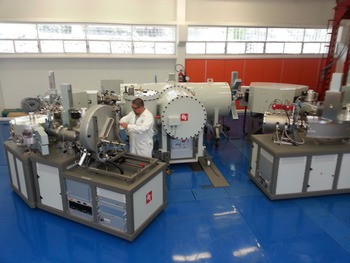
The idea of acquiring a new accelerator for AMS was not abandoned, and E. Chávez and his group began an unsuccessful pilgrimage in several provincial states to set up an AMS laboratory. At the end of 2009, the opportunity came when the National Council for Science and Technology (CONACyT, Consejo Nacional de Ciencia y Tecnología) issued a call for proposals to fund the new national laboratories. The IF, at the initiative of a group of its researchers (C. Solís, E. Chávez, and M. E. Ortiz, among others), with the support of Director G. Monsivais, submitted the proposal for the creation of an AMS facility. The project was approved, and with the joint funding of CONACyT and UNAM, the AMS Laboratory LEMA (Laboratorio de Espectrometría de Masas con Aceleradores) was established in 2013 (Solís et al. Reference Solís, Chávez-Lomelí, Ortiz, Huerta, Andrade and Barrios2014). The AMS system is based on a 1 MV tandem type accelerator with a multi-cathode negative ion source, manufactured by High Voltage Engineering Europa (HVEE) (Figure 2).
LEMA: the AMS system of the IF, UNAM.

The project’s initial funding allowed the implementation of 14C, 10Be, and 26Al AMS analysis. It was thanks to the prestige of M E Ortiz, emeritus researcher at the IF and Director G Monsivais, that important additional funding was obtained to fully equip the carbon sample preparation laboratory, to extend the AMS system to the analysis of 129I and Pu, and to build new facilities that house, besides LEMA, eight other small laboratories. LEMA started to conduct research in physics and related areas, train new specialists, and support the linkage of science with other cultural, intellectual, and productive activities. In 2017 a new beam line was coupled to the 1 MV accelerator for nuclear physics experiments and IBA.
APPLICATIONS
After the acceptance tests to verify the machine’s excellent performance, the first dated sample at LEMA was an object, apparently from ancient Egyptian culture, that belonged to a private collector. A small subsample was taken and resulted in a 14C age of 2700 ± 40 BP (902–827 cal BC). Since then, 14C dating of archaeological objects is by far the most frequently performed analysis.
In the nuclear physics beam line, experiments are conducted to measure nuclear reaction cross sections at low energy of relevance for stelar nucleosynthesis and astrophysics. Two of the most important publications in this field are the AMS cross-section measurement for 28Si(d,α)26Al and 9Be(n,γ)10Be nuclear reactions at low energies (Marín-Lámbarri et al. Reference Marín-Lámbarri, García-Ramírez, Sánchez-Zúñiga, Padilla, Acosta, Chávez, Cruz-Galindo, Huerta, Méndez, Raya-Arredondo, Rodríguez-Ceja, Solís and Barrón-Palos2020; Reza et al. Reference Reza, Zunun-Torres, Padilla, Mas-Ruiz, Marín-Lámbarri, Acosta, Amador-Valenzuela, Andrade, Belmont and Charón2020).
Since 2009, seven workshops have been organized at the IF to present the progress of different projects in which LEMA has participated. Some have contributed to the study of the chronology of historical or prehistoric events of national and international interest. Below are some relevant examples.
Tunnel under the Temple of the Feathered Serpent in Teotihuacan
The pre-Columbian city of Teotihuacan, declared a Cultural Heritage of Humanity site by UNESCO, is characterized by its vast monuments, the Temple of the Feathered Serpent and the pyramids of the Sun and Moon. Built between the 1st and 7th centuries, the city was one of the most important pre-Columbian centers of Mexico and Latin America.
In 2010, excavations near the Temple of the Feathered Serpent revealed the existence of a tunnel 14 m deep and 120 m long. This finding is considered one of the most important archaeological discoveries in the last decades, and after years of exploration, more than 100,000 objects have been recovered from inside.
The existence of this deep, underground tunnel was interpreted as Tlalocan. S. Gómez-Chávez, leader of the excavation, explains that this place, used as a sanctuary representing the underworld, was used for the recreation of myths of the original creation and to perform rituals related to the political exercise and the investiture of great rulers. 14C dating of some organic samples including rubber, wood, charcoal, bones, and teeth, indicated that the oldest-strata dates belong to a period between 120 to 320 cal AD, with two closure periods between 170 and 200 cal AD, and a final one around 220–235 cal AD. A last entrance occurred trough a shaft made at the end of the tunnel, close to the main chamber. The period was dated around 400–534 cal AD, near the collapse of the city. Therefore, the tunnel was used intermittently during the whole period of occupation of Teotihuacan (Gómez-Chávez et al. Reference Gómez-Chávez, Solís, Gazzola, Chávez-Lomelí, Mondragón, Rodríguez-Ceja and Martínez-Carrillo2017).
The Mayan Codex of Mexico
The Mayan Codex of Mexico (formerly Grolier) made public in 1971, is a document painted on tree-bark paper, called amate, containing 10 pages covered with a layer of stucco on both sides. The illustrations show the calendar of Venus. Since this object was obtained through looting, the date of its manufacture was uncertain, and its authenticity was questioned. In 2016 a team of specialists was convened to conduct a multidisciplinary analysis of the composition, iconography, production procedures, causes, and degree of damage to the codex. LEMA was commissioned to determine its age.
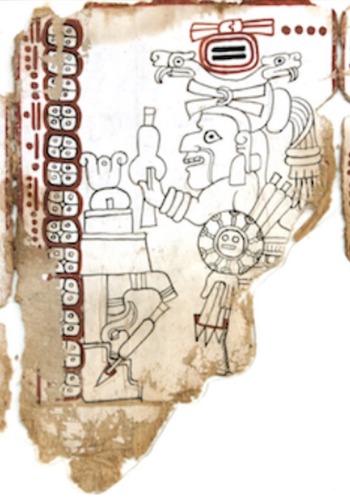
A previous date that was obtained at the NSF-Arizona AMS laboratory from page 11 of the codex (now page 10b), gave a 14C age of 809 ± 49 BP (1063 cal AD–1291 cal AD; Carlson Reference Carlson2012). The sample analyzed at LEMA from page 5 (Figure 3) gave an age of 850 ± 35 BP (1049 cal AD–1263 cal AD). Combined, these two dates placed the manufacture of the Codex in the range of 1159–1260 AD with 95% certainty (Solís et al. Reference Solís, Martínez Carrillo, Rodríguez-Ceja, Chávez and Christen2018, Reference Solís, Martínez Carrillo, Rodríguez-Ceja, Chávez, Christen and Jull2020). Together with other findings, this result led the specialists to consider the Mayan Codex of Mexico to be the oldest legible document in the Americas and recognize it as the 4th pre-Columbian Mayan Codex besides the Dresden, Paris, and Madrid Codex.
Page 5 of the Mayan Codex of Mexico.

Evidence of Human Occupation in Mexico around the Last Glacial Maximum
The next application deals with a prehistoric research project carried out for 10 years by C. Ardelean and his team at Chiquihuite Cave, in Zacatecas State, central-northern Mexico. Excavations revealed about 1900 limestone and basalt artifacts, identified as spear points and blades made by human hands. The raw materials do not belong to the petrology of the cave and were obtained more likely from the vicinities of the site. These objects were extracted from multiple stratigraphic levels. The organic materials associated with most of the objects were dated in four AMS laboratories, LEMA among them. Most of the material fell in an interval that dates to the Last Glacial Maximum, between 26,500 and 19,000 years ago, supporting new evidence for the antiquity of the human occupation in the Americas (Ardelean et al. Reference Ardelean, Becerra-Valdivia, Pedersen, Schwenninger, Oviatt, Macías-Quintero, Arroyo-Cabrales, Sikora, Ocampo-Díaz and Rubio-Cisneros2020).
EPILOGUE
We remember Professor Douglas Donahue’s visit to Mexico because he encouraged us to establish the first AMS laboratory in our country. The measurement of 14C on the 3 MV Pelletron proved that the IF had sufficient infrastructure to establish a 14C AMS laboratory, but more importantly, the existence of a team of researchers ready to plan, establish, and operate it. LEMA is now a reality, and in addition to continuing collaboration with the University of Arizona and other institutions, its collaborative efforts with the rest of Latin America persist and have been strengthened through its participation in the Latin American Radiocarbon Conference (CLARA).
ACKNOWLEDGMENTS
This work was supported by CONACyT and DGAPA-PAPIIT under grants 314857 and IG100619, respectively. The authors thank Sergio Martínez and Roberto Gleason for their technical support.