One of the most contentious issues in China–African relations is how to evaluate China's rapidly expanding role in the continent as an energy and resource extractor. Many African countries express gratitude for Beijing's generous offers of aid, cancellations of debt and promises of trade and investment in exchange for energy and minerals. Critics, however, charge that China's extractive behaviour in Africa is no less than neo-colonialism, as it seizes a new sphere of influence, grabs oil and other resources, props up repressive regimes and leaves individual African countries on the losing end. Beijing has refuted such characterizations by identifying itself with the developing world, stressing the reciprocal nature of its interactions with Africa and promising a new paradigm of China–Africa partnership based on the traditional friendship.Footnote 1
A close examination of China's relations with Africa in areas of energy and resources reveals much of the dynamics and complexities of China's growing ties with the continent. A number of initial studies have formed a good base for further debates on this fairly new subject. Some argue that China's rush to Africa for energy and resources is very similar to what the Western countries have been doing for decades, and concluded that the “new scramble” in the continent has produced or will have negative consequences for Africans.Footnote 2 Others have questioned if such a “scramble” is overly exaggerated or if it is too early to draw negative conclusions.Footnote 3 Yet others argue that China's energy expansion in Africa, as fast as it has been in recent years, is still relatively small by all major measurements, and charge that Western media has blown things out of proportion.Footnote 4 Despite their differences in arguments and supporting evidence, these studies share a similar methodology: they focus heavily on China's interactions with Africa, either as a continent or as different countries.
This article approaches China–Africa relations in the energy and resource sectors from a different angle, by focusing on the linkages of Chinese domestic development and its foreign policy behaviour. To look at Beijing's thirst for oil, minerals and other raw materials is a good starting point. But we also need to go beyond that by examining the impact of the current Chinese economic development model on its relations with African countries.
The first part of the article examines the domestic development context of the Chinese political economy that is key to understanding changing Chinese perception and behaviour in Africa. The second part demonstrates, through the historical evolution of China–Africa relations and the current debate on the nature of this relationship, that China is not a monolithic bloc when it comes to its relations with Africa. Even the three major sets of actors – the government, the state-owned companies and the individual industrialists – cannot be generalized as just having one behaviour pattern for each. Internal dynamics in each group may come out in a different manner depending on time, location and cases in hand. The third part of the article focuses on Chinese national oil companies and other enterprises, and reveals a number of unique features of Chinese energy and resource extractive operations in Africa.
Throughout the article, I argue that much of what the Chinese government, Chinese companies and individual entrepreneurs are doing today in Africa is an externalization of China's own development experiences in the past three decades. China's interactions with African countries are reflective of its own development contradictions, and major patterns of Chinese behaviour in Africa can be attributed to complex motivations and objectives of the actors involved.Footnote 5 I support this argument by extensive surveys of current literature on China's relations with Africa in energy and resource sectors, with a heavy emphasis on Chinese sources, and my field research interviews in China, Africa, Latin America and the Middle East in the past few years.
Changing Domestic and International Priorities and Their Implications for China's Africa Strategy
Over the past three decades, the Chinese leadership has pursued a modernization programme largely built on traditional economic development models: heavy industrialization, labour- and capital-intensive manufacturing industries, export-led growth, low labour cost and high environmental damage. By following such a development paradigm, China's “miracle” growth of GDP has come with heavy price tags on wages, workers' welfare, the eco-system and political reforms. Many have realized the negative impact of the Chinese development model on the country itself but few have examined what it means to Chinese foreign policy, especially the behaviour of Chinese enterprises abroad.
The first impact of the Chinese development model is China's growing hunger for more and more energy and natural resources, leading to massive extractive activities both inside China and around the world. A fast growing economy typically requires more energy, but China's modernization drive has produced a manufacturing structure that requires huge increases in energy consumption, creating an inefficient energy consumption system and a consumer trend that is difficult to sustain. China is now the “factory of the world.” The major portion of its economic output is oriented towards industries that are primarily energy-driven. With about 6 per cent of global GDP, China consumes 31 per cent of the world's coal, 30 per cent of iron, 27 per cent of steel, 40 per cent of cement, 20 per cent of copper, 19 per cent of aluminium and 10 per cent of electricity.Footnote 6
Accompanying this heavy industrial structure is the tremendous waste of energy. As acknowledged by Zhang Guobao 张国宝, deputy commissioner of China's National Development and Reform Commission, to generate every 10,000 yuan of GDP, China uses as much as three times the energy as the global average.Footnote 7 The ratio is even higher than major advanced industrialized countries. In producing US$1.00 GDP, China consumes eight times the energy that Japan does; and in producing the same industrial goods, China uses 11.5 times the energy of Japan.Footnote 8
Such a heavy demand for energy and raw materials have led to two major structural imperatives for China. One is to find ever more energy and resources within Chinese borders and to develop them as fast as possible. Another is the call by central government for Chinese enterprises to “go out,” that is, to go around the world to explore and extract additional energy and resources. High energy and commodity prices prior to the recent world economic recession added urgency for such an external push. Given Africa's rich endowment of energy, minerals and other key resources, it is only natural that Chinese enterprises would see the continent as a new frontier. In other words, a major structural requirement for China's continuous industrialization drive is to enter Africa aggressively and extract energy and resources, very much along the lines of what it has been doing at home for decades.
Second, China's modernization efforts not only feature a heavy industrial structure and a fast-growing auto industry but also attract the relocation of many polluting industries by American and other Western multinationals to China. They have caused severe damage to China's environment and the overall ecosystem, and in the process have made China one of the worst polluters on earth. China is now the largest consumer of the world's construction materials, expending the most energy in unit GDP production and ranking first in air and water pollution with 70 per cent of its rivers and 90 per cent of its city rivers being polluted.Footnote 9 While the United States and other industrialized countries remain the biggest producers of carbon dioxide emissions on a per capita basis, China is catching up fast, and became the overall largest carbon dioxide emitter as a country in 2007.Footnote 10 Being a signatory of the Kyoto Protocol but not subject to its emission reduction standards as a developing country, China is releasing ever more greenhouse gases into the atmosphere.
With such a domestic environment record and the struggle to find a way ahead, it is not surprising that China is not a leading power in the global fight for preserving the ecosystem. Chinese enterprises have little environmental consciousness, and do not possess much expertise in environmental assessment or protection. Thus, when they go to Africa and other parts of the world with primarily the extraction of energy and resources in mind, they are not natural promoters of the environment of the host countries. Whereas in advanced industrialized states such as Australia and Canada there are strict regulations on preservation and environment, many African countries do not have such systems in place. Facing the massive inflow of Chinese capital and extractive activities, these countries are thus very vulnerable to environmental degradation and weak in enforcing existing regulations.
Third, the Chinese development model and its urban prosperity are largely built on the low-wage labour of, and at the expense of, the majority of the Chinese rural population. Yet evidence is mounting that the high-GDP-centred development paradigm is too costly to sustain. As revealed by the China Human Development Report 2005, regional disparity is threatening the country's growth potential, and the widening urban–rural distribution gap has reached a dangerous level. Only two decades ago, China was one of the most equal societies on earth. Today, it ranks 90th in the United Nations Development Programme's 131-nation HDI.Footnote 11
The structural issues involved in locking the migrant workers where they are have to do with the policy choices China has made in the past 30 years in its modernization programme. In order to attract foreign investment, China has also focused on basic manufacturing and heavy industry that are capital-intensive, labour-intensive, heavy resource and energy consuming, and environment unfriendly. Such an industrial development model requires a low-cost labour force, and China's seemingly endless supply of migrant workers has filled the bill. Thirty years of reform has transformed China into a cut-throat, competitive capitalist market economy featuring severe exploitation of workers, especially migrant workers with sustained low wages. It is thus difficult to imagine that Chinese entrepreneurs and companies used to such domestic conditions would go to Africa and treat workers there any differently.
Finally, China's modernization paradigm has also led to direct human cost and suffering. And there is no clear indication that China has developed a political, social and cultural infrastructure to cope with the many social issues brought about by its fast economic development. In a rare disclosure of the enormous hidden cost of China's rapid economic development, the Chinese government acknowledged that “sudden public incidents” such as industrial accidents, social safety accidents and natural disasters are responsible for over one million casualties and the loss of 6 per cent of GDP every year. According to a People's Daily online special, over 5 million “public accidents” occurred in 2004 alone, causing the death of 210,000 people, injuring another 1.75 million and resulting in the immediate economic loss of over US$57 billion (455 billion yuan). It is estimated that the direct annual cost of such disasters for China is more than US$81 billion (650 billion yuan) on average, equal to 6 per cent of the country's annual GDP.Footnote 12
Thus, in the rush for industrialization and profits, Chinese enterprises are not well prepared in work safety procedures. Many of them in fact are negligent in these areas. China's civil society is weak. The legal system is still developing. And most importantly, political reform is lagging behind, thus leaving a major question mark on the transparency of many political, economic and social procedures that can make the state as well as the enterprises accountable for their actions. These weaknesses have severely limited the ability of Chinese businesses to function in a manner that is responsive to labour concerns, civil society demands and transparency requirements in their operations in Africa and other parts of the world.
But in every area listed above, there are also indications that the Chinese leadership and China as a whole are beginning to realize the negative impacts of the development paradigm in the past three decades. There are strong and growing voices for efficient use of energy and resources. More measures are being taken to tackle environmental problems. There are improvements in protecting migrant workers' rights. There are new regulations for work safety, transparency and dealing with civil complaints. And there are new government programmes to correct the income inequality trends and to increase the income levels of rural regions. These new developments are also reflected in China's growing presence in Africa in a very complex manner.
Energy, Resources and the Evolving Debates on the Nature of China–Africa Relations
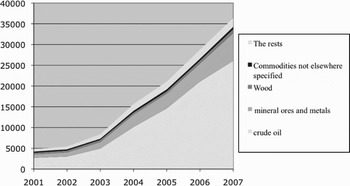
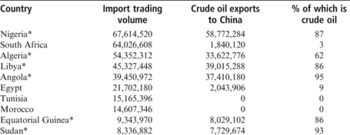
The single most striking character of China–Africa relations in recent years is the fast-growing Chinese appetite for the continent's energy and natural resources. As noted by other authors in this issue, China–African trade has increased dramatically in the past decade. And the share of energy and raw materials in China's trade with individual African countries is the most significant (Table 1 and Figure 1). Chinese customs statistics show that from 2001 to 2007, China's trade with Africa increased 681 per cent, only slightly slower than the growth of its trade with Latin America in the same period (687 per cent), but faster than its trade growth with other regions.Footnote 13
Composition of China's Imports from Africa, 2001–2007

China's Top Ten African Trading Partners by Imports, 2007

Notes:
Unit is US$ thousand. *denotes major crude oil exporting nations in Africa. China's import trade with major African oil exporting nations primarily consists of petroleum.
Source:
COMTRADE statistics.
China's relentless pursuit of economic development, as noted in the last section, had turned the country from a petroleum exporter to an importer by 1993, and by the turn of the new century its dependency on foreign oil had jumped to about 40 per cent, and now is at 50 per cent. Beijing's new target is to quadruple its economy again between 2000 and 2020, as it did from the late 1970s to the mid-1990s.Footnote 14 To achieve that goal, China must rely more and more on external energy supplies. The middle kingdom is now burning 7.8 million barrels of oil a day.Footnote 15 Although still far behind the United States, which consumes some 20.7 million barrels a day,Footnote 16 Chinese consumption is projected to reach a daily level of 10 million barrels within the next two decades or so, according to estimates of the International Energy Agency.Footnote 17
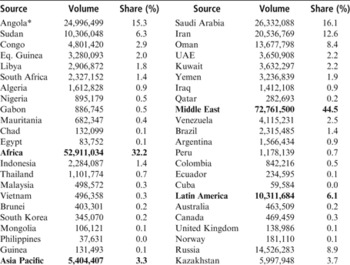
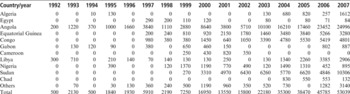
It is not surprising that in such a broad economic context, Africa has turned into a major energy supplier to China in recent years. Furthermore, an integral part of China's growing trade relations with the rest of the world was an increase in oil imports from different regions, resulting in Africa now supplying China with one-third of its imports (Table 2).
China's Crude Oil Imports from Major Exporting Nations, 2007

Notes:
Unit: tons. *According to Chinese Customs, Angola briefly overtook Saudi Arabia in the first half of 2006.
Source:
Chinese customs.
China's current demands for energy and raw materials have conditioned its presence in Africa primarily as a resource extractor. As many analysts point out, Chinese energy and resource activities in the continent have made them no different from other former colonial powers that had gone there for exactly the same purpose: to seize energy and resources for feeding their own development purposes rather than to do anything to serve the host countries.Footnote 18 The implications for such an association are critically clear because extractive activities by traditional Western powers in Africa are perceived by many as tainted with greed and suffering, as revealed by Nicholas Shaxson in Poisoned Wells.Footnote 19 Yet many in China's policy circles do not think that the relationship should be classified in this way.
First, there is a debate about whether China's new economic development model is a curse or a blessing for Africa. For critics, its downside in the past 30 years is clear despite its deliverance of a high economic growth rate: a brutal capitalist market economy; severe exploitation of labour forces; widespread corruption in both political and economic areas; widening inequality in income distribution; worsening environmental and ecological conditions; lack of corporate responsibility and transparency; and no experience or expertise of democratic governance. These particular constraints of China's domestic conditions may produce very negative consequences for African countries when combined with similar or worse local conditions.
But for those who have faith in “socialism with Chinese characteristics,” China's reform experiences in the past three decades can serve as a model for developing countries in Africa on how to eliminate poverty and make strides in industrialization. In Chinese official press and academic writings, there is a growing trend to view China's rapidly evolving presence in Africa as a force of good for the continent after its stagnation in the post-independent decades.Footnote 20 Senior Chinese policy makers and diplomats have confidently expressed the view that the Western colonial powers had their chance to deliver development to Africa in the second half of the 20th century but they failed miserably. Now it's China's turn to provide an alternative development path, one that is primarily based on the Chinese development lessons.Footnote 21
The fact that such claims are often backed and supported by the African governments and people themselves further strengthens these arguments. For example, the Hon. Festus Mogae, former president of Botswana, spoke highly of China's positive role and its investment in Africa and is openly critical of those who treat the Chinese presence in Africa in purely negative terms.Footnote 22 There is also substantial scholarship showing that Chinese loans and other forms of assistance to many countries, often with no strings attached, are seen as giving local autonomy without imposing certain values as do the loans from Western-dominated international financial institutions.Footnote 23
The reality is more of a mix between the two positions. There are certainly lessons from China's success story that can be utilized if they are applied properly to local conditions. Many African countries are inspired by China's fast modernization process and hope they can bring such prosperity to their own land. But there are also negative elements of China's development paradigm in the past three decades, described above, that could be harmful to local development once they are exported to Africa in the form of energy and resource extractive operations.
Second, inside China, policy makers and academics have also been debating about the nature of China's quest for energy and resource security. Those who hold a realist view of international relations insist that energy security belongs to the domain of traditional security issues. They see all Western criticism of China, from the Sudan to Zimbabwe, as no more than a device to drive China out of Africa. They advocate strong state support for Chinese enterprises in Africa and are not moved by humanitarian concerns in the Darfur region.Footnote 24
Others tend to treat China's growing energy and resource needs as belonging to the “non-traditional” security realm. They argue that China and the United States have similar interests in gaining access to Africa's vast energy and raw material resources, and both require a stable environment on the continent to achieve their objectives. The two major powers could also work together to tackle many of the development problems facing African countries. It is therefore in Beijing's interests to forge a truly “win-win” situation in its relations with Africa, while exploring a co-operative framework with the United States and the EU countries to ensure that the major powers do not engage in hostile policies that harm both the African people and their own interests.Footnote 25 They feel that China's international image as a new rising power and a “responsible stakeholder” is damaged by supporting the government of the Sudan or political leaders such as Mugabe in exchange for the kind of gains that are not vital to China's national interests.
The key issue here is not to make a right or wrong judgement in siding with one of the parties. Rather, observers of Africa–China relations should be aware of the existence of such debates. As a result of these internal development dynamics and complex views, Chinese foreign policy objectives and behaviours in Africa are neither monolithic nor static. They are constantly changing and being adjusted, reflecting China's shifting domestic priorities and opinions.
Local Adaptation of Chinese NOCs and Enterprises in Africa
The African operations of Chinese national oil companies (NOCs), state-owned enterprises (SOEs) and private enterprises reflect the internal tensions and contradictions of China's overall African strategy as examined in the previous sections. But there are more specific domestic and international concerns that influence the behaviour of Chinese NOCs and other companies in the continent. Each of these conditioning factors in turn has led to a particular set of operational practices in the quest for energy and resources by Chinese NOCs and extractive enterprises in Africa.Footnote 26 We can characterize the behaviour of Chinese energy and resource extractive activities in Africa in the following way.
Chinese firms are suffering from an energy and resource insecurity syndrome when it comes to doing business in Africa
There are often reports in the press that Chinese NOCs are bold in bidding wars backed by large amounts of capital, march around the world to lock in energy and other resources without hesitation, and are rapidly taking over the African continent from the traditional domination of Europeans and Americans.Footnote 27 And Chinese demand in recent years has driven up global oil prices.
Chinese perceptions are quite different. The Chinese officials from the Energy Bureau of the National Development and Reform Commission, now the National Energy Administration, point out that China does not produce enough oil and gas to meet its demands; they have no control of the skyrocketing oil prices but acknowledge China's need to import energy from abroad, with the result that oil is one of the largest items of China's annual imports.Footnote 28 They argue that China, with only around a 7 per cent share of the global oil trade, had only a marginal impact on the huge increase in world oil prices that began in 2004, an argument now proven to be correct. And they accuse the “international petroleum crocodiles” – large Western oil majors – for manipulating the oil prices for unprecedented profits.Footnote 29
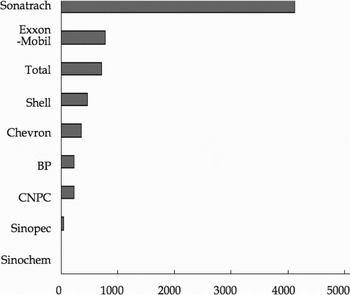
Hence the “go out” strategy was the order for China's NOCs and SOEs. Yet the Chinese firms are also aware that most of the world's oil reserves and fields are owned either by the host country's national oil companies or by half a dozen or so Western international oil companies (IOCs). In Africa for example, according to two studies by China National Offshore Oil Corporation (Africa) Ltd and China National Oil & Gas Exploration and Development Corp., NNPC of Nigeria ranks first in terms of accumulative, recoverable oil reserves rights, followed by Shell, Total, Exxon-Mobil and Chevron. Chinese oil companies are not in the top ten.Footnote 30Figure 2 shows the major ranking of main international energy companies in Africa.
2006 Production in Africa by World Major IOCs and NOCs

With such a sense of vulnerability and insecurity, Chinese NOCs, all of them lacking international experience in general and African expertise in particular, have tried to compensate by making more adventurous moves that may carry a higher level of risk: going into Africa's “troubled zones” with bold investment and aid packages in exchange for energy. China is willing to venture into zones that are still not totally dominated by the Western IOCs.
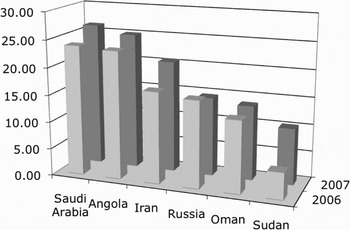
When Angola ended its 27-year civil war in 2002, few foreign countries were willing to get into the country. In 2004 China committed to a $2 billion oil-backed credit line for rebuilding the country's shattered infrastructure,Footnote 31 and increased this by a further US$1 billion in 2005.Footnote 32 Beijing also made Angola its largest foreign aid destination. It added another $2 billion in aid to Angola during Premier Wen's two-day visit in 2006.Footnote 33 Angola is currently the second largest oil producer after Nigeria in sub-Saharan Africa, producing 1.4 million barrels per day. One-third of that goes to China, making up 13 per cent of total Chinese imports. Angola was the second largest supplier of crude to the Chinese market after Saudi Arabia in both 2006 and 2007 (see Figure 3 and Table 3).
Two of China's Top Six Crude Oil Importing Countries are from Africa

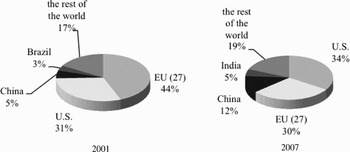
Africa's Crude Oil Export by Countries, 2001 versus 2007

As a major Chinese corporate executive told me in the autumn of 2008, her company's decision to enter Angola a few years before the end of its civil war was a substantial risk but it was also where the opportunity lay at the time. It paid off with large returns in the energy and real estate sectors. Now this executive's target is Zimbabwe. Even though it is still in turmoil, it is a rare chance to establish a presence. And once stability arrives, as she predicts, her company will gain returns just as it did in Angola.Footnote 34
The Sudan is another case where the West has criticized the Chinese presence while in recent years the Chinese NOCs have expanded their operations in the war-torn country despite the ongoing Darfur crisis, and many Chinese have hailed China–Sudan energy relations a success story.Footnote 35 According to Liu Guijin 刘贵今, the Chinese government's special representative for Darfur, China provided the Sudan with humanitarian assistance of about US$11 million in 2007, and will provide another US$90 million in soft loans.Footnote 36 Statistics from Chinese customs showed that the bilateral trade volume between the two countries rocketed from US$103 million in 1990 to US$3.35 billion in 2006. The bilateral trade figure surpassed US$5.66 billion in 2007, up 69.1 per cent from 2006. The Sudan is now China's third trade partner in Africa, trailing only Angola and South Africa (see Figure 4 for China's growing share of Africa's oil exports).Footnote 37
The Chinese National Petroleum Corporation (CNPC) is the largest oil investor in the Sudan.Footnote 38 By the end of 2007, the company had invested at least $5 billion in the country,Footnote 39 representing its single biggest foreign investment.Footnote 40 According to CNPC's 2006 annual report, the Sudan accounts for about half of all its overseas oil assets.Footnote 41 In 2007, China produced roughly 226,000 barrels of oil every day from three oil fields in the Sudan, or about 3 per cent of China's demand in that year.Footnote 42 CNPC hopes to produce 600,000 barrels per day of crude from the Sudan by 2010, even though it has reduced activities in the Darfur region because of unrest.Footnote 43 Based on 2007's data, China was buying 60 per cent of Sudan's crude oil output.Footnote 44
China's Oil Imports from Africa, 1992–2007

Notes:
Unit is thousand tons.
Sources:
1992–2002: China's Oil Interest in Africa: An International Political Agenda; 2003–2007: Chinese customs.
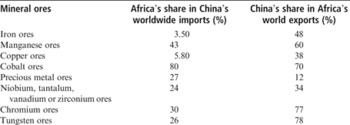
Africa's Mineral Ores Exports to China

Notes:
Though not a major receiver of Africa's total crude oil export worldwide (see Figure 4), China is a major customer when it comes to Africa's non-fuel mineral resources.
Source:
COMTRADE statistics.
The failed efforts by China National Offshore Oil Corporation (CNOOC) to acquire Unocal, the ninth largest US energy company, in the autumn of 2005 had an accelerating impact on Chinese NOCs expansion into Africa, Central Asia and the Middle East.Footnote 45 As a senior vice-president of CNOOC candidly told a visiting delegation of the US and Canada-based Energy Council, the Chinese NOCs considered the US Congress's block of the sale of Unocal to CNOOC as a violation of market principles. When his company was ready with US$18.5 billion to enter the US energy market, it had sincerely followed the advice of its US counterparts that it should refrain from investing in “funny places” – countries and regions that are not friendly towards the United States. But when CNOOC was rejected for political rather than business reasons, his company and other Chinese oil majors were forced to invest in places that are at times hostile to American interests. In another interview with the author, the same official further confirmed that major large-scale CNOOC investments in Africa, especially in Nigeria, were made after 2005, a decision derived directly from the Unocal affair.Footnote 46
The Unocal episode further enhanced the Chinese perception of energy insecurity. “If you can't do it somewhere, then you can always do it somewhere else,” Fu Chengyu 傅成玉, chairman of CNOOC, said in an interview in 2006. “We're looking at opportunities in Africa as a whole.”Footnote 47 And the records in Nigeria demonstrate that CNOOC has invested heavily in the country.
In 2006, CNOOC acquired a 35 per cent working interest in a licence to explore a Nigerian offshore oilfield for US$60 million. Then in January 2007 it acquired 45 per cent of the deepwater oilfield (formerly OPL 229, now OML 141) operation rights under an offshore oil production licence (OML130) with US$2.268 billion in cash.Footnote 48 The Niger Delta where OML130 is located is one of the basins with the most abundant oil and gas reserves in the world.Footnote 49 China was offered the exploration rights in return for investing US$4 billion (S$6.33 billion) in Nigeria's infrastructure.Footnote 50 Further, in April 2008 China agreed to offer Nigeria a US$2.5 billion loan in parallel with talks about gaining energy exploration rights in the country. So far, China has offered export guarantee credits worth up to US$50 billion as a bold strategy to woo Africa's biggest oil producer.Footnote 51
From these developments and cases, China's drive for securing more stable and affordable oil supplies from around the world in order to feed its domestic economic growth is a clear motive. Reduced production at home and the failed entry into the US energy market have made Chinese energy companies more insecure and they are thus making much bolder moves in their African operations. Going beyond the energy sector, Table 4 shows China's growing shares of Africa's major mineral exports. In the examples of both Sudan and Zimbabwe, the attitudes of the Chinese companies, both large and small, are typical reflections of the ongoing and often self-contradictory debates in China about its relations with Africa and the continent's role in China's own development needs. The argument of using Africa as “the last virgin land of energy and resources” and the view that China must be helping failed states out of their current mess by engaging them with economic and trade activities are mixed in China's presence in these two countries. In addition, the picture gets more complex when we factor in that in recent years Beijing has moved from strictly not interfering in other countries' domestic affairs to playing a more active role in mediating the Darfur conflict.
Chinese oil industry and energy companies are competitive in Africa even as latecomers
Historically, Western oil companies declared China a country of no oil reserves after decades of exploration without success in the early 20th century. When China did find a reserve at Daqing 大庆 in the north-east part of the country in the early 1960s, it had little technology of its own nor external help. The following decades saw many hard-fought battles by retired army divisions who were sent to the oil field to become workers. China's own short history of the petroleum industry was primarily home-grown and practically based on self-reliance principles of the 1960s and 1970s.
While the reform and openness since the late 1970s have seen the modernization of China's petro industries, lessons of the past are not lost. The Daqing oil field, wild land back in the 1960s and now a vibrant industrial city of more than a million, devotes an entire exhibition building to showcase its history of working under extremely hard conditions. When Chinese NOCs went global very swiftly in the early 21st century, they found themselves facing the well-established IOCs in Africa and other parts of the world. They lacked the technology, international management skills and other expertise to meet challenges far away from home. But Chinese oil companies have gradually discovered that what they lack can be compensated by the knowledge they had accumulated many years earlier in the oil fields of Daqing.
According to Wang Zhen 王震, dean of the School of Business at the China University of Petroleum (Beijing) and an energy economist who has done extensive work on Chinese NOCs in Africa and Central Asia, NOCs have developed technologies over the years that can turn certain African oil fields, those considered by Western companies to be of no value, into profitable operations. Chinese managers, engineers and workers are low cost and, more importantly, are used to working in harsh conditions. Chinese firms are also quite adept at drilling faulted block reservoirs and certain heavy oil deposits, which present a formidable challenge to Western companies. This gives Chinese NOCs an advantage in bidding on certain projects in Africa. In fact, taking into account also the low-cost local workforce, many Chinese energy extractive operations in Africa are at a lower cost than comparative Chinese domestic explorations of similar projects.Footnote 52
To further overcome the latecomer's effect based on such advantages, Chinese energy companies are committing large amount of funds and labour for exploration and development rights in resource-rich countries. They also enter into joint ventures with national governments, state-controlled energy companies or individual enterprises for a long-term local presence. It appears that the Chinese companies often outbid their competitors in major contracts awarded by governments of African countries because their concerns are not just short-term returns but strategic positioning for the future.Footnote 53
As illustrated earlier, Sudan remains one of the earliest and largest overseas energy projects by China's major energy companies, including investment, development, pipeline building, a large Chinese labour deployment and continuous operation. But Chinese NOC activities in Africa include close to 20 countries in the continent with petroleum exploration projects and oil equity interests.Footnote 54
It is common for Western press reports to treat Chinese oil and energy companies as the same as the Chinese state. But the reality is far more complicated. China's reform process in recent decades has decentralized economic activities. CNPC, Sinopec and CNOOC used to be central government ministries but are now independent corporations although they are still state-owned. All of them have international subsidiaries that are listed on international stock exchanges. These companies do take central government's call to “go out” as a general direction, but they do not normally behave like robots in carrying out orders. Their growing corporate interests, operational considerations and profit motives play a major part in their decisions to implement an overseas project, and do not always coincide with the priorities of the Chinese leadership. Chinese interests in Africa are quite diverse now that China is no longer a monolithic bloc.
As illustrated above, Chinese energy companies are swiftly expanding their operations in Africa primarily because they have identified a number of areas where they are competitive over their Western counterparts. They can make a good profit in most of their operations and their unique advantages can overcome their latecomer status. Thus the market forces that drive China's domestic competition also play a major role in how Chinese NOCs and other firms function in Africa. At the same time, their actions also seem to reflect the aim of the Chinese leadership to secure a larger supply of overseas energy and resources. But just as Chinese companies at home are facing the challenge of reducing income disparity and increasing wages for low-paid migrant workers, in Africa too, workers are not content with low wages in Chinese extractive operations in their own lands. For long-term sustainable development needs, China needs to address such critical issues both at home and abroad, and here the connections are close: a better labour environment at home will facilitate the necessary changes in Chinese operations in Africa. The reverse may also have an impact, although much less.
Chinese NOC operations abroad and especially in Africa have inadequate knowledge of good governance, corporate social responsibility and environmental protection
Under the Chinese development model of the past 30 years, as discussed earlier, Chinese government ministries in charge of energy development were transformed into the current large NOCs. They have been a major driving force behind China's high-energy consumption industrialization process. The demand for energy has grown so rapidly that there was little time to pay attention to environmental concerns. And corporate social responsibility has until recently been a foreign concept to Chinese companies, which are extremely profit-oriented at this particular stage of economic development. As China is a one-party state, the press is not free and NGOs are not strong enough to challenge the state or large corporations as their counterparts can in Western societies or some of the African countries.Footnote 55 Thus many Chinese firms are completely unused to being confronted with issues of transparency, corporate society responsibility, civil society and NGO involvement in resource development and environment assessment related to large-scale projects.
The case of Sinopec's operational experiences in Gabon provides the best example of Chinese NOCs' willingness to go through a difficult but necessary adaptation process. Sinopec is a latecomer and the main Chinese company operating in Gabon's oil sector. It has joint exploration with other companies but its own blocks are the Lotus, GT-Est and DT-Est blocks. Sinopec's experience in Loango once made major headlines around the world.Footnote 56 Having been awarded the Lotus exploration block located in the Loango National Park, Sinopec started its seismic exploration activities. The environmental impact assessment (EIA) was conducted by a Dutch company, but was of inferior quality. An international outcry led by Gabonese NGOs followed. International NGOs from Western countries provided their support, and the Gabonese government was under pressure to do a re-evaluation. The operation was halted in September 2006.Footnote 57
According to a senior Sinopec executive based in Gabon, the company had never intended to do a poor job on sustainability and environmental issues. In a lengthy conversation, he acknowledged that Chinese NOCs lack the necessary local and international know-how when conducting environmental assessments. “We screwed up in the first round,” he said, “but it was not entirely our own fault.” As it turned out, miscommunication seems to have played a role. The Sinopec executive pointed out that initially, the Gabonese government officials in charge were not enforcing regulations particularly well and Sinopec was not even informed that the area they were going into was a National Park.Footnote 58
Facing such a challenge and willing to get things right, Sinopec's Gabon subsidiary adopted three major steps. First, it accepted the criticisms levelled against the company by Gabonese and international NGOs, and committed funds to re-do the entire EIA for the project. The Dutch company which had done the previous EIA redid it in conjunction with EnviroPass, a Gabonese organization, and the World Wildlife Fund. Sinopec has since resumed activities and is currently exploring for oil in the Loango National Park. Several Gabonese, Western and Chinese respondents interviewed on the subject stated that the subsequently conducted EIA was the best ever produced in Gabon.Footnote 59 Sinopec is even committed to be a part of the verification process of the Extractive Industries Transparency Initiative, one of the very few Chinese firms which have agreed to participate in this annual reporting system.Footnote 60
Second, Sinopec pursued joint ventures with established Western oil companies for both profit and learning purposes. Sinopec's joint ventures in Gabon are two onshore concessions, Ozigo and Awoun, both with heavy and waxy crude oil and both operated by Shell Gabon. Sinopec's joint venture with Shell is the only profitable operation for Sinopec in Gabon while others are still in the stage of exploration.Footnote 61
Finally, Sinopec used China's strong traditional ties with the Gabonese government to make sure that Chinese energy interests in the country are not threatened by its initial setbacks on the project in the Loango National Park. When Sinopec entered the Ozigo joint venture, oil had already been discovered. In the exploration phase, the stakes were as follows: Shell 44.25 per cent, Amerada Hess 44.25 per cent and the Gabonese state 11.50 per cent. As the state's share was to be sold, Amerada Hess was allowed to buy 5.75 per cent and the other 5.75 per cent was sold to Sinopec. According to the senior manager quoted above, several other companies, including the ones participating in the exploration phase, were interested in buying the Gabonese state's share. However, it was sold to Sinopec even though it had not participated in the risk of the exploration phase. Some see this as a political move to allow China entry into Gabon's oil market.Footnote 62
At the Awoun deposit, oil was discovered in 2003. Production facilities are currently being built and the concession will come into production late 2009 or early 2010. According to a well-informed observer, Sinopec entered into the Awoun joint venture in a similar fashion to the venture with Ozigo once oil was already discovered.Footnote 63 Again, other companies also showed interest when the state's share was to be sold, but the share was given to Sinopec, which was interpreted as another favour by the Gabonese state to the company.
The case of Sinopec in Gabon is significant in that the turnaround process reflected what is happening in Chinese domestic scene: there are political, social, economical, civil society and international pressures for China, at this stage of its development, to pay more attention to the environment and the country's overall ecosystem. Although lacking such experiences at home, Sinopec Gabon displayed a willingness to confront its shortcomings, and take forward-looking measures to consolidate its position in the host country. Unlike in the cases of Sudan and Zimbabwe, where mixed actions are taking place as a result of China's domestic ongoing debates on how to deal with the two countries, Sinopec's operations in Gabon shows what a Chinese company can do in adapting to a new set of rules that are only beginning to emerge at home. However, as very few Chinese companies have signed on with the Extractive Industries Transparency Initiative, Sinopec Gabon's limited success cannot be generalized as a universal trend for all Chinese companies operating in Africa.
It is notable from the above analysis how large the perception gap is between the outside world and the Chinese themselves concerning the capacity, scale, operational reach and potential of Chinese energy companies in Africa and around the world. Influenced by a series of domestic contradictions and conflicting priorities of the Chinese government's African policy frameworks, Chinese NOCs are advancing into Africa with a number of their own historical, domestic and international constraints.
Assessments and Conclusions
Given the changing nature of the international political economy of energy and resources, the study of China's relations with Africa in general and in the extractive industries of energy and resources in particular is still at an early stage. Currently, the so-called “commodity super-cycle” of 2001–07 is over as the world economy headed into recession in 2008.Footnote 64 With the prices of oil and major raw materials falling, many African countries that are heavily dependent on exports of oil or other resource commodities as their major sources of revenue will suffer. As demand for these commodities drops worldwide, foreign multi-national corporations, Western as well as Asian, will move to adjust their ongoing and planned operations in Africa.
Regardless of the uncertainties of the world economy in the next few years, the focus of this study, as of many others in this volume, is more about China's fast ascendency to the continent in the recent booming years. This article may offer some initial assessments and reach some tentative conclusions.
First, economic data and relevant statistics indicate that energy and resource extraction has become the most important feature of China's relationship with Africa, but defining the nature of such a new partnership is far from uniform or conclusive. As well as the extreme and sensational views of some press reports and studies, even seasoned observers have not been able to escape entirely the trap of a good versus evil dichotomy when it comes to evaluating Chinese energy and resource activities in Africa. To argue simply that the Chinese presence in Africa is mostly good or mostly bad for African development is missing the dynamics and the complexities of the relationship. The core issue is not whether Chinese firms are doing good or bad things; they are certainly capable of doing both. Nor is it a measure of analytical depth just to consider whether the Chinese newcomers are the same as the old colonial powers. The reality is more complicated. Depending on time, country, sector and other specific conditions, the Chinese government and Chinese companies doing business in Africa may display different behaviours and preferences. Some limited generalizations, as attempted in this article, are possible, but more time, more research and gathering of data over a longer period are needed to reach comprehensive conclusions on the nature of China's engagement in Africa.
Second, it is important to study China–Africa energy and resource relations by focusing on the external dimensions of the two-way interaction, but that alone is inadequate to get a more in-depth view of the ways the Chinese do things in Africa. This article has concentrated on the logical correlations between domestic and foreign policy connections. It has demonstrated that changing priorities, debates and constraints of the domestic political economy has a direct impact on China's foreign policy and corporate behaviours in Africa by both the government and energy companies. To understand China's policies in the Sudan or Zimbabwe, the best place to begin is not necessarily a detailed review of China's bilateral interactions with each state. Rather, answers can be found within the Chinese domestic context. And any changes of Chinese policies towards the Sudan and Zimbabwe will come from significant domestic changes, involving factors presented in the first part of this article.
Third, the focus on domestic sources of China's African policy leads not to a grand design by a new Chinese empire to take over Africa but to a complex interplay between a China that has become a status quo world power and its historical role as a champion of the Third World demanding a new international economic order. The Chinese leadership is eager to grab Africa's energy and resources to feed the appetite of its economic growth back home, while trying to deliver benefits to Africans through aid, cancellation of debt and construction of infrastructure. The traditional Chinese foreign policy norm of non-interference in others' domestic affairs is being tested by progressive voices, both from within and outside China, of humanitarian intervention, human rights and democracy.
Beijing may have some overall strategic thinking on its role in Africa but China is no longer a monolithic bloc. Debates go on inside China's policy-making circles all the time. Facing increasing criticism from the Western press and NGOs, and the humiliating protests at China's Olympic torch relay around the world in 2008, Chinese policy makers and academics have also been debating how China can effectively respond to the crisis in the Darfur region. Some have argued that the international criticism of China's Sudan policy – and its increasing presence in Africa in general – is no more than trying to use human rights issues to drive China out of Africa, or at least to slow down its advances. They then insist that Beijing must not give in and should do everything to win the strategic competition. Others contend that it is not worth risking China's international reputation to protect its interests in Sudan or Zimbabwe which have little impact on China's overall economic interests. Some more pro-active measures in Darfur from Beijing, they argue, will promote China as a responsible power.Footnote 65
Fourth, the linkage between China's domestic development tensions and its African policies points to a Chinese energy strategy that is more driven by insecurity and vulnerability than a predatory desire to control energy and resources in the African continent. To make up for their own weaknesses, Chinese NOCs have intensified their investment and exploration in many African states, sometimes using aggressive measures to compete with their well-established Western counterparts. The history and composition of today's Chinese NOCs have given them certain advantages, beyond state-sport and financial power, in the areas of technology, labour and cost. They have developed an engagement pattern of their own, which may not be the same as Beijing's overall objectives in Africa. Even when the Chinese leadership may want certain outcomes from China's engagement in Africa, it may not have all the leverage or control over a fast-expanding network of state and private actors who have entered these markets following the logic of globalization and profit maximization.
Fifth, China's energy and resource extractive activities in Africa will continue to face challenges from the domestic front, host countries and the international community. The case of Sinopec in Gabon shows that Chinese firms are capable and willing to adapt to the African setting and international norms, but this case does not mean that all Chinese enterprises in Africa will practise what Sinopec has done. The structural pressure from China's current political and economic system is for more corruption and less transparency, and being non-democratic and environmentally unfriendly. If China's cut-throat capitalism continues to externalize its negative aspects to Chinese practices in Africa, only corrupt regimes in some of the African countries will benefit instead of the ordinary people. And there will certainly be more backlashes of local resentment against the Chinese presence.
Finally, a fundamental understanding of Chinese domestic development dynamics will help African countries to maximize their resource fortunes and avoid the “resource curse.” There is a clear eagerness by many developing countries in Africa to translate China's booming prosperity into opportunities for their own development, hoping that the coming of China is more positive than their experiences with European powers and the United States in the past. But as I have already warned, China's economic boom of the past three decades will not last forever. The driving force of China's extractive industries in Africa, ranging from oil to minerals to forestry, is its own domestic economic growth. The Chinese may bring benefits to the hosting countries but they are not primarily in those places to serve local interests. Thus, a slowdown of Chinese economic growth, a slowdown in China's energy demands or a combination of both, as has already happened since autumn 2008, will have a direct impact on those African countries that primarily base their economic interactions with China on energy and resource exports.Footnote 66
China's economic presence in the continent, as fast as it has been growing in recent years, is still relatively new and small in scale. Thus, the research agenda is wide open, many issues are yet to be explored, and patterns of behaviour to be established. There is also a need to take a more interdisciplinary approach, as this article has attempted, to combine international relations, comparative politics, area and country expertise and industrial sector-specific studies to achieve a more balanced, nuanced and comprehensive understanding of China–Africa relations.