Implications
This study demonstrates that a peroxisome proliferator-activated receptor gamma (PPARγ) agonist has no effect on milk fat synthesis and does not interact with a conjugated linoleic acid (CLA) supplement (29.9% of trans-10, cis-12). It demonstrates that the PPARγ agonist is unable to overcome the trans-10, cis-12 CLA effects on milk fat synthesis and expression of lipogenic genes and, thus, the mechanism of CLA appears to be independent of PPARγ.
Introduction
Conjugated linoleic acids are fatty acids naturally produced by rumen microbes as a result of the isomerization of linoleic acid. A variety of CLA isomers are found in meat, milk and dairy products from ruminants and the effects of trans-10, cis-12 CLA have been extensively studied in livestock animals. A number of biological activities have been attributed to CLA isomers and trans-10, cis-12 CLA specifically and dose dependently inhibits milk fat synthesis. The effect of trans-10, cis-12 CLA is conserved across species and has been reported to reduce milk fat synthesis in lactating cows (Baumgard et al., Reference Baumgard, Corl, Dwyer, Saebo and Bauman2000), pigs (Bontempo et al., Reference Bontempo, Sciannimanico, Pastorelli, Rossi, Rosi and Corino2004), ewes (Oliveira et al., Reference Oliveira, Gama, Fernandes, Tedeschi and Bauman2012; Ticiani et al., Reference Ticiani, Urio, Ferreira, Harvatine and Oliveira2016), goats (Fernandes et al., Reference Fernandes, Gama, Ribeiro, Lopes and Oliveira2014) and humans (Masters et al., Reference Masters, McGuire, Beerman, Dasqupta and McGuire2002).
First reported by Baumgard et al. (Reference Baumgard, Corl, Dwyer, Saebo and Bauman2000), trans-10, cis-12 CLA was the isomer responsible for inhibition of milk fat synthesis in dairy cows. Further work has described that the mechanism involves, at least in part, a coordinated downregulation of the gene expression of enzymes involved in milk fat synthesis (Harvatine et al., Reference Harvatine, Perfield and Bauman2009).
The peroxisome proliferator-activated receptor gamma (PPARγ) is a nuclear receptor activated by natural (e.g. fatty acids and eicosanoids) or synthetic (e.g. thiazolidinedione (TZD)) ligands able to initiate heterodimerization with retinoid X receptor followed by their binding to response element in the targeted genes (Kennedy et al., Reference Kennedy, Chung, LaPoint, Fabiyi and McIntosh2008). The stimulation of PPARγ by TZD promotes expression of lipogenic genes. However, specific trans polyunsaturated fatty acids such as trans-10, cis-12 CLA appear to be unable to activate the PPARγ expression in bovine mammary epithelial cells (Kadegowda et al., Reference Kadegowda, Bionaz, Piperova, Erdman and Loor2009).
Several studies have investigated specific PPARγ agonists in cattle, but little work has been conducted with sheep and goats (Bionaz et al., Reference Bionaz, Hurley and Loor2013). Collectively, these studies suggest that PPARγ gene expression can be manipulated in vivo and in vitro in ruminants by the use of synthetic agonists.
The central hypothesis of our study was that PPARγ regulates milk fat synthesis in the mammary gland and that trans-10, cis-12 CLA inhibits milk fat synthesis at least partially through inhibition of PPARγ. To test this hypothesis, we investigated the effect of a PPARγ agonist and the ability of the agonist to overcome trans-10, cis-12 CLA inhibition of milk fat synthesis in lactating ewes.
Material and methods
Animals, design and treatments
All procedures were approved by the Santa Catarina State University Ethical Committee, protocol no. 01.38.14 and were performed at Pinheiro Seco farm, Bom Retiro, SC (27°47'57.11"S and 49°29'14.65"W). A total of 24 Lacaune lactating ewes with 70±3 days in milk, weighing (BW) 60±0.45 kg and producing 1.2±0.34 kg milk/day were randomly assigned to one of the following treatments: (1) Control (intravenous infusion of 5 ml/day of sterile saline solution); (2) TZD (2,4 thiazolidinedione; Sigma-Aldrich, São Paulo, SP, Brazil; intravenous infusion of 4 mg/kg of BW/day in 5 ml of saline solution, once daily); (3) CLA (oral dose (30 ml) of 27 g/day of fatty acid methyl ester containing 4.1% palmitic acid, 3.6% stearic acid, 27.4% oleic acid, 1.2% linoleic acid, 29.8% cis-9, trans-11 CLA, 29.9% trans-10, cis-12 CLA and 3.0% others FA); (4) TZD+CLA. The amounts of TZD and CLA were based on the papers of Smith et al. (Reference Smith, Stebulis, Wadron and Overton2007) and Oliveira et al. (Reference Oliveira, Gama, Fernandes, Tedeschi and Bauman2012), respectively. In treatment 4, the infusion of TZD started 1 day before CLA dosing to allow TZD to stimulate PPARγ gene expression before CLA treatment.
Management, feeding, experimental period, sampling and analyses
All animals grazed paddocks of festuca (Festuca arundinacea Schreb.) and white clover (Trifolium repens L.) during the day and were housed collectively in a barn at night and received 1 kg/day of corn silage (dry matter) plus 0.9 kg/day of a concentrate mixture containing soybean meal (39%), ground corn (56%) and a commercial vitamin/mineral mix (5%). Free access to water and a mineral salt was provided. The corn silage, concentrate and predicted pasture intake were expected to meet or exceed the nutrient requirements according to the National Research Council (NRC) (2007). The predicted dry matter intake (DMI) based on Institut National De La Recherche Agronomique (2007) taking into account live weight, milk yield and milk composition. Ewes were milked twice a day at 0600 and 1430 h and all treatments were administered before the afternoon milking.
The experimental period was 7 days and individual milk samples were collected from both milkings on the last day of the period, pooled proportionally and stored at 4°C with a preservative (bronopol tablet; D & F Control Systems Inc., San Ramon, CA, USA). Milk fat, protein, lactose, and total solids were determined by infrared analysis (AOAC, 2000) (method 972.160) and somatic cells were counted by flow cytometry. Milk yield was measured on day 0 and 7 of the experimental period.
Mammary and adipose tissue biopsies
The mammary and adipose biopsies were performed according to the method of Ticiani et al. (Reference Ticiani, Urio, Ferreira, Harvatine and Oliveira2016). The biopsies were taken after the afternoon milking on day 7 of experimental period with an average duration of 15 min/ewe.
The mammary biopsy was made through the skin at the midpoint of the right rear quarter using a Bard Max-Core Disposable Core Biopsy Instrument (Bard Biopsy Systems, Covington, GA, USA) and the adipose tissue biopsy was taken from the tail head region immediately cranial and lateral to the last lumbar vertebra (dorsal subcutaneous depot), through scalpel excision. Tissue samples from mammary gland (~10 mg tissue/biopsy) and adipose tissue (~400 mg tissue/biopsy) were inspected to verify tissue homogeneity and immediately frozen in liquid N2. The animals were observed for 2 days post-biopsy and milked by hand to remove blood clots. The biopsy procedure resulted in minimal bleeding and milk appeared normal in 2 to 4 milkings following the biopsy. Flunixin meglumine (1.1 mg/kg of BW) was administered immediately following the biopsies and no intra-mammary infections were observed.
RNA extraction, synthesis of complementary DNA and quantitative real-time polymerase chain reaction
Total RNA was extracted from both mammary and adipose tissues samples according to Ticiani et al. (Reference Ticiani, Urio, Ferreira, Harvatine and Oliveira2016), using the RNeasy Lipid Tissue Mini Kit (Qiagen Sciences, Germantown, MD, USA) with on-column DNase treatment (RNase-free DNase set; Qiagen Sciences). The concentration of RNA was measured by a spectrophotometer (NanoDrop ND-2000; NanoDrop Technologies, Wilmington, DE, USA) and the quality by the A260/280 nm ratio with a mean value of 2.01 (±0.01). The total RNA was transcribed to complementary DNA (cDNA) using the High-Capacity cDNA Reverse Transcription kit (Applied Biosystems, Foster City, CA, USA) with random primers.
Polymerase chain reaction amplification was performed in triplicate in a 15 µl reaction. The data were analyzed with StepOne software v2.1 (Applied Biosystems).
Primer design
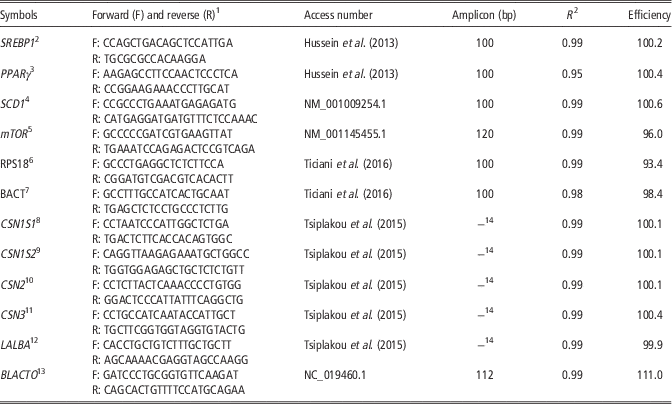
Primer sequences were obtained from published studies or designed from GenBank (NCBI, USA), using Primer Express 3.0 (Applied Biosystems), synthesized by Invitrogen (Carlsbad, CA, USA) and validated for specificity, linearity and efficiency. Gene expression of PPARγ, sterol regulatory element-binding transcription protein 1 (SREBP1), stearoyl CoA desaturase 1 (SCD1), mammalian target of rapamycin (mTOR), casein-αS1 (CSN1S1), casein-αS2 (CSN1S2), casein-β (CSN2), casein-κ (CSN3), β-lactoglobulin (BLACTO) and α-lactalbumina (LALBA) were determined (Table 1).
Ovine primers used in the real-time PCR analysis

1 Primers are reported as 5' to 3' sequence.
2 Sterol regulatory element-binding protein 1.
3 Peroxisome proliferator-activated receptor gamma.
4 Stearoyl CoA desaturase 1.
5 Mammalian target of rapamycin.
6 Ribosomal protein S18.
7 β-actin.
8 Casein-αS1.
9 Casein-αS2.
10 Casein-β.
11 Casein-κ.
12 α-lactalbumina.
13 β-lactoglobulin.
14 Not described in the paper.
Statistical analysis
Data were analyzed using the MIXED procedure of SAS (2009). Milk yield and concentration and yield of milk components were analyzed by the MIXED procedure with day ‘zero’ as a covariate (removed if not significant), treatment as a fixed effect and the animal as random effect. The data for all genes of interest were normalized by the geometric mean of housekeeping genes ribosomal protein S18 (RPS18) and β-actin (Vandesompele et al., Reference Vandesompele, De Preter, Pattyn, Poppe, Roy, De Paepe and Speleman2002) and the model for gene expression included the fixed effect of treatment and the animal as random. Data points with studentized residuals outside of±2.5 were considered outliers and excluded from analysis. When necessary data were log2 transformed and back transformed data is reported. LSMEANS were used to compare treatments and significance was declared at P<0.05 and a trend at P<0.10.
Results
Milk composition
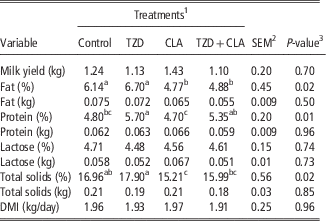
Milk production, milk components and estimated DMI are presented in (Table 2). Milk fat concentration was decreased 22.3% and 20.5% for CLA (P=0.05) and TZD+CLA treatments (P=0.06), respectively, compared with Control (Table 2). Milk protein concentration was 18.8% higher for TZD compared with Control (P=0.005). Total solids content was 10.3% (P=0.04) and 15% (P=0.004) lower for CLA compared with Control and TZD, respectively. There was no treatment effect on milk yield, lactose content, or yield of milk components.
Effect of trans-10, cis-12 conjugated linoleic acid (CLA), thiazolidinedione (TZD) and their interaction on milk yield, milk composition and dry matter intake (DMI) of lactating ewes

1 Treatments: Control (5 ml/day of sterile saline solution); TZD (4 mg/kg of BW/day in 5 ml of sterile saline solution); CLA (27 g/day FAME containing 29.9% of trans-10, cis-12 and 29.8% of cis-9, trans-11); and both TZD and CLA treatment (TZD+CLA).
2 Standard error mean.
3 Overall effect of treatment.
Expression of lipogenic enzymes in mammary gland and adipose tissue
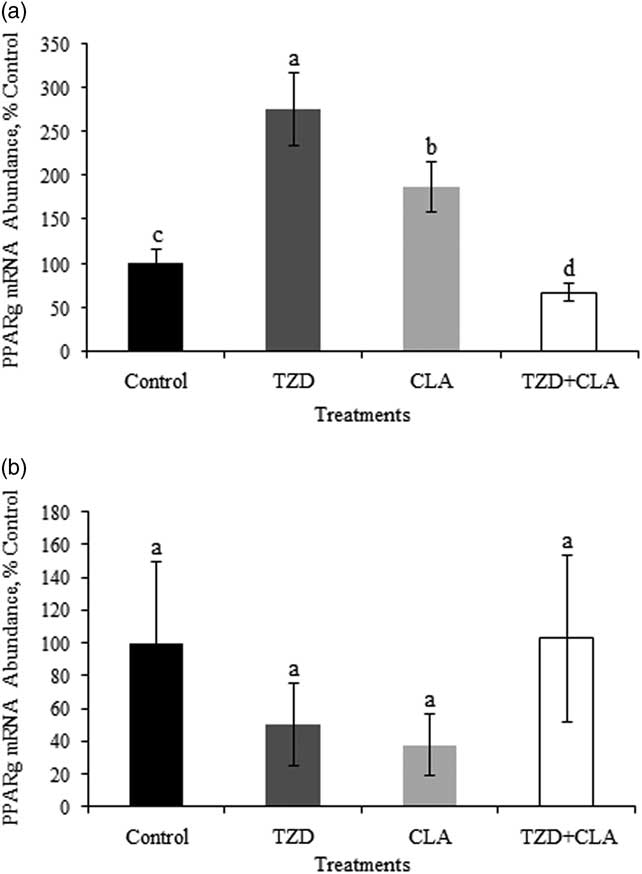
The TZD treatment increased PPARγ gene expression in mammary tissue 174.8 (P=0.0001), 47.2 (P=0.006) and 310% (P=0.0001) compared with Control, CLA and TZD+CLA, respectively (Figure 1a). Thiazolidinedione treatment had no effect on the PPARγ expression in adipose tissue (P=0.16; Figure 1b).
PPARγ gene expression in the mammary gland (a) and adipose tissue (b) of ewes supplemented with trans-10, cis-12 conjugated linoleic acid (CLA), thiazolidinedione (TZD) and their combination, compared with Control. Values are means±SEM. Different letters denote significant differences (P<0.05).

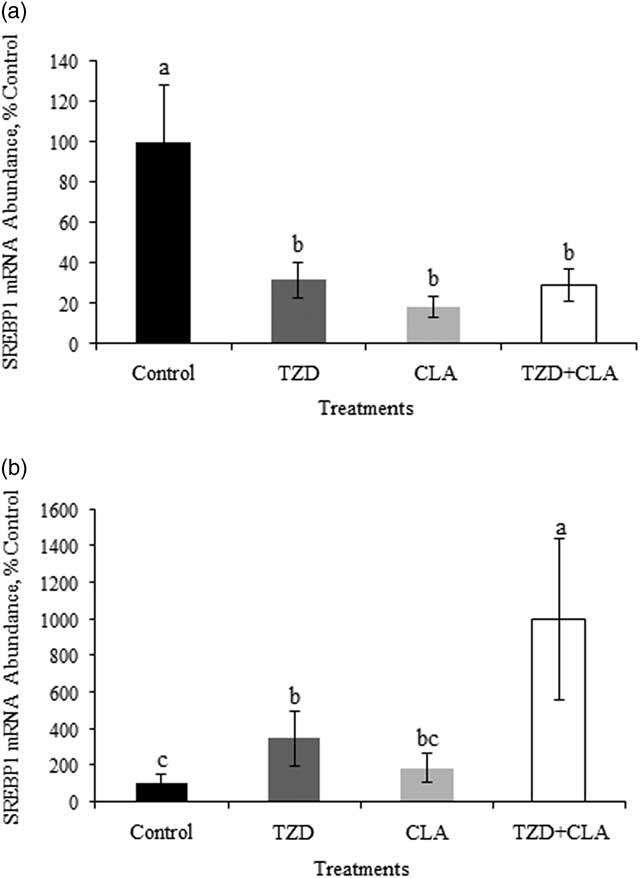
Expression of SREBP1 was decreased 81.5% (P=0.0004), 68.5% (P=0.009) and 71% (P=0.001) by CLA, TZD and TZD+CLA, respectively, compared with Control (Figure 2a). In adipose tissue, CLA had no effect on SREBP1 expression, but the TZD and TZD+CLA increased SREBP1 243.8% (P=0.0061) and 899% (P=0.0001) compared with Control (Figure 2b).
SREBP1 gene expression in the mammary gland (a) and adipose tissue (b) of ewes supplemented with trans-10, cis-12 conjugated linoleic acid (CLA), thiazolidinedione (TZD) and their combination, compared with Control. Values are means±SEM. Different letters denote significant differences (P<0.05).

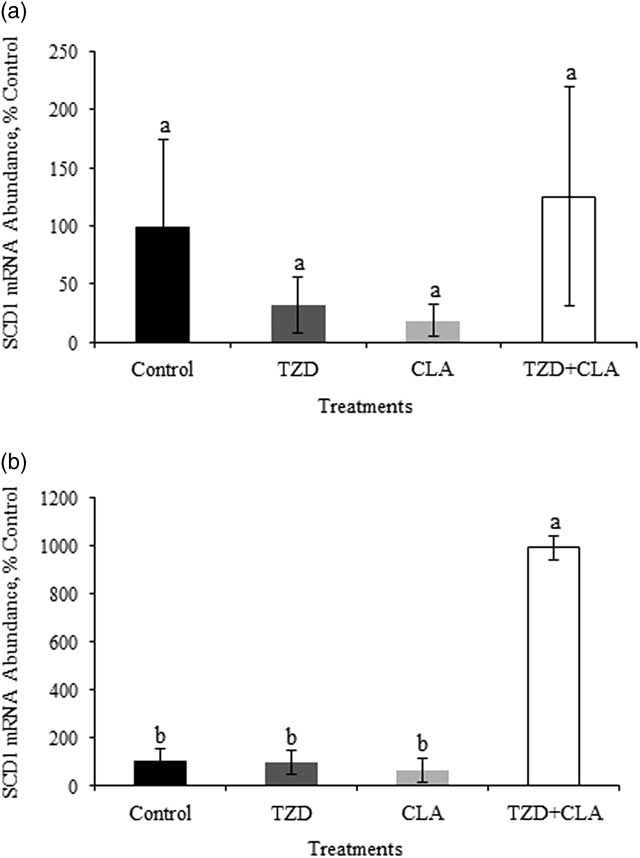
The expression of SCD1 in the mammary gland was not affected by treatments (P=0.20, Figure 3a). In adipose tissue, SCD1 gene expression was not different between Control, TZD, and CLA treatments (Figure 3b), but was increased 887%, 941% and 1543% in TZD+CLA when compared with Control (P=0.09), TZD (P=0.008) and CLA (P=0.002), respectively.
SCD1 gene expression in the mammary gland (a) and adipose tissue (b) of ewes supplemented with trans-10, cis-12 conjugated linoleic acid (CLA), thiazolidinedione (TZD) and their combination, compared with Control. Values are means±SEM. Different letters denote significant differences (P<0.05).

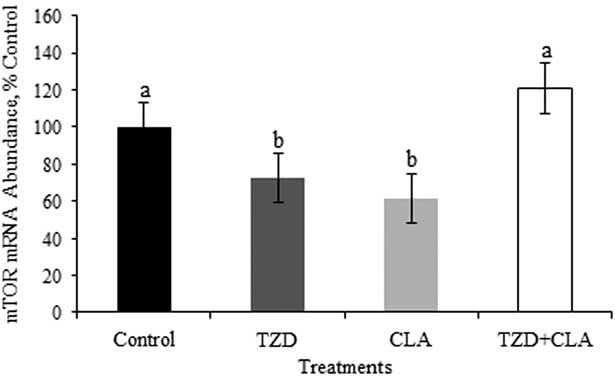
Expression of the mTOR gene in the mammary gland was reduced 27.6% and 38.4% by TZD (P=0.05) and CLA (P=0.005), respectively, compared with Control, but the expression of mTOR for TZD+CLA treatment was not different from Control (P=0.24, Figure 4).
mTOR gene expression in the mammary gland of ewes supplemented with trans-10, cis-12 conjugated linoleic acid (CLA), thiazolidinedione (TZD) and their combination, compared with Control. Values are means±SEM. Different letters denote significant differences (P<0.05).

Expression of genes codifying milk protein in mammary gland
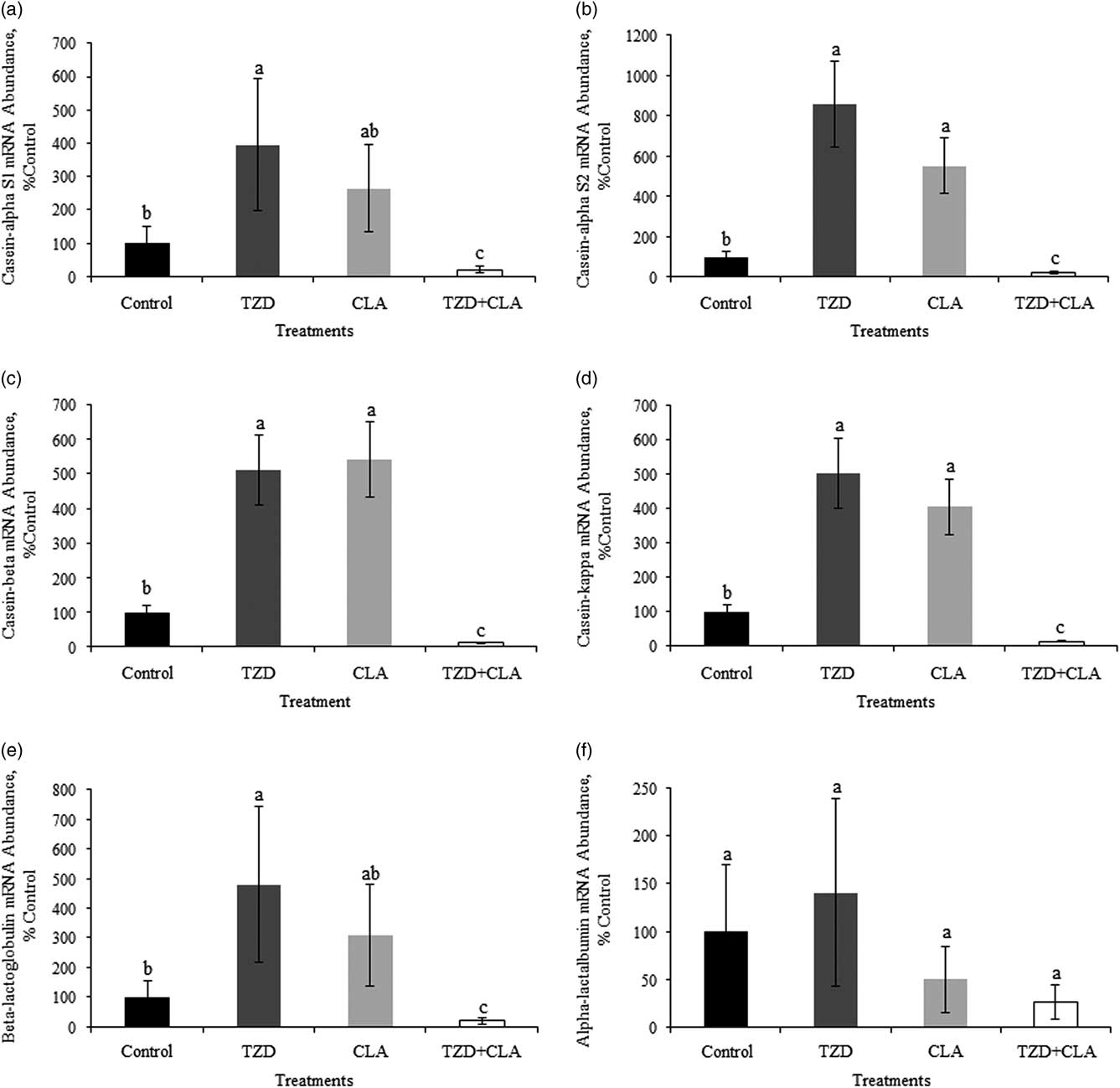
Since milk protein was modified by treatment, the expression of individual milk protein genes was determined (Figure 5). The genes encoding casein-αS1 and casein-αS2 were increased 295.6% (P=0.05) and 760% (P=0.01) by TZD compared with Control, respectively. Also, even with no difference between Control and CLA in milk protein content, CLA increased the gene expression of casein-αS2 in 453%. In addition, TZD increased the gene expression of casein-β and casein-κ by 409.8% and 502% (P=0.01) and CLA by 471.7% (P=0.001) and 304.7%, respectively, in comparison to Control. Beta-lactoglobulin was also increased (378.8%) by TZD (P=0.02) and there was no treatment effect on α-lactalbumin (P=0.17).
Casein-α S1 (a), casein-α S2 (b), casein-β (c), casein-κ (d), β-lactoglobulin (e) and α-lactalbumin (f) gene expression in the mammary gland of ewes supplemented with trans-10, cis-12 conjugated linoleic acid (CLA), thiazolidinedione (TZD) and their combination, compared with Control. Values are means±SEM. Different letters denote significant differences (P<0.05).

Discussion
Milk composition
The extent of inhibition of milk fat synthesis by rumen-unprotected CLA observed in this study was similar to that observed by Oliveira et al. (Reference Oliveira, Gama, Fernandes, Tedeschi and Bauman2012) and Ticiani et al. (Reference Ticiani, Urio, Ferreira, Harvatine and Oliveira2016) using the same CLA supplement. Conjugated linoleic acid had no effect on milk production or components others than milk fat in the current experiment, consistent with the common phenotype of CLA-induced milk fat depression (MFD). However, in some cases the reduction of milk fat by trans-10, cis-12 CLA may increase milk production and/or milk protein during early lactation as reported by Medeiros et al. (Reference Medeiros, Oliveira, Aroeira, McGuire, Bauman and Lanna2010) in dairy cows or underfeeding situations (Lock et al., Reference Lock, Teles, Perfield, Bauman and Sinclair2006).
Expression of lipogenic enzymes in mammary gland
Milk fat synthesis involves several biochemical pathways including fatty acid uptake, intracellular transport and activation, de novo synthesis, desaturation and esterification. Noteworthy, trans-10, cis-12 CLA is capable of decreasing expression of genes encoding enzymes involved in all of these pathways (Shingfield et al., Reference Shingfield, Bernard, Leroux and Chilliard2010). Importantly, expression of these genes is driven by transcription factors and the effect of CLA is presumably through inhibition or downregulation of these transcription factors. Regulation of lipogenic enzymes is very well characterized in adipose tissue and liver in other mammals and PPARγ is well established as a lipogenic regulator in adipose tissue.
PPARγ expression is normally high in adipose tissue and low in the mammary gland (Bionaz et al., Reference Bionaz, Hurley and Loor2013). This possibly explains why the TZD agonist did not stimulate the expression of PPARγ in adipose tissue, but increased the expression in mammary gland in this study. The effect of PPARγ on lipid metabolism has been investigated in bovine and goat mammary epithelial cell culture. Kadegowda et al. (Reference Kadegowda, Bionaz, Piperova, Erdman and Loor2009) used a MAC-T cell line with a low level of PPARγ expression (Bionaz et al., Reference Bionaz, Hurley and Loor2013) and observed that rosiglitazone did not increased PPARγ expression, but still increased expression of acetyl-coenzyme A carboxylase alpha (ACC-α), fatty acid synthase (FASN), acylglycerol-3-phosphate acyltransferase 6 (AGPAT6), diacylglycerol acyltransferase 1 (DGAT1), insulin-induced gene 1 (INSIG1) and SREBP1 from one to threefold, suggesting that these are PPARγ target genes in bovine mammary cells. In addition, treatment with trans-10, cis-12 CLA inhibited the stimulation of PPARγ target genes (Kadegowda et al., Reference Kadegowda, Bionaz, Piperova, Erdman and Loor2009). However, the current in vivo experiment observed that the TZD agonist was unable to stimulate an increase in milk fat synthesis or increase expression of PPARγ target genes in the mammary gland (i.e. occurrence of MFD in the TZD+CLA treatment and reduction in the expression of SREBP1 and PPARγ in the CLA and TZD+CLA treatments), suggesting that the pathway for CLA-induced MFD in ewes is not mediated by PPARγ.
In addition to PPARγ, SREBP1 is another family of transcription factors regulating lipogenic enzymes involved in milk fat synthesis in the mammary gland. Similar to the current experiment, others have observed a reduction in the expression of SREBP1 in bovine mammary epithelial cells treated with trans-10, cis-12 CLA (Kadegowda et al., Reference Kadegowda, Bionaz, Piperova, Erdman and Loor2009) and in cows during diet-induced and CLA-induced MFD (Harvatine and Bauman, Reference Harvatine and Bauman2006). Hussein et al. (Reference Hussein, Harvatine, Weerasinghe, Sinclair and Bauman2013) observed a 30% reduction in SREBP1 expression in ewes fed CLA and Kadegowda et al. (Reference Kadegowda, Bionaz, Piperova, Erdman and Loor2009) observed increased SREBP1 expression when MAC-T cells were treated with rosiglitazone. Our results however, showed a down-regulation of SREBP1 (−68.5%) by TZD in vivo compared with Control.
The trans-10, cis-12 CLA consistently alters the fatty acid composition of tissues by reducing the concentration of monounsaturated fatty acids, which originate mainly from the SCD1 (Lee et al., Reference Lee, Storkson and Pariza1995), even though the inhibition of SCD1 is not a part of the mechanism inhibiting milk fat synthesis (Harvatine et al., Reference Harvatine, Perfield and Bauman2009). Bionaz and Loor (Reference Bionaz, Chen, Khan and Loor2008) evaluated expression of lipid synthesis genes across the lactation cycle and observed that SCD1 was the most variable. Kinsella (Reference Kinsella1972) suggested that in growing ruminants SCD1 is predominantly expressed in adipose tissue, whereas during lactation SCD1 is highly expressed in the mammary gland, where it plays a crucial role in the synthesis of monounsaturated fatty acids.
Kadegowda et al. (Reference Kadegowda, Bionaz, Piperova, Erdman and Loor2009) reported that trans-10, cis-12 CLA reduced SCD1 expression in MAC-T cells and PPARγ agonist does not increase SCD1 expression. Similarly, to this previous in vitro work, in the current in vivo study there was no effect of TZD treatment on the expression of SCD1 in the mammary gland.
There are three major TZD compounds, troglitazone, rosiglitazone and pioglitazone, and each has the ability to activate PPARγ. However, unlike rosiglitazone and pioglitazone, troglitazone represses both SCD1 gene expression and protein abundance (Paton and Ntambi, Reference Paton and Ntambi2009). It is still unclear how the TZD compounds are able to exert different effects on SCD1 expression, but it may be due to differences in conformation of PPARγ isoforms, potency of the ligand and differences in conformational arrangement of the different ligands (Paton and Ntambi, Reference Paton and Ntambi2009). These contradictory findings may also be due to differences in the application of TZD, cell types, tissues and animal models (Li and Lazar, Reference Li and Lazar2002). Therefore, differences in our results compared with other studies might be due to changes in the action of the specific agonist in cell culture conditions compared with in vivo. In addition, the fully differentiated mammary gland has a very high rate of fat synthesis and may differ fundamentally in regulation compared with culture systems. It is also noteworthy that we are not aware of other studies testing PPARγ agonists in lactating ewes, and differences in breed and physiological stages may explain these divergence responses to TZD.
Expression of lipogenic enzymes in adipose tissue
Opposite to the mammary gland, CLA had no effect on PPARγ expression in adipose tissue. However, we observed greater expression of SREBP1 and SDC1 in adipose tissue in TZD+CLA treatment, although the mechanism of this interaction is unclear. Brown et al. (Reference Brown, Boysen, Jensen, Morrison, Storkson, Lea-Currie, Pariza, Mandrup and McIntosh2003) evaluated the effects of the main CLA isomers on human adipocytes and found that trans-10, cis-12 CLA reduced insulin-stimulated glucose uptake and the PPARγ expression. On the contrary, cis-9, trans-11 CLA stimulated the expression of PPARγ and several other target genes, suggesting that the trans-10, cis-12 CLA is indeed anti-adipogenic and cis-9, trans-11 CLA may be able to promote adipogenesis. In some conditions, CLA may mimic the effects of TZD via activation of PPARγ (Park et al., Reference Park, Albright, Storkson, Liu, Cook and Pariza1999), particularly when a mixture of isomers is used due to the fact that trans-10, cis-12 and cis-9, trans-11 CLA have different effects on lipid metabolism.
Expression of lipogenic enzymes during milk fat depression have been previously investigated and the increased lipid synthesis in adipose tissue during MFD may be an indirect response due to the reduction in energy required for milk fat synthesis. Harvatine et al. (Reference Harvatine, Perfield and Bauman2009) observed that cows abomasally infused with trans-10, cis-12 CLA had increased gene expression of enzymes involved in lipid synthesis (FASN, SCD1 and fatty acid-binding protein 1 (FABP1)) and lipid synthesis regulatory elements (SREBP1, SPOT14 and PPARγ) in adipose tissue whereas fat synthesis decreased in the mammary gland.
Expression of genes codifying milk protein in mammary gland
Another interesting finding is that the TZD treatment increased milk protein content. Milk protein synthesis is sensitive to dietary energy as increased insulin and energy availability stimulates milk protein synthesis. Previous hyperinsulinemic-euglycemic clamp experiments have directly demonstrated the ability of insulin to increase milk protein synthesis in cows (Mackle et al., Reference Mackle, Dwyer, Ingvartsen, Chouinard, Lynch, Barbano and Bauman1999) and one of the mechanisms may be through controlling the expression of milk protein genes and increasing translation via the mTOR (Bionaz et al., Reference Bionaz and Loor2012).
Importantly, TZD increases insulin sensitivity by stimulating the PPARγ and may have stimulated insulin signaling in mammary cells and consequently increased protein synthesis via mTOR. However, in this study it was observed that TZD reduced the expression of mTOR, and this result corroborates other studies in which there was a reduction in the mTOR expression in a keratinocyte cell line (He et al., Reference He, Sung, DiGiovanni and Fischer2006). This inhibition may be occurs because the agonist induces phosphorylation of adenosine monophosphate-activated protein kinase (AMPK), a negative regulator of mTOR and this probably occurs via a PPARγ-independent mechanism but it is important to say that we were not able to measure AMPK and mTOR at the protein level. The increased milk protein content may be related to other factors such as availability of nutrients and action from other regulators acting through mTOR independent signaling pathway. Future studies are needed to elucidate these regulatory mechanisms and may result in interventions to increase milk protein content. The effect of TZD on milk protein synthesis is very interesting, but the goal of the current project was the effect on milk fat synthesis and interaction with CLA.
Conclusion
To our knowledge, the effect of a PPARγ agonist on milk fat synthesis has not been previously investigated in vivo with lactating ewes. The PPARγ agonist did not stimulate milk fat synthesis and failed to overcome the anti-lipogenic effects of trans-10, cis-12 CLA in lactating dairy ewes. Expression of SREBP1, SCD1 and mTOR in mammary gland was reduced by CLA, confirming its negative effects on the expression of lipogenic genes, and TZD was not able to increase their gene expression. This study suggests that CLA inhibition of milk fat synthesis is through a PPARγ independent mechanism. The increase in expression of genes encoding milk proteins in response to TZD is a breakthrough observation from this study.
Acknowledgments
The authors thank to Fundação de Amparo à Pesquisa e Inovação do Estado de Santa Catarina (FAPESC) for the scholarship to Eveline C. Sandri and by the financial support through grant PAP UDESC/FAPESC 2015TR384. The authors also would like to thank Mr. Paulo Gregianin and his family from Pinheiro Seco Farm and the assistance of Monica Urio, Elvis Ticiani, Ana Paula Povaluk was gratefully appreciated. Also, the authors thank to Dr Jefferson Luís Meirelles Coimbra for discussing on the statistics design and retrieving some references.