Chlorhexidine (CHX) is a cationic polybiguanide that has bacteriostatic, bactericidal, and some antiviral and fungicidal activity. Since its discovery in 1954, CHX has become a mainstay of infection prevention for numerous medical and dental uses and its use is recommended by many guideline committees for infection prophylaxis. It is commonly found in, and its use is recommended for, topical skin disinfectants, preoperative surgical scrubs, and plaque-reducing mouthwashes. Reference Liippo, Kousa and Lammintausta1 Antimicrobial medical lubricants, contraceptive gels, eye-care products, facial cleansers, moisturizers, and wound-care products utilize CHX. Reference Liippo, Kousa and Lammintausta1,Reference Goon, White, Rycroft and McFadden2 It has also been used to impregnate the surfaces of medical devices (eg vascular catheters, sponges, and orthopedic pins). Reference Goon, White, Rycroft and McFadden2 Chlorhexidine has good activity against gram-positive bacteria, somewhat less activity against gram-negative bacteria and fungi, and minimal activity against mycobacteria. Reference Krautheim, Jermann and Bircher3 Its broad-spectrum antimicrobial activity results from its binding to proteins that contain phosphate in the bacterial cell wall, causing the bacterial cytoplasmic membrane to break and the cytoplasmic components to leak. Reference Calogiuri, Di Leo and Trautmann4
Despite its significant benefits for preventing infections, CHX is a potential allergen that can trigger IgE-mediated hypersensitivity reactions in sensitized individuals. Reference Nagendran, Wicking, Ekbote, Onyekwe and Garvey5 Allergic reactions to CHX have been reported, ranging from allergic contact dermatitis, erythema, urticaria, to anaphylaxis reactions. Reference Rose, Garcez, Savic and Garvey6 Diagnosis of reactions to CHX have been based on skin tests and specific IgE determinations. Reference Opstrup, Malling and Krøigaard7 Reports of allergic contact dermatitis to CHX are rare despite its frequent use Reference Goon, White, Rycroft and McFadden2,Reference Le Corre, Barbarot, Frot and Milpied8 ; however, reports of serious allergic reactions to these products have continued over the last decade. 9 Given the importance and significance of CHX medical products in preventing infections in hospital and clinical settings, we present the results of our comprehensive survey and our summaries of case reports published worldwide over several decades associated with use of CHX medical products to assess the extent of the risk of allergic reactions associated with its use as well as to identify measures that can make its use safer.
Methods
We searched 4 electronic databases (Medline, EMBASE, CINAHL, and Scopus) for studies published between 1946 and 2019 regarding allergy due to use of medical devices and or other medical or cosmetic products containing CHX. The following search string was applied: (chlorhexidine OR chlorhexidine gluconate OR chlorhexidine diacetate) AND (IgE OR IgE mediated OR itching OR pruritus OR hives OR urticaria OR angioedema OR anaphylaxis OR allergic contact dermatitis OR irritants OR occupational dermatitis OR irritant dermatitis OR irritant contact dermatitis OR contact dermatitis OR non-IgE mediated OR radioallergosorbent test OR RAST). The search string yielded 468 publications for title and abstract screening. Search results were first screened by title and abstract by 2 independent reviewers. Any disagreements were discussed by authors and consensus was reached. Resulting articles were read for full-text review and data abstraction. Reports were excluded if they could not be obtained in the English language, if they did not assess a medical device or a topically or orally applied fluid, or if they did not report an allergic reaction. Literature reviews were also excluded from the primary assessment; however, they were used to identify additional case reports and to identify inconsistencies with our findings.
For each case report or case report series, we abstracted the product type, route of exposure, type and severity of reaction (ie, how the reaction presented), time from initial exposure to reaction, the resolution of the reaction and any interventions that were required to resolve the reaction. In addition, information on presensitization was recorded, including the exposure route and how presensitization reactions presented. Finally, we collected information on whether testing was conducted to confirm CHX allergy was present and whether the allergic reaction due to exposure to CHX was confirmed or suspected. Cases were classified as confirmed cases of anaphylaxis or allergic reaction to CHX if a skin test with a second positive challenge was performed or if CHX-specific IgE antibodies were detected. Cases with single skin tests with or without positive tryptase tests (but lacking second challenges or IgE antibody detection) were classified as suspected cases of allergic reaction to CHX.
Results
In this study, we reviewed case report literature pertaining to allergic reactions with the use of CHX in medical devices as well as due to the use of CHX in gel, disinfectant solutions for skin wash, and other medical uses. Cases were stratified both by route of exposure (type of device or medical product) as well as by country.
Central venous catheter (CVC) associated allergic reaction cases
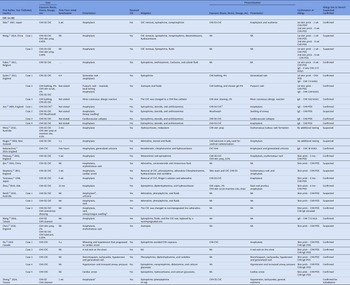
Globally from 1997 to 2019, 30 were reported in the literature with allergy reaction due to CVCs coated with CHX, for an average of 1.36 case reports per year. All cases were managed with intravenous fluids, steroids, and adrenaline (epinephrine). None of the cases were fatal. Most of these cases were reported in England (11 cases), and 1 case was reported in the United States. Of these 30 allergic cases, 17 (56.7%) were presensitized with CHX containing substances prior CVCs insertion. The period elapsed between presensitization and insertion of CVCs ranged from 6 minutes to 3 years. Most of these cases (20 cases, 66.7%) were confirmed using CHX-specific IgE detection or using a positive second skin-prick test. The itemized citation, case exposure route, time from initial sensitization, presentation, treatment, and diagnosis are summarized in Table 1.
Chlorhexidine (CHX) Allergy Cases Associated With Central-Venous Catheter (CVC) Devices

Note. BAT, basophil activation test; CHX-SS, CHC-silver sulfadiazine treated; NA, not available; POS, positive.
a Skin-prick tests conducted after presensitization, no additional studies conducted after second episode anaphylaxis. Reference Oda, Hamasaki, Kanda and Mikami10
b CVC not labeled to contain CHX – processed by sterile services unit, subsequently added warning label. Reference Jee, Nel, Gnanakumaran, Williams and Eren14
c CHX mouthwash was used while intubated after anaphylaxis. Reference Jee, Nel, Gnanakumaran, Williams and Eren14
d CVC left in place postoperatively, additional hypotensive episodes. Reference Baird and Cokis23
e CVC removed postoperatively continued airway/tongue swelling. Removed CVC line dressings, patient resolved. Reference Baird and Cokis23
f Anaphylaxis occurred prior to CHX-SS insertion and was resolved, further hypotension after CHX-SS insertion. Reference Zheng, Fang and Cai27
Semisolid gels, pastes, pads, creams, or dressings
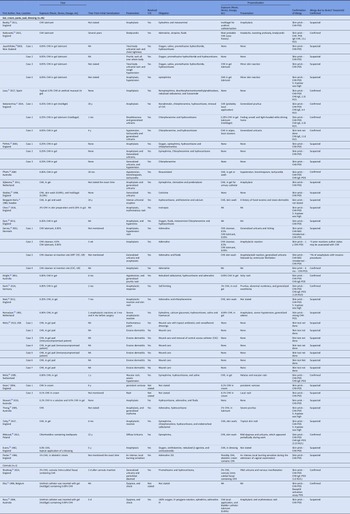
In total, 46 cases were reported with allergy reaction due to use of CHX in gel, creams, toothpastes, or cannulas during the period of the first report in 1992 through 2019 all over the world (with average 1.7 cases reported per year). All cases were managed with intravenous fluids, steroids, and adrenaline (epinephrine) or local treatment with hydrocortisone or wound care. None of the cases were fatal. Most of these cases were reported in England (17 cases), and 7 cases were reported in the United States. Of 46 allergic cases; 26 (56.5%) were presensitized with CHX containing substances. The elapsed time between presensitization and symptoms presentation ranged from 3 days to 22 years. Also, 15 cases (32.6%) were confirmed using Specific IgE-CHX detection or positive second-prick test. Case exposure route, time from initial sensitization, presentation, treatment, and diagnosis are summarized in Table 2.
Chlorhexidine (CHX) Allergy Due to Gels, Creams, and Oral Products

Note. NA, not available; POS, positive; ART, arterial catheter; UR, urinary catheter.
Topical washes, wipes, rinses, sprays or other fluid medical products
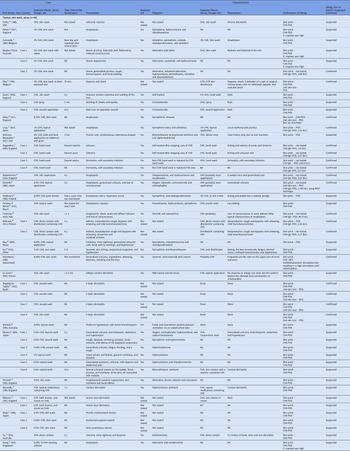
Globally, 48 cases were reported with allergy reaction from the appearance of first case in 1984 through 2019, with an average of 1.37 cases reported each year. All cases were managed with local treatment with hydrocortisone or wound care, while severe cases were managed with intravenous fluids, steroids, and adrenaline. None of the cases were fatal. Most cases were reported in England (14 cases), whereas 2 cases were reported in the United States. Of 48 allergic cases; 27 (56.3%) were presensitized with CHX-containing substances. The elapsed time between presensitization and symptoms presentation ranged from 15 minutes to 10 years. Moreover, 18 cases (37.5%) were confirmed using CHX-specific IgE detection or using a positive second skin-prick test. Case exposure route, time from initial sensitization, presentation, treatment, and diagnosis are summarized in Table 3.
Chlorhexidine (CHX) Allergy Cases Associated With Topical Washes, Wipes, Rinses, Sprays or Other Fluid Medical Products

Note. NA, not available; POS, positive.
Discussion
Chlorhexidine is used extensively in healthcare products, including preoperative shower solutions and antiseptic skin preparations, and it is bonded to devices such as surgical mesh, dressings, and the outer surfaces of urinary and CVCs. CHX also is a component of several commercial products such as mouthwashes, dental gels, contact lens solutions, toothpastes, moisturizers, and lubricants. Given the extensive use of products containing CHX in both community and healthcare settings, there is potential for allergic sensitization of patients. CHX can cause a spectrum of allergic reactions ranging from contact dermatitis to generalized urticaria and life-threatening allergic hypersensitivity. Practice guidelines published by the American Academy of Allergy, Asthma and Immunology and the American College of Allergy, Asthma and Immunology suggest taking a careful medical history focusing on prior adverse reactions. Reference Lieberman, Nicklas and Oppenheimer76 Any prior medication reactions increase the likelihood of adverse reactions, and multiple previous medication reactions pose yet a greater risk. When no prior sensitivity reaction has occurred or no information is available for a patient, it is necessary to be prepared because reactions can potentially occur and progress rapidly.
In this review, we analyzed 124 case reports of allergy due to CHX published between 1981 and 2019, ranging from mild allergic contact dermatitis to severe anaphylaxis. All mild cases were managed by local treatment with hydrocortisone or wound care, and severe cases were managed with intravenous fluids, steroids, and adrenaline (epinephrine). None of the cases was fatal. Recent reviews of CHX allergy have focused on the most prevalent types of topically or mucosally derived allergic reactions, Reference Sharp, Green and Rose77-Reference Dyer, Taktak, Parkes, Garcez and Gall80 so we have focused the discussion on analyzing vascular-catheter–associated CHX allergic reactions. Of 124 case reports of CHX allergic reactions, 30 cases of allergic reaction due to CVCs coated with CHX were reported from 1997 to 2019 all over the world, for an average of 1.36 cases reported each year. All cases were managed with intravenous fluids, steroids, and epinepherine. Of the reported allergic cases due to CHX CVCs, 17 patients (56.7%) were presensitized with CHX-containing substances prior to CVC insertion such as skin wash or wound disinfectants. The interval between presensitization and insertion of CVCs ranged from 6 minutes to 3 years.
The cases surveyed in this review reported only those that had published case reports. Potentially, more cases occurred that were not published as case reports. For example, a recent study Reference Rose, Garcez, Savic and Garvey6 consisted of surveys on CHX allergy cases reported by comprehensive surveys of 13 international institutions (members of the International Suspected Perioperative Allergic Reaction Group) spanning periods as long as 20 years. They report 252 cases from all routes of exposure, 16 of which were attributed to CVCs. It was unclear how many of the reactions were confirmed due to CHX allergy; however, similar to our study, most cases were associated with CHX products other than vascular catheters. Thus, many adverse reactions to CHX products are underreported and are not thoroughly investigated for causation, particularly those that resolve quickly or have mild symptoms.
The merits of using CHX CVCs warrant weighing the risk of allergic reaction against the risk of infection. Our study found an incidence of 30 documented cases over >30 years, or roughly 1 CHX CVC allergic reaction per year (most of these were outside the United States). The number of central-line–associated bloodstream infections (CLABSIs) in the United States has been estimated to be 400,000 per year. Reference Raad and Chaftari81 Compounding the relative benefit for infection prevention is that a significant percentage of CLABSIs cause mortality while no mortalities have been reported from CHX CVC allergic reactions.
Although the risk of infection and mortality from CLABSI far outweighs the risk of severe allergic reaction to CHX on CVCs, several steps can be taken to further mitigate the risk of allergic reaction to CHX, particularly since anaphylactic reactions can be severe. These include carefully reviewing patient history of prior allergic reactions as well as the history of prior patient exposure to CHX products. For patients at elevated risk for allergic reaction or with unknown histories of CHX exposure and for those undergoing blood chemistry testing prior to being catheterized, CHX IgE antibodies can be readily screened for using automated machines with commercially available IgE antibody detection kits such as ImmunoCap. Reference Johansson82 In addition, notification of the allergy risk should be prominently presented and an allergy risk question list Reference Rose, Garcez, Savic and Garvey6 can be included with CVC insertion kits. Since the use of perioperative CHX is increasing, continued vigilant surveillance of the incidence of allergic reaction to CVCs is warranted. Finally, as a precaution for rare but severe anaphylactic shock reactions, epinephrine should be routinely present on procedure carts or available in rooms where catheter insertion procedures are performed for rapid intervention to restore patient vitality.
Acknowledgments
The authors thank Ms Salli Saxton for her assistance in preparing the manuscript.
Financial support
Partial financial support for this work was received from Cook Advanced Technologies.
Conflicts of interest
Drs I. Raad and J. Rosenblatt are inventors of a minocycline, rifampin, CHX antimicrobial coating technology which is owned by the University of Texas MD Anderson Cancer Center and has been licensed by Cook Medical. All other authors report no conflicts of interest relevant to this article.