


Introduction
Insoluble mineral dust is present in the normal troposphere, and in terms of mass has been estimated to be 15% of the total aerosol (Pye, 1987). This dust originates mainly from continental areas where wind erosion is dominant (Shaw, 1989). Minor quantities of dust may be related to forest fires that produce ash and other insoluble organic particles. The evaluation of this input is important because atmospheric dust has a substantial influence on the atmospheric optical depth and regional and/or global radiative budget (Tegen and others, 1996; Moulin and others, 1997).
In Antarctica, long records of atmospheric dust concentration, covering the last climatic cycle ora fraction of it, have been obtained from the Vostok station and Dome C ice cores (Royer and others, 1983; Mounter, 1988; Petit and others, 1990). Mosley-ThompsonandThompson (1982) usedtheseas-onal variation of atmospheric dust in the South Pole ice core, coupled with other records, to carry out a dating that covered thepast 900 years. Agoodcorrclationhasbcenfound between the atmospheric dust and the stable-isotope records in both Antarctica and Greenland, as well as during the main Glaciol -interglaciol transitions and during their interstadial changes (i.e. fast variation in Greenland ice cores) (Royer and others, 1983; Hammer and others, 1985; Petit and others, 1990; Johnsen and others, 1992; Dansgaard and others, 1993).
During the ninth Italian Antarctic Expedition (Programma Nazionale Ricerche in Antartide; PNRA), a firn core was drilled to a depth of 22 m at the Hercules Névé (HN) site. The site is 100 km inland and 2960 m a.s.l., 150 km north of the Terra Nova Bay Italian station (73°06'22” S, 165°27'47"E) (Fig. 1), and is mainly characterised by the ab-
Map of northern Victoria Land, showing the drilling-site location on the Hercules Névé and the Terra Nova Bay Italian station.

Volume distribution vs radius of the dust particles for the total record andfor each of the sections A-E.

sence of katabatic winds from the plateau (personal communication from B. Stenni and others, 1997). The site is on an ice divide between two major HN Glaciol fluxes, the first southward, in the direction of the Ross Sea (Meander Glacier), and the second northward, in the direction of the Pacific Ocean through the Evans Névé and Rennick Glacier.
The 22 m HN firn core spans about 70years from the Antarctic summer 1993-94 to 1927 (±1). This dating was carried out by annual counting of all of the records obtained from the core (stable isotopes, ion chemistry, mineral dust, tritium analyses; Maggi and others, 1998). The annual accumulation rate has been calculated to be 16 g cm −2 a−1, the same value as that obtained from another firn core drilled 3 km to the north (personal communication from B. Stenni and others, 1997).
The main objective of this work was to investigate the transport and deposition of atmospheric dust to northern Victoria Land.
Methods
The drilling was done using a stainless steel SIPRE corer with fibreglass elongation. A mean annual temperature of -33.0°C was measured at a depth of 10 cm, after a 24 hour stabilisation period, using a PT100 probe. The recovered cores (10 cm in diameter and 50-90 cm long) were weighed for density. The maximum density at the bottom of the core was 0.63 g cm−3 (Maggi, 1996). For transportation to the laboratory the core pieces were sealed in polyethylene plastic bags.
HN dust-concentration records of the total particles, particles smaller than 0.9 μm and particles larger than 4.0 μm in radius.

The samples were prepared at the Laboratoire de Glaciologie et Géophysique de l'Environnement (LGGE), Grenoble, France. The external 1-1.5 cm of the cores was removed using a mechanical lathe with stainless-steel tools, and the inner part (7-8 cm diameter) was cut into 4-6 cm sections on a horizontal-flow bench (class 100). More than 500 samples were prepared for the analyses, with approximately 70 cm 3 of water in the upper samples and 125 cm in the lower samples. These samples were divided into three parts: one for chemical analysis (35-60 cm3 of water), one for stable-isotope content (15—35 cm) and one for dust studies (15-35 cm3). The dust samples were measured in a clean laboratory (class 10.000, with positive pressure).
Dust concentration and size classification were measured by liquid counting using a Coulter Counter TA2. The number of particles and volume were divided into 16 classes, ranging from 0.3 to 12 μm (± 5%) in radius. in the laboratory procedure, the first channel was rejected because electrical noise could disturb the final counting (Mounier, 1988). After the counting analysis, the single samples were filtered using Nucleopore polycarbonate filters (0.4 μm hole diameter) for future microparticlc analyses.
Results
A plot of volume distribution as a function of particle radius for the entire record is shown in figure 2a.The data for particles in the radius range 0.4-4.0μm could be fitted with a log-normal distribution, typical of atmospheric dust (Pye, 1987). The mode is close to 0.9 μm, compared to 1.0 μm found for particles in the Vostok ice core drilled in central East Antarctica (Petit and others, 1990). This mode represents the mean value for the long-range transport particles, generally related to remote source areas. For particles greater than 4.0 μm, the volume distribution increases, reaching a maximum value for the largest measured particles (12.0μm). These larger particles may be related to short-range transport both from local dust sources, probably originating from the weathering of the rocks that outcrop in the HN area, and from the sedimentary deposits at the glacier margins and in deglaciated areas.
The record of total dust concentration against depth is shown in Figure 3, as well as the record of small-mode particles concentration (radius range 0.4—0.9μm) and large-mode particles concentration (radius >4.0μm).
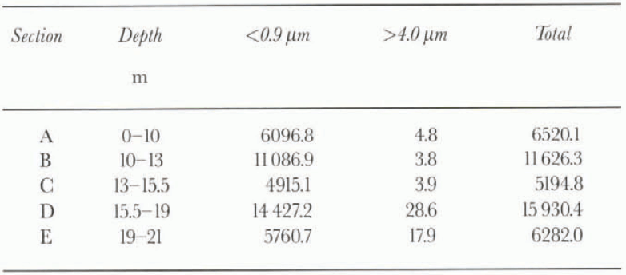
The record is characterised by lower concentration levels down to 10 m, at 13-15.5 m and below 19 m. Increases of dust concentration are mainly located at 10-13 m and 15.5—19 m. For this reason, the dust record has been subdivided into five sections ( A-Ε), using the mean values of dust concentration (Fig. 3; Table 1). The upper section, A (from surface to 10 m), has a mean concentration of 6.5 x 10³ particles g−1, with maximum values of 1.0-1.5 x 10⁴ panicles g−1. Section Β (10-13 m) has twice the mean concentration levels of section A (1.1 x 10⁴ particles g−1), with peaks up to 2.0 x 10⁴ particles g−1. in section C (13-15.5 m), the concentrations are close to those of section A, with a mean value of 5.0 x 10³ particles g−1. The concentration record for particles with a radius less than 0.9 μm is, for the first 15.5 m, similar to the record for the total number of particles (Fig. 3). By contrast, the record for the larger particles is more
Depth, mean and total dust concentration ( number of particles g−1) for sections A-Ε of the Η Ν record
Comparison between the HN dust-concentration record (mean annual value), the Quelccaya Ice Cap dust-concentration record (Thompson, 1902) and the South American (10-30°S) precipitation anomalies (Hulme, 1991).

uniform, without the variation found in the other particle-size ranges. The larger particles show a constant concentration from the top to 15.5 m, with a mean value of 4-5 particles g−1. Therefore, the increase of dust concentration in section Β of the record is due almost exclusively to the small particles. This feature may be related to an increase of dust input from remote sources, without the influence of local sources.
Section D (15.5-19 m) has the highest levels of dust concentration for the whole record, in terms of both the mean value (1.6 x 10⁴ particles g−1) and the peak values (more than 3.0 x 10⁴ particles g−1). in the lowest section, Ε (19-21 m), dust concentrations decrease to values close to those in sections A and C (table 1). The concentrations of the large particles (Fig. 3) are very similar to those of the small particles (< 0.9μm). in sections D and Ε the mean concentrations of the large particles are respectively 7 and 4 times greater than in the upper sections, A-C.
The upper 15.5 m, sections A-C, show similar volume-size distributions (fig. 2b-d), with the mode of the volume distribution close to 0.9 μm, a minimum around 4.0 μm and a maximum in the larger particle range. in section D, the mode occurs for a radius of approximately 1.5 μm (fig. 2e), but without the well-marked minimum around 4.0 μm. in section E, the size distribution of the particles shifts back to small values, with the mode close to 1.1 μm (fig. 2f) and still with the minimum around 4.0 μm unpronounced.
The shift in the volume-distribution mode from 1.5 μm for section D to 0.9 μm (close to the East Antarctic value of 1.0 μm from Vostok ice core) may be related to changes both in source areas and in atmospheric dynamics. To understand these shifts it is important to evaluate the availability of insoluble particles from source areas, normally related to drought periods and/or atmospheric circulation changes. Identification of dust sources is one of the main problems for understanding the atmospheric dust record from ice and firn cores. Using Nd and Sr isotopes, Grousset and others (1992) and Basile and others (1997) found that the source area of atmospheric dust for the central section of East Antarctica (Dome C and Vostok) is South America, mainly Patagonia in Argentina. From the size distribution of dust particles at HN, we believe that the largest particles are most likely to be of local origin. For smaller-mode particles we have as yet no geochemical information to decipher the geographical origin of the dust.
The HN firn core, dated by direct comparison of seasonal stable-isotope signals, major ions and the dust record, and using the tritium concentration as a control, permits the analysis of the dust-loading in the period 1927-94 (Fig. 4). The two main events in terms of concentration observed in the record are well defined temporally. The first (section D) spans around 10 years between 1932 and 1942, and the second (section B) the period 1951 -64. in Figure 4, the 1932-42 dusty period seems evidenced also by the Quelccaya Ice Cap record (Thompson, 1992), the unique record of atmospheric-dust from South America, part of which covers the same time-span as the HN record. The correspondence of events in this period may be related to atmospheric circulation changes or to changes in the South American dust source, and especially to times of intense drought (e.g. the “Dust Bowl” which occurred in North America). in fact, the record of mean precipitation anomalies in South America (Hulme, 1991; Houghton and others, 1996) shows, for the same period, negative values both in the annual average and in the 5 year moving average (Fig. 4). These features in the precipitation anomaly record, related to the El Niño Southern Oscillation (Houghton and others, 1996), seem to occur 2-3 years in advance of the HN dust peak.
The 1951-64 dusty period in HN, like the previous one, seems to be represented in the record of South American precipitation anomalies. The mean annual values of the precipitation anomalies, and the 5 year moving average, are generally negative, indicating another drought period. On the other hand, there is no clear correlation with the Quelccaya record; this record seems to anticorrclatc with HN for the 1945 75 period.
Conclusions
UN is a good site to investigate the evolution of atmospheric dust, in terms of concentration and size distribution, over northern Victoria Land. The high values of HN firn-core dust concentrations measured from 15.5 to 21 m (AD 1927-42) were observed in the records of both small (<0.9μm) and large particles (>4.0μm).
In the upper 15m of the record, covering the last 50 years, the differences in terms of dust concentration between small and large particles (section B; Fig. 3) are likely related to long-range transport changes, but not in the local circulation. The lack of correspondence between the Quelccaya and HN dust records (sections Α-C) can exclude the large-scale variations in terms of atmospheric influences on the dust sources, and we have no direct evidence that the dust originated in South America. However, there is a correlation between the increase in dust concentration from 1951 to 1964 in the HN core and precipitation anomalies for the same period in South America. This correlation would suggest a possible influence of drought events on these dust events. The increased concentration of biomass-burning chemical species (Udisti and others, 1998) provides further evidence of these possible drought events.
Changes in size distribution, indicated primarily by shifts of mode in particles less than 4.0 μm, may be related to modifications in atmospheric transport or its turbulence. These shifts, from 1.1 to 1.5 μm for the 1927-42 period, and from 1.5 to 0.9 μm for the period after 1942, underline that these changes are due to large-scale changes in atmospheric dynamics. The 1932-42 dusty period in HN may be linked partly to the drought and precipitation anomalies in South America, as well as to a period with a more turbulent atmosphere. On the other hand, the uniform size distribution of dust particles observed since 1942 suggests that the dust-con-centration changes in the period 1951-64 may be related to an increase of dust flux in northern Victoria Land, and not to the general increase of continental deflation of the source areas.
Our results suggest that atmospheric dynamics, with more turbulence and more transport capability, have occurred in the past, but at this time it is not possible to evaluate the magnitude of these changes (or whether they are related to global changes or only to more meridional transport). Finally, the comparison between drought periods (precipitation anomalies) and atmospheric-dust load cannot exclude South America as a source area of the long-range dust that reaches northern Victoria Land and East Antarctica, as observed for the Last Glaciol Maximum and other cold periods (Grousset, 1992; Basile, 1997).
Acknowledgements
The research reported here was carried out in the framework of a project on glaciology and palaeoclimatology of the Programma Nazionale di Ricerche in Antartide, and supported by ENEA. The authors thank the Italian Antarctic Project (PNRA) and the ninth Italian Antarctic Expedition's logistic personnel for help during the drilling operations. Special thanks to G. Orombclli for helpful discussions during the work. V. Maggi thanks the Italian National Research Council (CNR) for a grant to visit LGGE, Grenoble.



