Introduction
Benzodiazepines are highly effective in reducing anxiety. They are also used as hypnotics in agitated states, epilepsy and alcohol detoxification. However with long-term use, tolerance and dependence can become major issues. There are similar concerns with non-benzodiazepine hypnotic agents. These effects can be minimised through careful patient selection and adhering to best practice guidelines (Ashton Reference Ashton1994).
Best practice guidelines advise short-term use (<4 weeks), using the lowest dose possible and only after alternate therapies have been tried (Benzodiazepine Committee, 2002; College of Psychiatry of Ireland, 2012). Regular audit of benzodiazepine prescribing has been shown to improve prescribing practices (Mental Health Commission, 2010; College of Psychiatry of Ireland, 2012). This audit aimed to compare our prescribing with best practice standards.
Audit
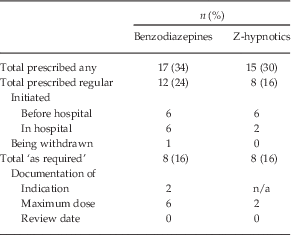
Over a 1-week period, 50 inpatient prescriptions in the three wards (acute, sub-acute and psychiatry for the elderly) of the psychiatric unit of a city centre hospital were reviewed. If benzodiazepines or z-hypnotics were prescribed, it was noted whether they were regular or ‘as required’, initiated before or during admission and any withdrawal attempts made. The benzodiazepine or z-hypnotic type was also recorded. Benzodiazepine doses were converted to diazepam-equivalents (Taylor et al. Reference Taylor, Paton and Kapur2012a).
In respect of ‘as required’ medications indication, maximum dose and review/cessation date were noted. It was documented how often ‘as required’ medications had been administered in the week before. Please see Table 1 for details of benzodiazepine and z-hypnotic prescriptions.
Audit: prescribing of benzodiazepines and z-hypnotics in 50 inpatients

Intervention
The results of the first part of the audit cycle were presented at a local audit meeting attended by both consultant and non-consultant hospital doctors working in the psychiatric unit. At this, education was provided around best practice guidelines for the prescribing of benzodiazepine and z-hypnotic medications and areas of need from the audit data were highlighted. This feedback was also emailed to all medical practitioners, including those newly employed during the interim period.
Re-audit
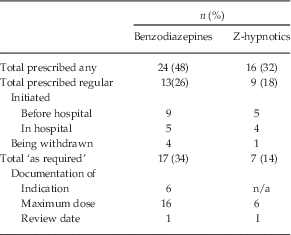
The re-audit involved 50 patients and was completed 4-months later. Please see Table 2 for details of benzodiazepine and z-hypnotic prescriptions.
Re-audit: prescribing of benzodiazepines and z-hypnotics in 50 inpatients

Results
Overall benzodiazepine prescribing was 34% and 48% for the audit and re-audit. Total z-hypnotic prescribing rose between the two data collection by 2%. The mean regular dose of benzodiazepine prescribed was 13.125 and 11.07 mg, respectively. The highest diazepam-equivalent dose of regular benzodiazepine was 20 mg in the re-audit, compared with 60 mg in the initial audit. In the re-audit, the highest charted ‘as required’ dose remained in excess of recommended maximums (80 mg audit; 90 mg re-audit).
Lorazepam was the most prescribed benzodiazepine in the acute ward (53% and 56%), as well as being the most commonly prescribed benzodiazepine overall within the unit (48% and 40%). There was prescribing of more than one benzodiazepine type in both data collection (18% and 21%). However, only in one individual, found in the re-audit, was there prescribing of more than one type regularly.
Between the two data collections, there were only minimal improvements in ‘as required’ prescribing: citing an indication for benzodiazepine administration (25–35%), specifying a time limit (z-hypnotics 0–14%; benzodiazepines 0–6%) and recording a maximum dose (z-hypnotics 25–86%; benzodiazepines 75–94%). The percentage of those administered ‘as required’ benzodiazepine doses in the week previous showed a reduction with completion of the audit cycle (70–35%). In all, 100% of those prescribed z-hypnotics were administered doses in the week before in both data collection. Within the audit cycle, no patient having received an ‘as required’ benzodiazepine dose had their regular benzodiazepines modified.
For both data sets, at least 50% of regular z-hypnotics and benzodiazepines were initiated before admission. Presumably many of these are far in excess of the guidelines for duration. Of regular benzodiazepines initiated in hospital, some exceeded the 4-week guideline (16% and 40%). In neither data collection did regular z-hypnotics initiated in hospital exceed this cut-off. There was an improvement in those being withdrawn with an increase of 22% for regular benzodiazepines, and 11% for regular z-hypnotics in the re-audit.
Discussion
Through this audit cycle there was an increase in both regular and ‘as required’ benzodiazepine prescribing. The increase, despite intervention, maybe because these medications continued to be necessary due to the nature of presentations to an acute setting. However, possible flaws in the intervention need to be considered also. How does benzodiazepine prescribing in this audit compare with other centres? The literature would suggest similar levels of usage in many other units. The Mental Health Commission reported a national figure of 57% and noted a huge variation between centres – 2–97% (Mental Health Commission, 2010). Another Irish study gave figures of 51% for regular and 66% for ‘as required’ benzodiazepine prescribing (Hallahan et al. Reference Hallahan, Murray and McDonald2009). A New Zealand study reported that 86.7% of admissions involved treatment with a sedative-hypnotic (Wheeler et al. Reference Wheeler, Kairuz, Sheridan and McPhee2007). In all, 18.7% of psychiatric inpatients received benzodiazepine prescriptions in a UK study (Haw & Stubbs, Reference Haw and Stubbs2007).
The dose of benzodiazepine prescribed should be as low as possible to control symptoms. In this audit cycle, the minimal reduction in regular benzodiazepine dosing and the ongoing high doses of ‘as required’ medication prescribed may be due to the acute nature of the presentations to the unit. This is not unlike other similar settings. In a Galway study, the mean daily diazepam equivalent dose for those prescribed benzodiazepines was 21.4 mg with one patient receiving a benzodiazepine dose greater than that specified in British National Formulary (BNF) guidelines (Hallahan et al. Reference Hallahan, Murray and McDonald2009).
Throughout the audit cycle, lorazepam was the most common benzodiazepine used. Perhaps its flexibility in method of administration (oral or intramuscular) is a factor in this, particularly in an acute setting. Lorazepam is recommended as a first choice agent in rapid tranquilisation because of its sedative properties and almost immediate effects (Taylor et al. 2012b). However, caution is needed as it has a short half-life and therefore is more likely to result in dependency if taken for an extended period (Joint Formulary Committee, 2015). This pattern of use is not unique to this unit. In 2008, lorazepam was the commonest benzodiazepine prescribed nationally (Mental Health Commission, 2009). A UK inpatient study found that 81.4% of individuals were prescribed lorazepam, and 54% administered doses (Choke et al. Reference Choke, Perumal and Howlett2007). In a New Zealand study, lorazepam was again most frequently prescribed (Wheeler et al. Reference Wheeler, Kairuz, Sheridan and McPhee2007). In research carried out in one Irish centre, clonazepam was the most commonly prescribed benzodiazepine overall, lorazepam ranking fourth and second, respectively for regular and ‘as required’ prescribing (Hallahan et al. Reference Hallahan, Murray and McDonald2009).
That there were only minimal improvements in ‘as required’ prescribing practices despite the educational intervention carried out suggests that a different strategy for instigating change needs to be considered. Similar to this audit, low levels of documentation for ‘as required’ medications have been seen in other Irish studies. An indication was only completed for 29% of ‘as required’ benzodiazepines and 12% of hypnotics in a Galway study (Hallahan et al. Reference Hallahan, Murray and McDonald2009). The Mental Health Commission found that ‘most’ ‘as required’ medications did not have an indication for use recorded (Mental Health Commission, 2010). In a UK study, an indication for lorazepam prescription was documented in only 42.2% of cases (Choke et al. Reference Choke, Perumal and Howlett2007).
There were only small improvements in documenting time limits for ‘as required’ medications in completing this audit cycle. Doing so is important to prevent extended periods of medication administration without review. Poor adherence to this is not unique to this unit. In 2008 and 2010 national reports, the majority of ‘as required’ medications had no time limit or review date (Mental Health Commission, 2009, 2010). A UK study found that 86.3% of lorazepam prescriptions had review dates, however the majority of these were set at >4 weeks (50% between 4 and 12 weeks and 14% at 1 year) (Choke et al. Reference Choke, Perumal and Howlett2007).
In the re-audit, there was an increase in the number of regular benzodiazepine scripts initiated in hospital exceeding 4 weeks in duration. This may be due to the acute setting and clinical need on the unit at that time. It was reassuring to see that no regular z-hypnotic scripts initiated in hospital exceeded 4 weeks in either data collection.
There was an improvement in the number of regular benzodiazepines and z-hypnotics being withdrawn in the re-audit. However, there are still significant gains to be made. Due to the acute nature of presentations to an inpatient setting, the withdrawal of longer-term benzodiazepines and z-hypnotics may be challenging, but not doing so could be seen as an opportunity missed. In a 2009 study, 11% of inpatients had been prescribed benzodiazepines and 5% prescribed hypnotic agents before their admission to hospital (Hallahan et al. Reference Hallahan, Murray and McDonald2009). In our audit figures were higher than this. In the same study, the mean duration for benzodiazepine prescriptions was 37 days (Hallahan et al. Reference Hallahan, Murray and McDonald2009). In a case series of 227 in-patients, Vandel et al. (Reference Vandel, Nezelof and Bonin1992) reported that hospitalisation was an inducer of benzodiazepine dependence in 16% of in-patients.
Conclusions
The fact that both benzodiazepines and z-hypnotics can be clinically useful in the acute setting may be one reason why there was no decrease in their prescribing in this audit. There was in fact an increase in many areas of prescribing, despite the intervention carried out.
The adequacy of the intervention may also be called into question in relation to ‘as required’ documentation. Only small improvements were shown in the areas examined. Alternate interventions that could be trialled include limiting ‘as required’ prescribing to senior clinicians, or the automatic expiry of scripts after a specified time period.
There are areas that a follow-up cycle could address. Guidelines suggest informing the patient if benzodiazepines are being used off label, and why use is appropriate in their case (College of Psychiatry of Ireland, 2012). Exploring patient opinion regarding medication minimisation would also be useful as attempts to reduce long-standing medications are less likely to be successful if met with resistance (Taylor et al. Reference Taylor, Paton and Kapur2012a).
Acknowledgement
The authors would like to extend their thanks to the staff and patients of the audit site.
Financial Support
This research received no specific grant from any funding agency, commercial or not-for-profit sectors.
Conflicts of Interest
None.
Ethical Standards
The authors assert that all procedures contributing to this work comply with the ethical standards of the relevant national and institutional committee on human experimentation with the Helsinki Declaration of 1975, as revised in 2008. The authors assert that ethical approval for publication of this audit was not required by their local REC.