Introduction
Thrips (Thysanoptera: Thripidae) are important banana pests in Brazil because they cause qualitative damage that depreciates the economic value of fruits and affects their sale in domestic and export markets (Fancelli et al. Reference Fancelli, Milanez, Mesquita, Costa, Costa and Silva2017). According to the type of damage caused, the insects can be classified as “fruit-eruption thrips”, which cause brown, rough eruptions (punctuations), or “fruit-rusting thrips”, which cause reddish-brown rustlike stains (Sato et al. Reference Sato, Mineiro and Raga2013; Fancelli et al. Reference Fancelli, Milanez, Mesquita, Costa, Costa and Silva2017). Thrips damage can also contribute to the introduction of phytopathogens into the fruit (Jones Reference Jones2005). Furthermore, some thrips species are recognised as quarantine pests, leading to the refusal of banana exports at ports of entry in other countries (Ministério da Agricultura, Pecuária e Abastecimento 2017).
Currently, eight species of thrips are recorded as banana pests in Brazil. These are Bradinothrips musae (Hood), Elixothrips brevisetis (Bagnall), Frankliniella brevicaulis Hood, Frankliniella fulvipennis Moulton, F. parvula Hood, Hercinothrips bicinctus (Bagnall), H. femoralis (Reuter), and Hoodothrips lineatus (Hood) (Nóbrega Reference Nóbrega1963; Monteiro et al. Reference Monteiro, Mound and Zucchi1999; Fancelli Reference Fancelli, Borges and Souza2004; Lima and Milanez Reference Lima and Milanez2013; Lima and Miyasato Reference Lima and Miyasato2017). However, early reports are not supported by identified voucher specimens deposited in entomological collections. As a consequence, several publications that cite species names may be inaccurate. Other publications seem to provide names without having checked the species identity. In addition, species names are sometimes cited under their synonyms, duplicated, misspelt, or with misguided species illustrations.
In recent years, collection of thrips with proper taxonomic support has occurred in banana-growing areas in several regions of Brazil. Although these studies have not detected all of the species reported in the literature throughout the years, they have found species that are not previously recorded. This situation leads to the hypotheses that (1) some of the thrips species reported as banana pests in Brazil represent misidentifications and either do not occur in the country or have a much more limited distribution, and (2) a number of thrips pests of bananas in Brazil have not yet been recorded.
Considering the importance of pest recognition as the first step for pest management and the economic importance of thrips in banana cultivation, correctly identifying which species do occur in Brazil is essential to avoid the propagation of erroneous information and the consequent adoption of inappropriate control strategies.
In this paper, we revise the identification of thrips species on banana crops in Brazil and present an illustrated identification key for their recognition. In addition, the damage types caused by each species are recognised and illustrated, and updated distribution records, as well as notes on biology, are provided.
Material and methods
The thrips specimens examined in this study have been manually collected over a period of one decade (2011–2021) on fruits of bananas from the most representative banana-growing areas in several Brazilian localities over seven states: Acre, Rondônia, Piauí, Ceará, Bahia, São Paulo, and Santa Catarina. All specimens were mounted on permanent slides, following the methods of Monteiro and Lima (Reference Monteiro and Lima2021) and are deposited in the Escola Superior de Agricultura “Luiz de Queiroz”, University of São Paulo, Piracicaba, Brazil and in the Coleção de História Natural da Universidade Federal do Piauí, Floriano, Brazil. In addition, re-examination of material previously deposited in the Escola Superior de Agricultura “Luiz de Queiroz” and from the California Academy of Sciences (San Francisco, California, United States of America), the Illinois Natural History Survey (Champagne, Illinois, United States of America), and the Smithsonian National Museum of Natural History (Beltsville, Maryland, United States of America) was carried out.
Observations were performed using a Zeiss Primo Star compound bright-field microscope and a Zeiss Axio Lab A1 phase-contrast microscope (Zeiss, Jena, Germany). Images were acquired with a Zeiss Axiocam ERC 5s attached to the Zeiss Axio Lab A1 microscope, processed with Helicon Focus 7 (Helicon Soft, Kharkiv, Ukraine), and edited with Adobe Photoshop CS6 (Adobe, San Jose, California, United States of America).
Results
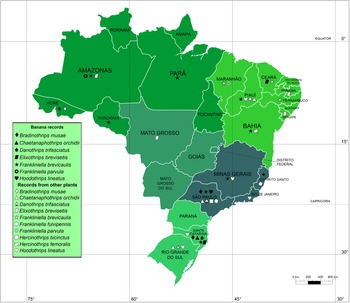
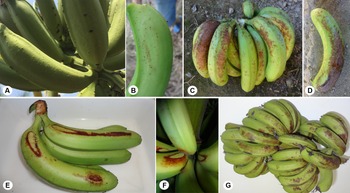
Based on the taxonomic support of voucher specimens and a decade-long collecting period throughout the country, only five of the eight species of thrips previously recorded as banana pests currently occur in Brazil. In addition, Chaetanaphothrips orchidii (Moulton) and Danothrips trifasciatus Sakimura are first recorded associated with banana crops in the country, totalling seven confirmed records (Fig. 1). The confirmed species can be distinguished by damage type on the fruit – that is, whether they cause eruption or rusting in bananas. Frankliniella brevicaulis and F. parvula belong to the first group, in which brown and rough punctuations (Fig. 2A, B) appear as a result of oviposition on the fruit peel. These species are sometimes also observed causing damage to the flower buds of the inflorescences and to fruits still in development. The second group comprises the following thrips: Chaetanaphothrips orchidii (Moulton) and Danothrips trifasciatus Sakimura, which damage the contact region between banana fruits, leaving elliptical rust marks with a clean area in the centre (ring-shaped; Fig. 2E, F), and Elixothrips brevisetis, Bradinothrips musae, and Hoodothrips lineatus, which leave the surface of the fruit peel more dry, rough, and cracked, sometimes covering the entire fruit (Fig. 2C, D–G).
Geographic distribution of thrips species occurring on banana and other crops in each Brazilian state. The geographic regions (north, northeast, central–west, southeast, and south) are depicted in different shades of green.

Thrips injuries on banana fruits. A–B, Frankliniella brevicaulis; C–D, Elixothrips brevisetis; E–F, Chaetanaphothrips orchidii and Danothrips trifasciatus; G, Bradinothrips musae.

In addition to the species above, F. insularis (Franklin) and Caliothrips phaseoli (Hood) were collected from banana crops in Guadalupe (24.ii.2021) and in Bom Jesus (25.vi.2020) (Coleção de História Natural da Universidade Federal do Piauí) in the state of Piauí, respectively. However, these reports do not seem to represent a phytosanitary problem as they are accidental occurrences.
The states with the highest richness of thrips on banana crops are Santa Catarina (five species) and São Paulo (three species; Fig. 1). The two states are among the largest banana-producing areas in the country. The several types of banana cultivars grown in Santa Catarina and São Paulo, in addition to their long history of banana cultivation and research compared to in the other Brazilian states, may explain the higher number of thrips species recorded.
Although C. orchidii, D. trifasciatus, F. parvula, and H. lineatus were recorded in banana crops only in Santa Catarina, they have been reported on other plants elsewhere in the country. Additional records will likely be found with more extensive fieldwork.
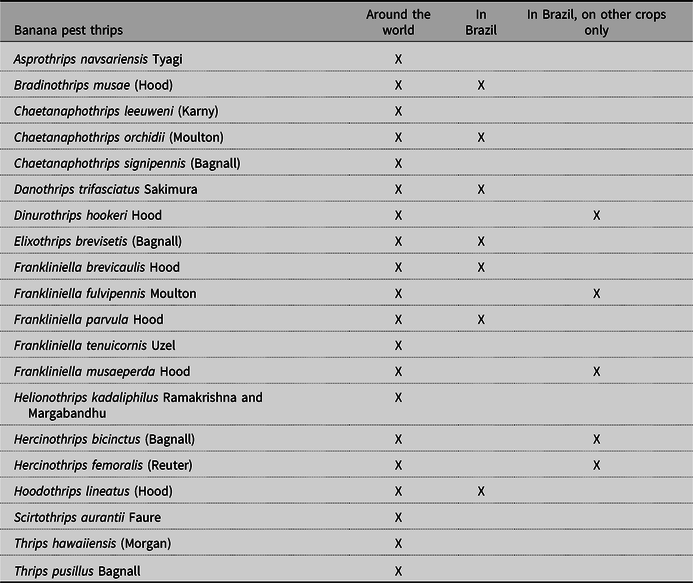
At least 20 species of thrips have been reported as banana pests worldwide (Table 1). Although 12 of these have been recorded in Brazil, Dinurothrips hookeri Hood, Frankliniella fulvipennis Moulton, F. musaeperda Hood, Hercinothrips bicinctus (Bagnall), and H. femoralis (Reuter) have been reported only on other hosts not on bananas (Table 1).
Pest thrips of bananas recorded in Brazil and worldwide.

This table is based on Bondar Reference Bondar1931; Moulton Reference Moulton1932; Martinez Reference Martinez1975; Tsai et al. Reference Tsai, Hwang and Chen1992; Childers and Achor Reference Childers, Achor, Parker, Skinner and Lewis1995; Mound and Marullo Reference Mound and Marullo1996; Lewis Reference Lewis1997; Fancelli Reference Fancelli, Borges and Souza2004; Cavalleri and Mound Reference Cavalleri and Mound2012; Hoddle et al. Reference Hoddle, Mound and Paris2012; Lima and Milanez Reference Lima and Milanez2013; Thomazini and Lima Reference Thomazini and Lima2014; Mound et al. Reference Mound, Lima, O’Donnell and Cavalleri2016; Lima and Miyasato Reference Lima and Miyasato2017; Poorani and Thanigairaj Reference Poorani and Thanigairaj2019; Michael and Lima Reference Michael and Lima2020; Lima Reference Lima2021; ThripsWiki 2021.
Frankliniella fulvipennis, H. bicinctus (sometimes listed as Caliothrips bicinctus), and H. femoralis are commonly cited in textbooks as banana pests in Brazil (Suplicy Filho and Sampaio Reference Suplicy Filho and Sampaio1982; Fancelli Reference Fancelli, Borges and Souza2004). However, no original documentation of the latter two species occurring on banana cultivation in the country was found. The frequent records of these pests causing fruit rusting were likely based on literature published for other countries, without proper identification of the Brazilian material. After examining dozens of thrips collections in Brazil and specimens deposited in many major Thysanoptera collections worldwide, no specimens of these three species were found on bananas in Brazil. Because of this absence of taxonomic support, we therefore recommend that these species no longer be considered to be associated with banana cultivation in Brazil.
Hercinothrips femoralis and H. bicinctus have only one confirmed record in Brazil, collected from “night queen” and species of Boraginaceae, respectively (Bondar Reference Bondar1931; Moulton Reference Moulton1932). The specimens are deposited and were examined at the California Academy of Sciences and the Illinois Natural History Survey. Meanwhile, F. fulvipennis was reported on banana farms by Nóbrega (Reference Nóbrega1963) in São Paulo state but without voucher specimens. One possibility is that this represents a misidentification of F. brevicaulis, which is commonly collected throughout Brazil on bananas. Below, we provide an identification key to thrips species confirmed as banana pests in Brazil. Additional comments are available under each species in the section below.
Key to pest thrips of bananas confirmed in Brazil
1. Pronotum with four pairs of setae at least twice as long as discal setae (Fig. 3B); ctenidia on abdominal tergites V–VIII anterolaterally to spiracle (Frankliniella)…………………2
–. Pronotum with at most two pairs of setae twice as long as discal setae (Fig. 3H); ctenidia on abdominal tergites absent……………………………………………………3
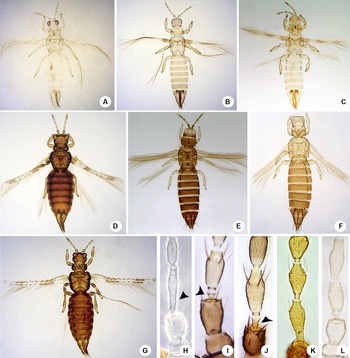
2. Pedicel of antennal segment III cup-shaped (Fig. 4I); forewings largely pale but weakly shaded brown basally………………………………… Frankliniella brevicaulis
–. Pedicel of antennal segment III elongated, almost twice as large as subbasal ring (Fig. 4J); forewings dark although slightly paler at base………………… Frankliniella parvula
3. Body white or yellowish (Fig. 4A–C, F); head without reticulation or with reticulation only posteriorly (Fig. 3A)……………………………………………………4
–. Body brown (Fig. 4D, E, G); head completely reticulated (Fig. 3C)………………6
4. Postocular setae robust and extremely long (Fig. 3A); campaniform sensilla on metanotum absent……………………………………………… Bradinothrips musae
–. Postocular setae never extremely long and robust (Fig. 3B, C); campaniform sensilla on metanotum present (Fig. 3F)………………………………………………5
5. Pronotum with six pairs of setae on posterior margin (Fig. 3H); metanotum with transverse sculpture lines…………………………………………… Danothrips trifasciatus
–. Pronotum with two pairs of setae on posterior margin; metanotum without transverse sculpture lines……………………………………… Chaetanaphothrips orchidii
6. Sensilla on antennal segment III simple (sometimes appearing forked) (Fig. 4K); mesonotum fully divided longitudinally (Fig. 3D); anal setae on abdominal segment X expanded (Fig. 3I)………………………………………… Elixothrips brevisetis
–. Sensilla on antennal segment III forked; mesonotum without complete longitudinal division (Fig. 3E); anal setae on abdominal segment X not expanded………… Hoodothrips lineatus
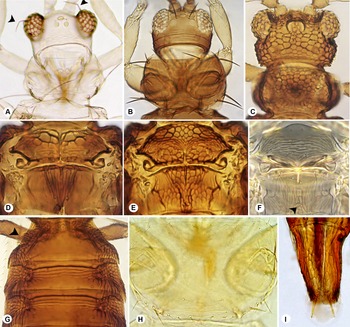
Pest thrips of bananas in Brazil. A–C, Head and pronotum: A, Bradinothrips musae (arrows on the elongated postocular setae); B, Frankliniella brevicaulis; C, Elixothrips brevisetis. D–F, Mesonotum and metanotum: D, Elixothrips brevisetis; E, Hoodothrips lineatus; F, campaniform sensilla in Chaetanaphothrips orchidii. G, Abdominal segment II constricted anterolaterally, with several curved microtrichia in Hoodothrips lineatus; H, pronotum of Danothrips trifasciatus; I, expanded anal setae on abdominal segment X in Elixothrips brevisetis.

Pest thrips of bananas in Brazil. A–G, Female body: A, Bradinothrips musae; B, Chaetanaphothrips orchidii; C, Danothrips trifasciatus; D, Elixothrips brevisetis; E, Frankliniella brevicaulis; F, Frankliniella parvula; G, Hoodothrips lineatus. H–L, Antennal segments II–IV: H, Bradinothrips musae (arrow on elongate segment III); I, Frankliniella brevicaulis (arrow on cup-shaped pedicel); J, Frankliniella parvula (arrow on elongate pedicel); K, Elixothrips brevisetis; L, Danothrips trifasciatus.

Bradinothrips musae (Hood) (Figs. 2G, 3A, and 4A, H)
This species (Fig. 4A) causes reddish rust on bananas (Fig. 2G). In Brazil, B. musae has only been reported on banana farms in São Paulo (Monteiro et al. Reference Monteiro, Mound and Zucchi1999) and Santa Catarina, although it has been recorded on other plant species in Acre and Piauí (Fig. 1). The pair of exceptionally long and robust postocular setae (Fig. 3A) and the elongated pedicel of the antennal segment III (Fig. 4H) are the most remarkable features of this species. Bradinothrips musae is of quarantine importance in some South American countries, including Argentina, which imposes restrictions on bananas received from Brazil if this pest is detected (Sakai Reference Sakai2010; Ministério da Agricultura, Pecuária e Abastecimento 2017).
Chaetanaphothrips orchidii (Moulton) (Figs. 2E, F, 3F, and 4B)
This species is widely distributed in the Americas on orchids and sometimes bananas (Mound and Marullo Reference Mound and Marullo1996). In Brazil, C. orchidii was first reported on bananas in Garuva, Santa Catarina (8.v.2013) (Coleção de História Natural da Universidade Federal do Piauí and Escola Superior de Agricultura “Luiz de Queiroz”). Diagnostic characteristics include two pairs of ocellar setae; pair III within the ocellar triangle; weakly reticulated metanotum; medium and small setae behind the anterior margin; the first vein of the forewing with three setae in the distal half; second vein with four setae; and tergite VIII with toothed craspedum medially interrupted and with a specialised sculpture area around the spiracle.
Chaetanaphothrips orchidii is the only species of the genus recorded in Brazil (Monteiro and Lima Reference Monteiro and Lima2021). In other countries, the congeneric C. signipennis (Bagnall) is sometimes reported as a banana pest. It differs from C. orchidii in the presence of the ocellar setae pair I and pronotum with only one pair of long posteroangular setae (Mound and Marullo Reference Mound and Marullo1996).
Danothrips trifasciatus Sakimura (Figs. 2E, F, 3H, and 4C, L)
This species has been recorded in São Paulo on Calophyllum brasiliense Cambessèdes (Calophyllaceae) (Thomazini and Lima Reference Thomazini and Lima2014). On bananas, D. trifasciatus was first recorded in Santa Catarina (8.v.2013) (Escola Superior de Agricultura “Luiz de Queiroz”). This species resembles C. orchidii but differs mainly by a less extensive sculptured area associated with the spiracle on tergite VIII, the pronotum with six pairs of setae on the posterior margin, and the forewing with three dark bands. In addition, antennal segments III and IV have unusually long bifurcated sensory cones (Fig. 4L). Both species were found together causing rust lesions with a similar oval shape and a clear centre on the banana peels (Fig. 2E, F).
Elixothrips brevisetis (Bagnall) (Figs. 2C, D, 3C, D, I, and 4D, K)
This monotypic genus, known as “banana rind thrips”, was first recorded in Brazil in the state of Santa Catarina, damaging banana crops (Fig. 2C, D; Lima and Milanez Reference Lima and Milanez2013). More recently, Lima et al. (Reference Lima, O’Donnell and Miyasato2020) recorded E. brevisetis in Amazonas, Mato Grosso, Paraíba, and Sergipe on different plant species, as well as in Aratuba, Ceará, causing damage to banana plantations. Elixothrips brevisetis is remarkable for its expanded anal setae on abdominal segment X (Fig. 3I).
Frankliniella brevicaulis Hood (Figs. 2A, B, 3B, and 4E, I)
This is the most common thrips species found on bananas in Brazil (Fig. 1). Frankliniella brevicaulis has been reported to cause eruptions in bananas (Fig. 2A, B) in Santa Catarina, Minas Gerais, Bahia, Espírito Santo (Mound and Marullo Reference Mound and Marullo1996), São Paulo (Monteiro et al. Reference Monteiro, Mound and Zucchi1999), Rondônia, Amazonas, and Pará (Costa et al. Reference Costa, Lemos, Teixeira, Silva, Adaime and Zucchi2016). Recently, it was collected in Rio Branco, Acre (25.vii.2019) (Coleção de História Natural da Universidade Federal do Piauí) and Guadalupe, Piauí by the authors (24.ii.2021) (Coleção de História Natural da Universidade Federal do Piauí). The most remarkable morphological characteristic of this species is the cup-shaped pedicel on antennal segment III (Fig. 4I).
Frankliniella parvula Hood (Fig. 4F, J)
The pedicel of antennal segment III, which is elongated in F. parvula (Fig. 4J) and cup-shaped in F. brevicaulis (Fig. 4I), is the most reliable character to distinguish the two pest species of Frankliniella that occur in banana crops in Brazil. Frankliniella parvula has been reported as a banana pest in Costa Rica, Trinidad and Tobago, Jamaica, Haiti, St. Vincent, St. Lucia, Grenada, Mexico, Colombia, Honduras (Sakimura Reference Sakimura1986; Mound and Marullo Reference Mound and Marullo1996), Guadeloupe (Simon 1993), and Cuba (Vásquez and López Reference Vásquez and López2001). However, the only confirmed record for bananas in Brazil was from Amazonas, on the ornamental banana, Musa ornata Roxburgh (Lima and Miyasato Reference Lima and Miyasato2017).
Hoodothrips lineatus (Hood) (Figs. 3E, G and 4G)
The species has been reported in six Brazilian states (Fig. 1) on different plant species, sometimes under the original name Tryphactothrips lineatus Hood. Despite this, H. lineatus has been recorded causing rust in banana fruits only in the state of São Paulo (Martinez Reference Martinez1975). This record is considered doubtful and untraceable because the author did not indicate vouchers of the collected material. However, we had access to specimens in the Smithsonian National Museum of Natural History with collection data (banana fruit, Estado de São Paulo (9.vi.1969) Martinez col. O’Neill det.) that coincide with the publication. Examination of these specimens allowed us to confirm this record.
Hoodothrips lineatus has brown colouration, a reticulated body, and abdominal segment II constricted anterolaterally, with several curved microtrichia (Fig. 3G); these character states are similar to those of E. brevisetis. They can be distinguished by the mesonotum completely divided longitudinally (Fig. 3D) and by the expanded anal setae on abdominal segment X (Fig. 3I), which is found only in E. brevisetis.
Acknowledgements
The authors thank Dr. José Maria Milanez (Epagri), Dr. José Nilton Medeiros da Costa (Embrapa Rondônia), Dr. Maria Goretti Araujo de Lima (Universidade Estadual do Ceará), and Dr. Ronaldo Pavarini (Universidade Estadual Paulista) for their support during thrips collections, Dr. Roberto Antonio Zucchi for access to the Thysanoptera collection, Escola Superior de Agricultura “Luiz de Queiroz” (University of São Paulo, Piracicaba, São Paulo, Brazil), Dr. Cheryle O’Donnell for access to the National Collection of Thysanoptera, Smithsonian National Museum of Natural History (Beltsville, Maryland, United States of America), Dr. Christopher Grinter for access to Thysanoptera collection, California Academy of Sciences (San Francisco, California, United States of America), and Dr. Tommy McElrath for access to the Thysanoptera collection, Illinois Natural History Survey (Champaign, Illinois, United States of America). Fundação Amazônica de Defesa da Biosfera and REFAUNA provided financial support for the corresponding author to visit the United States National Entomological Collection and California Academy of Sciences in 2017. Collections of Thysanoptera in Brazil have been authorised by the Sistema de Autorização e Informação em Biodiversidade (SISBIO), Instituto Chico Mendes de Conservação da Biodiversidade (ICMBio), Ministry of Environment, through License # 54104.
Author contributions
W.P.S.: thrips collection and identification and manuscript preparation; R.B.B.: thrips collection and manuscript preparation; É.F.B.L.: thrips collection and identification and manuscript preparation; M.F.: manuscript draft contribution; and R.S.S.: manuscript draft contribution.
Funding
The Coordenação de Aperfeiçoamento de Pessoal de Nível Superior (CAPES) and Fundação de Amparo à Pesquisa do Estado do Piauí (FAPEPI) provided financial support for the first two authors.
Conflicts of interest
The authors declare no conflicts of interest.