


One important aspect of interpreting the fifth-century Christological controversy, and in particular of evaluating the messy proceedings at the Council of Ephesus in ad 431, is understanding the nature of the theological relationship between John (bishop of Antioch), Nestorius (bishop of Constantinople), Cyril (bishop of Alexandria) and Celestine (bishop of Rome). In this article, I intend to expand and defend an argument I have advanced elsewhere, namely that John of Antioch is a crucial figure for understanding these theological relationships.Footnote 1 In order to defend this point and the reconstruction of the Christological controversy that goes along with it, I will examine at some length one of John's letters that has received little attention from scholars, his letter to Nestorius written in the autumn of 430, some seven months prior to the Council of Ephesus.Footnote 2 I will first deal with the letter's place within the chronology of the controversy and scholars' theological interpretations of it. Then I will offer my own reading of the letter, dealing with its theological significance. Next I will more briefly examine Nestorius' response to John's letter and the light that response throws on the theological relationship between the two men. Finally, I will draw some conclusions about the way my understanding of that relationship affects our view of the Council of Ephesus, the reunion of 433 and the Christological controversy as a whole.
Chronology of the controversy: autumn ad 430
There are several excellent treatments of the complicated events leading to the Council of Ephesus,Footnote 3 and for the purposes of this article I will give only a very brief summary of those events. The furore and controversy over Nestorius' refusal to call Mary Theotokos, which had been brewing since he became bishop of Constantinople in 428, reached its boiling point in the summer of 430. In August of that year Pope Celestine held a synod in Rome that condemned Nestorius, and he called for the latter's recantation of his errors and his affirmation of the faith held by Rome and Alexandria. In a somewhat surprising move, Celestine made Cyril his executor. Cyril energetically took on this task by convening the Egyptian bishops in a synod that also condemned Nestorius, and by writing his Third letter to Nestorius and the infamous twelve anathemas (sometimes called the ‘twelve chapters’) that accompanied it. The letter, an explanation of the Creed as Cyril understood it, was designed to express ‘the faith of Rome and Alexandria’ that Celestine had commanded Nestorius to accept. The anathemas were designed to identify the errors that Celestine had commanded Nestorius to recant, but they were expressed so boldly (and, one must conclude, so incautiously) that they provoked outrage among the oriental bishops, prompting several counter-attacks and contributing greatly to the fractious nature of the dual proceedings at Ephesus. This maelstrom of letter-writing and pamphleteering in November and December 430 provides the immediate historical background to the letter from John of Antioch to Nestorius that forms the primary subject of this article.
Several pieces of information enable one to place John's letter in the sequence of events. The letter was unquestionably written after news arrived sometime in November 430 that Celestine had commanded Nestorius to renounce his errors, since John explicitly mentions Celestine's ten-day time limit for Nestorius to comply.Footnote 4 We also know that the letter reached Nestorius shortly before Sunday 7 December, and thus after Nestorius had received Cyril's anathemas on the previous Sunday, 30 November.Footnote 5 Furthermore, although Nestorius had already seen the anathemas when he received the letter, we know that John had not seen them at the time he wrote it, because the heading on Nestorius' response to John reads: ‘The letter of Nestorius, which he sent to the holy John, bishop of Antioch, concerning the city of Constantinople, in response to the latter's letter which he [John] had sent to him [Nestorius] before he received the letter of the holy Celestine, pope of the Roman city, together with the third letter of the blessed Cyril.’Footnote 6 As a result, John's letter may be dated confidently to the end of November, after John had received some letters from Celestine and Cyril (about which more later), but before John or Nestorius saw Cyril's Third letter to Nestorius and the anathemas. Nestorius received communications from Celestine and Cyril (with the anathemas) on the last day of November, and then several days later he received John's letter, which showed no awareness of the anathemas. Nestorius then responded to John's letter with one of his own and sent him Cyril's anathemas and two of Nestorius' sermons preached on 6 and 7 December.Footnote 7
Scholarly assessments of John's letter to Nestorius
Since at least the late nineteenth century, it has been common for scholars to view the Christological controversy as a clash between rival ‘schools’ based at Antioch and Alexandria. Naturally, according to this understanding, John of Antioch is thought to have been a representative of the Antiochene school, and thus a theological ally of Nestorius from the beginning of the controversy. Adolph von Harnack, for example, writing in 1897, calls John ‘the cautious friend of Nestorius’ and refers to him as a moderate Antiochene.Footnote 8 Robert Sellers, writing in 1953, asserts of John that ‘His policy was to unite peoples of different cultures under a common allegiance to the doctrinal principles of the Syrian [that is, Antiochene] school of thought, as these had been systematized by the venerated Theodore of Mopsuestia.’Footnote 9 Justo González, writing in 1970, argues that Nestorius had John's support from the beginning and refers to John as a theologian of the Antiochene school.Footnote 10 Scholars who view John as a theological ally of Nestorius do not generally cite the letter upon which this article is focused, but when they do, they see it as John's statement that he will stand by his friend Nestorius in the controversy. For example, Norman Russell wrote in 2000 that
Nestorius was taken aback by Cyril's starkly aggressive stance. He at once sent the Twelve Chapters to John of Antioch, with the result that the Antiochenes rallied to the defence of their Constantinopolitan colleague. Although urging Nestorius to show moderation and come to some compromise, they did not recognize in Cyril's propositions a statement of Orthodox belief.Footnote 11
As his source, Russell cites the letter with which I am concerned, although he does not quote it or discuss it further.Footnote 12
On the other hand are scholars who assume that John sided theologically with Celestine and Cyril, that the intent of the letter was to convince Nestorius to accept Celestine's demand, and that the subsequent emergence of the anathemas enraged John so much that he then began to side actively with Nestorius in spite of his fundamental theological agreement with Cyril. Lionel Wickham, writing in 1983, asserts that as a result of eastern anger over the anathemas,
Nestorius now had a breadth of support he would otherwise never have enjoyed. For when the controversy was still brewing John had written a warning letter to Nestorius advising caution and reminding him that even their master Theodore of Mopsuestia had admitted freely and publicly to error. Without the chapters Nestorius could have expected no help from John or from men of judgement. Now they would make common cause with him.Footnote 13
Wickham does not directly indicate which letter he has in mind, but it is clear from his description that it is the letter that I am addressing. Similarly, John McGuckin wrote, in 1994, that the anathemas drastically altered the eastern attitude toward Cyril because, prior to their emergence, ‘when John of Antioch received a copy of the Roman verdict he had in fact urged Nestorius to conform to its reasonable demands, adding that this was the advice of many of the other oriental bishops’.Footnote 14 McGuckin cites the letter I am addressing as his source. Christiane Fraisse-Coué agrees with this assessment of both the tone and the timing of the letter, writing, in 1995, that
From the Alexandrian emissaries [John] has received notification of Celestine's and Cyril's decisions, and unaware of the turn the conflict has taken, he writes Nestorius a letter in which he recommends prudence, counsels him to defer to Pope Celestine's demand and to adopt a more nuanced attitude toward the term Theotokos. For John and the bishops in his train, who do not yet know of the Alexandrian anathemas, the debate is about nothing but the (in their eyes) unproblematic acceptance of the title Mother of God, which expresses the economy of salvation and which the doctors of the Church have never challenged.Footnote 15
In this passage one should notice Fraisse-Coué's assertion that the title Theotokos is a way of expressing the economy of salvation, and that John and other oriental bishops had no objection to this title. I will return to these ideas more fully below.Footnote 16
So there are two different characterisations of John's letter: it was either a warning to Nestorius that he needed to step into line theologically (a stance that John later abandoned in his anger over the anathemas), or it was a stand-by-your-friend piece designed to assure Nestorius of John's support. In order to decide between these competing views and to throw further light on the relationships between the various bishops in the year 430, a careful examination of the letter's theological tone and content will be required.
John's letter to Nestorius
After introducing his letter with typical ecclesiastical civility in paragraph 1, John states in the second paragraph (in a manner reminiscent of the New Testament Book of Jude) that he had wanted to write about other profitable matters, but he is not able to do so. Instead, he must address the concern at hand:
But since our sins (αἱ ἁμαρτίαι ἡμ ν) have greatly increased the Church's troubles, I am forced to make known to your Holiness the letters that have recently been written to us from Rome and Alexandria. For the Alexandrian clerics who came to us suddenly have given us several letters which I am sending on to your Piety, one from the most holy bishop Celestine, and others from the most God-loving bishop Cyril. I am sending you copies, and I urge you to read them with an appropriate disposition, so that you will neither be beset by troubling thoughts of the sort that often bring about contentions and damaging divisions, nor, even worse, treat the matter casually, since the devil knows how, by disregard, to bring many bad things to such a pitch that they cannot be corrected. Instead, I beseech you to read these letters with care, to take with you several like-minded colleagues to examine the issues, to give them the freedom to explain what you need to hear, although it is not pleasant (τò συμɸέρον ἀλλὰ μ τερπνòν εσηγήσασθαι). For certainly, if many genuine colleagues were to have the freedom to examine this question freely, we should easily come to one accord, and what seems to be gloomy would become joyful.Footnote 17
There are three noteworthy points about this excerpt. First, this is clearly not the way one would begin a letter if one's purpose were to stand by and support the addressee. If John had thought that Cyril and Celestine were the cause of the Church's current troubles, he could certainly have made that opinion clear, even if diplomatic scruples had made him loath to criticise two eminent bishops directly in a public letter. But there is no indication at all that John implicates Cyril and Celestine. Instead, he writes that ‘our sins’ have led to the current troubles in the Church. What are the sins to which he is referring? John does not specify, but there seem to be two possibilities. John could be referring to some mishandling of the situation on the part of the oriental bishops, but this seems unlikely, since ‘sins’ is a rather strong word to use of diplomatic bungling. It is more likely that the phrase ‘our sins’ is a euphemistic way of saying ‘your sins’, and that John is referring to Nestorius' refusal to call Mary Theotokos. It will become clear that John is honestly baffled over Nestorius' opposition to that title for Mary. John believes that the appellation Theotokos is so important that it would be a genuine sin, not just an excusable case of verbal scruples, to deny the title to Mary.
The second noteworthy aspect of this passage is that John mentions several letters that he has received from Rome and Alexandria. One of these is from Celestine, and this is obviously the letter in which Celestine calls for Nestorius to recant his errors and affirm the faith of Rome and Alexandria.Footnote 18 John has also received letters from Cyril, and while we do not know how many such he has received, one of them was surely Cyril's letter to John himself,Footnote 19 in which Cyril explains that he had tried (by writing his First and Second letters to Nestorius) to persuade Nestorius to follow the faith of the Fathers, but that when Nestorius appealed to Rome, Cyril was forced to send Posidonius there with documentation demonstrating Nestorius' errors. Cyril goes on to describe the results of the Roman synod, about which Celestine has also informed John in his letter that John receives at the same time. Cyril then subtly urges John to try to talk sense into Nestorius by writing:
Accordingly it is the duty of your reverence to consider what is advantageous. For we shall follow the judgments from him [Celestine] fearing to slip away from the communion of so many bishops. They have been constrained not by paltry reasons, nor have they rendered judgement and pronounced sentence for slight causes, but for the faith itself, and for the churches everywhere disturbed, and for the edification of the people.Footnote 20
John's letter to Nestorius can be regarded as John's attempt to do what Cyril here urges him to do. John is not rallying to the support of Nestorius; he is reminding his friend that there are serious concerns about his theology.
The third noteworthy aspect of this passage is that John goes to great lengths to urge Nestorius to take the letters seriously. He believes that Nestorius needs to hear what is written in these letters, and he knows it will not be pleasant for him to do so. He urges Nestorius to gather around himself some colleagues who will help him to consider the contents of the letters aright, rather than reacting purely out of anger and indignation. Again, this is not the way one writes to a friend whose side one intends to take in a dispute. Rather, this is the way one writes to a friend whom one believes to be in the wrong, a friend who needs to make a change but who is unlikely to do so. At this point in the letter, John is tip-toeing around the issue itself, but it is already clear where he stands. He sides with Rome and Alexandria, and he wants to see his friend Nestorius do the same.
Immediately after the passage quoted above, John moves in paragraph 3 to the theological issue at hand. He reminds Nestorius that Celestine has given him only ten days to recant, and he writes:
But it is possible to do this task even in one day, or even in a few hours. For it has to do with using a name that is apt for describing the economy, on our behalf, of Christ, the Lord of all (ἐν τ κατὰ τòν παμβασιλέα Χριστòν πὲρ ἠμν οκονομία), a name frequently used by many of the Fathers, which also demonstrates the saving birth from the virgin (τ σωτηρίῳ ἐκ παρθένου γεννήσει). This is easy to do when your Holiness does not need to avoid a danger or to take into consideration the fact that you ought not to contradict yourself publicly.Footnote 21
Here John hesitates to use the word Theotokos, but that is obviously what he is referring to. He establishes two primary reasons for insisting that Mary be called Theotokos. First, this is a title that the Fathers have used; and second, this title protects the saving birth. John will soon explain much more specifically how the title safeguards the salvific value of Christ's incarnation, but even at this point it is clear that soteriological concerns lie behind his advice to Nestorius. He believes that his friend's opposition to the title is simple nitpicking (he may imagine Nestorius to be thinking that since Christ is human as well as divine, Mary is the bearer of the God-man, not simply the bearer of God), and he urges Nestorius to desist from such hair-splitting and affirm the saving truth that God the Son was truly born from Mary. John continues:
The west, Egypt, and no doubt even Macedonia have considered it necessary to sever the unity that God's grace has granted to the community of the churches through many exertions and toils of saints and of noteworthy bishops, especially the labours of our common father, the holy and great Acacius. Who could blame you if you decide to say what you think? Or rather, who could fail to approve of you, if you accept the title of which, as we know, your Reverence is aware, and accept this for the sake of the stability and peace of the world?Footnote 22
In this section John beseeches Nestorius to act for the good of the Church by accepting the title Theotokos, although he still has not used the word. John equates saying what Nestorius thinks with accepting the title Theotokos for Mary, an equation which provides an important glimpse into John's mind at this time. All John is asking Nestorius to do is to use the accepted title that guards the truth that John thinks Nestorius himself believes. He is apparently unaware that Nestorius' objection to the title Theotokos comes from a genuine theological refusal to accept that God the Son was born of her. For Nestorius, saying what he thinks and saying that Mary was the bearer of God are not the same thing, but John thinks that they are, because he believes that Nestorius agrees with him in affirming such a birth. It will be more than two years before John realises that Nestorius does not, in fact, agree with him on this fundamental point.
After this exhortation, John goes on to describe the example of Theodore (Nestorius' teacher and bishop of Mopsuestia until his death in 428). If John did, in fact, side with Nestorius, one would expect him to laud Theodore as a great Christological thinker, since Nestorius' Christology is clearly derived from that of his master. But he does exactly the opposite: he criticises Theodore's initial refusal to accept the title Theotokos but commends his later change of mind and acceptance of it. John concludes this paragraph by writing that Theodore ‘unhesitatingly corrected a statement he had made a few days before, for the good of the Church, and having set himself right, he immediately turned away the accusation made against him, not considering correction to be feeble, since everyone knew that what was unsound was the thing he had said; and everyone accepted his prompt change’.Footnote 23 Thus John is here adding another line of reasoning to his recommendation: not only have many Fathers used the term Theotokos, and not only is the title necessary in order to safeguard the true incarnation of God the Son, but even Theodore finally accepted it. Theodore was not too proud to be corrected by the weight of other authorities and, by implication, Nestorius too should be willing to swallow his pride and change.
At the beginning of paragraph 4, John sums up what he has written so far, using somewhat more direct language and finally using the word Theotokos:
The change I am urging your Piety to make is neither a scandalous change of theology nor a puerile contradiction of yourself, as one might say. But as we have learned, you yourself have often said to many people that you are not opposed to the pious sense of that title but reject only the term itself, and that if some men of renown in the Church were to make a principle of using this term, you would not reject it and would undoubtedly call the holy virgin Theotokos. For this reason, I, on being asked to state our understanding of the matter, urge you to reconsider, and not to be proved in the wrong in your thinking, but to add to the reality the name and term as well, a name that many of the Fathers thought, spoke, and wrote, and not to reject the word that proves the pious disposition you have in your soul. For none of the Church's teachers rejected this name. For those who have used it are many and renowned, and those who have not used it did not criticise those who did use it.Footnote 24
Here again John assumes that in reality Nestorius agrees with him, and he urges him to ‘add to the reality the name and term as well’, to use the title that many theologians employ to convey the reality of the incarnation.
At this point, John shows his theological colours explicitly by explaining why it is dangerous to refuse Mary the title Theotokos. He asserts:
For if we were not to accept what is signified by this title, we would fall short of the truth on many points, and in particular we would be in danger concerning the unsearchable economy of the only-begotten Son of God (περ τν ρρητον οκονομίαν το μονογενος υἱο το θεο). For if one suppresses this term or what it signifies, then it immediately follows that neither is God the one who has taken on himself the unsearchable economy for our sake, nor is God the Logos the one who manifested such an exceedingly great love for us in emptying himself and taking the form of a servant [Philippians ii.7]. But these are things that the divine Scriptures particularly affirm in connection with God's great love for us, when they declare that the pre-existent, eternal, and only-begotten Son of God descended in an impassible manner to be born from the virgin (τòν προαιώνιον κα συναίδιον κα μονογεν το θεο υἱòν έπ τν ἐκ παρθένου γέννησιν ἀπαθς τ λóγ καταγάγωσι), according to the saying of the divine apostle, God sent forth his Son, born of a woman [Galatians iv.4].Footnote 25
In this crucial passage, John ties the use of the title Theotokos to the belief that the Son of God was born of Mary. He does not use the words ‘Christ’ or ‘Jesus’, since it would be perfectly obvious (and ambiguous) to say that Christ was born of Mary. Rather, he piles expression upon expression in order to insist that the one born of Mary was ‘the only-begotten Son of God’, ‘God the Logos’, ‘the pre-existent, eternal, and only-begotten Son of God’. What John insists on so strongly here is precisely what Nestorius has refused to admit. Nestorius, like his master Theodore, sees Christ as a uniquely-graced man, a man indwelt by God the Son in a greater way than Christians are indwelt by the Holy Spirit. Because of this understanding, Nestorius does not and will not say that the Logos was the one who took upon himself the economy of the incarnation. He affirms that Christ was born of Mary because in his thought, the word ‘Christ’ refers to both the Logos and the assumed man. God the Logos was eternally born of the Father, and the man Jesus was born of Mary, so in this sense (according to Nestorius) one may say that Christ was born of God and of Mary. Nestorius' Christ is emphatically not the incarnate Logos, but rather a conjunction of the assumed man who accomplishes our salvation and God the Logos who assists him, indwells him and cooperates with him.Footnote 26 John does not yet realise how thoroughly Nestorius disagrees with him, as shown by his perplexity throughout this letter over why Nestorius will not call Mary Theotokos.
Furthermore, what John writes here shows clearly that his insistence on the birth of the Logos from Mary is linked to soteriological concerns. As John sees it, salvation is tied to God's great love for us, to God's taking on himself the unsearchable economy of the incarnation. Again, this is precisely what Nestorius' soteriology rejects. For Nestorius, salvation is a human task of ascending toward a perfect age, what Nestorius' teacher Theodore has called the ‘second katastasis’, an ascent that we accomplish as we follow the graced man Jesus who led the way for us. And once again, John's tone here shows that he does not recognise the rift between Nestorius and himself. He writes as one who expects Nestorius to agree with him, who cannot understand why his friend is being so obstinate in refusing to use the title that safeguards the belief that God the Son had to descend (and did descend) to be born from Mary in order to save humanity.
Having made his case for the title Theotokos, John concludes the letter by repeating his exhortation to Nestorius, with a good deal less diplomatic restraint than he exercised earlier:
This shows clearly, as I said above, the unsearchable birth of the Only-begotten from the virgin. If, because of this birth, the fathers call the virgin by this name, as in fact they do call her, then pardon me for saying so, but I do not see why we have taken up this unnecessary problem that pits us against ourselves and, as you see, against the peace of the Church … . I urge you to receive this counsel from us. I implore you to do these things. Do not give any place or thought to creeping schism.Footnote 27
In this passage it is noteworthy that John urges Nestorius to receive counsel ‘from us’. He is not writing privately as one friend to another. Instead, he is writing a public letter that will be circulated among various officials of Church and State, and he points out that he is not alone in this sentiment. In fact, John names a number of prominent oriental bishops, arguing that they stand with him in affirming the title Theotokos for Mary. These bishops are Archelaus (of Caesarea in Cappadocia), Apringius (of Chalcis in Syria), Theodoret (of Cyrrhus in Cilicia), Helladius (of Ptolemais in Phoenicia), Meletion (of Mopsuestia in Cilicia) and Macarius (soon to become bishop of Laodicaea in Asia, as John mentions, since Nestorius may not yet know of his recent election).Footnote 28 This catalogue of men who side with John is significant because all their episcopal sees are located on the Anatolian peninsula or in Syria/Phoenicia. None of them could possibly be accused of having political reasons for wanting to side with the bishops of Alexandria and Rome. Instead, they would all be expected to side with Antioch and Constantinople in any theological or ecclesiastical dispute. Furthermore, at least one of them (Helladius) is an intimate friend of Nestorius, as also is Count Irenaeus, whom John mentioned in the first paragraph of the letter.Footnote 29 John insists that all these men (including, significantly, Theodoret, who has often been claimed as the author of the supposedly ‘Antiochene’ Formula of Reunion) agree with him. Does this mean simply that they acknowledge the appropriateness of using the title Theotokos? Perhaps, but when one considers that John has just given explicit soteriological reasons for the significance of that title, it is more likely that they affirm (or at least that John thinks they affirm) not only the title itself, but also the reasons he gives for it: that it safeguards the divine economy by which God the Son has personally entered human history for our salvation.
This examination of John's letter to Nestorius makes it clear that scholars such as Wickham and McGuckin have read it correctly. One cannot justifiably argue, as Russell and others do, that John is siding with Nestorius but urging him to be diplomatic in his dealings with Cyril. Instead, John is siding with Rome and Alexandria, urging John (at first discreetly and then more boldly) to do what Celestine has demanded of him: affirm Mary as Theotokos. Furthermore, it is also clear that John takes for granted that God the Son has himself entered human existence through the incarnation, and that such personal presence of the Logos on earth is essential to the saving economy. This is the saving truth that he believes the title Theotokos safeguards, the truth that is in danger if one fails to affirm that title for Mary. Finally, it is clear that John does not realise how completely Nestorius disagrees with him. He thinks that he is urging a friend to accept a common title about which he has a few scruples, when in fact he is urging his friend to accept a way of looking at the incarnation which is utterly foreign to his understanding. Furthermore, it is clear that John believes he is speaking not only for himself, Cyril, and Celestine, but also for the bishops of the orient, and thus for the entire Christian world.
In light of the unmistakable impression John gives in this letter that he agrees with Cyril and Celestine, it is remarkable that only a few weeks later, he is rallying the entire orient against Cyril.Footnote 30 The only thing that can account for such a drastic change of attitude is the unveiling of Cyril's anathemas in the interval between John's writing this letter and his beseeching the eastern bishops to take up their pens against Cyril. So, here again, we see that Wickham and McGuckin have read John's letter correctly. Only if this letter revealed a wholehearted approval of Nestorius could it be legitimately assumed that John had been on Nestorius' side the entire time. Given what John actually writes in the letter, it is clear that he does not approve of Nestorius' reticence about the title Theotokos, although he does not yet realise the depth of his disagreement with Nestorius. His later anger over Cyril's anathemas is what throws him solidly (albeit temporarily) onto Nestorius' side in the dispute.
Nestorius' response to John and Cyril
Nestorius responded to John's letter (and to Cyril's Third letter with the anathemas, which he received a few days before) in two ways. First he preached two sermons in Constantinople (on Saturday and Sunday, 6 and 7 December), dealing with the issue of the Theotokos.Footnote 31 Since this was within ten days of receiving the ultimatum from Celestine, it may be regarded as his official response to the demand that he renounce his errors and affirm the faith of Rome and Alexandria. Second, Nestorius wrote to John, apparently enclosing copies of the two sermons and of Cyril's anathemas.Footnote 32 There are several striking things about these three documents.
The first sermon (which is much longer than the second, at least in its surviving form) reiterates several classic Nestorian themes. He speaks at length of the way heretics have used the title Theotokos by itself; in no fewer than four separate places he brings up the need to balance this title with Anthropotokos. He continues to use the word ‘conjunction’ (συνάɸεια in Greek; coniunctio in the Latin translation preserved for us) to describe the Christological union,Footnote 33 even though Cyril has explicitly said in his Third letter to Nestorius that this is not an adequate way to describe the union.Footnote 34 And Nestorius interprets the Apostle Paul's statements that God sent forth his Son (Romans viii.3; Galatians iv.4) by saying that some statements about Christ apply to God the Word and others to the man, but that Christ is one because words like ‘Christ’ and ‘Son’ apply to both the Word and the man. In the process of presenting this argument, Nestorius insists that Paul did not say, ‘God sent God the Word.'Footnote 35 This assertion is especially significant because, as we have seen, John has specifically insisted that the reason for calling Mary Theotokos is to safeguard the truth that God did send God the Word into the world, that the Son Mary bore was, in fact, not just the Christ (an ambiguous word for Nestorius), but God the Word. Celestine and John have urged Nestorius to accept the title Theotokos. This sermon shows that although Nestorius has technically consented to this demand, he has done so only very grudgingly, with much qualification, and emphatically not for the reasons upon which John has insisted.
The second sermon is much shorter and, significantly, much less polemical than the first. Nestorius uses the word ‘united’ rather than the more objectionable ‘conjoined’ to describe the Christological union.Footnote 36 He does not try to associate those who use only the term Theotokos with any heretics, although he does, of course, insist on the need to balance that term with Anthropotokos.Footnote 37 Nestorius' letter to John is similarly non-polemical. In fact, in this letter he does not even mention the need for the title Anthropotokos, and he implies that he would have accepted the title Theotokos even if John had not written to him. Nestorius writes, ‘Even before your religiosity's letter, if I may say so, I resolved the issue myself, since I realised that it was necessary from consultation with us all to proclaim harmoniously and unanimously the title by which the mother of God is named.’Footnote 38
Nestorius' irenic tone and ambiguous content in the second sermon and the letter contrast somewhat with the more pointed first sermon, and one wonders whether this contrast is deliberate. Of course, on one hand there is no need for Nestorius to be more specific when he writes to John. All he needs to do is assert that he accepts the title Theotokos, since the furore that Cyril's anathemas will produce as soon as John reads them will very likely overshadow anything Nestorius himself might write. As the anathemas emerge, the playing field shifts: Cyril is now the suspect in the minds of the orientals, and Nestorius has been exonerated by virtue of his accepting the title Theotokos. However, there may be another reason for Nestorius' ambiguity in the letter. He has read John's very clear statements about the significance of the title, and he cannot have failed to recognise that John, and presumably the other oriental bishops that John has named, differ significantly from him in their theology. Perhaps he is counting on being able to use the uproar over the anathemas to mask the differences between John and himself, if he simply remains quiet about them.
It is at this point that the battle lines of Ephesus were forged, but had the anathemas not been on the table, this might have been the point at which John and the other orientals began to recognise the serious problems posed by Nestorius' Christology, problems that Cyril, Cassian and, apparently, Celestine had noted previously. If John had read Nestorius' first sermon more carefully, he would likely have seen that what he and others affirmed was precisely what Nestorius rejected (that God the Word was sent personally into the world). But because of the anathemas, the moment passed, and the two sides that were to form rival councils the following year at Ephesus began to do battle over the anathemas, rather than over Nestorius' thought per se.
Ephesus and the Formula of Reunion
This interpretation of John's letter to Nestorius concurs with that of scholars such as Galtier, Wickham, McGuckin and Fraisse-Coué, and has significant implications for an understanding of the events surrounding the Council of Ephesus and the long search for reconciliation, culminating with the Formula of Reunion in ad 433. If the common view that John and Nestorius stood together theologically is accepted, then one is forced to conclude that either John or Cyril compromised when they later accepted the Formula of Reunion and were reconciled. Either John compromised by accepting Cyril's faith, in the process betraying his friend Nestorius for the sake of saving his own see; or Cyril compromised because he was more concerned with deposing Nestorius than with seeking the truth. This view asserts that if Cyril could come to terms with John in 433, he could just as easily have come to terms with Nestorius two years earlier.Footnote 39 One is thus forced to postulate a deliberate compromise of theological principles in order to achieve reconciliation. However, it is clear that John's letter to Nestorius rules out the possibility that those two men sided together theologically. Thus one need not postulate that either John or Cyril compromised, or that Chalcedon itself was a compromise between competing Christologies. Instead, John and Cyril stood together in insisting on the birth of God the Logos from Mary, and as they recognised this fundamental agreement between themselves, they were able to be reconciled in 433.Footnote 40
Although this reading of the letter eliminates the thorny problem of deliberate compromise by either Cyril or John, it leaves two other problems. First, why, if John actually agreed with Cyril, was John so furious over the anathemas, and why did he fan the flames of the oriental furore over them? The answer seems to be that Cyril overstated his case so badly in writing the anathemas that he alienated those with whom he was actually in substantial agreement. Cyril's efforts in the year 431 to clarify what he had meant by the anathemas did eventually satisfy most of the orientals, a fact that apparently indicates that the earlier furore had come about because those anathemas gave the orient the wrong impression about what Cyril believed, rather than because the orient fundamentally disagreed with him.
A second problem, certainly the more important one, is the obvious question of why John joined Nestorius in what we now call the Conciliabulum at Ephesus, rather than joining Cyril's council. The probable answer is that John simply did not realise the depth of Nestorius' disagreement with him (and with virtually everyone else as well). As long as John thought Nestorius fundamentally agreed with him, he could assume that the problem was one of getting his obstinate friend to come around, as well as getting Cyril to be more gracious. Cyril was the one who finally caused John to snap by opening the proceedings of the council before John's oriental party had arrived, and John directed the Conciliabulum largely because of his disgust at the way Cyril had acted. But it is highly unlikely that John would have allowed such personal disgust to dictate his actions if he had known that anyone was in fundamental theological disagreement with others. If he had known then that Nestorius really did deny the birth of the Logos from Mary, he would certainly have regarded that denial as more serious than any of Cyril's political or personal actions. He would not have failed to side with Cyril. But, clearly, John did not know that Nestorius' theology was not his own; only if this is recognised can real sense be made of his actions both at Ephesus and in later being reconciled to Cyril. John did not compromise, nor did he change his mind on any fundamental points. Instead, John first sided with Nestorius because he believed him to be orthodox and believed Cyril to be treating him unfairly. When he later recognised that Nestorius' faith was not his own (and thus that Cyril was justified in seeking his deposition), John did the only thing he could consistently do: agree to Nestorius' deposition and be reconciled publicly with Cyril.
It is perhaps helpful to summarise this interpretation of the place of John and Nestorius in the Christological controversy by speaking of two different sets of battle lines at Ephesus, one political and the other theological:
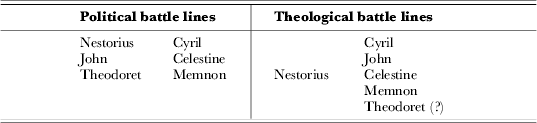
The two councils at Ephesus were divided according to the political battle lines, because the theological issues were not yet clear to all concerned.Footnote 41 It was only during the search for peace between 431 and 433 that the true theological battle lines became apparent, and both John and Cyril then acted accordingly.
If Cyril and John were acting consistently between 431 and 433, then the typical modern portrayals of the Christological controversy do not do justice to the way in which the fifth-century protagonists themselves saw it. If the controversy had been about whether one should use the ‘one nature’ or the ‘two natures’ formula, as many today argue, then one would have to accuse Cyril of compromising when he accepted the Formula of Reunion. If the controversy had actually been about whether Christ was truly human, as many argue, then one would have to accuse of John of compromising when he was reconciled with Cyril, whose Christological formulae seem to many modern interpreters to deny such a full humanity. But if both were being consistent, as I have argued, then one is forced to admit that they did not see either of these issues as lying at the heart of the controversy. As a result, my interpretation of the actions of Cyril and John lends support to what I have argued at length in Grace and Christology in the early Church,Footnote 42 namely that the controversy was fundamentally about whether God the Logos had personally entered our world for our salvation.Footnote 43 On this point, Cyril, John and virtually everyone else agreed. On this point Theodore, Nestorius and perhaps a few others disagreed. As a result, when the Chalcedonian Definition is examined today, we need to recognise that its oft-quoted statement about the two natures united without confusion, without change, without division, without separation does not constitute the heart of what it affirms. This statement is of course significant, and it does constitute a major terminological contribution made at Chalcedon, but the heart of the affirmation is that the One who was eternally begotten of the Father is the same One who has been born of Mary in time, for our salvation.Footnote 44 This truth, not a particular set of terms or a particular vocabulary, was what Cyril, John and virtually everyone else stood for. This is the truth that John sought to convince Nestorius to uphold in his letter written in November 430, prior to Ephesus. This is the truth Nestorius denied, leading the Church ultimately to call him a heretic. And only when we recognise that this was the central issue of the controversy, do the various actions of Cyril, John and others truly make sense to us today.


