Introduction
The frequency of natural disasters such as earthquakes, hurricanes, and drought has been increasing rapidly worldwide.1, Reference Rajabi, Khankeh, Ranjbar, Mousavi, Norouzi and Farokhi2 Every year, natural disasters affect around 34 million people psychologically, socially, and economically. Approximately 8% of all disasters that have happened within the past 20 years were earthquakes. Earthquakes are ranked third in deaths caused by natural disasters and first in terms of economic losses.1 Two successive earthquakes with magnitudes of 7.8 and 7.6 happened on February 6, 2023, and affected 11 cities in Turkey, which caused the deaths of more than 45,000 people, in addition to more than 115,000 people suffering from injuries.Reference Armitage3 Individuals could be negatively affected in terms of many aspects due to the trauma caused by an earthquake.
Postearthquake trauma may be caused by conditions such as injury, fear, the presence of damage at one’s home, the loss of a relative, aftershocks, loss of future possibilities, and changes in one’s place of residence.Reference Thapa and Acharya4, Reference Zhou, Wu and Zhen5 The trauma caused by the earthquake intensifies further due to the absence of private spaces, including secure bathrooms and toilets, as well as the lack of sanitation essentials like soap and water, exposure to cold, anxiety, and depression.Reference Rupe, Rodean, Hurley, Miller, Boncoeur and Masonbrink6, Reference Tayyaba Rehan, Imran and Mansoor7
Research shows that men and women in different regions of the world are affected by earthquakes differently, and their coping mechanisms vary.Reference Gündüz8 Natural disasters affect the reproductive health of women negatively. Menstruation, pregnancy, childbirth, and the postpartum period lead women to be affected by natural disasters to a higher extent.Reference Sohrabizadeh, Tourani Sogand and Khankeh9 The menstrual cycle is one of the most important difficulties in terms of women’s health. Earthquakes could have negative effects on the menstrual cycle, a normal physiological process for women of reproductive age that is highly sensitive to unfavorable conditions and emotional factors such as stress and trauma.Reference Rupe, Rodean, Hurley, Miller, Boncoeur and Masonbrink6, Reference Tayyaba Rehan, Imran and Mansoor7, 10
Women affected by earthquakes have been reported to have dysmenorrhea, premenstrual syndrome, menorrhagia, polymenorrhea, amenorrhea, oligomenorrhea, metrorrhagia, abnormal vaginal bleeding, and irregular menstruation.Reference Chavan, Boob, Simpatwar and Sakhalkar11-Reference Tearne, Guragain, Ghimire, Leaning and Newnham15 The rates of menstrual irregularities after earthquakes were reported to be 42.4% by Rajabi et al. and 76.6% by Liu et al.Reference Rajabi, Khankeh, Ranjbar, Mousavi, Norouzi and Farokhi2, Reference Liu, Yang and Yuan16 When it is considered that one-fourth of women who are affected by earthquakes are at reproductive age, the potential effect of earthquakes on the menstrual cycle should not be overlooked.10 Considering this information, it is crucial to recognize the significance of the concept of gender while analyzing the effects of earthquakes. The determination of changes in the menstruation cycle, which is an ordinary condition in women’s lives but might be neglected during earthquakes, is considered to be highly important for providing the necessary support for the menstruation period without losing time, determining the right approach, implementing early interventions, and preventing the exacerbation of the perceived trauma that is experienced. In this respect, the purpose of this study is to determine the effects of the perceived trauma levels of women at reproductive age after the February 6, 2023, earthquakes in Turkey on their menstruation cycle.
Methods
Study Design
This study, which utilized a descriptive and correlational design, was conducted between March 17, 2023, and April 17, 2023, after the earthquakes that happened on February 6, 2023, in Turkey and affected 11 cities.
Sample
Data were collected using an online questionnaire created on the Google Forms platform. Women who were affected by the earthquakes in 11 provinces (Adana, Adıyaman, Diyarbakır, Elazığ, Gaziantep, Hatay, Kahramanmaraş, Kilis, Malatya, Osmaniye, and Şanlıurfa) were sent the link to the questionnaire form via social networks and online communication platforms (WhatsApp, Facebook, Twitter, and Instagram). The online data collection system prevented duplicate entries by limiting responses to one per IP address. Additionally, participants were required to confirm eligibility through a screening question at the beginning of the questionnaire form. Moreover, the Google Form was set up so that participants would be required to fill in each question and could mark only one of the options given in each question. Of all women who responded to the online questionnaire, 20.8% were residents of Adana, 14.1% were from Hatay, 12.8% were from Malatya, 11.5% were from Kahramanmaraş, 11% were from Osmaniye, 8.2% were from Adıyaman, 8.2% were from Gaziantep, 8.2% were from Kilis, and 5.6% were from Diyarbakır. No participants from the Şanlıurfa and Elazığ provinces responded to the online questionnaire. The study utilized the snowball sampling method to reach more participants. The data collection forms were first sent to women known to the researchers. Afterward, the women who were contacted were asked to share the data collection forms with other women whom they knew who also met the inclusion criteria. Following this chain of contact, every participant had the opportunity to reach others and invite them to participate in the study, and data were collected this way. Detailed information about the study and an informed consent statement were included at the beginning of the online questionnaire form to let potential participants know that participation in the study was voluntary. Data of the women who filled out the online questionnaire form were transferred to the online registration system.
The sample size required for the study was calculated using the G*Power 3.1.9.6 program. A linear multiple regression analysis was performed with an effect size of f2:0.15, a 5% margin of error (α = 0.05), and 95% power (1-β = .95), and it was found that at least 172 participants needed to be included to determine the effects of women’s perceived trauma levels after the earthquakes on their menstruation cycle. Considering potential data losses, 355 women who agreed to participate in the study were included in the sample.Reference Cohen17, Reference Erdfelder, Faul and Buncher18 The inclusion criteria were being aged 15-49 years, residing in the earthquake region on February 6, 2023, and having a regular menstruation cycle. The exclusion criteria were using oral contraceptives (as these drugs could affect menstruation) and having polycystic ovary syndrome (as it causes irregular menstruation), endometriosis (as it increases the amount of menstrual bleeding), myomas (as they cause irregular and excessive bleeding), or a pelvic inflammatory disease (as it would lead to pain during menstruation).
Data Collection
Data were collected using a Participant Information Form and the Post-Earthquake Trauma Level Determination Scale.
Participant information form
The Participant Information Form developed by the researchers in line with the literature included 32 questions about the sociodemographic characteristics (e.g., age, education level, marital status, income level), earthquake-related characteristics (e.g., city of residence in the earthquake region, status of injury due to the earthquakes, form of injury due to the earthquakes, and status of having a relative injured due to the earthquakes), and menstruation-related characteristics (e.g., status of menstruating during the earthquake period, frequency of menstruation before/after the earthquakes, duration of menstruation before/after the earthquakes) of the participants.Reference Bilandi, Farahani and Ahmadi19-Reference Tanhan and Kayri23
Post-Earthquake Trauma Level Determination Scale
Post-Earthquake Trauma Level Determination Scale (PETLDS), which consists of 20 items, was developed in 2013 by Tanhan and Kayri, who also performed its validity and reliability study.Reference Tanhan and Kayri23 The reason for choosing this scale was that its validity and reliability study was conducted with the participation of individuals who experienced another large-scale earthquake in Turkey in 2011 (Van Earthquake). The aforementioned validity and reliability study was also carried out with a large sample (1505 individuals, 401 females, 1104 males). PETLDS has response options on a 5-point Likert-type scale ranging from 1-I strongly disagree to 5-I strongly agree. Scores to be obtained from the scale range from 20 to 100. Higher scores indicate a higher severity of the effects of the earthquake in question on individuals. Cronbach’s alpha value for the scale was reported as 0.87 in its Turkish validity and reliability testing study. In this study, this coefficient was determined as 0.91.
Statistical Analysis
Data analysis was performed using the SPSS 22.0 package program. The analyses included descriptive statistics (frequencies, percentages, means, standard deviations), independent-samples t-tests for 2 groups demonstrating normal distribution, one-way ANOVA for more than 2 groups demonstrating normal distribution, and the Kruskal-Wallis test for more than 2 groups demonstrating non-normal distribution. In the post hoc tests of significant differences, Bonferroni correction was used to determine the source of these differences. The comparison of the severity of dysmenorrhea in relation to PETLDS mean scores was performed using Pearson’s correlation analysis. A multiple linear regression analysis was performed to see the effects of the variables related to PETLDS. The level of statistical significance was determined as P <.05.
Ethical Aspect of the Study
Before the study was conducted, ethical approval was obtained from Bartın University Social Sciences and Humanities Ethics Committee (2023-SBB-0158). The participants were provided with information about the study, and their informed consent was received online via Google Forms. Our article was presented as an oral presentation at the 2nd International, 3rd National Women’s Health Nursing Congress held in Ankara on 21-23 December 2023.
Results
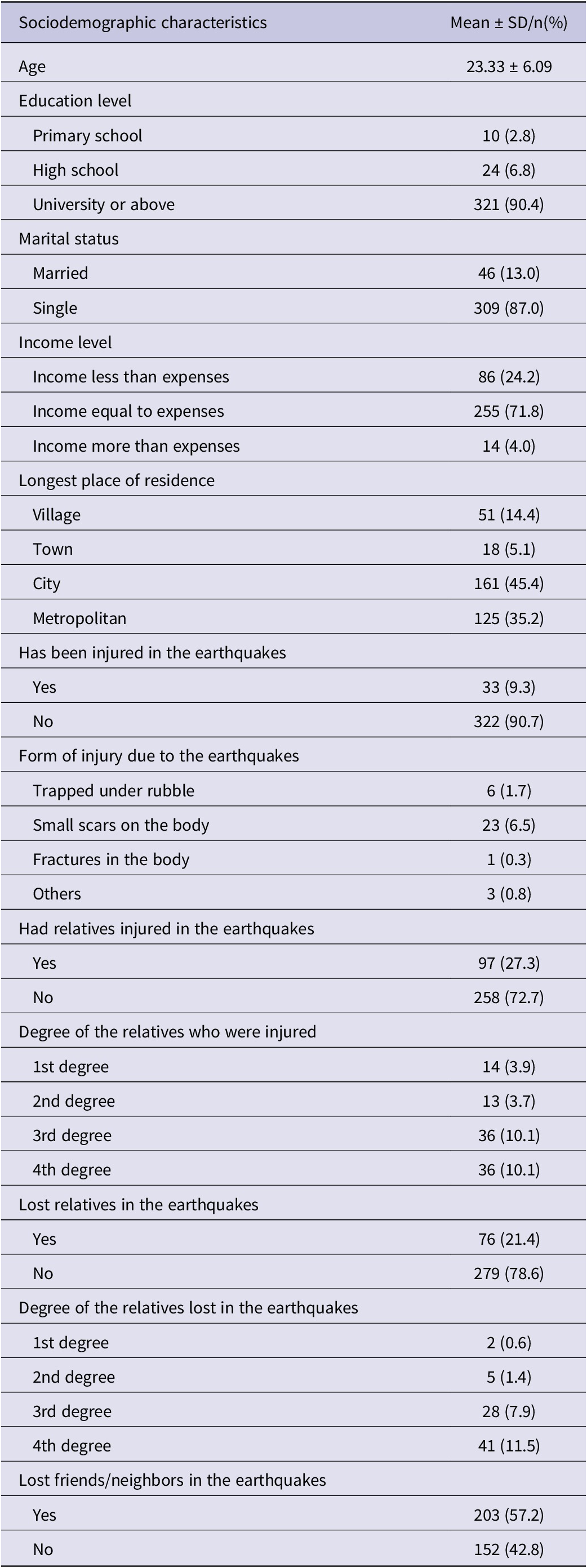
The mean age of the participants was 23.33 ± 6.09. It was found that 90.4% of the participants were university graduates, 13% were married, 71.8% had income equal to expenses, and 45.4% spent the majority of their lives in cities. Of all participants, 9.3% were injured in the earthquakes, 6.5% had small scars on their bodies, 27.3% had relatives who were injured in the earthquakes, 21.4% lost relatives in the earthquakes, and 57.2% lost a friend/neighbor (Table 1).
Sociodemographic characteristics of the participants (N = 355)

SD, standard deviation.
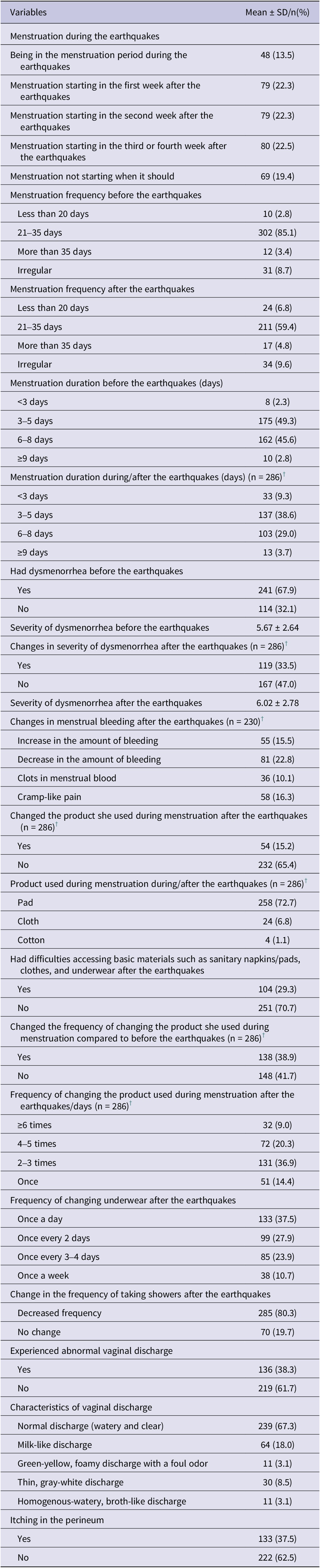
It was determined that 13.5% of the participants were in their menstrual period during the earthquake. While the reported menstruation frequency was every 21-35 days on average for 85.1% of the participants before the earthquakes, this ratio was found to decrease to 59.5% after the earthquakes. It was reported by 49.3% of the participants that their menstruation continued for 3-5 days before the earthquakes, while 38.6% reported the same duration for the period during/after the earthquakes. Before the earthquakes, 67.9% of the participants had dysmenorrhea. The severity of dysmenorrhea rated by the participants, which was 5.67 ± 2.64 before the earthquakes, was found to increase to 6.02 ± 2.78 after the earthquakes. After the earthquakes, 22.8% of the participants reported a decrease in the amount of bleeding during menstruation, and 15.2% had changes in the products they used during menstruation. Among these products, 72.7% of the participants used pads, 6.8% used a cloth, and 1.1% used cotton. Besides, 29.3% of the participants had difficulties in accessing basic needs such as sanitary napkins, cloths/fabrics, and underwear, and 38.9% experienced/had to make changes in the frequency of changing the product they used during menstruation compared to the period before the earthquakes, where 14.4% changed the product they used during menstruation only once a day, 10.7% changed their underwear once a week, and 80.3% reported a decrease in the frequency of taking showers after the earthquakes. Moreover, 38.3% of the participants reported having abnormal vaginal discharge, 18% had discharge with a milk-like appearance, and 37.5% had itching in the perineum (Table 2).
Menstruation-related characteristics of the participants

† Only those who had menstruation responded.
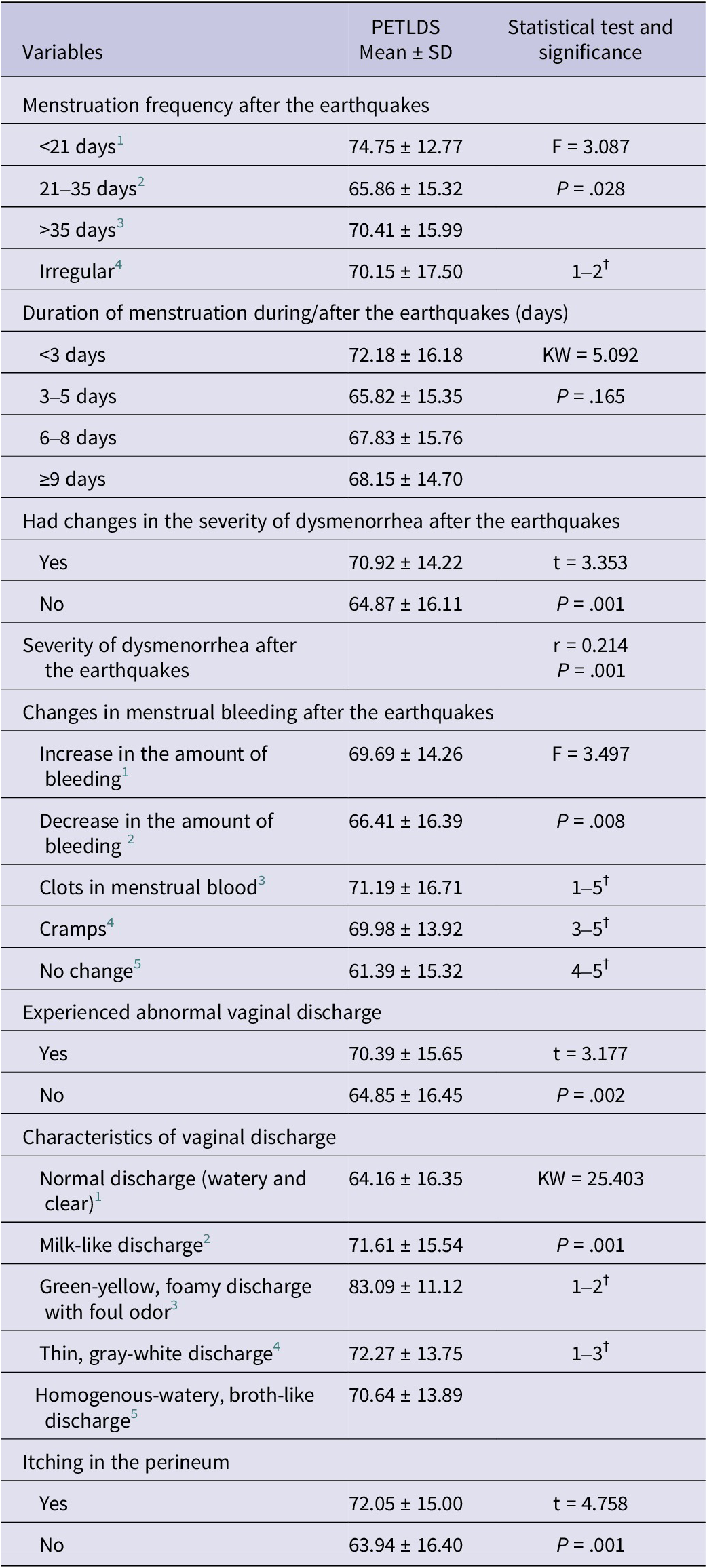
The perceived trauma levels of the participants with a menstruation frequency shorter than 21 days before the earthquakes were found to be higher in comparison to those women who had menstruation frequencies of 21-35 days (F = 3.087, P = .028). Perceived trauma levels were found to be higher in the participants who experienced changes in the severity of their dysmenorrhea (t = 3.353, P = .001), as well as those who experienced an increase in the amount of bleeding, a decrease in the amount of bleeding, or clots in their menstrual blood (F = 3.497, P = .008). A significant positive relationship was detected between perceived trauma levels and the severity of dysmenorrhea after the earthquakes (r = 0.214, P = .001). Perceived trauma levels were found to be higher in the participants who had milk-like discharge or green-yellow or foamy discharge with foul odor compared to those who had normal discharge (KW = 25.403, P = .001). The participants who had itching in the perineum were found to have higher perceived trauma levels than those who did not (t = 4.758, P = .001, Table 3).
Comparison of PETLDS scores based on the menstruation characteristics of the participants

F, ANOVA; KW, Kruskal-Wallis; PETLDS, Post-Earthquake Trauma Level Determination Scale; r, Pearson’s correlation analysis; SD, standard deviation; t, independent-samples t-test.
†Bonferroni correction indicated significant differences between the groups.
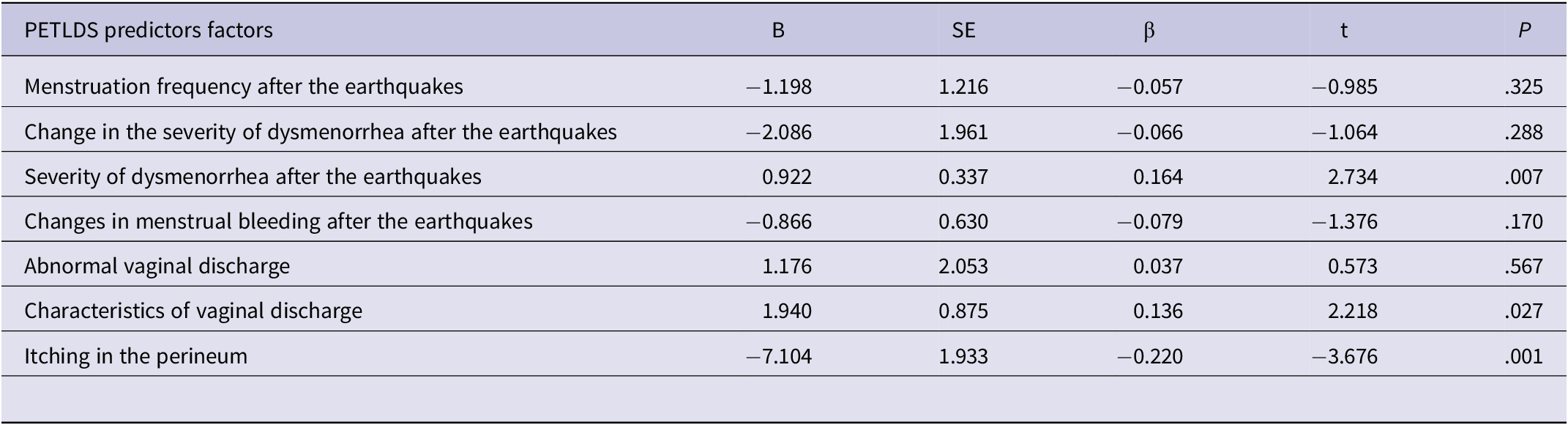
In paired comparisons, the multiple regression model established with the variables that were determined to have significant effects on the mean PETLDS scores of the participants (frequency of menstruation after the earthquakes, changes in the severity of dysmenorrhea after the earthquakes, severity of dysmenorrhea after the earthquakes, changes in menstrual bleeding after the earthquakes, status of having abnormal vaginal discharge, characteristics of vaginal discharge, status of itching in the perineum) indicated that the significant predictors of the perceived trauma levels of the participants after the earthquakes included the severity of dysmenorrhea (β-coefficient = 0.164, P = .007), characteristics of vaginal discharge (β-coefficient = 0.136, P = .027), and itching in perineum (β-coefficient = −0.220, P = .001), and these variables were found to explain 15.3% of the total variance in perceived trauma levels (Table 4).
Analysis of PETLDS mean scores and predictors†

R = 0.381, R2 = 0.145, AdjR2 = 0.124, P = .001
PETLDS, Post-Earthquake Trauma Level Determination Scale; SE, standard error.
† Multiple linear regression analysis.
Discussion
This study, which aimed to determine the effects of perceived trauma levels on the menstruation cycle of women at reproductive age after the February 6, 2023 earthquakes in Turkey, revealed that the severity of dysmenorrhea, the characteristics of vaginal discharge, and whether women experienced itching in the perineum were significant predictors of their perceived trauma levels after the earthquakes, and these variables explained 12.4% of the total variance in the variable in question.
Although the variables included in the multiple linear regression analyses were not found to be statistically significant predictors, the paired comparisons indicated that the perceived trauma experienced by the participants after the earthquakes affected their menstruation frequency. After the earthquakes, changes were found in the menstruation frequencies of the participants associated with changes in their perceived trauma levels (more than 35 days, irregularity, less than 21 days), and those with high perceived trauma levels were found to have a menstruation frequency of shorter than 21 days. A study conducted after an earthquake in Iran showed that around half of women (42.4%) experienced changes in their menstruation frequency, as well as menstrual irregularities.Reference Rajabi, Khankeh, Ranjbar, Mousavi, Norouzi and Farokhi2 Similar studies have reported significantly increased ratios of women experiencing menstrual irregularities such as menorrhagia and oligomenorrhea after earthquakes.Reference Li, Qin and Hu24–Reference Mariam, Azhary and Leng26 The findings of this study showed that the perceived trauma experienced after the earthquakes in Turkey increased the menstruation frequencies of women.
The results of this study showed that the severity of dysmenorrhea increased with an increase in the perceived trauma levels of the participants after the earthquake. The report titled “Menstruation in the Time of Emergencies” published by UNICEF after the earthquake that happened in Lombok, Indonesia, stated that the stress experienced during the period in question intensified the dysmenorrhea experienced by women.10 A study that investigated changes in menstruation symptoms in women after an earthquake reported that menstrual disorders such as dysmenorrhea were strongly associated with posttraumatic stress disorder caused by the earthquake, and 85.7% of women were reported to experience dysmenorrhea after the earthquake.Reference Takeda, Tadakawa, Koga and Nagase27 There are also other studies in the literature reporting an increase in menstruation-associated pain and symptoms with an increase in the severity of posttraumatic stress disorder caused by earthquakes.Reference Bilandi, Farahani and Ahmadi19, Reference Mariam, Azhary and Leng26, Reference Maknun and Nahar28 The findings of this study showed that the perceived trauma experienced after the 2023 earthquakes in Turkey increased the severity of dysmenorrhea in women.
The participants of this study who had milk-like and green-yellow discharge, foamy discharge, or discharge with a foul odor and those who experienced itching in the perineum had higher perceived trauma levels after the earthquakes. In the menstruation period, when infection risk increases, the careful monitoring of women becomes necessary in the presence of a disaster, which has dramatic consequence in the daily lives of women.Reference Bilandi, Farahani and Ahmadi19 After an earthquake, women have to use unclean water, try to maintain their personal care in nonhygienic conditions, and are left with unclean absorbents such as fabrics and old clothes as they cannot access hygienic menstruation products.Reference Li, Qin and Hu24, Reference Yoosefi Lebni, Khorami, Ebadi, Azar, Khosravi and Safari29-Reference Williams31 Living in nonhygienic conditions after an earthquake has been reported to cause urogenital system infections (vaginal discharge with foul odor, redness, itching, and rash in the genital area, urinary tract infections).Reference Budhathoki, Bhattachan and Castro-Sánchez20, Reference Downing, Benjimen, Natoli and Bell32, Reference Demir and Gerçek-Öter33 Bilandi et al. found that due to poor hygiene conditions, women in an earthquake region did not want to experience menstruation, and a lack of necessary hygiene conditions affected the severity of their psychological conception of their personal problems.Reference Bilandi, Farahani and Ahmadi19 The findings of this study demonstrated that abnormal vaginal discharge, including green-yellow discharge, foamy discharge, and discharge with a foul odor, as well as itching in the perineum negatively affected women’s perceived trauma levels after the 2023 earthquakes in Turkey.
This study revealed the effects of the perceived trauma levels of women after the 2023 earthquakes in Turkey on the severity of dysmenorrhea, vaginal discharge characteristics, and perineal itching statuses of women. These results indicate the need for investigating the perceived trauma levels of women, who are affected by traumatic situations caused by natural disasters the most, as well as evaluating the issue in terms of women’s health. Hence, health professionals should not overlook the effects of perceived trauma after earthquakes on the menstrual cycle of women and make assessments accordingly.
Strengths and Limitations of the Study
Accessing women living in the regions affected by the Turkey earthquakes a short time after the earthquakes is the strength of this study. Contacting women shortly after the earthquakes is believed to indicate their perceived trauma levels and the effects of this perceived trauma on their menstrual cycle more accurately. This study also had some limitations. Firstly, it was an important limitation that the study was carried out online, and the sample included only women who were using certain social networks and communication platforms. Secondly, as another limitation, women using oral contraceptives and those with polycystic ovary syndrome, endometriosis, myomas, or pelvic inflammatory disease diagnosis were excluded from the study. Thirdly, because the study was performed in the early postearthquake period, problems in access to the internet may have been experienced by other women in the region, especially in the provinces that experienced considerable destruction. Finally, the fact that the preearthquake menstruation-related information of the participants was collected retrospectively was considered a limitation.
It is recommended that future studies be planned with face-to-face designs and that their samples include women who are using oral contraceptives, those with polycystic ovary syndrome, endometriosis, myomas, pelvic inflammatory diseases, and other conditions.
Data availability statement
Data is available on request due to privacy/ethical restrictions. The data used in this study can be shared on demand if any concerns rise due to the reliability of the data, but according to the ethical and legal regulations in Turkey, the authors cannot share the data via a data repository.
Acknowledgments
We thank all participants for their contribution to the study.
Competing interests
The authors report there are no competing interests to declare.